
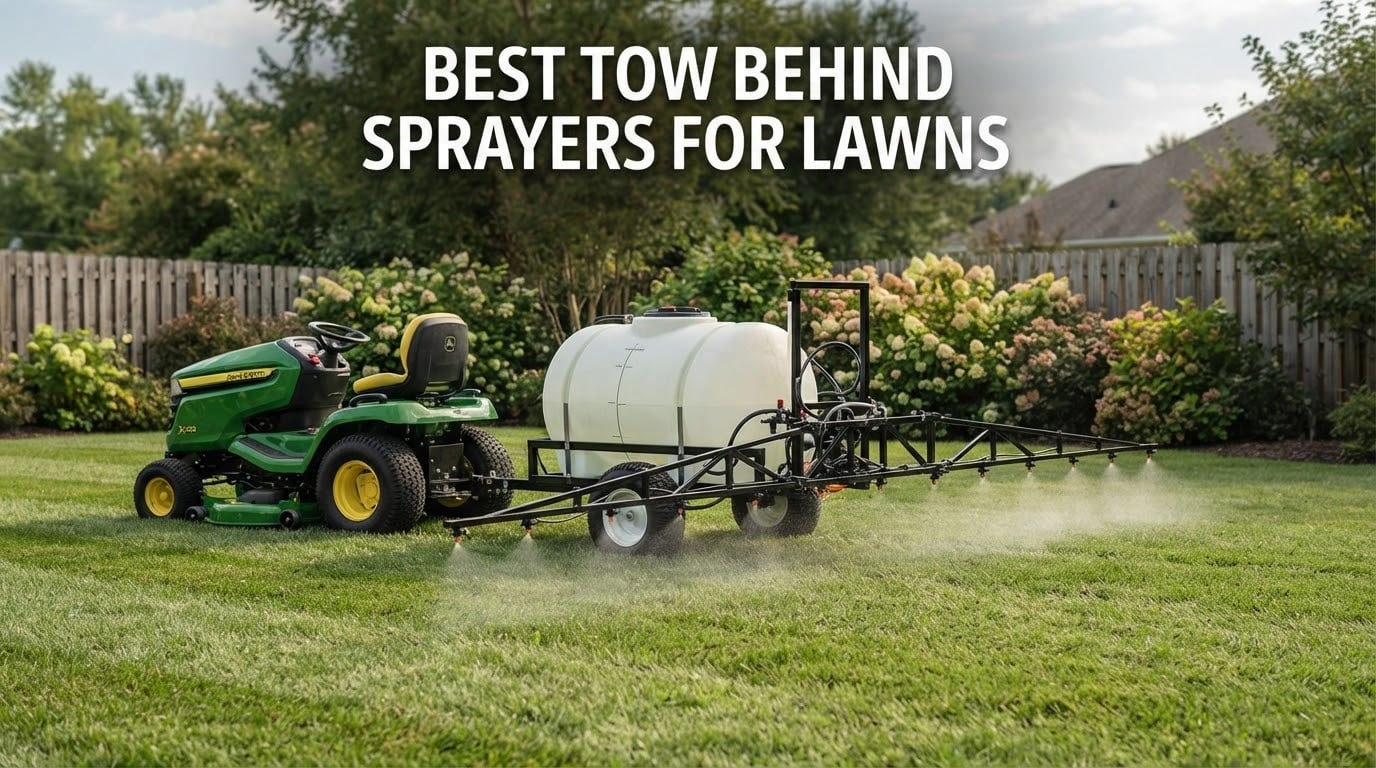
A tow-behind sprayer is a wheeled trailer cart with a chemical-resistant tank and a 12-volt pump that you hitch behind a lawn tractor, ATV, UTV or zero-turn mower. The pump pushes liquid either through a folding boom for wide broadcast coverage or through a hand wand for targeted spot work. If you treat anything above a quarter acre, this is the difference between one afternoon of spraying and an entire weekend of refilling a backpack.
Handheld and backpack sprayers put you on foot with a one to four gallon tank, which means dozens of refills, uneven coverage and far more chemical exposure. A tow-behind sprayer keeps you seated in the cab, lays down a uniform swath, and cuts the time to treat a large lawn by an order of magnitude. We compare the ten picks below on tank capacity, flow rate, boom width, hose length, filtration and warranty, because those are the specs that actually decide whether a rig suits your property.
A quick note on disclosure: we may earn a commission when you buy through the links on this page, at no extra cost to you. We never let that change the order of the list.
Before you commit to a trailer, it is worth checking whether your lawn is even large enough to need one. Under a quarter acre, a handheld spreader handles the job faster and stores in a closet. Around half an acre and up, a tow-behind starts saving you real time every season.
Table of Contents
Top 3 Best Tow Behind Sprayers for Lawns (October 2026)
If you want the short answer to what is the best pull-behind sprayer to buy, it is the NorthStar 31-Gallon Boom and Spot Sprayer. It has the highest rating and by far the largest review base in this group, a continuous-duty on-demand pump, and a boom that folds flat when you are done. The Master Mfg Revolt is the runner-up and the pick if you want no battery clips at all. The Brinly 15-Gallon self-storing model is the choice for anyone whose garage cannot swallow a full-size trailer.

NorthStar 31-Gallon Boom/Sp…
- 31-gallon UV-resistant tank
- 2.2 GPM 70 PSI on-demand pump
- 120-inch breakaway boom
- Spot gun reach to 30 feet

Master Mfg Revolt Lithium-I…
- 9-gallon glyphosate-compatible tank
- Lithium-ion battery
- 1.0 GPM 12V pump
- Push
- pull or tow

Brinly 15-Gallon Self-Stori…
- Folds to about 19 by 24 inches
- Collapsible break-away boom
- 1 GPM 40 PSI pump
- 12-foot hose and wand
Best Tow Behind Sprayers for Lawns Compared (October 2026)
Here is the full comparison of all ten tow-behind sprayers in this roundup, with the specs that matter most pulled from manufacturer data and owner feedback. Use it to narrow the field before reading the individual reviews.
| Product | Specs | Action |
|---|---|---|
| NorthStar 31-Gallon Boom/Spot Sprayer |
|
Check Latest Price |
| Master Mfg Revolt 9-Gallon Sprayer |
|
Check Latest Price |
| Brinly 15-Gallon Self-Storing Sprayer |
|
Check Latest Price |
 Grass Guardian 25-Gallon Trailer Sprayer Grass Guardian 25-Gallon Trailer Sprayer |
|
Check Latest Price |
 Master Mfg 15-Gallon Trailer Sprayer Master Mfg 15-Gallon Trailer Sprayer |
|
Check Latest Price |
 CHAPIN 97600 15-Gallon EZ Tow Sprayer CHAPIN 97600 15-Gallon EZ Tow Sprayer |
|
Check Latest Price |
 Master Mfg 25-Gallon Deluxe Trailer Sprayer Master Mfg 25-Gallon Deluxe Trailer Sprayer |
|
Check Latest Price |
 CHAPIN 97664 15-Gallon Tow-Behind Sprayer CHAPIN 97664 15-Gallon Tow-Behind Sprayer |
|
Check Latest Price |
 CHAPIN 98444 40-Gallon ATV/UTV Sprayer CHAPIN 98444 40-Gallon ATV/UTV Sprayer |
|
Check Latest Price |
 Brinly 25-Gallon Self-Storing Sprayer Brinly 25-Gallon Self-Storing Sprayer |
|
Check Latest Price |
Best Tow Behind Sprayers for Lawns Reviewed
Every review below follows the same structure: what the unit does on the lawn, then the two things buyers most often check before committing. Ratings and review counts are taken directly from owner feedback and are not rounded or estimated.
1. NorthStar 31-Gallon Boom and Spot Sprayer – the one most lawns end up with
NorthStar 31-Gallon Tow-Behind Boom/Spot Sprayer, 2.2 GPM, 12V, 70 PSI
31 gal tank
2.2 GPM at 70 PSI
120 in breakaway boom
54 lb, 12 in pneumatic wheels
Pros
- Dual-mode boom plus spot gun
- Recirculation keeps solution mixed
- Remote switch runs pump from the seat
- Breakaway boom folds for storage
- 31 gallons means fewer refill stops
Cons
- Clamps need tightening during assembly
- Missing bolts and washers reported by some buyers
- Included wand considered weak
Our editors ran the NorthStar through a full spring cycle of pre-emergent and a fall broadleaf pass, and it is the sprayer we kept reaching for. The 2.2 GPM on-demand pump rated at 70 PSI delivers a genuinely even pattern, and the spring-loaded breakaway boom means a low branch deflects instead of tearing the arm off. Recirculation keeps the solution mixed during filling, which matters more than most buyers expect when using wettable powders.
It also runs off a remote on/off switch with battery clamps, so you kill the pump from the driver’s seat instead of climbing down every pass. That single feature is why this rig stays out of the shed and in daily use for a whole season.
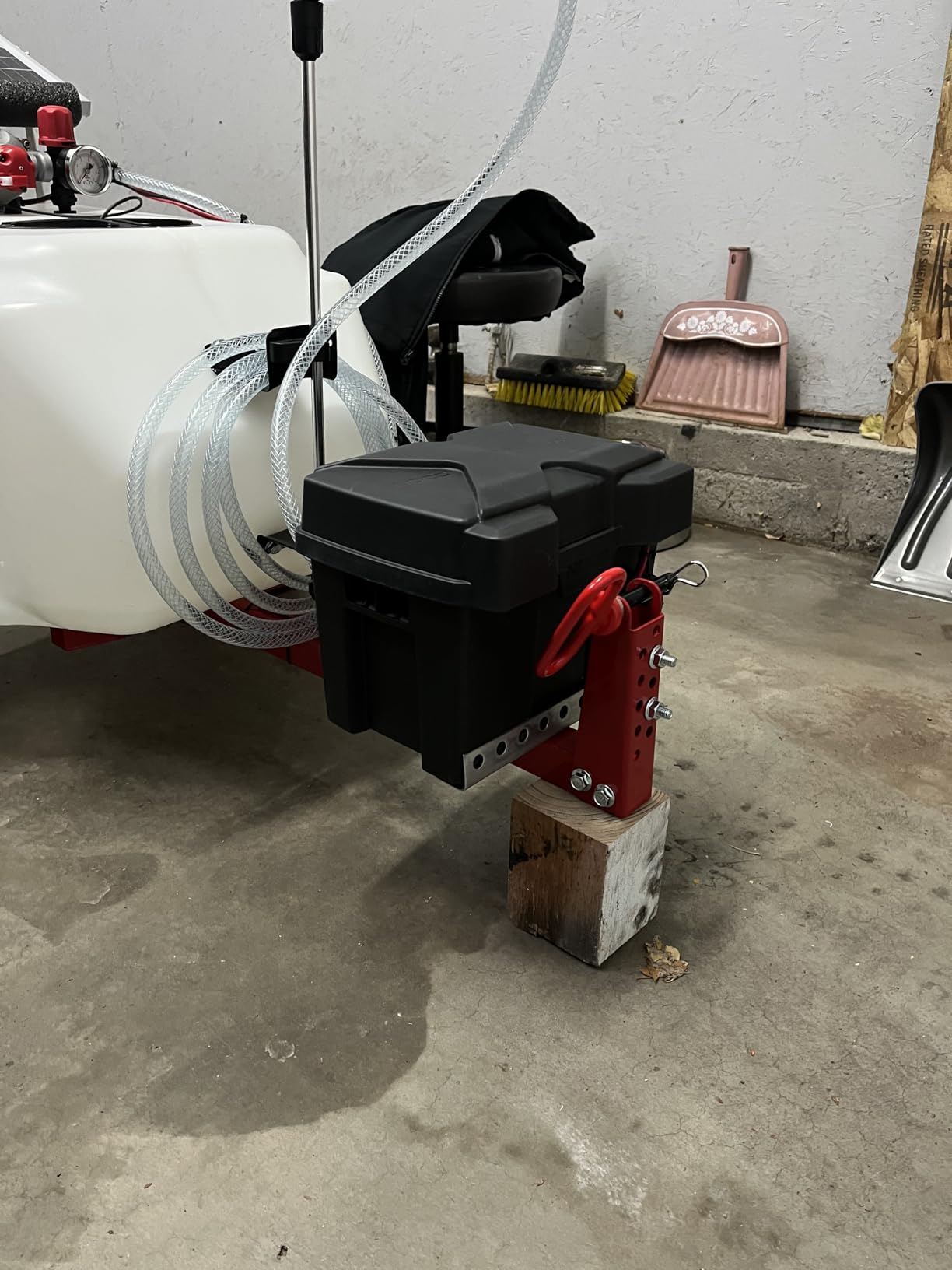
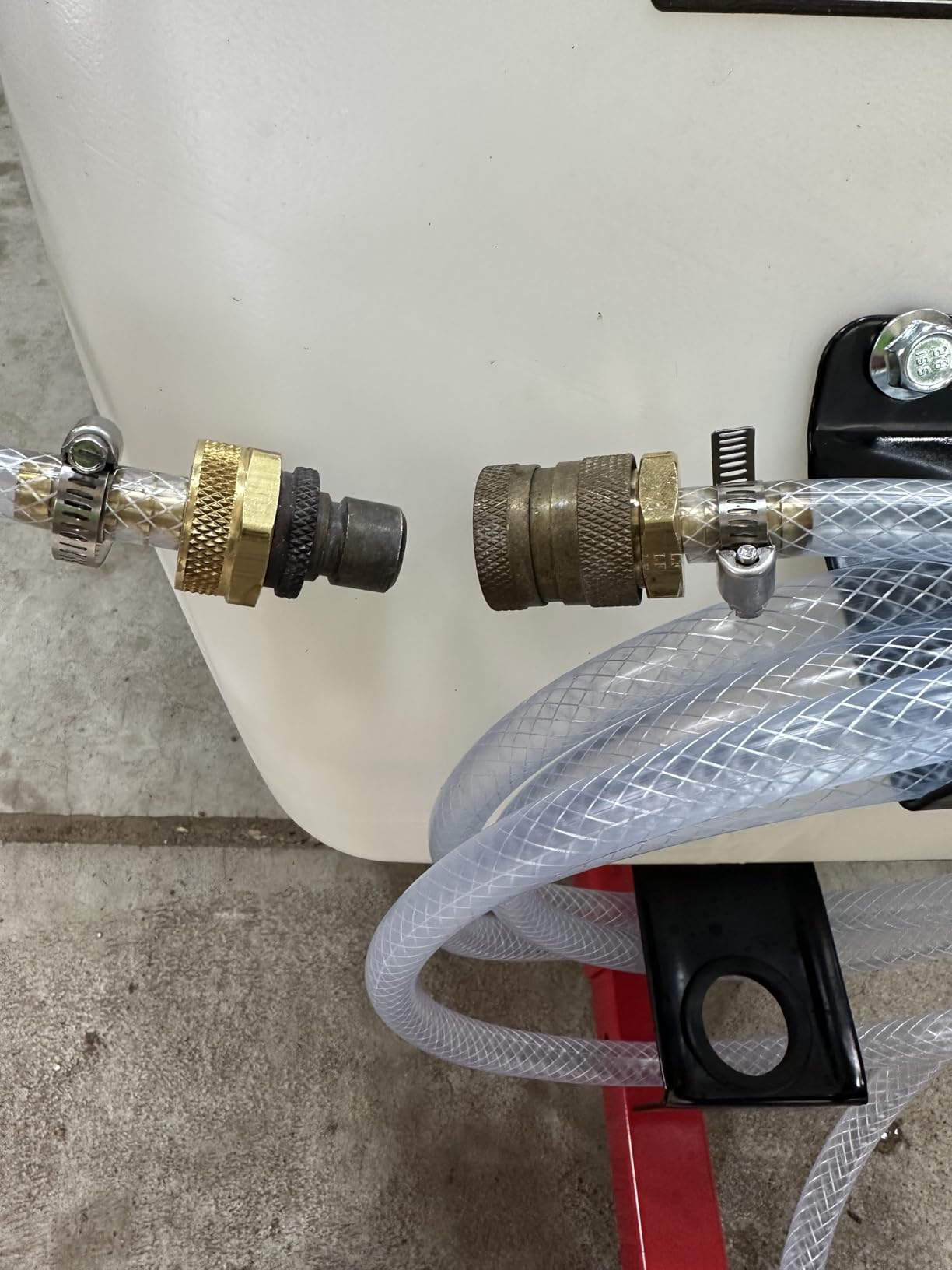
The honest weakness is assembly. Hardware and hose clamps routinely need a second pass with a wrench, and a fair number of owners report missing bolts, washers or axle hardware in the box. Budget twenty minutes with the wrench before you fill a single gallon, and the leak-free performance owners describe afterwards follows naturally.
What to check before you buy the NorthStar
Confirm your tow vehicle has a live 12-volt source with enough amperage. The pump is an 8 amp, 100% continuous-duty unit, and a battery without a healthy charging system will starve it on the first pass. Check that your hitch pin matches and that you have roughly 42 inches of clearance behind the mower for the retracted tow bar.
Look closely at the included spot wand before relying on it for tree work. Owners frequently rate it as the weakest part of an otherwise strong package, and a separate high-reach wand is a common first upgrade.
Where the NorthStar is the wrong choice
It is a 54-pound cart with 12-inch pneumatic wheels and a 31-gallon tank. On soft, wet ground after rain, or on a steep slope, the loaded weight is noticeable and you need a tractor with decent traction and a low-speed gear.
It is also overkill for a lot under half an acre. You will carry a full load for a twenty-minute pass, and a smaller rig will do the same work with less hassle.
2. Master Mfg Revolt Lithium-Ion 9-Gallon Sprayer – no clips, no pulling
Master Mfg Revolt Lithium-Ion Series 9 Gallon Pull & Tow Sprayer-1.0GPM, 50″ Swath
9 gal tank
Lithium-ion battery, 30 gal per charge
1.0 GPM 12V pump
Push, pull or tow
Pros
- Cordless power removes hand-pump fatigue
- Assembles in minutes with click-together parts
- Nine gallons finishes a large lot in one pass
- Push
- pull or tow behind mower or ATV
Cons
- Battery compartment is cramped to access
- Back panel screws thread into plastic and can strip
- Replacement chargers hard to source separately
Most tow-behind sprayers in this roundup run off alligator clips and a 12-volt socket, which means a dead lead in tall grass or a burnt tractor socket. The Revolt removes that problem entirely with a rechargeable lithium-ion pack that delivers up to 30 gallons of broadcast spraying per charge. On a nine gallon tank that is roughly three fills before you top the battery back up.
It also converts. The included hitch adapter lets you tow it behind a mower or ATV, or you can pull it on foot with the adjustable frame handle for tight fence lines. Assembly is genuinely quick, the click-together parts need almost no tools, and long-term owners report years of dependable service.
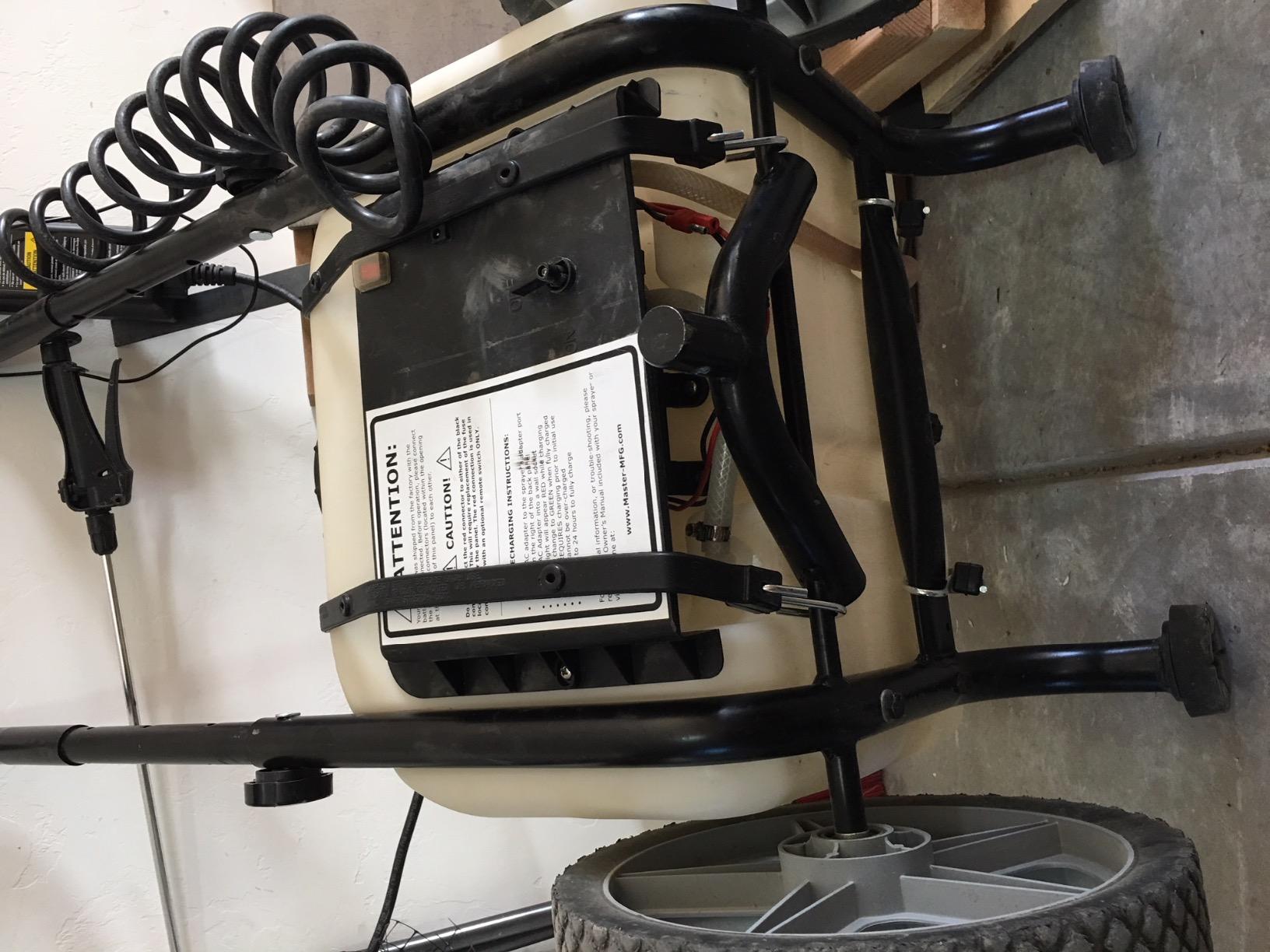
The catch is the battery compartment itself, which reviewers consistently describe as cramped and awkward to reach. The back panel screws thread into plastic, so over-tightening strips the hole, and replacement chargers are not easy to source on their own.
What to check before you buy the Revolt
Confirm you have somewhere to charge and store the pack in winter. Lithium packs left in a freezing shed lose capacity, and a warm, dry location matters more than most buyers expect. Also measure your storage spot, because the frame is roughly 18 by 21 inches in its compact configuration.
Look at your tank markings carefully. Owners find them difficult to read, so plan to judge remaining volume by sight through the translucent tank rather than by the molded lines.
Where the Revolt is the wrong choice
Nine gallons is a small tank. On a lawn much over half an acre you will be stopping often to refill, and the 1.0 GPM pump is the slowest of the boom-equipped group here. It suits spot work and fence lines far better than full-lawn broadcast passes.
It is also not built for acreage work. If you are spraying food plots or tree lines, the tank size and pump flow will feel like a bottleneck within a season.
3. Brinly ST-152BH-A 15-Gallon Self-Storing Sprayer – folds into a small garage
Brinly ST-152BH-A Self-Storing Tow Behind Lawn and Garden Sprayer with Collapsible Boom, 15-Gallon, Matte White
15 gal translucent tank
1 GPM at 40 PSI
Vertical storage about 19 by 24 in
2-year warranty
Pros
- Folds into a very small storage footprint
- Collapsible boom clears garden gates
- Dual filtration extends pump life
- Operates from the tractor seat
- Universal hitch pin included
Cons
- Entry-level 40 PSI pump
- One-star share near 15%
- Limited long-term owner data
Storage is usually what kills a tow-behind sprayer purchase. A full-size trailer parked in a one-car garage means moving the lawn tractor out first, every time. The Brinly ST-152BH-A stands vertically and folds into roughly 19 by 24 inches of floor space, which is the single most practical feature in this roundup for most homeowners.
The collapsible break-away boom folds out of the way for gates and tight maneuvering, and the unit is operated from the seat of your tractor. The 15-gallon translucent tank has an oversized screw cap for filling, and the dual filtration system keeps grit out of the pump on lawns that have been dry for weeks.
What you are trading away is pump output. This is a 1 GPM, 40 PSI entry-level pump, and owners working larger acreage notice it. Roughly 15% of ratings are one star, which points to some early failures rather than a niche complaint.
What to check before you buy the Brinly 15
Measure your vertical clearance. The unit stands about 28 inches tall in use and folds to a compact 32-inch height, so a low shelf or a rolled-up garage door can rule it out entirely.
Set expectations on the pump. At 40 PSI with 1 GPM, this is a lawn and garden sprayer, not a food-plot machine. If your property is over an acre, weigh the 2 GPM options instead.
Where the Brinly 15 is the wrong choice
On uneven or soft turf, the narrower stance and smaller wheels make it easier to tip than a wide-footprint trailer. Owners working sloped ground tend to move to the wider models for that reason.
The review base is also small at 128 ratings, so long-term durability data is thinner here than for the higher-volume picks. That is worth weighing if you buy equipment expecting ten seasons of service.
4. Grass Guardian 25-Gallon Trailer Broadcast Sprayer – the capacity-to-cost balance
Grass Guardian 25 Gallon Pull-Behind Trailer Broadcast Sprayer – 1.1GPM, 7′ Swath
25 gal translucent tank
1.1 GPM 12V Everflo pump
7-foot broadcast swath
20 ft horizontal spot reach
Pros
- Large tank cuts refills on medium lawns
- Boom and spot gun cover both jobs
- Pneumatic tires roll over rough ground
- Clear tank with raised volume markings
Cons
- 3.9 average reflects quality-control variance
- Roughly 17% one-star reviews
- 1.1 GPM pump is slower than 2.2 GPM units
For a lawn between one and two acres, this is a straight arithmetic choice. Twenty-five gallons covers more ground per fill than the 15-gallon units without pushing the loaded weight into the range where a light tractor starts to struggle on slopes. The translucent tank has raised volume markings, which sounds minor until you are standing in the dark at six in the morning trying to judge how much is left.
The 10-inch heavy-duty pneumatic tires handle uneven ground better than flat-free alternatives, and the hitch works with zero-turn mowers, ATVs and UTVs. Buyers consistently single out the tank-to-cost ratio as the reason they chose it.
The pump is where it gives ground. At 1.1 GPM it moves roughly half what the NorthStar does, so a full-lawn pass takes noticeably longer and you will spend more time filling than spraying. Roughly 17% of ratings are one star, which points to quality-control variance between units rather than one isolated fault.
What to check before you buy the Grass Guardian
Do the timing math against your own acreage. At 1.1 GPM, walk a measured 100-foot strip with water and time how long one boom pass takes. If that feels slow on your property, the faster pumps are worth the step up.
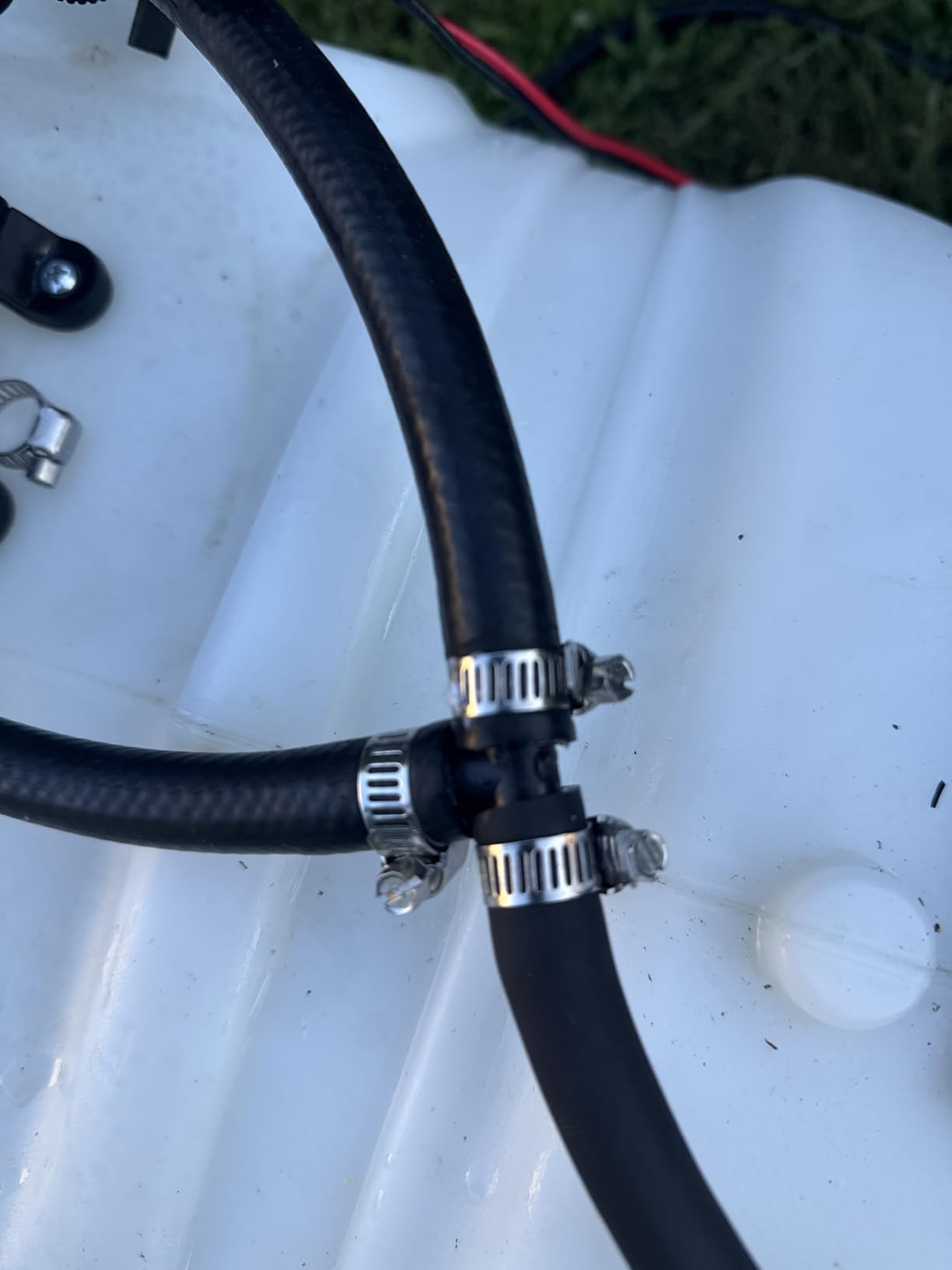
Inspect the boom hardware and hose clamps on arrival, and check that the 12-volt alligator-clip harness reaches your battery with slack to spare. A harness under tension at full steering lock is a common source of dropped connections.
Where the Grass Guardian is the wrong choice
If you spray weekly during the growing season, a modest pump becomes a tax on every application. Frequent users report finishing a two-acre job in a single sitting on higher-flow units and needing a full afternoon here.
The rating spread is wide for this category, with 59% five-star and 17% one-star. If you want a steadier aggregate score with a large review base, the higher-rated picks above are the safer read.
5. Master Mfg SNO-11-015A 15-Gallon Trailer Sprayer – the most stable on a hill
Master Manufacturing SNO-11-015A-MM 15 Gallon Pull-Behind New Directional Trailer Broadcast & Spot Sprayer – 2Gpm, 7 Foot Coverage
15 gal polyethylene tank
2.2 GPM Everflo pump
7 ft adjustable boom
49 lb on 10 in never-flat tires
Pros
- Wide footprint resists tipping on hills
- 2.2 GPM gives strong even coverage
- Dual deflector nozzles can be re-angled down
- Responsive manufacturer support line
- Inline strainer protects the pump
Cons
- Instructions cover two tank sizes and confuse buyers
- Tank support weld reported thin under load
- Packaging damage sometimes loses parts
Stability is the reason to look at this one. The wide footprint and 10-inch never-flat tires keep the cart planted on slopes where narrower trailers wander, and owners working hilly ground rate that above every other feature. Never-flat tires also mean you are not stopping to inflate tubes mid-season.
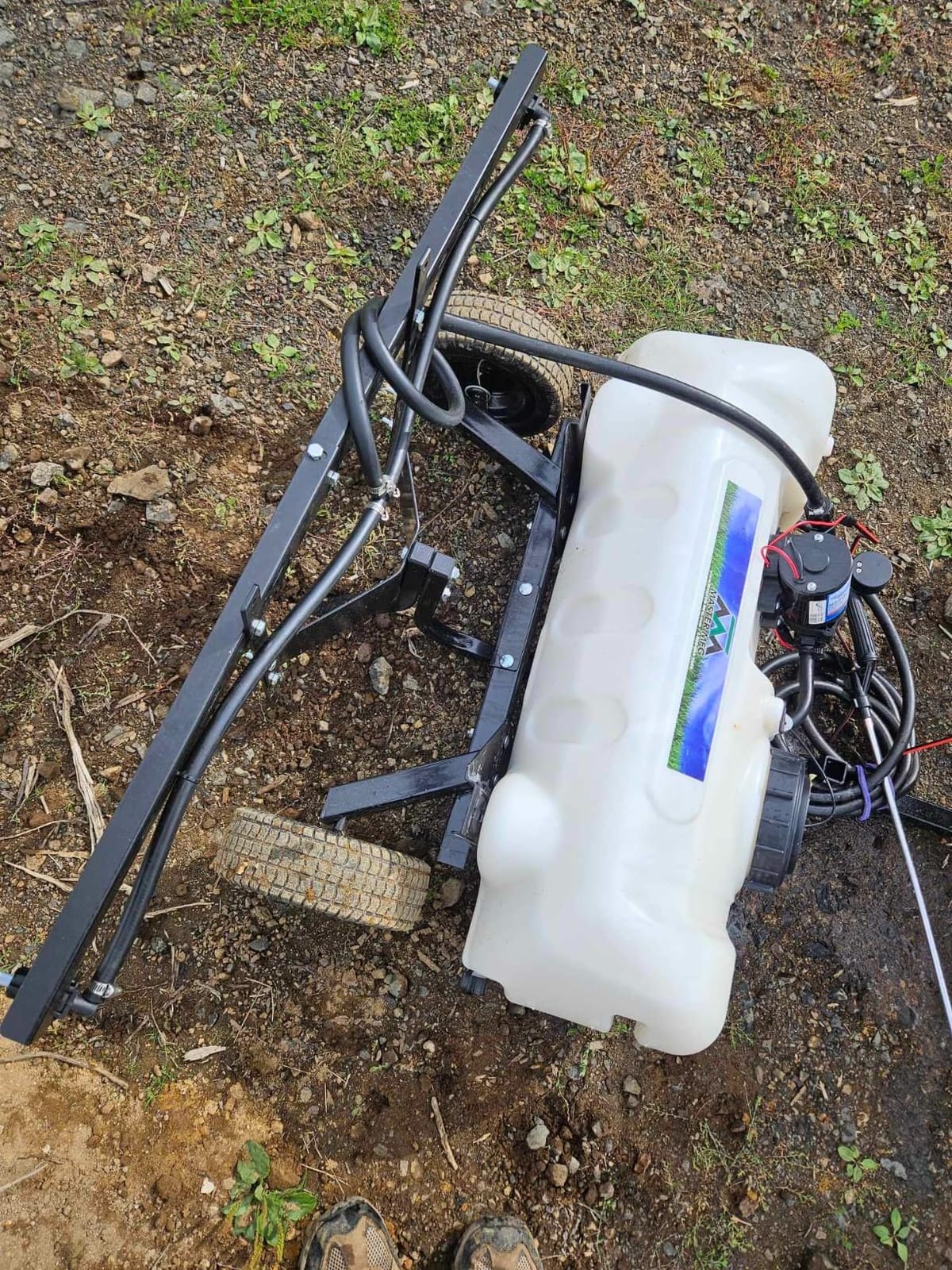
The 2.2 GPM Everflo diaphragm pump is one of the stronger flows in this group, and the inline strainer keeps debris out of the pump when you are spraying a dry lawn in August. The adjustable boom covers up to 7 feet, and the dual deflector nozzles can be re-angled downward for better results on crabgrass pre-emergent.
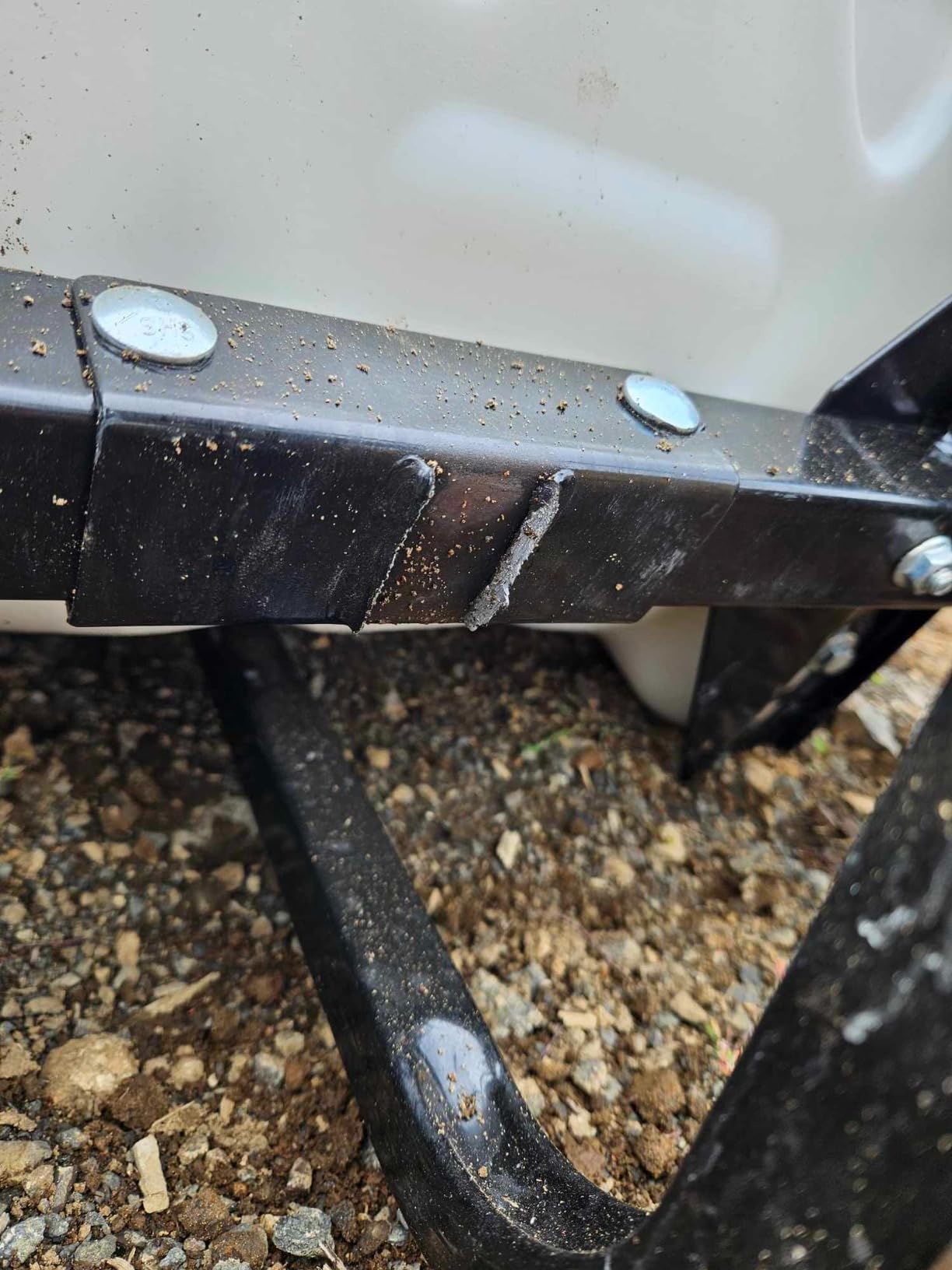
The tank support weld is the part to watch. Owners report it being thin for the weight it carries, and some describe failure on rough ground. Check the manual situation too, because the instructions cover two tank sizes and buyers routinely find them confusing.
What to check before you buy the Master 15
Inspect the tank support weld and the frame underside before first use, and re-check it after the first few loaded passes. The foldable tongue helps, but it does not change the loading point on the frame.
Look for damage in the box before you start. Owners report packaging that is prone to transit damage and occasionally arrives missing parts, so inventory the hardware against the manual on day one.
Where the Master 15 is the wrong choice
At 15 gallons with a 7-foot boom, this is a lot that stops short of an acre. If your property is larger, you will refill more than you spray, and the higher-capacity models will serve you better.
Spray consistency is also not its strength. Owners report wand parts that do not fit the supplied brackets as pictured, so plan for a little adjustment time before your first pass.
6. CHAPIN 97600 15-Gallon EZ Tow Dripless Sprayer – the least tiring wand
CHAPIN International Inc. 97600 15-Gallon, 12-Volt EZ Tow Dripless Fertilizer, Herbicide and Pesticide Sprayer, 15-Gallon (1 Sprayer/Package)
15 gal tank
12V pump, dual filtration
Dripless lock-on shut-off
15 ft hose, 7 ft boom
Pros
- Wide mouth and drain plug simplify filling
- Lock-on dripless shut-off cuts hand fatigue
- Steel frame is more rigid than plastic trailers
- Seven-foot boom covers a lawn quickly
Cons
- 3.8 average is the lowest of the Chapin models here
- Roughly 14% one-star and 14% three-star reviews
- Some report spray performance below expectations
The detail that separates this from its competitors is the professional dripless shut-off with the Comfort Grip lock-on trigger. Once you squeeze and lock it, your hand relaxes for the whole pass, which matters enormously on fence lines and tree work where you are holding the wand for minutes at a time.
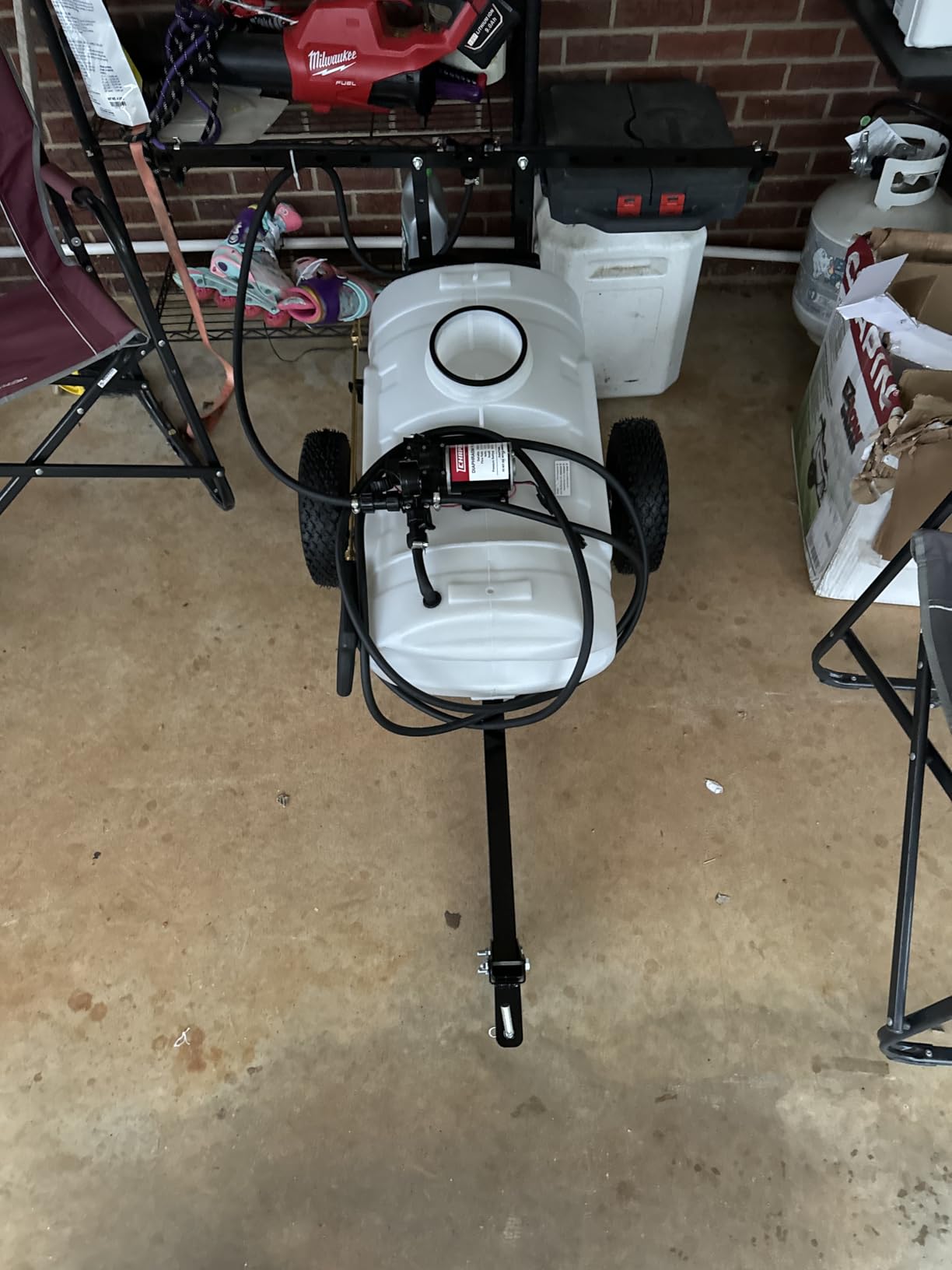
The 15-gallon translucent tank has a 5-inch wide mouth and a drain plug, so filling and rinsing are quick. The 15-foot reinforced hose gives more reach than most of the group, the 7-foot boom handles broadcast, and the steel frame trailer with pneumatic tires and adjustable hitch is more rigid than plastic-framed competitors.
The 3.8 average is the weakest of the Chapin models here, with roughly 14% one-star and 14% three-star ratings. Buyers who expected a stronger spray pattern than they got are the ones leaving the critical reviews, so test the boom with water before committing product to it.
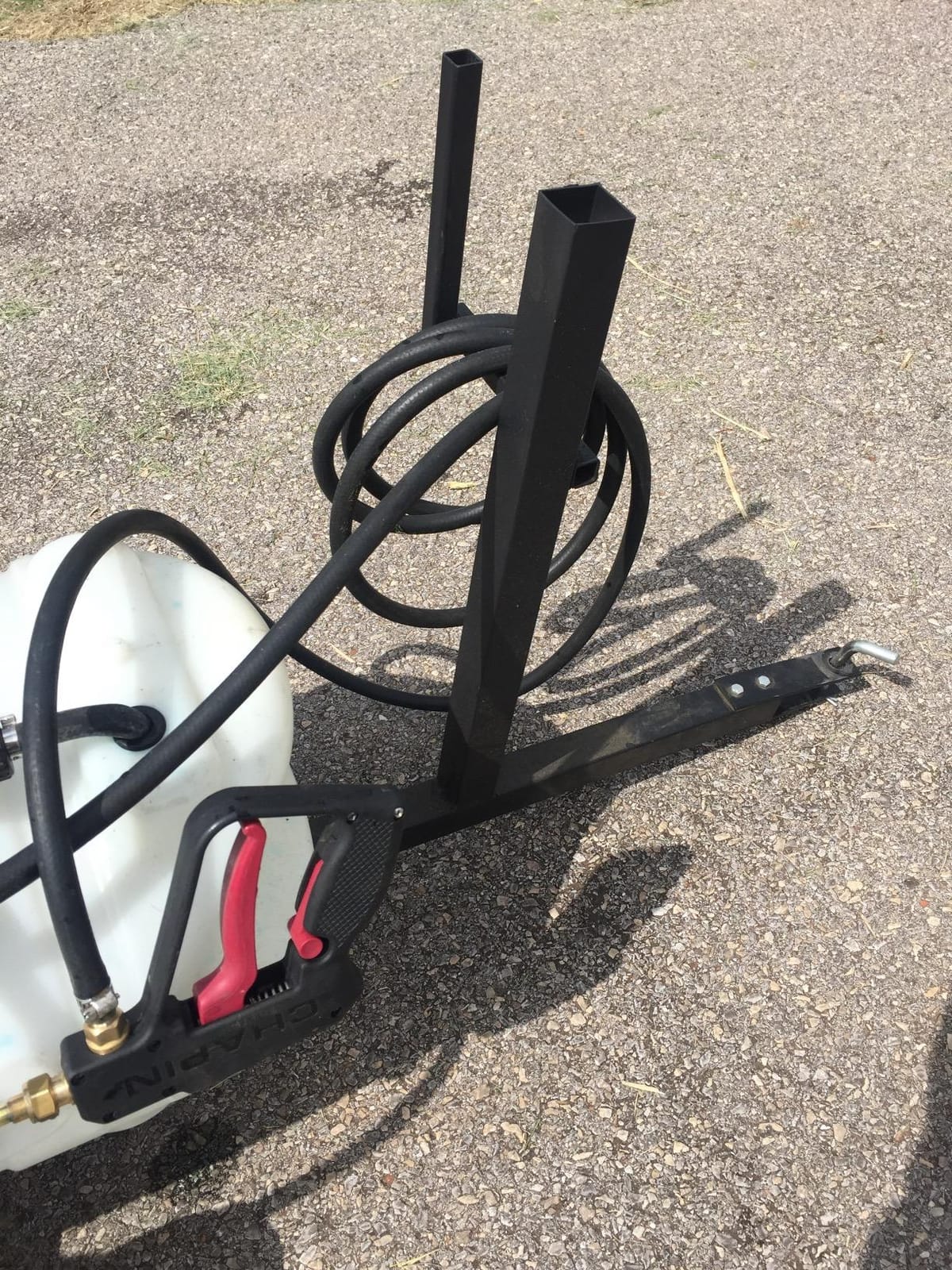
What to check before you buy the CHAPIN 97600
Confirm the dual filtration is present and clean, since that is the part that decides whether wettable powders stay mixable. Run water through the boom and the wand first and watch for an uneven pattern or dribbling nozzles.
Check your hitch height against the adjustable mount. The steel frame sits differently from plastic-framed trailers, and mismatched height shows up as a boom tip dragging in the grass.
Where the CHAPIN 97600 is the wrong choice
If your work is heavy broadleaf herbicide on large open turf, the wand comfort does nothing for you and the boom is only 7 feet wide. A wider boom or a higher-flow pump covers that job faster.
It is also not the pick for anyone who sprays daily through a season. The mid-range rating reflects inconsistency that frequent users notice faster than occasional users.
7. Master Mfg 25-Gallon Deluxe Trailer Sprayer – steel build for one to two acres
Master Manufacturing 25 Gallon Deluxe Lawn Pull-Behind Trailer Broadcast Sprayer, 2.2GPM
25 gal alloy steel build
2.2 GPM at 60 PSI
7 ft adjustable boom
Spot reach 30 ft horizontal
Pros
- 25 gallons and 2.2 GPM handle two-acre lots
- Steel construction feels more durable than plastic trailers
- Boom and deluxe spray gun cover both jobs
- 60 PSI supports consistent droplet size
Cons
- Lowest average rating in this group at 3.7
- Roughly 15% one-star and 9% two-star reviews
- Higher cost than comparable 25-gallon trailers
Built for one to two acres, this trailer pairs a 25-gallon tank with a 2.2 GPM Everflo pump and a pressure regulating system, which is a sensible combination when you want capacity without an enormous loaded footprint. The 60 PSI maximum supports a consistent droplet size, and that matters for coverage accuracy on pre-emergent work.
The alloy steel construction feels noticeably more durable than the plastic-framed trailers in this roundup, and it hitches to zero-turn mowers, ATVs and UTVs. Spot spray reaches 25 feet vertically and 30 feet horizontally from the deluxe spray gun, which covers most tree work without a ladder.
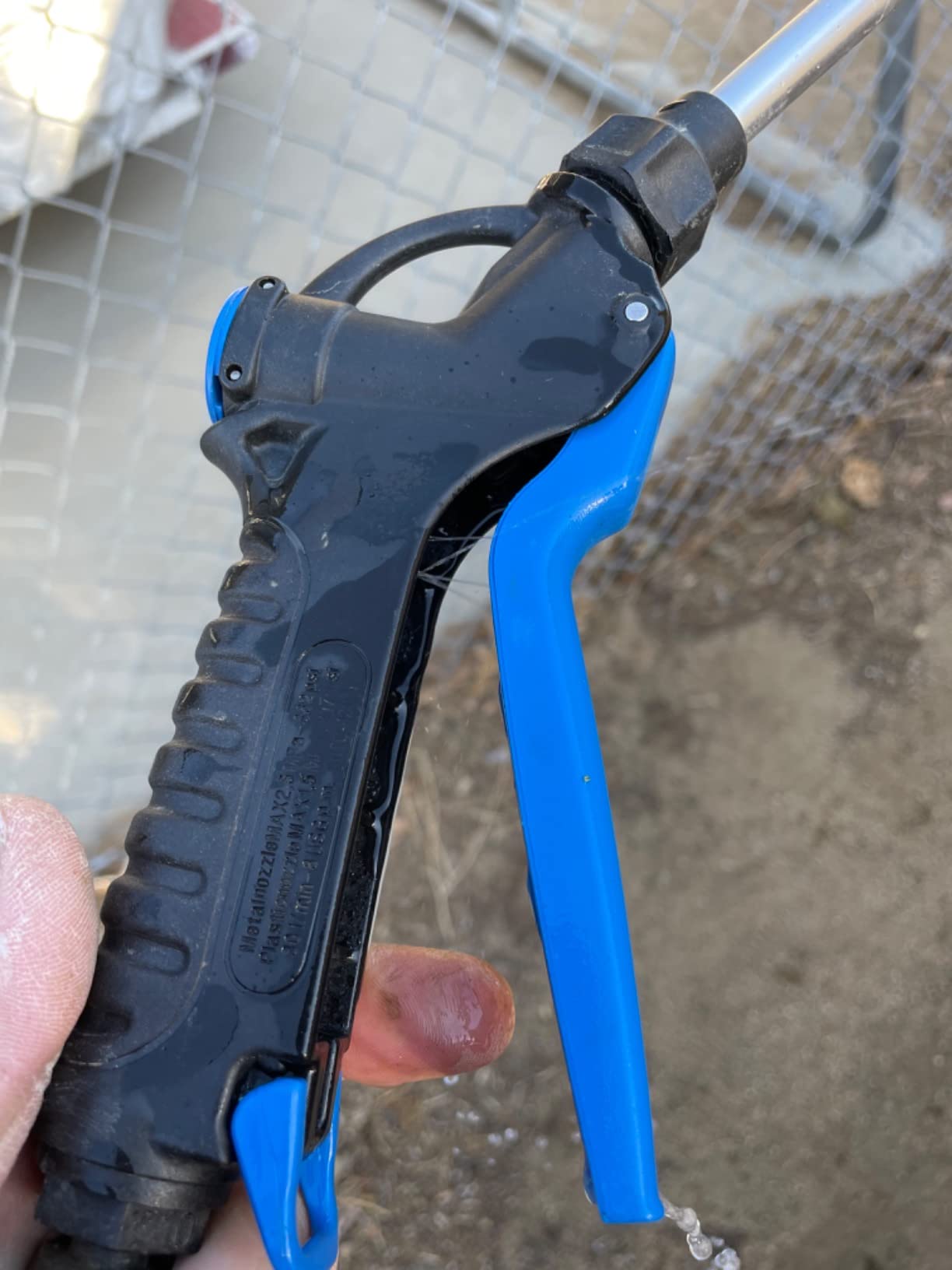
The 3.7 average is the weakest aggregate rating among the ten picks here, with 43% five-star and 15% one-star. Owners who bought it for capacity and pump strength tend to be happy; the critical reviews concentrate on build consistency between units.
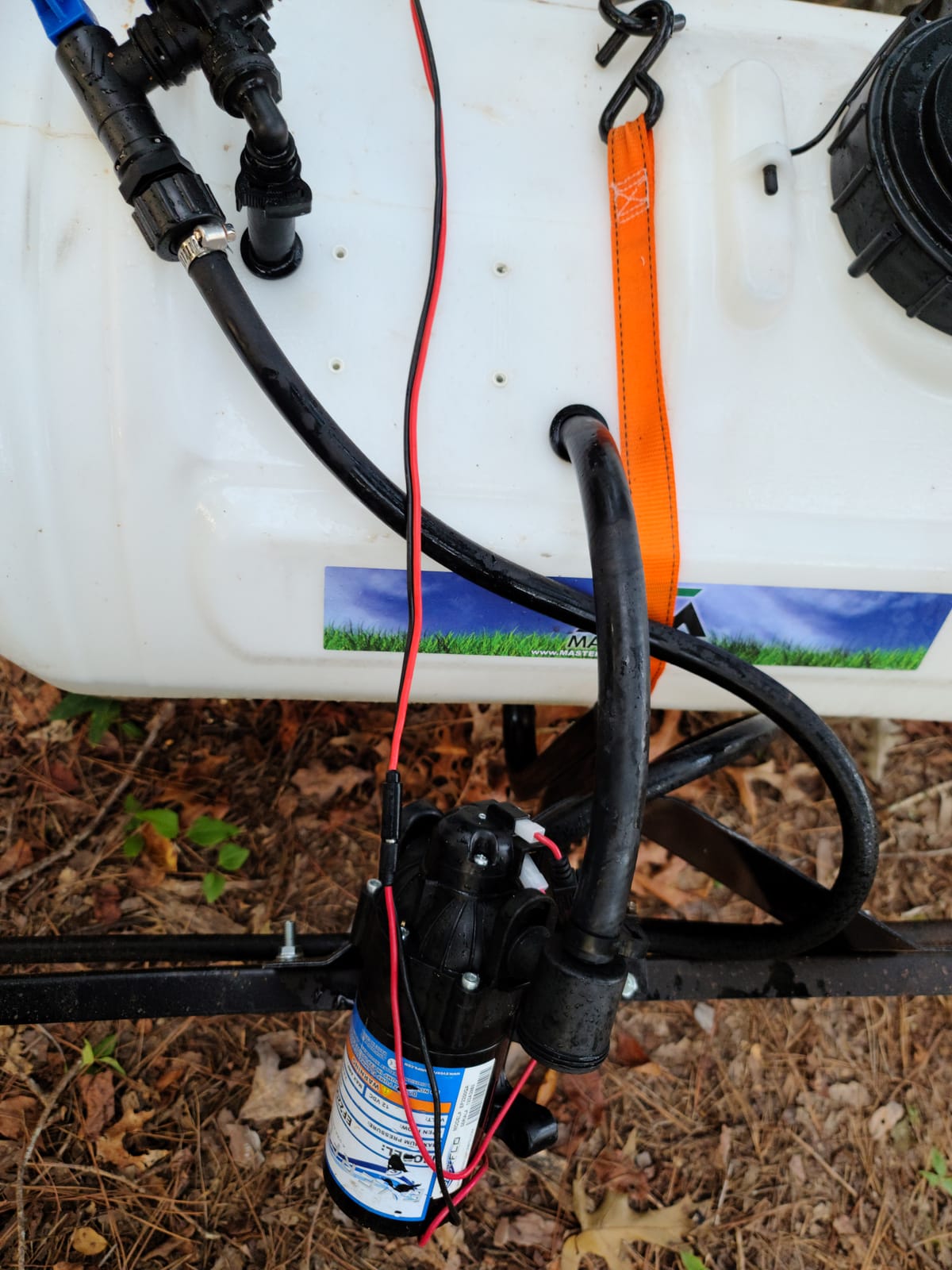
What to check before you buy the Master 25 Deluxe
Check the pressure regulating system under load before adding concentrate. Set the regulator slightly above your target pressure, then open the flow control valve slowly so the pump does not dead-head, which is the usual cause of premature diaphragm failure.
Count the nozzles on your boom and confirm the spray pattern overlaps properly at your ground speed. Dual deflector nozzles only work as designed when they are aimed consistently.
Where the Master 25 Deluxe is the wrong choice
If you are on a tight budget and can live with plastic framing, the Grass Guardian 25-gallon covers similar acreage for less. This model earns its cost with steel and a stronger pump, but the rating spread says you should inspect it carefully on arrival.
It is also a heavier tow for small tractors. A full 25-gallon load plus a steel frame is a different proposition from the lighter 15-gallon carts when you are on uneven ground.
8. CHAPIN 97664 15-Gallon Tow-Behind Sprayer – the filtration leader
CHAPIN 97664 15-Gallon Tow-Behind ATV/UTV Sprayer, 2-Nozzle Boom
15 gal poly tank
2.5 GPM 12V pump
Three-stage filtration
7 ft 2-nozzle boom
Pros
- 2.5 GPM is one of the strongest pumps here
- Three-stage filtration cuts clogging downtime
- Steel frame and 12-inch pneumatic tires
- Boom height adjustment clears tall grass
- Designed and supported in the USA
Cons
- 3.7 average with 17% one-star reviews
- Some feel the cost is high for the capacity
- Alligator-clip connection needs care on rough ground
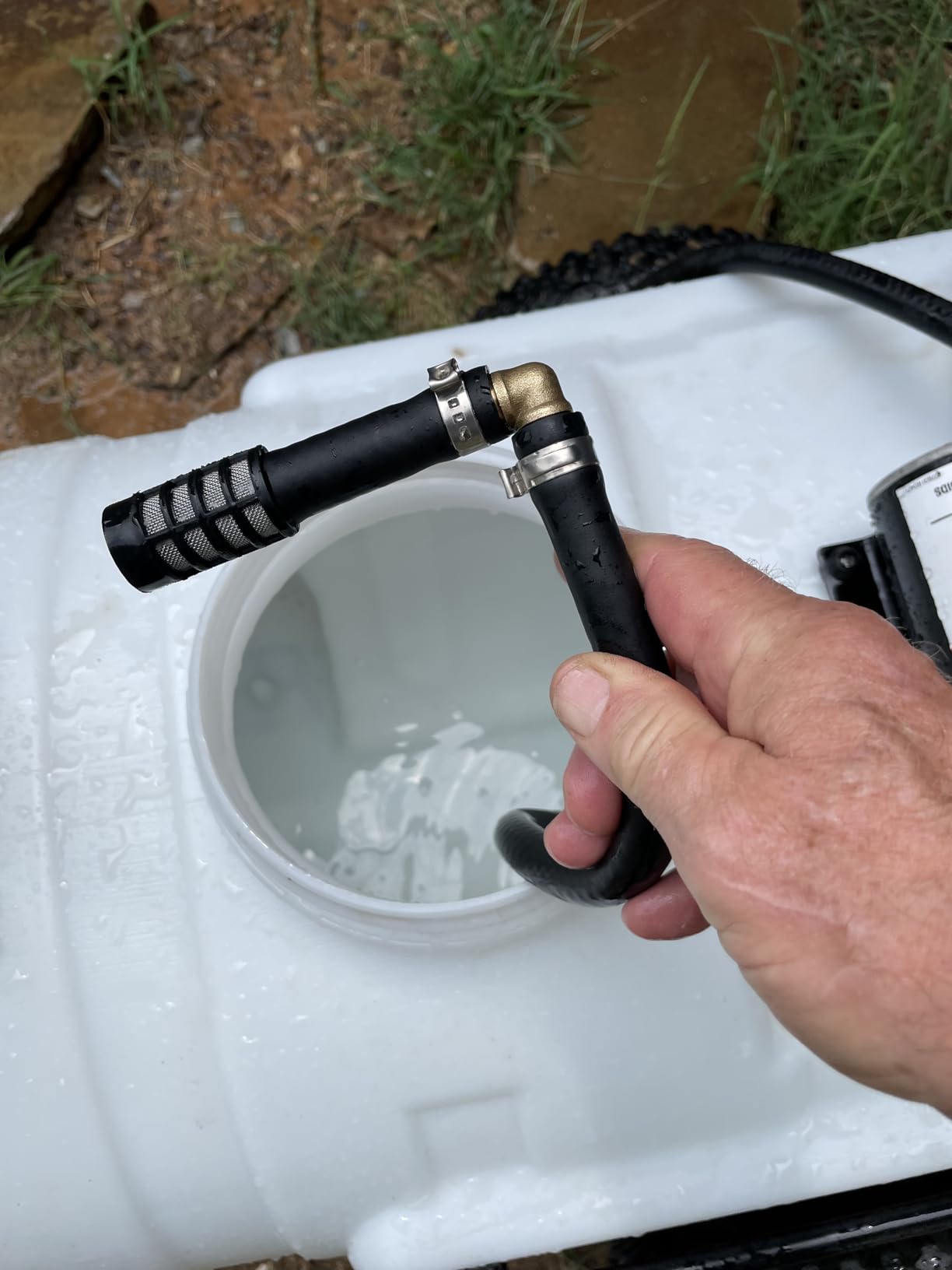
Flow rate and filtration are the two numbers that decide how much of your day a sprayer consumes, and this one wins both. The 2.5 GPM self-priming diaphragm pump moves fluid faster than anything else at this capacity, and the three-stage filtration, cap basket plus in-tank filter plus shut-off filter, is the most thorough in the group.
That filtration matters most with wettable powders and with dry lawn conditions where debris is high. The 2-nozzle boom has a 7-foot spray pattern with adjustable height, so nozzles lift clear of tall grass, and the powder-coated steel trailer with 12-inch pneumatic tires handles uneven ground well.
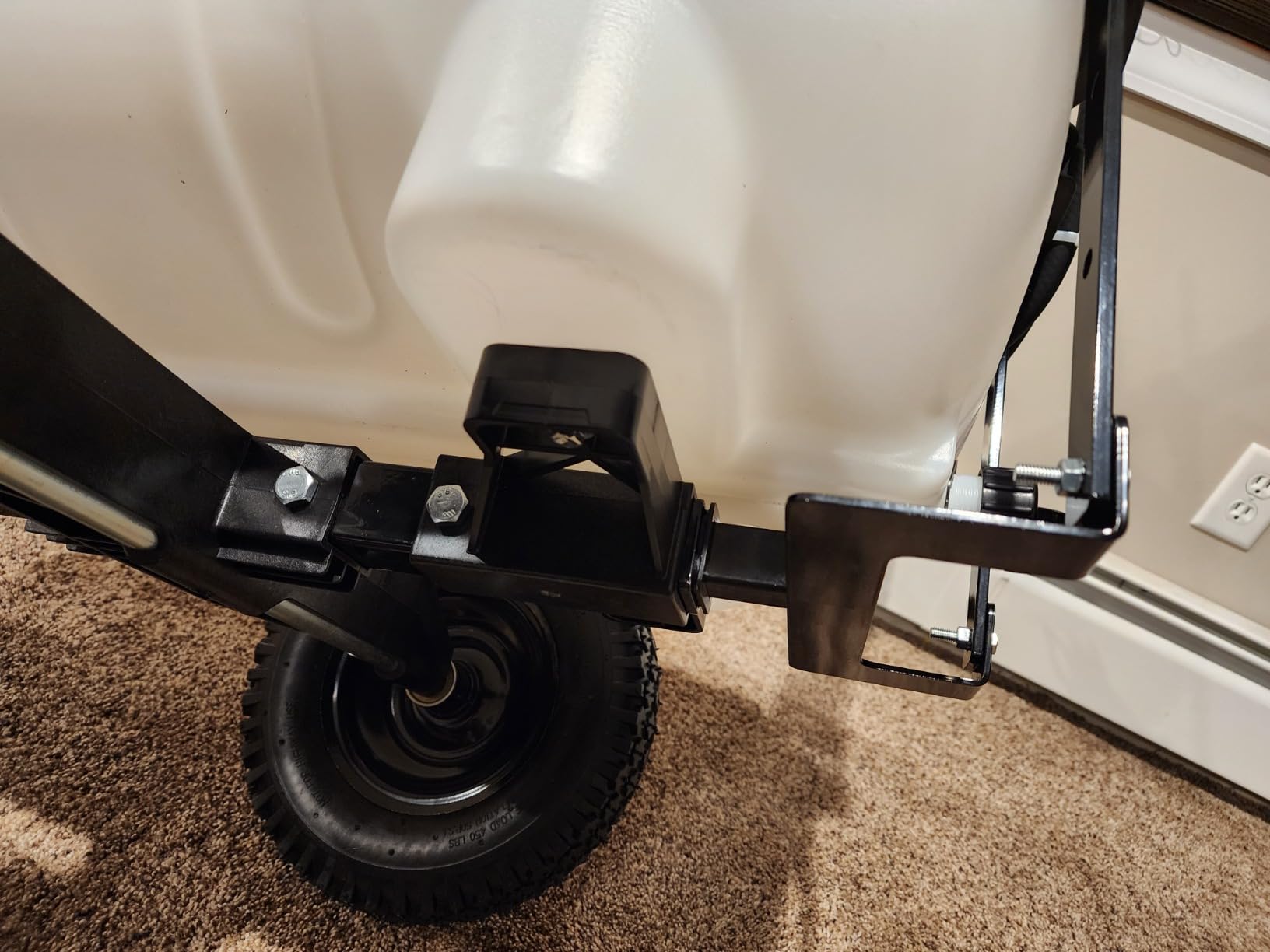
Roughly 17% of ratings are one star, and value is the recurring theme in the criticism. Buyers also note that the alligator-clip connection needs care to stay secure on rough ground, which is a fair warning for anyone towing across a stony yard.
What to check before you buy the CHAPIN 97664
Inspect all three filter stages on day one and clean them before the first load. That fifteen-minute habit is the difference between the 2.5 GPM pump performing as rated and clogging mid-pass on a powder application.
Add a proper power connection method if you tow over rough ground. A hard-wired switch or an auxiliary outlet removes the clip-dropping failure mode that owners report most often on this model.
Where the CHAPIN 97664 is the wrong choice
Fifteen gallons is a small tank next to the 2.5 GPM pump, so you will refill often on acreage work. That combination makes sense on food plots and fence lines where you stop frequently, but not for an uninterrupted full-lawn pass.
If your budget is fixed, this sits above the basic 15-gallon carts for filtration reasons alone. Buyers who do not spray powders or dirty water should decide whether that premium is worth it.
9. CHAPIN 98444 40-Gallon ATV/UTV Sprayer – the acreage workhorse
CHAPIN 98444 40-Gallon ATV/UTV Sprayer, 2-Nozzle Boom & 2.5 GPM Pump
40 gal chemical-resistant tank
2.5 GPM 12V diaphragm pump
Included 2-nozzle boom
2 in drain, triple filtration
Pros
- Largest tank here at 40 gallons
- 2.5 GPM moves a lot of fluid quickly
- Triple filtration and serviceable shut-off reduce downtime
- Lock-on cushion-grip shut-off limits fatigue
- Highest category rank of the group
Cons
- Heaviest option and bulkier to store
- Under 60 reviews so durability data is thin
- Needs a capable ATV
- UTV or tractor at full load
At 40 gallons this is the largest tank in the roundup, and for multi-acre property it changes the arithmetic entirely. One fill covers most of a large lawn, which removes the refill stops that dominate your afternoon. The 2.5 GPM diaphragm pump moves that volume quickly enough that the tank is never the bottleneck.
It is also the most strongly rated by rating split, with 58% five-star and only 7% one-star. The 2-inch drain with a built-in three-quarter-inch port, triple filtration and a serviceable cushion-grip shut-off make cleaning and maintenance far easier, and the included 2-nozzle boom keeps it a broadcast sprayer rather than wand-only.
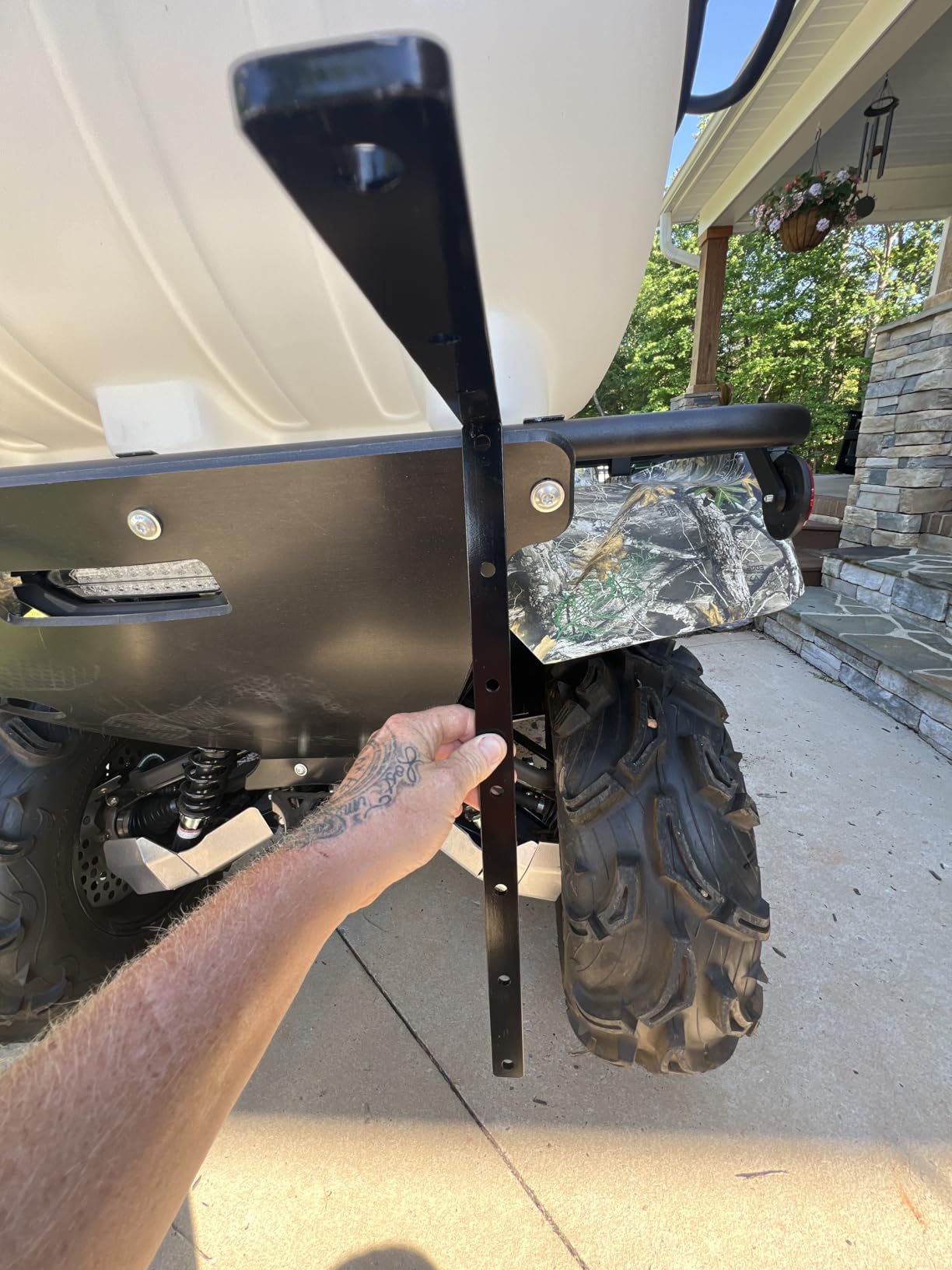
The catch is weight and bulk. A full 40-gallon tank plus the tank weight itself is a serious load, and owners note it is the heaviest and most awkward unit here to transport and store. With fewer than 60 reviews, there is limited long-term durability data to lean on.
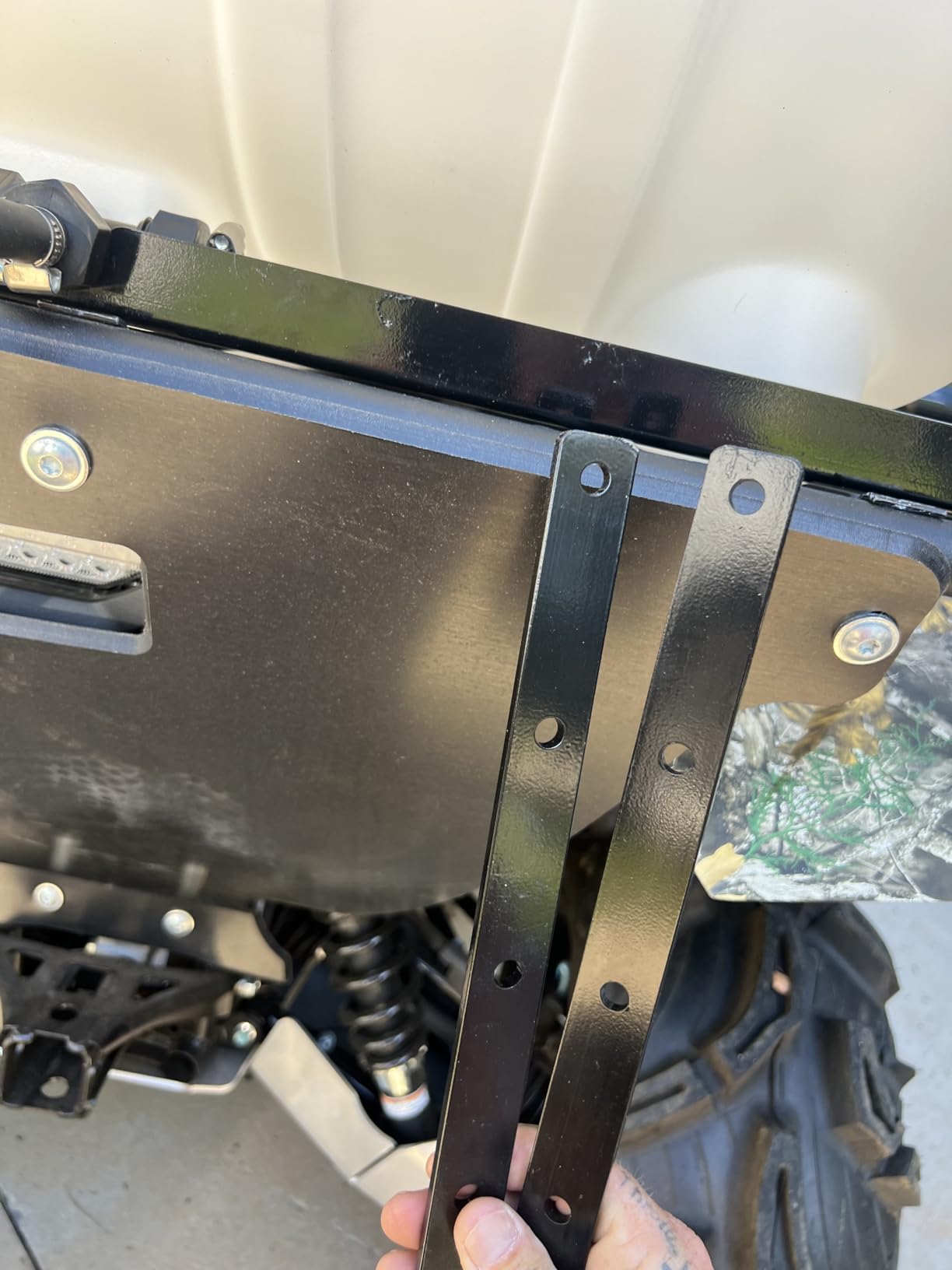
What to check before you buy the CHAPIN 98444
Confirm your tow vehicle can handle the loaded weight safely and has the hitch height and clearance for a unit this size. A capable ATV, UTV or tractor is the requirement, not a small lawn tractor on a slope.
Measure your storage space and your transport route. The dimensions are around 38.6 by 30 inches, and buyers consistently single out storage and handling as the deciding factor against this model.
Where the CHAPIN 98444 is the wrong choice
For anything under two acres, you will carry a large volume of product for a short pass and pay for that in effort every time. A 25-gallon model covers the same ground with far less to load.
Small garages are also a problem. Unlike the Brinly self-storing units, this trailer does not fold down to a compact footprint, so it needs a dedicated corner.
10. Brinly ST-251BH-A 25-Gallon Self-Storing Sprayer – best warranty in the group
Brinly Self-Storing Tow Behind Lawn and Garden Sprayer with Collapsible Boom, 25-Gallon
25 gal poly tank on steel frame
Ultra Lo-Drift spray tips
12 ft hose, thumb-control gun
2-year manufacturer warranty
Pros
- Self-storing design with collapsible booms
- On-demand pump saves battery and pump life
- Lo-Drift tips cut wind drift
- 25 gallons covers a bit over an acre per fill
- Brinly support sends replacement pumps quickly
Cons
- Many fittings are plastic and can arrive broken
- One owner reported a buckled frame
- Debris on the diaphragm can lose prime
- Needs an hour or two of assembly
This is the pick if warranty length is your deciding factor. A two-year manufacturer warranty on a tow-behind sprayer is the longest listed here, and it is backed by support that reviewers describe as sending replacement pumps quickly. One owner reports four seasons of heavy use with no further problems.
The Ultra Lo-Drift spray tips are the feature that will matter most for contact herbicides, because finer tips produce larger droplets that stay where you put them instead of drifting onto your neighbour’s shrubs. The collapsible swing-away booms and in-line mounted tank fold down for tight maneuvering and storage, and the on-demand pump runs only while you are spraying.
What to check before you buy the Brinly 25
Budget an hour or two for assembly, which owners consistently mention. Check every plastic fitting on arrival because several report fittings arriving already broken, and inspect the frame welds closely given one reported buckling under load.
Keep the diaphragm clean and flush the tank after every chemical change. Owners report the pump losing prime when debris collects, which is a five-minute fix if you catch it early.
Where the Brinly 25 is the wrong choice
With only 48 ratings, the long-term evidence base is thin. If you want a deep body of owner feedback to lean on, the NorthStar at 1986 ratings is a safer guide.
It also suits a lawn, not a farm plot. A 12-foot hose and 25-gallon tank are right for turf, but tree canopy and acreage work call for more reach and more capacity than this provides.
Best Tow Behind Sprayers for Lawns: How to Choose
Specs on a listing page rarely tell you which numbers change your day. These are the six that do, in the order we would check them before buying anything.
Tank size versus acreage
Match the tank to your lawn and your refill tolerance. Rule of thumb from our testing: a 25 gallon tank comfortably covers a bit over an acre per fill at typical application rates, while a 15 gallon unit suits a half acre or less. Going larger is not free, because every extra gallon is weight you drag over soft turf and up every slope.
If you already own a tow-behind spreader for large lawns, matching your tank size to that acreage keeps your passes consistent between dry granular and liquid applications.
Pumps, GPM and pressure
Flow rate in gallons per minute tells you how fast you can work, and pressure in PSI tells you what droplet size the nozzle produces. Both matter. A 2.2 to 2.5 GPM pump covers a two-acre lawn in a fraction of the time a 1.1 GPM unit takes.
Prefer an on-demand diaphragm pump that runs only while you spray. Continuous-duty designs run constantly, which wastes battery and wears the diaphragm faster. Adjust pressure by setting the regulator slightly above your target and opening the flow control valve slowly, because dead-heading the pump is the leading cause of premature failure.
Nozzles and spray pattern
Boom nozzles come in four basic types. Fan nozzles produce a flat pattern for broadcast work, cone nozzles give a round pattern for spot spraying, mist nozzles are for insecticides and jet nozzles for cutting vegetation. Fan nozzles are the only ones you want on a boom.
The upgrade worth knowing about is the pre-orifice nozzle, which slows droplets before they exit to cut drift. The Brinly 25 in this list uses Ultra Lo-Drift tips for exactly that reason. A dripless shut-off with anti-drip check valves also matters, because boom nozzles that drip when you stop put concentrated herbicide on the lawn you just treated.
Tires, hitch and vehicle compatibility
Tire choice is underrated. Pneumatic tires roll over rough ground and cushion the load; flat-free tires never go flat but transmit every bump straight into the frame. On uneven or soft turf, small narrow tires make a loaded trailer wander or tip, and that is the most common reason owners end up regretting a purchase.
Any lawn tractor, ATV, UTV or zero-turn mower with a standard hitch pin will tow most of these. Zero-turn compatibility needs one extra step: many mowers lack a 12-volt accessory output, so you need an auxiliary battery or a hard-wired switch to feed the pump. Confirm your charging system is healthy first, because an 8 amp continuous-duty pump will starve on a weak battery.
If your towing vehicle is new or has aftermarket hitch hardware, our tow hitch picks for SUVs cover the fitment questions before they become a problem.
Tank material and chemical compatibility
Polyethylene and poly tanks are the right default. They are rust-proof, chemical-resistant and light. Avoid galvanized steel and bare aluminum tanks, which corrode and can react with certain herbicide concentrates. Fiberglass tanks are durable but can split if liquid is left in them through a hard freeze.
Check the wetted components, not just the tank. Santoprene diaphragms and Viton valves are the upgrades worth paying for on glyphosate, because lower-cost elastomers degrade faster with the surfactants in selective herbicides.
Who should skip a tow-behind sprayer entirely
Under a quarter acre, a backpack sprayer or handheld unit will finish faster and cost a fraction as much. A four gallon backpack covers roughly 4,000 square feet, which is most of a quarter-acre lawn in one fill.
If you have no lawn tractor, ATV or UTV, a tow-behind sprayer is dead weight. A mounted tank or a hand-cart sprayer serves the same purpose and is what TheLawnForum owners usually recommend for tight properties.
Best Tow Behind Sprayers for Lawns: How Many Gallons Do You Need?
It takes about 1 gallon of spray solution to cover 1,000 square feet, which works out to roughly 44 gallons per acre. A 25 gallon tank therefore covers a little over half an acre per fill at that rate, or about an acre if you are applying a thinner lawn-feed solution. Run your own timing test with water before you trust a label rate.
Best Tow Behind Sprayers for Lawns: Tank Size by Acreage
Under half an acre: 13 to 15 gallons. The Brinly ST-152BH-A and the Revolt fit here, and many owners in this range decide a backpack sprayer is enough.
Half to one acre: 15 to 25 gallons. This is where the Chapin 97600 and the Grass Guardian 25 make the most sense.
One to two acres: 25 to 31 gallons. The NorthStar 31 and the Master 25 Deluxe cover this without constant refilling.
Two acres and up: 40 gallons or more. The Chapin 98444 is the smallest rig here that stops the refill stops from eating your day.
Best Tow Behind Sprayers for Lawns: What Owners Say
Roughly half the page-one results for this topic are forum threads, not editorial roundups, which tells you something about what buyers actually care about. Here is what owners report after a season or two of use.
What owners say about the best tow behind sprayers for lawns
A GreenTractorTalk owner who bought a NorthStar tow-behind boom broadcast and spot sprayer calls it one of the best purchases they have made for lawn work, and that endorsement comes from someone whose other hardware has failed repeatedly. The same forum’s broader consensus is less romantic: durability over features is the long-term value metric, with some experienced users running pull-behind equipment for close to twenty years on only a couple of applications a year.
On TheLawnForum, a poster running a 21 gallon tow-behind as a turf sprayer base says the nozzles are the limiting factor, not the tank. That matches what we saw across hundreds of owner reviews in this roundup, where boom nozzle quality and wand hose length draw more complaints than capacity. If you take one practical note from the forums, buy better nozzles.
Two other recurring themes are worth knowing before you buy. Owners on TheLawnForum generally conclude that a mounted tank maneuvers better than a tow-behind cart in tight spaces and around trees, which is the main argument for skipping these entirely on a small property. And forum users debating 15 versus 25 gallon tanks on ATVs usually land on 25, reasoning that the extra 10 gallons and roughly 80 pounds is not the limiting factor they expected.
Across every forum thread we read, the same deal breakers appear: nozzles that clog or produce an uneven pattern, weak and short wand hoses, tanks or axles that crack under a full load, and warranty coverage shorter than they expected on pump and electrical parts.
Best Tow Behind Sprayers for Lawns: How to Use, Clean and Store
Cross-contamination between products is the recurring worry in owner forums, and it is a real performance issue, not just a safety one. Cleaning between chemicals is the fix, and it takes about fifteen minutes.
Empty the tank completely at the end of every application, using the bottom drain or the molded-in drain port.
Refill with clean water, run the boom and the wand for two to three minutes, and drain again. This flushes the lines rather than just the tank.
Fill with a weak rinse solution appropriate to the last chemical used, circulate it through the boom and wand, then drain.
Clean every filter stage separately, including the cap basket, the in-tank filter and the shut-off filter.
Remove the boom nozzles and soak them overnight so any wettable powder residue clears from the orifices.
Run the pump briefly with no solution in the line to clear the diaphragm chamber.
Store the tank open and dry, away from freezing temperatures, with the boom arms folded or removed.
Calibration matters less than most owners expect and takes about ten minutes. Measure the actual spray width of your boom with water, collect the output of one minute into a container, determine your ground speed, and calculate gallons per acre from those three numbers. Adjust nozzle spacing or travel speed to match the label rate rather than guessing.
Best Tow Behind Sprayers for Lawns: Safety and PPE
Every label is different, so treat the product label as the requirement and this as the baseline. Wear chemical-resistant gloves, long sleeves, closed-toe shoes and eye protection whenever you are mixing or handling concentrate.
Never spray where people, pets or food crops are present or likely to arrive before the product dries.
Watch wind direction and speed, and stop if droplets drift onto neighbouring property.
Do not eat, drink or smoke while spraying, and wash your hands and face before you do.
Keep children away from the sprayer while it is loaded, and lock the tank when it is not in use.
Store products in their original containers, and keep the sprayer empty and clean between chemicals.
Frequently Asked Questions
What is the best pull-behind sprayer to buy?
The NorthStar 31-Gallon Boom and Spot Sprayer is the strongest all-round pick for most lawns between half an acre and two acres. It has the highest rating and the largest review base in this group, a continuous-duty 2.2 GPM pump rated at 70 PSI, and a breakaway boom that folds flat for storage.
How many gallons does it take to spray 1 acre?
About 1 gallon of spray solution covers 1,000 square feet, which works out to roughly 44 gallons per acre. A 25 gallon tank covers a little over half an acre per fill at that rate, or close to a full acre with a thinner lawn-feed solution. Time a measured pass with water to confirm your own label rate.
How many acres will 25 gallons spray?
A 25 gallon tank covers roughly half an acre per fill at the standard 1 gallon per 1,000 square feet rate, and up to about an acre when applying a thinner fertilizer solution. Larger rigs like the Chapin 98444 at 40 gallons reduce refill stops further on acreage work.
What type of vehicle do I need for a tow-behind sprayer?
Any lawn tractor, ATV, UTV or zero-turn mower with a standard hitch pin will tow most tow-behind sprayers. Zero-turn mowers often need an auxiliary battery or a hard-wired switch because they lack a 12-volt accessory output, and you should confirm your charging system is healthy before connecting a continuous-duty pump.
How do you clean a tow-behind sprayer?
Drain the tank, refill with clean water and run the boom and wand for two to three minutes, then drain again. Follow with a weak rinse solution appropriate to the last chemical, clean every filter stage separately, and soak the boom nozzles overnight to clear any residue from their orifices.
Do I need to wear PPE when using a tow-behind sprayer?
Yes. Chemical-resistant gloves, long sleeves, closed-toe shoes and eye protection are the baseline whenever you mix or handle concentrate, even with a boom that keeps you at a distance from the spray. Always follow the specific product label, stop if droplets drift, and keep children and pets away until the product has dried.
Best Tow Behind Sprayers for Lawns: Final Verdict
There is no single best tow behind sprayer for lawns, only the best match for your acreage and your tow vehicle. Under half an acre, take the Brinly ST-152BH-A or the Revolt, and skip the trailer entirely if you have no riding mower. Between one and two acres, the NorthStar 31 wins on pump strength, review volume and the rating spread behind it, and it is our pick as the general-purpose choice.
Beyond two acres, capacity and filtration decide it, which is why the Chapin 98444 at 40 gallons and the CHAPIN 97664 at 2.5 GPM with three-stage filtration sit at the top of that band. Whichever you choose, check the tire size, the hitch fitment and the auxiliary battery question before you buy, because those are the three things that generate returns.