
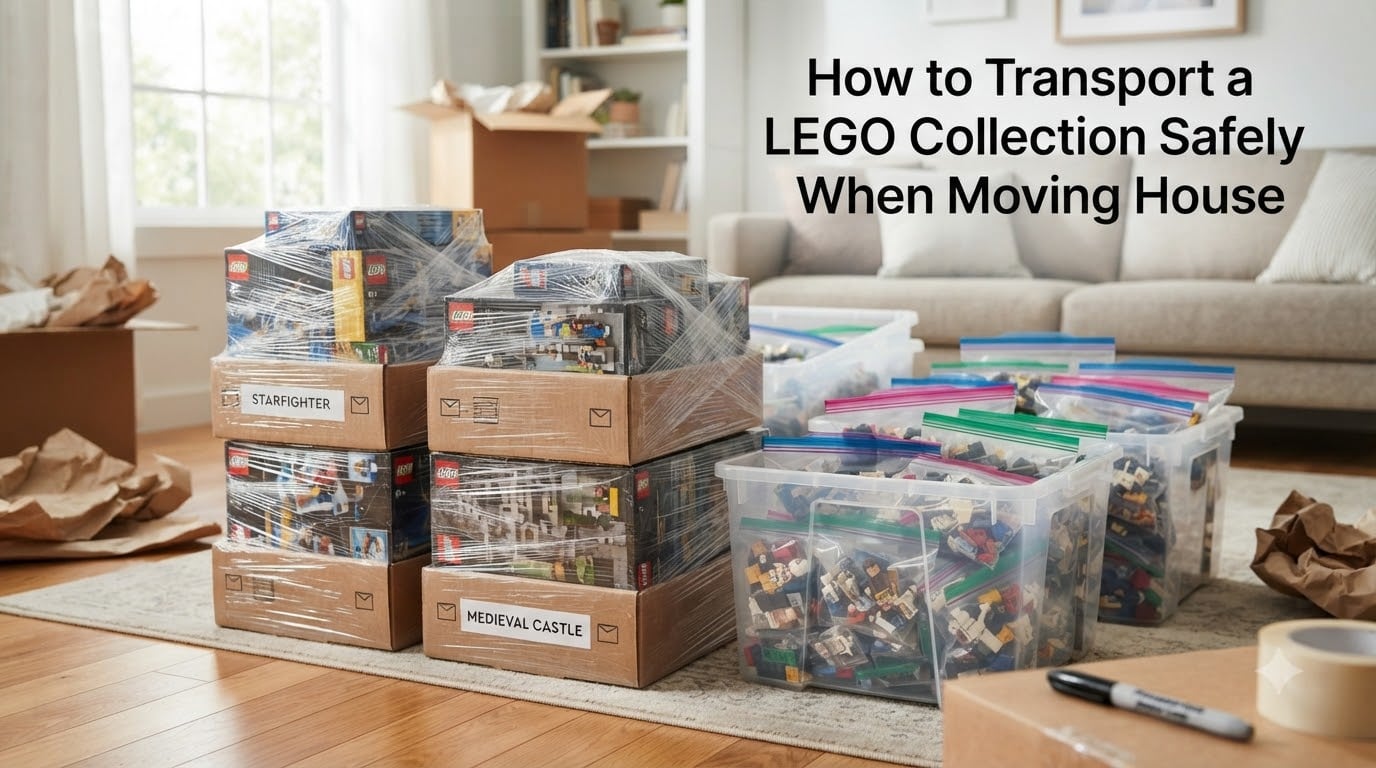
Moving house is stressful enough without watching a truck door close on fifteen years of your collection. I have moved my own LEGO accumulation twice in five years, once across town and once more than 900 miles, and I learned the hard way that bricks packed like ordinary household items arrive as mixed-up soup. If you need to transport a LEGO collection safely when moving house, everything comes down to three habits: sort before you pack, wrap everything so it cannot shift, and label boxes so they get treated like the valuables they are.
This guide is the method I use now, sharpened by hours in r/lego moving threads and the trial and error of collectors who have done it at serious scale. You will find packing steps for loose bricks, built sets, minifigures, and sealed boxes, plus the labeling tricks that protect collections from rough handling. It is updated for 2026 and works for everything from a shoebox of bricks to a wall of display sets.
The stakes are real. One crushed box can destroy a build that took forty hours, and one tipped bin can fuse five sorted sets into an afternoon of re-sorting. An hour of prep per shelf of LEGO is cheap insurance by comparison.
Table of Contents
How to Transport a LEGO Collection Safely When Moving House: The Short Answer
The safest way to transport a LEGO collection when moving house is to sort pieces by set, wrap every built set tightly in plastic wrap and then packing paper, bag loose bricks in resealable bags inside rigid bins, fill every gap so nothing shifts, and label the boxes fragile and top-load only. Keep the most valuable boxes with you in your own car whenever possible. The rest of this guide breaks each step down in detail.
Why LEGO Needs Different Packing Than Other Toys
LEGO is uniquely bad at surviving a careless move. The pieces are small, numerous, and perfectly shaped to escape into truck ramps, box seams, and carpet.
The failure stories are remarkably consistent across forum threads. Pieces shake loose and mix between sets, built models collapse when boxes shift, and cartons get crushed because a mover stacked furniture on what looked like a light box of toys. One collector on r/lego arrived to find an entire box of sets flattened after movers laid it horizontally under other boxes with no padding between layers.
Then there is value. A collection can include retired sets that cost serious money and effort to replace, not to mention builds with pure sentimental weight.
So treat your LEGO like fine dishware, not like a toy bin. That single mindset change prevents most disasters.
Sort and Organize Before You Pack
Packing unsorted LEGO is how collections get ruined, because every mistake compounds when everything is mixed together. Sorting first means a dropped box costs you one cleanup, not the whole weekend.
Here is the three-step method I use before a single box gets taped shut:
- Sort by set first. Keep each set’s pieces together in resealable bags or small containers, and drop in a slip of paper with the set name or number.
- Photograph every built set before you take anything apart. Shoot all angles, including the back, so you can rebuild exactly and inventory what belongs in each bag.
- Separate the big categories: loose play bricks, minifigures, built display sets, sealed boxed sets, and spare parts with instructions.
If displayed sets are dusty, a soft brush or lint roller is enough. Nobody needs to hand-wash ten thousand bricks in the middle of a move.
Packing Materials Checklist
Running out of supplies halfway through is the most common complaint in moving threads, so gather everything before you start. Here is the full list:
- Sturdy small and medium cardboard boxes, with the small ones reserved for heavy loose bricks
- Rigid plastic bins with secure lids as the backbone of the move
- Resealable bags in sandwich and gallon sizes
- Plastic wrap or shrink wrap for built sets
- Packing paper, plus bubble wrap for large and delicate builds
- Wardrobe boxes for very large sets, since their metal bars and tall walls add structure
- Permanent markers, printed labels, packing tape, and foam sheets or cut pool noodles for dividers
One rule of thumb: lighter boxes survive better. A giant tote filled to the brim with bricks is back-injury heavy, and heavy boxes get dropped.
How to Pack Loose LEGO Bricks
Loose bricks are the easiest part of the move if you bag them, and the worst part if you do not. Follow this order:
- Bag each set separately in resealable bags, pressing out the air before you seal them.
- Nest those bags inside rigid plastic bins. Bags alone get crushed and punctured, so the bin is the armor and the bags are the organization.
- Fill empty space in each bin with packing paper or a towel so the contents cannot slide.
- Run the shake test: lift the bin and rock it gently. If you feel or hear movement, add more filler. As one r/lego user put it, pack it so that when you shake the box, everything has minimal movement.
- Tape the lid, label the bin with room and contents, and stack bins no more than three high.
Resist giant bins entirely. Two half-full medium bins beat one overloaded monster every single time.
How to Pack Minifigures Safely
Minifigures are small, surprisingly valuable, and painfully easy to lose, so they earn their own packing pass.
- Remove hats, hair, backpacks, and handheld accessories, then bag those tiny parts with their owner so nothing gets orphaned.
- Group figures into small bags by theme or set, ten to fifteen at a time, with a strip of soft cloth or paper between layers. Small jewelry bags work brilliantly here.
- Lay the bags flat in a single layer inside a small rigid container so figures are not pressing on each other.
- Keep the minifigure container with your instructions and other irreplaceables instead of at the bottom of a heavy bin.
How to Pack Assembled LEGO Sets Without Breaking Them
Built sets are where most moves go wrong, and where plastic wrap earns its legendary reputation. The goal is to turn each set into one rigid, cushioned object that cannot shed pieces in transit.
- Remove anything that snaps off easily: antennae, flags, thin weapons, detachable vehicles, and all minifigures. Bag and label those parts with the set.
- Wrap the set tightly in plastic wrap, spiraling around it several times so the structure is held together as one unit. The classic advice from r/lego is to wrap each set securely in plastic wrap first, then add a second layer of packing paper.
- Add that second layer of paper or bubble wrap, tucking extra cushioning into fragile spots like spires, columns, and exposed edges.
- Choose a box only slightly larger than the wrapped set. The set should sit snug, not float.
- Fill every remaining gap with crumpled paper, and place a cardboard or foam sheet between stacked sets.
- Mark the box FRAGILE, THIS SIDE UP, DO NOT TIP, and make clear to everyone that it is top-load only.
For very large builds like a UCS-scale starship or a row of modular buildings, wardrobe boxes are the collector favorite. The tall walls and metal bar give you rigid, protected space that nothing else in the truck gets stacked onto.
Keep Built or Disassemble? A Simple Decision Guide
The biggest debate in every moving thread is whether sets should travel built or torn down. There is no universal answer, but the pattern is clear.
| Factor | Keep It Built When | Disassemble When |
|---|---|---|
| Set size | Small and medium sets that fit in a box with cushioning | Large sets, UCS models, and anything too big to wrap securely |
| Structure | Solid, blocky builds with few protruding parts | Fragile spires, thin wings, hinges, and stringed elements |
| Destination | Going straight onto a shelf in the new place | Heading into long-term storage |
| Distance | Local move in your own car | Long distance or packed into a shared moving truck |
| Rebuild appetite | You dread rebuilding and the set is sturdy | You enjoy the rebuild and want zero breakage risk |
When in doubt, take the middle path: break a big set into three to five large sections instead of individual pieces. Sections pack like small built sets and snap back together in minutes at the new house.
Packing Sets Still in Their Original Boxes
Sealed and boxed sets are the simplest to move and the most important to protect, because condition drives collector value.
- Keep sets sealed in their original boxes, and do not flatten or unpack anything.
- Wrap each box in packing paper or a paper sleeve to prevent scuffing, then pack them flat in a sturdy carton.
- Fill the gaps so boxes cannot slide, and never let the carton bulge or overhang.
- Label the carton high value and store it flat somewhere temperature-stable, never a hot attic or garage.
Labeling Strategies That Protect Your Collection
Labels are your only voice when you are not standing next to the truck, and they change how boxes actually get handled.
My favorite trick comes from a BrickNerd moving story: label LEGO boxes as office boxes or craft supplies. Boring labels lower theft risk on multi-stop moves, and you can quietly tell the movers which boxes matter most.
For boxes that need gentle handling, go the opposite direction and mark them HIGH VALUE and FRAGILE, TOP LOAD ONLY in red marker on every face. If you ever file a claim, accurate high-value labeling also supports your case with movers and insurers.
- Put room plus contents on the top and at least one side of every box.
- Number your boxes and keep a simple list so nothing vanishes silently.
- Add THIS SIDE UP arrows on every built-set box, not just the top.
What Is the LEGO 5-2 Rule?
Direct answer: LEGO has never published an official 5-2 rule. The phrase floats around forum threads about sorting and moving, where collectors use it as shorthand for going broad before going deep: split your collection into about five big categories first, then add a second level of sorting only if a category is still unmanageable.
That is why the idea travels with moving advice. Five broad bins load into a truck in an afternoon, while twenty hyper-sorted containers take forever and get mixed anyway. Treat the 5-2 rule as community slang for sort broad and refine later, not as an official guideline.
Temperature and Climate Considerations During the Move
LEGO bricks are ABS plastic, and ABS has two enemies: sustained heat and wild temperature swings. A parked car or a non-climate-controlled truck in summer can get hot enough to slowly warp bricks, especially thin plates and long beams.
Keep boxes out of direct sun and off hot metal truck floors on multi-day drives. If bins come off a cold truck into a warm house, let them sit closed for an hour so condensation does not form on the bricks.
The same logic applies at the destination. Garages, attics, and sheds swing between freezing and baking, so choose an interior, temperature-stable room for anything you are not unpacking right away.
Working With Professional Movers
You can absolutely hand LEGO to movers, but only if you set the terms. A little coordination goes a long way.
- Walk the crew through the LEGO boxes personally and point out the top-load-only cartons. Movers handle hundreds of boxes a day, and the word fragile means little without context.
- Ask for wardrobe boxes, or supply your own before the crew arrives, so large sets get tall protected space.
- Consider declaring value on the collection so coverage matches what is actually in the boxes.
- Move the irreplaceables yourself: minifigures, retired sets, custom builds, and instruction books ride best in your own car.
Nearly every crushed-box horror story in moving threads involves a box stacked horizontally under heavy furniture with no padding. If you can supervise the truck loading, your odds improve dramatically.
Post-Move Unpacking and Reorganization
How you unpack decides whether your first build session is joyful or a scavenger hunt. Work in this order:
- Pick one sorting room and open one bin at a time instead of unpacking everything at once.
- Rebuild built sets from your photos, checking each bag of parts against the image before you start.
- Shelve the display sets before you sort any loose bricks, so the fragile work happens while you are fresh.
- Set up your permanent sorting system, whether by part, color, or set, before the play area goes live.
- Keep a lost-piece list as you go, then order replacements through LEGO’s Bricks and Pieces or Pick a Brick service.
Expect small attrition. Even careful moves lose a piece or two under baseboards, and the replacement services exist for exactly this moment.
Frequently Asked Questions
What is the best way to transport LEGO creations when moving?
Wrap each built creation tightly in plastic wrap to hold the pieces together, add a second layer of packing paper, then pack it snugly in a sturdy box with cushioning filling every gap. Gently shake the box before sealing; if you feel movement, add more padding. Keep these boxes top-loaded so nothing heavy sits on them.
What is the LEGO 5-2 rule?
LEGO has never published an official 5-2 rule. The phrase circulates in collector forums as shorthand for sorting broad first and refining later: divide pieces into about five large categories, then add a second level of sorting only if a category is still unmanageable. Treat it as community slang, not an official guideline.
Is it safe to store LEGO in ziplock bags?
Yes, resealable ziplock bags are one of the safest and cheapest ways to move loose bricks. They keep sets separated, prevent spills, and make unpacking simple. Keep the bags inside a rigid bin so they cannot be crushed, and store them away from heat and direct sunlight.
Is it safe to store Legos in the garage?
Only briefly, and never in extreme weather. Garages swing between baking and freezing, sustained heat can slowly warp bricks, and humidity encourages brittleness and dust. For anything longer than a few weeks, choose a climate-controlled indoor room instead.
How do I move large LEGO sets long distances?
Disassemble large sets into logical sections, photograph each stage, then bag and label the pieces by section. Pack the bags in rigid plastic bins with foam or paper filling the gaps, keep the instructions with each set, and transport the most valuable bins in your own car rather than the truck.
How do I organize my Lego collection after moving long distance?
Unpack one bin at a time in a dedicated sorting space, rebuild from your photos, and shelve display sets before sorting loose bricks. Order any lost pieces through the Bricks and Pieces or Pick a Brick service, then set up your permanent sorting system before the next build.
Ready to Move Your Collection
If you take one thing from my two moves and every forum thread I have read since, it is this: you can transport a LEGO collection safely when moving house without losing a single piece. Sort by set, wrap everything so it cannot move, label like it matters, and keep the crown jewels in your own car.
Then, on day one in the new place, rebuild something. It makes a new house feel like home faster than anything else you can unpack.