
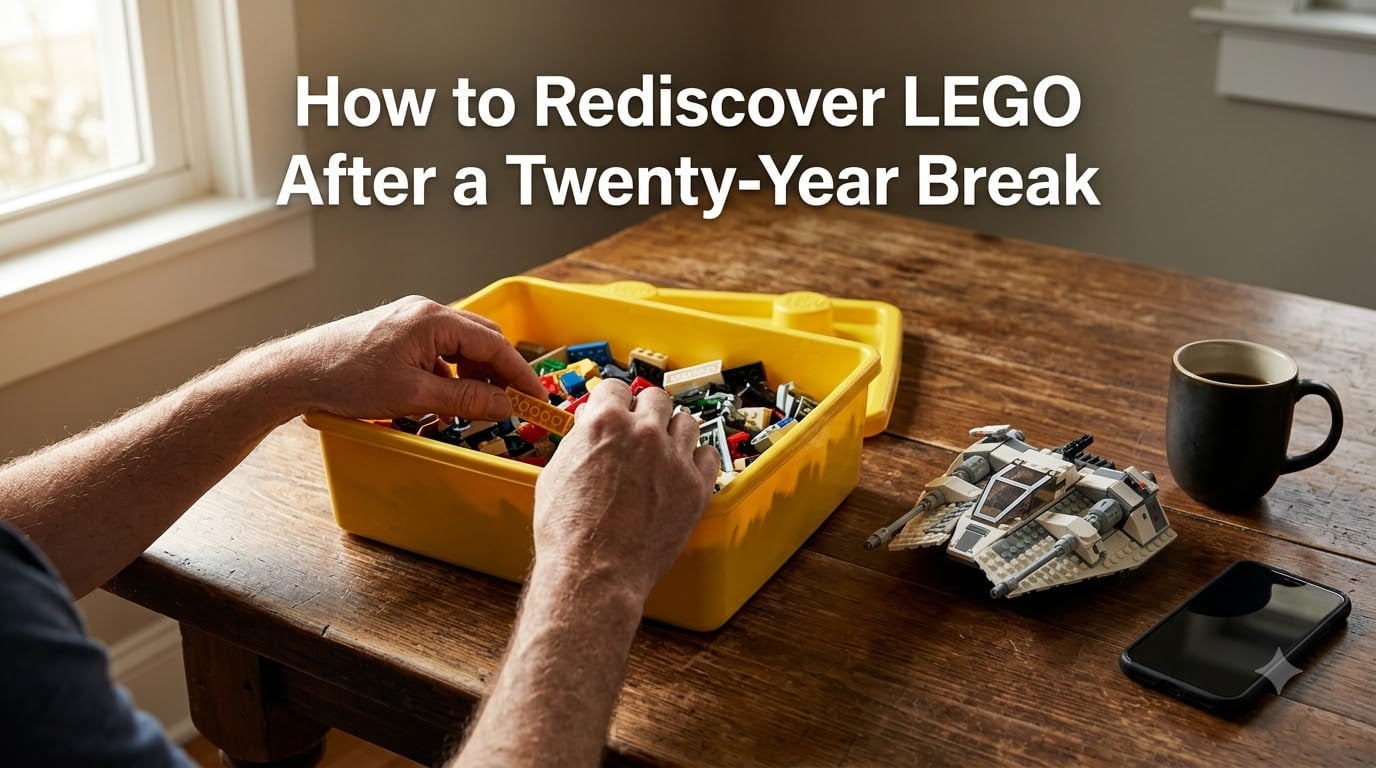
I dug my old LEGO tub out of my parents’ garage last spring and opened it in front of my wife. The bricks spilled across the kitchen table, faded yellows and brittle whites catching the light, and the smell hit me before the memories did. That stale plastic scent unlocked something I had not felt since middle school. Twenty years had passed. The hobby had not waited for me to come back.
If you are wondering how to rediscover LEGO after a twenty-year break, you are in good company. Thousands of adults find their way back to the brick every year, and the path is smoother than it was when we were kids. In this guide I will walk you through the changes you missed, where to find parts you have lost, how to choose between rebuilding old sets and buying new ones, and how the adult LEGO community welcomes you with open arms.
Table of Contents
What Is the LEGO Dark Ages and Why Adults Return
The term LEGO Dark Ages describes the gap many adults have between their childhood brick phase and their return as grown-ups. For most of us, the gap ran from our teenage years through college and into our twenties. Life filled up with jobs, apartments too small for displays, and a vague sense that LEGO belonged to kids.
Then something shifts. A friend posts a photo of a completed Saturn V rocket. A coworker keeps a Millennium Falcon on their desk. You see a Stranger Things set at Target and your heart skips. The hobby calls you back, and a community has been waiting.
Adults who love LEGO call themselves AFOLs, short for Adult Fans of Lego. The label has no entry requirements. You do not need a display room or a vintage Black Seas Barracuda to qualify. If you build with bricks as an adult and enjoy it, you are an AFOL.
For decades the AFOL community was a quiet subculture of forums and conventions. Then LEGO leaned in with its Adults Welcome initiative in 2026, launching an 18+ product line and signaling openly that grown-ups belong in this hobby. The stigma we grew up with has officially lifted.
How LEGO Has Changed in the Last Twenty Years
Twenty years is a long time in any hobby, and LEGO has changed more than you might expect. The pieces are better. The building techniques are smarter. The themes are broader. Returning now is like stepping into a familiar room that has been quietly remodeled.
Here is what you missed:
Building techniques have evolved. The 5/2 rule is a modern technique where you stack plates in alternating directions to create angles and curves that older sets achieved with bulky SNOT (Studs Not On Top) work. The technique took off around 2015 and shows up in advanced sets like the Colosseum and the new Razor Crest.
The piece library exploded. Modern sets include specialized parts like bar holders, clip plates, and inverted slopes your childhood tubs never saw. These pieces unlock shapes that were impossible in 2005.
Themes are massive. Star Wars has never stopped. Harry Potter returned in 2018 and now spans Hogwarts, Hogsmeade, and collectible minifigures. Architecture, Botanicals, and Ideas all launched after you left. Icons (formerly Creator Expert) targets adult builders directly.
Instructions and apps. Many new sets ship with the LEGO Builder app, which lets you zoom, rotate, and track progress digitally. Lost your paper booklet? PDFs of most modern instructions live on the official LEGO site.
The biggest change is psychological. LEGO now designs with adults in mind. That means more complex builds, more display-worthy models, and fewer compromises on the adult experience.
Finding and Assessing Your Old LEGO Collection
Before you buy anything, hunt down what you already own. Most returning builders find at least one stash, often split between a parent’s house, a basement bin, or a forgotten shelf. My own collection had migrated through three basements before I reunited the pieces.
Once you have your bricks, run a quick condition check:
Look for brittleness. Older ABS plastic can crack, especially in white, light gray, and red. Pieces from the late 1990s and early 2000s are most prone. Cracked studs and stress marks mean replacement time.
Check for discoloration. Yellow and light gray oxidize over years of sunlight and air exposure. Some builders embrace the patina. Others bleach lightly with hydrogen peroxide and sunlight for a like-new look.
Wash gently. A mesh bag, mild dish soap, and a cool rinse restores dusty bricks. Skip the dishwasher. Heat warps plastic and ruins decals.
Sort into broad buckets first. Do not sort by piece or color on day one. Start with rough categories: bricks, plates, slopes, minifigures, specialty. Finer sorting comes later, and only if you plan to build MOCs (My Own Creations).
Where to Find Replacement Parts and Missing Pieces
Missing pieces are the number-one frustration for returning builders. A 1,000-piece set from 1998 with 47 missing elements is not a rebuild, it is a scavenger hunt. Two sources solve this: Pick a Brick from LEGO and BrickLink from the community.
LEGO Pick a Brick lives on the official LEGO site and at physical LEGO stores. You order individual elements by the cup. Pieces are new, authentic, and ship from official warehouses. Prices run higher than the secondary market, but you get guaranteed quality and the full modern catalog.
BrickLink is a marketplace run by AFOL sellers worldwide. After LEGO acquired it in 2023, it became the de facto global store for both new-old-stock and used LEGO parts. You can source 1980s pirate ship rigging alongside brand-new Botanical stems. Prices are usually lower than Pick a Brick for common elements, and rare parts become findable.
For instructions, the official LEGO instructions archive at lego.com covers most sets back to the early 2000s. Older sets require a community hunt on sites like Peeron or the Brickset instructions library.
Choosing Your Path: Rebuild Old Sets or Start New
Every returning builder faces the same fork in the road: rebuild what you had, or build what you missed. Both paths work. The choice depends on your goals, your budget, and how much nostalgia is driving the comeback.
Rebuilding old sets delivers maximum nostalgia. You remember every wing, every cockpit hatch, every minifigure smirk. Sets like 7181 TIE Interceptor and 6210 Jabba’s Sail Barge hit different when you lived them as a kid. The downside is sourcing missing pieces and paying secondary-market prices for retired kits.
Starting new sets opens the door to what you missed. Star Wars Ultimate Collector Series, the Icons modular buildings, Harry Potter Hogwarts Express, Botanical flowers. These are designed for adult hands with sophisticated techniques. The downside is the sticker shock on premium sets.
MOC building is the third path. MOC stands for My Own Creation, and it means designing something no official set has ever offered. The community at Rebrickable and Eurobricks shares thousands of free instructions. MOCing rewards the parts library you have been quietly sorting.
My suggestion for the first three months: buy one mid-range Icons set for the joy of a fresh build, then tackle a rebuild of one childhood favorite. Balance satisfaction and nostalgia.
Storage and Organization Tips for Returning Builders
The hardest part of returning to LEGO is not the builds. It is what to do with 15,000 bricks when you finish. Storage matters more than most beginners expect.
Sort by piece, color, or set depending on your style. Builders who focus on MOCs sort by piece and color for quick access. Builders who focus on set collecting sort by kit and store incomplete sets together.
Container options include:
Akro-Mils drawers for small parts and frequent access.
Sterilite shoeboxes for sets in progress and complete models.
Clearstack bins from The Container Store for bulk storage of plates and bricks.
Ziploc bags within bins for partially disassembled sets you plan to rebuild.
Whatever you choose, label everything. Six months from now you will not remember which bag holds the Saturn V rocket fins.
Overcoming the Adult LEGO Stigma
Most adults returning to LEGO share one private worry: is this weird? The honest answer is no, but I remember asking the same question.
The stigma you remember came from childhood. Grown-ups told you to put away toys. Teenagers mocked anything that smelled like a kid. That world is gone. LEGO is now a billion-dollar adult product line with a dedicated 18+ age marker on the box.
If your spouse or family member gives you grief, invite them into a build. Few people mock a hobby once they have clicked two bricks together and watched a wall rise. My wife now has strong opinions about Star Wars UCS sets, which I count as a win.
And if the inner critic still nags, remember this: LEGO’s CEO builds sets at his desk. Architects, surgeons, and engineers keep LEGO on their shelves. The hobby has been quietly approved by every serious adult who tried it.
Budget Planning for Your LEGO Comeback
LEGO can drain a checking account faster than you expect. Premium adult sets run from 100 to 850 dollars, and the temptation to buy the entire Icons catalog hits hard. Set a budget before you start browsing.
A practical starter budget for a returning adult runs between 200 and 400 dollars for the first three months. That buys two mid-range sets and a few Pick a Brick orders. Skip the flagship UCS Millennium Falcon until you know you are committed to the hobby long-term.
Watch for sales at LEGO.com, Target, and Walmart during Black Friday and mid-summer. BrickLink lots offer cheaper bulk pieces. Buying used sets from local Facebook Marketplace listings often saves 30 to 50 percent over retail.
Avoid the impulse buy on the Icons Modular Building release day. Every collector regrets at least one set they bought in a launch-day rush.
Joining the Community: AFOLs, LUGs, and Online Resources
Returning to LEGO is more fun with people. The community has grown into a global network of friendly, creative builders who love welcoming newcomers.
Reddit’s r/lego is the most active English-language forum, with over a million members. The subreddit’s wiki has a dedicated section for returning adults called “Awakening.” Posts about childhood finds and new-set hauls get warm, supportive comments.
LEGO User Groups (LUGs) are local clubs that meet for builds, displays, and conventions. Find one through the LEGO Ambassador Network directory. LUGs run public displays at conventions, libraries, and comic cons.
BrickLink, Eurobricks, and Brickset forums host deeper technical discussions about piece compatibility, MOC design, and set collecting. Brickset also maintains the most accurate database of every LEGO set ever produced.
Rebrickable lets you upload your collection and find MOC instructions that match your parts. It is the bridge between owning 30,000 loose bricks and finding something to build with them.
The Mental Health Benefits of Returning to LEGO
Beyond nostalgia, LEGO offers something rarer: a screen-free creative practice. Studies in 2026 have shown that hands-on building reduces cortisol and improves mood. The repetitive click of bricks has a meditative quality that phones never replicate.
Returning builders often describe LEGO as a stress outlet, a creative outlet, and a way to decompress after work. The hobby asks for patience and rewards focus. Both are scarce in adult life.
If you came back looking for the fun of childhood, you will find it. If you stayed for the mental break, you will find that too. The hobby works on more levels than most people expect.
Frequently Asked Questions About Returning to LEGO
What is the 5/2 rule in LEGO?
The 5/2 rule is a modern building technique where plates are stacked at 90-degree angles in alternating layers of five and two plates. The technique creates strong angled structures, curves, and offset detail work without relying on traditional SNOT (Studs Not On Top) methods. It became popular in advanced adult sets after 2015 and shows up in builds like the Colosseum and modern Star Wars helmets.
Is it okay to like LEGO as an adult?
Yes. LEGO has actively marketed to adults since its Adults Welcome initiative, with most flagship sets now labeled 18+. The AFOL (Adult Fan of Lego) community numbers in the millions worldwide, and LEGO’s CEO publicly builds at his desk. Adult LEGO hobbyists include architects, engineers, and surgeons who keep sets on their shelves and desks. It is one of the most normalized creative hobbies of 2026.
What is the hardest LEGO for adults?
The hardest LEGO sets for adults by piece count and complexity include the 9,036-piece Colosseum, the 7,541-piece Star Wars Ultimate Millennium Falcon, and the 6,970-piece Titanic. Beyond piece count, advanced sets like the Grand Piano and the new Razor Crest test technique with dense SNOT work and intricate mechanical details. Build time for the hardest sets ranges from 15 to 40 hours.
What are adults who love LEGO called?
Adults who love LEGO call themselves AFOLs, which stands for Adult Fan of Lego (sometimes written Adult Fans of Lego). The label emerged in online forums in the early 2000s and has no formal membership requirements. AFOLs organize into local LEGO User Groups (LUGs) and gather at conventions like BrickFair and Brickworld every year.
Will retired LEGO sets ever come back?
Retired LEGO sets rarely return in their original form, though LEGO occasionally re-releases popular themes like Pirates, Lion King’s Castle, and Hogwarts Express with updated molds and piece designs. These modern remakes differ from the originals in detail, color, and sometimes piece count. Truly retired sets like the original 1990s Black Seas Barracuna only return on the secondary market through BrickLink and aftermarket sellers.
Is it illegal for a 100 year old to play with LEGOs?
No. LEGO has no age restrictions for buyers or builders. The 18+ label on premium sets is a marketing designation indicating complex builds, not a legal restriction. People of all ages build LEGO, and the LEGO company’s Adults Welcome campaign explicitly targets senior builders. A 100-year-old can buy and build any LEGO set available for sale.
Welcome Back to the Brick
The hobby you remember is here, and it is better than ever. You will discover new themes you missed, techniques you never imagined, and a community that has been quietly building while you were away. If you are ready to start, dig out your old bricks, buy one set that makes you smile, and begin.
The twenty years you spent away were not wasted. They gave you the patience, the budget, and the perspective to enjoy LEGO in a way your childhood self could only dream of. Welcome back to the brick. The AFOL community is glad you made it.