
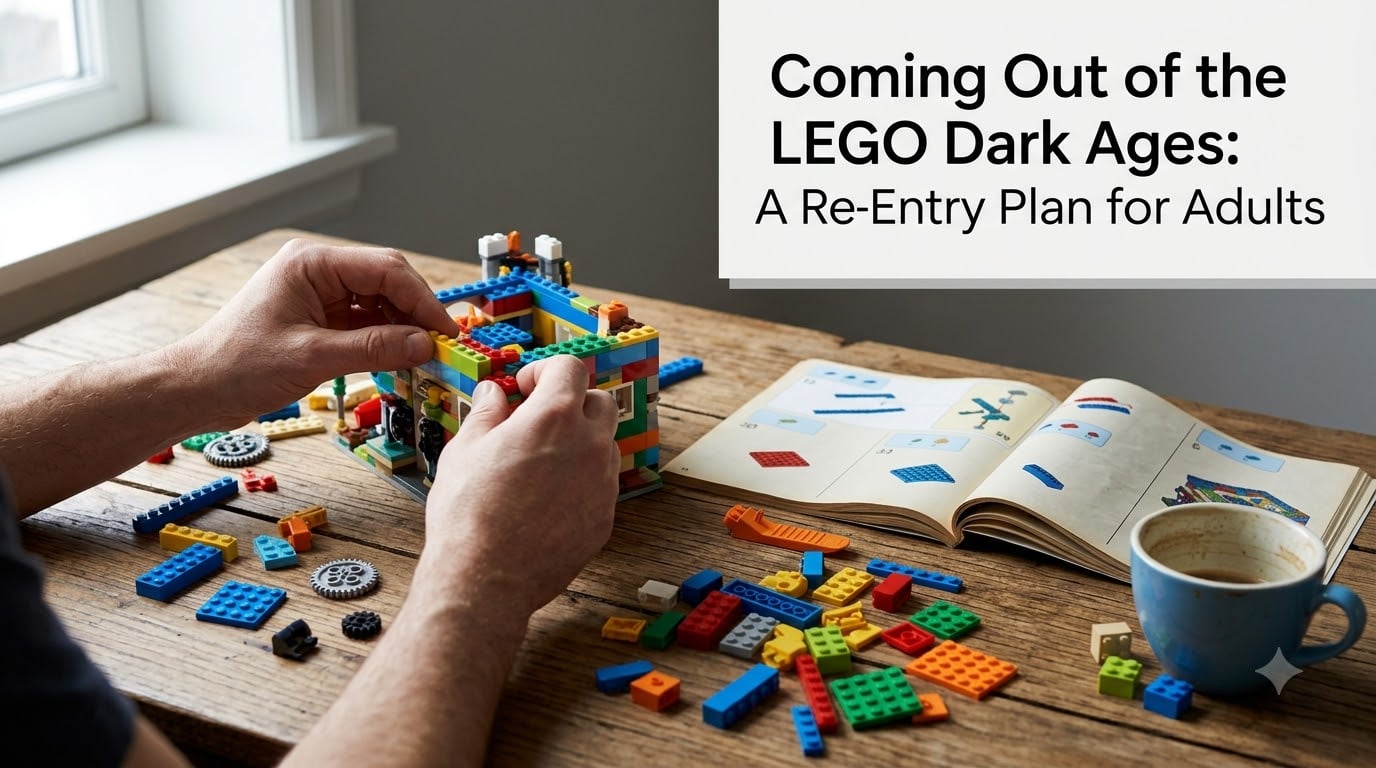
You built towers, planes, and probably a few wildly inaccurate pirate ships as a kid. Then somewhere between algebra class and your first apartment, LEGO stopped being part of your life. Your old bricks are in a shoebox somewhere, or maybe in your parents’ attic. That gap has a name in the LEGO community: the Dark Ages.
Coming out of your LEGO Dark Ages as an adult is not only normal, it’s almost a rite of passage. Tens of thousands of AFOLs (Adult Fans of LEGO) rejoin the hobby every year. The hobby is bigger, more welcoming, and more beautifully designed than when you left. This guide is your re-entry plan: what changed, the new vocabulary, where to spend your money, and how to find your people.
Table of Contents
What Are the LEGO Dark Ages, Really?
The LEGO Dark Ages is the stretch of time, usually starting in the mid-teens and lasting into the 20s, 30s, or beyond, when a builder stops actively engaging with LEGO. The term was coined by adult fans in the early 2000s and quickly stuck because it perfectly describes the silence between childhood obsession and adult reawakening.
For most builders, the Dark Ages happens because LEGO competes with cars, college, dating, careers, and the general gravitational pull of adult responsibilities. Surveys on r/AFOL and Eurobricks show the average Dark Ages lasts between 8 and 15 years. The good news: the Dark Ages always end. The trigger is usually a single moment, a video, a set, a kid, a LEGO Store visit, that flips the switch back on.
5 Signs You’re Ready to Come Back to LEGO
I talk to returning builders every week, and the same five signs keep showing up. If any of these sound familiar, your Dark Ages are ending.
- Nostalgia ambushes you in public. You see a Stranger Things LEGO set at Target and your hands start reaching for the box before your brain catches up.
- YouTube’s algorithm has noticed. Your recommended tab is full of Brick Vault, JANGBRiCKS, and Beyond the Brick videos.
- You have wall space. You finally own a place where you can display something larger than a key tray.
- Stress has you looking for a screen-free hobby. Your hands need something to do that isn’t a phone or a controller.
- Disposable income has arrived. For the first time in your life, you can buy LEGO without a bake sale.
What Changed: The Modern LEGO Landscape
If you left LEGO in 2003, you would barely recognize the brand today. The product portfolio has expanded in ways that would feel like science fiction to your 12-year-old self. Three adult-focused themes now drive most of the excitement.
LEGO Icons (formerly Creator Expert) is the flagship adult line, with detailed cars, modular buildings, castles, and pop-culture nods like the typewriter and the home alone house. LEGO Ideas takes fan-submitted designs and turns them into real sets, including hits like the Seinfeld apartment, the Titanic, and several Botanicals sets.
LEGO Botanicals is the quiet revolution. Succulents, bouquets, and miniature wildflower arrangements have brought thousands of adult builders, especially those who don’t want to display a spaceship, into the hobby. Piece counts keep climbing. Sets that took 4 hours to build a decade ago now take 15 to 40.
Licensed collaborations have multiplied too. Star Wars, Harry Potter, Marvel, Lord of the Rings, and Disney remain. Newcomers include Dungeons and Dragons, Wicked, Wednesday, and Fortnite. There is more LEGO than there has ever been, which is both the joy and the danger.
The Vocabulary You Need: AFOL Glossary
Walking back into LEGO as an adult feels like returning to a town that built a whole new language while you were away. These are the terms you’ll hear in the first week. Memorize them and you’ll save yourself a lot of confused Googling.
- AFOL: Adult Fan of LEGO. That’s you now. Welcome.
- MOC: My Own Creation. A custom build not based on a set.
- SNOT: Studs Not On Top. A technique where bricks are rotated sideways or upside down for smoother surfaces.
- UCS: Ultimate Collector Series. The big, expensive Star Wars sets.
- CMF: Collectible Minifigures. The blind-bag series.
- Pick-a-Brick (PAB): LEGO Store wall where you fill a cup with individual elements.
- LEGO Ideas: Platform where fans submit designs that can become real sets.
- Gateway set: The first set that pulls a returning adult back into the hobby.
- AFOL community: The welcoming, slightly obsessive network of adult builders worldwide.
You’ll also see “LEGO.com VIP,” “BrickLink,” and “Bricks & Minifigs” within your first 24 hours back. Don’t worry. They are friendlier than they sound.
The 5/2 Rule: A Lifesaver for Set Budgets
The 5/2 rule is one of those pieces of community wisdom that circulates in AFOL forums without ever appearing in an official LEGO brochure. The idea is simple: in any given month, you should aim to spend no more than 5 days actively browsing LEGO listings, and limit purchasing to 2 days per month.
Why does it matter? Because the modern LEGO marketplace is engineered to pull your wallet open. Retire alerts, double VIP points weekends, and endless browsing on BrickLink make impulse buys almost inevitable. The 5/2 rule keeps the hobby fun instead of stressful. Browse five days a week for joy and inspiration. Actually buy on two designated days, ideally with a pre-written list. I’ve watched this framework save collectors hundreds of dollars a year, and it has saved me too.
Budget Planning: Building a Reasonable LEGO Fund
No competitor guide covers this in any depth, and it is one of the first things returning builders ask about. Adult LEGO is not cheap. A single Icons set can run from $80 to $600. UCS Star Wars sets clear $1,000. Without a plan, the hobby turns into a credit-card spiral.
Here is the framework I share with every returning adult. First, set a monthly LEGO cap. For most people, this lands between $75 and $200. Treat it like a gym membership: a fixed budget you don’t exceed. Second, prioritize gateway sets before impulse buys. Third, learn to track retiring sets on sites like Brick Economy and Brickset. Retiring sets often double or triple in secondary-market value within six months, which makes early purchase a quiet form of saving. Finally, remember the secondary market exists. BrickLink, eBay, and Bricks & Minifigs stores carry retired sets at fair prices if you missed them the first time.
Where to Buy: The Modern LEGO Marketplace
The good news is that buying LEGO is easier now than at any point in history. The trick is knowing which channel to use for what.
LEGO.com is the home base for new releases, double VIP points events, and exclusive sets you cannot buy anywhere else. LEGO Brand Stores still offer the Pick-a-Brick wall, which is worth the trip alone. Amazon is great for convenience but watch for third-party sellers inflating prices on hot sets. BrickLink is the secondary-market powerhouse, with used sets, retired sets, and individual parts in essentially unlimited inventory. Target, Walmart, and Costco run excellent holiday sales if you can be patient.
For most returning builders, I’d recommend starting at LEGO.com for new releases, supplementing with BrickLink for parts you need, and only using Amazon for the occasional deal.
Finding Your Community: LUGs, Reddit, and Beyond
LEGO is, surprisingly, a deeply social hobby for adults. You will never be the only adult in the room. Three communities matter most.
LEGO User Groups (LUGs) are local clubs that meet monthly for builds, swaps, and show-and-tell. Most major cities have at least one. LUGs.org is the global directory. Showing up to your first meeting is nerve-wracking, but every LUG veteran remembers their first night and will hand you a coffee.
Reddit is where the global conversation happens. r/lego is for general builds, r/AFOL is for adult hobbyists specifically, and r/LegoMarketplace handles buying and selling. Search “just came out of my dark ages” and you’ll find hundreds of welcome-back posts with thousands of supportive replies.
YouTube is the third pillar. Channels like Brick Vault, JANGBRiCKS, and Beyond the Brick review every major set, interview designers, and document conventions. Subscribe before you buy any expensive set. You’ll save yourself from some real disappointments.
The Therapeutic Side: Why LEGO Helps Adults
This is the angle that gets talked about most in forums and least in buying guides. LEGO, as an adult hobby, is good for your brain. Building produces a flow state that quiets intrusive thought, which is why therapists have started recommending it for anxiety and burnout. The tactile, screen-free nature of the hobby gives overstimulated nervous systems a place to land.
For adults with ADHD, in particular, LEGO offers what psychologists call “interest-based nervous system regulation.” The visual progress of a build, the small rewards of finding the right piece, and the clear endpoint all work with an ADHD brain instead of against it. Several Reddit threads with thousands of upvotes are dedicated to “LEGO as ADHD management.” If that resonates with you, you are not alone.
Beyond clinical framing, there is something simpler. Adults who build LEGO report better sleep, less doom-scrolling, and a sense of accomplishment that doesn’t require a performance review. The hobby gives you back the version of yourself that built without an agenda.
Your First Gateway Set: Where to Start
A gateway set is the first adult-oriented set that pulls you back in. It should be something you actually want to look at when it’s done, in a price range you won’t regret, and challenging enough to feel like an event.
Three sets that work beautifully as gateways: the LEGO Icons Wildflower Bouquet (around $60, low commitment, gorgeous on a shelf), the LEGO Icons Tudor Corner modular building (around $200, deep mid-range commitment, hours of build time), and the LEGO Ideas Seinfeld Apartment (around $200, licensed theme that resonates with most adults).
How do you choose? If you want art on your shelf, pick Botanicals. If you want a tiny neighborhood you can add to over years, pick Modular. If you want pop culture, pick Ideas. Whichever you choose, you are starting a tradition. Gateway sets lead to second sets. Second sets lead to a hobby.
Frequently Asked Questions
What is the LEGO Dark Ages?
The LEGO Dark Ages is the period between childhood and adulthood when a builder stops engaging with LEGO, typically lasting from the mid-teens into the 20s, 30s, or beyond. It ends when an adult rediscovers the hobby and rejoins the community as an AFOL.
What is the 5/2 rule in LEGO?
The 5/2 rule is a community budget guideline: browse LEGO listings up to 5 days per month for inspiration, but only make purchases on 2 designated days each month. It keeps the hobby fun, prevents impulse buys, and protects your wallet during retire alerts and VIP events.
Is it normal for an adult to play with LEGO?
Yes. LEGO is a global adult hobby with millions of AFOLs (Adult Fans of LEGO). LEGO now designs entire product lines, like Icons and Botanicals, specifically for adult builders, and conventions regularly draw thousands of adult attendees.
What does AFOL mean?
AFOL stands for Adult Fan of LEGO. It is the community term for any adult who actively builds, collects, or displays LEGO. There is no minimum age or skill requirement; if you enjoy LEGO as a grown-up, you are an AFOL.
Where should I buy LEGO as a returning adult?
Start at LEGO.com for new releases and exclusive sets. Use BrickLink for retired sets, used sets, and individual parts. Use Amazon for convenience but watch third-party prices. For first-time gateway sets, LEGO.com or your local LEGO Brand Store are the best starting points.
Is LEGO good for mental health?
LEGO is widely reported to help with stress, anxiety, and focus. Building produces a flow state that calms overstimulated nervous systems, and many adults with ADHD describe it as effective nervous system regulation. It is a tactile, screen-free hobby that offers small, frequent rewards as a build progresses.
Welcome Back to the Brick
Your LEGO Dark Ages are over, and you picked the right year to come back. The hobby is bigger, the community is more welcoming, and the sets are more thoughtfully designed than ever before. Take the first step: pick a gateway set, set a monthly budget, join r/AFOL, and find your nearest LUG. The kid who used to build wildly inaccurate pirate ships is still in there. Welcome home.