
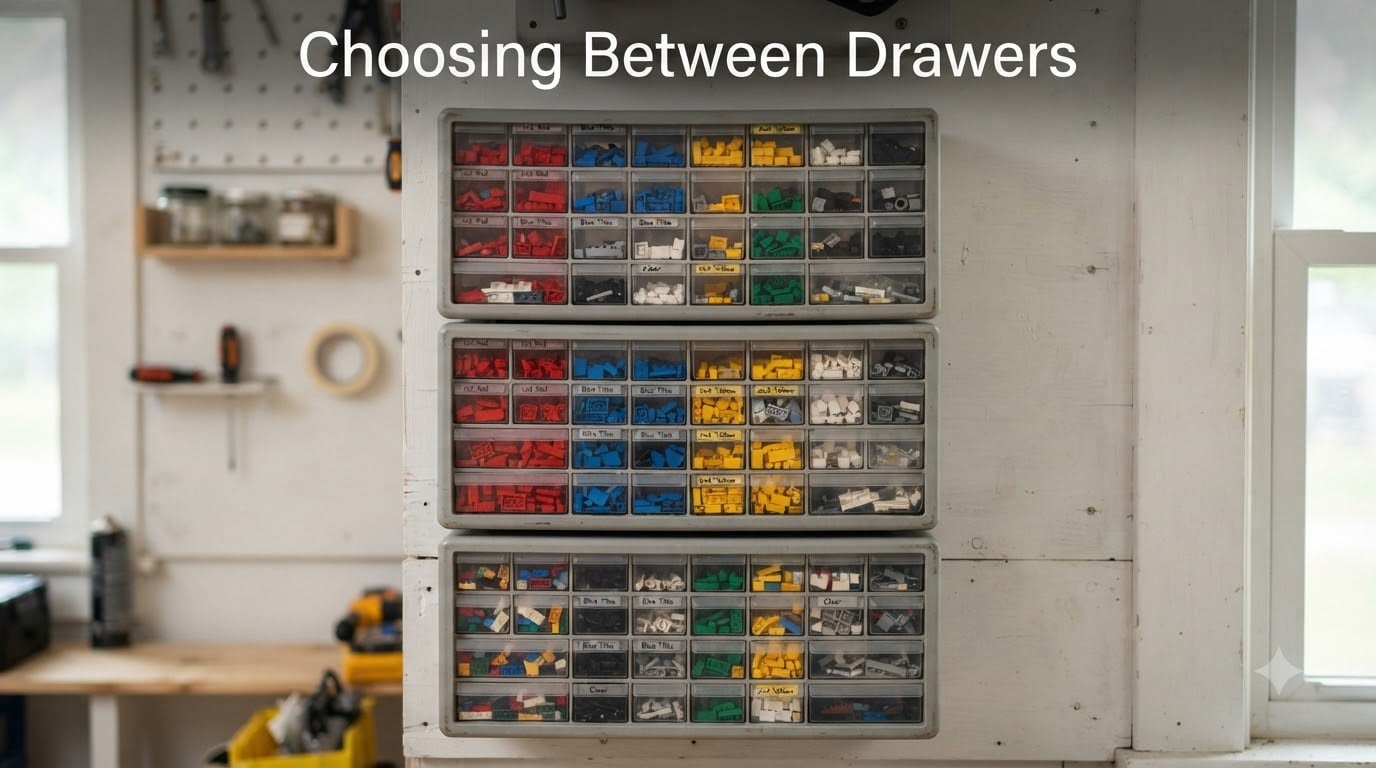
Walk into any AFOL’s build room and you will see the same dilemma playing out: hundreds of thousands of plastic bricks and not enough clarity on how to store them. Choosing between drawers for LEGO storage organization is a decision that shapes how fast you build, how easily you find that one specific bracket piece, and how much wall space your collection ultimately eats.
I have spent years testing different drawer configurations, from cheap Sterilite units bolted to garage walls to wall-spanning Akro-Mils cabinets that hold everything by part family. What I learned is that there is no single right answer, but there is a right answer for your collection size, your sorting style, and your budget.
This guide breaks down every factor you need to consider when picking LEGO storage drawers. We will cover the three tiers of drawer storage, compare the big three brands (IRIS, Akro-Mils, and Sterilite), explain the LEGO 5-2 rule that no other guide covers, and help you decide between sorting by color, shape, or part type.
Whether you are staring down a 2,000-piece starter collection or trying to wrangle a 200,000-piece mountain accumulated over decades, the right drawer system transforms your build experience. Let’s get into it.
Table of Contents
Understanding Drawer Types for LEGO Storage
Not all drawers serve the same purpose. LEGO builders typically organize their storage into three tiers, each handling a different scale of sorting. Understanding these tiers is the foundation of choosing between drawers for LEGO storage organization.
Primary Storage: Large Drawers for Bulk Categories
Primary drawers are your biggest, deepest units meant for broad categories. Think a single drawer stuffed with all your gray plates, another with all your wheels and tires, and another holding every minifigure you own. These drawers handle high volume and reduce the number of containers you need overall.
Large drawers shine when you are still sorting loosely. They work well for colors, for common element types, or for unsorted overflow while you work your way through a new bulk purchase. Most builders use primary drawers sized at least 10 inches wide and 15 inches deep.
Secondary Storage: Medium Drawers for Part Families
Once your collection grows, primary drawers start overflowing and blending categories. That is when medium drawers step in. These split broad categories into specific part families: one drawer for 1x bricks, another for tiles, another for modified plates.
Secondary drawers are where the magic happens for builders who sort by part type. Medium-sized drawer cabinets with 20 to 40 compartments per unit let you visually scan dozens of part categories at a glance without opening anything.
Tertiary Storage: Mini Drawers for Specialized Small Parts
Mini drawers handle the tiny, frequently-needed pieces that get lost in larger compartments. Think Technic pins, 1×1 studs, hinges, clips, and small accessories. These drawers are shallow, often transparent, and sometimes subdivided further with removable dividers.
The biggest advantage of mini drawers is speed. When every small bracket has its own labeled slot, you stop wasting build time digging through a mixed pile. Forum users on r/LegoStorage consistently cite mini drawers as the single biggest time-saver in their setups.
Storage Density: Why It Matters
Storage density is how much usable brick storage you get per square foot of wall or floor space. High-density drawer systems pack more pieces into less room, which matters enormously when your collection outgrows your available space.
Drawer cabinets mounted on walls achieve the highest density because they stack vertically without wasting the space between units. Open bins and shoeboxes, by contrast, leave gaps that add up fast across a large collection.
Choosing Between Drawers for LEGO Storage Organization: Key Factors
Six factors should drive your drawer decision. Skipping any of these leads to a system that breaks down within a year of purchase.
Collection Size Drives Everything
Your total piece count determines your storage tier. Under 5,000 pieces, you can get away with a single medium drawer cabinet. Over 100,000 pieces, you need a combination of primary, secondary, and tertiary storage spanning an entire wall.
Be honest about where your collection is heading, not just where it is today. Most builders underestimate their growth rate. If you actively buy sets or bulk lots, plan for double your current size.
Drawer Dimensions and Compartment Volume
Measure before you buy. Interior dimensions matter more than exterior because tapered drawer walls reduce usable space significantly. A drawer advertised as 12 inches wide may only hold 10 inches of actual bricks at the bottom.
For primary storage, target drawers with at least 400 cubic inches of interior volume. For secondary storage, 150 to 300 cubic inches per compartment works well. Mini drawers need 20 to 80 cubic inches for effective small-part sorting.
Material Durability
Plastic thickness varies wildly between brands. Thin-walled drawers flex under weight, causing drawers to jam or fall off their tracks when fully loaded with dense elements like 2×4 bricks. Look for drawers rated for at least 5 pounds per compartment.
Reddit users frequently report that budget drawers crack within two years of heavy use, while name-brand units last a decade or more. The cost difference per drawer is often less than a dollar, making durability a clear win.
Transparency and Visibility
Clear or translucent drawers let you see contents without opening them, which saves enormous time during builds. IRIS drawers are community favorites specifically because of their clarity. Opaque drawers force you to label everything, and labels peel, fade, or fall off.
Semi-transparent drawers offer a middle ground. They show silhouette and color without full transparency, which is enough for many builders to identify contents at a glance.
Stackability and Modularity
Your drawer system should grow with your collection. Stackable, modular units let you add capacity without replacing existing storage. Wall-mounted cabinet styles are the most modular because you can fill a wall progressively over months or years.
Look for systems with compatible accessory lines: extra drawers, divider inserts, and mounting brackets. Buying into a modular ecosystem prevents the frustration of mismatched storage down the road.
Drawer Slide Quality
A common complaint from LEGO builders is pieces tumbling out when a drawer jerks open. Smooth-sliding drawers with gentle stops prevent this. Test the slide action in person if possible, or check community reviews for jerk complaints before ordering online.
Some builders add small felt pads or rubber bumpers to drawer stops to soften the closing motion. This five-minute fix saves hours of re-sorting pieces that would otherwise scatter.
IRIS vs Akro-Mils vs Sterilite: Brand Comparison
Three brands dominate LEGO storage: IRIS, Akro-Mils, and Sterilite. Each has distinct strengths that make it better for different collection profiles. Here is how they stack up based on community feedback and long-term use.
IRIS: The Community Favorite
IRIS medium and large drawer cabinets are the most recommended option across LEGO forums and Reddit communities. Their drawers slide smoothly, the plastic is thick enough for daily use, and the transparency is genuinely clear rather than cloudy.
The IRIS 44-drawer cabinet is a specific favorite for tertiary storage. Each compartment is the right size for sorting small parts by type, and the clear front lets you spot exactly what you need. Multiple r/LegoStorage users report their IRIS units lasting 5-plus years with no issues.
The main drawback is cost. IRIS sits in the mid-to-upper price range, though the per-drawer cost is competitive when you factor in longevity.
Akro-Mils: The Industrial Workhorse
Akro-Mils drawers are built for garages, workshops, and industrial settings. They are heavier-duty than IRIS or Sterilite, with thicker plastic and reinforced drawer fronts. The divider system is excellent, letting you customize compartment sizes within each drawer.
For LEGO builders, Akro-Mils shines in primary and secondary storage. Their large drawer cabinets handle heavy brick loads without sagging, and the dividers let you split a single drawer into multiple part categories as your sorting evolves.
The tradeoff is transparency. Akro-Mils drawers are more translucent than transparent, which makes spotting small parts harder. Many builders pair Akro-Mils for bulk storage with IRIS for small-part sorting to get the best of both.
Sterilite: The Budget Option
Sterilite drawer units are everywhere, cheap, and adequate for starting out. They work well for primary bulk storage where you do not need fine sorting or visibility. Their wide, shallow drawers are decent for color-based sorting.
The downside is build quality. Sterilite drawers flex under load, tracks can warp over time, and the plastic is thinner than IRIS or Akro-Mils. For builders on a tight budget starting their first real storage system, Sterilite gets the job done until you can upgrade.
Cost-Per-Drawer Analysis
When comparing brands, calculate cost per usable drawer, not cost per unit. A 40-drawer Akro-Mils cabinet at a higher price point often beats four 10-drawer Sterilite units on cost-per-drawer, especially when you factor in wall space efficiency.
From my experience and forum pricing data, here is the rough breakdown. IRIS averages around $1.50 to $2.00 per drawer compartment. Akro-Mils runs $2.00 to $3.00 per compartment but lasts longer. Sterilite comes in under $1.00 per drawer, making it the cheapest entry point.
Remember that the cheapest option per drawer is not always the cheapest overall. If you replace Sterilite twice in the time an Akro-Mils unit lasts, the Akro-Mils wins on total cost of ownership.
The LEGO 5-2 Rule Explained
The LEGO 5-2 rule is a sorting principle that no competing storage guide covers, yet it is one of the most practical frameworks for deciding drawer organization. The rule is simple: allocate your five most-used element categories to your two most accessible storage locations.
For most builders, the five most-used categories are standard bricks (1x and 2x), plates, tiles, Technic connectors, and minifigure accessories. These five categories account for roughly 70% of daily building activity. The two most accessible locations are whatever is at eye level and arm’s reach from your build surface.
Applying the 5-2 rule means these high-traffic categories get the prime real estate in your drawer system. Less-used categories like rare colors, specialized minifigure parts, or seasonal elements move to higher shelves or less convenient drawers.
This rule directly influences drawer choice. If your most-used categories live at arm’s reach, those drawers need smooth slides, clear visibility, and enough volume for frequent access. Reserve your deepest, most rugged drawers for bulk storage of rarely used parts.
Sorting Strategy: Color vs Shape vs Part Type
How you sort determines what drawers you need. Three main strategies exist, each with distinct storage implications.
Sorting by Color
Color sorting is the default approach for most beginners and works well for collections under 25,000 pieces. Each drawer holds one color, mixed across part types. You grab a handful of gray when building and pick out the specific piece you need.
The advantage is simplicity. You need relatively few drawers: one per color in your collection. The disadvantage is that finding a specific part within a color still requires digging, and drawers fill up unevenly because some colors are far more common than others.
Color sorting pairs well with large primary drawers. You do not need fine compartmentalization because each drawer serves as a mixed-parts bin.
Sorting by Shape or Part Type
Part-type sorting is the gold standard for serious builders and AFOLs with large collections. Each drawer or compartment holds a specific element type: all 1×2 bricks in one, all 2×4 plates in another, all jumper plates in a third.
This method dramatically speeds up building because you always know exactly where every part lives. The tradeoff is that you need far more compartments, which means more drawers, more labeling, and more upfront sorting effort.
Part-type sorting demands secondary and tertiary drawer systems. Medium drawer cabinets with dividers handle the bulk of part categories, while mini drawers cover the dozens of specialized small elements.
The Hybrid Approach
Many experienced builders use a hybrid system. They sort high-volume categories by part type and low-volume categories by color. For example, all 1×1 round plates might share a single drawer regardless of color, while rare colors like dark orange get their own combined drawer.
This hybrid approach optimizes drawer usage. You avoid dedicating an entire drawer to a color you rarely use, while still getting the speed benefits of part-type sorting for pieces you grab constantly.
Drawer Size Recommendations by Collection Size
Your collection size is the single biggest factor in choosing drawer dimensions. Here is a practical guide based on real-world setups from the LEGO community.
Under 5,000 Pieces
Small collections need simplicity. A single 20-drawer cabinet handles the entire collection with room to grow. Sort by color for now and resist the urge to over-organize. One medium IRIS or Akro-Mils cabinet mounted on a wall or set on a desk covers everything.
Total cost should stay under $50. Save your budget for when the collection grows.
5,000 to 25,000 Pieces
This is where most builders start feeling storage pressure. You need a combination of one large primary drawer unit for bulk storage and one medium cabinet for finer sorting. Consider transitioning from color sorting to part-type sorting for your most-used categories.
Budget $100 to $200 for this tier. Focus on stackable or wall-mountable units so you can add more later.
25,000 to 100,000 Pieces
Mid-size collections require a full three-tier system. You need primary drawers for bulk colors or categories, secondary cabinets for part families, and mini drawers for small specialized elements. Most builders at this level dedicate an entire wall to drawer storage.
This is also where brand quality starts mattering. Flimsy drawers that survived at 10,000 pieces start failing under the weight of 50,000. IRIS and Akro-Mils are the go-to choices at this scale.
Over 100,000 Pieces
Large collections need professional-grade systems. Multiple Akro-Mils cabinet walls, supplemented by IRIS mini drawers for fine sorting, are standard. Many builders at this scale also add secondary overflow storage like bins or boxes for less-used elements.
Costs at this level run from $500 to $2,000-plus depending on how thoroughly you sort. The investment pays off because a well-organized large collection lets you build complex MOCs without spending hours hunting for parts.
Mini Drawers vs Large Drawers: Making the Tradeoff
One of the hardest decisions in choosing between drawers for LEGO storage organization is balancing mini drawers against large drawers. Each has clear advantages.
When Mini Drawers Win
Mini drawers win when you sort by part type and need rapid access to specific small elements. They also win in small spaces where you need maximum category density per square foot. A 44-drawer mini cabinet holds 44 distinct part categories in the same wall space as a 6-drawer large unit.
If you build Technic, mini drawers are almost mandatory. The sheer variety of pins, axles, connectors, and bushes demands fine-grained sorting that large drawers cannot provide efficiently.
When Large Drawers Win
Large drawers win when you sort by color or handle high-volume bulk storage. They also win for builders who prefer a simpler, less granular system. Fewer drawers means less labeling, less maintenance, and lower cost per unit.
Large drawers are also better for set preservation. If you keep sets together rather than sorting by part, large drawers accommodate complete or partially complete sets without disassembly.
Transitioning Between Systems
Most builders start with large drawers and add mini drawers as their collection and sorting ambition grow. Plan for this transition by choosing modular systems from the start. If your large drawer cabinet cannot accommodate add-on mini units, you end up with mismatched storage.
A practical approach: start with one large and one mini cabinet. Use the mini cabinet for your ten most-used small part categories and the large cabinet for color-based bulk storage. As your collection grows, add more of whichever type fills up first.
How to Choose the Right LEGO Storage Drawers
Here is a step-by-step process to narrow your options and make a confident drawer decision.
Step 1: Measure Your Available Space
Before browsing any products, measure your wall or floor space. Note width, height, and depth available. Factor in clearance for drawers to open fully. A cabinet that fits the wall but blocks a door when open is useless.
Wall-mounted storage saves floor space but requires stud finding and proper anchoring. Floor-standing units are easier to set up but eat more room.
Step 2: Count Your Pieces and Categories
Estimate your total piece count and decide how many sorting categories you want. If you sort by color, count your active colors. If you sort by part type, estimate 50 to 100 categories for a mid-size collection. Your category count directly determines how many drawers or compartments you need.
Step 3: Choose Your Sorting Strategy First
Pick your sorting method before choosing drawers. Color sorting demands fewer, larger drawers. Part-type sorting demands more, smaller drawers. Trying to buy drawers before deciding how to sort leads to mismatched storage that does not fit your workflow.
Step 4: Calculate Cost Per Drawer
Divide the unit price by the number of usable drawers. Compare across brands. Factor in expected lifespan: a unit lasting 10 years at double the cost of a 3-year unit is cheaper per year.
Step 5: Plan for Expansion
Buy into a modular system. Check whether the brand offers add-on units, extra drawers, and compatible accessories. The best storage systems grow incrementally so you never have to start over.
Labeling Tips for LEGO Drawers
Even with transparent drawers, labels help. Use label holders that slide into drawer fronts rather than stick-on labels, which peel and leave residue. Print labels with both text and a small image of the part for instant visual recognition.
For opaque drawers, labels are mandatory. Color-code labels by category type (bricks, plates, Technic, minifigures) so you can spot the right drawer zone at a glance.
Kid-Friendly Drawer Modifications
If children use the storage, choose drawers with secure stops that prevent full removal. Add non-slip pads under floor units to prevent tipping. Lower the most-used drawers to child height so kids can reach common pieces without climbing.
Consider deeper drawers for kid-friendly setups. Shallow drawers dump contents more easily when yanked open, which is the number one mess complaint from parents.
Dust Management
Dust accumulation is a major pain point from forum discussions. Drawers with tight-fitting fronts keep dust out far better than open bins or loose-lidded containers. If dust is a serious concern in your build space, prioritize drawer brands with sealed fronts over those with gaps.
Some builders add weather stripping or foam tape to drawer gaps for a tighter seal. This is especially useful in garages or basements where dust levels are higher.
Common Mistakes When Choosing LEGO Storage Drawers
Avoiding these frequent mistakes saves money and frustration.
The biggest mistake is over-sorting too early. Builders with 3,000 pieces try to maintain 60 separate categories and end up with drawers holding five pieces each. Start broad and refine as your collection grows.
Another common error is ignoring drawer depth. Shallow drawers limit what you can store. Deep drawers hold more but become bottomless pits if not subdivided. Match drawer depth to your sorting granularity.
Finally, do not underestimate the value of uniform drawer sizes. Mixed drawer systems from different brands look messy, waste wall space, and make expansion harder. Standardizing on one brand and size simplifies everything.
Frequently Asked Questions
What is the LEGO 5-2 rule?
The LEGO 5-2 rule means assigning your five most-used element categories to your two most accessible storage locations. Standard bricks, plates, tiles, Technic connectors, and minifigure accessories typically account for 70% of daily building. Keeping these at eye level and arm’s reach from your build surface maximizes efficiency.
What’s the best way to organize LEGO?
The best way depends on collection size and building style. For most builders, a tiered system works best: 1) sort by color in large drawers for collections under 25,000 pieces, 2) transition to part-type sorting in medium and mini drawers as the collection grows, 3) use a hybrid approach combining both methods for large collections over 50,000 pieces.
Is it better to organize LEGOs by shape or color?
Sorting by shape or part type is better for builders who create custom MOCs and need rapid access to specific pieces. Sorting by color is better for younger builders, casual collectors, and sets under 25,000 pieces. Many experienced builders use a hybrid approach: part-type sorting for frequently used categories and color sorting for rare or specialized elements.
What is the best container for organizing LEGOs?
The best containers for LEGO storage are clear plastic drawer cabinets from IRIS or Akro-Mils. IRIS drawers are preferred for their transparency and smooth sliding, while Akro-Mils offers superior durability and divider options. For budget storage, Sterilite drawer units work well for primary bulk sorting. The ideal system combines large drawers for bulk storage with mini drawers for small specialized parts.
Conclusion: Making Your Drawer Decision
Choosing between drawers for LEGO storage organization comes down to four decisions: your collection size, your sorting strategy, your available space, and your budget. Match your drawer system to those factors and you will build faster, find pieces easier, and actually enjoy your storage setup instead of fighting it.
Start simple, plan for growth, and prioritize modularity. A single well-chosen drawer cabinet today beats a dozen mismatched containers tomorrow. Pick a brand you trust, measure your space carefully, and apply the LEGO 5-2 rule to keep your most-used pieces within arm’s reach.
Your bricks deserve a system that works as hard as your imagination does. Now go build something great.