
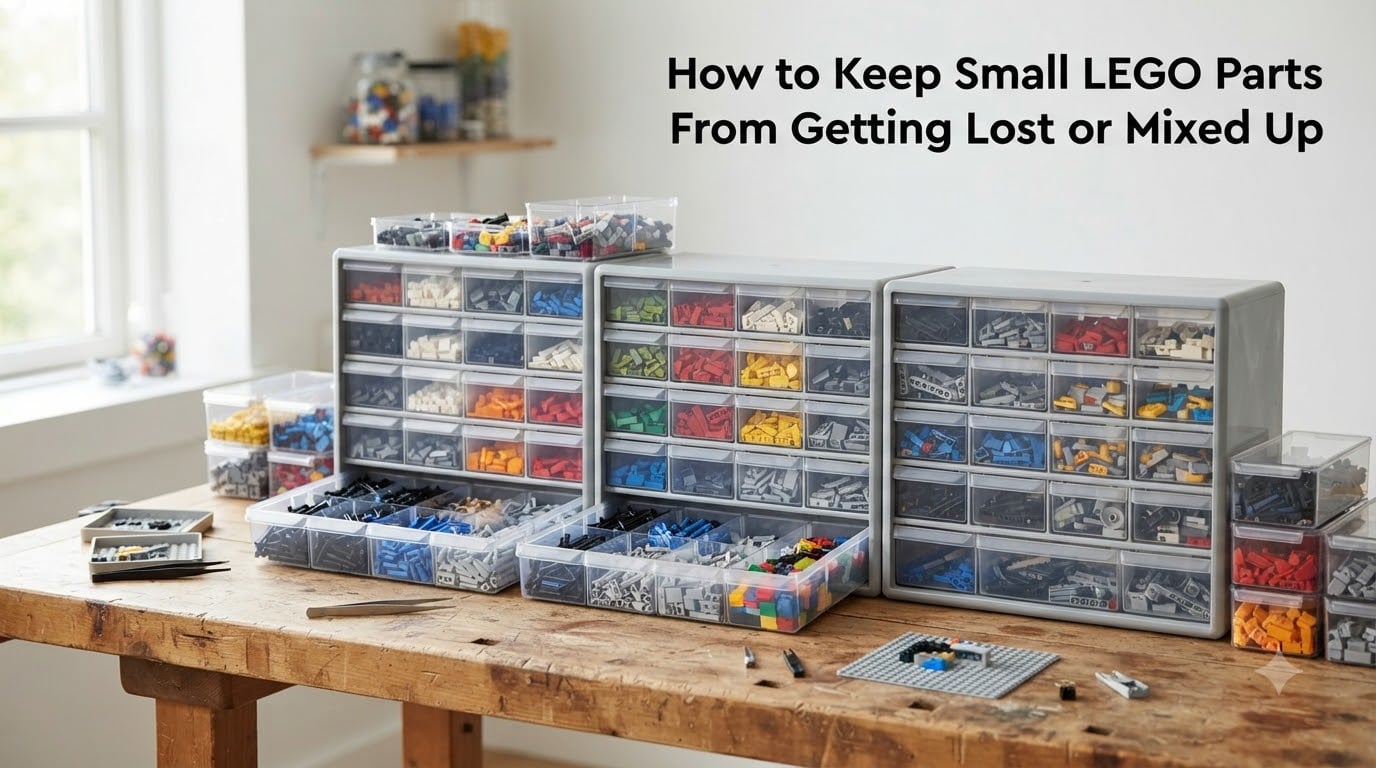
I have lost count of the Technic pins I have vacuumed up over the years. Tiny black pins vanish into carpet fibers like they were made for disappearing.
If you are reading this, you probably know that exact frustration. A $0.05 piece holds up a build, and somehow it is the only piece that goes missing every single time. I have spent hours hunting for one 1×1 round plate while my kids run through the room like tiny tornadoes.
After sorting through five large bins of mixed LEGO with my family last winter, I figured out what actually works to keep small LEGO parts from getting lost. This guide covers the methods we use daily, the containers that earn their space, and the mindset shift that keeps the hobby fun instead of overwhelming.
Table of Contents
Why Small LEGO Parts Disappear So Easily
Small pieces vanish for predictable reasons. Once you see the patterns, prevention becomes simple.
The dimensions work against tiny pieces. A 1×1 plate is roughly 8mm wide, which fits between carpet fibers, couch cushions, and floorboard gaps. Static electricity sends them airborne. Pets bat them under furniture. Smaller children pocket them without thinking.
Mixed collections make things worse. When pieces share a bin, a black 1×2 plate sits next to twenty other black plates. Your eyes skip over it during builds. Dedicated compartments solve this more than any sorting method.
Pro tip: the moment a piece hits the floor is when it disappears fastest. Prevention during active building matters as much as storage after the fact.
Quick Prevention Tips Before You Start a Build
These five habits stop more losses than any storage upgrade. I run through them every time I open a set.
- Clear the build area completely. Sweep first, then build. Pieces hide in dust bunnies you forgot existed.
- Set out a small bowl or tray for pieces-in-use. Mine is a wooden pasta bowl that holds 1×1 plates, minifig accessories, and Technic pins mid-build.
- Lay down a sheet or towel before sorting. A cotton sheet catches every bounce and rolling pin. Fold the corners inward when you finish.
- Empty your pockets before you start. Wallet change, coins, and tiny pieces all look the same on the floor.
- Set a 30-minute timer for piece counts. Stop, count visible pieces, and rescue anything off the build area.
These habits cost nothing. They prevent roughly 80% of the lost-piece problem in my house. Storage is what handles the remaining 20%.
Sorting Methods: Color vs Type Compared
The color-versus-type debate has fueled LEGO forums for over a decade. Both methods work. The right one depends on how you build.
I have tried both systems over thousands of hours of sorting. Here is the comparison that helped me decide.
Color sorting groups every red piece together, every blue piece together, regardless of shape. Display builders love this because finished builds pull from one color family at a time. The downside is finding a specific 1×4 plate among 400 other red pieces still takes time.
Type sorting groups every 1×4 plate together across colors, every 2×2 brick together, every Technic pin together. Active builders who follow instructions prefer this. The downside is that finding a specific color among 30 shades of gray requires more digging.
Hybrid sorting is what I landed on after three years of trial. Large bricks go by type because shape matters more than color. Small pieces go into dedicated drawer organizers because type sorting by hand takes forever for tiny elements.
None of these are wrong. Pick the system you will actually maintain. A perfectly color-sorted collection that falls apart in six months is worse than a roughly type-sorted one that you keep up for a decade.
Container Solutions for Small LEGO Pieces
The container you choose matters more than the sorting method. Wrong containers erase even perfect sorting because pieces settle into unreachable corners.
Here are the storage options I have tested with my family, ranked by how well they handle small parts.
IKEA Trofast Frame System
The Trofast is the most-mentioned LEGO storage solution on Reddit and Facebook groups for good reason. The plastic bins slide out, so kids can grab what they need and put it back. The frames stack, which saves floor space. Bins come in multiple sizes for different piece categories.
For tiny pieces, pair the Trofast frame with smaller inner containers. I use the Trofast for medium pieces and dedicate one Trofast bin to a stack of smaller organizers.
Akro-Mils Drawer Organizers
These heavy-duty plastic drawer units have small compartments built in. Each drawer is around 2 inches deep with dividers that create 6-24 separate cells depending on the model.
Akro-Mils is the gold standard for Technic pins, clips, and 1×1 plates. I keep one drawer unit on my workbench holding nothing smaller than a 1×2 plate. The pieces stay visible and sortable.
Mesh Zipper Pouches
Mesh pouches let you see contents without opening. The zipper keeps pieces from spilling during a sorting session. They come in multi-packs for cheap.
I use mesh pouches for in-progress builds. Each bag holds a step’s worth of pieces, labeled with the step number. When the build ends, I empty the bags back into storage.
Stackable Shoeboxes
Clear plastic shoeboxes stack vertically and hold set-specific storage. One box per set keeps instructions with pieces so rebuilding is easier.
The downside is finding one shoe-sized container among ten identical ones. I write the set name on painter’s tape on the front.
Fishing Tackle Boxes
Tackle boxes earn their place for Technic-heavy collections. The clear compartments come in tiny sizes perfect for pins. Many have adjustable dividers so you control compartment size.
A Plano-style tackle box holds more small pieces than a comparably-priced LEGO-specific organizer. The brand is irrelevant as long as the dividers do not shift.
The Unsorted Bin: The Secret to Sanity
Here is the mindset shift that changed everything for our family. Perfection is not the goal. Roughly 85% organization is the realistic target.
The unsorted bin is exactly what it sounds like. One open bin or large container holds every piece you do not feel like sorting right now. When you finish a build session, anything that does not belong elsewhere goes in this bin.
Why this matters: sorting fatigue is real. After an hour of separating 1×1 plates by shade, you stop caring. The unsorted bin catches the pieces you would otherwise leave in a pile on the floor. A messy bin is better than pieces sliding under furniture.
Place the unsorted bin at kid height if kids build with you. They will use it independently once they understand the rule: “If you do not know where it goes, it goes in the unsorted bin.”
I sort the unsorted bin roughly twice a year during big clean-up days. Some pieces get sorted to type, some stay in the bin. Both outcomes are fine.
Step-by-Step Sorting Process
When you face a tower of mixed LEGO bins, the work feels impossible. Here is the process I use to make it manageable.
Step 1: Stack the large pieces. Pull out everything larger than a 2×4 brick and stack it in piles by shape. Bricks in one pile, plates in another, slopes in another. Do not worry about color yet. This step removes 70% of the volume in the first hour.
Step 2: Pull tiny pieces into a tray. Anything 1×2 or smaller goes into a separate tray. Do not sort yet. Just isolate them so they stop hiding among the bigger pieces.
Step 3: Sort the tiny pieces by element type. Now sort the tray contents into small containers. Pins in one compartment, clips in another, 1×1 plates in another, hinges in another. Use your drawer organizers here.
Step 4: Sort the large pieces by your chosen method. Either color or type, depending on your system. Spend no more than 20 minutes per pile. Set a timer.
Step 5: Put away what you sorted. Move sorted pieces into your main storage. Anything left in piles goes into the unsorted bin.
Step 6: Stop when you are tired. Sorting is its own hobby. You will not finish in one session. Stop, close the bins, and come back next week. The LEGO will still be there.
Special Tips for Technic Pins, Clips, and Small Connectors
Technic pieces are the most-lost LEGO category by far. Pins weigh almost nothing. Clips bounce across rooms when dropped. Hinges hide in couch cushions for months.
Storage for these pieces needs three things: small compartments, soft-close drawers, and clear visibility. Open bins fail here because pins migrate to the bottom and get crushed.
I keep one drawer organizer dedicated to Technic parts with 24 compartments. Each compartment holds one part type: pins, half-pins, friction pins, clips, axle connectors, and so on. The pieces never leave this organizer except into a build.
For active builds, I use a small magnetic tray to hold pins mid-construction. The magnet catches dropped pins so they do not roll under the table. Only use magnetic trays if you do not mind rare metal pieces sticking together.
Pro tip: keep a roll of painter’s tape near your Technic builds. If you drop a pin you cannot find, press a strip of tape to the carpet. The adhesive picks up tiny pieces better than fingers.
Organization for Kids vs Adult Builders
Kids and adults sort LEGO differently. The systems that work for adult hobbyists usually fail for children.
Kids need simple systems. Three to five bins maximum, picture labels for non-readers, low-height bins they can reach without help. The unsorted bin is non-negotiable for kid spaces. Children lose interest in precise sorting fast, and forcing it kills the hobby.
Adult hobbyists can sustain more granular organization. Twelve-compartment drawer organizers, color-coded bins, and set-specific boxes all work. The risk is over-organizing to the point where finding pieces becomes its own chore.
Family setups need a hybrid system. I run a Trofast with seven large bins for general categories (bricks, plates, slopes, minifigs, wheels, Technic, baseplates) plus one Akro-Mils drawer unit for small parts. The kids use the Trofast. I use the drawer unit. Both systems share the same room.
Teach kids the unsorted bin first. Once they own that habit, introduce one new rule at a time. Adding rules faster than kids can absorb them creates resistance.
Buying Guide: Storage by Collection Size
Match your storage investment to your actual collection. Overspending on containers you will not fill wastes money. Underspending creates the chaos you are trying to escape.
Small collection (under 1,000 pieces): Four to six small shoebox-sized bins are enough. Sort into bricks, plates, specialty pieces, and minifigs. Label each bin with a marker on painter’s tape.
Medium collection (1,000 to 10,000 pieces): One IKEA Trofast frame plus one drawer organizer. The Trofast handles the bulk categories. The drawer organizer handles small parts. Total investment is reasonable and reversible.
Large collection (10,000 to 50,000 pieces): Two or three Trofast frames stacked, plus a dedicated drawer organizer wall. Add a small rolling cart if you build in multiple locations.
Massive collection (50,000+ pieces): Custom drawer walls, often called “LEGO walls,” become worth the build time. Plywood, drawer slides, and small plastic bins create wall-mounted storage that holds tens of thousands of pieces in plain sight.
Whatever size you choose, start small. Buy one organizer, try it for a month, then expand. Storage solutions that look great on YouTube sometimes fail at home. Real testing beats review-reading.
Frequently Asked Questions
How do I stop losing LEGO pieces during builds?
Use a small bowl or tray for pieces-in-use, lay a sheet or towel on the build surface, empty your pockets before starting, and set a 30-minute reminder to do a quick piece count. Most losses happen during active builds, not storage, so prevention during the build matters more than organization afterward.
What is the LEGO 5 2 rule?
The LEGO 5-2 rule is a community shorthand suggesting that sorting five common piece categories while leaving two categories for an unsorted bin keeps the hobby sustainable. The exact categories vary by builder, but the principle is the same: prioritize sorting where it saves you time, and accept imperfection elsewhere.
How should I store small LEGO pieces like Technic pins?
Use a drawer organizer with small compartments, such as Akro-Mils, or a fishing tackle box with adjustable dividers. Each compartment should hold one part type. Avoid open bins because pins migrate to the bottom and get crushed or lost. Soft-close drawers also prevent bounce-outs during active building.
Should I sort LEGO by color or by type?
Color sorting works best for display builders who pull from one color family at a time. Type sorting works best for active builders who follow instructions and need specific shapes quickly. Many builders use a hybrid approach: large pieces by type and small pieces by subcategory. Pick whichever system you will actually maintain long-term.
How do I prevent small LEGO pieces from getting lost on the floor?
Build on a sheet or towel that catches dropped pieces, work in a cleared area without carpet if possible, and use painter’s tape to lift tiny pieces from carpet fibers when you cannot see them. Keep a small handheld vacuum with a narrow nozzle nearby for fast recovery of pins and 1×1 plates.
Start Small, Stay Consistent
Keeping small LEGO parts from getting lost comes down to three habits. Prevent losses during builds. Sort with a system you will maintain. Accept the unsorted bin as your friend.
Do not try to organize your whole collection in one weekend. Buy one container, set up one zone, and live with it for a month. Adjust based on what frustrates you. Storage is a tool, not a personality test.
Methods evolve as your collection grows. What worked when we had one bin fails now that we have four. Revisit your setup every six months. Pieces still vanish sometimes, but the time spent hunting has dropped by hours each month, and the hobby feels more fun as a result. Updated for 2026, this guide reflects what works in our home right now.