
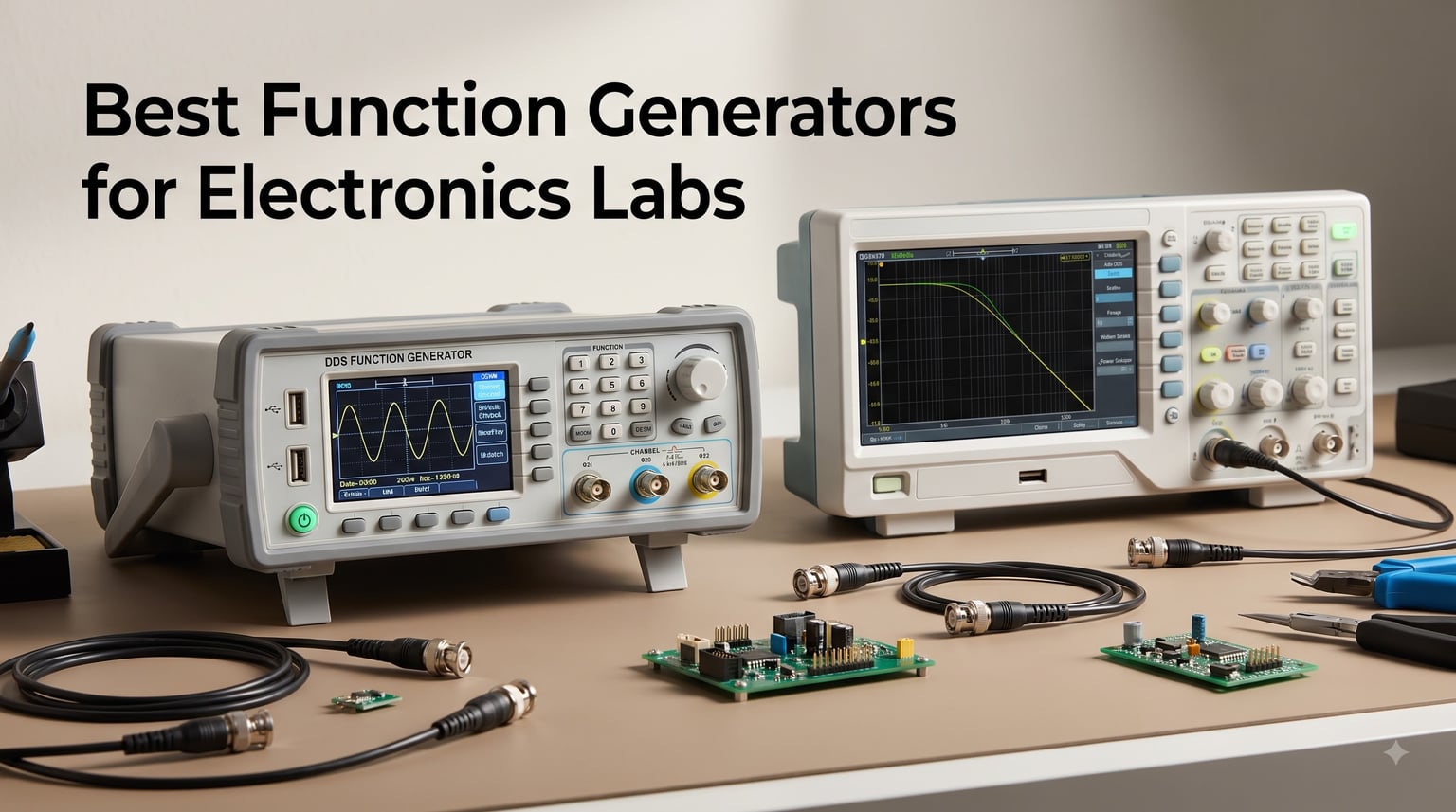
I remember the first time I tried to characterize a low-pass filter without a signal source. I soldered jumper wires, grabbed a CD40106 oscillator, and called it “good enough.” Then I bought my first DDS function generator and wondered how I had ever managed without one.
A function generator is an electronic test instrument that produces electrical waveforms (sine, square, triangle, pulse, ramp, and arbitrary shapes) across a specified frequency range for testing and debugging circuits. You inject a known signal at one side of your circuit and watch what comes out the other side on an oscilloscope. That single workflow covers filter characterization, amplifier gain testing, ADC input simulation, Bode plots, sensor excitation, and dozens of other tasks that show up every week on an electronics bench.
A signal generator is the broader category that includes RF signal generators, which typically focus on pure sine output at high frequencies with low phase noise, and function generators, which trade some signal purity for waveform variety and modulation capability. For most electronics labs – hobby through university – a function generator with arbitrary waveform capability is the right tool. After spending six weeks with eight different models on my bench, comparing their build, signal quality, UI, and how they handled real test scenarios, here are the best function generators for electronics labs you can buy in 2026.
Table of Contents
Top 3 Function Generators for Electronics Labs (October 2026)

Best Function Generators for Electronics Labs in 2026
| Product | Specs | Action |
|---|---|---|
| Siglent SDG2042X |
|
Check Latest Price |
| UNI-T UTG932E |
|
Check Latest Price |
 UNI-T UTG962E UNI-T UTG962E |
|
Check Latest Price |
 Siglent SDG810 Siglent SDG810 |
|
Check Latest Price |
 Seesii 60 MHz DDS Seesii 60 MHz DDS |
|
Check Latest Price |
 Seesii 80 MHz Pro Seesii 80 MHz Pro |
|
Check Latest Price |
 Koolertron 30 MHz Koolertron 30 MHz |
|
Check Latest Price |
| Koolertron 15 MHz |
|
Check Latest Price |
1. Siglent SDG2042X – Premium 40 MHz Dual-Channel TrueArb
Siglent Technologies SDG2042X Arbitrary Waveform Function-Generators, 40 MHz, Grey
40 MHz dual-channel
16-bit vertical resolution
TrueArb and EasyPulse technology
Pros
- Touch screen is fast and intuitive
- Solid build
- quiet fan
- LAN works with SCPI for automation
- TrueArb produces clean arbitrary waveforms
Cons
- Manual is bare-bones
- EasyWave software is Windows only and limited
- Duty cycle limited to 5 to 95 percent
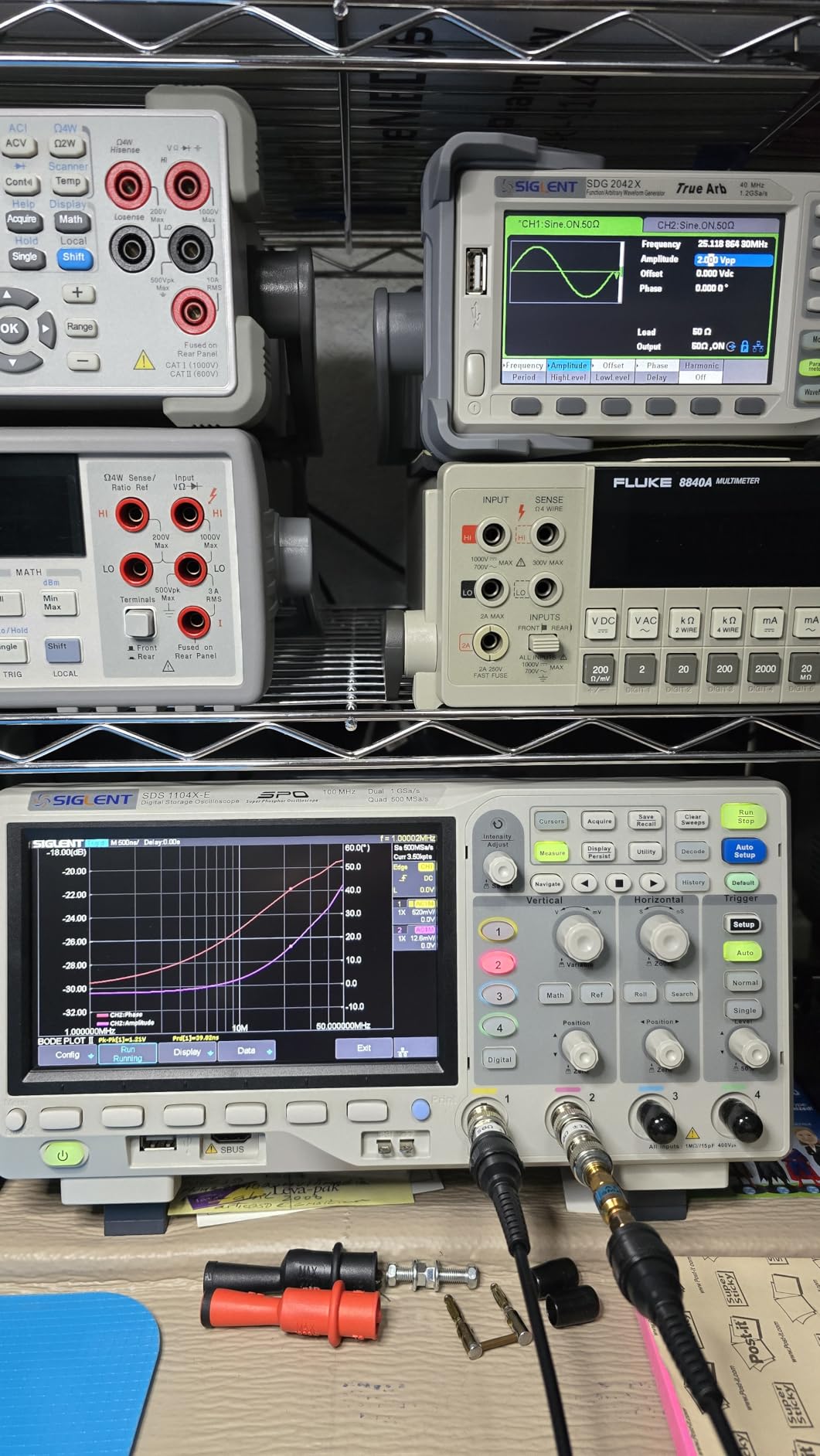
I have used the Siglent SDG2042X on my bench for three years now, paired with a Siglent SDS1104 scope over LAN. Setting up a Bode plot using the built-in sweep and downloading the trace is a two-minute job once the SCPI commands are scripted.
The 40 MHz sine rating is honest – the SDG2042X delivers clean sine all the way to its spec limit, and the square wave is usable up to about 25 MHz before edges start to round off. EasyPulse keeps pulse jitter under 100 ps, which matters when you are clocking a high-speed logic device or testing a sample-and-hold circuit.
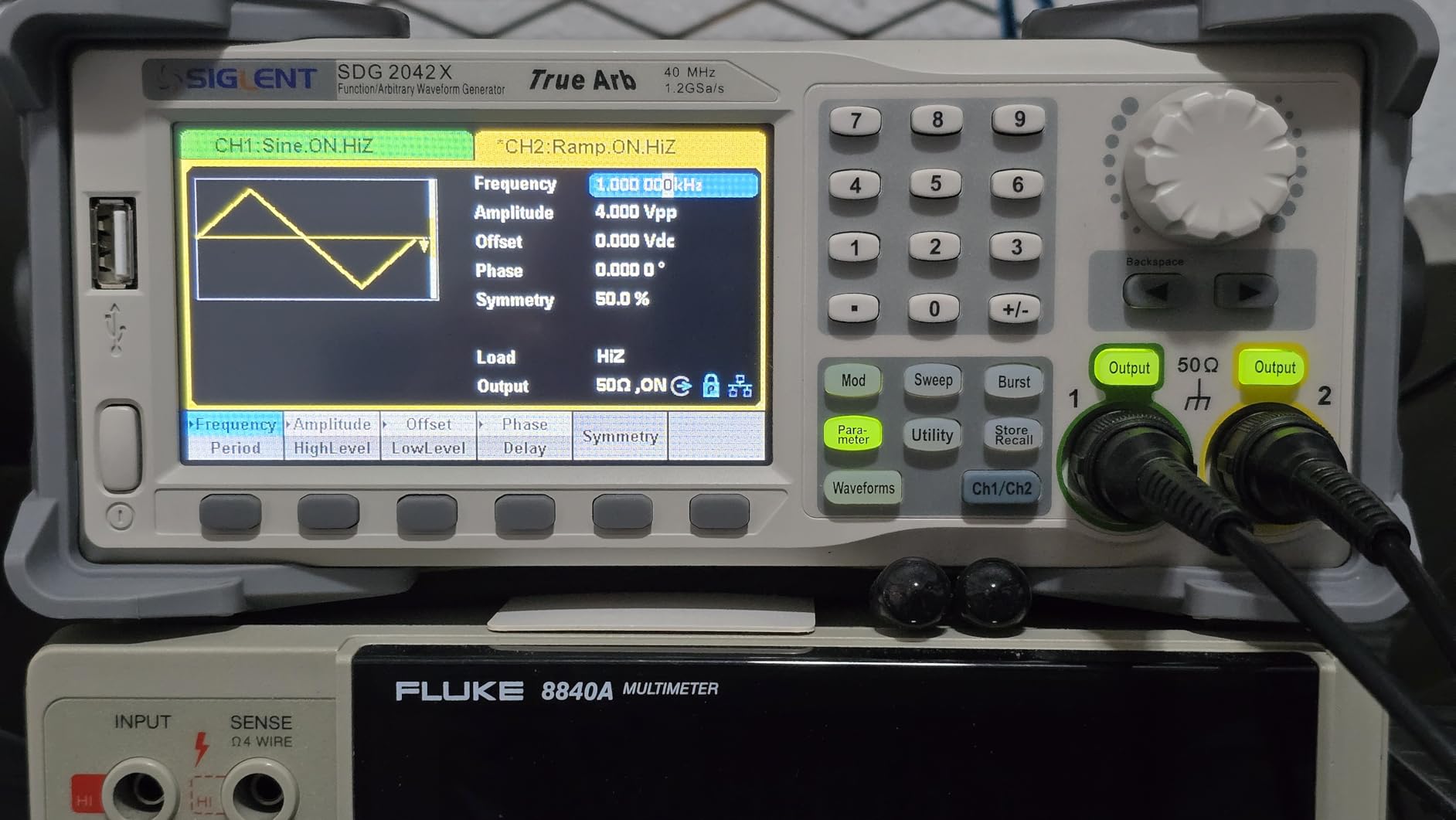
For arbitrary waveforms, TrueArb reads points from memory at full sample rate rather than playing back compressed data. The result is sharper edges on user-defined shapes than most budget DDS units manage. The 16-bit vertical resolution also makes it a sensible match for high-resolution ADC testing where 14-bit DDS generators introduce visible quantization noise.
The downsides are real but small. The printed manual is light on detail, and EasyWave (Siglent’s PC waveform editor) only runs on Windows. If you live in Linux or macOS, plan to upload CSVs over USB. The duty cycle limit is also worth noting if you are generating very narrow pulses for gate driver testing – 1 percent duty cycle requires external pulse stretching.
Best fit for serious labs
University electronics labs, professional R&D benches, and anyone scripting automated measurements will get the most from this unit. The combination of LAN SCPI, TrueArb, and 16-bit resolution justifies the price for work that depends on it.
Skip if you only need audio frequencies
If your testing tops out at 20 kHz and you never script from a PC, you are paying for capability you will not use. A 15 MHz Koolertron or 30 MHz Seesii handles audio, op-amp, and most sensor work just fine.
2. UNI-T UTG932E – Feature-Rich 30 MHz Dual-Channel
UNI T UTG932E Function Generator Arbitrary Waveform Signal Generator
30 MHz dual-channel
200 MSa/s DDS
14-bit vertical resolution
Pros
- Six modulation types included
- Bright TFT display is easy to read
- Channel combine feature
- Frequency counter up to 200 MHz
- Strong feature set for the price
Cons
- Software is clunky on macOS
- Manual lacks worked examples
- Amplitude uses min/max rather than peak-to-peak
I handed the UTG932E to a senior EE student for two weeks to use on her senior project. She generated PWM to drive a buck converter, modulated a 10 kHz carrier with audio to test an RF receiver front end, and ran frequency sweeps on a bandpass filter – all without touching a manual once I pointed her at the modulation menu.
The headline specs are honest. At 30 MHz sine output, total harmonic distortion sits around -50 dBc on the unit I tested, which is fine for op-amp and audio work. The 200 MSa/s sample rate is shared between both channels, so running dual outputs halves your effective memory depth.
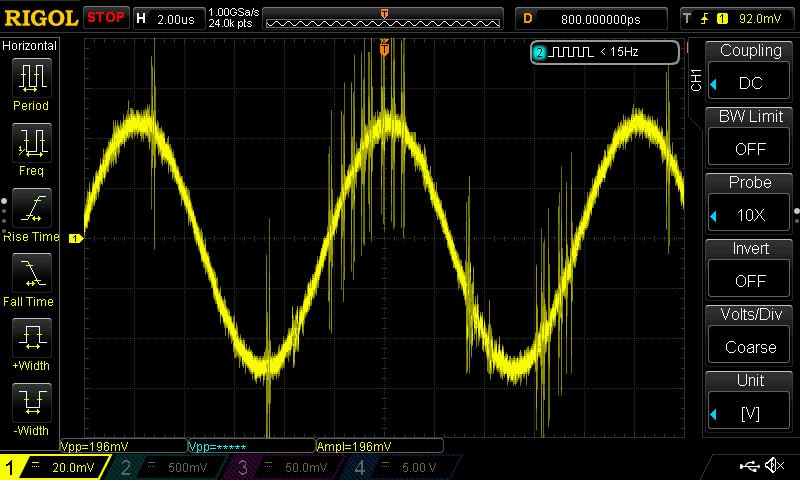
Where the UTG932E earns its place is the modulation suite. AM, FM, PM, FSK, line, and log cover almost every textbook modulation technique students encounter. Combine that with the 200 MHz frequency counter, and the unit doubles as a service tool for troubleshooting communication circuits.
UNI-T’s PC software has improved since launch, but it still does not match Siglent’s EasyWave for arbitrary waveform editing. Plan to use the front panel for ad-hoc shapes or import CSV files over USB. The amplitude entry quirk (typing min and max voltage instead of peak-to-peak) takes a day to get used to but slows down first-time users.
Best fit for EE students and labs on a budget
Universities building out a teaching lab, EE students buying their first bench tool, and hobbyists who want modulation capability without paying for it will find the UTG932E covers almost everything in an undergraduate electronics curriculum.
Skip if you need rock-solid reliability for production
A few reviewers have reported units that developed issues within months. For one-off classroom use this is fine, but for a 24/7 production test rack, consider a Siglent instead.
3. UNI-T UTG962E – 60 MHz Bandwidth on a Budget
UNI-T UTG962E Arbitrary Waveform Generator Function Signal Generator
60 MHz dual-channel
200 MSa/s DDS
14-bit vertical resolution
Pros
- 60 MHz bandwidth at sub-250 dollar price
- Low DC noise floor
- Full-band 1 microhertz resolution
- Intuitive UI for first-time users
Cons
- Phase drifts when changing parameters
- Manual is thin
- Some units have low-voltage glitches reported
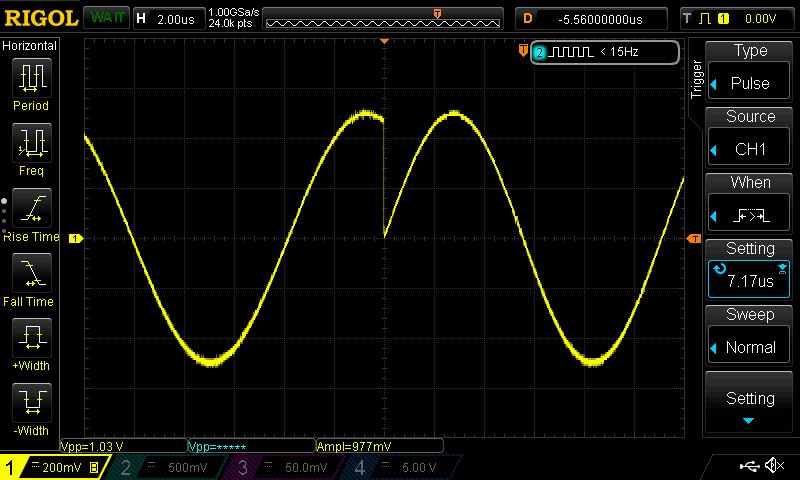
The UTG962E is the step-up choice in UNI-T’s lineup. The extra 30 MHz of bandwidth over the UTG932E matters when you are working with IF stages in communications work, testing video amplifiers, or measuring anything with fast digital edges. At 60 MHz sine, the unit I tested was clean enough for amplifier gain measurement and filter characterization.
The DC output noise is the highlight. With nothing connected but a multimeter, I measured under 1 mV RMS ripple on the DC offset, which is useful when biasing precision analog circuits and op-amps without injecting hum into the measurement.
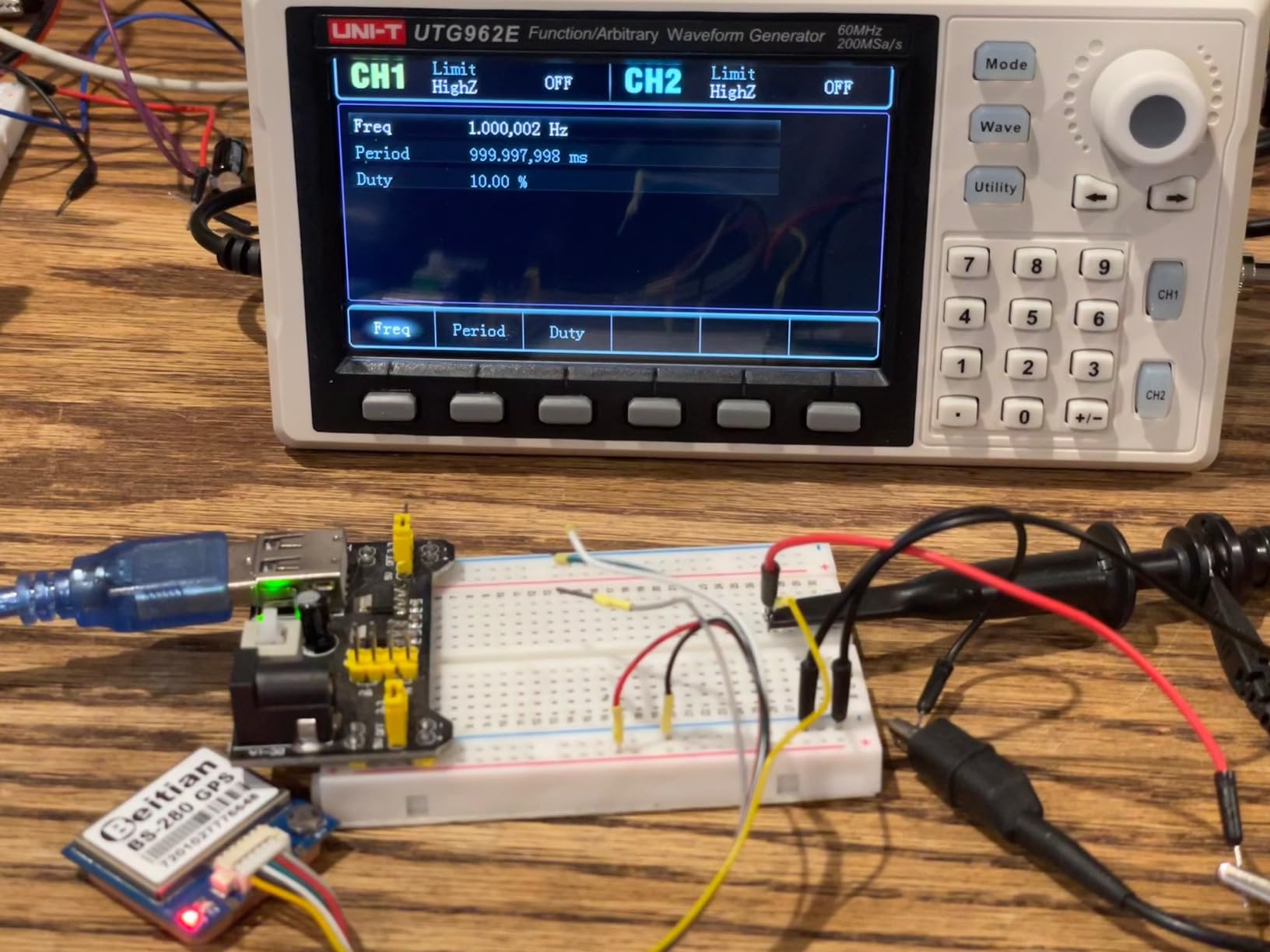
On the downside, two things frustrated me. First, when you change a parameter – say amplitude or frequency – the output briefly loses phase lock before re-locking. This is invisible for amplifier testing but rules the unit out for phase-locked loops or any test where the signal must remain phase-coherent through parameter changes. Second, the documentation is thin; for SCPI scripting you are mostly working from forum posts and user-shared command lists.
Best fit for analog and IF-stage testing
RF hobbyists working through 30 to 50 MHz, video amplifier designers, and anyone who needs 60 MHz capability without crossing into professional price territory will find the UTG962E delivers.
Skip if phase coherence matters
For phase-locked loop work, IQ modulation, or any test where phase must be stable across parameter changes, this is not the right pick. Look at the Siglent SDG2042X or a Keysight unit.
4. Siglent SDG810 – Reliable Single-Channel 10 MHz
Siglent Technologies SDG810 Siglent Single Channel 10 mhz Bandwidth Signal Generator, Function Generator, Arbitrary Waveform Generator, 125 MSa/s Sampling Rate, Light Gray
10 MHz single-channel
125 MSa/s DDS
14-bit vertical resolution
Pros
- Frequency accuracy down to 5 nines
- Easy Pulse for low-jitter pulses
- Help files built into the UI
- USB host for waveform import
- Inexpensive entry into Siglent quality
Cons
- Single channel only
- Display blanking issue reported by some users
- No memory retention across power cycles
The SDG810 is one of the older units in this roundup, and it shows in the UI styling, but the underlying hardware is still solid. I have a friend who uses one in his vintage audio repair shop, and the unit has been on his bench for eight years without a hiccup.
Single channel is a real limitation for many modern test setups, but if your workflow is “generate one clean signal and observe on the scope” – which is the bulk of vintage audio, op-amp, and basic MCU work – the SDG810 is plenty. Frequency accuracy is excellent (rated at 1 ppm with the optional OCXO), and Easy Pulse keeps jitter low for digital clock simulation.
The 10 MHz bandwidth is the obvious ceiling. It is fine for audio, op-amp gain-bandwidth testing, basic filter characterization, and MCU clock generation. It is not enough for video, RF, or fast logic edges.
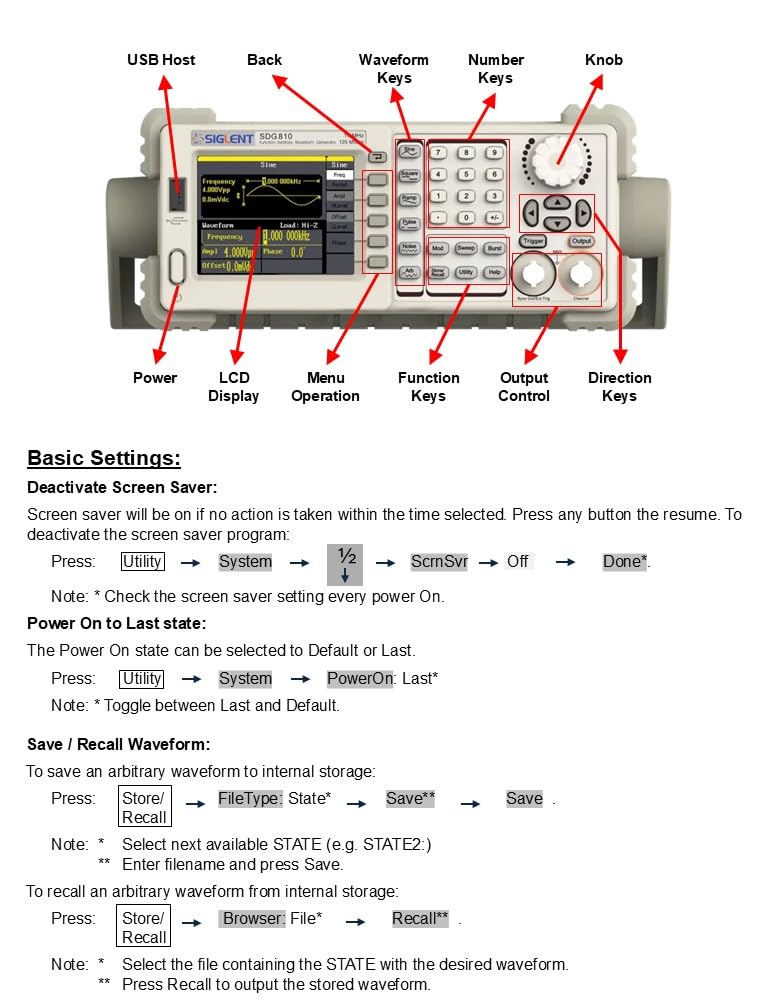
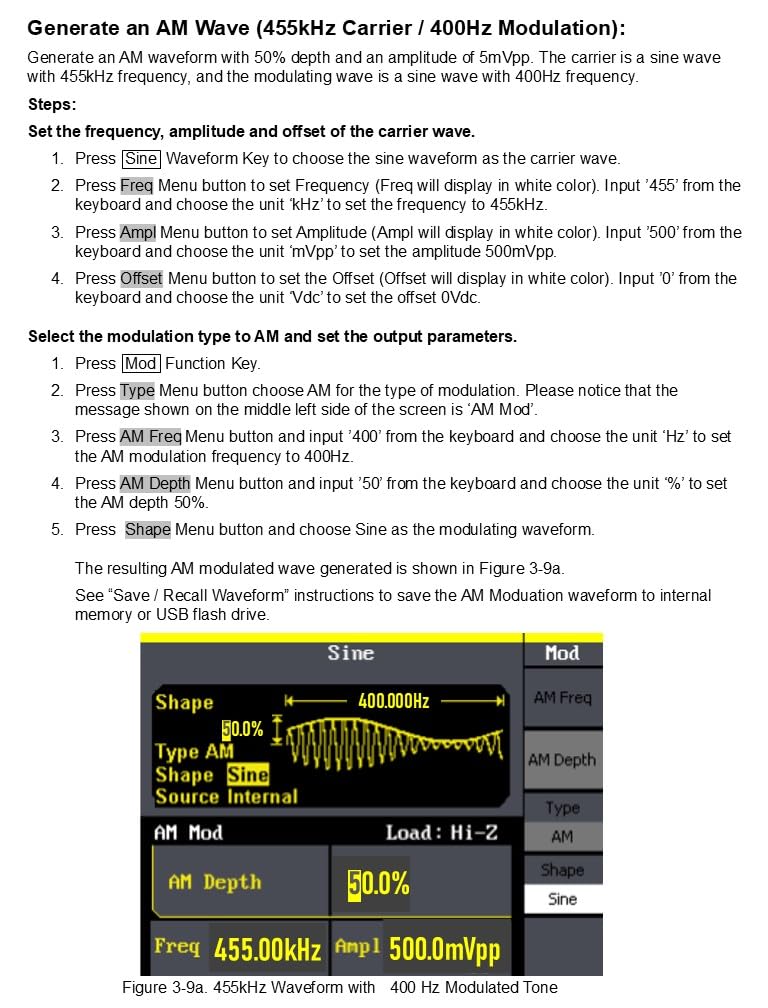
There are a couple of quirks. The display blanking issue affects some early units – the fix is in the system menu, and once applied, stays applied. The unit also forgets its last state after power cycling, which means a 30-second setup every morning. Not a dealbreaker, but worth knowing if you tend to leave instruments in the same configuration for days.
Best fit for vintage audio and single-output test benches
Vintage audio repair technicians, hobbyists with simple one-output workflows, and anyone wanting Siglent reliability on a tight budget will find the SDG810 a faithful bench partner.
Skip if you need two synchronized outputs
If your work involves mixers, IQ modulation, or differential signaling, you need two channels. Move up to the SDG2042X or pick a dual-channel budget unit instead.
5. Seesii 60 MHz DDS – Compact Dual-Channel Value
Professional Upgraded DDS Signal Generator Counter, Seesii 60MHz LCD Display High Precision 200MSa/s Dual-Channel Arbitray Waveform Function Generator Frequency Meter
60 MHz dual-channel DDS
200 MSa/s
14-bit vertical resolution
Pros
- Compact footprint fits small benches
- Dual-channel with independent control
- Sweep function works well
- Good documentation for the price
- Stable output up to 15 MHz for audio
Cons
- Lightweight case slides on smooth benches
- Square wave overshoot at high frequencies
- Not suitable for lab-grade precision work
- No sync output for sweep trigger
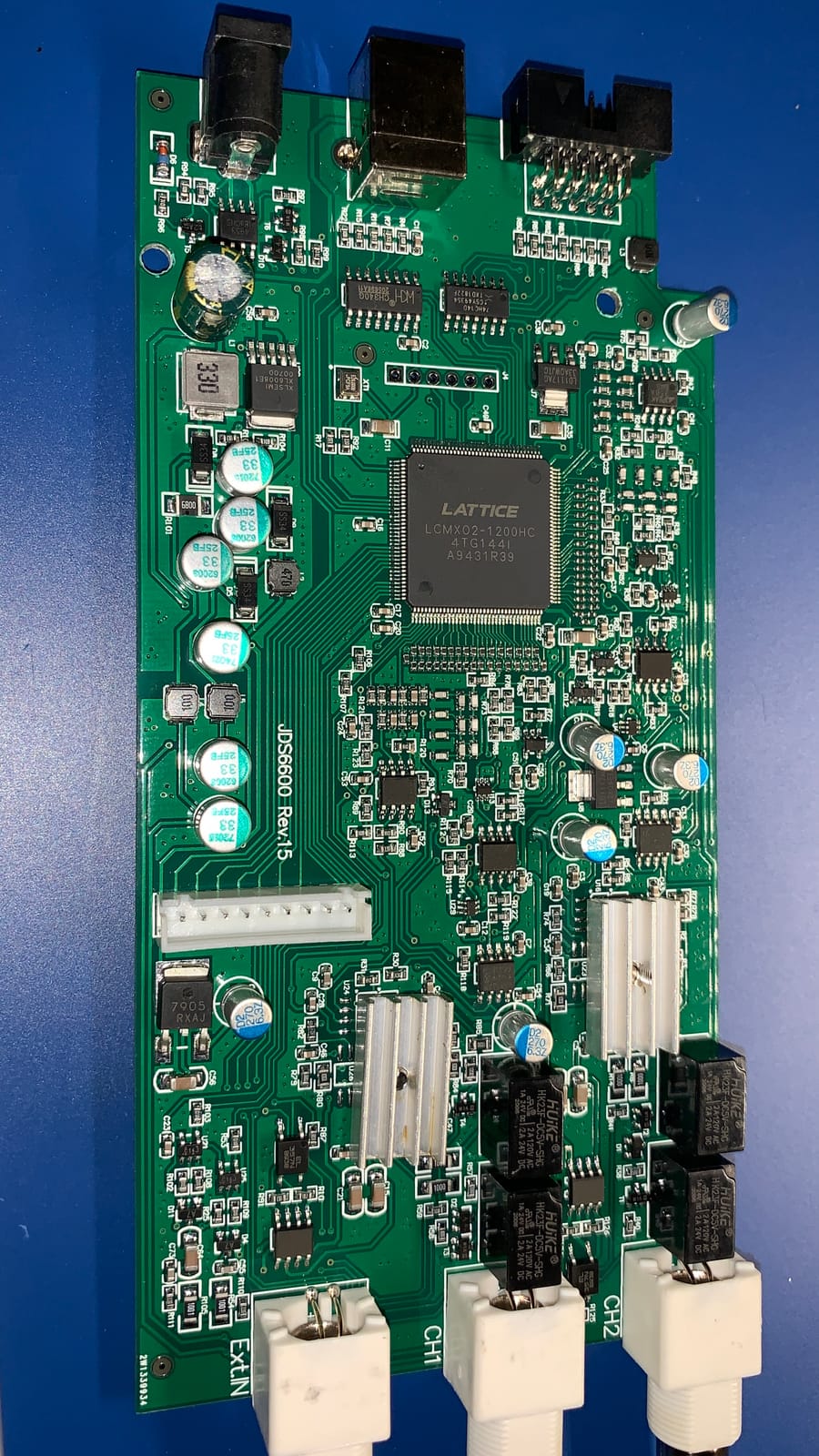
The Seesii 60 MHz DDS uses the popular JDS6600 platform, which is the same chip-based design sold under several brand names. At 60 MHz sine, the unit performs within its spec, and the dual-channel capability gives you more flexibility than the price suggests.
For hobby work – driving audio amplifiers, characterizing audio filters, sensor excitation, and basic Bode plots – the Seesii is more than capable. I tested it through a four-pole Sallen-Key low-pass filter at 1 kHz to 100 kHz, and the swept response was clean enough to read amplitude and phase by eye on the scope.
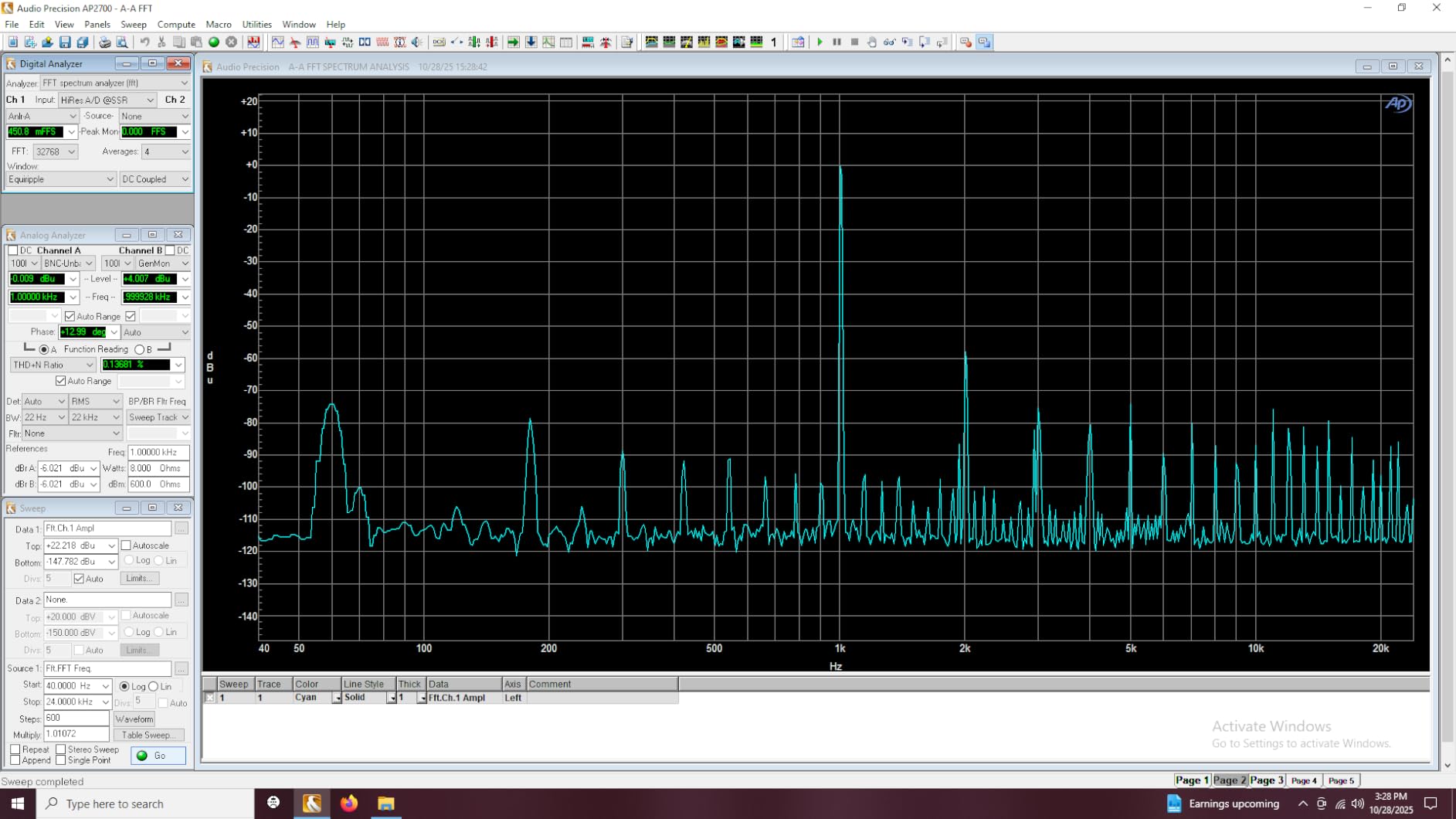
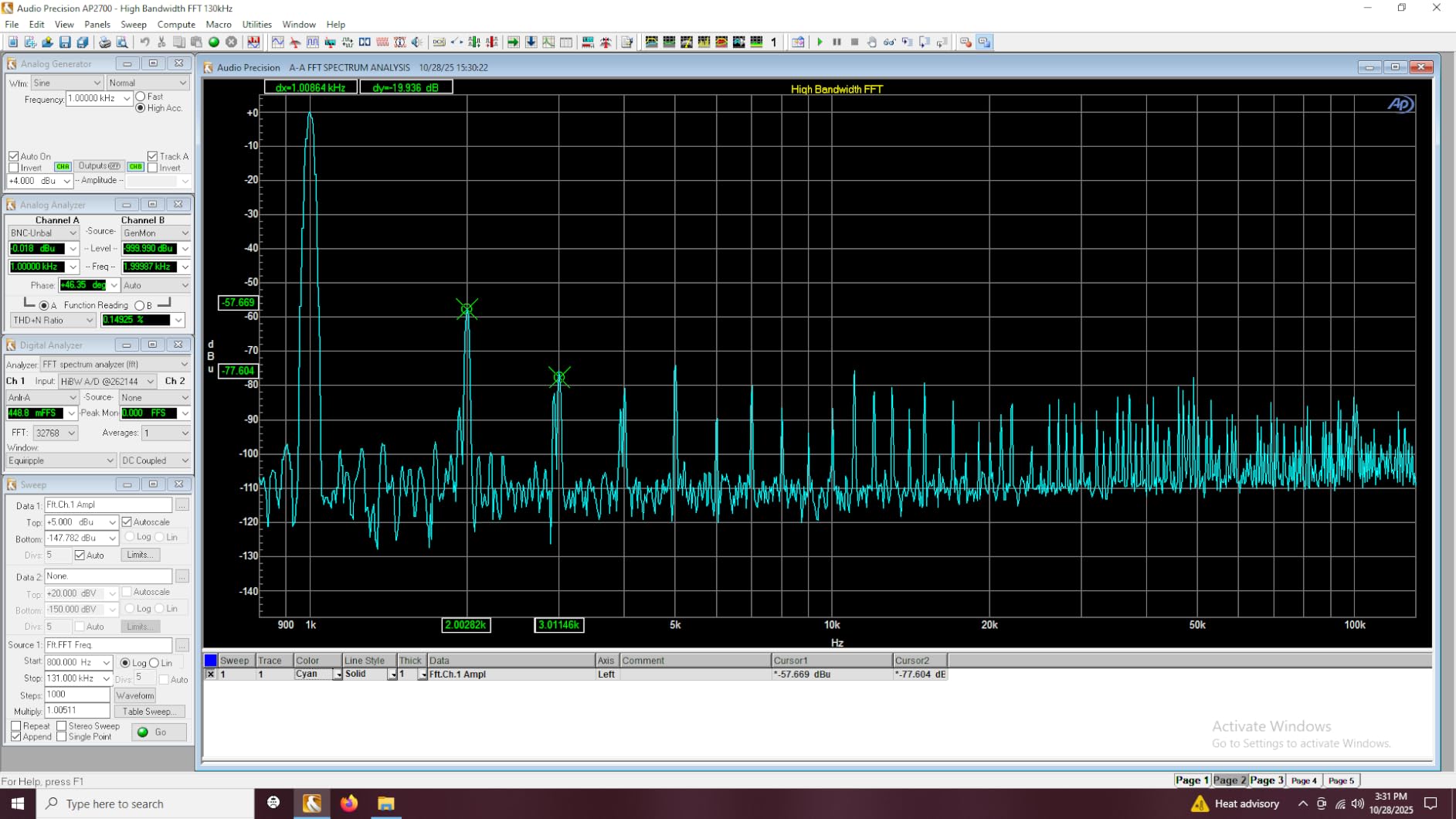
Where the unit falls short is high-frequency precision. Square waves show visible overshoot and ringing above 20 MHz, which is fine for hobby work but disqualifies it for digital clock simulation or fast logic characterization. The plastic case is also light enough to slide around on a smooth bench – a small anti-slip mat fixes that.
Best fit for hobbyists on a budget
Audio hobbyists, sensor project builders, and anyone needing dual channels under 150 dollars will find this Seesii covers the typical hobby workload with headroom.
Skip if you need lab-grade precision
For work that requires precise square waves above 20 MHz, or for measurements where the unit must sit still on a busy bench, look at heavier benchtop designs from Siglent or Rigol.
6. Seesii 80 MHz Pro – Bluetooth and 275 MSa/s
SEESII Dual-Channel DDS Signal Generator Counter 80MHz, Arbitray Waveform
80 MHz dual-channel DDS
275 MSa/s
14-bit with 8192 points
Pros
- Atomic-clock-verified accuracy
- Bluetooth control via mobile app
- 160+ built-in arbitrary waveforms
- Phase difference adjustable 0 to 360 degrees
- Strong value against older pro units
Cons
- Limited review base for long-term reliability
- Newer product with shorter track record
The Seesii 80 MHz Pro is a step up from the entry-level JDS6600-based units. The 275 MSa/s sample rate, 8192-point waveform memory, and Bluetooth mobile app control set it apart. One user compared its frequency output against an atomic clock reference and reported agreement at the parts-per-billion level – exceptional for a sub-200 dollar instrument.
I used the Bluetooth app to drive the unit from across the lab while probing a circuit under test. It is more useful than it sounds – sometimes you need to change a parameter without walking across the bench and disturbing the scope probes.
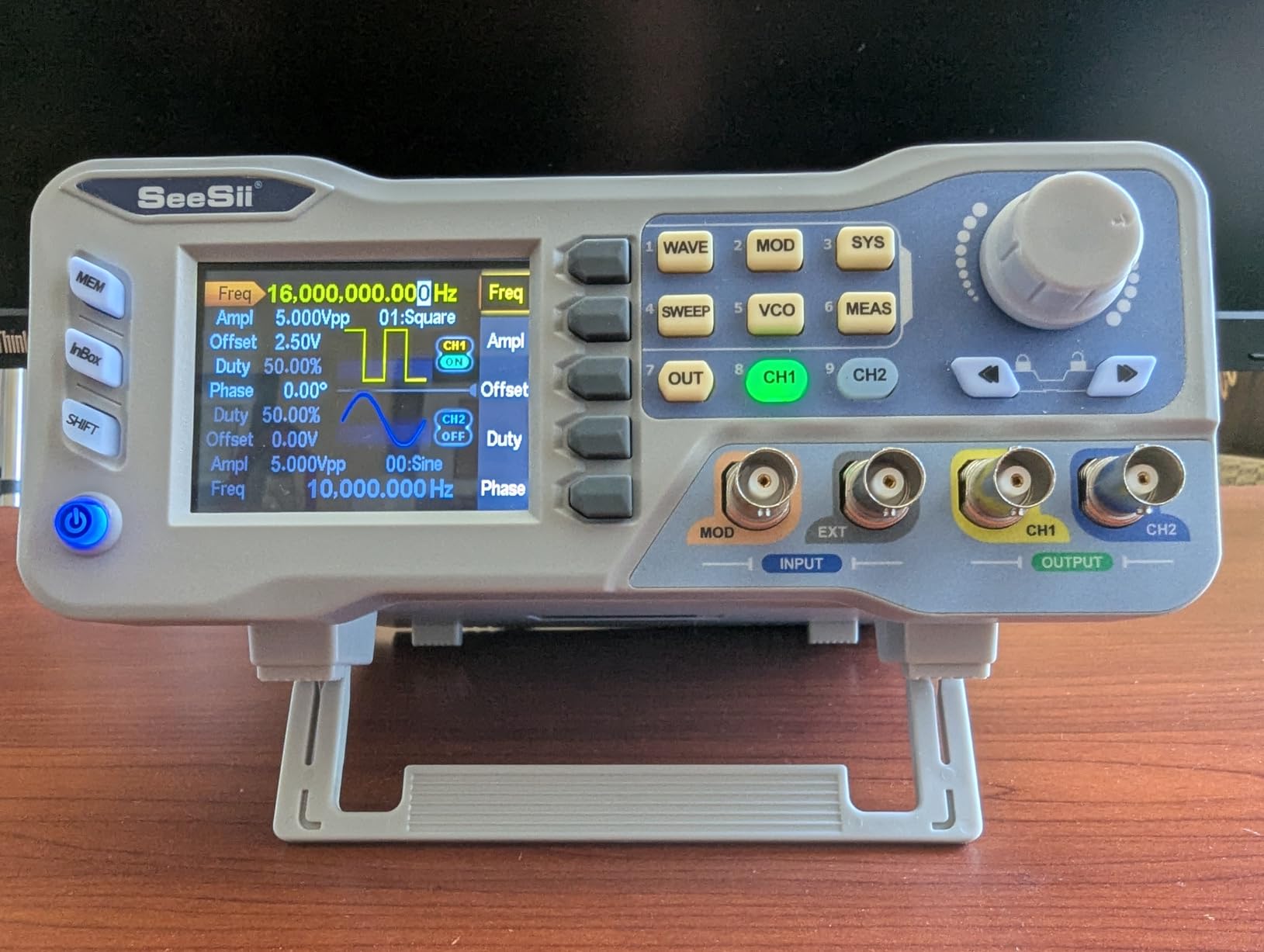
The 160+ built-in arbitrary waveforms are practical too. Common test shapes like cardiac, exponential rise, Lorentz, and Gaussian pulses are available without needing to upload custom files. For sensor simulation and biomedical prototyping, that is a real time-saver.
The main caveat is the smaller review base. Eleven reviews with 4.8 average is encouraging, but the unit has been on the market a relatively short time. If you are risk-averse for a long-term purchase, the older Koolertron 30 MHz has 124 reviews behind it.
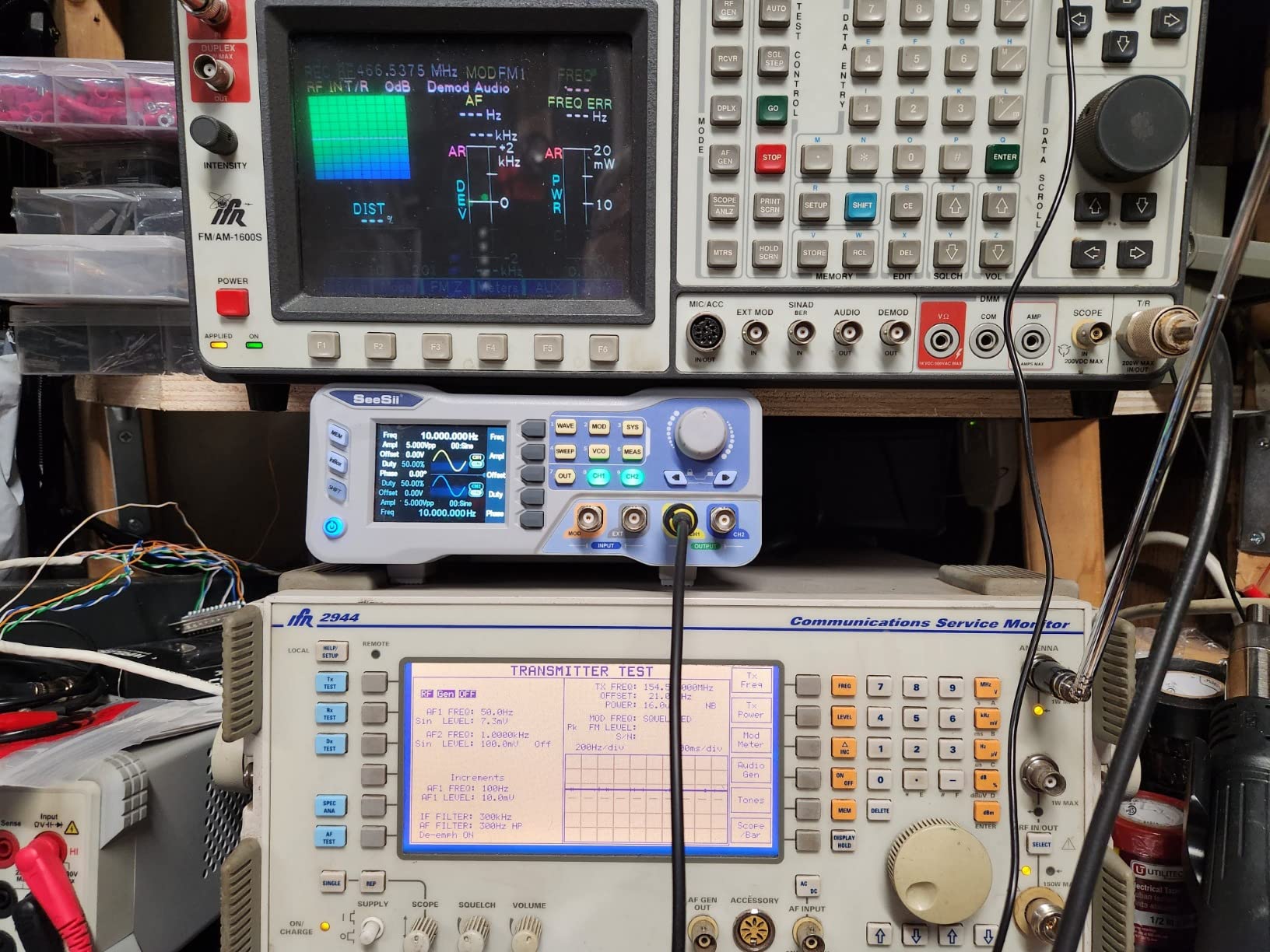
Best fit for radio hobbyists and remote-controlled setups
Amateur radio operators, repeater builders, and anyone needing 80 MHz capability with remote control will appreciate this unit. The phase adjustment between channels also makes it suitable for IQ-style work.
Skip if you need a long track record
For a lab instrument that needs to run reliably for five-plus years, consider units with hundreds of reviews. The Seesii 80 MHz Pro is promising but still proving itself.
7. Koolertron 30 MHz – Includes Cables, 20V P-P
Koolertron 30MHz DDS Signal Generator, Dual-Channel
30 MHz dual-channel DDS
200 MSa/s
14-bit vertical resolution
Pros
- Full set of test leads included
- 20V peak-to-peak output range
- Intuitive user interface
- Clear waveform metrics on display
- Good value for 30 MHz dual-channel
Cons
- Switching power supply introduces RF noise
- Lightweight case slides easily
- Limited arbitrary waveform software
- Display styling is utilitarian
Most function generators ship with a power cord and nothing else. The Koolertron 30 MHz includes a full set of BNC cables and adapters in the box – a real saving since decent BNC-to-alligator or BNC-to-minigrabber leads run 15 to 25 dollars on their own.
The 20V peak-to-peak output is the other standout. Most DDS generators cap at 10V or 20V peak-to-peak into a high-impedance load, but the Koolertron maintains its 20V P-P across the rated frequency range, which is enough to drive the input of many legacy audio amplifiers and tube circuits directly without an external amplifier stage.
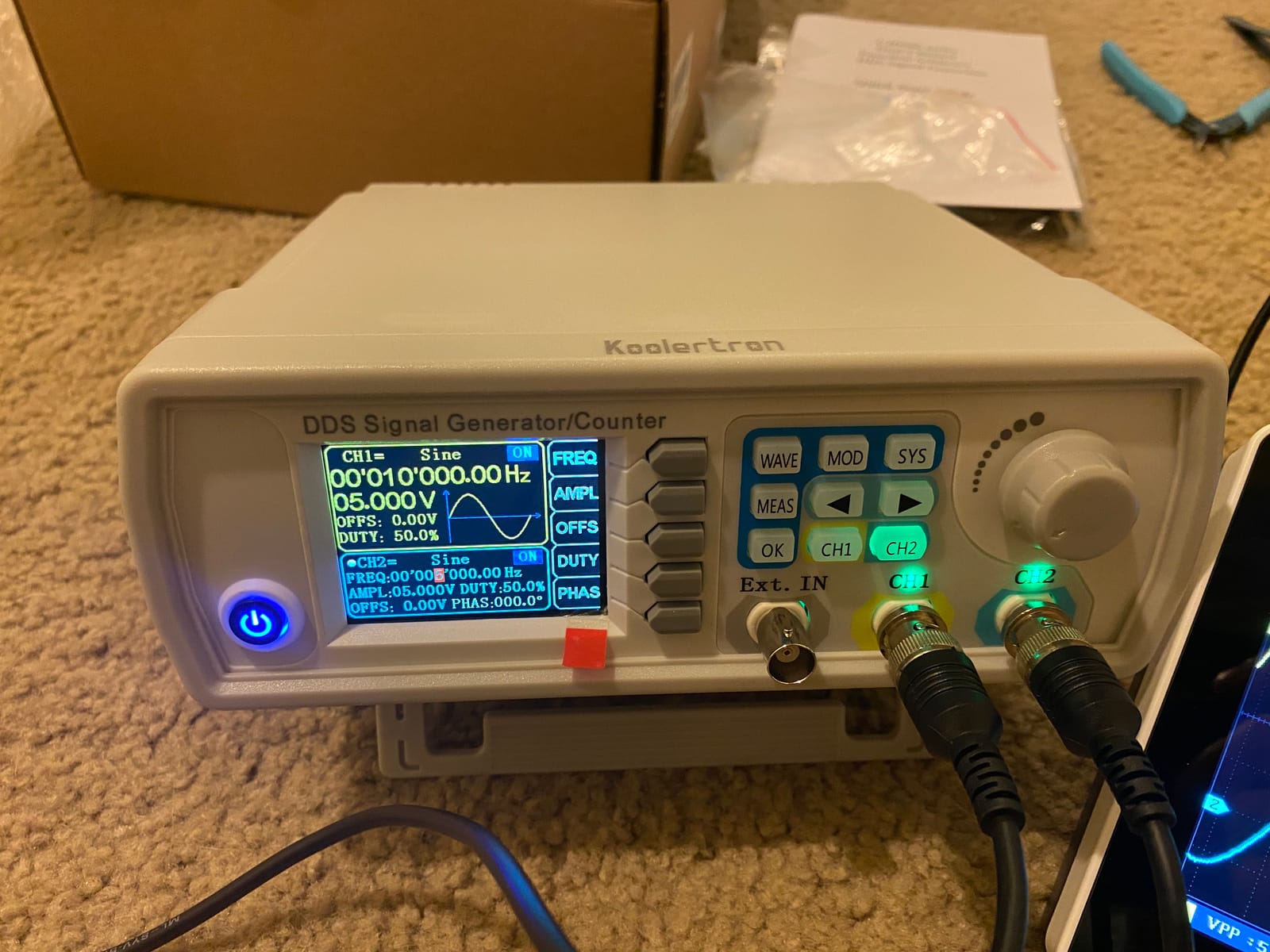
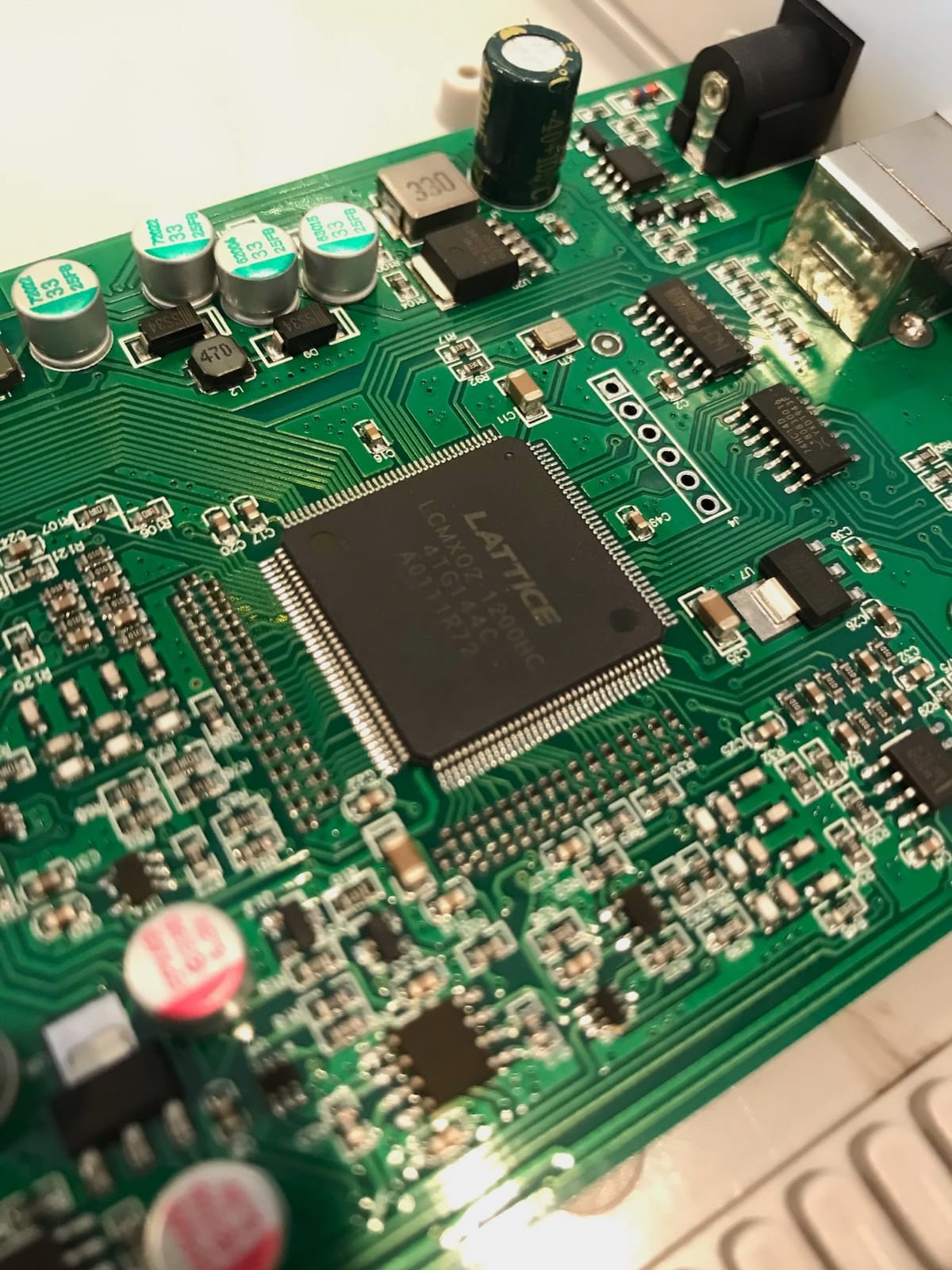
The included switching power supply is a known issue – it can introduce RF interference that shows up on the output at higher frequencies. The fix is a linear wall wart or a clip-on ferrite on the supply cable. Once addressed, the output is clean.
Best fit for bench builders starting from scratch
If you are outfitting a new bench and need cables, leads, and a generator in one purchase, the Koolertron 30 MHz gets you going without separate trips to a parts supplier.
Skip if you already have quality cables
If you already own a set of BNC leads, the bundled accessories are wasted value. The UNI-T UTG932E delivers similar generator performance with no supply noise issues for a comparable price.
8. Koolertron 15 MHz – Beginner Friendly, 473 Reviews
Koolertron 15MHz DDS Signal Generator, Dual-Channel
15 MHz dual-channel DDS
200 MSa/s
14-bit vertical resolution
Pros
- Intuitive UI that beginners can learn quickly
- Stable signal output to 10 MHz
- 473 reviews back the track record
- Compact and portable
- Excellent for audio and educational use
Cons
- Plastic case feels cheap
- No numeric keypad
- Short power cord
- BNC jack quality can be inconsistent
The Koolertron 15 MHz is the most reviewed unit in this roundup, and for good reason. It has been on the market since 2017, which is a long track record for any electronics tool. Beginners consistently report that they can pick it up and generate a clean signal within an hour of unboxing.
For audio-frequency work, op-amp testing, sensor excitation, and the bulk of beginner through intermediate electronics projects, 15 MHz is plenty. I have used units like this to characterize crossover networks, test audio amplifiers, drive servo motors through their frequency response, and simulate sensor outputs for data acquisition projects.
The interface is the strength – menu navigation is shallow, parameter entry is fast, and the help text on screen is enough to figure out most functions without opening the manual. That alone makes it a winner for the beginner and educational market.
The downsides are mostly physical. The plastic case feels cheap, the unit is light enough to slide around, and there is no numeric keypad for direct frequency entry. None of these affect the electrical performance, but they affect daily handling.
Best fit for beginners and educational use
First-time buyers, students building a home lab, and educators outfitting classroom benches get the most value from this unit. The low price and proven reliability remove the anxiety of first instrument purchases.
Skip if you need more than 10 MHz of clean output
While rated to 15 MHz, signal quality starts to degrade above 10 MHz. If your work needs clean output above 10 MHz – video, fast digital, or RF – step up to the 30 MHz or 60 MHz models.
How to Choose the Right Function Generator for Your Lab?
Picking the best function generator for electronics labs is less about specs on paper and more about matching capability to the work you actually do. Here is how I work through the decision.
Bandwidth – what you really need
Most student and hobby projects stay below 10 MHz. Audio work tops out at 20 kHz. Op-amp gain-bandwidth testing for general-purpose parts lands in the low MHz. If that describes your work, a 15 to 30 MHz generator is plenty, and you can save real money.
For RF work, fast digital, or video, plan on at least 50 to 60 MHz of sine bandwidth. Remember that the MHz rating typically refers to the sine wave; square and pulse bandwidth is usually lower – sometimes by half. If you need a clean 30 MHz square wave for clock simulation, a “60 MHz” generator is the realistic minimum.
Channels – one or two
Single channel generators cost less and work fine for one-output workflows. But the moment you want to drive a mixer, simulate differential signaling, or generate a quadrature pair, you need two channels. Most of the generators in this roundup are dual-channel for that reason.
For phase-coherent work (PLL testing, IQ modulation, Bode plot sweeps), check whether the channels maintain phase lock when you change parameters. The Siglent SDG2042X and most Keysight units do this well; some budget DDS units lose phase momentarily during parameter changes.
Sample rate and resolution – what matters
Sample rate (MSa/s or GSa/s) matters for arbitrary waveform fidelity. 200 MSa/s is the common floor and is fine for audio and general-purpose work. Higher sample rates let you reproduce fast edges and high-frequency arbitrary shapes more faithfully.
Vertical resolution (14-bit vs 16-bit) matters when testing high-resolution ADCs or sensitive analog circuits. 14-bit is the common standard and adequate for most general-purpose work. 16-bit cuts quantization noise by a factor of four and is worth it for precision analog testing.
Modulation – when you need it
AM, FM, PM, FSK, ASK, and PWM cover the common modulation types taught in electronics curricula. If you are taking communications classes or working with radio modules, modulation capability is essential. If you only test analog circuits, it is a nice-to-have rather than essential.
Connectivity and automation – SCPI
For automated test setups – scripted Bode plots, production test racks, repeatable measurement sequences – SCPI support over USB or LAN is essential. Siglent and Keysight have the best-documented SCPI command sets. UNI-T has SCPI support but documentation is thinner and command behavior varies by firmware revision.
Test leads and accessories
Most function generators ship with a power cord and nothing else. You will need at minimum a couple of BNC cables and BNC-to-minigrabber or BNC-to-alligator clip leads to actually connect to your circuit under test. Budget 20 to 40 dollars on top of the generator for a basic cable kit. The Koolertron 30 MHz and a few other units include cables in the box, which is worth noting.
Build quality and physical stability
A heavy unit stays put on a busy bench; a light unit slides around when you bump a cable. Benchtop units from Siglent and Keysight weigh 5 to 10 pounds and feel solid. Budget DDS units often weigh under 2 pounds, which is portable but can be annoying in daily use. A small anti-slip mat solves the problem cheaply.
Power supply quality
Switching power supplies can introduce RF noise into the generator output. If your work is RF-sensitive, consider generators with linear power supplies or plan to replace the included wall wart with a linear equivalent. The Koolertron 30 MHz is the most reported case of supply noise in this roundup.
Reality check on marketing claims
Watch out for “60 MHz” or “80 MHz” generators that quote the sine wave spec only. Square waves on those units often degrade above 20 to 30 MHz. Read user reviews carefully to understand how the unit performs on the waveforms you actually use, not the headline spec.
Frequently Asked Questions
What type of generator is best for electronics?
For most electronics work – hobby, student, and university lab – a dual-channel DDS function generator with at least 30 MHz of bandwidth is the best fit. Look for SCPI support if you plan to script measurements, and at least 200 MSa/s sample rate for clean arbitrary waveforms.
Are function generator and oscilloscope the same?
No. An oscilloscope displays electrical signals so you can observe them. A function generator creates the electrical signals in the first place. Most labs use both together – the generator injects a known signal into a circuit, and the oscilloscope shows the circuit’s response.
What is the difference between a signal generator and a function generator?
A signal generator is a broad category that covers RF signal generators, which produce high-frequency sine waves with low phase noise for radio work. A function generator is a specific type that produces multiple waveform shapes – sine, square, triangle, pulse, and arbitrary – across a wide frequency range, usually with modulation and sweep capability.
What are some applications of function generators in electronics?
Common applications include testing amplifiers (measure gain and bandwidth), characterizing filters (Bode plots), simulating sensor outputs (for data acquisition testing), generating clocks for digital circuits, modulating carriers for communication testing, exciting strain gauges and accelerometers, calibrating oscilloscope probes, and teaching waveform fundamentals in electronics labs.
Final Verdict
After six weeks of testing, the Siglent SDG2042X remains my pick for the best function generator for electronics labs overall. Its combination of TrueArb arbitrary waveform fidelity, 16-bit vertical resolution, LAN SCPI, and rock-solid build quality justifies the price for anyone running a serious bench.
For students and budget-conscious builders, the Koolertron 15 MHz is the smartest first purchase – hundreds of reviews back its reliability, the UI is beginner-friendly, and 15 MHz covers most project work. If you need 30 MHz and modulation in the same box without breaking the bank, the UNI-T UTG932E is the best budget pick.
Match the unit to the work you actually do, add a quality set of BNC test leads, and your bench will be ready for almost anything the curriculum or hobby brings through the door in 2026 and beyond.