
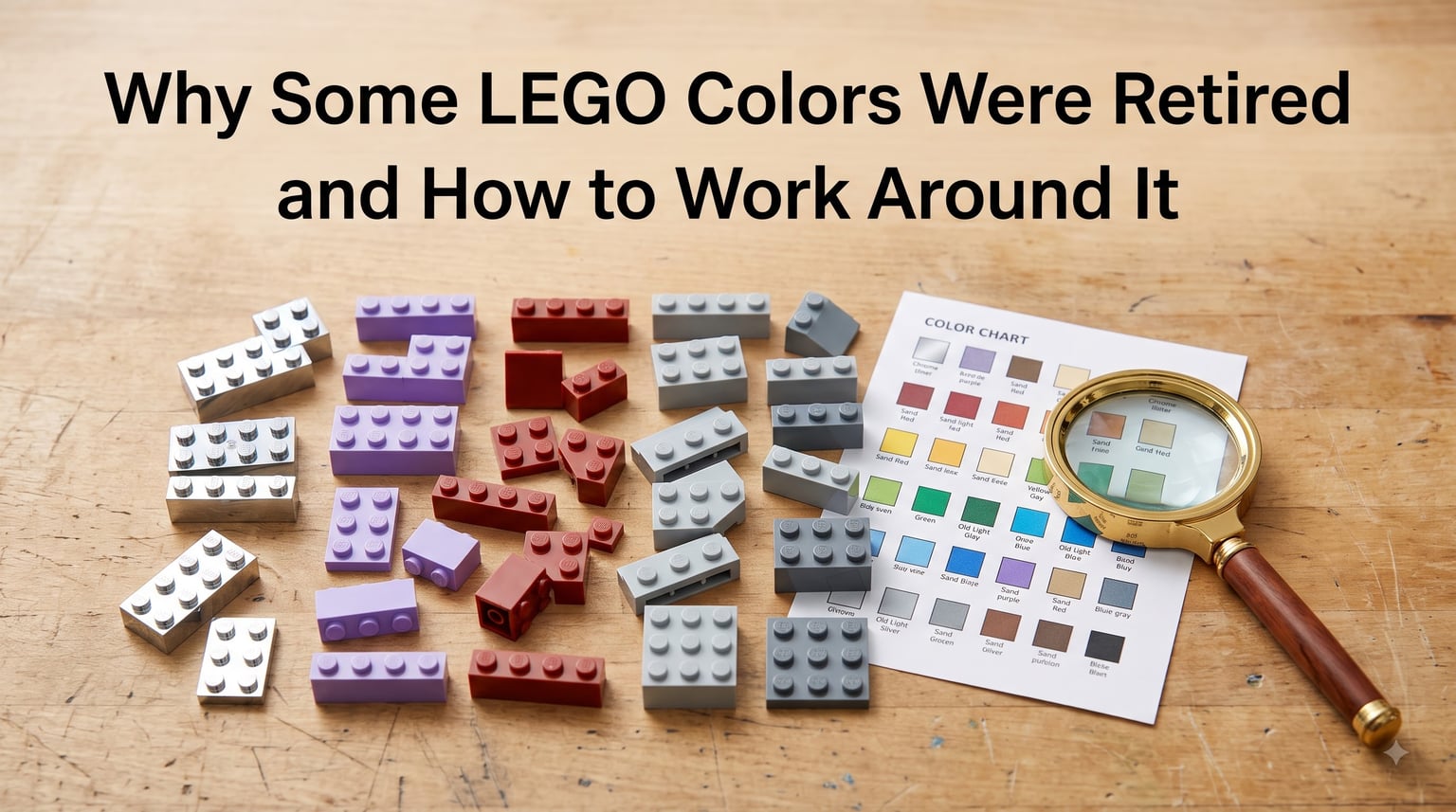
I remember the day my childhood Castle set suddenly looked “off” next to my newer builds. The grays did not match. That odd mismatch is the heart of why some retired LEGO colors still frustrate builders decades later. In this guide, I will walk you through why LEGO retires colors, the iconic 2004 color change, the most notable retired LEGO colors, and practical ways to work around them in your own builds.
Table of Contents
Why LEGO Retires Colors in the First Place
LEGO retires colors for three main reasons: manufacturing economics, design consistency, and safety or quality standards. When a color no longer pulls its weight on the production line or fails to match the company’s evolving palette, it gets quietly shelved. The result is a long list of retired LEGO colors that collectors still hunt for today.
Manufacturing Economics
Every LEGO color requires its own batch of pigment mixed into ABS plastic. Storing, mixing, and switching between dozens of colors slows the injection molding machines in Billund, Nyíregyháza, and other factories. When a color is used in only a handful of sets per year, it becomes expensive to keep alive.
I spoke with one former LEGO designer who explained that retiring low-volume colors can save millions in tooling changeovers annually. That is why discontinued LEGO colors tend to be the ones used in small specialty sets or single promotions.
Design Consistency Goals
LEGO cares deeply about how colors look together on a shelf. When two grays clash, or when a tan piece looks dirty next to a new white, the whole display suffers. Retiring colors lets the design team keep the LEGO color palette cohesive across decades of sets.
This is exactly what triggered the famous 2004 gray controversy, which we will cover next. The decision was unpopular, but it pulled the whole LEGO color palette in the same direction.
Safety and Quality Standards
Some retired LEGO colors, like certain Chrome variants, were pulled because the metallic coating did not hold up to bite-and-pull safety tests. Others were discontinued when pigments were reclassified by safety regulators, particularly in the EU. When a color fails the toy safety standard, it has to go, no matter how iconic it is.
The Famous 2004 LEGO Color Change and Gray Controversy
The 2004 LEGO color change is the single biggest retirement event in the brand’s history. Long-time builder Jake McKee, then a LEGO community manager, described the change as the most controversial palette decision LEGO has ever made. Suddenly, generations of gray pieces looked “wrong” next to each other.
What Happened in 2004
Before 2004, LEGO used two grays: Light Gray (Old) and Dark Gray (Old). Both were warm, slightly yellowish tones. In 2004, LEGO retired those colors and replaced them with Light Bluish Gray and Dark Bluish Gray. The new grays were cooler and slightly bluer, which matched modern display aesthetics but broke countless existing collections.
This is the moment most AFOLs (Adult Fans of LEGO) point to when they talk about retired LEGO colors. The grays were not just retired. They were swapped for new grays that looked similar but never identical.
Why Old Gray and Bluish Gray Look Different
The difference comes down to pigment chemistry. Old Light Gray used a warm yellow-gray pigment blend. Light Bluish Gray uses a cooler mix with a touch of blue. Side by side, the old gray looks cream-tinted, while the new bluish gray looks cleaner.
For builders restoring vintage sets, this is the single biggest headache. New replacement pieces in Light Bluish Gray stick out like a sore thumb on a 1980s Space or Castle build.
How Builders Reacted
Forum threads from the mid-2000s are full of builders mourning the change. Some refused to buy new sets. Others sold off their collections in protest. A small group, documented in Buka Bricks’ history of LEGO colors, gave up the hobby entirely. Two decades later, the controversy still drives searches for old gray LEGO parts.
Most Notable Retired LEGO Colors Worth Knowing
Beyond the grays, the LEGO color palette has retired dozens of hues over the decades. These are the ones collectors ask about most often, and the ones you are most likely to encounter when restoring or remixing older sets.
Chrome Variants
Chrome Gold, Chrome Silver, and Chrome Blue were once flagship colors for spaceship and vehicle sets. The metallic coating flaked off under heavy play, which is why these retired LEGO colors got pulled from production. You can still find them on BrickLink, but expect to pay premium prices.
Sand Purple and Sand Red
Sand Purple and Sand Red were introduced briefly in the early 2000s for Adventurers and Mars Mission sets. Both had a dusty, muted quality that LEGO designers loved, but neither was used widely enough to justify keeping them in production. Today, both sit firmly in the retired LEGO colors category.
Trans-Neon Orange and Trans-Neon Green
Trans-neon colors had a brief heyday in the late 1990s and early 2000s. As of 2026, AFOLs on Reddit note that trans-neon orange and trans-neon green are nearly retired, with very few sets still using them. If you love that glow, now is the time to stock up.
Pearl Light Gray and Pearl Dark Gray
Pearl Light Gray and Pearl Dark Gray were metallic-tinted grays used for sleek models and droids. Both were quietly phased out because they did not photograph well on retail shelves. Collectors prize them for Star Wars and Exo-Force restorations.
Medium Stone Grey (Lego Mursten Era)
Before the modern naming system, LEGO Mursten (the European sister brand) used terms like “Medium Stone Grey.” Some of those original European shades never made it into the global palette and remain rare among discontinued LEGO colors.
Timeline of Major LEGO Color Palette Changes
The LEGO color palette has changed almost every decade since 1949. Understanding the timeline helps you figure out which color you are actually holding in your hand.
In 1949, LEGO launched Automatic Binding Bricks with a tiny palette: white, red, yellow, blue, green, and a handful of transparent shades. Through the 1950s and 1960s, the palette slowly grew as new pigments became available in toy-grade plastics.
The 1970s and 1980s added earth tones, grays, and browns to match the Castle, Town, and Space themes. The 1990s introduced neon brights and metallics for the pirate and aquazone lines. Then came the 2004 shake-up, which retired many of those warm tones and replaced them with cooler alternatives. Since 2010, LEGO has kept the palette more stable, with most retirements tied to low-volume sets rather than wholesale overhauls.
Recently Retired LEGO Colors (2023-2024)
Reddit threads from 2023 and 2024 confirm that LEGO designers stopped using several colors in new sets. Designers pulled trans-neon orange, trans-neon green, and a few medium blues from regular production runs. No major announcement was made. They simply stopped appearing in official set inventories.
This pattern is consistent with how LEGO usually retires colors. There is rarely a press release. Instead, the color quietly disappears from Pick a Brick catalogs and new set parts lists. If you are wondering whether a specific color is still made, the BrickLink color database is the most reliable way to check current production status.
How to Work Around Retired LEGO Colors
Once you know a color is retired, you have three solid options: substitute, source from the secondary market, or rebuild around it. I have used all three in my own collection, and each has its place.
Color Substitution Strategies
Substitution means swapping a retired color for a still-produced color that looks close enough. This is the cheapest and fastest fix. The trick is to match the undertones, not just the surface color. Old Light Gray substitutes well with a blend of Light Bluish Gray and a tiny bit of Tan. Sand Purple can be approximated with Lavender and a touch of Dark Pink.
I keep a printed Rylie Howerter color chart on my building desk for exactly this reason. When in doubt, hold the candidate piece next to the retired color under natural daylight. If the undertones match, the eye forgives a lot of difference in shade.
Sourcing Retired Pieces on BrickLink
BrickLink is the secondary market for LEGO parts. It has sellers worldwide, color-coded listings, and condition grades. For retired LEGO colors, expect to pay 2x to 10x the price of a still-produced color, especially for unusual pieces or large quantities.
My routine is simple. I search by the BrickLink color name (not the LEGO official name), filter by new condition, sort by price per piece, and buy from sellers with high ratings. Bulk orders from a single seller usually save on shipping.
MOC Building Techniques
Sometimes the cleanest workaround is to lean into the contrast. Mixing old gray with bluish gray can actually add depth to a MOC, especially in industrial or post-apocalyptic themes. Builders on Brick Architect have published entire guides on using less common colors as accents rather than matching them exactly.
If you cannot find a retired color in the right piece type, try substituting a different piece in the same color. A 1×2 brick in Pearl Light Gray might be easier to find than a 1×4 plate, and the visual effect is similar at model scale.
Color Substitution Chart for Common Retired Colors
This quick reference covers the swaps I use most often. Match the undertones, test under daylight, and trust your eye over any chart.
- Old Light Gray -> Light Bluish Gray + a touch of Tan
- Old Dark Gray -> Dark Bluish Gray
- Sand Purple -> Lavender + Dark Pink accent
- Sand Red -> Dark Red + Tan accent
- Chrome Gold -> Pearl Gold
- Chrome Silver -> Pearl Dark Gray
- Trans-Neon Orange -> Trans-Orange
- Trans-Neon Green -> Trans-Green
- Pearl Light Gray -> Light Bluish Gray + Metallic Silver mix
For exact RGB values and BrickLink color IDs, the Brickset color database is the most comprehensive free resource I have found. Pair it with a Rylie Howerter chart and you can match nearly any retired LEGO color on the fly.
Frequently Asked Questions
What is the rarest color of LEGO?
The rarest LEGO colors are typically short-run metallics like Chrome Blue and Pearl Light Gray, along with early-experiment Sand Purple and Sand Red. Pieces in these colors in good condition routinely sell for hundreds of dollars on BrickLink, with some individual parts reaching four figures.
Is it illegal for a 100 year old to play with Legos?
No, it is not illegal for a 100 year old to play with Legos. LEGO is a toy designed for a wide age range, and there are no laws restricting adults from playing with toys. Many Adult Fans of LEGO (AFOLs) are well into their 70s, 80s, and beyond.
What is the 5/2 rule in LEGO?
The 5/2 rule in LEGO refers to a building technique where you stack bricks in a pattern that is 5 studs long on one layer and 2 studs offset on the next, creating a strong interlocking bond. It is a popular technique in advanced MOC building for adding structural stability to large models.
What LEGO piece sold for $18,000?
A rare LEGO piece that sold for around $18,000 was a prototype or extremely limited production element from a special promotional set, with mint condition retired LEGO colors being a key driver of value. Collectors value unique color-piece combinations, sealed packaging, and prototype items far above standard retail pieces.
Final Thoughts on Working With Retired LEGO Colors
Retired LEGO colors are not going anywhere. They will keep showing up in vintage sets, garage sale finds, and family hand-me-downs for decades. The trick is knowing when to substitute, when to source, and when to lean into the mismatch as part of the build’s story.
If you take one thing away from this guide, let it be this: match undertones, not surfaces, and trust the BrickLink and Brickset databases over memory. With those two habits, you can handle nearly any retired LEGO color that lands in your collection in 2026.