
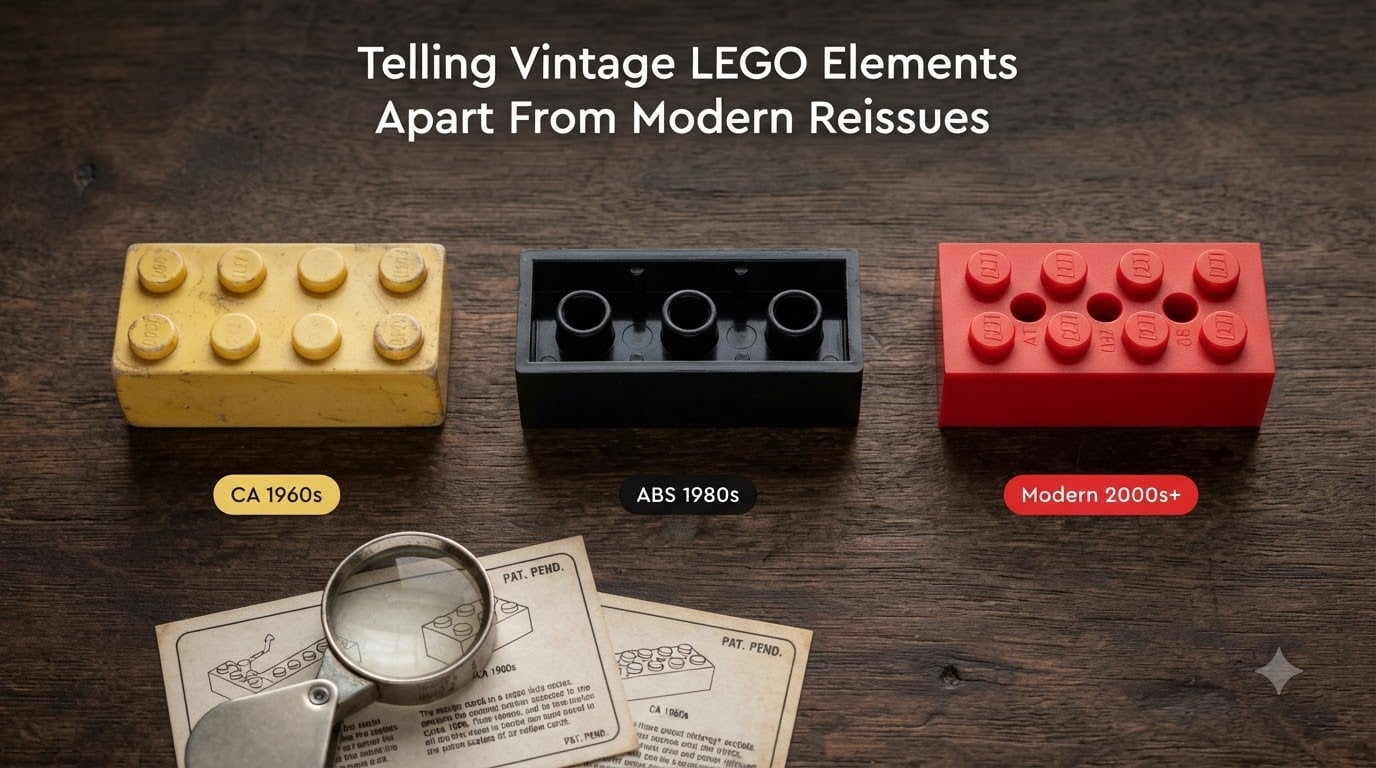
I started collecting LEGO as a kid in the late 1980s, and thirty years later I have tubs of bricks from at least four different production eras mixed together. Sorting them taught me one thing quickly: telling vintage LEGO elements apart from modern reissues is harder than the forums make it look. The differences exist, but they are subtle. Our team has spent months going brick by brick through inherited collections, garage sale hauls, and eBay lots to build this guide. Here is what we learned about identifying vintage LEGO elements versus the modern reissues you find today.
Whether you are restoring a 1977 Galaxy Explorer or just trying to figure out what is actually in that old bucket in your attic, the following techniques will help you date your pieces with confidence.
Table of Contents
Defining the Three Eras of LEGO Elements
Before you can identify anything, you need clear era boundaries. Collectors generally divide LEGO production into three periods, each with its own manufacturing characteristics. Learning these eras is the foundation for telling vintage LEGO elements apart from modern reissues.
Vintage LEGO (1949 to 1978). This covers the earliest LEGO bricks, including the original wooden toys, the early cellulose acetate pieces, and the transition era. Pat. Pend. markings appear on most pieces from this period. Clutch power was inconsistent, colors were limited, and the manufacturing process varied between the Billund, Nyíregyháza, and later Kladno facilities.
Classic LEGO (1978 to 2003). After the patent expired in 1988 and the modern minifigure design stabilized in 1978, LEGO settled into a long production run. Pieces from this era share standardized ABS construction, hollow studs, and the iconic LEGO logo on every stud. Most minifigures built today draw their basic structure from these years.
Modern LEGO (2003 to present). Today’s bricks use refined ABS formulations, more precise mold tolerances, and additional sustainability initiatives including bio-based plastics. Mold codes became standardized, part numbers became universal, and quality control reached the current near-imperfection tolerance.
If you grab three bricks from these three eras and put them side by side, the difference is visible at a glance. The challenge is doing it with a single brick in your hand.
Material Differences: Cellulose Acetate vs ABS Plastic
The single most reliable material difference between vintage LEGO elements and modern reissues is the plastic itself. LEGO used cellulose acetate (CA) from 1949 until 1963, then shifted to acrylonitrile butadiene styrene (ABS), which is what they still use today.
CA bricks are noticeably different. They tend to yellow faster than ABS, are more brittle, and have a slightly waxy feel when you rub them together. They also tend to deform under heat, so any CA-era brick left in a hot attic will often warp. If you have a brick that looks warped, smells faintly of vinegar (acetic acid is a CA breakdown byproduct), and has a dull matte surface, you are probably holding a pre-1963 vintage piece.
ABS plastic holds color much better, resists yellowing, and snaps rather than warps. Modern ABS is also more consistent in color batch to batch. The drawback is that ABS stress-whitens when scraped, which is why you often see white marks on old LEGO bricks that have been handled a lot.
There is one tricky exception. LEGO ran a small amount of polyamide (nylon) bricks in the 1960s and early 1970s for specialty pieces like plant stems and flexible elements. These are rare and worth researching separately.
Injection Point Location and Stud Construction
This is where LEGO manufacturing has changed most dramatically, and where most AFOLs learn to identify vintage LEGO elements. The injection point is the small mark left where molten plastic entered the mold. Its location tells you almost everything.
Side-injected vintage bricks (pre-1978). The earliest injected LEGO bricks have their injection point on the side of the stud, not on top. Look at a stud from a 1960s or 1970s brick and you will see a small circular or oval mark on the vertical surface. This is the only era where side injection is normal.
Stud-top injected modern bricks (1978 onward). After 1978, injection points moved to the top of the stud. Today’s LEGO production uses stud-top injection exclusively. You will see a small dimple or a faint circle on the very top of each stud.
Hollow tubes on the bottom. Most LEGO bricks 2 plates tall or higher have hollow tubes on the underside. These create clutch power and reduce plastic use. The transition from solid to hollow tubes happened in stages. Bricks without any internal tube structure are pre-1970s vintage. Bricks with partial tube structure but missing the inner ridge are mid-1970s. Fully hollow tubes with complete rings are 1978 onward.
Here is where the 5/2 rule comes in. The 5/2 rule is a general guideline collectors use to gauge how many internal tubes a brick should have: roughly 5 tubes for every 2 plates of length. So a 2×4 brick should have around 10 tubes if produced under the modern standard. If you count the underside of an old LEGO brick and find fewer than 5/2 would predict, you are probably holding a vintage piece with sparse internal support.
Marking Identification: Pat. Pend., Logos, and Mold Codes
Every LEGO brick tells you when it was made if you know where to look. The markings on LEGO pieces have followed a clear evolutionary path, and learning this timeline is essential for telling vintage LEGO elements apart from modern reissues.
No markings at all (1949 to 1954). The earliest LEGO bricks, especially the wooden and early plastic versions, often had no company markings. Pure blank studs.
Patent Pending or Pat. Pend. (1954 to 1989). Once LEGO filed their modern brick patent in 1958, pieces started carrying Pat. Pend. or full patent text. This marking covers the largest span of vintage LEGO production and is the single most common old brick identifier. You will find it molded into the undersides of plates, inside tubes, and on the bottom of flat tiles.
Patent number text (1958 to 1988). Once the patent was granted, LEGO stamped specific patent numbers onto bricks, especially for export to the United States. Look for long strings of numbers on the underside of larger pieces.
LEGO logo transition (1978 to 1990s). The familiar stud-top LEGO logo started appearing on most pieces by the late 1970s. Early logo pieces have a thinner font than modern equivalents, and the logo sits slightly off-center on some vintage elements.
Modern part numbers and design numbers (1990s onward). Today, almost every LEGO element carries a 4 to 5 digit design number and often an element ID. These numbers let you search BrickLink or Rebrickable to identify the exact year and mold generation of a piece. If your brick has a clearly stamped number inside the tube structure, you are looking at a modern or late-classic piece.
Mold codes. A mold code is a small alphanumeric code on the piece that identifies which production mold made it. Mold codes change frequently as tools wear out and get replaced. Two identical-looking 2×4 bricks from different mold codes may be from completely different years. Peeron.com maintains a database of mold codes across decades.
Clutch Power and Physical Feel
Clutch power is the friction between studs and tubes that holds bricks together. It has changed dramatically across eras, and experienced collectors can tell apart vintage LEGO elements and modern reissues just by stacking and pressing on them.
Vintage LEGO bricks (pre-1980s) often have looser clutch. They click together with a softer feel and come apart with light pulling. This is partly due to looser manufacturing tolerances and partly because the plastic compounds aged differently.
Classic LEGO (1980s to mid-1990s) has firmer clutch power but is generally a touch looser than today’s pieces. Collectors often describe these as the “Goldilocks” bricks in terms of feel.
Modern LEGO (post-2003) has the tightest, most consistent clutch power. Stacks of 50 bricks feel noticeably different from stacks of vintage pieces of the same type. Modern pieces also click together with a sharper, more precise sound.
If you are testing clutch, always use identical-shape pieces. Comparing a 1970s 2×4 to a 2020s 2×4 gives you a clear feel difference, while comparing across completely different piece types tells you almost nothing.
Minifigure Evolution From 1974 to Modern Day
Minifigures have their own distinct era markers, separate from system bricks. Learning these is critical for telling vintage LEGO elements apart from modern reissues in your minifigure collection.
1974 to 1977 prototype minifigures. These early figures had no movable legs, no printed faces, and no hands. They used simple head and torso components. They are extremely rare and highly collectible.
1978 to 1989 classic minifigures. The 1978 redesign introduced movable legs, hands, and printed faces. The early versions had a slightly slimmer torso profile and a different hip joint than later pieces. The first licensed figures (notably the 1989 Batman) signaled the start of modern minifigure design.
1990s to present modern minifigures. Today’s minifigures have refined hip joints, more detailed torso prints, and better facial expressions. The basic structure of these figures has stayed consistent, but mold codes change frequently.
When sorting a mixed minifigure lot, look at the torso and hip area first. Early minifigure torsos are noticeably different and almost impossible to mistake for modern figures once you know what to look for.
Color Palette Changes Over Time
Color is one of the easiest tells for telling vintage LEGO elements apart from modern reissues, but only when you are comparing pieces from the same color family. Some classic colors have shifted over the decades.
The most famous example is white. Old white (pre-1990s) has a creamy, slightly yellow tint compared to modern bright white. Put them side by side and the difference jumps out. The same is true of black: vintage black often looks slightly grayer and less saturated than today’s deep black. Light gray and dark gray have also shifted across eras.
For accurate color dating, BrickLink maintains detailed catalogs showing which color a part shipped in during each year. If your piece is a color that was discontinued in 1985 but you can clearly see it on an old brick, that is a fast identification.
Cross-Support Variations on Slopes
Most collectors overlook slope pieces, but they have their own identification markers that vary by era. Cross-support ridges are the internal ribs on the underside of slopes that give them rigidity.
Early slopes (pre-1980s) often have minimal or no cross-support. Mid-era slopes have partial cross-support. Modern slopes have full cross-support patterns with multiple ribs. The transition happened gradually, so collectors use specific years like 1986, 1992, and 2003 as rough markers.
If you hold a 33-degree slope up to a light source, you can see the internal structure through the translucent plastic on transparent pieces. The pattern tells you which era the slope came from.
Identification Tools and Resources
You do not have to identify every brick by eye. A handful of tools and databases make the job much faster.
BrickLink. The largest LEGO marketplace, but also one of the best identification resources. Their catalog shows every part with year ranges, mold codes, and color variants. The advanced search lets you filter by element number, design ID, and production year.
Rebrickable. Combines a part database with set inventories, making it easy to figure out which sets a specific brick shipped in.
BrickIt and Brickognize. Mobile apps that use your phone camera to identify LEGO pieces in real time. Brickognize is generally more accurate for older or unusual pieces. These are particularly useful when sorting through large quantities.
Peeron. A long-running database focused specifically on mold variations and design numbers across decades. It is the best resource for finding exactly which mold generation you have.
For tough cases, the eurobricks.com forum has a dedicated identification section where experienced AFOLs will help you date specific pieces from clear photos. The Brick Fantastic team has used them on multiple occasions for old Town and Space sets.
Frequently Asked Questions
What is the 5/2 rule in LEGO?
The 5/2 rule is a guideline collectors use to estimate the correct number of internal hollow tubes on a LEGO brick. It states that a brick should have roughly 5 tubes for every 2 plates of length. A 2×4 brick should have around 10 tubes under the modern standard. Counting fewer tubes than 5/2 predicts usually indicates an older vintage element with sparser internal support.
How do I identify vintage LEGO pieces?
Identify vintage LEGO pieces by checking four main markers: material (cellulose acetate yellows and warps, ABS does not), injection point location (side injection on pre-1978 bricks versus stud-top on later pieces), markings (Pat. Pend. indicates pre-1989 production), and tube structure (sparse or absent internal tubes indicate older pieces). Combining these checks gives you the most reliable dating.
What is the difference between modern and vintage LEGOs?
Vintage LEGO (pre-1978) uses cellulose acetate or early ABS with side injection points, sparse tube structure, and Pat. Pend. markings. Modern LEGO (post-2003) uses refined ABS with stud-top injection, full tube structures, standard part numbers, and detailed mold codes. The differences are visible in clutch power, color stability, and overall consistency.
Is vintage LEGO worth money?
Yes, vintage LEGO often carries significant collector value, particularly sealed sets, rare minifigures, and pre-1970s pieces. Even loose vintage bricks can command higher prices than modern equivalents, especially in uncommon colors. Values vary widely depending on condition, rarity, and whether the original instructions and packaging are included.
Is there an app that identifies LEGO pieces?
Yes. Brickognize and BrickIt are the two most popular apps for identifying LEGO pieces using your phone camera. Brickognize is generally better for older and unusual pieces. For more detailed dating and mold variation analysis, web-based tools like BrickLink and Peeron are typically more reliable.
Final Thoughts on Collecting Vintage LEGO
Telling vintage LEGO elements apart from modern reissues gets easier with practice. The first few pieces will take you twenty minutes each, but eventually the side injection points, Pat. Pend. stamps, and color differences jump out immediately. Our team still occasionally debates a brick over coffee, but for the most part the patterns become obvious once you have handled a few hundred old pieces in person.
If you take one thing from this guide, let it be this: no single marker is reliable on its own. Combine material, injection point, markings, and tube structure, and you will get accurate dating almost every time. The hobby is more rewarding when you know what is actually in your collection.