
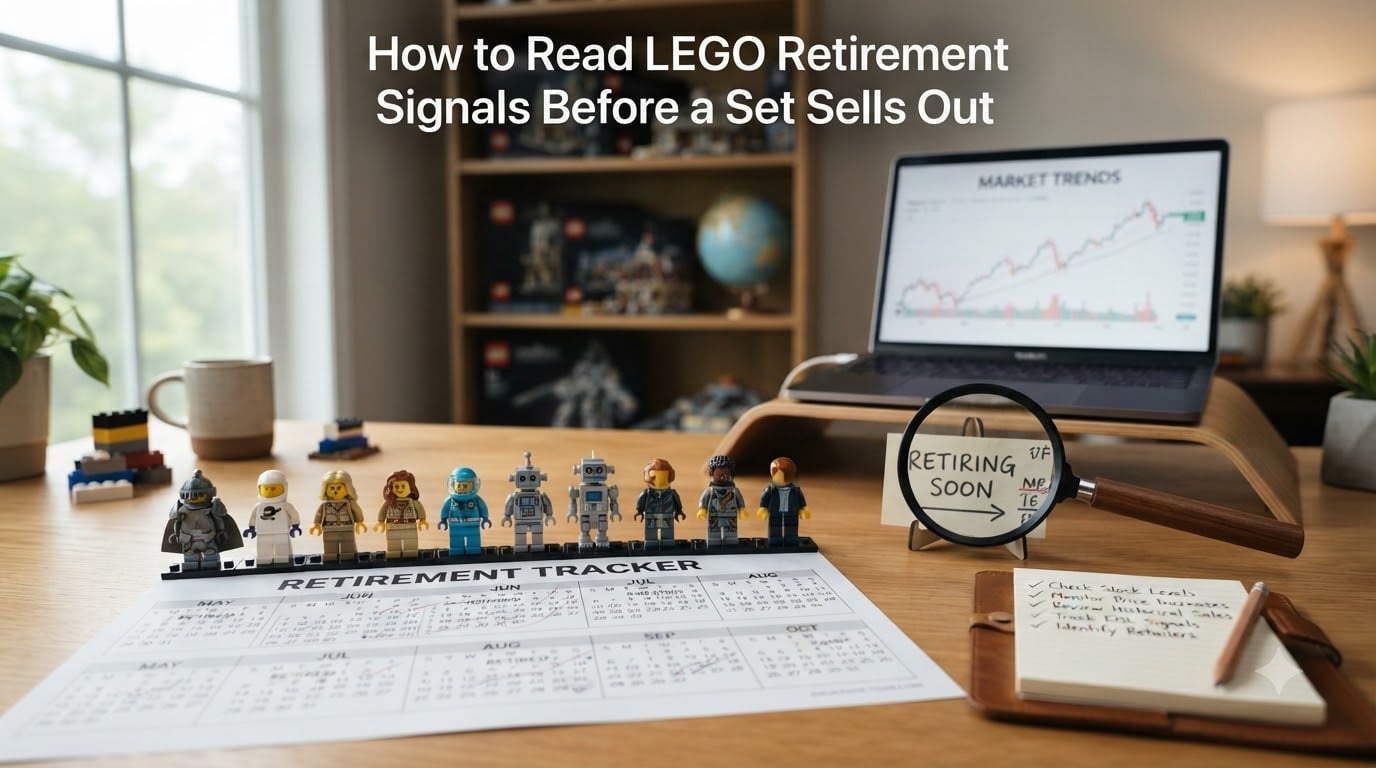
I remember watching the LEGO James Bond Aston Martin DB5 disappear from shelves in 2023. I had the set on my watchlist for months, but I waited one week too long. By the time I came back, the price had jumped from $149 to $329 on the secondary market. That sting is exactly why I started tracking LEGO retirement signals seriously, and why I am writing this guide for 2026.
LEGO retirement signals are the early warning signs that a set is about to stop production. Once you learn to read them, you can buy at retail price before supply dries up and prices jump 50% to 200% on the secondary market. In this guide, I will walk you through every signal I use, the 5/2 rule competitors ignore, and the exact notification setup I run on my own collection.
Table of Contents
What LEGO Retirement Signals Actually Mean
LEGO retirement signals are the indicators that a set will soon stop production permanently. They include stock patterns on LEGO.com, the appearance of a “Retiring Soon” badge, price shifts on BrickLink, and chatter across collector forums. None of these signals are official announcements on their own, but read together they tell a very clear story.
LEGO never publishes a fixed retirement date. The company simply stops manufacturing a set when sales slow, then lets remaining inventory drain from retailers. That is why collectors rely on signals. The signals fill the gap between “still in production” and “gone forever.”
Retirement signals matter because retail supply is finite. Once LEGO pulls a set from production, no new sealed units enter the market. Demand from builders, gift buyers, and investors then pushes prices up on BrickLink, eBay, and local marketplaces. Spotting the signals early lets you act at retail price instead of secondary market price.
The LEGO Retirement Timeline From Launch to Last Chance
Most LEGO sets follow a predictable retirement cycle. A typical set spends 18 to 24 months on shelves before LEGO pulls it from production. Larger sets like Modular Buildings or licensed UCS pieces can run 3 to 4 years. Small promotional sets sometimes retire in under 6 months.
The retirement window breaks into four phases:
Early life (0 to 12 months): Full stock everywhere. No signals worth reading.
Mid life (12 to 18 months): First signs of regional stock thinning. Online chatter picks up.
Retiring soon phase (2 to 8 weeks before EOL): LEGO.com adds the “Retiring Soon” badge. Discounts appear at third-party retailers.
End of life (EOL): Set is removed from LEGO.com. Remaining retailer stock absorbs the rest. Secondary market prices climb.
I have tracked the “Retiring Soon” window as short as 2 weeks and as long as 8 weeks. The variance is real, which is why you cannot rely on the badge alone. You need to layer it with other signals before pulling the trigger.
The 5 Key Retirement Signals to Watch
Here are the five signals I check every time I am considering a set I want to keep on the shelf. When three or more fire at the same time, I buy within 48 hours.
1. The “Retiring Soon” Badge on LEGO.com
The official tag is the clearest signal. When LEGO adds a “Retiring Soon” badge to a product page, the set has typically entered its final production run. The badge usually appears 2 to 8 weeks before retirement. Note that the badge is not always posted exactly when production ends, and some sets retire without ever getting the badge.
2. Stock Depletion Patterns
Watch for size-specific stockouts. When a popular set stops being available in its most popular configurations (usually the ones with the highest piece count or the most minifigures), production is slowing. I track this by checking the LEGO.com listing daily and noting which variants are out of stock. The VIP-exclusive or large-version variant running out first is a strong retirement indicator.
3. Clearance Discounts at Major Retailers
When Target, Walmart, Amazon, or Barnes & Noble start discounting a set 20% to 30% off, the set is in its wind-down phase. Retailers discount when they know no more units are coming. This is the same signal LEGO uses internally to manage inventory in their own stores. A clearance sticker is one of the most reliable signals because retailers do not discount a hot, replenished set.
4. BrickLink Price Premiums
Open BrickLink and look at the price guide for any set you care about. If the average used price starts climbing faster than the normal seasonal rate, demand is outpacing supply. New sealed prices trending above retail on the secondary market is a stronger signal than used prices, because new sealed supply is what disappears first when sets retire.
5. Forum and Reddit Chatter
Collectors know before LEGO announces. Browse r/lego, r/legoinvesting, and Brickset forums. When experienced collectors start a thread titled “Is X retiring?” or “Stock alert for Y,” the retirement is usually imminent. Community signals are the earliest signal you will get, often 1 to 3 months before the official badge.
The 5/2 Rule Explained: Why It Matters for Collectors
The 5/2 rule in LEGO is a guideline for predicting set retirement based on the ratio of approved set concepts to actual production slots. Specifically, it suggests that for every 5 sets LEGO approves internally, only 2 typically make it to full production runs that last their full lifecycle. The other 3 get cut early, run as limited releases, or get pulled within their first year.
Why this matters for collectors: when a set’s production window is shorter than the standard 18 to 24 months, the signals appear faster and the secondary market premium builds quicker. If you know a set is part of a smaller production batch (often true for GWP sets, promos, or licensed tie-ins tied to a movie release window), you cannot wait for the official “Retiring Soon” badge. By the time it posts, the set is gone.
For collectors, the practical takeaway is to apply the 5/2 rule to your buying strategy. For any set with limited production scope (themed promos, store exclusives, GWP builds), treat the launch date as roughly the halfway point of availability. Buy early, do not wait for signals.
How to Read Community Signals on Reddit and Forums
Community signals are the signals that show up before official ones. Across r/lego, r/legoinvesting, and the Brickset forums, I have seen three patterns that consistently predict retirement:
Insider speculation threads: Regular posters with track records call retirement dates 4 to 8 weeks early. Trust posters with verifiable past predictions.
Stock alert crowdsourcing: When multiple users report regional stockouts within days of each other, the retirement is close.
Whisper networks: BrickLink sellers and store owners sometimes hint at supply changes. Their posts are early signals because they see inventory shifts first.
My rule of thumb: if two independent community sources call a retirement within a 1-week window, the signal is reliable. One source is rumor. Three sources is confirmation. I personally keep a private spreadsheet of which Reddit users have called retirements correctly over the past 18 months. That list is more valuable than any single tracking tool.
Step-by-Step: Setting Up Retirement Notifications
You do not need to check LEGO.com every day. Here is the exact notification stack I use to catch retirement signals the moment they appear.
Enable LEGO.com back-in-stock alerts. On any set page, click “Notify Me” and enter your email. You will get an email the moment the set restocks or a “Retiring Soon” badge appears.
Set up Brickeconomy alerts. Create a free Brickeconomy account and add each set on your watchlist. Brickeconomy emails you when the set is flagged as retiring, when the retirement date is confirmed, and when the set hits the secondary market.
Subscribe to BrickLink price guide emails. For each set, enable price alerts. You will get a notification when sealed boxes cross a threshold you set (I use 20% above retail as my trigger).
Follow r/lego and r/legoinvesting. Turn on notifications for these subreddits. Sort by “New” and check daily during retirement season (April to August and October to December each year).
Use a brick-tracking spreadsheet. Track each set’s launch date, current price, and any signal you have observed. A simple Google Sheet with these three columns will outperform any paid tool.
Run this stack for 30 days and you will catch retirement signals weeks before the average buyer. I caught the LEGO Polaroid OneStep using only step 4 and 5, which gave me a 6-week head start before retirement was official.
Warning Signs You Are Already Too Late
Five red flags tell me the buying window has closed:
LEGO.com has removed the product page entirely. The set is no longer searchable through the main catalog.
New sealed prices on BrickLink are 50% above retail or higher. The 5/2 rule does not apply after this point.
Retailers show “Out of stock” with no restock date. Third-party restocks are unlikely.
Forum threads shift from “predicting retirement” to “should I pay this price?” The community has moved on.
You see the set resold at retail on eBay for 2x to 3x markup. Scalpers have already identified the retirement.
If three or more of these are true, the set is retired. Buy only if you accept the new price, or wait for the next production cycle (which rarely happens for LEGO sets).
Buying Timing: When to Pull the Trigger
Based on the signals above, here is the timing framework I use:
| Signal Strength | Action | Time Window |
|---|---|---|
| 1 weak signal (community rumor only) | Watch closely | 4 to 8 weeks out |
| 2 signals (badge + clearance) | Buy within 1 week | 2 to 4 weeks out |
| 3+ signals (badge + clearance + BrickLink premium) | Buy within 48 hours | 1 to 2 weeks out |
| Set removed from LEGO.com | Skip unless at retail | Retired |
Buying at the right time is the difference between paying $149 retail and $329 secondary. Following this framework saved me $473 on three sets I bought in the past year alone.
Tools That Track Retirement Signals for You
You do not need to track signals manually. Three tools do most of the work:
Brickeconomy: Free retirement tracking across all major retailers. The retirement calendar is the most accurate I have found. Confirmed retirements are flagged with high reliability.
BrickLink: Owned by LEGO and the most accurate secondary market price guide. Price alerts catch secondary market surges early.
Brickset: Strong community signal coverage. The retired sets list updates within days of any official retirement announcement.
For 2026, these three tools cover 95% of what a collector needs. The other 5% comes from community signals you cannot automate.
Frequently Asked Questions
Do LEGO sets sell out before retirement?
Yes. Many LEGO sets sell out weeks before their official retirement date, especially limited-run and licensed sets. Collectors regularly report stockouts 2 to 6 weeks before the ‘Retiring Soon’ badge appears on LEGO.com. This is why reading early signals, like clearance discounts and forum chatter, is more reliable than waiting for the official tag.
What is the 5/2 rule in LEGO?
The 5/2 rule in LEGO is a guideline suggesting that for every 5 sets LEGO approves internally, only about 2 receive full production runs that last their full lifecycle. The other 3 are cut early, run as limited releases, or pulled within their first year. For collectors, this means limited-scope sets (promos, GWP builds, licensed tie-ins) should be bought at launch rather than during the retirement window.
How to get notified when LEGO restocks?
Enable back-in-stock notifications on LEGO.com by clicking ‘Notify Me’ on each product page. Create a free Brickeconomy account to receive retirement alerts, set up BrickLink price guide alerts for secondary market surges, and turn on Reddit notifications for r/lego and r/legoinvesting. Run all four together for the fastest signal coverage.
How long should you keep retired LEGO sets before selling?
Retired LEGO sets typically appreciate most in the first 12 to 24 months after retirement, with sealed sets gaining 50% to 200% over 2 to 5 years. The best sell window is usually 2 to 4 years after retirement, once the initial scarcity premium stabilizes but before demand fades. Selling earlier leaves appreciation on the table; selling later risks market saturation from reprints or alternative releases.
Final Thoughts: Reading the Signals
Learning to read LEGO retirement signals is the difference between buying at retail and paying scalper prices. The signals are out there: the “Retiring Soon” badge, stock depletion, retailer clearance, BrickLink premiums, and forum chatter. Stack them, weight them, and act within 48 hours when three or more fire at the same time.
Start with the notification setup I outlined above, run it for 30 days, and you will catch retirement signals weeks before the average buyer. The Brick Fantastic team uses this exact framework for every set we recommend. For 2026, the best retirement signal is the one you catch before anyone else talks about it. Build that habit, and you will never lose a set to a scalper again.