
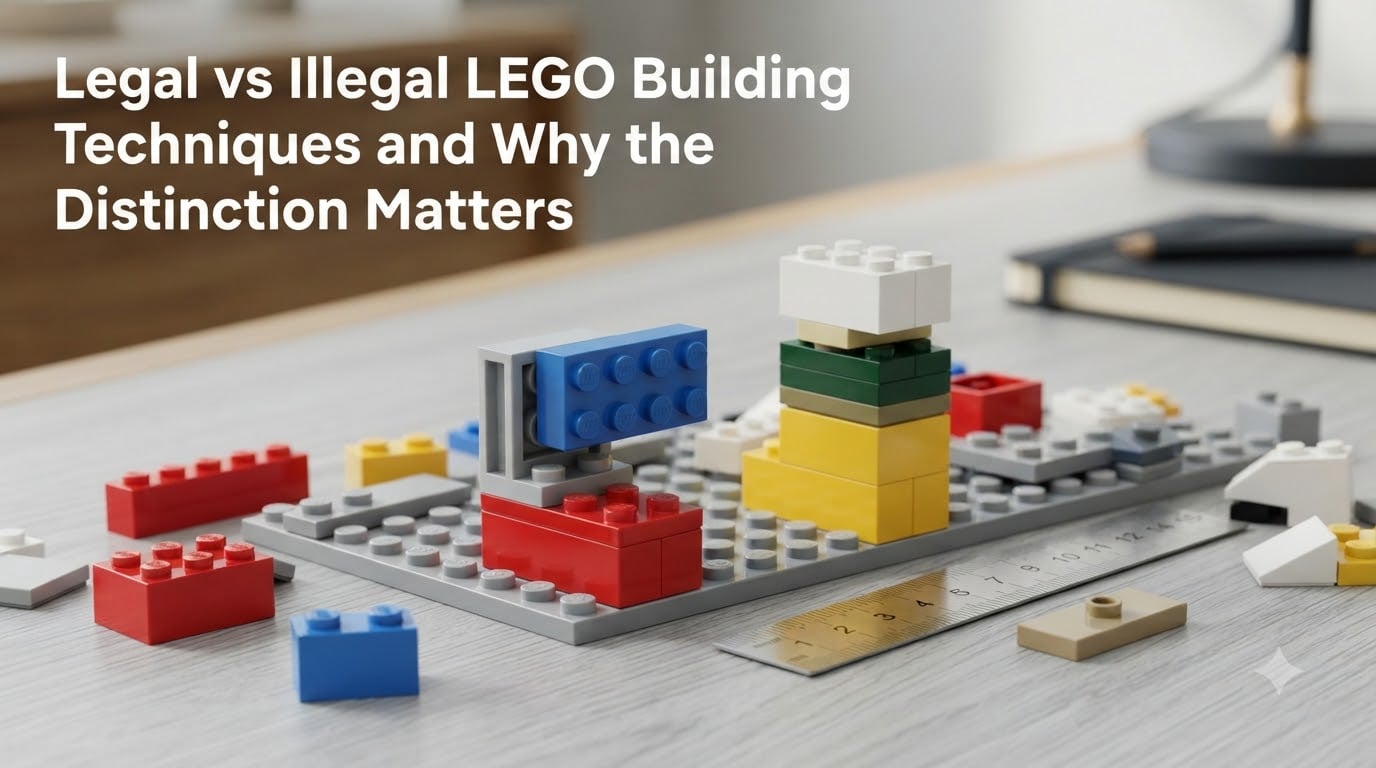
I have spent the last few years building with LEGO almost every day, and one question keeps coming back from newer builders: are illegal LEGO building techniques real, and why do AFOLs talk about them as if they were actual laws? The short answer is yes, they are real, but they are LEGO-illegal, not actually illegal in any legal sense. The term refers to building methods that place undue stress on bricks, leading to potential damage or reduced clutch power over time.
Understanding the difference between legal and illegal LEGO building techniques is one of the most important lessons a new builder can learn. It protects your collection, makes your MOCs more durable, and explains a lot of the unspoken rules you will see in AFOL communities. In this guide, I will walk you through the origin of the term, the most common illegal techniques, the famous 5/2 rule, and why the distinction actually matters in 2026.
Table of Contents
What Does ‘Illegal’ Actually Mean in LEGO Building?
The word “illegal” in the LEGO community is a piece of community shorthand, not a statement about copyright or trademark law. When builders call a technique “illegal,” they mean it puts elements under stress they were never designed to handle. It is the same idea as saying “don’t stand on that chair” – the chair is not breaking the law, but it is about to break you.
More precisely, illegal LEGO building techniques are methods that force elements beyond their designed tolerances, preventing them from returning to their original shape and leading to permanent deformation. In practice, this means the bricks lose clutch power (the friction that holds them together) and your model becomes loose, wobbly, or even damaged over time.
Some new builders wonder if using these techniques can get them in trouble with LEGO the company. The answer is no. LEGO does not police community builds, and even official LEGO Ideas challenges now state that all building techniques are allowed unless specifically excluded in the challenge rules. The “illegal” label is a community quality standard, not a corporate rule.
The Origin Story: Jamie Berard and ‘Stressing the Elements’
The term “illegal” in LEGO building was first used by LEGO designer Jamie Berard in a 2006 presentation called “Stressing the Elements.” Berard, who has gone on to become a host on LEGO Masters, gave the talk to explain how certain building practices flex, twist, and deform LEGO plastic in ways that cause long-term damage.
Before that presentation, many AFOLs built in any way that worked, even if it stressed their bricks. Berard’s talk introduced a shared vocabulary. Once the community had a name for these techniques, builders could discuss them, warn newcomers, and design better models. It was a turning point that turned “that looks sketchy” into “that is illegal.”
Since 2006, the concept has spread far beyond Denmark. You will find it referenced in Reddit threads, Eurobricks discussions, BrickNerd articles, and now in AI Overview answers from search engines. It is one of the few pieces of building theory that almost every AFOL agrees on.
The 5/2 Rule in LEGO Explained
The 5/2 rule is one of the simplest and most useful tools for understanding legal vs illegal LEGO building techniques, yet it is rarely explained clearly. The rule is a guideline for placing studs and connections so the resulting structure is strong and stable.
The basic idea is this: for every 5 modules of length, you should have at least 2 points of vertical connection. A module is 8 LDU (LDraw Units), which is the width of a single stud. So if you are building a horizontal beam, you want a stacked connection (a brick or plate layer) at least every 5 studs to keep the structure rigid.
If you build a long horizontal section with no vertical support for 6, 7, or more studs, the unsupported section will flex, sag, and eventually deform. That flex is what makes the technique illegal – it stresses the plastic in the unsupported region. The 5/2 rule is a quick mental check that prevents this kind of stress.
I use the 5/2 rule as a sanity check on every MOC I build. If I am laying down a row of plates longer than 5 studs, I ask myself where the next vertical connection is. If the answer is “nowhere,” I either add a stud or rethink the design. It takes five seconds and prevents hours of rebuilding later.
Common Illegal LEGO Building Techniques (With Examples)
These are the illegal LEGO building techniques I see most often in new builders’ MOCs. Each one creates stress in a different part of the element, and each has a simple legal alternative. If you recognize any of these in your own builds, do not panic – just rebuild that section.
1. Plates Between Studs (Stud Compression)
When you wedge a thin plate between the studs on top of a brick instead of stacking it on top, the plate forces the studs apart slightly. Over time, the studs lose their grip and the plate sits loosely. This is one of the most common illegal techniques because it looks tidy when first built.
2. Sideways Studs Without Support (SNOT Stress)
Studs Not On Top (SNOT) building is a popular advanced technique, but doing it without proper bracing is illegal. When you rotate a brick 90 degrees and rely on a single clip or pin to hold it, the unsupported studs and tubes can flex and crack. Always pair SNOT sections with structural reinforcement.
3. Mismatched Element Connections
Forcing a Technic pin into a stud hole, jamming a clip where a bar should go, or stacking a 1×1 plate on a half-stud offset are all mismatched connections. They look clever, but they concentrate force in spots the element was not molded to handle.
4. Stud Reversal (Studs-Down Stacking)
Turning bricks upside down so the studs face down into a cavity creates a strong-looking but actually weak connection. The hollow tubes underneath flex outward, and the connection loosens with every rebuild. It is a tempting shortcut for flush surfaces.
5. Roller Skates (Plate Attached to Tile Underside)
Slipping a plate under a tile so the plate’s studs press against the tile’s underside is nicknamed “roller skates” in the AFOL community. It works for a photo, but the tile rocks and the plate deforms within a few rebuild cycles.
6. Log Bricks in Tight Cavities
Log bricks (the round brick with bar) are designed to sit in larger cavities, not to be wedged between standard bricks. When forced into a tight space, the bar bends and the brick cracks at the connection point.
Legal vs Illegal LEGO Building Techniques: Quick Comparison
Here is a side-by-side look at common scenarios. The illegal side is the shortcut, the legal side is the LEGO-approved way to achieve the same visual effect. Use this as a quick reference when you are stuck on a design.
Studded top surface: Illegal – plate between studs. Legal – stacked plate or tiles.
Sideways detail: Illegal – unsupported SNOT. Legal – SNOT with clip and plate backing.
Offset connection: Illegal – half-stud force. Legal – jumper plate or 1×2 with offset groove.
Long horizontal span: Illegal – more than 5 studs without vertical support. Legal – follow the 5/2 rule.
Hidden plate layer: Illegal – plate pressed under a tile. Legal – SNOT with proper bracket element.
Technic pin in stud hole: Illegal – jamming pin into a stud. Legal – use a half-Technic brick instead.
Why These Techniques Cause Real Damage to Your Bricks
LEGO elements are precision-molded in ABS plastic with tolerances measured in micrometers. The studs are exactly 4.8mm wide and 1.7mm tall. The tubes inside bricks are exactly 6.51mm wide. These measurements matter because the friction between them is what holds your model together.
When you apply an illegal technique, you are forcing these precise surfaces into positions the mold was not designed for. The plastic flexes slightly to accommodate the stress. Over time, it loses elasticity and stops returning to its original shape. That is element deformation, and it is permanent.
Once a stud is deformed, the brick has reduced clutch power. It will not grip as tightly as a new brick, and that loss is irreversible. Newer elements are made of more stress-resistant ABS, but they still deform eventually. Vintage 1970s and 1980s elements deform much faster because the older plastic formulation is more brittle.
This matters even for casual builders. A LEGO collection can represent hundreds of dollars in parts, and a single illegal technique can quietly loosen dozens of pieces over a year. I learned this the hard way with a UCS Millennium Falcon I built in college – half the plates were loose within two years because of stud compression mistakes.
When LEGO Designers Break Their Own Rules
One of the most interesting things about illegal LEGO building techniques is that official LEGO sets sometimes use them. The community is fine with this because LEGO engineers can test the limits in ways individual builders cannot. It is one of the few situations where “illegal” applies to hobbyists but not to the company itself.
Examples from BrickNerd’s research show the Winter Village Post Office, Disney Castle, and the Voltron set all use techniques that would be considered illegal in a community build. The Disney Castle, in particular, is famous for SNOT sections that rely on precise engineering only possible at the factory level.
There is a useful lesson here. LEGO designers break the rules when the visual result justifies the engineering risk, and they do it with full knowledge of which elements can take the stress. As hobbyists, we rarely have that data, which is why we should stick to legal techniques unless we have a specific reason to break them.
How LEGO Masters and Competitions Handle Illegal Techniques
LEGO Masters has changed the way many viewers think about illegal techniques. Contestants regularly use SNOT, mismatched connections, and other borderline methods to win challenges. The show demonstrates that what matters is the final result and structural integrity, not whether every connection is technically legal.
Officially, LEGO Ideas now states that all building techniques are allowed in challenges unless the rules for a specific competition say otherwise. This is a major shift from earlier years, when some challenges banned certain illegal techniques explicitly. For the AFOL community, this has opened up creative possibilities and reduced the stigma around experimental building.
That said, most experienced AFOLs still treat illegal techniques as a last resort. The community wisdom is that a model using legal techniques will be more durable, more rebuildable, and more valuable on the secondary market. Illegal builds tend to fall apart when disassembled, which makes them poor investments.
Tips for Building Better MOCs Without Damaging Pieces
After years of building (and rebuilding) MOCs, here are the rules I follow. They keep my collection in good shape and save me from the frustration of loose plates. I share them with anyone who asks how I keep my older sets together.
First, always check the 5/2 rule before committing to a long horizontal section. Second, when you are tempted to use an illegal technique for a visual effect, look for a legal element that does the same job – the LEGO catalog is huge and there is almost always a better option. Third, test any questionable connection by gently wiggling it; if it flexes, it is illegal.
Fourth, store your built models carefully. Even legal builds degrade if stored under pressure or in hot attics. Fifth, buy from reputable sellers and avoid counterfeit LEGO, which uses lower-grade plastic and deforms much faster under any kind of stress.
How LEGO Building Standards Have Evolved Over Time
Many techniques that were illegal in 2006 are perfectly legal today, thanks to new element designs. The SNOT bracket (Design ID 99784) and the 1×2 plate with groove (Design ID 60478) were specifically created to give builders legal ways to do jobs that previously required illegal techniques. This is part of LEGO’s ongoing dialogue with the AFOL community.
The arrival of more Technic integration elements, flexible hinge parts, and specialized SNOT bricks has steadily reduced the number of situations where an illegal technique is the only option. Modern builders have it easier than ever to do complex builds legally, and the trend continues every year with new parts released in sets like the Botanical Collection and the Modular Buildings series.
This evolution is one reason the term “illegal” still matters. It is not a fixed list of forbidden techniques. It is a living standard that changes as LEGO invents new elements. The techniques that are illegal in 2026 may be legal in 2030, and that is a feature, not a bug. The community is constantly inventing, and LEGO is constantly responding with new parts.
FAQs
Are illegal LEGO building techniques real?
Yes, illegal LEGO building techniques are real, but they are illegal in a community sense, not a legal one. They refer to building methods that place undue stress on bricks, leading to deformation and reduced clutch power over time. LEGO Ideas challenges officially allow all techniques unless specifically excluded.
What is the 5/2 rule in LEGO?
The 5/2 rule in LEGO states that for every 5 modules of length in a horizontal section, you need at least 2 points of vertical connection. A module is 8 LDU, the width of a single stud. Following this rule keeps builds rigid and prevents stud stress, sagging, and long-term deformation.
What counts as an illegal building technique?
Any technique that forces LEGO elements beyond their designed tolerances counts as illegal. Common examples include plates wedged between studs, studs-down stacking, mismatched Technic pin and stud connections, unsupported SNOT sections, and horizontal spans longer than 5 studs without vertical support. Each one stresses the plastic in ways the element was not molded to handle.
Can using illegal techniques void a warranty or get you disqualified from LEGO Ideas?
No, using illegal techniques does not void a LEGO warranty because LEGO does not warranty community builds. LEGO Ideas explicitly states that all building techniques are allowed unless a specific challenge rules them out. The ‘illegal’ label is a community quality standard, not a corporate policy or legal restriction.
How can I tell if my LEGO bricks are stressed or damaged?
You can tell LEGO bricks are stressed if they no longer hold tightly, the studs wobble when pressed, plates spin loosely on top of bricks, or the element has visible cracks or rounded stud edges. Once a brick shows these signs, the damage is permanent and the element will not return to its original clutch power. Rotate stressed pieces to less critical positions in your collection.
The Real Takeaway on Legal vs Illegal LEGO Building Techniques
The distinction between legal vs illegal LEGO building techniques is one of the most practical lessons in the hobby. It protects your collection, makes your MOCs more durable, and connects you to a global community of builders who have agreed on shared standards. Whether you are building a simple house or a 5,000-piece UCS set, following these rules will save you time, money, and frustration.
Start with the 5/2 rule. Audit one of your existing MOCs for the six common illegal techniques I listed. Replace what you can with legal alternatives. Within an hour, you will have a sturdier model and a better understanding of why the LEGO system works the way it does. That understanding is what separates casual builders from AFOLs, and it is something I wish someone had explained to me years ago.