
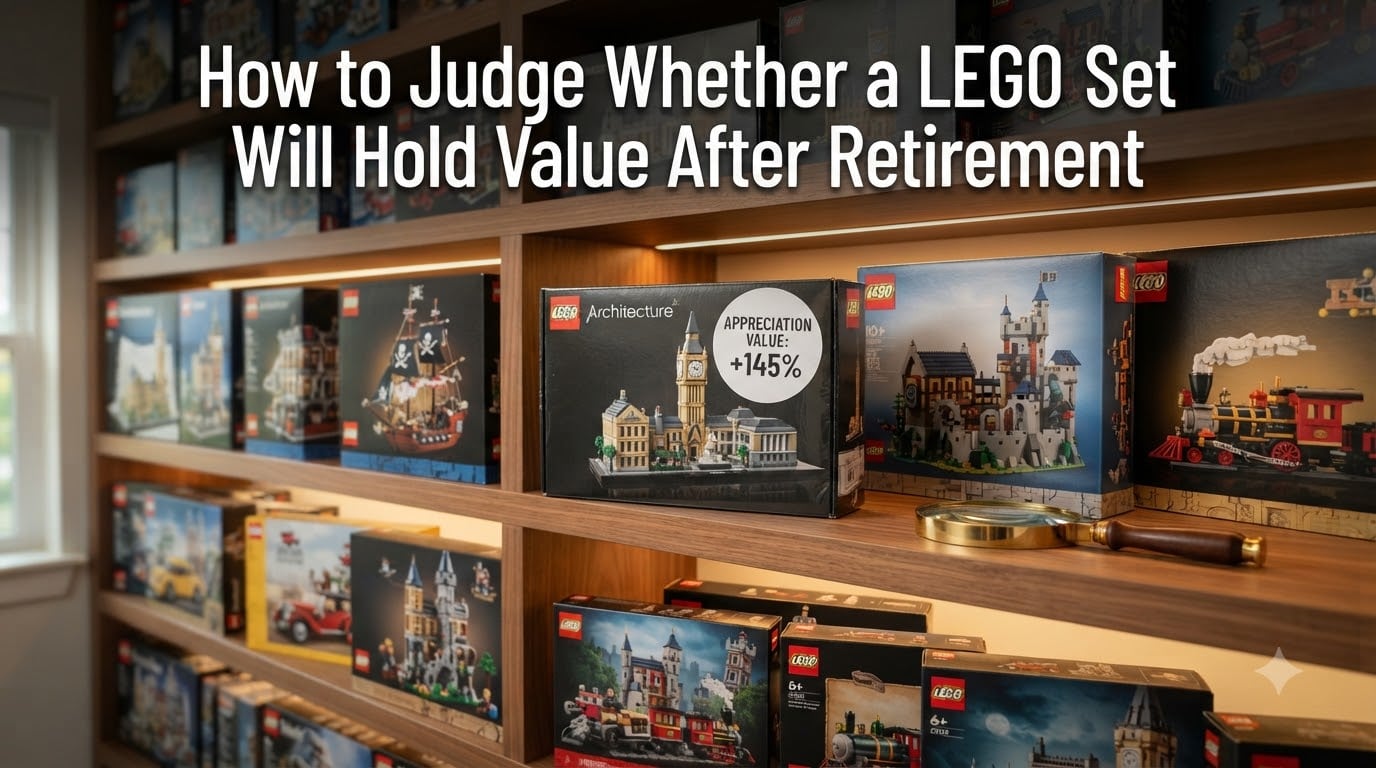
I’ve been collecting LEGO for years, and the question I get most often is whether a set will actually be worth more after LEGO stops making it. The honest answer is that some retired sets become gold, while others sit on shelves collecting dust next to their original price tags. After watching hundreds of sets through their full lifecycle, I’ll walk you through exactly how to judge whether a LEGO set will hold value after retirement.
You don’t need a finance degree to evaluate LEGO sets. You need a framework, the right data, and a clear understanding of what retirement actually means in the LEGO world. I’ll show you all three.
Table of Contents
What LEGO Retirement Means and Why It Matters
LEGO retirement is the moment LEGO Group officially stops production of a specific set. Once that happens, the supply on store shelves becomes fixed. No new sealed boxes will ever be made again.
The average lifespan of a LEGO set is roughly 3 to 5 years, though some popular sets can stay around longer and a few get pulled much earlier. After retirement, the only way to get a brand-new sealed copy is from the secondary market, which includes platforms like BrickLink, eBay, and B&M resellers.
This matters because retirement creates a supply shock. Demand from collectors, builders, and investors often remains steady or grows after retirement. When supply shrinks and demand holds, prices move up. That’s the core mechanic behind LEGO set appreciation, and it’s why retired LEGO sets value rises in many cases.
How to Judge Whether a LEGO Set Will Hold Value After Retirement: Core Factors
When I evaluate a set before buying, I run through a checklist of factors that consistently separate winners from losers. Here’s the framework I use.
Theme popularity: Themes like Star Wars, Harry Potter, Modular Buildings, and LEGO Ideas have proven track records of appreciation. Star Wars remains the king of the secondary market, but Harry Potter Modulars and licensed Icons sets are climbing fast.
Exclusive minifigures and pieces: A set with unique minifigures that you can’t get elsewhere tends to hold value far better than one with generic figs. The Dark Trooper Helmet saw massive returns partly because the Dark Trooper minifig was exclusive to that one set.
Display appeal: Sets designed to be displayed sell better after retirement. UCS Star Wars sets, Modular Buildings, and large Icons vehicles all have built-in display value that keeps demand high decades later.
Box condition (sealed status): A sealed, mint-condition box is worth dramatically more than an opened set. This is the single biggest condition factor.
Piece count sweet spot: Medium-sized sets in the 600 to 1,200 piece range tend to be the best investments. They are affordable enough to buy multiples, large enough to feel premium, and easier to store than UCS-scale sets.
Limited edition or promotional status: Sets sold only at LEGO Stores, conventions, or as promotions carry built-in scarcity that supports long-term value.
The 5/2 Rule Explained (And Why It Matters)
The 5/2 rule is a community shorthand that experienced LEGO investors use to set expectations for retired set performance. It stands for two related ideas.
The “5” refers to roughly 5% annual appreciation as a baseline expectation for a well-chosen set held over multiple years. The “2” refers to the fact that only about 2% of LEGO’s catalog is retired in any given year, which keeps supply tight relative to the overall catalog.
In practice, this rule gives you a reality check. If a set isn’t beating roughly 5% annual appreciation, it may not be worth tying up your capital. Conversely, if you’re chasing set-killing returns of 500% or more, you’re fishing in a very small pool. Most investors who follow the 5/2 rule outperform those who pick sets based purely on gut feeling.
Use the 5/2 rule as a baseline. Pick sets you expect to at least double MSRP in roughly 14 years at 5% annual growth, and treat anything beyond that as a bonus rather than the plan.
Theme Popularity and Exclusivity in Detail
Not all themes perform equally after retirement. From tracking data on BrickEconomy and BrickLink over the past decade, a few patterns stand out.
Star Wars Ultimate Collector Series (UCS): These sets consistently outperform the broader market. The 75192 Millennium Falcon remains a benchmark for LEGO investing, though it took years to reach its current value. UCS sets benefit from adult collectors with disposable income.
Modular Buildings: The Modular Buildings line has appreciated reliably since 2007. Café Corner, the original Modular, sells for many times its original MSRP. Newer Modulars tend to follow this pattern.
LEGO Ideas: Sets from the Ideas theme often perform well because they come from fan designs with built-in communities waiting to buy them.
Harry Potter and Icons: Both themes have strong followings. Hogwarts Castle and large Icons sets have shown solid post-retirement growth.
On the flip side, themes tied to short-lived franchises, obscure sub-themes, or sets marketed primarily to young kids tend to underperform. Always check whether the set has a long-term adult fan base before assuming it will hold value.
Condition: Sealed vs Opened vs Built
Condition is where most of the value gap lives. A sealed set can be worth two to four times what an opened version of the same set sells for.
Sealed (MISB): Mint In Sealed Box sets command the highest prices. The box must be undamaged, with all original seals intact. Creases, sun fading, or crushed corners significantly reduce value.
Open box, unbuilt: Sets that were opened but never built still hold meaningful value, often 60 to 80% of sealed pricing depending on how carefully the contents were stored.
Built, complete with box and manual: A complete built set with original box and instructions still has value, but the gap from sealed widens considerably.
Built, no box: Without original packaging, value drops significantly. Buyers have no way to verify completeness or authenticity, so prices compress.
If you’re buying sets to potentially resell or hold for value, keep them sealed. If you want to build them, accept that you’re paying for the experience, not the investment.
Timing: When to Buy and When to Sell
Timing matters as much as set selection. Most sets see their sharpest appreciation in the 6 to 12 months immediately after retirement. Some examples have achieved 35% gains or more in that first year.
Buying pre-retirement: The best entry is usually 3 to 6 months before retirement, when retailers discount remaining stock and you can still find sealed boxes at MSRP or below.
The retirement pop: The moment LEGO officially retires a set, prices on the secondary market typically jump overnight. This is the window where sellers make most of their gains.
Holding too long has risks: Holding for 5+ years isn’t always better. Some sets plateau, others get re-released in updated form, and storage costs add up. The community has seen plenty of investors who held sets “too long” and watched the market move on.
Seasonal patterns: Demand often spikes around the holiday season and during the summer building months. Listing at the right time can mean a 10 to 20% difference in final sale price.
Warning Signs a Set Won’t Hold Value
Not every set is a good investment. Here are the red flags I watch for before committing money.
Re-release risk: If LEGO remakes a similar set with updated branding, the original loses much of its scarcity. This has happened with several Creator Expert vehicles.
Market saturation: When too many investors buy the same set at once, supply floods the secondary market after retirement, killing the appreciation curve. Watch r/legoinvesting for chatter about oversaturation.
Weak theme momentum: If the parent franchise is fading in popularity, demand will fade with it. A 15-year-old movie franchise doesn’t drive the same collector interest as it did at launch.
Storage and capital costs: Holding sealed sets ties up space and money. If your opportunity cost is high or your storage is limited, smaller sets might serve you better than investing in a UCS-scale model.
How to Research Set Value Before You Buy
Smart LEGO investing starts before you ever click “buy now.” These are the tools I use to research any set I’m considering.
BrickLink: The official LEGO secondary market. Check the “Price Guide” tab for historical sales data of similar retired sets. This is the most reliable price reference.
BrickEconomy: Tracks price trends for individual sets over time. Useful for spotting whether a theme is appreciating or stagnating.
BrickPicker: A community site with investment ratings and retirement predictions. Useful for cross-referencing other sources.
r/legoinvesting: The Reddit community for LEGO investors. Useful for sentiment checks and warnings about oversaturation.
Before buying, run the set number through BrickLink and compare at least three recently retired sets from the same theme. If those comparables show 30%+ appreciation within a year of retirement, you have a reasonable expectation your set might perform similarly.
FAQs
Do LEGO sets increase in value after retirement?
Most LEGO sets increase in value after retirement, though results vary widely. Average returns run roughly 10 to 11% annually over the long term, with strong sets achieving 35% or more in their first year post-retirement. Theme popularity, exclusivity, and condition drive the actual outcome.
What is the 5/2 rule in LEGO?
The 5/2 rule is a community shorthand used by LEGO investors. The 5 refers to roughly 5% annual appreciation as a baseline expectation for a well-chosen retired set. The 2 refers to the fact that only about 2% of LEGO’s catalog retires each year, which keeps supply tight relative to the overall catalog.
How to determine the value of retired LEGO sets?
Use BrickLink’s Price Guide to check historical sales of comparable retired sets. Cross-reference with BrickEconomy for trend data and BrickPicker for community ratings. Compare three or more recently retired sets from the same theme to set realistic expectations for your set.
What is the average lifespan of a LEGO set?
The average lifespan of a LEGO set is roughly 3 to 5 years from launch to retirement, though popular sets can stay in production longer. Limited edition and promotional sets often have much shorter lifespans of just 1 to 2 years.
How do you know if a LEGO set will be worth money?
Look for these signals: strong theme popularity (Star Wars, Modular Buildings, Ideas), exclusive minifigures or pieces not available elsewhere, display appeal that appeals to adult collectors, limited edition status, and a piece count between 600 and 1,200. Sealed box condition multiplies value by 2 to 4 times compared to opened sets.
Do LEGO sets have good resale value?
Most LEGO sets hold at least MSRP value when sold on the secondary market, and well-chosen retired sets commonly sell for 1.5x to 3x their original price within a few years. Top performers like UCS Star Wars and Modular Buildings can reach 5x to 10x MSRP over longer time horizons.
Final Verdict: Is LEGO Investing Right for You?
Judging whether a LEGO set will hold value after retirement comes down to theme strength, exclusivity, condition, and timing. Use the framework I outlined here, research with BrickLink and BrickEconomy before you buy, and apply the 5/2 rule as your reality check.
LEGO investing is real, but it’s not magic. Most sets that hold value do so because smart collectors evaluated them carefully before retirement. If you want to learn how to judge whether a LEGO set will hold value after retirement, start with the checklist in this guide and apply it to your next purchase.
Pick sets you genuinely like, store them carefully, and let time do the rest. That’s the real formula.