
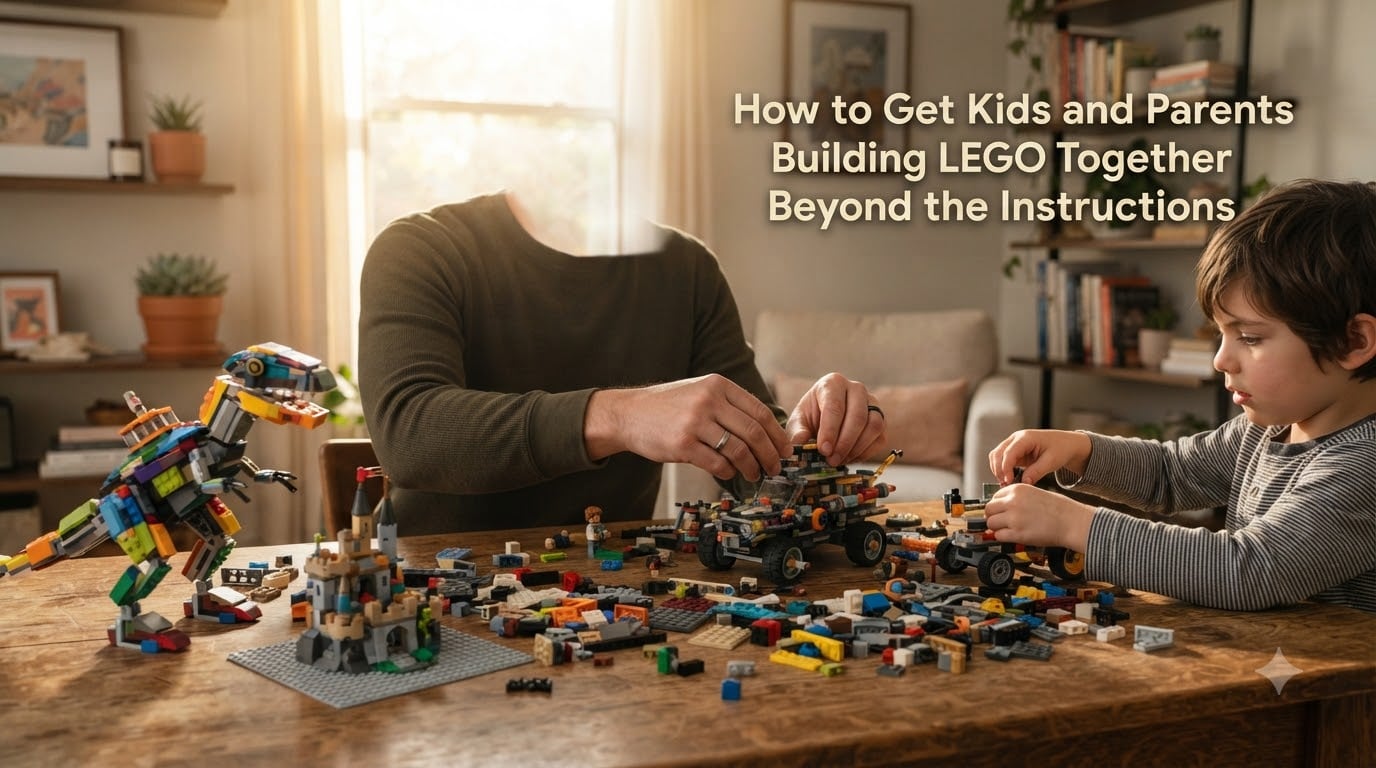
The first time my seven-year-old tossed the instruction booklet aside mid-build and announced, “I’m making a robot dinosaur now,” I froze. I had spent forty minutes hunting down the right gray slopes. In that moment, I realized something had shifted — LEGO had stopped being a kit and become a conversation between us.
That single decision to put the booklet down changed how our family builds. In this guide, I’m sharing what I’ve learned about getting kids and parents building LEGO together beyond the instructions — including the 5/2 rule nobody seems to talk about, free-build activities that actually engage reluctant builders, and a progression system that has turned my kids into confident creators.
Table of Contents
Why Building LEGO Beyond the Instructions Matters for Families
When we ditch the instruction booklet, something subtle but powerful happens: the power dynamic shifts. Suddenly my kids aren’t trainees following my lead — they’re collaborators pitching ideas alongside me. I’ve watched my daughter engineer a hamster obstacle course from a single 2×4 brick and a hinge plate, then teach her four-year-old brother how it worked.
Building LEGO beyond the instructions does three things the booklet can’t. It builds creative confidence because there’s no wrong answer. It strengthens problem-solving muscles when a creation collapses under its own weight. And it creates a shared language of inside jokes — every family seems to develop one or two weird LEGO mascots that show up in builds for years.
The screen-free, hands-on nature of free building matters too. In a week where my kids logged more iPad time than I’d like, our 45-minute LEGO session felt like a pressure release valve — both for them and for me.
Understanding Your Child’s Builder Personality
Before you can lead a free-building session, you have to figure out who’s sitting across the table. Over the past three years of building with my kids and watching other families at our local LEGO User Group, I’ve noticed three distinct builder personalities.
The Follower loves precision
The Follower wants the booklet open at every step. They’ll sort pieces by color before starting and refuse to skip ahead. Followers aren’t afraid of free building — they’re afraid of failing at it. Start them with low-stakes challenges (“Build the tallest tower you can with these eight bricks”) that have no model to compare against.
The Inventor dreams big
Inventors have seventeen unfinished builds on the table at all times. They love grand ideas but lose steam on execution. Inventors thrive on collaboration — your role is to be the builder-of-details. When my son announces a “battle arena with a drawbridge and a catapult,” I handle the small pieces while he sketches the layout with bigger bricks.
The Destroyer tests everything
The Destroyer builds to demolish. Crash tests, weight challenges, “how many bricks can this hold before it breaks” — these kids want to see physics in action. Lean into it. Build a ramp together, then race cars down it. The destruction isn’t failure; it’s data collection.
Knowing which type you’re working with changes everything about the rest of this guide.
Setting Up Your LEGO Building Space for Success
The first five minutes of any build session set the tone. I’ve learned this the hard way after dozens of “I’m bored” complaints that trace back to a missing baseplate or a tangled pile of technic pins.
Sort by color only when it helps. For complex sets, color-sorting saves sanity. For free building, mixed bins trigger more creativity because kids can see options they wouldn’t have searched for. I keep three bins available — large bricks, small bricks, specialty pieces (wheels, hinges, slopes).
Lighting matters more than people realize. We added a small LED lamp to our build table, and evening sessions got 30% longer because eye strain wasn’t cutting kids off after twenty minutes.
Build at kid-height when possible. A play mat on the floor or a kids’ table gets you eye-level with the work, which makes collaboration natural instead of feeling like you’re supervising from above.
Using the LEGO Builder App and Build Together Feature
The free LEGO Builder app has quietly become the most underrated parenting tool in our house. Its Build Together feature — released in 2025 — splits instructions across multiple devices so each family member can tackle their own section of the same set in parallel.
Here’s how we use it on a typical weekend. My phone shows steps 1-20, my daughter’s tablet shows steps 21-40, my son gets the final sections. Each builder pre-sorts their parts using the app’s piece list, then we build simultaneously while checking in with each other. The traditional “wait for Dad to finish step 14 before you can start” bottleneck disappears.
For younger kids (under 6), the 3D zoom and rotation features are transformative. A four-year-old doesn’t need to interpret the flat booklet — they spin the model on screen, see which brick goes where, then find it in the pile.
But the screen requires boundaries. We use a simple rule: the app is for instructions and piece-finding only. Once a section is complete, the screen goes away. This protects the hands-on magic that makes LEGO different from a YouTube tutorial.
Free Building Activities That Go Beyond the Instruction Booklet
Free-build prompts work best when they’re specific enough to start but open enough to evolve. Vague suggestions like “build something cool” usually end in blank stares or instant frustration.
My family’s favorite challenges include building the tallest free-standing tower (must survive a 10-second wobble test), designing a vehicle that can carry one minifig across a 12-inch gap without falling, and creating a “secret lair” with at least one trap door. We also love building a creature using only six bricks (the limitation forces creativity), constructing a bridge that holds the most pennies, and inventing a new vehicle for a minifig with a job (chef, astronaut, mail carrier).
Time-boxing helps hesitant builders. “You have 15 minutes — go.” I’ve seen Follower-types sketch out ambitious plans in that window that surprise everyone, including themselves.
Theme nights work too. “Pirate vs. Castle” challenge nights have produced some of our most elaborate builds. Each side gets the same brick budget and 30 minutes. We judge on creativity, not realism.
Save the best creations in a photo album on your phone. Six months later, your kid will flip through it and remember exactly what they were thinking when they built each one. That memory becomes motivation for the next session.
The 5/2 Rule in LEGO Building Explained
The 5/2 rule is a simple framework I’ve seen veteran AFOLs (Adult Fans of LEGO) use to keep their hobby balanced with family life, and it translates perfectly to parent-child building. The idea is this: for every 5 hours spent following instructions and building kits, spend 2 hours in creative, instruction-free building.
The ratio isn’t arbitrary. Five hours of structured building develops the technical skills your hands need — clutch power, sub-model construction, SNOT techniques. Two hours of free building keeps those skills from becoming rigid. Without creative time, builders tend to only know how to replicate patterns they’ve seen. Without structured time, creativity lacks technique to express itself.
For families, the 5/2 rule looks like a weekend rhythm. Saturday morning might be a 90-minute instruction build together — a Creator Expert set or a Technic vehicle. Sunday afternoon opens up free building where anything goes. Over a month, you’ll notice your kids starting to remix the instruction sets on their own, building extensions to official models or combining parts from two kits.
The rule also protects adult collectors. By giving free-build time its own dedicated slot, you keep the structured sets pristine while still satisfying the creative itch. My Creator Expert Ferris Wheel has stayed factory-fresh for two years because free building has its own brick bins.
If 5:2 feels too ambitious, start with 3:1. The exact ratio matters less than the principle: balance structured building with creative building so neither dominates.
Handling Mistakes and Building Resilience Together
Every parent who’s built with kids has lived the same scene: a 6-year-old in tears because a tower fell, a 9-year-old screaming that the wrong piece was used three steps back, a 4-year-old quietly dismantling a sibling’s hard work.
What I’ve learned is that mistakes aren’t problems to solve — they’re the actual lesson. LEGO is uniquely forgiving because almost every error is reversible. A brick placed wrong can be pried off. A section built in the wrong order can be disassembled and rebuilt.
Pre-build, we name the “mistake moment” out loud. “We’re going to put something in the wrong spot today. That’s not failure — that’s how we figure out the right way.” This simple announcement defuses 90% of the frustration that comes from surprise disappointment.
When frustration builds, switch tasks before scolding. Hand the kid a different section to sort, a minifig to pose, or stickers to apply. Small wins reset the emotional state.
Letting Kids Lead: Stickers, Minifigs, and Customization
The cheapest, fastest way to build ownership is to hand over the parts that don’t affect structural integrity. Stickers placed slightly crooked teach children that perfection isn’t the goal — expression is. Our family rule: stickers go where the kid wants them to go, period.
Minifig customization is another low-stakes ownership moment. We keep a bin of extra hair pieces, faces, and accessories. Before starting a set, each kid customizes their own minifig who “lives” in the build. Six months later, those customized figures resurface in completely different sets. Continuity becomes storytelling.
When my daughter took over organizing all the tiny accessory pieces for our Modular Building Series set, she became the “Accessories Director.” That title mattered more to her than any structural work — and the role made her invested in finishing the build.
Building Confidence: A Progression System That Works
After watching dozens of families at our LEGO User Group, I’ve noticed the kids who thrive follow a predictable progression. The stages aren’t about skill — they’re about confidence.
Beginners start with parallel play where parents and kids build separate models side-by-side. The kids aren’t building together yet, but they’re learning to build alongside someone. Duplo and 4+ sets work great here.
Helpers then graduate to the assistant role where they sort pieces, hand bricks over, and apply stickers. They’re supporting the build without leading it. Junior sets (7+) fit this stage perfectly.
Collaborators start suggesting modifications, picking up steps the parent is too tired to finish, and occasionally catching mistakes before they happen. Creator 3-in-1 and small City sets live in this zone.
Leaders run their own builds with the parent as the assistant. By this stage, kids are running entire sub-builds while the parent holds pieces and follows directions.
Don’t rush these stages. Skipping from Helper to Leader sets kids up to fail publicly, which can poison the whole hobby. Six months in each stage is fine — there’s no finish line.
One practical tip: keep a “skills journal” where kids draw or dictate what they built this month. Reviewing it every six months reveals growth that’s invisible in the day-to-day.
Frequently Asked Questions
What is the app that lets you build Legos together?
The LEGO Builder app has a Build Together feature that lets multiple family members work on the same set from different devices. Each person gets a section of the instructions on their own phone or tablet, then you build simultaneously and check in as you go. It works with most new kid-oriented sets and is available free on iOS and Android.
How to build LEGO with no instructions?
Start by sorting your bricks into large, small, and specialty bins. Pick a simple prompt like u0022build the tallest tower you canu0022 or u0022create a vehicle for one minifig.u0022 Set a 15 to 30 minute timer so kids don’t feel overwhelmed by endless possibilities. Build alongside your child rather than directing them, and save photos of finished creations for motivation.
What is the 5/2 rule in LEGO?
The 5/2 rule in LEGO means balancing 5 hours of structured, instruction-following building with 2 hours of free, instruction-free creative building. This ratio keeps technical skills sharp while giving creativity room to develop. For families, it works well as a weekend rhythm: one session building a kit together, another session creating freely.
Why do kids with ADHD like LEGO?
Kids with ADHD often love LEGO because it provides immediate physical feedback — clicks, snaps, and visible progress every few seconds. The build follows predictable steps with a clear end goal, which gives structure without feeling restrictive. The hands-on nature also offers a built-in fidget component that helps with focus and regulation.
What are the benefits of building LEGO together as a family?
Building LEGO together as a family builds creative confidence in kids, develops fine motor skills, strengthens problem-solving abilities, and creates shared memories. Parents get screen-free bonding time while kids practice patience, collaboration, and persistence. The collaborative dynamic also teaches children that mistakes are fixable and creativity has no wrong answers.
How does building LEGO help a child’s development?
Building LEGO helps a child’s development in several measurable ways. Fine motor skills improve as small fingers manipulate pieces. Spatial reasoning grows through rotating and fitting parts together. Math skills get reinforced through counting, symmetry, and pattern recognition. Executive function develops as kids plan multi-step builds and recover from mistakes. Social skills build through collaborative play and taking turns.
Final Thoughts
Getting kids and parents building LEGO together beyond the instructions isn’t a complicated formula. It’s about creating a space where the booklet is optional, the mistakes are celebrated, and the time together matters more than the model at the end.
Start small. Sort the bins, pull up the Build Together feature, and try one of the free-build prompts this weekend. Apply the 5/2 rhythm. Match your approach to your child’s builder personality. Most importantly, put your phone down and build something weird next to them.
The robot dinosaur I mentioned at the start of this guide still sits on our shelf. It’s lopsided, the colors clash, and one leg is a wing piece because that’s what was on the table. It’s also the most treasured build in our house — because it was the first one we made together without anyone telling us how.