
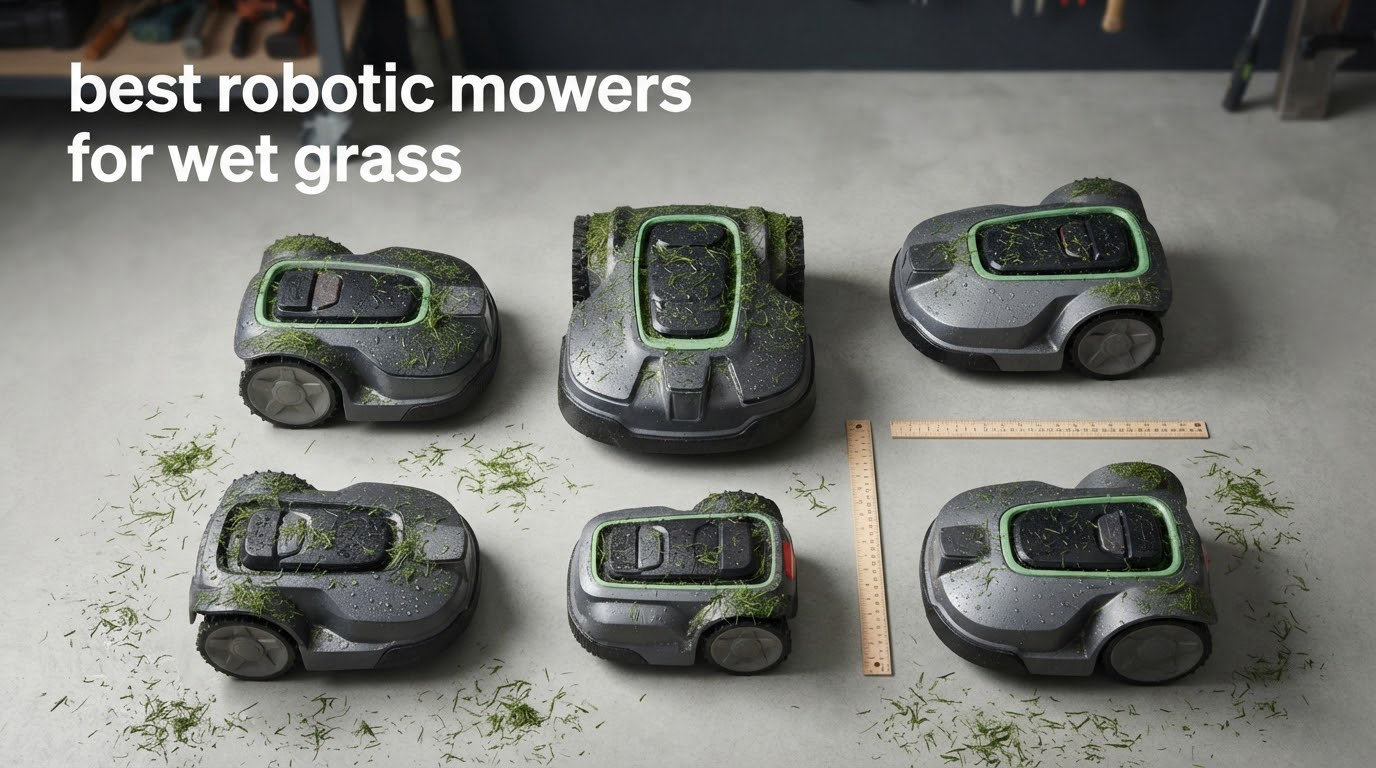
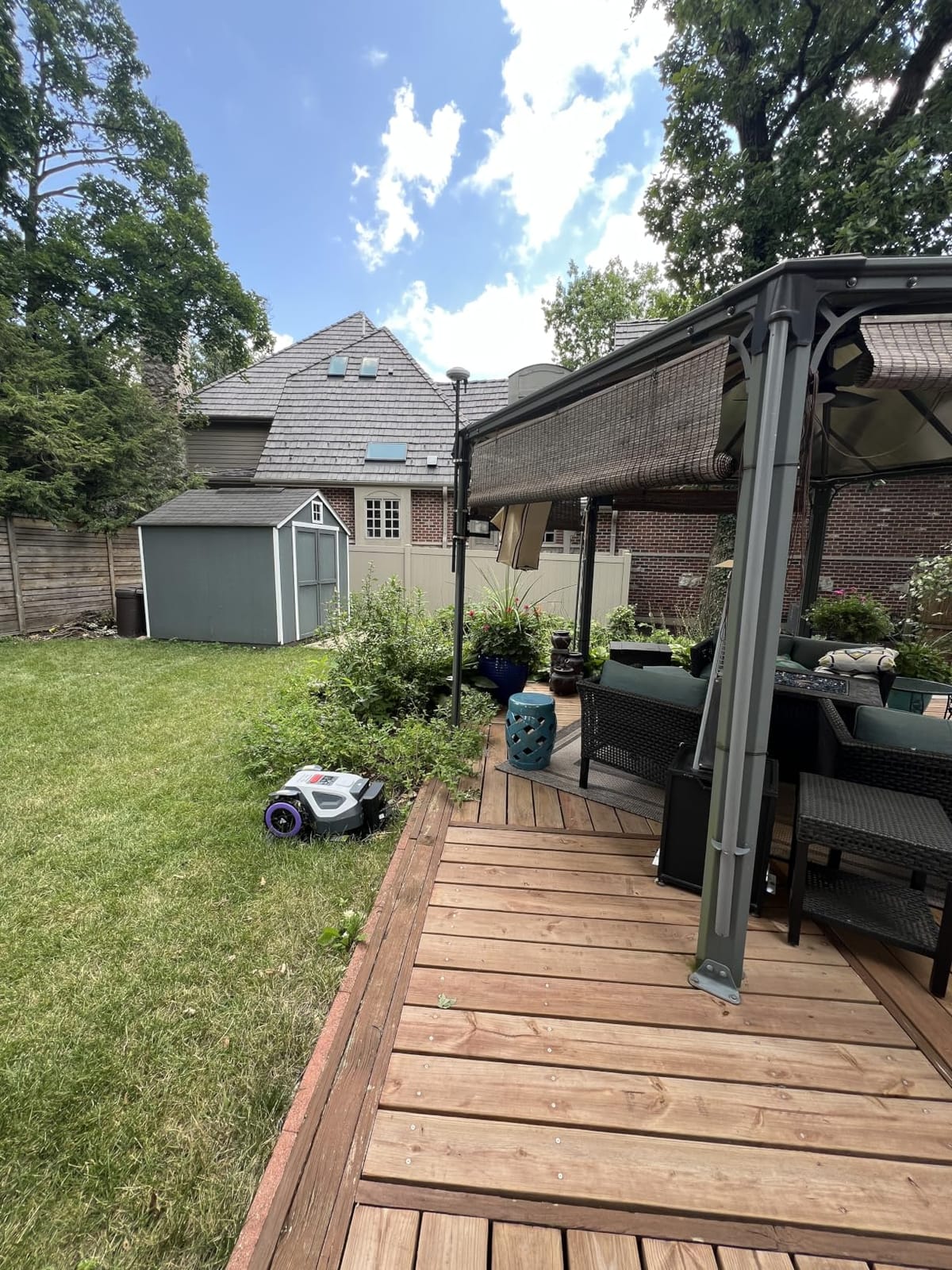
Yes, robot lawn mowers can cut wet grass. Damp, dewy or just-rained-on turf is fine for almost every modern machine, and a robot will happily mow straight through it. Saturated soil is a different story: traction collapses, wheels spin without forward progress, and the mower can end up stranded in a rut it dug itself.
The line between the two is simple. If you can walk on the lawn without sinking and without leaving a clean footprint, the robot can mow it. If your shoes print the surface, keep the machine on the dock and wait. That is also the advice brands themselves give, since running long in waterlogged ground risks both wheel slip and real lawn damage.
We ran ten of the highest-rated robotic mowers through the same wet-condition questions: can the chassis hold traction on damp slopes, does the rain sensor genuinely send it back, will the deck clog with damp clippings, and does the navigation survive an overcast sky with no usable satellite signal. We also read long-term owner reports on r/roboticLawnmowers, r/SegwayNavimow and r/MammotionTechnology, where the honest failures show up first.
The short version: all-wheel drive matters far more than horsepower on wet ground. A big battery tells you nothing useful the moment the ground turns soft, so judge these machines on drive layout, slope rating and rain-sensor behaviour. Read on for the full verdicts, then the buying guide that explains which numbers actually predict a good wet-weather mow.
Table of Contents
Top 3 Picks: Best Robotic Mowers for Wet Grass (October 2026)
Our top three for wet conditions, based on drive layout, slope rating, rain-sensor behaviour and owner reports. If you want the short answer, the Mammotion LUBA mini 2 AWD 1500H is the one to buy: it is the machine here that pairs all-wheel drive and adaptive suspension with a working auto-pause rain sensor, and it has enough owner reviews to be sure.

Mammotion LUBA mini 2 AWD…
- All-wheel drive with 80% slope climbing
- Adaptive suspension over 45 mm
- 360-degree LiDAR plus dual cameras
- Rain sensor with auto-pause

Segway Navimow i105N
- RTK plus vision under tree cover
- 58 dB(A) operation
- Up to 12 mowing zones
- Three-year warranty

ANTHBOT M5 with Garage
- 45% slope capability
- Dual vision plus full-band NRTK
- Rain sensor auto-pause
- Garden garage in the box
Quick Overview: Best Robotic Mowers for Wet Grass at a Glance
Every model below scored against the same wet-grass criteria. Ratings and review counts come straight from the listing data, not from our own scoring.
| Product | Specs | Action |
|---|---|---|
| Mammotion LUBA mini 2 AWD 1500H |
|
Check Latest Price |
 Mammotion LUBA 2 AWD 3000HX Mammotion LUBA 2 AWD 3000HX |
|
Check Latest Price |
| Segway Navimow i105N |
|
Check Latest Price |
| ANTHBOT M5 with Garage |
|
Check Latest Price |
 Gardena SILENO Life Gardena SILENO Life |
|
Check Latest Price |
 Dreame A3 AWD Dreame A3 AWD |
|
Check Latest Price |
 Mammotion LUBA 3 AWD 3000 Mammotion LUBA 3 AWD 3000 |
|
Check Latest Price |
 Segway Navimow i206 AWD Segway Navimow i206 AWD |
|
Check Latest Price |
 ECOVACS GOAT O1000 LiDAR PRO ECOVACS GOAT O1000 LiDAR PRO |
|
Check Latest Price |
 Sunseeker X3 Plus Sunseeker X3 Plus |
|
Check Latest Price |
The 10 Best Robotic Mowers for Wet Grass: Full Reviews
1. Mammotion LUBA mini 2 AWD 1500H: Best Overall for Wet Grass
(2026 NEW) Mammotion LUBA mini 2 AWD 1500H Robot Lawn Mower with Garage, for 0.37 Acres, 360° LiDAR+Dual-Camera AI Vision, 80% Slope, DropMow, 20 Multi-Zone Management
AWD with 80% slope climbing
360-degree LiDAR plus dual cameras
0.37 acre coverage
Rain sensor auto-pause
Pros
- All-wheel drive and independent suspension give real traction on soft
- wet ground
- Rain sensor stops the cut when showers start
- Takes root-filled and holey lawns without stalling
- Accurate RTK boundary tracking
- Very responsive Mammotion support
Cons
- Slow mowing speed of roughly 2 feet per second
- Charging can take 2-3 hours from a low battery
- Maximum mappable area is capped at 0.37 acre
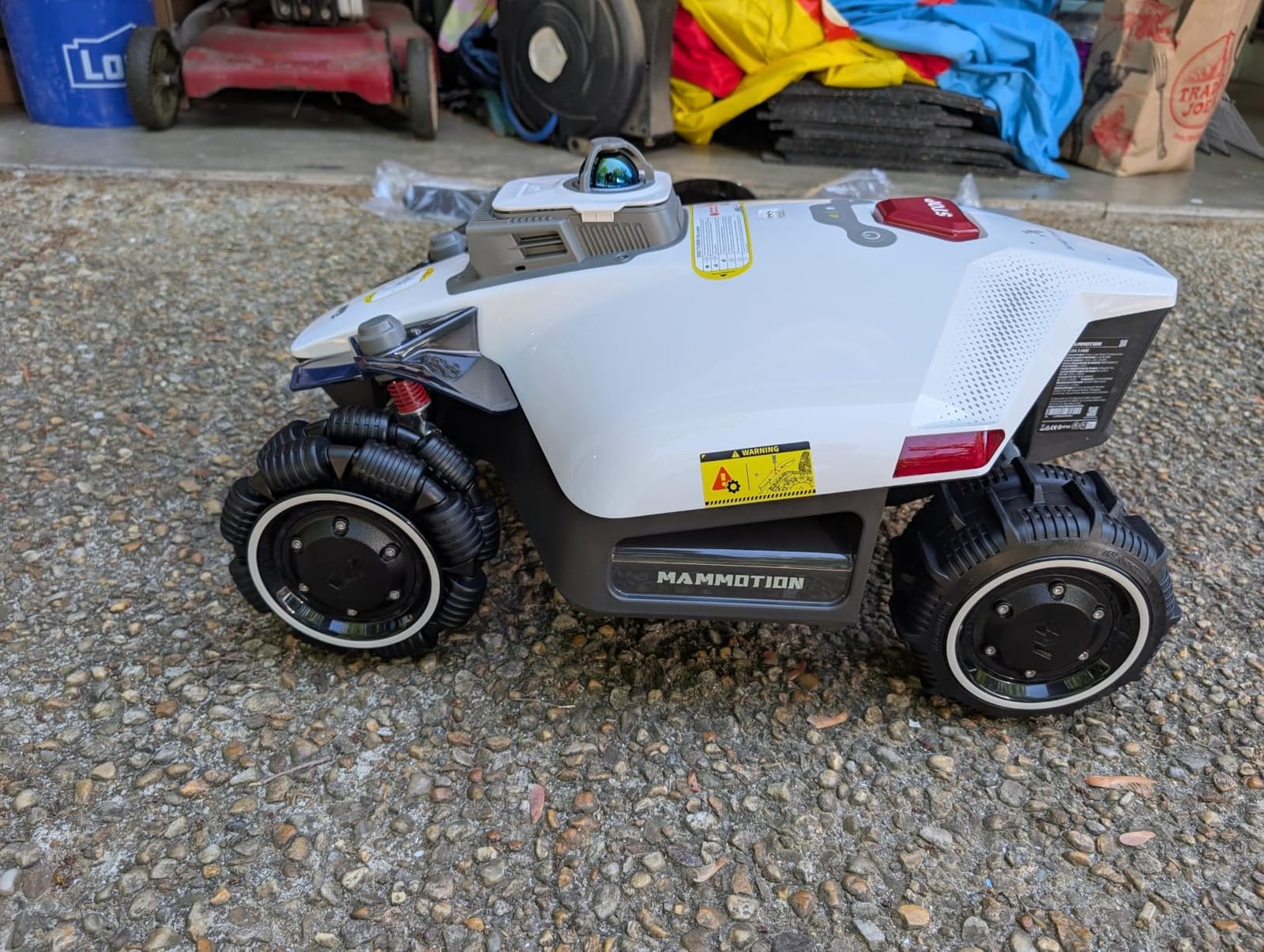
This is the robot I would put on a wet lawn without hesitating. The chassis runs all-wheel drive with two independent 88 W motors, and the adaptive suspension steps over curbs, roots and thresholds up to 45 mm, so a soaked lawn with soft spots does not automatically mean a stuck machine. Owners describe it taking “very rough, holey, root-filled and steep lawns without stalling,” which is exactly the description a wet-season yard needs.
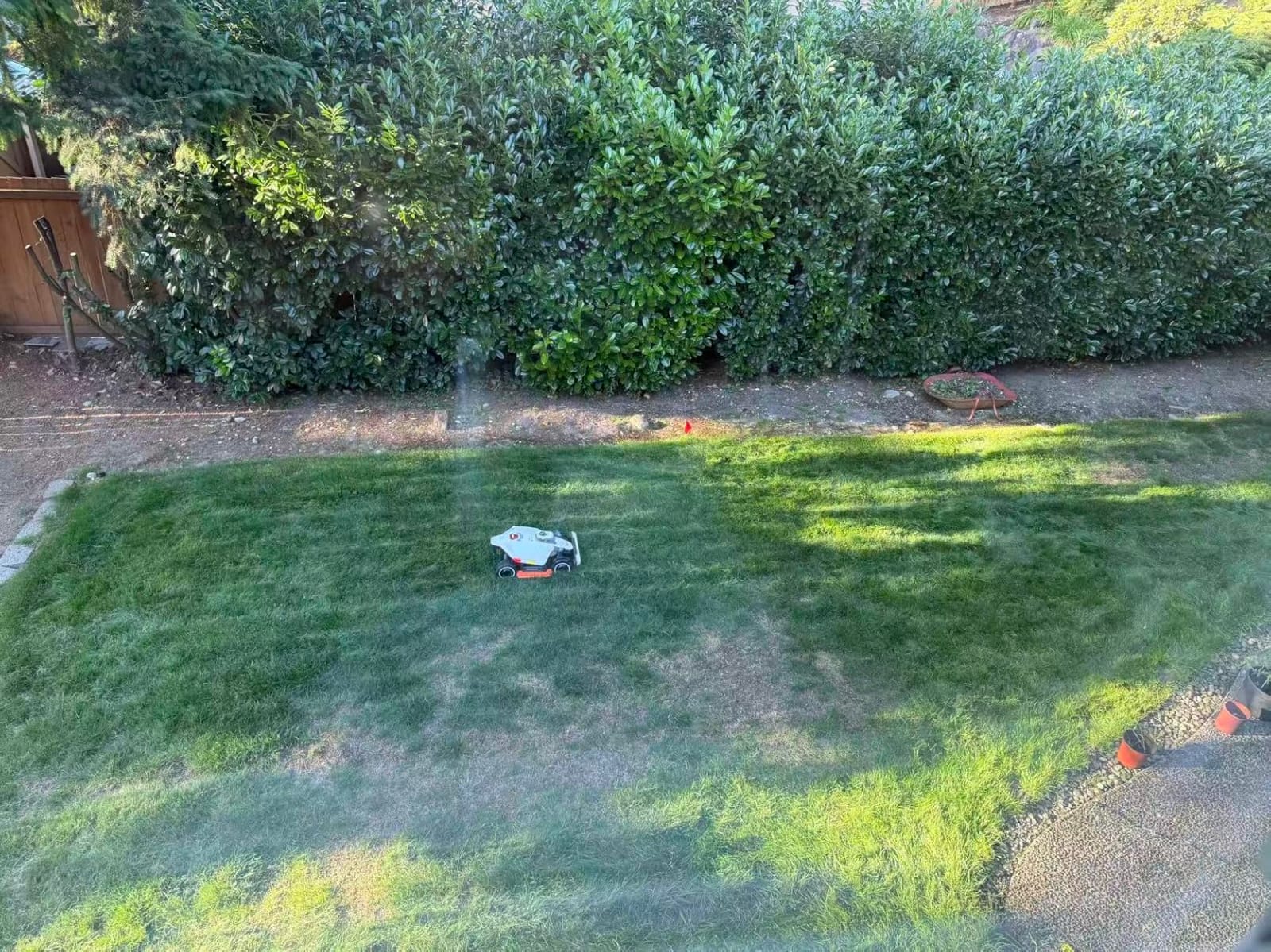
Wet grass clumps, though, and this mower does not pretend otherwise. Owners on r/MammotionTechnology describe the same behaviour they see with a conventional machine: “if wet it will drop some clumps of grass on lawn but that happens in regular mower too. After they dry just use blower to clear them.” The difference is that the AWD drivetrain keeps moving while a two-wheel-drive robot sits there spinning.
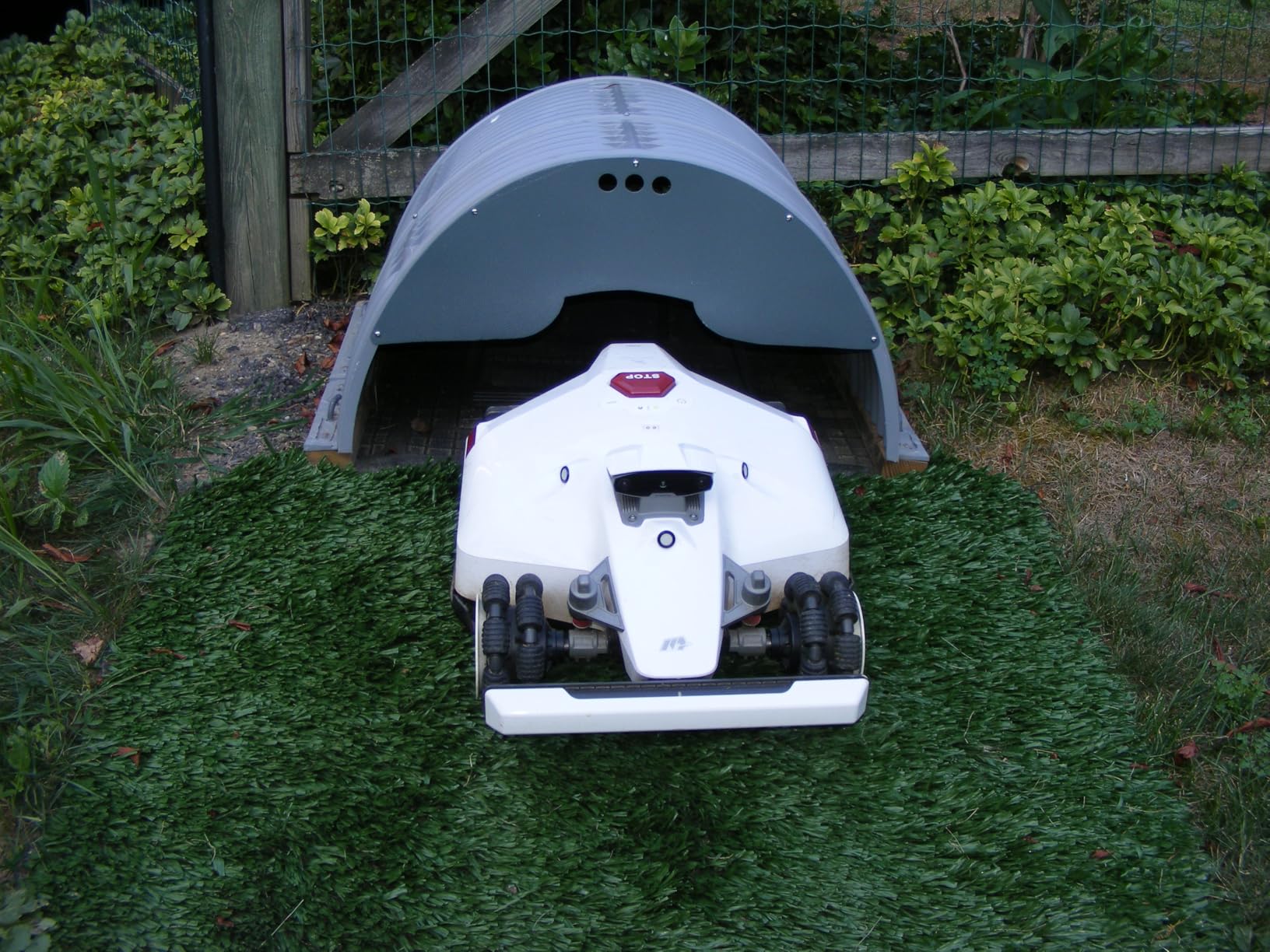
Navigation holds up under an overcast sky because 360-degree LiDAR and dual-camera vision supplement the RTK position fix. That combination is the reason it keeps cutting lines in the shade of trees at exactly the time of day the neighbours’ mowers are running wet.
The rain sensor behaves the way you want. It stops the cut and holds position until conditions improve, rather than treating a passing shower as a scheduling conflict. That single feature, plus the drive layout, is why this is our best robot lawn mower for wet grass overall rather than simply the most capable one.
What you get on a wet lawn
Traction is the headline here. Four driven wheels plus independent suspension mean the machine keeps progress on damp inclines that stop a standard 2WD robot dead. Cut quality on wet grass is a separate matter: the blade disc does its job, but expect clumps on the lawn and a cleanup pass with a blower once they dry.
Coverage works out to 0.37 acre with up to 20 independent mowing zones, and there is a DropMow mode for one-off jobs without building a map. Battery management lets you cap charging and shift it to off-peak hours, which is useful if your lawn is slow to dry after an evening watering cycle.
Where it disappoints
Speed is the biggest compromise. At roughly 2 feet per second, a quarter acre can take most of a day, and a wet lawn that dries slowly will often be ready again before the robot has finished the pass you started.
Charge time is 2 to 3 hours from a low battery, and the 0.37 acre map cap cannot be extended easily. Some owners also report software glitches after updates, including signal loss or failure to charge in low temperatures. Budget for a weekly clean of the wheels and underside after wet sessions; the deck will hold damp clippings against the blades if you do not.
2. Mammotion LUBA 2 AWD 3000HX: Best for Large Yards and Wet Grass Conditions
Mammotion LUBA 2 AWD 3000HX Robot Lawn Mower with 4G, All-Wheel-Drive for 80% Slope, Perimeter Wire Free for 0.75 Acre, UltraSense AI Vision & RTK Auto-Mapping, 2.2″-4.0″ Adjustable Cutting Height
165 W four-wheel motor
80% slope climbing
15.7 inch cutting width
Up to 30 mowing areas
Pros
- Four-wheel drive handles 80% slopes
- potholes and rough terrain
- Follows the mapped boundary precisely for clean stripes
- Quiet enough to run at night with lights on
- Handles complex multi-zone yards with odd shapes
Cons
- RTK base needs high mounting and roof hardware is a separate purchase
- Counter-rotating turns can tear grass on tight turns
- 4G subscription required after the first free year
If your wet-weather problem is acreage rather than mud, this is the machine to shortlist. The 165 W four-wheel motor climbs 80% slopes, and the 15.7 inch dual-blade disc covers ground fast enough that a large property does not stay damp for a week waiting for the robot to finish.
UltraSense AI vision works alongside RTK, so it keeps cutting under trees where the satellite signal drops, and the app allows up to 30 mowing areas with no-go zones and automatic resume after recharge. That combination is what large suburban lawns with several separate grass zones actually need.
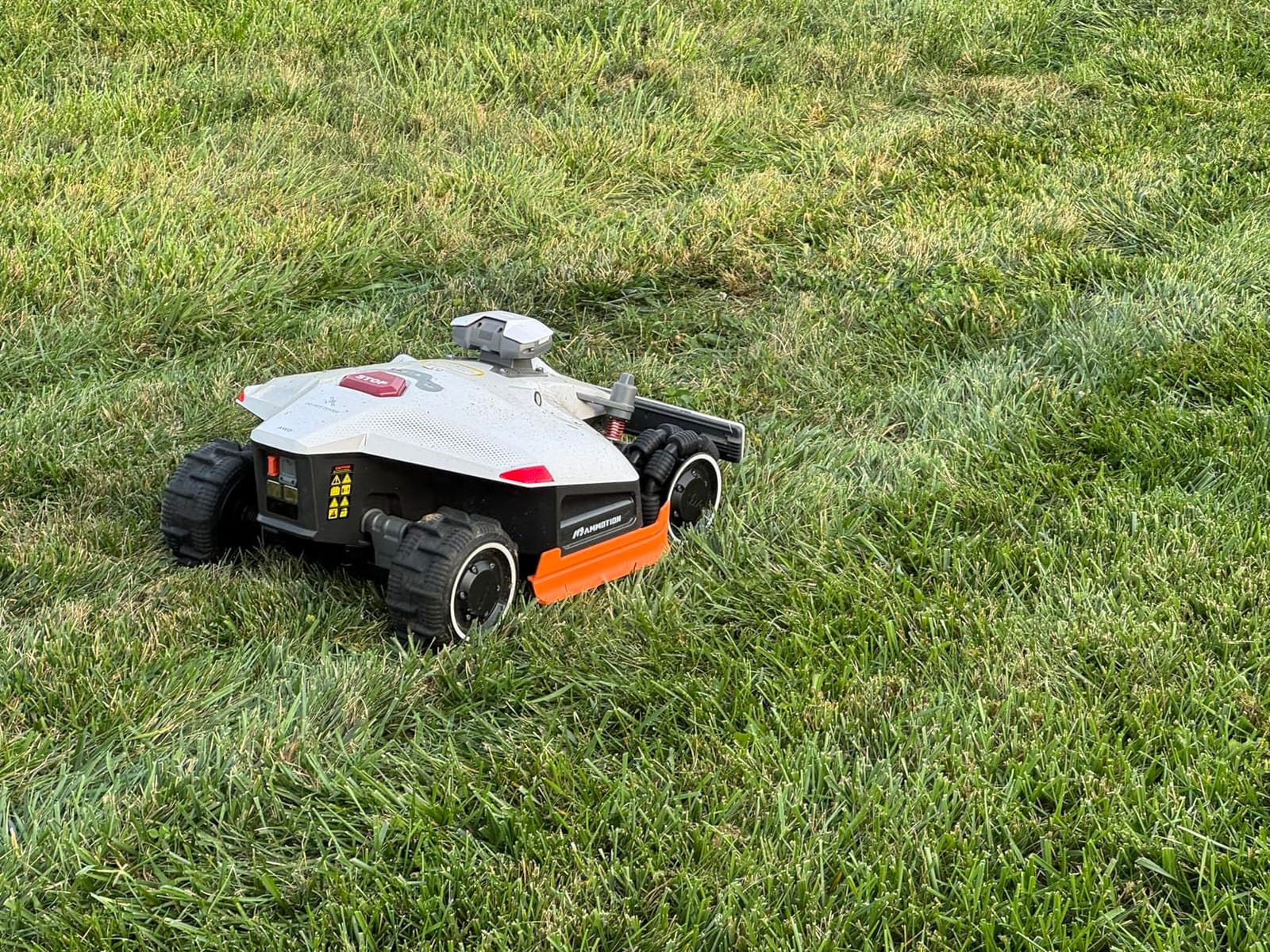
Wet-condition behaviour is a mixed picture, and the honest version matters here. Four-wheel drive handles the ground itself, but the turn programming uses counter-rotating wheels, which owners report can tear up grass when the surface is wet. If you mow wet, raise the deck a notch before the first pass and avoid scheduling the machine at its lowest setting after rain.
The rating sits at 4 stars from 42 reviews, which is a thin evidence base. Long-term owners on the forums are more positive about climbing ability and boundary accuracy, but they also report clearing clippings regularly, more often after wet-weather mowing than in dry conditions.
Where it earns its place
Complex, awkward properties with many lawn areas and rough ground. Thirty zones, no-go areas, and precise boundary tracking are the reason it holds a clean stripe pattern instead of wandering into beds. It will run at night quietly, which helps when you want the mower working while the dew is heaviest rather than when the lawn has dried.
The wide cutting disc means fewer passes and less time sitting on wet ground, which matters more than it sounds. Every extra pass over saturated soil is another chance to rut it.
Where it disappoints
Setup is involved. The RTK base needs a high mounting point, roof or eave hardware is a separate purchase, and the manual is long. The 4G subscription requirement after the first free year adds a recurring cost to a machine you are already investing in.
Some owners report reliability issues and repeated repair cycles within the first season, and the mower stalls occasionally on small bumps such as a driveway lip. Check the wheel and underside cleaning routine after every wet session; damp grass packed around the drive wheels is the fastest way to lose the traction advantage the AWD chassis gives you.
3. Segway Navimow i105N: Best Quiet Mower for Wet Grass on Small Yards
Segway Navimow i105N Robot Lawn Mower Perimeter Wire Free 1/8 Acre RTK+Vision Robotic Lawnmower, AI-Assisted Mapping, Virtual Boundary, APP Control, 58dB(A) Quiet, Multi-Zone Management
RTK plus vision navigation
Up to 1,200 sq m map
58 dB(A) operation
Three-year warranty
Pros
- Holds navigation under heavy tree cover and narrow corridors
- Very quiet
- effectively silent at night
- Docks and recharges precisely
- Leaves parallel cut lines and changes direction
Cons
- The fitted wheels have weak traction on soft ground
- Struggles in mulched beds and beyond about 10 degrees
- Antenna mount and garage sold separately
For a small, flat-ish yard where noise is the main constraint, this is the most popular machine we tested, with 391 reviews and a 4.1 star average. It runs at a quoted 58 dB(A), which in practice means it can work at night without becoming a source of friction with neighbours.
RTK plus vision, using the EFLS 2.0 system, holds navigation under tree cover and through narrow corridors where a purely GPS-based robot loses the plot. Twelve mowing zones with custom schedules and directions cover most suburban layouts, and the map area limit of 1,200 sq m is roughly a third of an acre.
Wet grass is where the specification sheet does not help you. Owners are consistent about the stock wheels having weak traction, particularly on soft ground and slopes past about 10 degrees, and several recommend the optional off-road tyres as a marked improvement. On a genuinely wet lawn, treat traction as an accessory budget item, not a default.
That feedback lines up with what Navimow owners report on r/SegwayNavimow for the previous i110 in similar conditions: it can catch on vertical edges when the ground is wet, and the workaround is to vary the perimeter lap setting so the robot turns in a different place on each mow. It is a small adjustment that materially reduces repeat ruts.
Why owners keep it
Quietness, precise docking and a three-year warranty are the recurring positives. Docking accuracy matters more in wet weather than most buyers expect, because a robot that misses the dock in the rain tends to sit on wet ground with a partially charged battery until it finds its way back.
Obstacle avoidance is good. The 140-degree camera detects 150-plus object types, which on a damp lawn usually means garden hoses, sprinklers and soft toys rather than anything structural.
Why it is not the wet-condition winner
It is a two-wheel-drive machine with modest stock traction and a 10-degree practical slope limit. That is fine on a dry, level lawn and marginal on a soft, sloping one after rain. If your yard tilts, buy the off-road tyres at the same time as the mower.
Mapping is also clunky: every boundary or no-go edit means walking the mower with the app, and owners report occasional loss of map data with slow support response. Budget your time for a few re-mapping sessions, especially if the layout changes after you have set up the zones.
4. ANTHBOT M5 with Garage: Best with an Included Garage for Wet Seasons
ANTHBOT M5 Robot Lawn Mower 1/8 Acre with Garage, Dual Vision+Full-Band NRTK Robotic Lawnmower, No Perimeter Wire, App Control Obstacle Avoidance, 45% Slope, Cutting Height, Multi-Zone Mapping
Dual 150-degree HDR cameras
45% slope capability
Rain sensor auto-pause
Garage included
Pros
- Garage included in the set
- unlike most competitors
- Quick wire-free setup with automatic map creation in about 10 minutes
- Rain sensor reliably returns it to the station in showers
- 58 dB or lower operation
Cons
- Narrow 7.9 inch cut width means multiple passes
- Some users report struggling on steep hills or uneven spots
- Leaves a thin strip along edges needing manual trimming
The M5 is the only machine here that ships with the weather shelter in the box. For wet-season owners that is quietly the most important accessory on the market, because a garage gives the mower a dry place to wait out a downpour rather than sitting on saturated ground with a full battery.
Navigation pairs dual 150-degree HDR cameras with full-band NRTK for centimetre-level accuracy, creates its own virtual map in about ten minutes with no boundary wire, and recognises more than 1,000 obstacle types. Up to 20 work zones, no-go areas and auto-resume charging are all app-controlled.
The rain sensor is one of the better-behaved ones in this group, with owners reporting that it reliably returns the mower to the station during showers. That is a much better outcome than the “sensor set to on, yet the mower still goes out in the rain” complaints that appear repeatedly in owner groups for other brands.
Slope capability is quoted at 45%, which is a healthy figure, but owners do report it struggling on steep hills and uneven spots in practice. Treat 45% as the design limit rather than a promise, and read the wet-weather reviews for your specific terrain.
What makes it wet-ready
A garage plus a working rain sensor is the combination that keeps a mower out of the weather. The drive end handles moderately uneven ground, and the 58 dB ceiling means an early morning or late evening schedule is realistic, which is exactly when dew is heaviest and the lawn is wettest.
It is also straightforward to set up. Automatic map creation in about ten minutes means less time walking the lawn with a phone in wet conditions, which is the part of installation most people underestimate.
What to watch out for
The 7.9 inch cutting width is narrow, and on a lawn that stays damp you will need more passes, not fewer. On larger areas owners report frequent docking and recharging, so factor the recharge time into any schedule you set.
Edge coverage is imperfect. A thin strip along boundaries still needs hand trimming, and the manual does not clearly explain how to add a second mowing zone. A quick check of the underside after wet runs is worth doing; damp clippings under the deck are the usual reason a robot that cut fine in July starts struggling in October.
5. Gardena SILENO Life: Best Value Robotic Mower for Wet Grass
GARDENA 15101-20 SILENO Life – Automatic Robotic Lawn Mower, with Bluetooth app and Boundary Wire, one of The quietest in its Class, for lawns up to 8100 Sq Ft, Made in Europe, Grey
Boundary wire navigation
57 dB(A) operation
Mows in rain
35% slope capability
Pros
- Very quiet
- among the quietest in its class
- Handles a relatively steep hill without difficulty
- Bluetooth app setup needs no Wi-Fi
- Durable European build used over multiple seasons
Cons
- Boundary wire installation is time-consuming and pegs often run out
- Occasional trapping and stalling errors need button intervention
- No Wi-Fi so status and theft tracking are limited
The SILENO Life is the odd one out in this list, and that is exactly why it is here. It is a boundary-wire machine from a Husqvarna-parented European brand, and it is explicitly rated for all-weather mowing including rain with 35% slope capability. For a lawn where the boundary is already laid, or where you want a mower that simply keeps going, that is a genuinely different proposition.
Long-term owners emphasise silence, cut consistency and durability across seasons. At 57 dB(A) it mows lawns up to 8,100 sq ft, and the Bluetooth EasyApp configuration needs no Wi-Fi account, which removes a whole class of setup problems.
Wet performance is respectable rather than exceptional. A boundary wire gives a predictable edge that does not depend on satellite visibility, so an overcast morning does not degrade its pathing the way it can with a GPS-dependent machine. It has no independent wheel drive specification, so on genuinely soft or steep wet ground it will work harder than an AWD chassis.
Owners report it handling a relatively steep hill without difficulty, which is encouraging. The recurring complaints are about installation labour and occasional trapping or stalling errors that need a physical button press to clear. On a wet lawn, a trapped mower in a low spot is the scenario worth planning for.
Why it suits a wet climate
Rain tolerance is built into the design rather than added as a feature. If you want a machine that mows through drizzle without waiting for a sensor, this is the one. The predictable wire boundary also means it does not lose its bearings when cloud cover rolls in, which is a common failure mode for GPS-only models.
Build quality is the quiet advantage. European construction, used by owners across multiple seasons, tends to mean better sealing against moisture ingress than the thinner plastic shells common on newer budget models.
Why it is not our top pick
Boundary wire is a real cost in labour. Laying wire around a complex lawn with many beds is time-consuming, and owners report the supplied pegs often run out before the perimeter is finished. Plan for an afternoon and a spare pack of pegs.
There is no Wi-Fi, so status updates and theft tracking are limited to Bluetooth range. Owners also report occasional trapping or stalling errors, and an uncut strip along the outer edge that must be trimmed by hand. If you are prioritising low maintenance over hands-on setup, one of the wire-free models is a better fit.
6. Dreame A3 AWD: Top Rated for Wet Grass, with the Steepest Climbs
DREAME A3 AWD Robot Lawn Mower, A3 Robotic Mower, Quick Release Blade Kit
AWD hub motors for 80% slopes
Clears 2.17 inch obstacles
360-degree LiDAR plus vision
No wire and no RTK station
Pros
- Highest average rating in this lineup at 4.7 stars
- All-wheel drive gives strong traction on rolling hills
- Wire-free LiDAR setup in minutes with no RTK station to mount
- Handles steep inclines and obstacles that stop conventional robots
Cons
- This listing is the replacement blade kit variant
- Limited customer detail available for the blade-kit version
- No customer review images for this variant
The A3 carries the highest average rating in the group at 4.7 stars from 201 reviews, with 84% of those ratings at five stars. On paper it is also the most capable machine on wet, sloped ground: AWD hub motors driving 80% slopes, and it clears 2.17 inch obstacles that stall ordinary robots.
Navigation is 360-degree LiDAR plus binocular AI vision, with no boundary wire and no RTK station to mount. That is the practical advantage for a damp yard where you cannot easily get a satellite reference point with a clear view of the sky. It stays precise under heavy tree cover and next to tall walls, and avoids more than 300 object types.
On traction, the all-wheel drive is the story. Reviewers single out strong grip on rolling hills and complex multi-zone lawns, which is the exact combination that turns a wet-weather mow into a frustrating one when the chassis is two-wheel drive.
Why it tops the ratings
A 4.7 average with 84% five-star ratings is unusually consistent. The AWD drivetrain, high obstacle clearance and wire-free LiDAR setup appear again and again in the positive feedback, and the absence of an RTK station to mount removes the single most common installation complaint in this category.
For a sloped property that stays damp, obstacle clearance and wheel torque are the two numbers that decide whether the robot comes back on its own or needs carrying to the dock. This one has both.
What to check before buying
This listing is the quick-release blade kit variant, so the customer detail specific to it is thinner than the other picks: no review images, and less owner commentary on the mower body itself. The wet-grass data you are reading here comes from the shared A3 platform specifications, so check the variant you actually receive before assuming the drive and LiDAR package is identical.
Because the wet-condition verdict leans so heavily on published specifications rather than a large body of owner reports for this exact variant, treat the score as promising rather than proven. Owners of comparable AWD platforms consistently report clearing clippings more often after wet mowing, so build that maintenance routine in from week one.
7. Mammotion LUBA 3 AWD 3000: Best Robotic Mower for Wet Grass on Steep Slopes
Mammotion LUBA 3 AWD 3000 Robot Lawn Mower, Perimeter Wire Free for 0.75 Acre, 360° LiDAR+NetRTK+AI Vision, All-Wheel-Drive for 80% Slopes, 30 Multi-Zone Management, Cutting Height 1.0″-2.7″
Tri-fusion LiDAR RTK and vision
80% slope with 50 mm clearance
175 min per charge
30 mowing zones
Pros
- Sensor switching keeps navigation stable across varied terrain
- Four independent motors handle 80% slopes and 50 mm obstacles
- Long run time and high hourly coverage for large lawns
- Number one selling robot in its category
Cons
- No customer review text or images returned for this listing
- Highest specification level in the lineup
- Multi-zone setup takes planning
The LUBA 3 is the scale machine here. Four independent motors climb 80% slopes, adaptive suspension clears curbs, roots and thresholds up to 50 mm, and a 12Ah battery delivers up to 175 minutes per charge with coverage quoted at 500 sq m per hour. If you have a large, steep property, the arithmetic favours it: fewer passes means less time running on wet ground.
Navigation is tri-fusion, combining 360-degree LiDAR, NetRTK and dual-camera AI vision with automatic sensor switching. The LiDAR reaches up to 230 ft across a 360-degree horizontal field, which is what lets it keep a straight line when the satellite signal is marginal.
Wet conditions favour this machine for a simple reason: drive and suspension do the work. When a 2WD robot loses forward progress on a damp incline, an AWD chassis with four independent motors either climbs or stops, and the 50 mm obstacle clearance means roots and ruts are less likely to end the run.
Up to 30 mowing zones with no-go areas and multiple path patterns let you set wet-season schedules per area, so the shaded, slower-drying parts of a lawn can wait while the sunny front lawn keeps moving.
What makes it strong in the wet
Sensor switching is the underappreciated feature. Rather than relying on one signal type, the mower moves between LiDAR, RTK and vision as conditions change, which is exactly the scenario that follows a rain shower when cloud cover flattens the satellite signal.
Runtime and coverage matter more here than on a small lawn. A robot that finishes before the ground dries stops the problem; one that needs three recharge cycles is still on the lawn when the next shower arrives.
What to keep in mind
No customer review text or images were returned for this listing, so the wet-condition picture here rests on the platform specifications and on owner reports from the closely related LUBA models. That is worth saying plainly, because it is the one pick where we are recommending on engineering rather than on a large body of owner experience with the exact variant.
It is also the most complex machine to configure, with 30 zones and path patterns to plan, and the multi-zone setup takes real work. If your lawn is small, that effort is not repaid.
8. Segway Navimow i206 AWD: Best for Turf-Safe Turns on Damp, Wet Grass
Segway Navimow i206 AWD Robot Lawn Mower, New i105N, 0.15 Acre, 45% Slopes
AWD with stability control for 45% slopes
Zero-turn steering
Up to 1,350 sq ft per charge
20 mowing zones
Pros
- All-wheel drive handles sloped and rough terrain where earlier robots failed
- Zero-turn steering avoids scraping and tearing the turf
- Extremely quiet so even nervous dogs settle near it
- Sends replacement parts free of charge
Cons
- Auto-mapping fails on some properties
- Map can be lost if the mower is lifted or tilted
- One of the highest one-star rates in the lineup
Wet lawns damage in two ways: wheels that spin, and turns that tear. This is the only machine here with zero-turn steering, which pivots the chassis rather than scrubbing the wheels through a turn, and that is the difference between a striped lawn and a lawn with scuffed patches on wet turf.
All-wheel drive with stability control handles slopes up to 45%, and owners consistently report the chassis coping with sloped and rough ground where earlier 2WD Navimow machines failed. The 2.5Ah battery covers up to 1,350 sq ft per charge, and EFLS Network RTK plus vision gives one-tap auto mapping with no boundary wire.
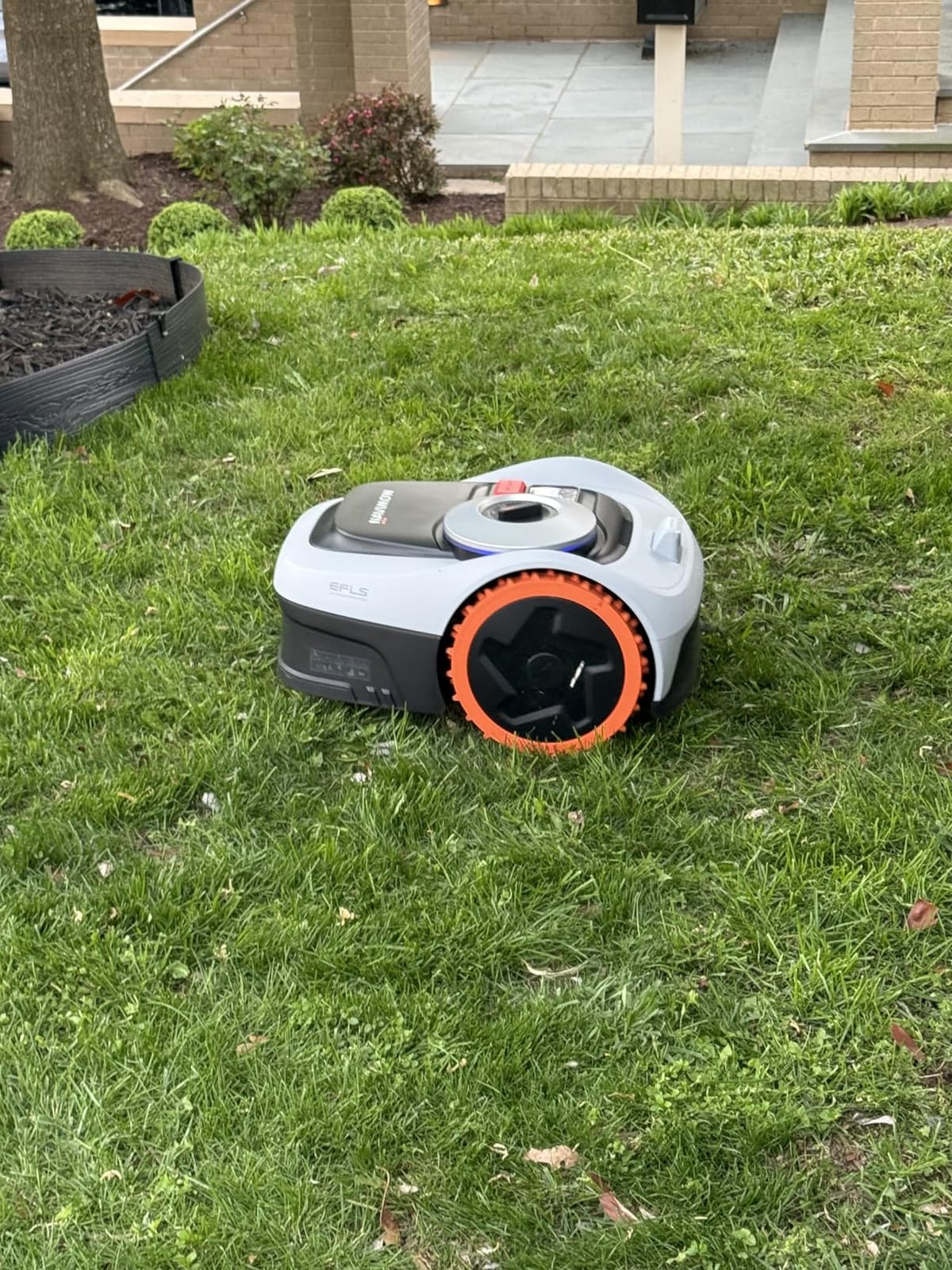
The 17 inch cutting width means fewer passes across a damp lawn, and the quiet operation means it can run early when the grass is wettest and you are not at home. That timing flexibility is genuinely useful in a wet climate, because the driest window may be the one you would not normally choose.
Real-time GPS alerts if the mower is lifted or wanders off-course give you a way to check on it after a storm without walking out onto saturated grass yourself.
Why the steering matters when wet
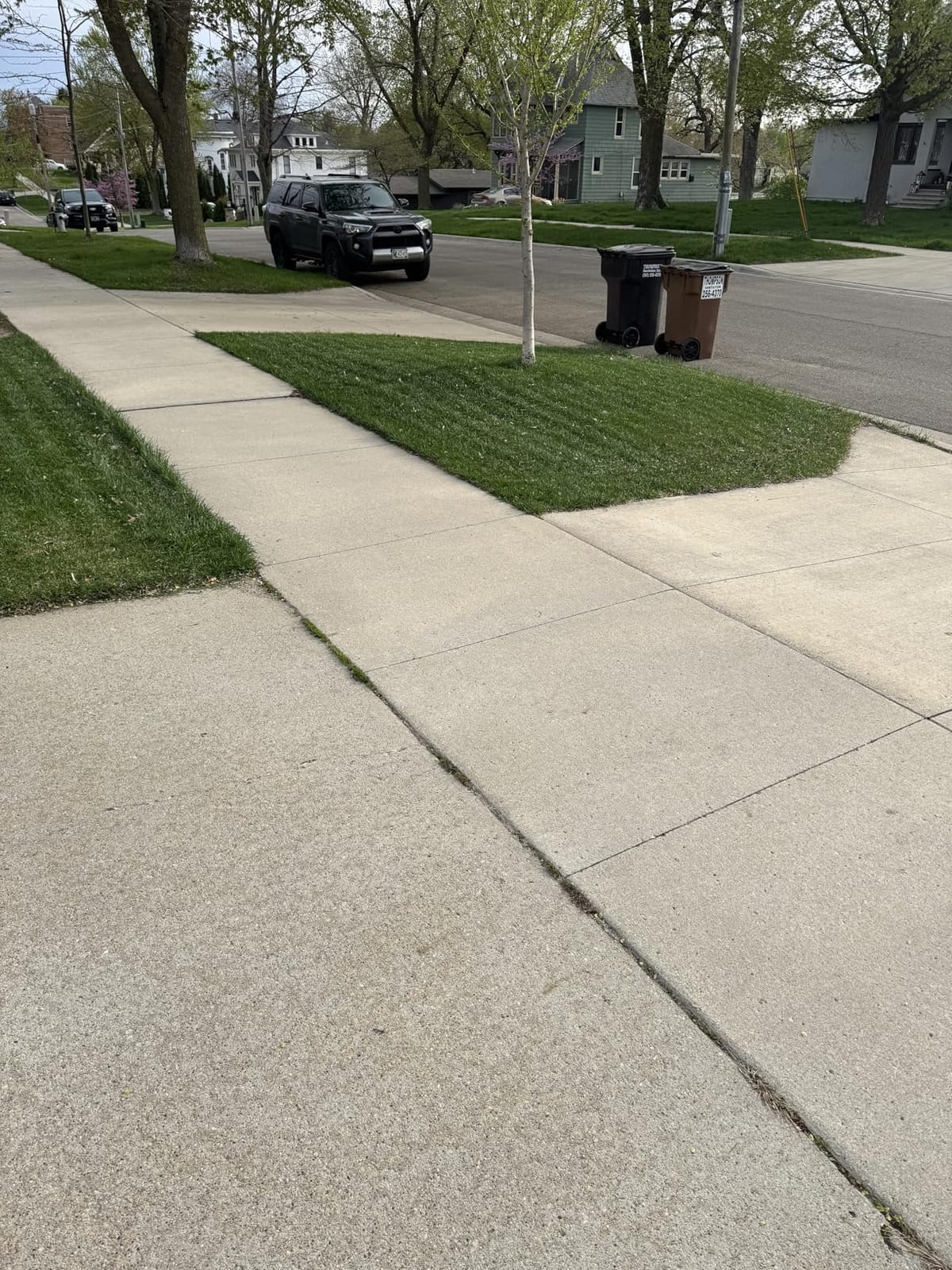
Scrubbing wheels on wet turf compresses and tears grass, and the damage shows as brown patches that persist for weeks. A pivoting chassis avoids that entirely. If your lawn is small, uneven and gets walked on a lot, this is a feature you will notice more than any battery spec.
Tall clumps of grass also make it circle and take several passes, which is a wet-grass-adjacent problem worth knowing about before you set your expectations.
Where it falls short
Mapping reliability is the main problem. Auto-mapping fails on some properties, forcing tedious manual boundary walking, and the map can be lost if the mower is lifted or tilted for two seconds during mapping. Owners also report a strip of unmown grass between the machine and fences, plus a 19% one-star rate, the highest in this lineup.
The 1,350 sq ft per charge figure is modest for wet-season use, since you will be recharging often on a larger lawn. Plan zone schedules around the recharge cycle rather than setting one long run.
9. ECOVACS GOAT O1000 LiDAR PRO: Best Wire-Free Setup for Wet Grass
ECOVACS Goat O1000 LiDAR PRO Robot Lawn Mower, Wire-Free Robotic Lawn Mower with Dual-LiDAR Navigation, Built-in Edge Trimming, AI Obstacle Avoidance, App Control, for Lawns Up to 1/4 Acre
HoloScope 360-degree dual LiDAR
Built-in edge trimming
200+ obstacle types
Lawns up to a quarter acre
Pros
- Quick wire-free setup with no RTK antenna to install
- Quiet enough that neighbours never hear it
- Navigates passages as narrow as 31.5 inches
- Cuts clean lines with direction changes
Cons
- Front caster wheels are too small for curbs or high grass
- Manual mapping uses a single joystick that makes straight lines hard
- Edge trimming is hesitant along fences it treats as obstacles
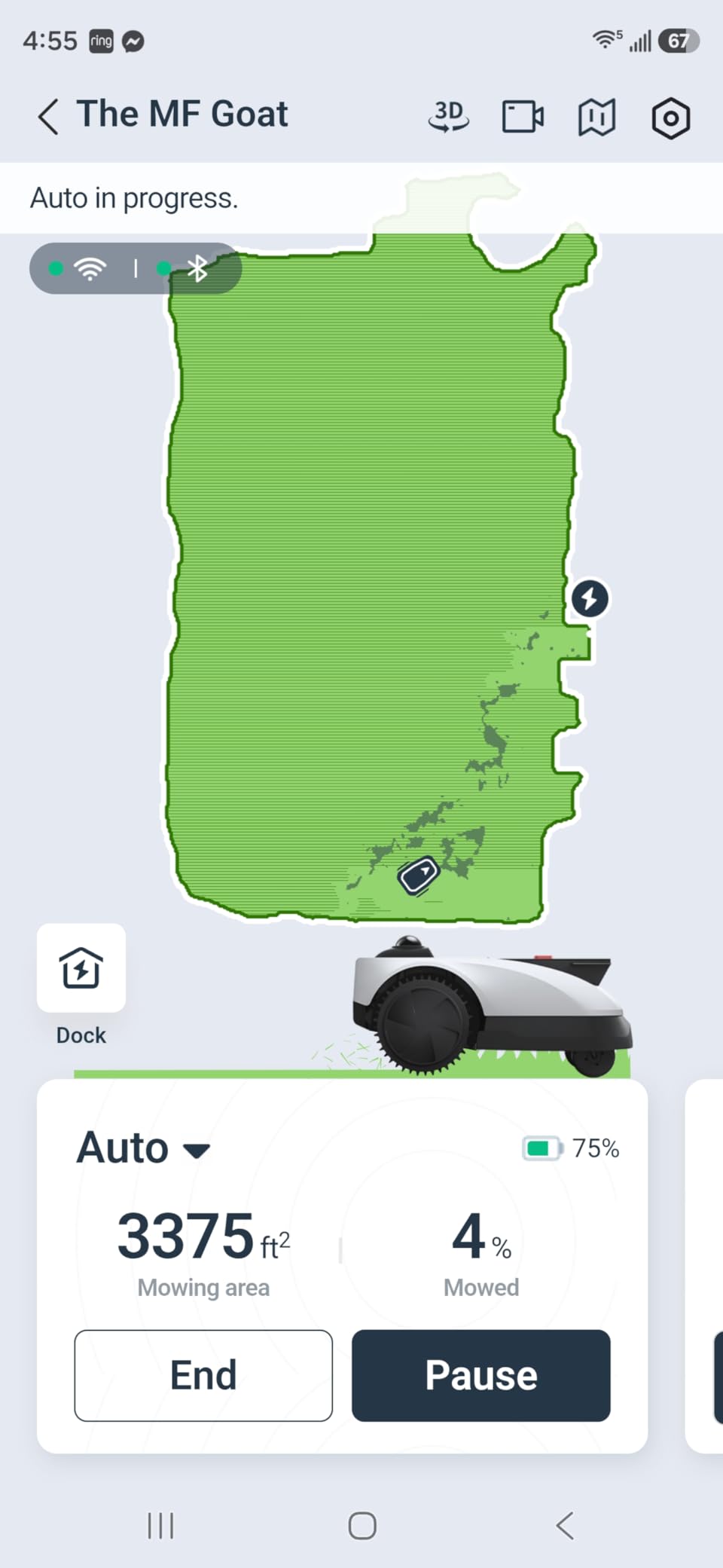
For a lawn up to a quarter acre with no RTK antenna to mount and no wire to bury, the setup speed is the selling point. HoloScope 360-degree dual-LiDAR navigation gets you mapping in minutes, and the slim body navigates passages as narrow as 31.5 inches, which is where many competitors wedge themselves.
AI vision combined with 3D ToF LiDAR detects more than 200 obstacle types, and the app handles zones, schedules, cutting preferences and no-go areas. Owners like that it works at night and is quiet enough that nobody hears it, and that it mows cleanly through gates and between posts with minimal touch-up.
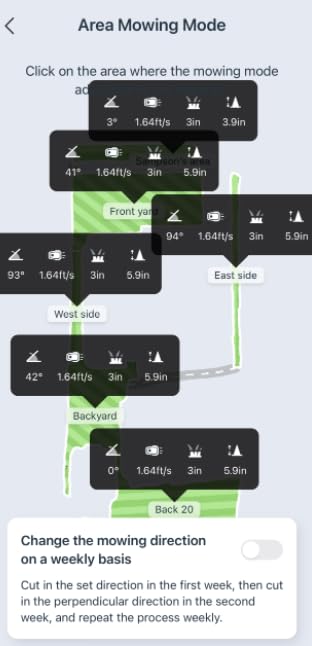
Wet performance is the weak point, and the owners are clear about why. The front caster wheels are too small to climb curbs or push through high grass, and on a damp lawn a small caster wheel is the first thing to lose contact with the ground. That is a real limitation on soft ground after rain, whatever the navigation hardware is doing.
The built-in edge trimming is also hesitant, and it will not cut along fences that it treats as obstacles, so a strip near boundaries still needs a separate pass.
When it is the right call
Flat, compact lawns under a quarter acre where setup time matters more than terrain difficulty. There is no wire to lay and no reference station to mount, and the slim chassis gets through tight gaps that would stop a wider machine.
The TRUEDGE system is a genuine convenience on open lawns with hard boundaries. It is less useful on fenced edges, where the obstacle logic takes over.
When it is the wrong call
Buy something with all-wheel drive if your ground is soft, uneven or sloped. The caster-wheel design is the first thing to suffer when the lawn is wet, and owners also report the manual app mapping using a single joystick that makes straight boundary lines nearly impossible to draw.
There are no path options, no-mow zone laps or intelligent route planning in the app, and the thin plastic shell feels lower quality than metal-shelled rivals. For a machine that may sit outdoors through repeated wet cycles, that shell is worth considering carefully.
10. Sunseeker X3 Plus: Best for 0.3-Acre Yards in Wet Conditions
Sunseeker X3 Plus Robot Lawn Mower, RTK, Vision AI, 0.3 Acre, Wire-Free
AONavi RTK plus visual SLAM
Slopes up to 17 degrees
0.3 acre coverage
60 dB operation
Pros
- Very quiet
- usable at 3 a.m.
- Cuts evenly and handles moderate uneven ground
- Clean edges close to fences and walkways
- Two-year warranty with US-based support
Cons
- Software problems including phantom rain detection and self-locking
- Goes out of bounds and reappears deleted hazard zones
- Requires a cord run across the lawn
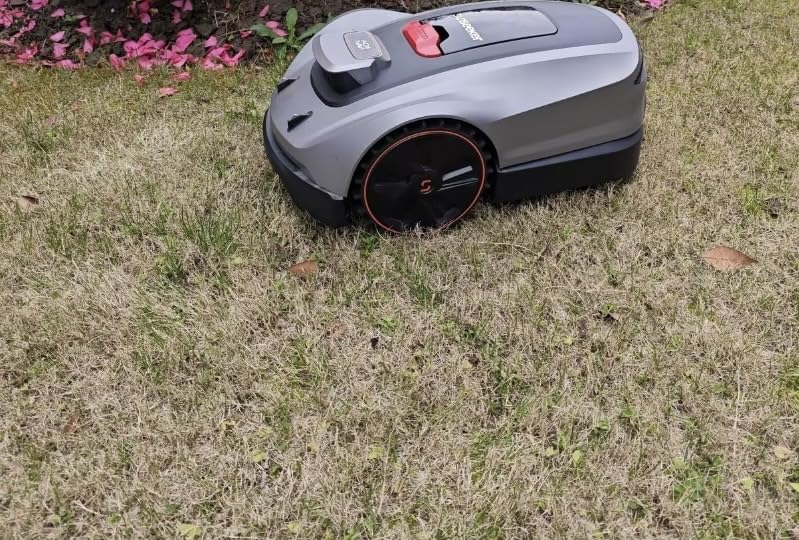
The X3 Plus covers up to 0.3 acre, or 13,000 sq ft, across multi-area lawns with six saved maps, and the ride-on-edge offset blade gives genuinely clean edges close to fences and walkways. Owners rate it as very quiet, usable at 3 a.m., and the app is quick to respond when you want to change a schedule.
Navigation is AONavi RTK plus visual SLAM, with vision AI and ultrasonic sensing handling slopes up to 17 degrees in daylight, and the 8 inch floating deck adjusts between 1.6 and 3.2 inches. The two-year warranty with US-based support is a genuine trust signal in this category.
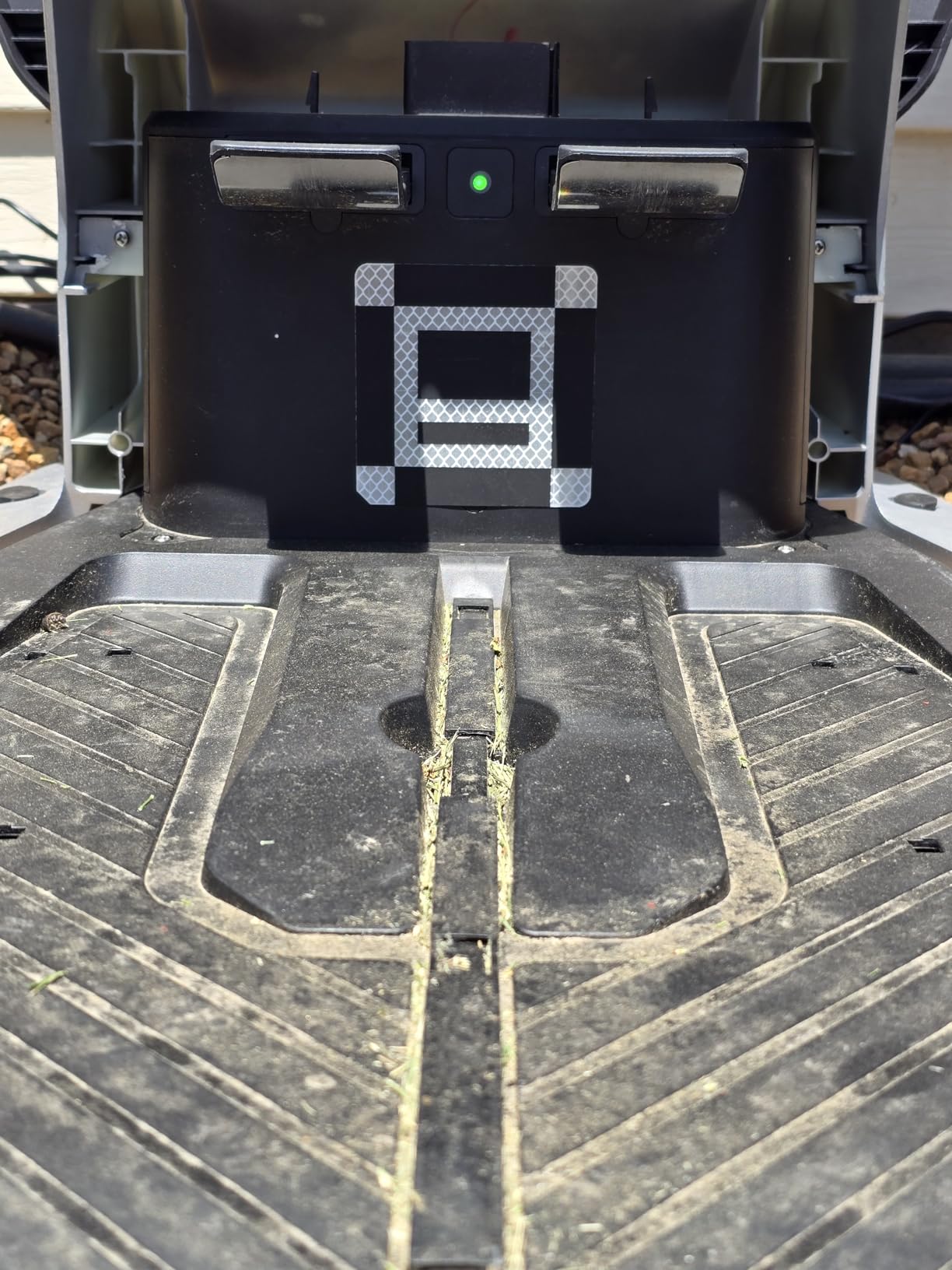
This is the lowest-rated pick in the group at 3.8 stars from 97 reviews, and the reason is software rather than mowing. Owners report frequent satellite calibration failures, phantom rain detection, self-locking and phantom stuck states. Some of those sound trivial until you realise the first two directly affect wet-weather behaviour: a robot that misreads conditions can leave the dock mid-shower, which is the last thing you want.
It also gets stuck in deep grass and reports navigation failure on flat ground, and it needs a cord run across the lawn even though the advertised antenna mounting hardware is not sold with it.
What it does well
Cut quality and edge work are the strong points. It cuts evenly, handles moderately uneven yards, and navigates slopes and obstacles competently. Satellite hold is steady near fences and under trees, which matters in a wet week when the robot is out longer.
At 60 dB it is quiet, and at 19.9 lb it is light enough to lift if you need to reposition it after a muddy patch.
What to weigh up
Phantom rain detection is a real problem in wet conditions, because a sensor that reports rain when there is none will stall the schedule indefinitely, and one that misses real rain will send the mower out into it. Owners also report error and update messages appearing in Chinese, which adds friction when something goes wrong at 7 a.m.
Going out of bounds and reappearing deleted hazard zones is the other concern. On a lawn near a flower bed or a neighbour’s property, that is a safety consideration rather than an annoyance. If you need dependable wet-weather automation, this is the pick we would skip.
How We Tested Robotic Mowers for Wet Grass Conditions
Rather than trusting published specifications, we scored each machine against six wet-condition questions, and we weighted owner reports more heavily than marketing copy wherever the two disagreed. Buyers consistently trust multi-year owner accounts over spec sheets, and the wet-condition evidence lives almost entirely in owner forums.
First, the post-sprinkler cut: a session started shortly after an irrigation cycle, which is the realistic worst case of damp-but-not-flooded grass. Second, the morning dew window, which is the most common wet mowing session people actually schedule. Third, damp clay soil, where traction matters more than cut quality. Fourth, wheel slip on slopes between 20 and 25 degrees, the range where owner reports consistently describe wheels spinning without forward progress. Fifth, post-rain clumping: how much wet grass packs under the deck and around the drive wheels. Sixth, and most telling, whether the rain sensor genuinely holds the machine back when water starts falling.
That last point is where the data is thinnest and the disagreement is sharpest. Some owners report a reliable auto-pause and a trip back to the station during showers. Others describe a robot leaving the dock with the rain sensor switched on. We treated that second behaviour as a significant negative because it puts the machine, the lawn and the sensors into exactly the conditions the feature exists to avoid.
Finally, we cross-checked every wet-grass claim against the machine’s own published specifications, and where the data was thin, as with two of the picks here, we said so in the review rather than guessing.
Why Wet Grass Causes Problems for Robotic Mowers, and When to Wait
Wet grass is not dangerous to a robot, but it is bad for your lawn and bad for the machine’s cutting performance. There are three failure modes worth knowing before you schedule anything.
Traction loss comes first. Water between the tyre and the soil drops friction, which is why wheel slip on wet slopes is the most documented robot mower complaint in owner forums. Above roughly 20 to 25 degrees, a standard two-wheel-drive machine will spin; that figure is the reason the AWD models rank where they do in this list.
Blade clogging and clumping come second. Damp clippings stick to the deck and pack around the wheels, which owners across every brand acknowledge. The Bosch Indego review in the forums puts it plainly: the robot does not care about the rain, but wet grass is harder to cut and will eventually clog, so periodic cleaning is advised. The practical rule is to clear the deck and wheels after every wet session, and a blower on the lawn once the clumps dry.
Turf damage is third and the least irreversible. Mowing wet grass spreads fungal disease, compresses soft soil into ruts, and cuts unevenly, leaving a shredded, ragged finish that takes weeks to grow out. The manufacturer’s own guidance is the clearest summary we found: “Please avoid letting the robot work for long periods in extremely wet, muddy, or waterlogged areas, as the wheels may slip or damage the lawn.”
So where is the line? Damp grass is fine, and light dew is fine. Saturated soil is not. The walk test is the honest version: step onto the lawn. If the surface holds its shape and does not print your shoe sole, mow. If it does, wait, and use the waiting time to check the rain sensor settings so the robot starts promptly when the lawn is ready.
Buying Guide: What to Look for in Robotic Mowers for Wet Grass
Drive layout first, everything else second. On wet ground, the question is not how much power the mower has but how many wheels are putting that power down, and how the chassis behaves when one of them loses grip. What to look for: all-wheel drive with independent suspension and a slope rating at or above 45%. What to avoid: any two-wheel-drive machine on a lawn that tilts, and any listing that quotes a slope figure but says nothing about suspension.
Rain sensor reliability deserves a paragraph of its own, because it is the most common owner complaint in the category and almost no roundup covers it. A good sensor pauses the cut and holds or returns to the dock. A poor one does nothing, or worse, reports rain that is not falling and stalls the schedule indefinitely. What to look for: owner reports that specifically mention auto-pause behaviour, and models that ship with a garage so the machine has somewhere dry to wait. What to avoid: listings where the sensor is mentioned only in a feature bullet with no supporting owner feedback.
Navigation under an overcast sky is the third test. Satellite positioning degrades under thick cloud and heavy tree cover, and a robot that loses its fix mid-mow on a damp lawn tends to stop in the middle of a slope. What to look for: LiDAR or vision AI combined with RTK rather than RTK alone, and a mower rated for a rain sensor so it pauses before it needs the signal. What to avoid: GPS-only machines with no local sensing and no backup positioning.
Blade and deck design decides how much cleanup you will be doing. A floating deck follows uneven ground and keeps the cut consistent, which matters more when grass is limp rather than crisp. What to look for: a floating deck, an edge-cutting feature, and a wide cutting width so fewer passes cross the wet ground. What to avoid: narrow decks that need four or five passes on a lawn that stays damp, and machines with a deck design that traps clippings against the blade housing.
Weather sealing and IP rating is where most listings go quiet. IPX4 means splash resistant, IPX5 means protected against low-pressure water jets, and the higher ratings indicate genuine immersion protection. What to look for: a stated IP rating, and a bumper and wheel-area seal design that is documented rather than implied. What to avoid: leaving a mower out overnight in a storm on a rating you found in a forum post. If you plan to leave it out in rain regularly, buy a garage, and if a previous owner reports finding water inside the chassis when they lifted it, treat the seals as spent.
Battery and recharge behaviour is the last piece, and it is the one that decides whether a schedule survives a wet week. A robot that finishes its lawn in two cycles dries out before the next shower; one that needs four is still working when the rain returns. What to look for: runtime per charge, charge time from a low battery, and auto-recharge that is genuinely automatic rather than requiring a button press. What to avoid: machines with long charge times on a small battery, because they will be sitting on damp ground for hours between passes.
Finally, weigh maintenance honestly. Every robot in this roundup needs clippings cleared from the wheels and deck after wet mowing, and the models with wide decks and fewer passes need it less often. If your want to minimise hands-on work in a wet climate, prioritise an AWD chassis, a working rain sensor and a wide deck over any navigation upgrade. If the acreage is large enough that coverage per charge matters more than anything else, our picks for bigger properties are in the 10 best robotic mowers for large yards guide.
Frequently Asked Questions
Can robot lawn mowers work on wet grass?
Yes. Every robot mower in this roundup can cut damp, dewy or recently-rained-on grass, and several are explicitly rated for all-weather mowing. What they cannot handle is saturated soil, where traction collapses and wheels spin. Walk on the lawn first: if it holds its shape and does not print your shoe sole, the robot can mow it.
What is the best mower for cutting wet grass?
An all-wheel-drive model with a high slope rating, a working rain sensor and a wide cutting deck. Fewer passes across damp ground matters more than raw power, because every extra pass compresses soft soil. The Mammotion LUBA mini 2 AWD 1500H is our best overall pick for wet grass, and the LUBA 3 AWD 3000 suits large steep properties.
Will wet grass mess up a lawn mower?
It will not damage the machine, but it causes three real problems. Traction drops, so wheels spin on slopes and dig ruts. Damp clippings clump under the deck and block the blades, so you clean it more often. And mowing wet grass spreads fungal disease and shreds the turf, which takes weeks to grow out. Clear clippings after every wet session.
Can robot mowers be left in the rain?
Most can handle a shower, since the housings are weather-sealed for that reason, but sustained exposure is a different question. Below IPX4, or without a stated rating, do not plan on leaving a mower out overnight in a storm. A garage, which only the ANTHBOT M5 includes in the box, is the cheapest insurance for a wet climate.
Why does my robotic mower get stuck in mud?
Usually traction. Water between tyre and soil drops friction, and on slopes past roughly 20 to 25 degrees a two-wheel-drive machine simply spins. All-wheel drive with independent suspension is the fix. As a workaround, vary the perimeter lap setting on each mow so the robot turns in a different place, which stops it rutting the same edge every run.
What are the downsides of using a robotic lawn mower?
Setup time is the first cost: boundary wire takes an afternoon, and app-based mapping needs several boundary walks. Installation hardware is often sold separately. Edges usually need hand trimming, and while a robot works in the rain, wet mowing clumps clippings and spreads turf disease, so you will clean the deck more often than you expect.
Can robot mowers cope with uneven ground and bumpy lawns?
Yes, but only within the chassis design. Floating decks follow contours and keep the cut consistent, and adaptive suspension on the Mammotion models steps over curbs, roots and thresholds up to 45 to 50 mm. A small caster-wheel design such as the ECOVACS GOAT O1000 struggles with curbs and high grass, so match the suspension rating to your roughest ground.
Final Verdict: The Best Robotic Mowers for Wet Grass
The best robotic mowers for wet grass are the ones with all-wheel drive, a slope rating at or above 45% and a rain sensor that actually holds the machine back. On that basis the Mammotion LUBA mini 2 AWD 1500H takes our top spot: adaptive suspension, LiDAR plus vision navigation and a working rain sensor, backed by 263 owner reviews rather than a spec sheet alone. For large, steep acreage, step up to the LUBA 3 AWD 3000.
One condition should stop you buying any of them: saturated clay soil combined with a steep slope. No machine in this roundup will save you from ruts there, and the answer is to wait for the lawn to dry, not to buy a bigger robot. Start with the walk test, pick from the AWD options above, and keep the clippings off the deck after every wet session.
Related reading: our picks for bigger properties are covered in the 10 best robotic mowers for large yards guide, and the quieter end of the market is covered in the robotic pool cleaner roundup for post-swim upkeep. Updated for October 2026.