
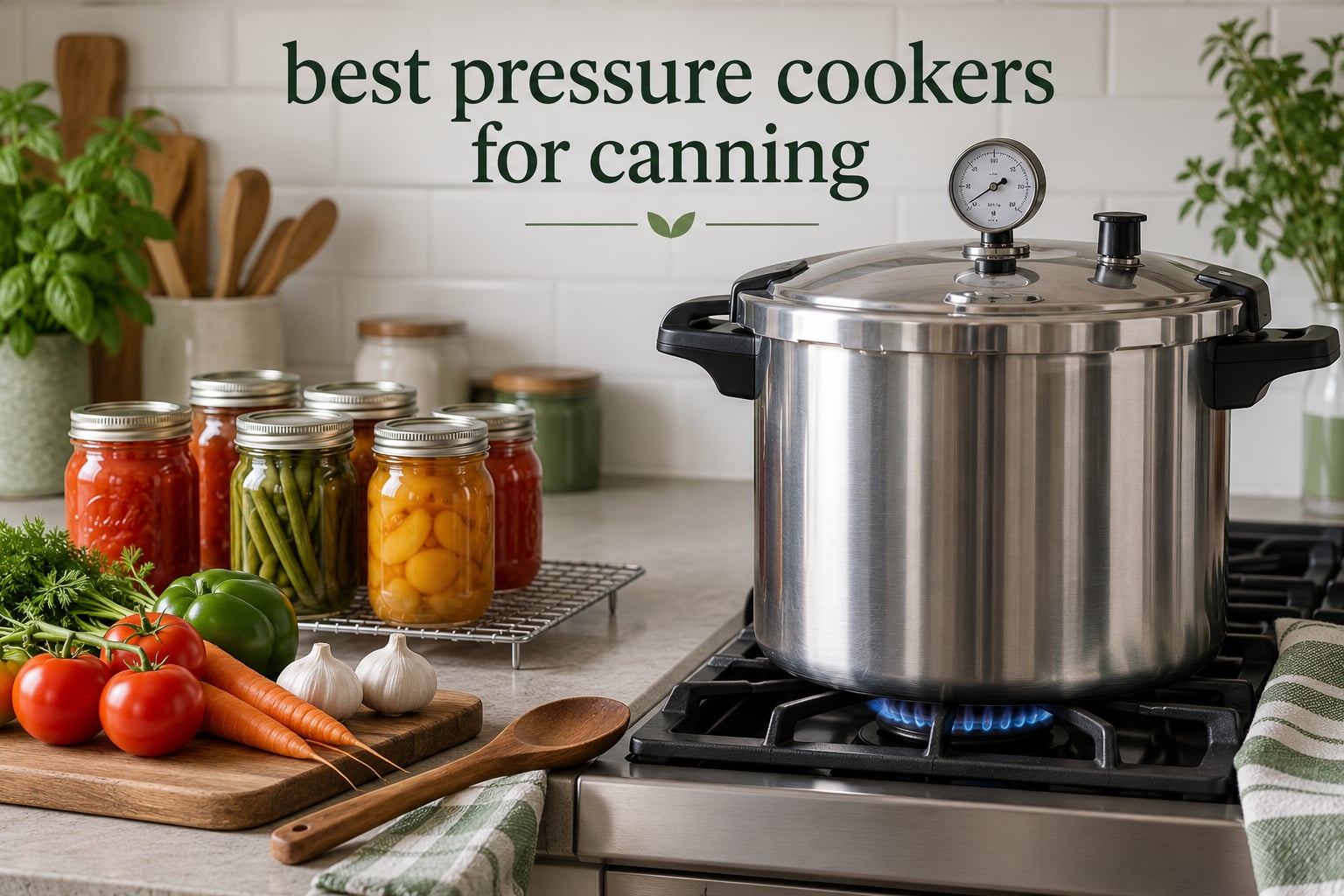
The best pressure cookers for canning are pressure canners: stovetop or electric vessels tested to hold 240 F under 10 to 11 PSI long enough to destroy botulism spores in low-acid food. Our top pick is the Presto 01781 23-Quart, which holds 7 quart jars or 20 pints per load, carries a deluxe dial gauge, and comes with a 12-year limited warranty. A standard kitchen pressure cooker is not a canner, and we flag the difference clearly throughout.
We lined up ten of them for this guide, from a 25-quart gasket-free cast aluminum heirloom to two compact units that hold a handful of jars. Some are real pressure canners built for the job, some are pressure cookers marketed as canning vessels, and a few sit in between. The difference matters, because process times and pressure targets come from NCHFP-tested recipes and not from the manual in the box.
We also weighed the practical stuff forum canners argue about most: burner size, loaded weight, whether the dial can be trusted at altitude, how often the gasket needs replacing, and whether you can stack a second layer of jars. If you are still deciding between a stovetop canner and an electric one, our electric pressure cooker guide covers the general electric-cooker landscape first.
Table of Contents
Top 3 Picks: Best Pressure Cookers for Canning (October 2026)
Six use cases cover almost everyone, and each one maps to a specific unit below. The Presto 01781 takes the overall slot because it pairs the largest review base in the category with a dial gauge that holds pressure at elevation, while the All American 925 wins on build quality and a seal with no gasket to replace.

Presto 01781 23-Quart Canner
- 7 quart
- 20 pint or 26 half-pint capacity
- Deluxe dial gauge for altitude work
- 12-year limited warranty

All American 925 25-Quart Canner
- Gasket-free metal-to-metal seal
- 19 pint or 7 quart jar capacity
- Made in the USA
NESCO NPC-9 Smart Electric Canner
- 4 quart or 5 pint jars per load
- Digital programs with safety lock lid
- High-altitude valve included
All Ten Picks at a Glance in 2026
Everything below, in one table. Jars held is the useful number, because a quart capacity means very little once you count what actually fits around the canning rack.
| Product | Specs | Action |
|---|---|---|
| Presto 01781 23-Quart Pressure Canner |
|
Check Latest Price |
 Presto 01784 23-Quart Induction Canner Presto 01784 23-Quart Induction Canner |
|
Check Latest Price |
| NESCO NPC-9 Smart Electric Canner |
|
Check Latest Price |
 Presto 02152 17-Quart Digital Canner Presto 02152 17-Quart Digital Canner |
|
Check Latest Price |
| All American 925 25-Quart Canner |
|
Check Latest Price |
 T-fal 22-Quart Pressure Canner T-fal 22-Quart Pressure Canner |
|
Check Latest Price |
 MIRRO 22-Quart Pressure Canner MIRRO 22-Quart Pressure Canner |
|
Check Latest Price |
 WantJoin 16-Quart Pressure Cooker WantJoin 16-Quart Pressure Cooker |
|
Check Latest Price |
 Stark USA 6.0-Quart Pressure Cooker Stark USA 6.0-Quart Pressure Cooker |
|
Check Latest Price |
 BreeRainz 5.3-Quart Canner BreeRainz 5.3-Quart Canner |
|
Check Latest Price |
How We Picked the Best Pressure Cookers for Canning
Be clear about the testing here: this roundup is built from manufacturer specifications, published listings and owner review patterns, not from side-by-side lab canning. Nothing here was processed in a test kitchen, so we do not claim tasting results or measured seal times.
What we did do was rank every unit against the same checklist. First: is it sold and labelled as a pressure canner rather than a general pressure cooker. Second: stated capacity in quart and pint jars. Third: gauge type, weighted or dial, and whether altitude correction is required. Fourth: stove compatibility, including induction. Fifth: gasket situation and what consumables it costs to own.
Process authority stays where it belongs. Processing times, venting steps and pressure targets come from the USDA Complete Guide to Home Canning and current NCHFP tested recipes, and we do not publish times we cannot trace to those sources. Our job was to help you buy the right vessel, not to substitute a recipe.
1. Presto 01781 23-Quart Pressure Canner: the Best Overall Pick
Presto 01781 23-Quart Pressure Canner and Cooker
23-quart aluminum body
Holds 7 quarts, 20 pints or 26 half-pints
12 years, 12 pounds, smooth-top ready
Pros
- USDA-recommended method for vegetables
- meats
- poultry and seafood
- Works on regular and smooth-top ranges
- Deluxe dial gauge covers the full processing range
- Large 7-quart or 20-pint batch
- 12-year limited warranty
- Rack and 76-page book included
Cons
- No induction compatibility
- Aluminum body suits boiling-water canning not highly acidic food
- Dial needs active monitoring
- Heavy to lift once loaded
Our overall pick has the deepest owner base we found: 20113 ratings averaging 4.8, with 88 percent five-star. In a niche where people press a safety case out of the same pot every autumn for twenty years, that volume of repeat use is the most persuasive spec sheet we can find.
The vessel holds 7 quart jars, 20 pints or 26 half-pints around the included canning and cooking rack. That is a genuine garden-harvest batch, and it is the reason this model keeps showing up as the recommendation in the beginner conversations we read. If you have ever wondered whether one unit is too small, this is the size most people outgrow last.
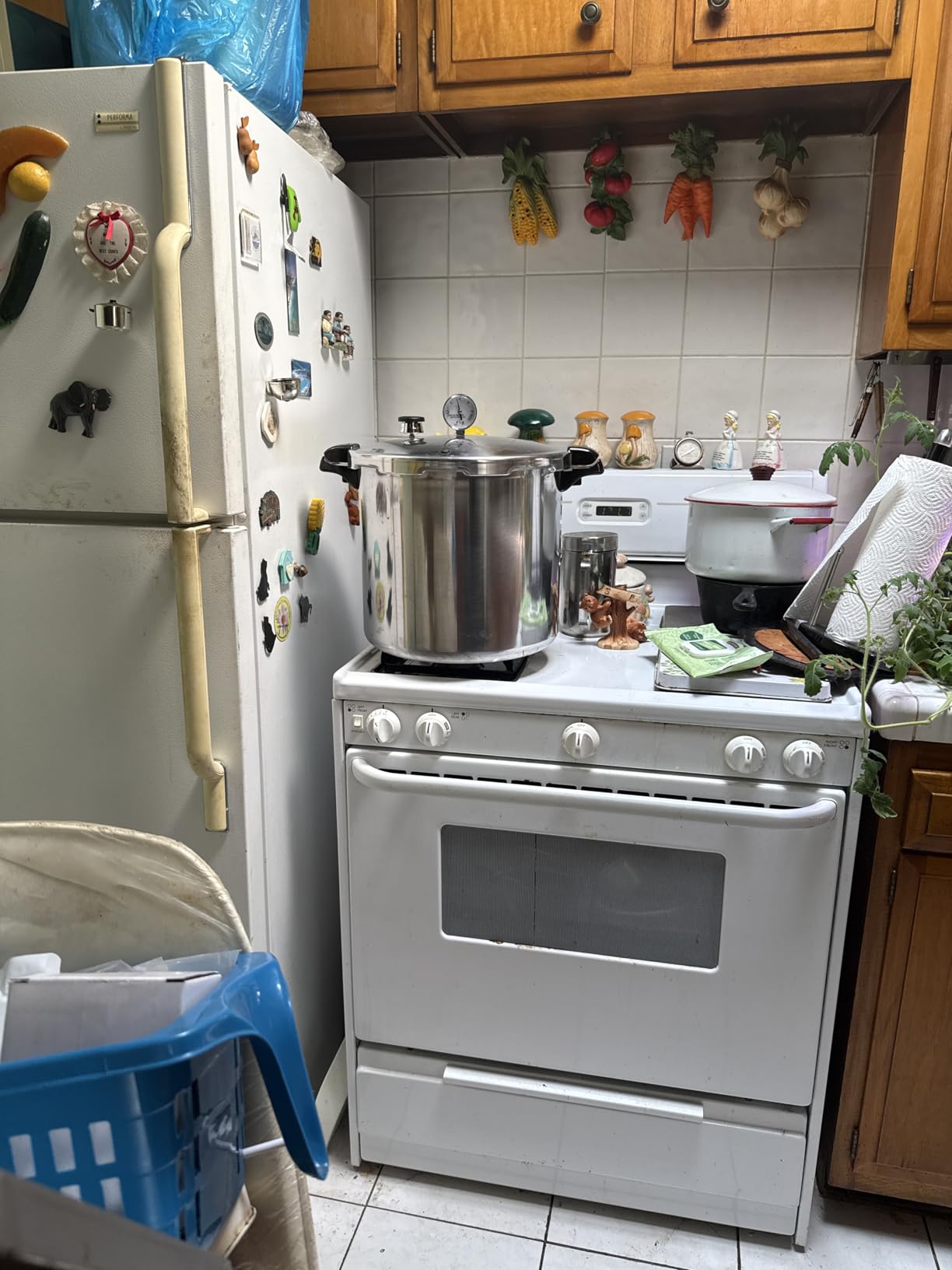
The deluxe dial gauge is the technical reason we rank it first. A dial reads actual pounds per square inch rather than inferring it from a weight, so you can correct for altitude and confirm the 10 or 11 PSI target holds. It does demand attention. You watch the needle and adjust the burner by hand for the whole processing time, which is the honest cost of the accuracy.
Construction is warp-resistant heavy-gauge aluminum in polished silver, and Presto claims it works on regular and smooth-top ranges. It is listed at 12 pounds empty, which sounds manageable until you add glass, food and water. Plan to load it on the burner, not to carry it. Owner reviews routinely mention lifting it full as the single annoyance of the format.
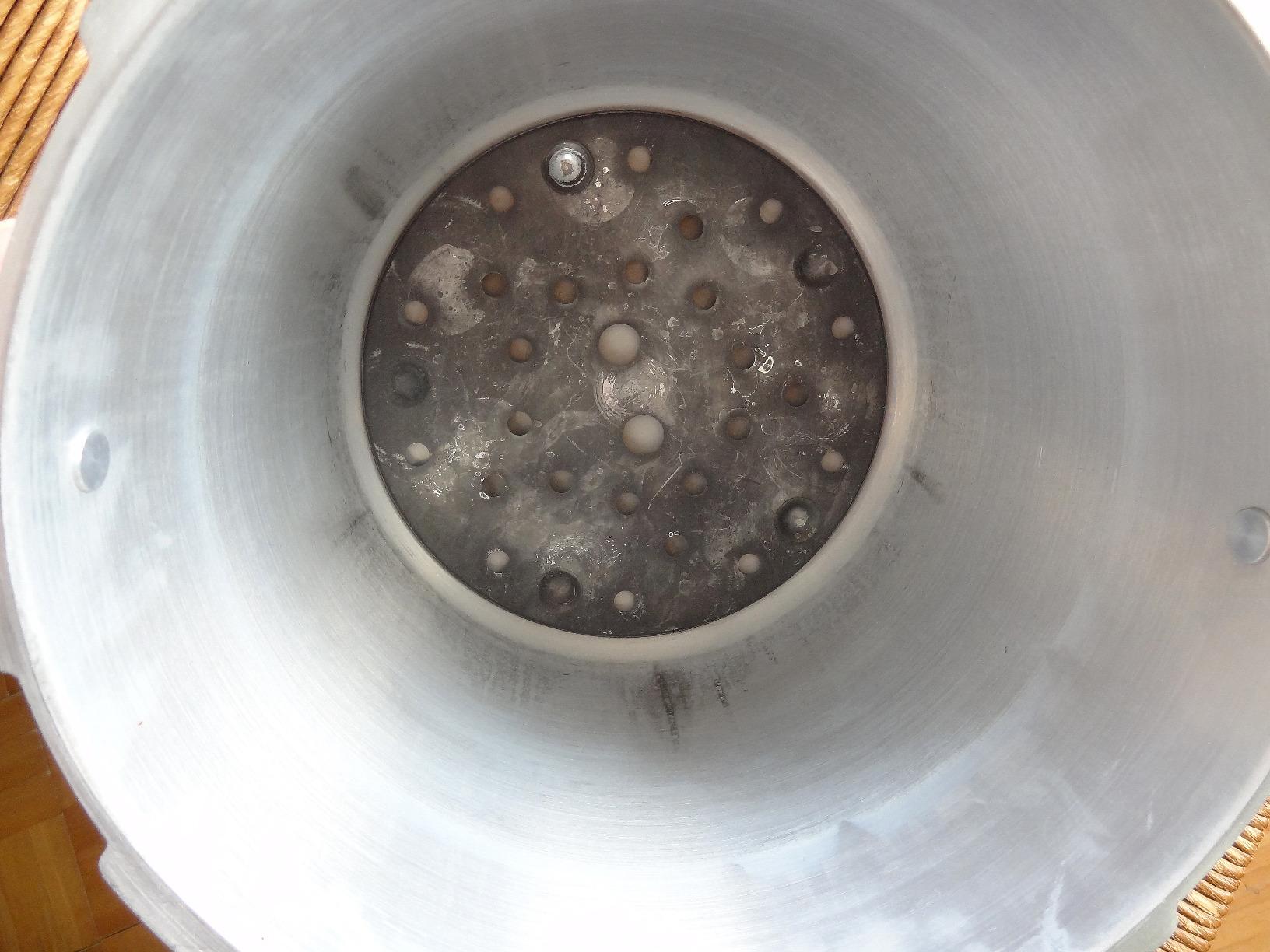
What the Presto 01781 handles well
The capacity-to-effort ratio is the winner. One rack gives you a full load of quarts, and owners on r/Canning consistently recommend adding a second interior rack to double-stack jars, which roughly doubles a batch without a second pot. The 76-page book that ships with it is enough to learn venting and pressure release, though the NCHFP recipes remain the authority.
The warranty is unusual in this category: 12 years. Parts, gaskets and the rack are all available, which is what makes a canner a two-decade purchase instead of a five-year one. The rating distribution, 88 percent five-star against 2 percent one-star, is about as tight as consumer hardware gets.
Where it falls short
There is no induction compatibility, and that is a hard door for anyone on a magnetic cooktop. The aluminum body also means pressure canning is the correct mode, while fruits, jams, jellies, pickles and salsa go in under a boiling-water canning setup instead. Very acidic food can pit aluminum, so keep tomato and acid-heavy products out of the pressure cycle.
Finally, the dial is a manual instrument. If you want a set-and-forget cycle with no heat juggling and no altitude math, the digital electric unit further down handles that role instead.
2. Presto 01784 23-Quart Induction Compatible Canner: Best for Modern Cooktops
Presto 01784 23-Quart Induction Compatible Pressure Canner
23-quart aluminum with stainless-clad base
Induction, gas, electric and smooth-top
7 quarts, 20 pints or 26 half-pints
Pros
- Only unit here rated for induction in a 23-quart class
- Air vent and cover lock blocks opening under pressure
- Same USDA-endorsed pressure canning as the 01781
- Stainless base resists the scorching plain aluminum suffers
- 12-year limited warranty
Cons
- Loaded weight makes it hard to move
- Aluminum body limits highly acidic food
- Pressure dial still needs watching
This is the same 23-quart architecture as our top pick with one decisive change: a stainless steel-clad base that works across induction, gas, electric and smooth-top stoves. Buyers who nearly skipped the Presto line over induction compatibility should look here first.
It holds 7 quart jars, 20 pints or 26 half-pints, and it carries the same 12-year limited warranty. The rating sits at 4.8 across 5530 reviews with a star distribution identical to its sibling, which tells you the induction change did not cost anything in canning performance.
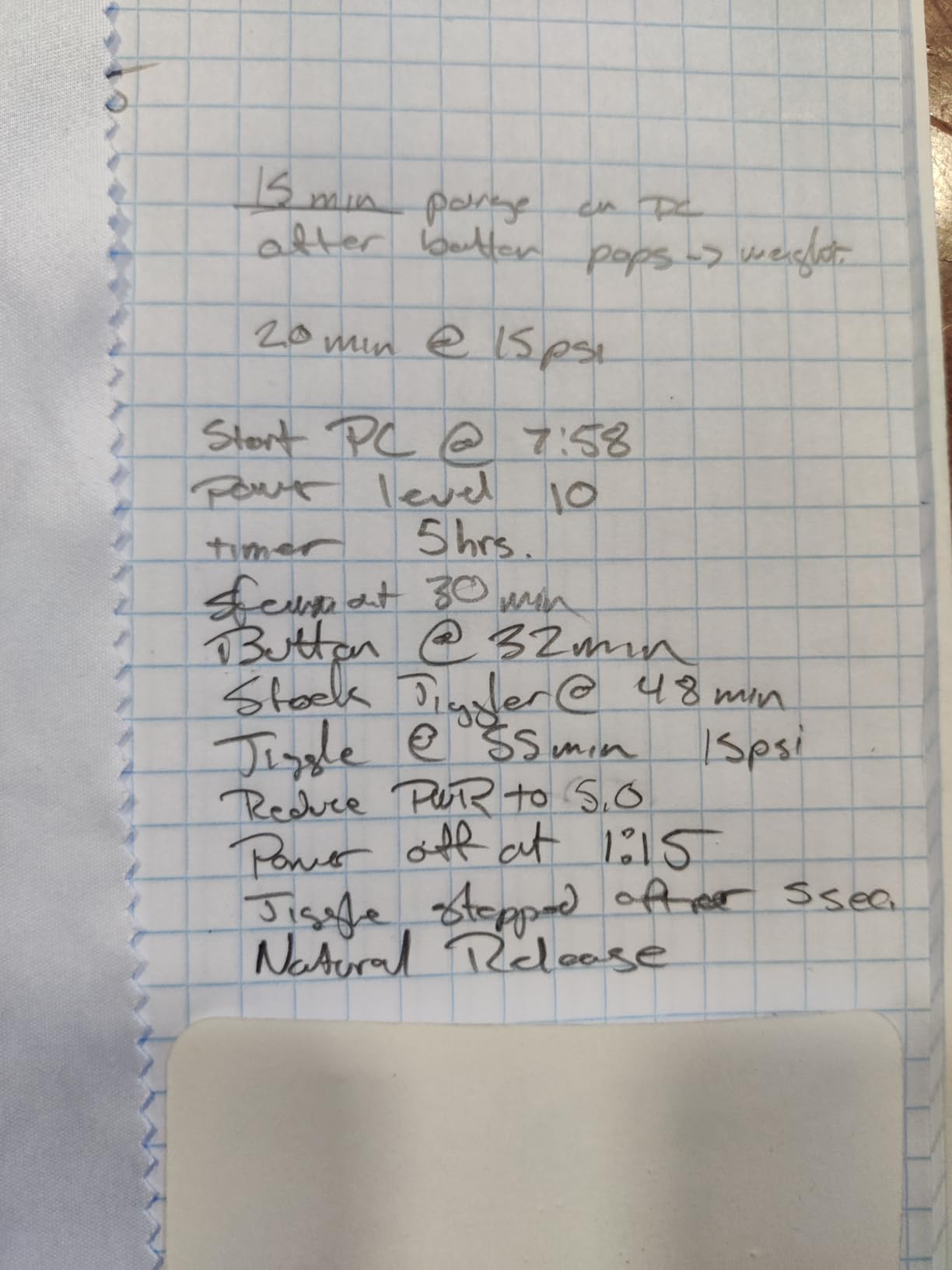
The air vent and cover lock is the feature owners notice after the first week. Pressure only builds when the cover is fully closed, and the lock prevents the lid from being opened until the vessel is depressurized. On a heavy aluminum canner that sits near a flame, that removes a class of mistake that has nothing to do with your technique.
Weighing in at 5.67 kg, the practical caution matches the standard Presto: get it onto the burner empty, then fill it where it sits. The stainless-clad base also resists the discoloration that plain aluminum picks up after a season of use, which matters if the pot lives on your cooktop rather than in a cabinet.
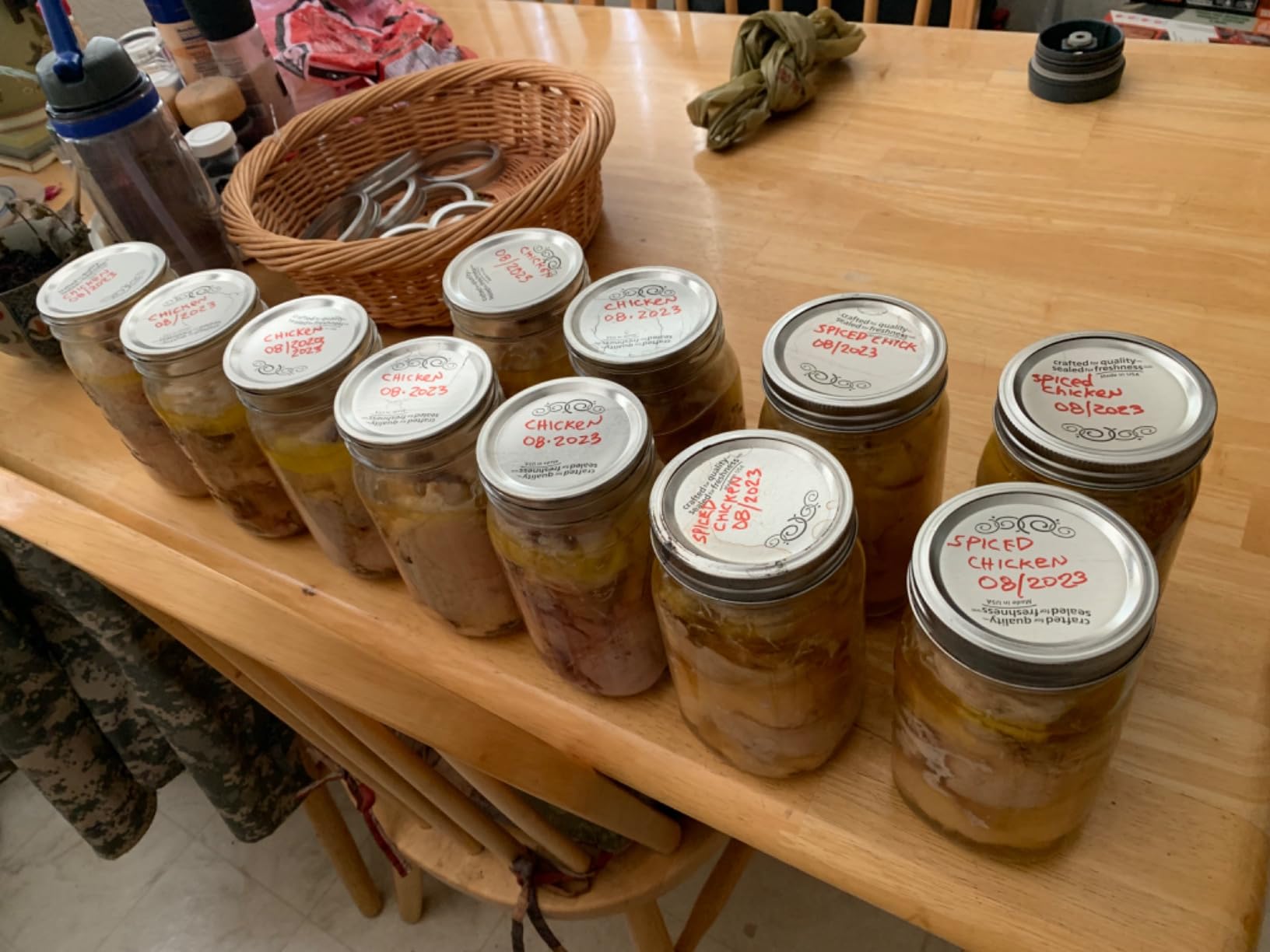
Reasons to buy it over the standard 23-quart
If you cook on glass or induction, this is not a nice-to-have, it is the difference between a usable canner and an unusable one. Even on gas, the clad base spreads heat differently and cuts down on the scorching that shows up around the base of plain aluminum after a full season of canning.
The cover lock also makes it a reasonable second canner for a household where two people process on the same stove, since it is the only 23-quart unit in this roundup that discourages opening a pressurized lid by reflex.
Reasons to look elsewhere
It costs more than the standard Presto 01781 and the canning job is otherwise the same, so if your stove is gas or coil there is no functional gain. The aluminum body still rules out pressure canning highly acidic food, and the loaded vessel remains a two-handed lift on the counter.
Owners also report that the dial still needs active watching and manual heat adjustment through each cycle. That is a design choice shared across manual canners, not a fault in this model, but it is worth knowing before you buy any of them.
3. NESCO NPC-9 Smart Electric Canner: Best Electric for Beginners
NESCO NPC‑9 Smart Electric Pressure Canner and Cooker for Home Food Preservation, 9.5‑Quart Stainless Steel with Digital Controls
9.5-quart nonstick inner pot
4 quart or 5 pint jars per load
Digital, 1000 watts, high-altitude valve
Pros
- Removes heat juggling and the fear factor beginners report
- Four modes including pressure cook
- slow cook
- steam and water bath
- Safety lock lid
- float valve and pressure regulation
- High-altitude limiting valve included
- Removable condensation catcher
Cons
- Only 4 quart or 5 pint jars per load
- Wide-mouth pints are awkward to grip
- Wordy instructions
- Audible beeps throughout the cycle
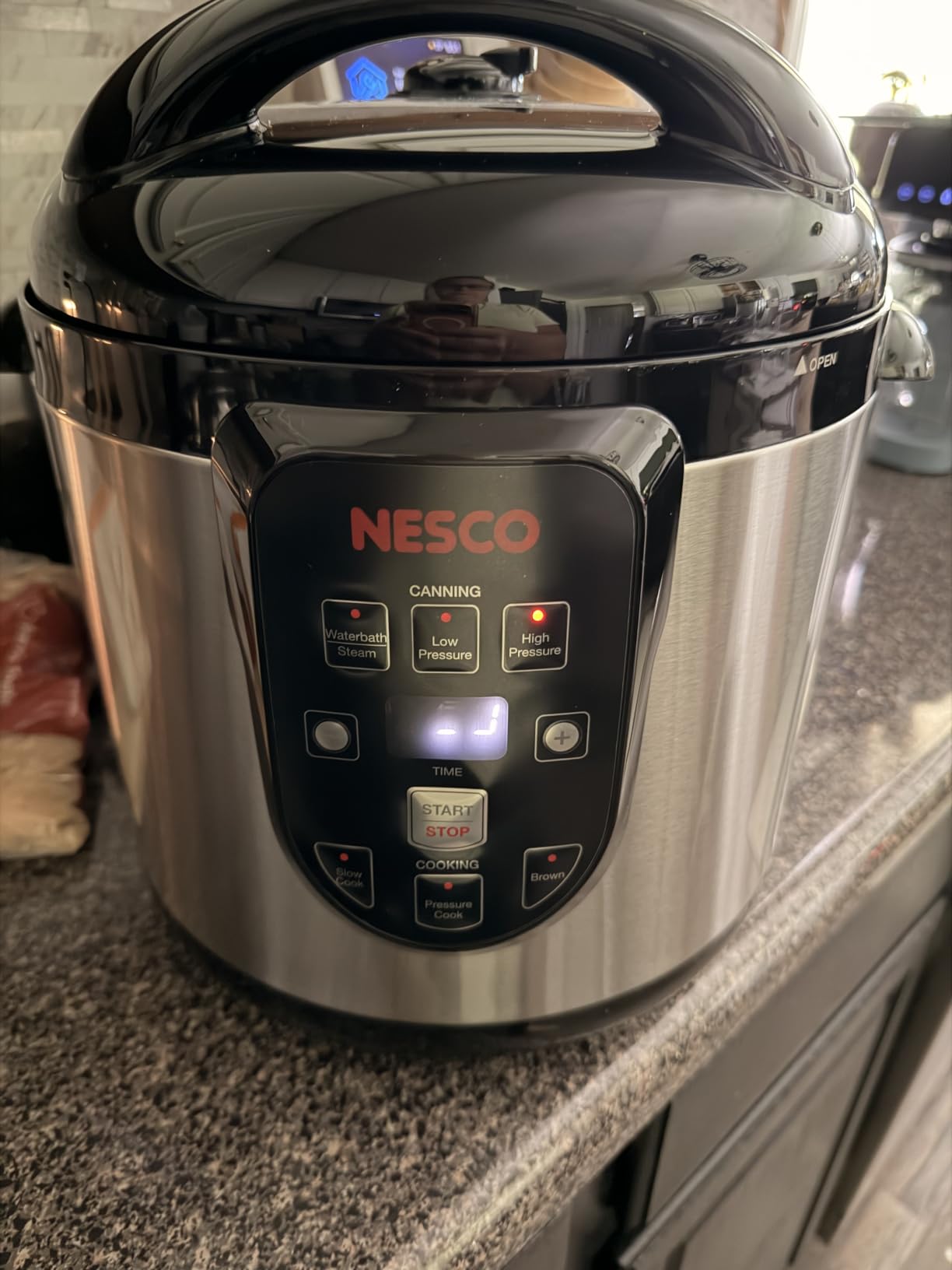
Owner reviews on this electric unit describe it less as a high-output canner and more as a confidence restorer. People who found long-time stovetop canners intimidating keep saying the same thing: the lock lid, float valve and regulated cycles took the fear out of the process.
Batch size is the trade. It holds 4 quart jars or 5 pint jars per load, so a serious garden harvest means several cycles in a row. For jam, pickles, salsa, a few jars of beans or a monthly meat batch, that is genuinely fine, and for a first canner it is more than enough room to learn.
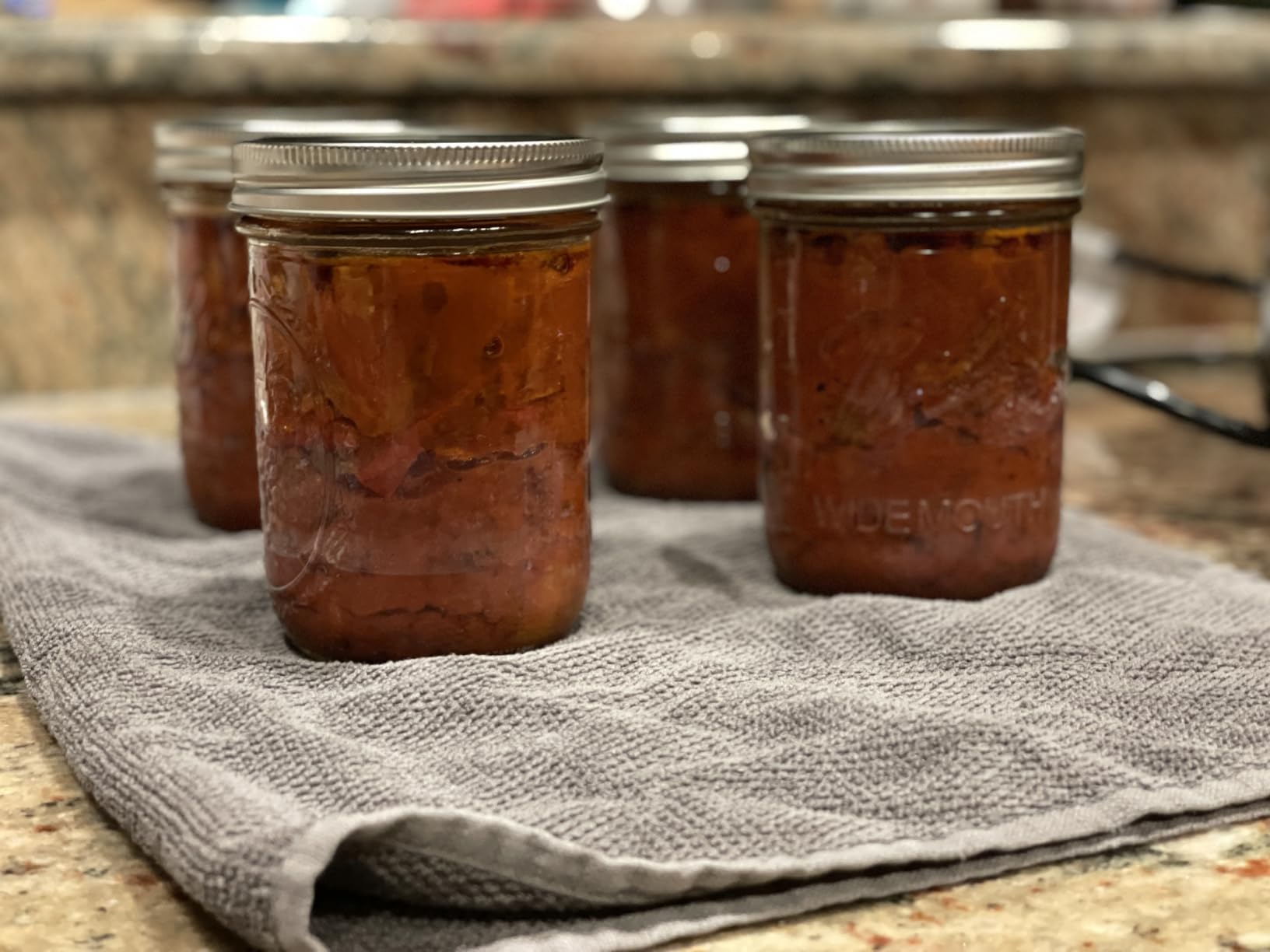
Because pressure and temperature are regulated automatically, nobody is chasing a needle. The 1000-watt element brings the 9.5-quart removable nonstick inner pot to pressure, and preset programs plus a timer walk the cycle. Four modes cover pressure cook, slow cook, steam and water bath, so the same appliance handles high-acid fruit as well as low-acid vegetables.
A standard and a high-altitude limiting valve ship in the box, which removes the single most common stovetop mistake at elevation. The removable condensation catcher simplifies cleanup, and several long-term owners report years of problem-free canning of sauce, meats and beans.
What works well about an electric canner
Consistency. A sensor-driven cycle removes burner-dial drift, and no amount of distracted attention changes the outcome. That single advantage is why electric units keep gaining share among new canners, and it is worth more than raw capacity when you are processing for the first time.
The included canning rack, steam rack and condensation catcher mean you are not hunting accessories before your first batch. The compact footprint also matters in a kitchen without a dedicated canning station.
Where the compromises sit
Four quarts or five pints is a small load, and wide-mouth pint jars are reported as genuinely difficult to grip and remove from the pot. If you plan to process a whole harvest in an afternoon, budget for repeated cycles rather than one heroic load.
The warranty is one year, noticeably shorter than the 12 years on the Presto stovetop units. The instructions are wordy, which adds a modest learning curve for newcomers, and the unit beeps loudly at plug-in, timer setting and pressure stage changes.
4. Presto 02152 17-Quart Digital Canner: Best Programmable Electric
Presto 02152 17-Quart Digital Pressure Canner
17-quart stainless steel digital canner
Quart-jar sized interior
No altitude adjustment needed
Pros
- Temperature sensor holds exact canning temperature automatically
- No altitude adjustment required anywhere in the country
- Extra-tall interior designed around quart jars
- Stainless steel body is durable and easy to maintain
- Control knob plus LED display guides each step
Cons
- 24.3 pounds and bulky on the counter
- One-star share runs higher than the manual Presto models
- Full electric cycle takes longer than stovetop canning
This is the pick for anyone who wants stovetop-grade results without watching a dial. A sensor inside the vessel automatically maintains the exact temperature required for safe canning, so the burner equivalent that could have drifted simply is not there to drift.
The extra-tall 17-quart interior is sized specifically for quart jars, which makes it a natural middle ground between a 9.5-quart electric and a 23-quart stovetop pot. It draws 1485 watts, is programmable, and includes a canning rack. Twelve and seventeen-quart configurations exist in the line, so the same platform covers a small kitchen too.
The most-praised feature across reviews is the absence of altitude adjustment. If you live above 1000 feet, a weighted stovetop canner forces you to choose a heavier weight and shorten nothing else, while a dial canner means reading a different target. This unit simply runs the same cycle anywhere.
Stainless steel construction is another quiet upgrade over aluminum. It will not pit from acidic food, it cleans without scrubbing, and it will not discolor the way aluminum does after a few seasons. A control knob with an LED digital display guides each step rather than leaving you to interpret a gauge under steam.
What you gain by going digital
Repeatability across batches. Set the program once and the sensor holds the temperature, so your third batch of green beans processes identically to your first. Owners who already trust the results of manual canning still cite this as the reason to switch, because the failure mode of a manual canner is heat drift, not a wrong starting recipe.
It also performs boiling water canning for high-acid food, so the appliance covers the full range instead of forcing you to own a second vessel for jam and pickles.
What you trade away
At 24.3 pounds the unit is heavy and bulky, and it occupies serious counter space permanently. A full electric cycle also takes longer than stovetop canning, because the element heats and cools more slowly than a flame.
The rating distribution is the widest of the Presto models here, with a 5 percent one-star share against 84 percent five-star. The recurring complaints are about wanting a longer cycle or a smaller footprint rather than about failed seals, but the spread is wider than the manual models and worth factoring in.
5. All American 925 25-Quart Pressure Cooker/Canner: Best Heirloom Build
All American 1930: 25qt Pressure Cooker/Canner (The 925) – Exclusive Metal-to-Metal Sealing System – Easy to Open & Close – Suitable for Gas, Electric, or Flat Top Stoves – Made in the USA
25-quart cast aluminum
Holds 19 pint or 7 quart jars
Gasket-free metal-to-metal seal
Pros
- Highest average rating in the roundup at 4.9
- Machined metal-to-metal seal means no gasket to replace
- Positive action clamps lock a steam-tight seal
- 19 pint or 7 quart jar capacity
- Built to last for decades
- Manual doubles as a cookbook
Cons
- 24 pounds empty
- Aluminum pits or corrodes with acidic food
- Long heat-up and cool-down from the vessel mass
- English-only instructions
The All American 925 holds the highest average rating of anything we covered, at 4.9 across 9758 reviews with 93 percent five-star and only 1 percent one-star. Owner reviews read like long-term logs from canners processing thousands of jars a season, and the tone is closer to brand loyalty than product feedback.
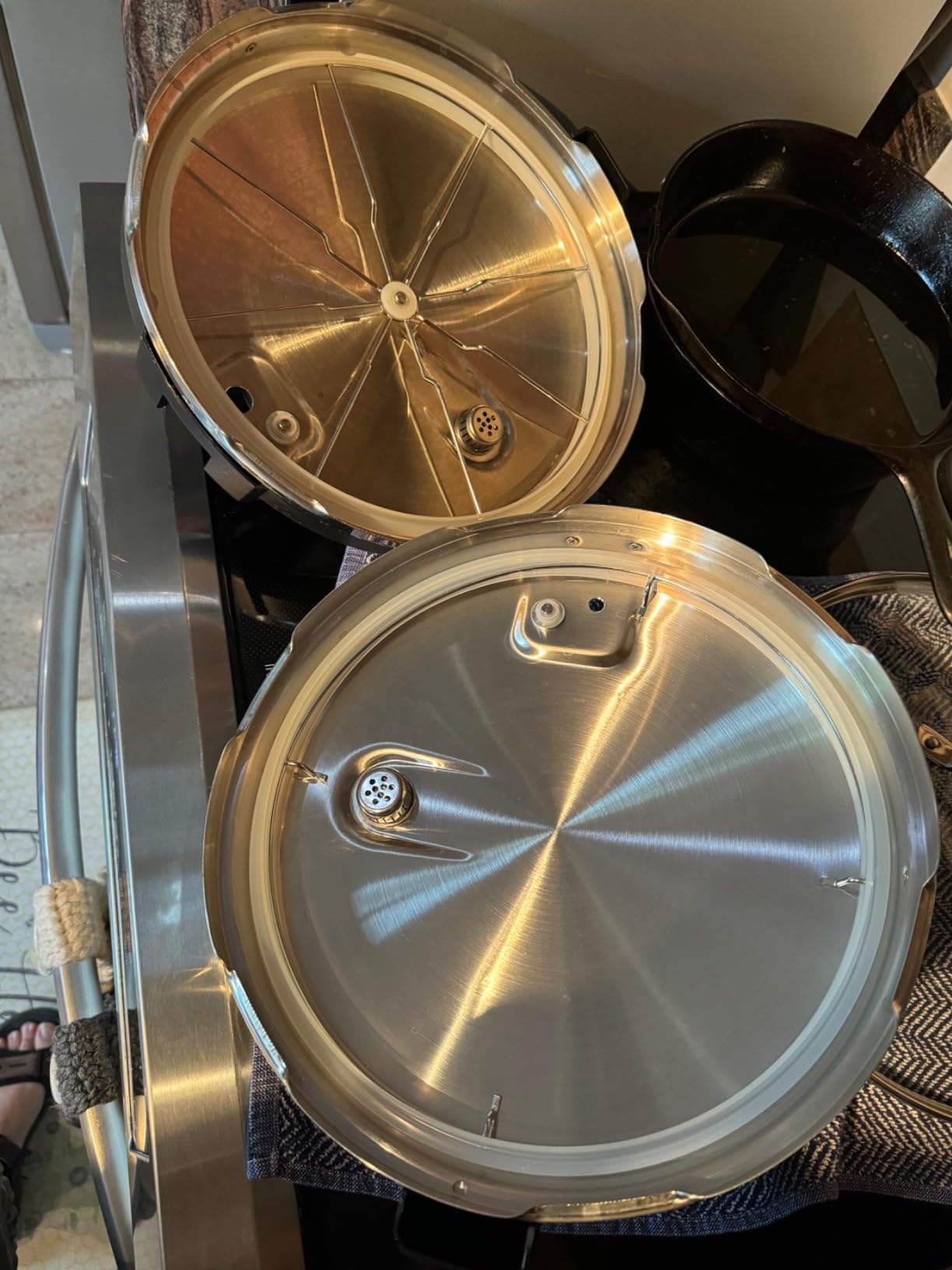
The reason is the sealing system. Instead of a rubber gasket, precision-machined positive action clamps lock the cover against a metal-to-metal seat, so there is no consumable part to crack, harden or replace. For a canner meant to be inherited rather than replaced, that removes the single most common failure mode in the category.
Capacity runs to roughly 19 pint jars or 7 quart jars, and the vessel ships in a family of sizes from 10.5 to 41.5 quarts so the same brand can follow you from a first batch to a full homestead run. An easy-to-read steam gauge and a precision-machined regulator weight give you both a visual reference and a weighted backup.
It is made in the USA by the Wisconsin Aluminum Foundry, with US-based service, replacement parts and free safety labels. Forum consensus repeatedly names All American as worth every penny among heavy users, and that is exactly the buyer this design serves.
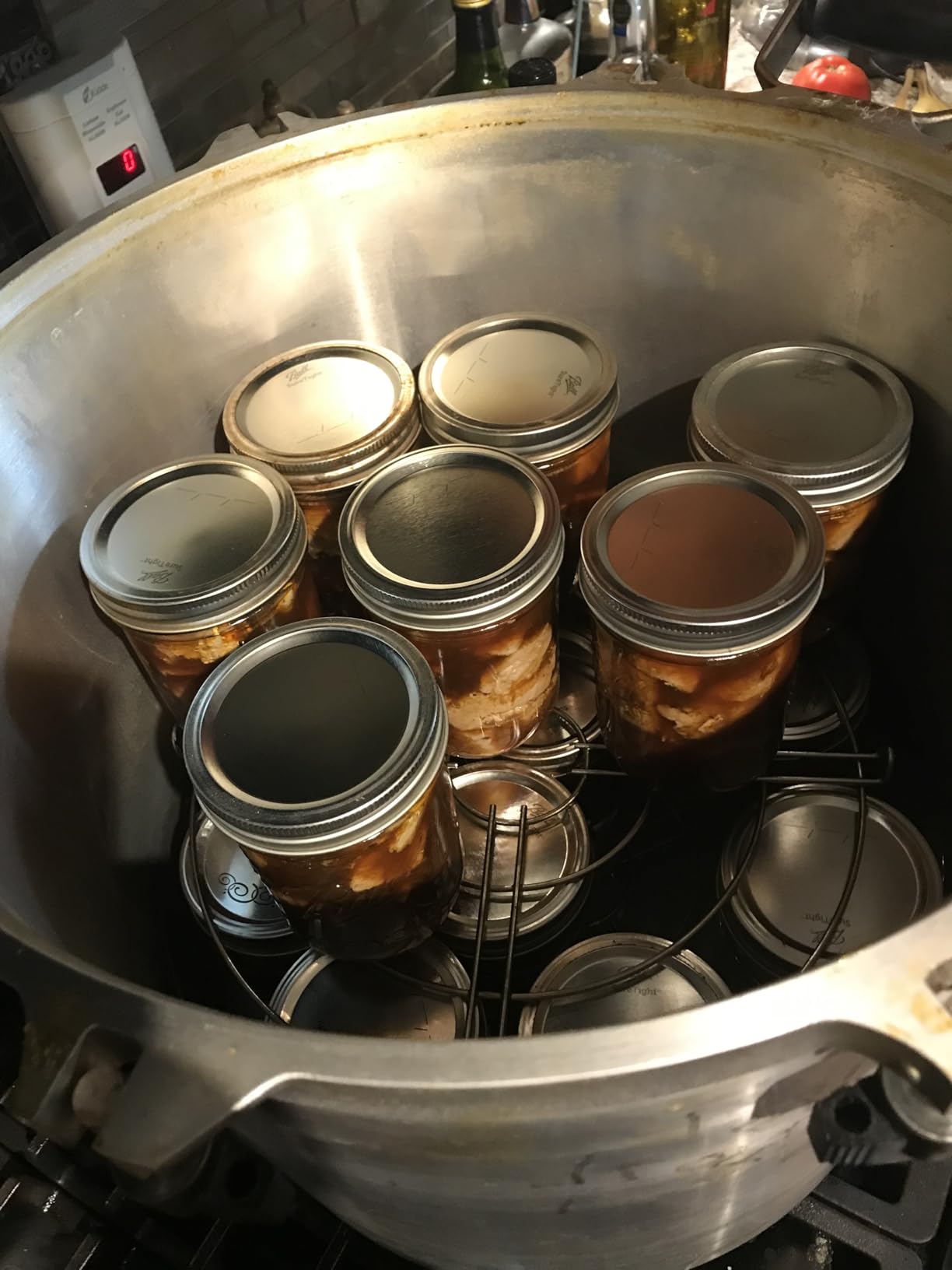
Why the gasket-free design is worth real money
Gaskets cost little but they are the part that ages. Owners of gasketed canners describe slow pressure loss and gasket cracking, and the usual fix is a yearly replacement regardless of condition. A metal-to-metal seal removes that line of maintenance entirely, and it also removes the risk of loading a batch with a ring that has gone hard.
Two practical owner tips repeat constantly. Lightly oil the sealing seat so the cover does not stick and the lid does not vapor-lock at zero pressure, and buy a burner at least as wide as the pot base. Both are habits worth building before your first full load.
Where the tradeoffs are real
At 24 pounds empty this is the heaviest canner in the roundup and a genuine two-handed lift. The mass also means long heat-up and cool-down times, so a batch takes longer from cold to shelved than it does in a lighter aluminum pot.
The aluminum body will pit or corrode with acidic food, and some owners report mineral buildup that calls for distilled or pre-boiled water. Instructions are English-only, cleaning chemicals can react with the aluminum, and a stuck lid occasionally needs gentle prying with a cloth-wrapped screwdriver.
6. T-fal 22-Quart Pressure Canner: Best Budget Starter
T-fal 22-Quart Aluminum Pressure Canner, 3 PSI Settings, Home Canning, Includes Racks & Canning Guide, Large Capacity, Pressure & Water Bath Canning for Vegetables, Meats, Seafood & Fruits, Silver
22-quart polished aluminum
Holds 7 quart, 18 pint or 24 half-pint jars
Three PSI settings in the canner weight
Pros
- Three PSI settings built into the weight with nothing to swap
- 24 half-pints
- 18 pints
- 16 wide-mouth pints or 7 quarts
- Two canning racks included for jar stacking
- Complete step-by-step guide in the box
- Handles low-acid and high-acid canning
Cons
- Rubber gasket can leak at pressure
- Some owners report gauges that never register a change
- The printed guide falls apart
- Not well suited to glass or smooth-top cooktops
The T-fal 22-quart is the most debated unit here, and the split in its reviews is unusually wide: 74 percent five-star against 9 percent one-star. Many owners call it the easiest pressure canner to operate, and the reason is specific. Its three PSI settings are built into the canner weight, so there are no loose ring weights to swap, misplace or lose in a cupboard.
Capacity is generous. It holds 24 half-pints, 18 pints, 16 wide-mouth pints or 7 quarts per batch, and two canning racks ship in the box so you can stack a second layer of jars without buying anything else. A complete step-by-step canning guide is included as well.
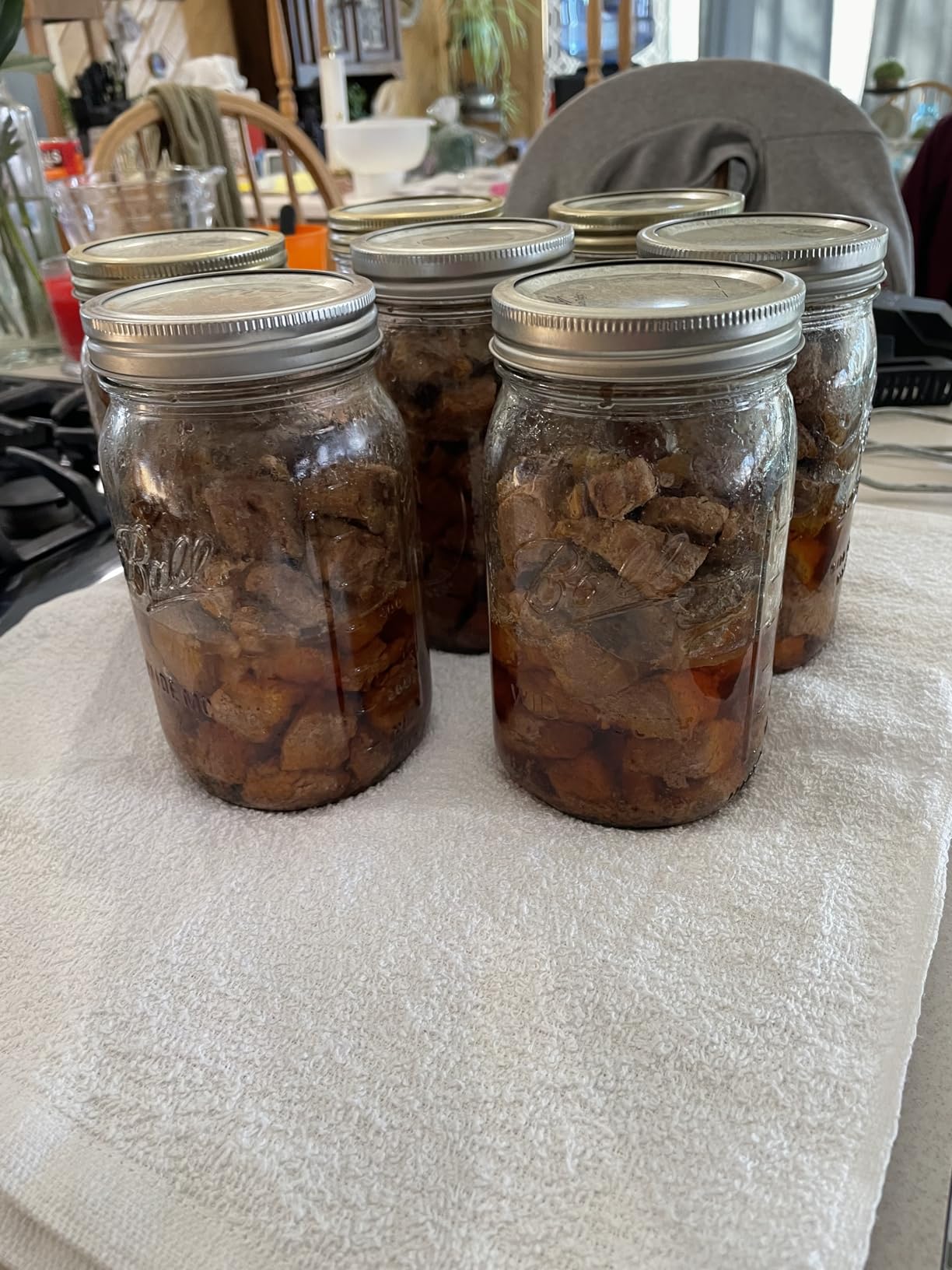
Construction is polished aluminum with even heating, listed at 14.8 pounds, and it handles both pressure canning of low-acid food and boiling-water canning of high-acid food. The locking lid, beginner-friendly steam release valve and easy-to-read gauge cover the basics, and the warranty is one year.
Here is the honest counterweight. A recurring minority thread in reviews concentrates on quality control: gaskets leaking at the handle, gauges that never moved or read incompletely, manuals arriving with broken bindings, and packaging that cracked a manometer. Hand alignment also needs care the first time you close the lid.
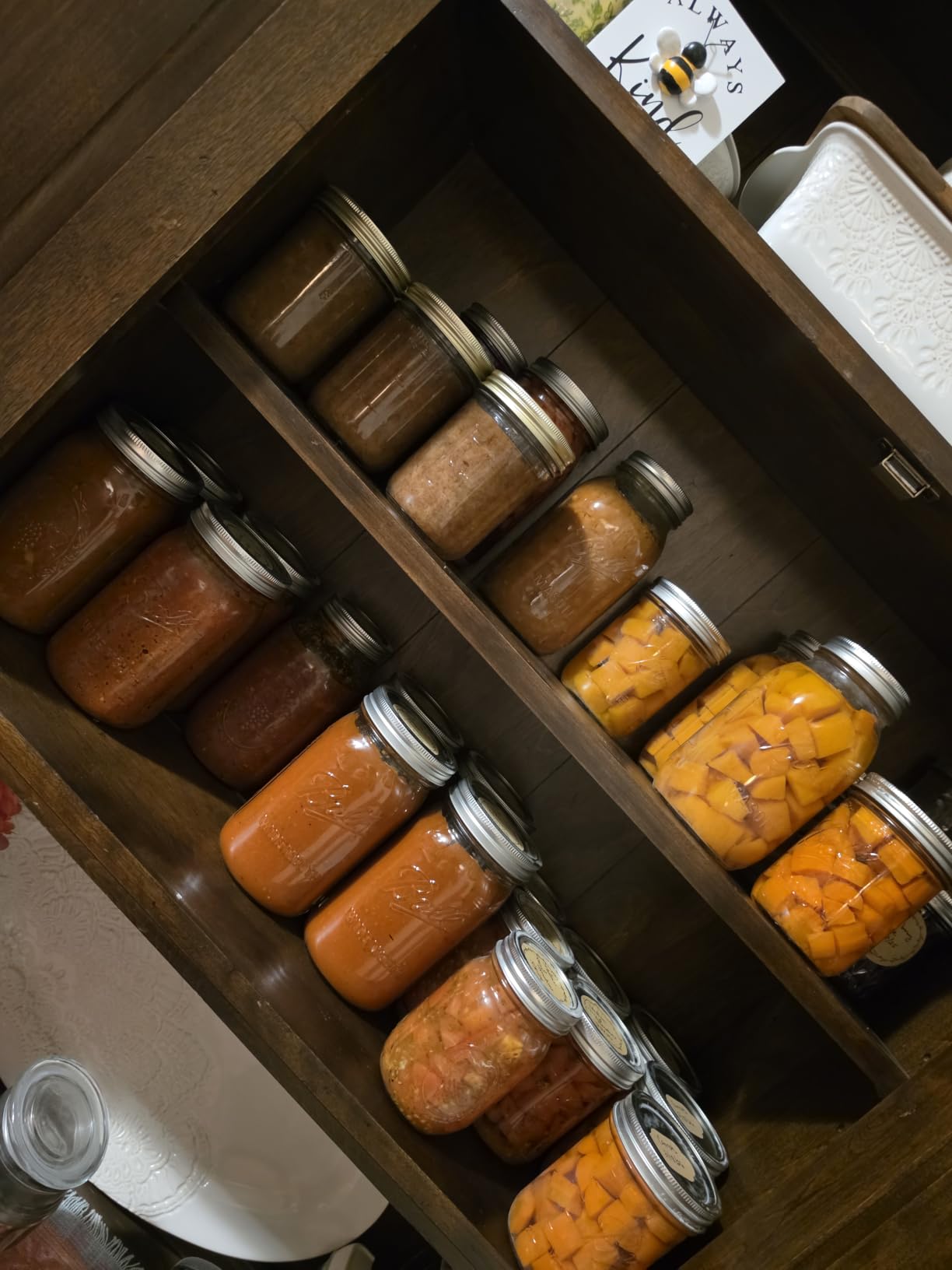
What you get for the entry outlay
Most of what a beginner actually needs. Two racks, a full guide, a multi-setting weight and a workable 7-quart batch, all from a brand with a large existing owner base at 6778 reviews. If you are learning on a gas or coil range and want a large first load without spending heavily, the package is complete.
The integrated multi-PSI weight is a genuine design advantage over ring-weight systems, particularly if you plan to switch between 5, 10 and 15 PSI at different elevations. Nothing goes back in a drawer between loads.
Where buyers report regret
The gasket is the weak point. Owners describe leaks at pressure, and the usual cause is a ring that has gone hard and needs cleaning or re-seating rather than being replaced. Check the gasket early and often rather than trusting a unit that has been on a shelf for a season.
Its 16.26-inch height also demands real counter and burner clearance, and reviewers advise against glass or smooth-top cooktops. The aluminum body can discolor and pick up residue after limited use, and the guide’s troubleshooting content references older procedures, so follow current NCHFP tested recipes instead.
7. MIRRO 22-Quart Pressure Canner: Best for Weighted Regulators
MIRRO 22 Qt Aluminum Pressure Canner with 3 Regulators, 5, 10 & 15 PSI
22-quart aluminum with three regulators
5, 10 and 15 PSI supplied
Dual cool-touch handles, two racks
Pros
- Three regulators supplied covering 5
- 10 and 15 PSI
- Pressure judged by sound and jiggle rather than a gauge
- Heats quickly and holds steady
- Consistently sealed jars with little siphoning
- Two racks and dual cool-touch handles
- Simple enough that first-time canners succeed
Cons
- No pressure reading valve or numeric reference
- Regulator must be pushed firmly to seat
- Staining appears around the steam vent
- Not recommended for glass or smooth-top stovetops
The Mirro 22-quart is the one to buy if you have decided you do not want a gauge. Three regulators covering 5, 10 and 15 PSI ship in the box, and you read pressure the old way, by the sound and the jiggle of the weight. Long-time canners on DiscussCooking describe owning a Mirro for about 40 years and replacing the gasket only once in that span.
Those owners switching back from a dial-gauge canner say the weighted system is the appeal. It requires less attention because there is nothing to read, and review patterns show consistently sealed jars with virtually no siphoning. The 22-quart size handles up to a 7-quart batch, and the family also comes in 16 quarts.
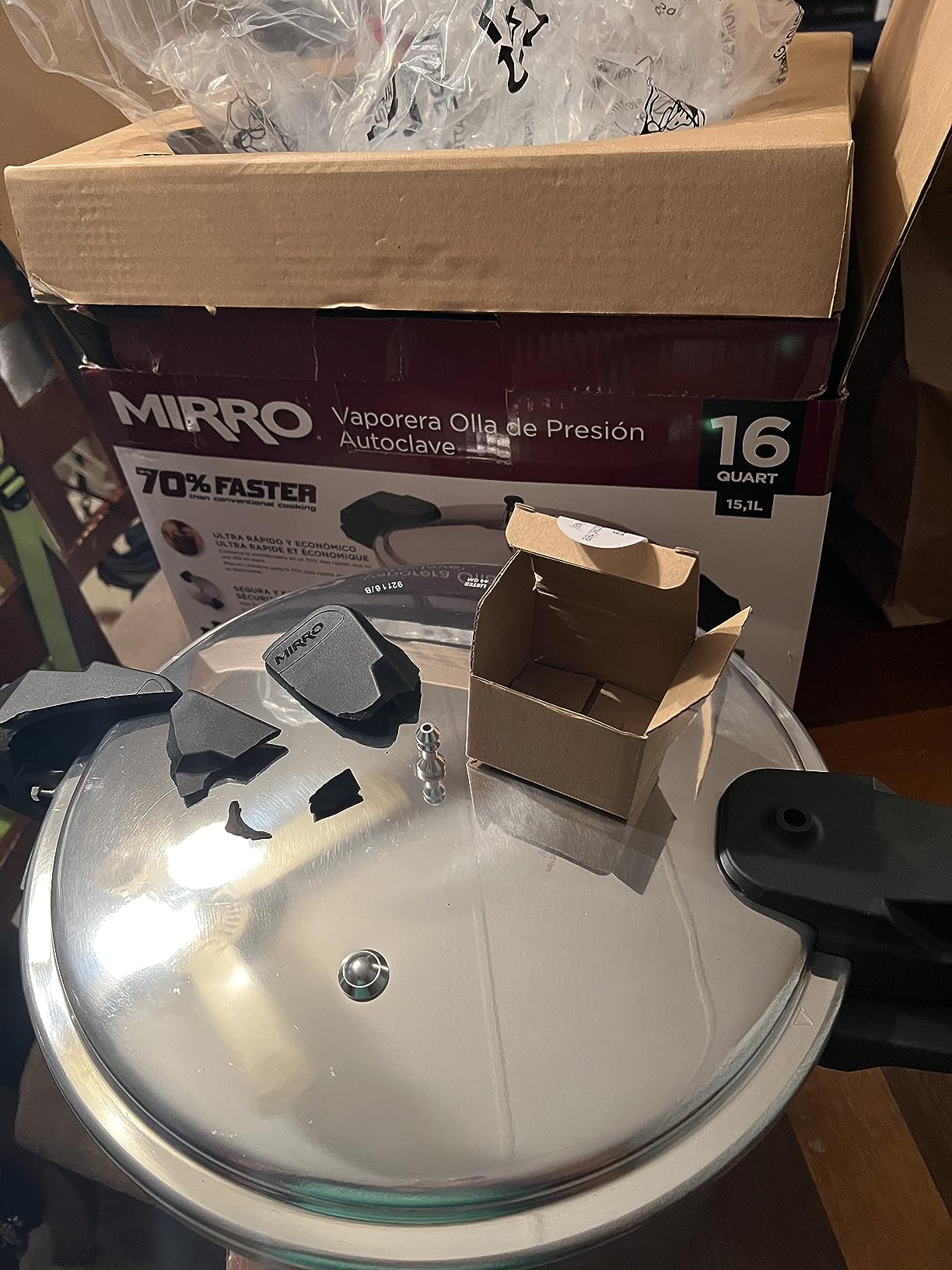
It heats quickly and holds a steady temperature with little heat adjustment, which is where weighted systems genuinely beat a manual dial. Dual cool-touch handles make the lift safer, two racks are included for optimized canning space, and the locking lid and steam release valve are simple mechanisms with few moving parts.
At 6.21 kg it is lighter than several rivals here, the mirror-polished exterior is easy to clean, and the natural aluminum interior resists the deep staining that shows up elsewhere. It functions as both a pressure canner and a pressure cooker, and the unit is listed as dishwasher safe.
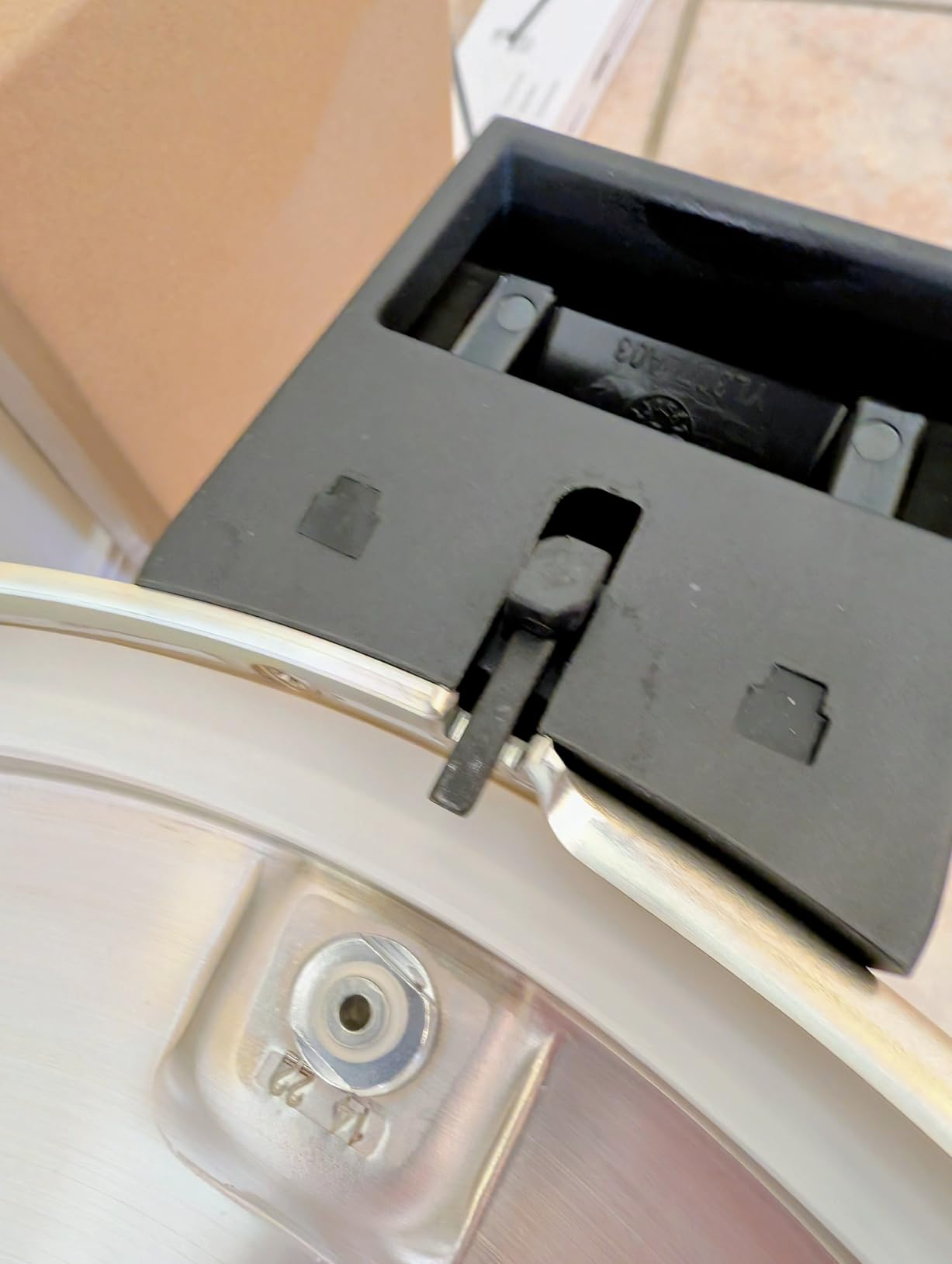
Why weighted regulators still make sense
Simplicity is the whole argument. You choose a weight for your altitude, set the heat until the weight begins to rock, and leave it. There is no needle to interpret through a steam-clouded lid and no annual accuracy check to schedule at a county extension office.
Supplies are simple too. A canner that is 20 or 40 years old only ever needed one replacement gasket, which is a very different maintenance history from a gasketed unit that gets a new ring every year regardless.
What you give up
There is no pressure reading valve and no gauge, so you have no numeric reference for pressure at all. If you want to confirm a reading or adjust for an unusual altitude, you cannot, and for high-elevation canners that is a real limitation.
Cosmetic issues dominate the complaints: rust-colored staining around the steam vent appears soon after first use, and the regulator must be pushed firmly onto the stem until it audibly pops or pressure will be wrong. The 16-quart version lacks a jar stacking rack, aluminum corrodes with acidic food, and reviewers advise against glass and smooth-top stovetops.
8. WantJoin 16-Quart Pressure Cooker: Best Mid-Size Induction Option
WantJoin 16Qt Aluminum Pressure Cooker w/Release Valve & Multiple Protective Devices,Pressure Canner Compatible with Gas & Induction Cooker,Canner Rack Included
16-quart aluminum with 70 Kpa pressure
Reaches a 239F boiling point
Gas and induction compatible
Pros
- Induction compatible in a size most aluminum pressure cookers skip
- Eight built-in safety features including self-locking valve
- 70 Kpa raises the boiling point to 239F
- 16-quart size handles family-sized batches
- One-year coverage with direct support
Cons
- Steam tray sits mid-pot instead of the bottom
- Aluminum discolors dramatically after one use
- Light-gauge construction feels flimsy
- Rack that keeps jars off the base is not included
We include this 16-quart unit because it solves a specific problem: induction compatibility at a size that most aluminum pressure cookers ignore. It is compatible with gas and induction stoves, which narrows the field a lot when your cooktop is magnetic.
Maximum pressure is rated at 70 Kpa, which raises the boiling point to 239F. That is the figure to hold in mind when reading the marketing, because the USDA and NCHFP position for low-acid canning is 240F. Before you use any small aluminum cooker for canning, check the current tested recipe requirements against what the unit actually holds.
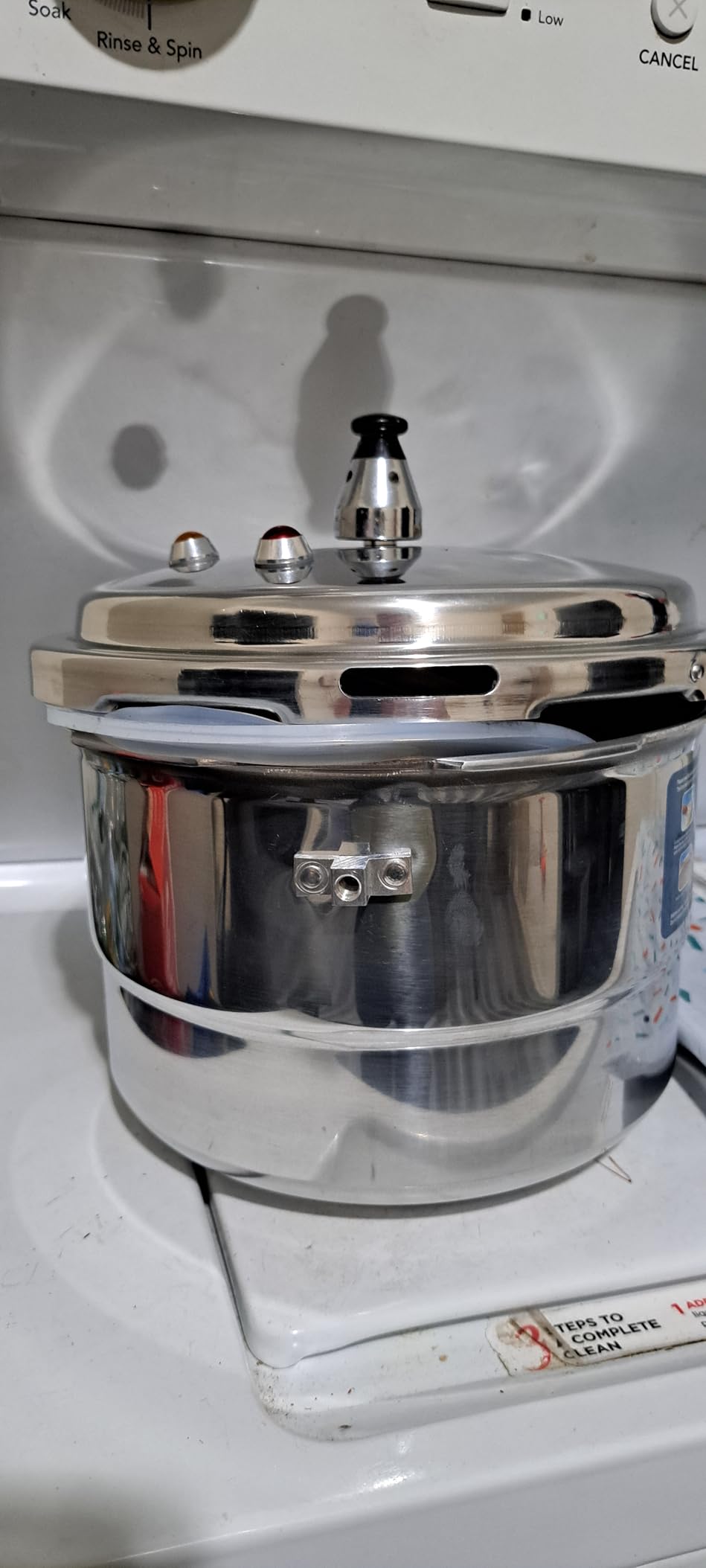
Eight safety features are built in, including a self-locking valve, a limit valve, an anti-blocking lid, a safety valve and a pressure release window. The line also runs from 4 to 23 quarts, so the same platform covers a small apartment kitchen and a large batch, and one-year coverage comes with professional one-on-one technical support.
Honest framing here: reviews are mostly about fast everyday pressure cooking rather than serious home canning, and 70 percent five-star against 9 percent one-star reflects that split. If you want a canner for garden harvests, the dedicated units above are the safer bet.
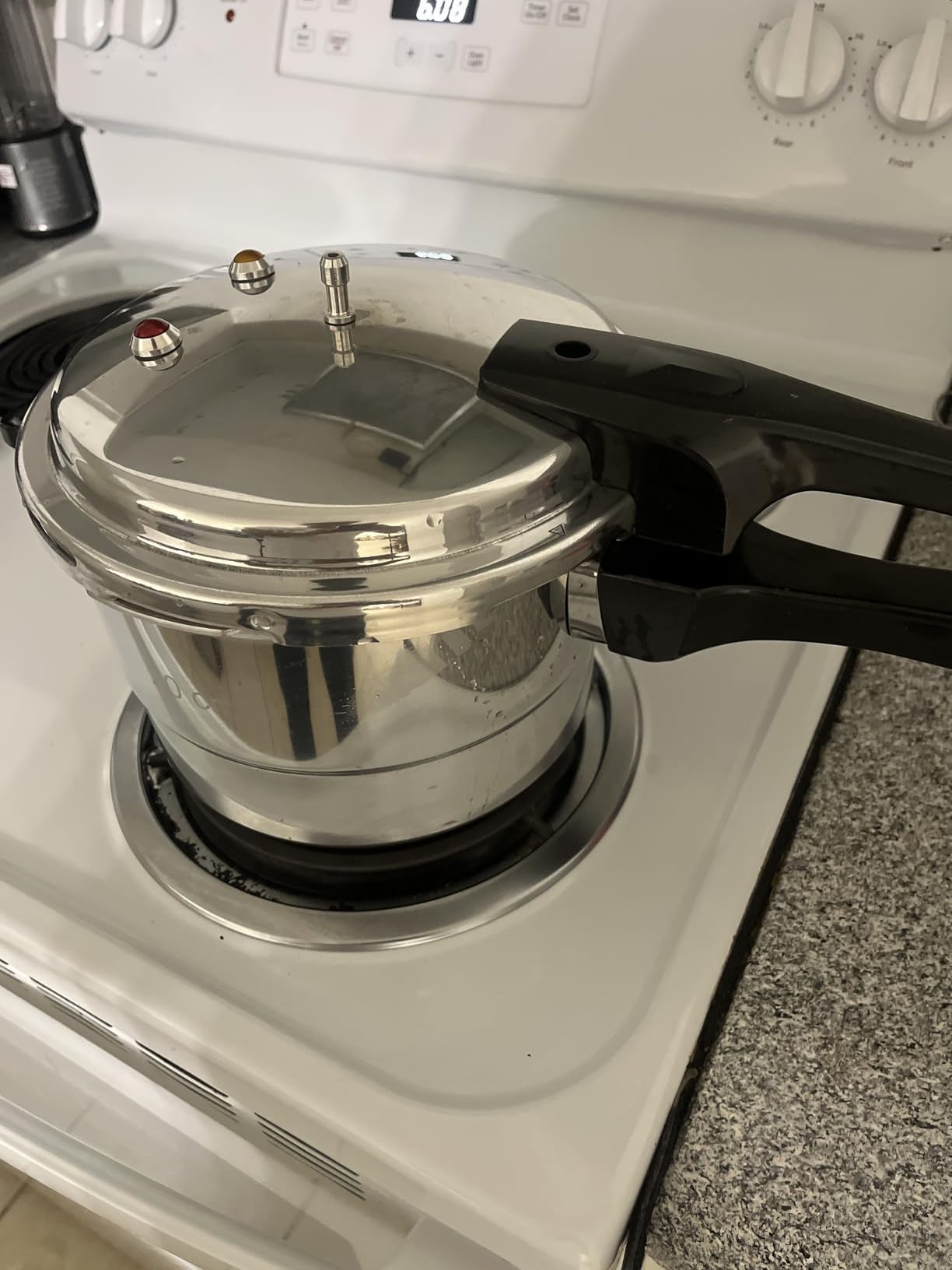
Where it earns its place
Induction compatibility is the headline. Canners working around glass-top and induction weight limits keep naming this as an option, and the 16-quart size sits in the sweet spot for a household batch without the 40-plus-pound lift of a large cast aluminum canner.
For weeknight pressure cooking alongside a small amount of canning, the combination of size, safety valves and a direct support line is a reasonable package.
Why we would not rely on it for canning
The included steam tray sits halfway down the pot rather than at the bottom, so a second rack has to be bought to keep jars off the base. That is a real problem for canning specifically, because jars need a stable surface.
Build quality is the other concern. Light-gauge aluminum feels flimsy to some owners, the body can discolor dramatically after a single use, some units arrive with a gasket that does not fit properly against the lid, and customer support queries have gone unanswered. At a 4.3 average it carries the lowest rating of the full-size vessels here.
9. Stark USA 6.0-Quart Pressure Cooker: Best Compact Magnetic-Base Cooker
Barton 6.0 Quart Pressure Cooker Pot Release Valve Aluminum Canning Cooker Pressure Release Pot Stove Top Instant Fast Cooking Stovetop Pressure Canner Pot Gas Stoves, (5.67L)
6-quart heavy-gauge aluminum
Magnetic base for induction, gas and electric
3.6 pounds, locking lid
Pros
- Induction-compatible magnetic base at a compact 6-quart size
- Triple safety system with regulator
- multiple valves and locking lid
- Light at 3.6 pounds so it is easy to handle
- Heat-resistant long handle stays comfortable to grip
- Smooth surface resists stains and cleans up quickly
Cons
- 6 quarts limits canning to a couple of jars
- Discoloration around the top rim does not wash away
- Small against dedicated 16- to 25-quart canners
At 3.6 pounds and 6 quarts, this is the unit to look at if a 24-pound canner is simply not going to happen in your kitchen. It lifts with one hand, stores in a cabinet and still works on induction, gas and electric ranges thanks to its versatile magnetic base.
Heavy-gauge aluminum alloy is specified for rapid, even heating without hot spots, and a triple safety system combines a high-precision pressure regulator, multiple safety valves including a self-locking valve, and a secure locking lid. A heat-resistant long handle handles the opening and closing.
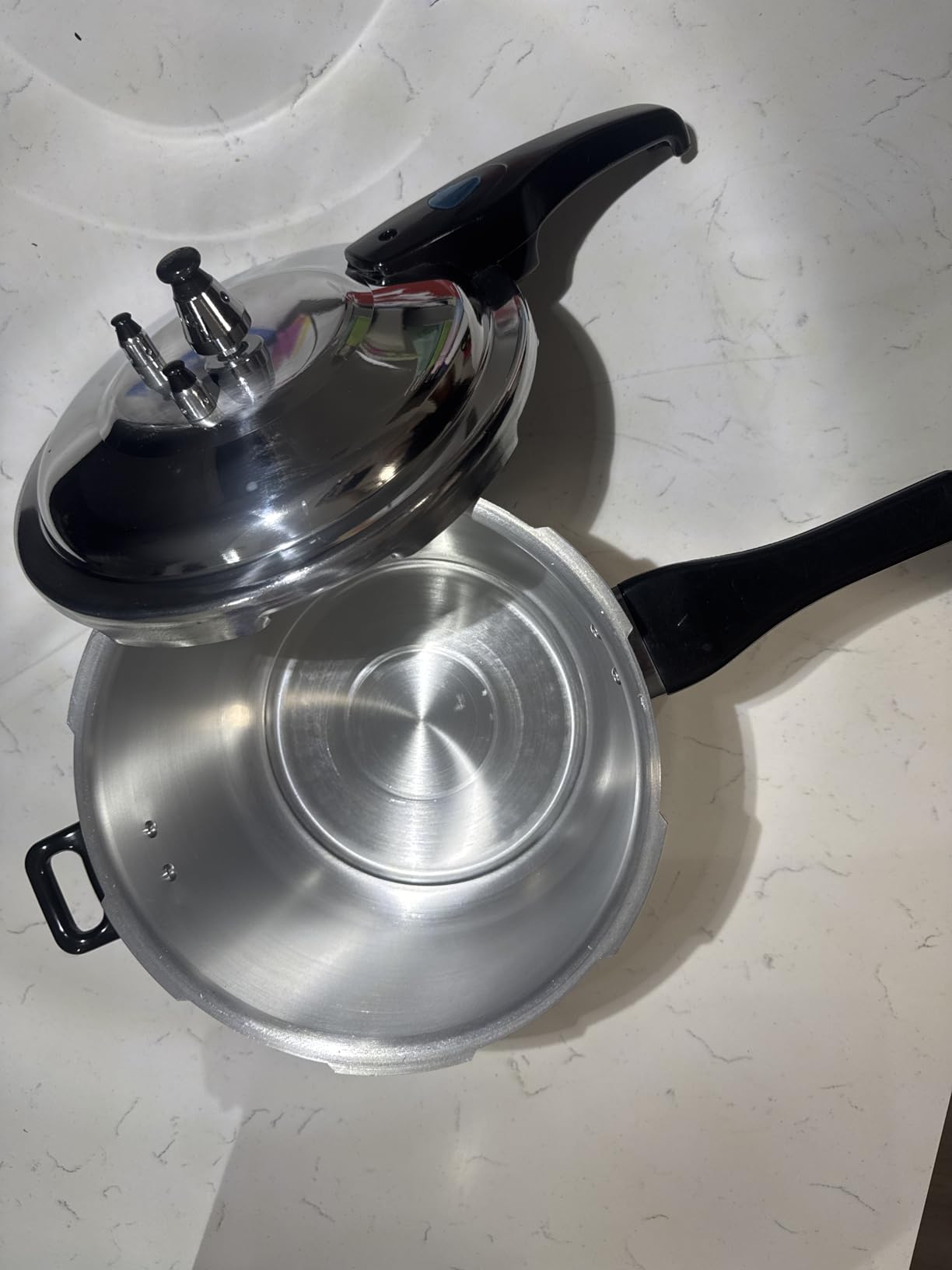
Cleaning is the quiet advantage. A smooth surface resists stains and wipes down fast, which matters for a small pot you will use for weeknight beans, grains and meats as much as anything else. Reviewers consistently note fast cooking times and a handle that stays cool to the touch.
Be realistic about the canning side. Six quarts is a compact everyday pressure cooker that can handle a small number of jars, and several owners note the capacity falls below what they need and plan to move to a larger unit.
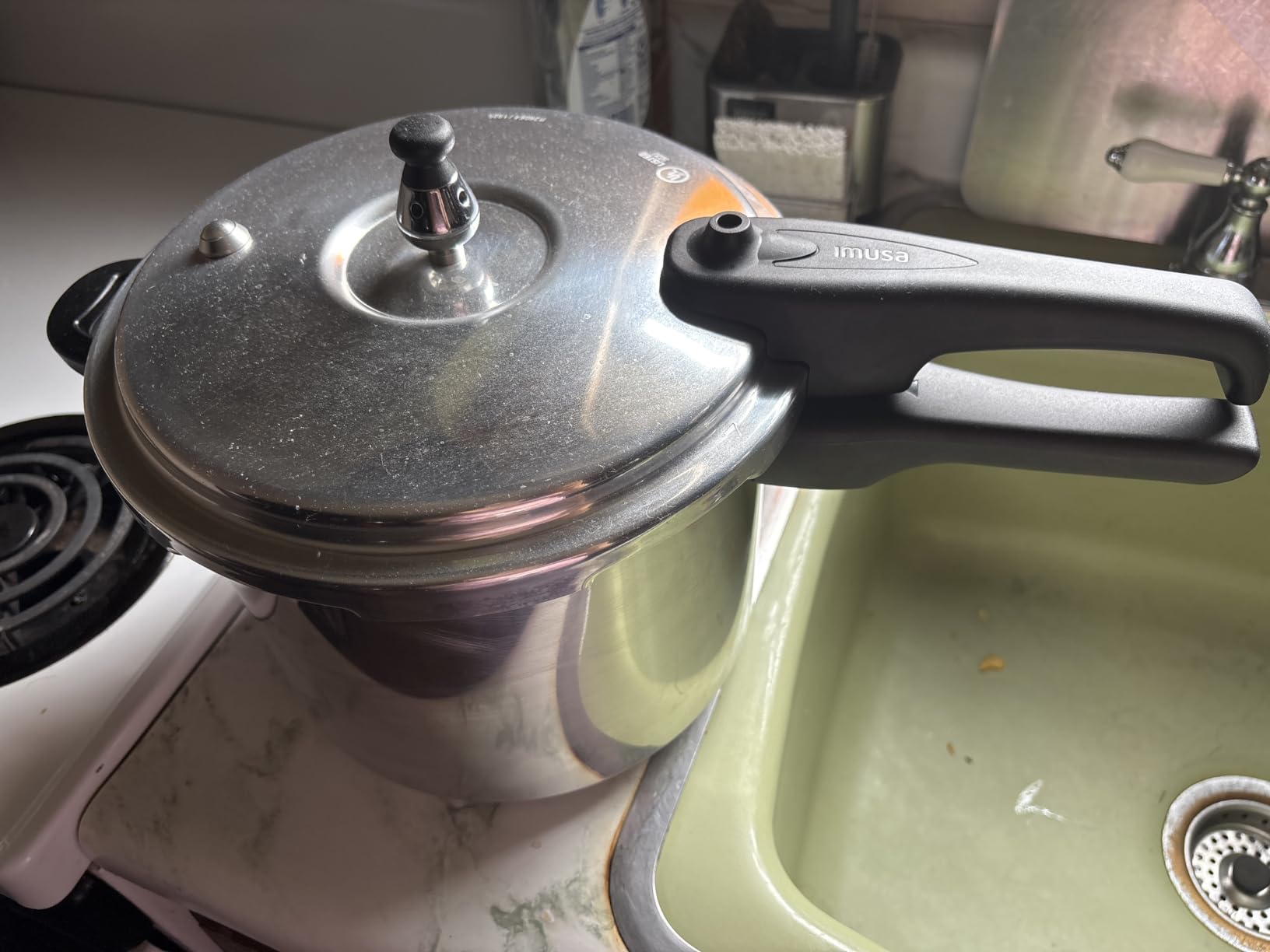
What it is genuinely good at
Everyday pressure cooking in a compact footprint. Tenderizing beans, meats and grains quickly, a magnetic base that works on any cooktop type, and a body light enough to move with one hand while hot are all real, frequently praised benefits.
It also suits moderate-size household batches, and the smooth surface that resists staining is what keeps it appealing after months of use rather than just the first week.
Why it is not a canning answer
Six quarts cannot hold a meaningful batch of quart jars. Even a small load means multiple cycles, and the specs do not describe a canner-class jar capacity or an internal rack sized for canning.
The most common complaint is cosmetic: light discoloration appears around the top rim after several uses and does not wash away. Plan on it cosmetically, and consider a dedicated canner for anything beyond a few jars.
10. BreeRainz 5.3-Quart Stovetop Pressure Cooker and Canner: Best for Tiny Kitchens
BreeRainz 5.3 Qt Stovetop Pressure Cooker & Canner, 10 PSI Induction Compatible Aluminum Pressure Canning Pot, Fast Cooking 70% Faster, Safe Triple Valve System, for Home & Small Kitchens
5.3-quart aluminum with stainless clad base
Holds a stable 10 PSI
Boiling point raised to 240F
Pros
- Maintains a stable 10 PSI for preservation
- Induction-compatible stainless steel clad base
- Triple protection with regulator
- safety valve and self-locking lid
- No electronics so there is no control board to fail
- Rack included for canning several jars
Cons
- Smallest capacity in the roundup
- Smallest review base so durability is less proven
- Aluminum body reacts with highly acidic food
This is the smallest unit in the roundup at 5.3 quarts, and its appeal is unusually specific. It holds a stable 10 PSI on the stovetop, which is the figure the USDA and NCHFP position for low-acid canning, and high-pressure steam raises the boiling point to 240F.
The body is heavy-gauge aluminum with a stainless steel clad base, and it works on gas, electric, ceramic and induction cooktops. That combination of a stable weighted-style pressure and a magnetic base is rare at this size, and it is why canners working around induction weight limits notice it.
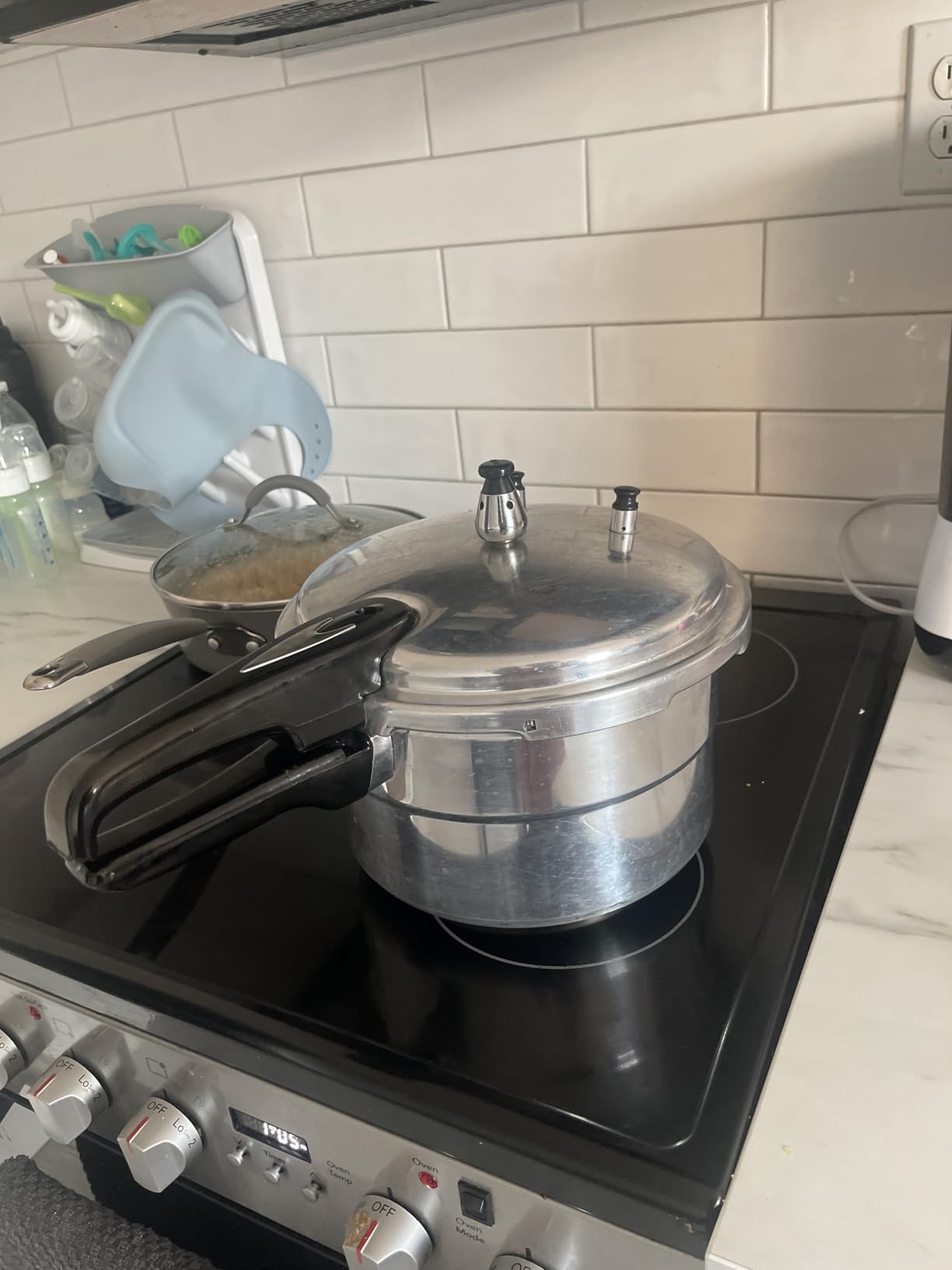
Triple protection covers a pressure regulator valve, a safety valve and a self-locking lid. A rack is included for steaming and canning multiple jars at once, and detachable sealing components with a smooth interior make cleaning simple. Replacement gaskets are easy to source, which matters in a category where part availability decides whether a cooker survives.
There are no electronics at all, and that is a real long-term argument. No control board, no display, no sensor to fail. The mechanism is mechanical and the same one that has not changed in this category for decades.
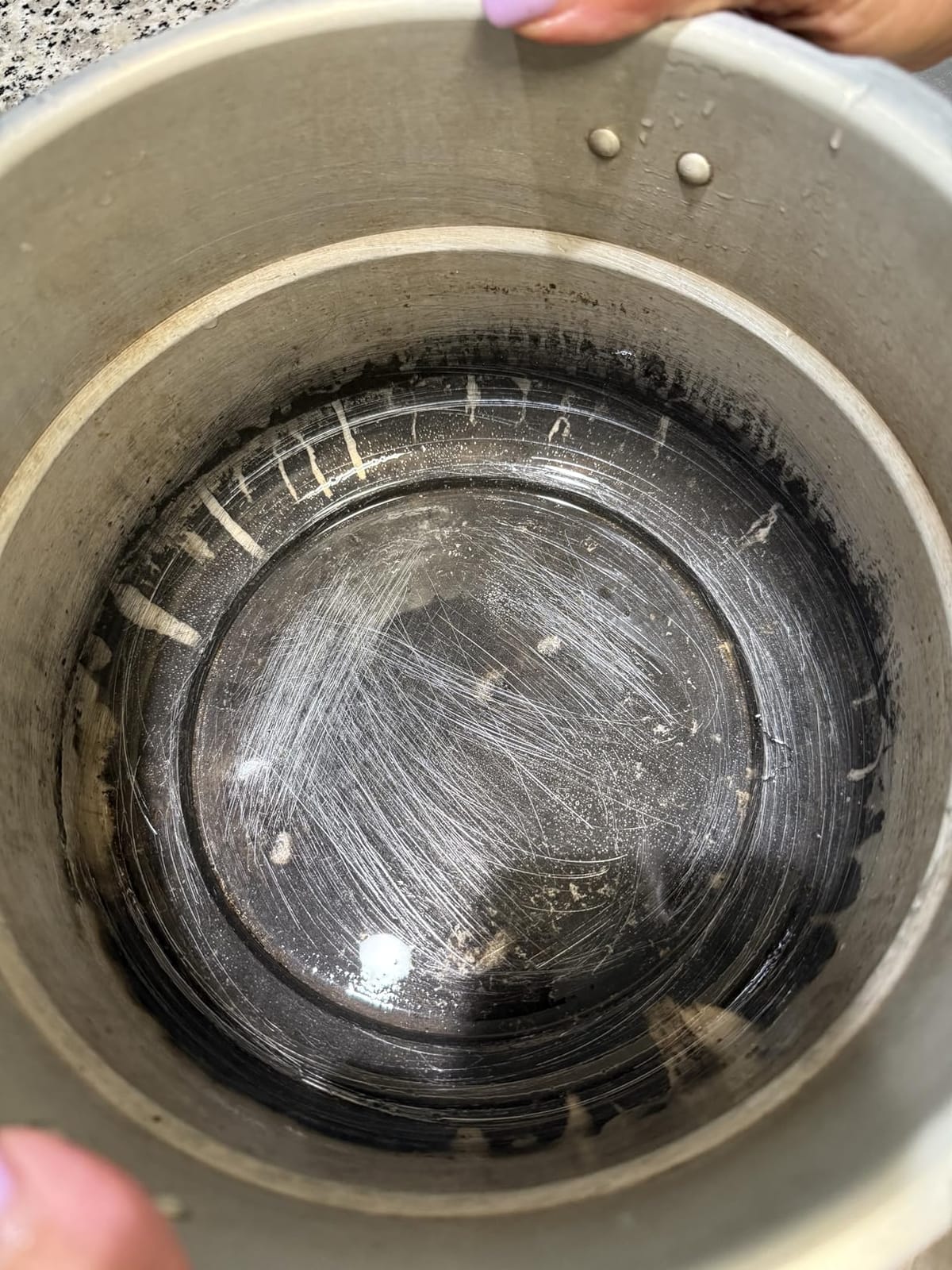
Where the compact format works
Couples, small families and apartment kitchens where a 20-quart canner is not going to be stored. At 5.3 quarts it suits very small batches, and buyers pick it specifically for stable stovetop pressure in a compact induction-compatible body.
It functions as a 2-in-1 pressure cooker and canner, so a small kitchen can cover beans, stocks and a limited amount of preservation with one appliance.
Why we rank it last
Capacity, mostly. It is the smallest vessel here and the only sensible for very small batches, so anyone processing a garden harvest will find it limiting quickly. The aluminum body also reacts with highly acidic food, so keep tomato and acid-heavy products to a boiling-water setup.
The second issue is evidence. At 181 ratings it has by far the smallest review base in the roundup, so a 4.4 average carries much less weight than the 20113-review 4.8 on the Presto 01781. Long-term durability is simply less proven, and that matters when you are buying a safety-critical vessel you expect to keep for decades.
Best Pressure Cookers for Canning vs. Regular Pressure Cookers: What Changes
Short answer to the most common question on this topic: no, you cannot use an arbitrary pressure cooker as a canner. A canner must hold 240 F under 10 to 11 PSI for the full processing time from a tested recipe, and it must have enough internal volume for at least four quart jars or seven pints. Most household pressure cookers are built for short, high-heat cycles on smaller volumes and will not hold a processing pressure for long enough.
Three differences do the work. First, jar capacity, because canning is not cooking. A 6-quart cooker that tenderizes a whole chicken has no room for jars and no canning rack. Second, the lid, since canner lids use a sealing ring and a vent pipe sized for slow pressure changes rather than rapid release. Third, documentation, since a canner ships with canning guidance and is sold for the purpose, while a cooker is not validated for food preservation.
The food science is why this is not a matter of preference. Low-acid foods, which include vegetables, meats, poultry, beans and soups, can carry Clostridium botulinum spores. A boiling water bath cannot reach the temperature needed to destroy them, which is the entire reason pressure canning exists. Acidified foods such as fruit jams, pickles and properly acidified tomatoes are handled in a boiling water canner instead, and our stainless steel canning stockpot guide covers the vessels built for that job.
Dial Gauge or Weighted Gauge: Which One Should You Buy?
Buy a dial gauge if you want a numeric pressure reading, if you live at altitude and want to confirm the target, or if you process large batches where an unattended 30-minute drift would matter. The cost is attention, because you hold the reading by hand for the entire processing time. A dial can also drift, so it deserves an annual accuracy check at a county extension office.
Buy a weighted gauge if you want less attention and less maintenance. You choose a 5, 10 or 15 PSI weight for your elevation, set the heat until it rocks, and walk away. Nothing to read, nothing to test annually, and nothing to misread. The trade is that you have no numeric reference if something looks off, and at higher elevations a weighted system means choosing a heavier weight and following the current tested recipe for that weight.
One confusion worth clearing up: the All American carries a gauge but is commonly run by weight, and Presto dial models use a counterweight that does not rock the way a ring weight does. Check the manual and the tested recipe rather than assuming either system behaves the standard way.
How Big a Pressure Cooker Do You Need for Canning?
Match the canner to the batch, not to your ambitions. Most home canners do fine with 16 to 17 quarts, and that is the beginner sweet spot. Move up to 21 to 23 quarts only when you routinely process more than about seven quart jars in a session, or when you want a second layer of jars on a second rack without doubling the number of cycles.
Going bigger is not automatically better. A 23-quart canner is slower to vent and cool, and on a small burner it can overhang the heat source, which is the most common complaint in glass-top and induction discussions. A canner that overhangs its burner heats slowly and unevenly, and that is a performance problem before it is a safety one.
Loaded weight is the other half of sizing. A 24-pound empty vessel plus jars, food and water is a two-handed lift, so the practical limit is often the size you can lift off the burner and carry to a cooling area, not the size that fits the jars.
Stove Compatibility: Gas, Coil, Glass-Top and Induction
Gas and electric coil ranges accept essentially every canner in this roundup, and they are the least fussy setup. Give the pot a burner at least as wide as its base and you avoid the slow heating that shows up on undersized burners.
Glass and smooth-top cooktops are where the complaints concentrate, and the reason is physics rather than marketing. A heavy cast aluminum canner transfers heat slowly, and a glass surface limits the burner size you can use. The fix is a clad base, which is why the Presto 01784 and the two smaller induction-compatible units in this roundup exist.
Induction narrows the field further. A magnetic base is required, and that rules out most plain aluminum canners outright. Among the full-size canners here, the Presto 01784 is the only one rated for induction, which is why we recommend it to anyone on a magnetic cooktop.
Brand Head-to-Head: Presto vs T-fal, Nesco and All American
Presto versus T-fal is the closest genuine rivalry here. Presto gives you a deluxe dial gauge, a 12-year warranty and a much tighter review profile at 4.8 across 20113 ratings. T-fal gives you three PSI settings built into the weight, two racks in the box and a wider spread of owner opinion at 4.4. Choose T-fal for the all-in-one package and integrated multi-setting weight, and Presto for gauge accuracy, warranty length and a far more proven record.
Presto versus Nesco is not really a match, it is a format question. Presto is stovetop and manual, NESCO is electric and regulated. The NESCO NPC-9 holds 4 quart jars or 5 pints with no heat juggling and a high-altitude valve included, while the Presto 01781 holds 7 quarts or 20 pints and needs you to manage the burner yourself. Presto wins on capacity and price per jar, NESCO wins on consistency and attention required.
Presto versus All American is the most interesting duel. Both are USDA-endorsed for the same foods and both are made to last. All American wins on rating at 4.9, on the gasket-free metal-to-metal seal, and on the number of pint jars it holds at 19. Presto wins on weight at 12 pounds against 24, on warranty length at 12 years, and on review volume. If you can lift it and intend to keep it for thirty years, the seal design is the deciding factor.
The Mirro 22-quart sits in the weighted-gauge corner, offering three regulators and a decades-long service history, at a 4.5 across 741 reviews. It is the option for people who want the least attention per load, and the option to skip if you want a numeric reading.
Gasket Care, Maintenance and Lifetime Cost
Gaskets are the consumable that decides your long-term cost. On a gasketed canner, expect to replace the sealing ring roughly yearly, and treat a gasket that has gone hard, cracked or flattened as a failed part rather than a consumable you can stretch. A slow loss of pressure partway through a process is almost always the gasket, not the recipe.
Test it before you commit a full batch. Put the ring in place, close the lid, and check the seal by pressure decay or by the feel of the clamped lid. If the unit is a weighted model, a regulator that does not rock evenly is the equivalent warning sign.
Then there is the annual dial check. If your canner has a dial gauge, take it to a county extension office for an accuracy test, the same way you would check a tire pressure gauge. A drifting needle is one of the quiet ways a good canner becomes unsafe without anyone noticing.
Aluminum bodies add a maintenance note that stainless ones do not. Acidic food and mineral-heavy water both work on aluminum, so pre-boiling water or using distilled water limits scaling, and owners of the All American mention mineral buildup often enough to plan for it. Stainless digital and electric units skip the issue entirely.
Five Buying Mistakes to Avoid
First, buying a general pressure cooker and assuming it can can. The box has to say canner, and the jar capacity and documentation have to back it up. Several small 5 to 6 quart units in this roundup are excellent pressure cookers and are not validated for food preservation.
Second, over-buying on size. The 23-quart canner is slower to vent and cool, is harder to lift loaded, and can overhang a small burner. Buy it when a 16-quart genuinely runs out of room, not because bigger looked better on the shelf.
Third, ignoring burner size and loaded weight. A pot that overhangs the heat source heats slowly, and a pot you cannot safely lift off the burner is a pot you will use less than you planned. Measure the burner before you order, and plan to fill the canner where it sits.
Fourth, ignoring the stove type. Most complaints in forum threads about canners that will not heat trace back to glass-top or induction kitchens buying a plain aluminum canner. If you are on a magnetic cooktop, induction compatibility is not a preference.
Fifth, skipping the second rack. Owners on r/Canning recommend a second interior rack specifically so jars can be stacked in two layers, which is the cheapest way to raise batch size on a 21 to 23 quart canner. Three of the ten units here already include two racks, so check the box before buying another part.
Frequently Asked Questions
Can any pressure cooker be used as a canner?
No, not an arbitrary one. A pressure canner must hold 240 F under 10 to 11 PSI for the entire processing time listed in a tested recipe, and it must hold at least four quart jars or seven pints around a canning rack. Most household pressure cookers are designed for short high-heat cycles, lack the jar capacity, and are not validated for food preservation. The box has to say canner.
What is the difference between a pressure cooker and a canning pressure cooker?
A pressure canner is built for preservation. It has canning-capacity interior volume, a sealing ring and vent pipe designed for slow pressure changes, a canning rack, and documentation for tested processes. A pressure cooker is built for fast cooking in small volumes and is not tested for low-acid preservation. Canning requires 240 F to destroy botulism spores, which a boiling water bath cannot reach.
Is there a pressure canner that doesn’t require a gasket?
Yes. The All American 925 uses a precision-machined metal-to-metal sealing system with positive action clamps instead of a replaceable rubber ring, so there is no gasket consumable to crack or harden. Most other canners, including the Presto, T-fal, Mirro and NESCO units in this roundup, use a sealing ring that should be inspected and replaced on a schedule.
How big of a pressure cooker do you need for canning?
Most home canners are well served by 16 to 17 quarts, which is the beginner sweet spot. Move up to 21 to 23 quarts when you routinely process more than about seven quart jars or want two layers of jars on a second rack. Go smaller, 9.5 quarts, for jam, pickles and small batches. Consider loaded weight, because a large canner full of glass and food is a two-handed lift.
Which pressure canner is better, Presto or T-fal?
Presto, for most people. The Presto 01781 and 01784 hold 7 quart jars or 20 pints, carry a 12-year limited warranty and rate 4.8 across thousands of reviews, with the 01784 adding an induction-compatible base. The T-fal 22-quart is a strong budget alternative with three PSI settings built into the weight and two racks in the box, but its owner ratings are more polarized and its gasket and gauge draw more complaints.
What are the differences between Presto and All American pressure canners?
Presto 01781 is a 12-pound aluminum canner with a deluxe dial gauge, 7-quart capacity and a 12-year limited warranty. The All American 925 is a 24-pound cast aluminum canner with a gasket-free metal-to-metal seal, roughly 19 pint or 7 quart jar capacity and a 4.9 rating, and it is made in the USA. All American is heavier and heats more slowly, but it needs no gasket replacement and is built as a lifetime vessel.
Which pressure canner has the highest rating?
Among the ten units reviewed here, the All American 925 has the highest average rating at 4.9 across 9758 reviews, with 93 percent five-star. The Presto 01781 and 01784 follow at 4.8, and the Presto 01781 also has by far the largest review base at 20113 ratings. Rating alone is not the whole decision, since capacity, stove type and gauge type change what a given canner is actually good for.
Conclusion: The Best Pressure Cookers for Canning in 2026
The Presto 01781 23-quart is our pick for the best pressure cookers for canning overall, with 7 quart jars or 20 pints per load, a deluxe dial gauge and a 12-year warranty behind the deepest owner base in the category. If your cooktop is magnetic, take the Presto 01784 instead, since it is the only full-size canner here rated for induction. If you want no gasket to replace and intend to keep the canner for decades, the All American 925 is the strongest build. If stovetop heat management is the part that intimidates you, the NESCO NPC-9 trades batch size for set-and-forget consistency.
Whatever you choose, follow current NCHFP tested recipes, verify the 240 F target, and run a full seal check with the food you intend to can before a season’s worth of produce arrives on the counter. That last habit matters more than any spec on this list.