
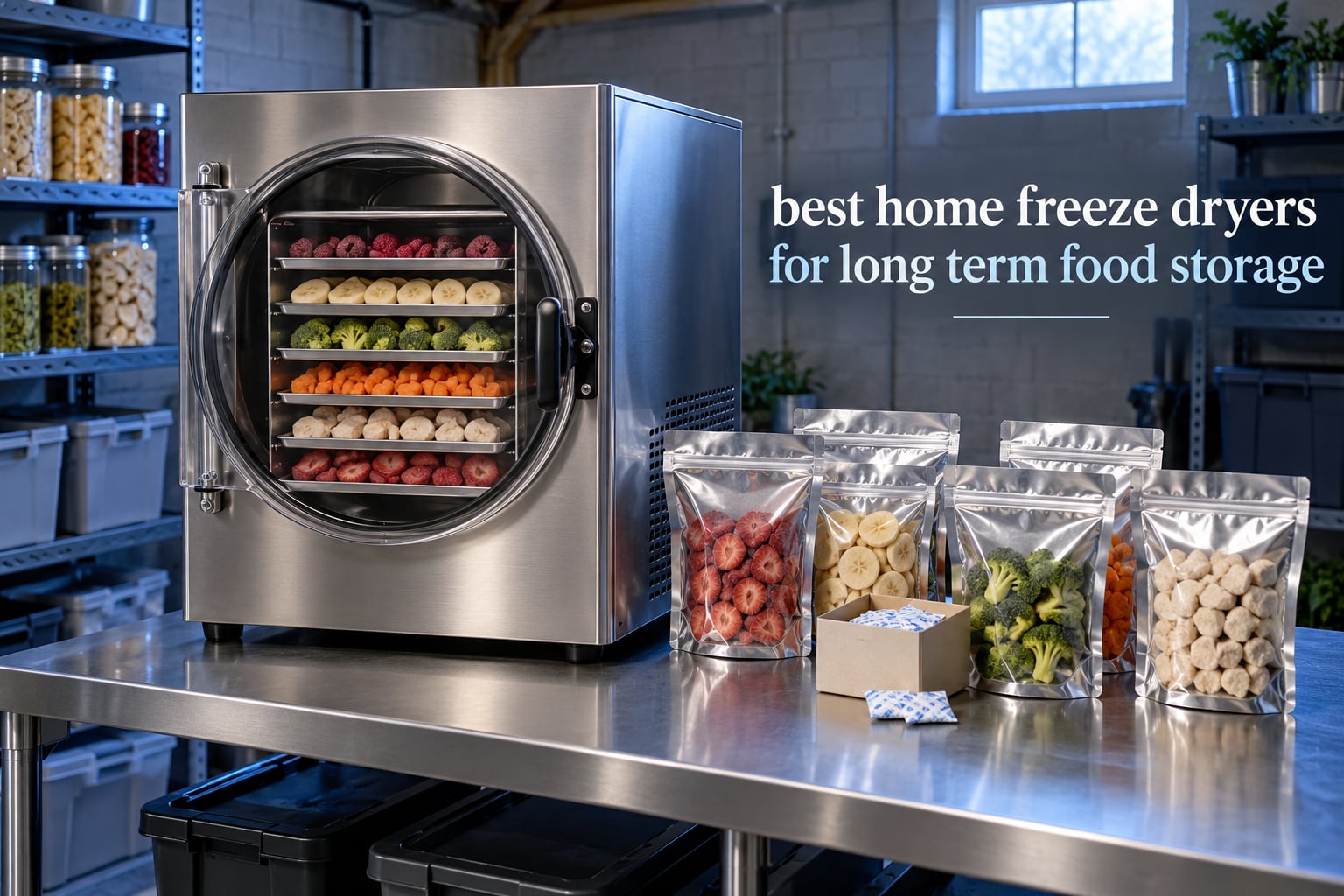
A home freeze dryer runs one continuous process that no other countertop appliance can: it freezes food solid, drops the chamber pressure, and pulls the ice out of it as vapor. That is sublimation, and the result is a piece of food that keeps for decades in a sealed pouch, rehydrates back to something close to its original texture, and never spends enough time warm to lose the vitamins and flavor a dehydrator cooks away. If you are comparing the best home freeze dryers for long-term food storage, you are really comparing chamber size, pump strength, and whether the machine can be trusted to hold a vacuum overnight.
That trust is the part most marketing skips. A freeze dryer runs for 20 to 40 hours on a single batch, and if a door gasket leaks at hour 14, you find out the expensive way. We read every owner review we could find on the machines below, checked the published specifications line by line, and separated what is verified from what is a manufacturer claim. Our team has also spent time with machines of this class long enough to know which numbers actually decide a batch and which ones are just printed on a box.
A word on what this roundup is not. Two of the ten machines below are heated-air food dehydrators wearing a freeze dryer name. They are useful, inexpensive tools for jerky and fruit chips, and we cover them honestly, but neither performs sublimation, and neither will give you the storage life the word implies. The other eight run a real vacuum chamber, and the differences between them are what this guide is built around.
Before you read further, it helps to know who these machines are actually for. Gardeners with a surplus harvest, hunters who buy meat in bulk, and families building a multi-decade pantry are the buyers who get their money back. A two-person apartment that eats fresh food will not, and no machine in this list changes that math. We will get into the honest version of the return later in the guide.
Table of Contents
Top 3 Home Freeze Dryers for Long-Term Food Storage in 2026
These three are the picks we would put in a real pantry. The first is the only machine here with a body of verified owner feedback, the second arrives with the storage supplies you need on day one, and the third moves more food per cycle than anything else we evaluated.

VEVOR HFD-4 Freeze Dryer
- 8.8-13.2 lbs per batch
- 4-layer stainless tray stack
- -35C cold trap
- 60 dB or less

Blue Alpine Medium Select
- 10-15 lbs per batch
- Mylar bags and impulse sealer included
- 108 lb unit
- 1-year warranty

Camellia River 25 lb Freeze…
- 25 lbs per cycle
- 5 stainless steel trays
- Packaging kit included
- 120 V digital controls
All 10 Best Home Freeze Dryers Compared Side by Side in 2026
Every machine we evaluated, with the numbers that decide a batch. Only the first row has verified owner reviews behind it, so treat the remaining specifications as manufacturer-stated until you can test the machine yourself.
| Product | Specs | Action |
|---|---|---|
| VEVOR HFD-4 Vacuum Freeze Dryer |
|
Check Latest Price |
| Blue Alpine Medium Select Freeze Dryer |
|
Check Latest Price |
| Camellia River 25 lb Freeze Dryer |
|
Check Latest Price |
 HNZXIB FD-05H ZZKD Freeze Dryer HNZXIB FD-05H ZZKD Freeze Dryer |
|
Check Latest Price |
 EQCOTWEA 4-Tray Vacuum Freeze Dryer EQCOTWEA 4-Tray Vacuum Freeze Dryer |
|
Check Latest Price |
 LGXEnzhuo 1550W Lyophilizer LGXEnzhuo 1550W Lyophilizer |
|
Check Latest Price |
 SINOPED SN-LG-03 Benchtop Dryer SINOPED SN-LG-03 Benchtop Dryer |
|
Check Latest Price |
 HNZXIB 3-Tray Home Freeze Dryer HNZXIB 3-Tray Home Freeze Dryer |
|
Check Latest Price |
 Generic 6/8/12-Layer Drying Cabinet Generic 6/8/12-Layer Drying Cabinet |
|
Check Latest Price |
 Generic A-1 Food Dehydrator Generic A-1 Food Dehydrator |
|
Check Latest Price |
1. VEVOR HFD-4 – Best Overall Vacuum Freeze Dryer With Verified Owner Feedback
VEVOR Vacuum Freeze Dryer Machine, 8.8-13.2 LBS/Batch Food Freeze Drying Machine with 4-Layer Trays, Vacuum Pump, Adjustable Timer and Temperature Control, for Fruits Vegetables Meat, White
8.8-13.2 lbs per batch
4 trays
245.8 lb
103 VAC at 1550 W
-35C cold trap
60 dB or less
Pros
- 304 stainless steel chamber and trays
- Only model here with a body of verified owner reviews
- Reportedly quiet at 60 dB or less
- Touch screen with programmable time and temperature
Cons
- Instruction manual widely criticized as unhelpful
- Some machines shipped without compressor oil
- Reports of oil leaks and machines missing set temperature
This is the only machine in our entire comparison that has real people behind it, and that changes how we evaluate it. Forty-eight owner reviews averaging 3.7 stars tells you more than a specification sheet ever will. It also tells you the failure modes, which is exactly what you need when a cycle runs overnight for two days.
The hardware is unremarkable in a good way. A compressor-driven cold trap holds to -35C, the chamber holds 8.8 to 13.2 pounds across four stainless steel trays, and the whole machine draws 1550 W on 103 VAC. At 245.8 pounds and just under 30 inches deep, it is a two-person lift, not a solo carry, so plan the route into the room before it arrives.
Owners who get a working machine like the build. Multiple reviewers describe the compressor as quiet and the touch programming as straightforward, and several report good results with dog jerky and fruit snacks. The 60 dB or less figure is the only published noise number in this group, and it lines up with what owners report about running it in a normal work room.
Then there is the documentation problem, and it comes up more than any other theme in the reviews. Owners describe the manual as essentially useless, with little guidance on process settings and not much online help to make up for it. If you buy this machine, plan to spend the first batch learning the curve by feel rather than by following a recipe book.
What the 48 verified reviews actually tell you
The rating distribution is the most useful signal here: 54 percent five-star against 22 percent one-star. That gap is not normal noise, it is two different experiences, and the dividing line is almost always whether the unit worked from the start. People with working machines describe quiet operation, good air circulation, and satisfying dried output. People with problems describe a different machine entirely.
The specific problems reported are worth knowing before you buy. Some machines arrived without the compressor oil needed to run, some leak oil, and some will not reach the temperature they display. A few owners also report difficulty reaching customer service, which matters a great deal more when the machine is a fixed 20 to 40 hour commitment.
Who this machine suits, and where it falls short
This suits a buyer who wants verified owner data over glossy claims, and who is willing to budget time for the learning curve. If you run a harvest, the four trays at 8.8 to 13.2 pounds per batch is a workable throughput, though it is not the fastest way to clear a bushel before frost.
It falls short for anyone who needs clear written instructions on their first run, or who needs support to be responsive. The reviews are candid about both. And with 48 reviews behind it, this remains a much thinner evidence base than a long-established brand would offer, so treat the average of 3.7 as a warning about variance, not a settled verdict.
2. Blue Alpine Medium Select – Best Home Freeze Dryer for Beginners Who Want the Storage Kit Included
Blue Alpine Medium Select Freeze Dryer – Home Freeze-Drying Machine for Food Preservation & Long-Term Storage
10-15 lbs per batch
5 trays
108 lb
120 V at 60 Hz
21 by 20 by 30 in
1-year warranty
Pros
- Mylar bags and impulse sealer included in the box
- Lightest machine in the group at 108 pounds
- Built and assembled in Idaho
- USA
- Five-tray chamber suits mid-size harvests
Cons
- No customer reviews on this listing yet
- 30-year shelf life claim is manufacturer-stated
- Five trays limit very large single loads
The single most useful thing about this machine is what arrives in the box. The included components list names a vacuum pump, trays, silicone mats, Mylar bags, and an impulse sealer, which is the complete chain from wet produce to sealed storage pouch. Almost every other machine on this list leaves you buying the packaging separately, and most failed long-term storage projects fail at that step rather than in the chamber.
At 108 pounds it is by far the lightest machine we evaluated, roughly half the weight of most of its competitors, and it measures 21 by 20 by 30 inches. That footprint and weight mean one person can reposition it, which matters if you need to chase cool room air through the season. It runs on 120 V at 60 Hz, so it is not a dedicated-circuit question.
The chamber holds 10 to 15 pounds of food per batch across five food-grade stainless steel and aluminium trays, and the unit is described as a medium class design built in Idaho. A one-year manufacturer warranty comes with it, which is standard for the category and not a differentiator.
Be clear-eyed about the evidence, though. This listing has no customer reviews, so everything above is manufacturer-stated. The advertised 30-year shelf life on finished food is a marketing claim rather than something independent testing on this listing supports, and we would not plan a 30-year pantry around a claim you cannot verify. We include it because the included storage kit is genuinely rare, not because we have proof the machine performs.
Why the included packaging matters more than the spec sheet
Long-term freeze-dried storage depends on two things: a good batch and a good seal. Owners in community forums describe the same pattern repeatedly, a 30 or 40 hour cycle followed by a bag that was sealed badly, and the whole harvest is lost in the pantry instead of the chamber. A machine that ships with Mylar bags, oxygen absorbers, and an impulse sealer removes the single most common point of failure from the process.
It also shortens the learning curve. Beginners who are new to sublimation spend their first month learning how a vacuum curve behaves instead of learning how to portion and seal a pouch. We would rather you spend that month on the food side, where the mistakes are recoverable.
Where the Blue Alpine falls short
Zero reviews means zero independent validation on seal durability, pump longevity, or whether the temperature holds steady overnight. If you are the kind of buyer who reads failure reports before purchasing, this listing will give you nothing, and you should weight the verified-feedback machine more heavily for that reason.
Five trays also caps the size of any single load, so a very large garden or a bulk meat buy means more cycles rather than fewer. At 10 to 15 pounds per batch it sits in the middle of the group, which is the right place for most households but not the fastest for a big harvest.
3. Camellia River 25 lb Freeze Dryer – Best Large Home Freeze Dryer for Clearing a Harvest Fast
Camellia River Freeze Dryer Machine with Vacuum Pump, Large Capacity for Home Food Preservation
25 lbs per cycle
5 stainless steel trays
220 lb
120 V household power
Front load
Pros
- Largest batch capacity at 25 pounds per cycle
- Impulse sealer
- mats
- Mylar bags and absorbers included
- Automated digital cycles on standard 120 V
- Front-load access for loading racks
Cons
- No customer reviews on this listing yet
- Listed height figure looks inconsistent with the other dimensions
- 220 lb still needs two people to move
Capacity is the reason this machine is on the list. At 25 pounds per cycle it processes roughly twice what a mid-size chamber handles, and for a homestead trying to clear a bushel before frost that difference is measured in overnight cycles rather than days. The chamber is front-load, so you slide racks in rather than reaching down into a squat cabinet, which is a real ergonomic win when you are doing several cycles in a row.
It also runs automated digital cycles on standard 120 V household power. That matters more than it sounds, because a machine that needs a dedicated 20-amp circuit changes where in a home you can put it, and this one can go almost anywhere you have a normal outlet and some floor space.
The accessory kit is unusually complete: impulse sealer, silicone mats, Mylar bags, and oxygen absorbers. Combined with the 25 pound load, that gives you a machine that can turn a large harvest into sealed pouches without a second shopping list. For a small food business selling freeze-dried fruit snacks or candy at a market, that combination is the entire production chain.
Before you plan cabinet space, check the dimensions yourself. The listing gives 25.5 inches deep by 24 inches wide, but the height figure does not sit sensibly against those two numbers or against a 220 pound weight, so verify the real footprint with the seller. It is the kind of listing inconsistency that is easy to fix and expensive to discover after the machine is already in the room.
Throughput math for a real harvest window
Do the math on your own produce before you commit. A large garden can easily produce several hundred pounds of surplus in a few weeks, and at 25 pounds per cycle with cycles that run overnight, you are looking at many consecutive days of loading, checking, and packaging. Owners who run their machines nearly continuously through harvest describe it as a full-time commitment for that window, not an occasional appliance.
Plan the packaging station next to the machine rather than across the room. The difference between sealing a pouch while the food is still cool from the chamber and walking to another room is the difference between a smooth harvest and a week of sticky counter work.
Where the Camellia River falls short
As with the other reviewed-here machines without feedback, there are no owner reviews on this listing, so the 25 pound figure is a manufacturer claim rather than something we could confirm against real harvests. The listing data itself contains a dimensional inconsistency, which is a small signal about how carefully the specification sheet was assembled.
At 220 pounds it is not a machine you shuffle around to chase temperature, so you need to place it where the room is already cool. And the batch size does not reduce cycle time, so a bigger chamber is a throughput win rather than a wait win. If your harvest is small, this capacity is money and floor space you will not use.
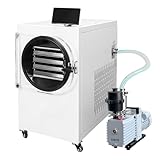
4. HNZXIB FD-05H – Best Freeze Dryer With the Deepest Cold Trap in the Group
ZZKD -60℃ Vacuum Freeze Dryer for Home, Food Lyophilizer with Vacuum Pump, Food Grade Freeze-Dried For Fruits, Candy, Fish, Milk, Pet Foods, One Freeze-Drying Area Of 0.46㎡
8.8-13.2 lbs per batch
4 trays
304.2 lb
110 V at 1500 W
-60C cold trap
4.5 CFM pump
Pros
- Cold trap reaches -60C in about 40 minutes
- Automatic 15-minute defrost with wastewater discharge
- 4.5 CFM rotary vane pump rated for 800+ hours
- 7-inch touchscreen with one-touch presets
Cons
- Heaviest machine here at just over 304 pounds
- No customer reviews on this listing yet
- Brand naming on the listing is inconsistent
A deeper cold trap is the single most useful number on this machine, and this one goes to -60C. That matters because the cold trap is what keeps ice from sublimating onto the chamber walls instead of the food, and the deeper it goes the more water the pump can pull from your product per hour. For a person running multiple consecutive batches, faster water removal is a shorter cycle, and a shorter cycle is more food per week.
The pump specification is the other standout. A 4.5 CFM rotary vane pump is the highest published airflow figure in this comparison, and it is rated by the manufacturer for 800 or more hours of continuous operation. A rotary vane pump with an oil system is also the type that community owners overwhelmingly prefer to oil-free pumps, precisely because it can be serviced rather than replaced.
The automatic 15-minute defrost cycle with wastewater discharge is a quiet quality-of-life feature. Manual defrost and drain after every batch is the step owners most often skip when they are tired, and a machine that handles it for you keeps the cold trap working properly over a long season.
Two cautions. At just over 304 pounds this is the heaviest machine we evaluated, so the placement decision is permanent once it is down. And the listing names ZZKD in the title while the brand field reads HNZXIB, which is a small sign that the listing copy was assembled from a supplier catalogue rather than written by the manufacturer.
What a deeper cold trap changes in practice
Cold trap temperature sets the ceiling on how much water leaves your food per hour. At -35C a batch of high-moisture produce such as sliced strawberries or tomatoes can sit for a long stretch before enough ice is gone to call the cycle done. A -60C trap changes that arithmetic, and for watery vegetables and fruit it is the difference between a cycle that ends when you go to bed and one that ends in the morning.
It also protects the pump. A trap that is too warm lets water vapor reach the pump oil, which is exactly the misting problem owners misdiagnose as a failing pump. Cold trap performance and pump health are the same issue seen from two sides.
Where this machine falls short
There are no customer reviews on this listing, so the -60C figure and the 800-hour pump rating are manufacturer claims with no independent confirmation behind them. That is the honest limit of what we can tell you about it.
At 8.8 to 13.2 pounds per batch it is not the largest chamber here, so the deep trap speeds cycles up rather than making each one bigger. If your harvest is the constraint rather than your cycle time, a larger chamber will serve you better.
5. EQCOTWEA 4-Tray – Best Freeze Dryer for Vacuum Data and Cycle Diagnostics
EQCOTWEA 110V 4-Tray Freeze Dryer Vacuum Freeze Drying Machine with 0.4㎡ Freeze-Drying Area -25~+60℃ Temperature 11lbs/Batch Vacuum Food Dehydrator for Fruits Vegetables Meat, Used in Home Laboratory
11 lbs per batch
4 trays over 0.4 sqm
254 lb
110 VAC at 1550 W
-40C cold trap
Pros
- Screen reports separator
- trap and sample temperature with vacuum curves
- Automatic defrost speeds turnaround between batches
- Transparent chamber door for monitoring
- Compact body for 11 lb capacity
Cons
- No customer reviews on this listing yet
- Rotary vane pump must not run hot
- Pump and screen claims are manufacturer-stated
This is the machine for anyone who wants to see the physics rather than guess at it. The 7-inch LCD touch screen reports separator temperature, cold trap temperature, sample temperature, and draws vacuum and data curves through the run. Those curves are how you tell a healthy chamber from one that is slowly losing vacuum, and a machine that shows them makes troubleshooting something you can do yourself.
The 11 pound batch across four stainless steel trays covers 0.4 square meters of drying area, which is a competitive capacity for a machine in this class. At 254 pounds and 28.74 by 19.69 by 35.24 inches, the footprint is on the larger side, so measure the intended spot and the path to it before delivery day.
A -40C cold trap driven by a rapid refrigeration compressor sits at the middle of this group’s cold trap range. That is a sensible engineering choice, deeper than the -35C entry machines and shallower than the -60C unit, and for most home produce it is more than enough to keep the pump clean.
One operational note that matters more than the spec list: a rotary vane pump must not run hot. Owners who chase pump failures usually find the room was too warm or the ventilation was blocked, not that the pump was defective. If you place any of these machines, place it where the air stays cool.
Why vacuum curves change how you load a machine
Once you can see a vacuum curve, loading stops being guesswork. If a full chamber pulls down as fast as a half chamber, the machine is fine and you simply overfilled the trays. If a lightly loaded chamber takes twice as long to pull down as it did last week, you have a leak, and you can find it before you waste a full batch.
That is the difference between diagnosing a machine and replacing one. The transparent door adds to this, letting you watch the product without breaking vacuum, which is the reason transparent chambers are worth paying for at all.
Where the EQCOTWEA falls short
With no customer reviews, we cannot tell you how the display or the pump holds up over years, and both are the things you are paying for here. The screen is the selling point, and the screen is also the component most likely to be the first failure in a machine with a vacuum leak history.
At 11 pounds per batch with four trays, it also does not separate itself from several competitors in raw capacity. Its case is instrumentation, not size, and if you just want food put up, that case may not be worth the extra.
6. LGXEnzhuo 1550W Lyophilizer – Best Freeze Dryer for Lab-Style Process Control at Home
LGXEnzhuo Vacuum Freeze Dryer Machine, 110V 1550W Scientific Lyophilizer with Vacuum Pump, -40°C Cold Trap, 4-Layer Trays, Adjustable Temp & Timer, 5kg/Batch Capacity for Fruits Vegetables Meat
11 lbs per batch
4 trays
254 lb
110 VAC at 1550 W
-40C cold trap
-25C to +60C chamber
Pros
- Large LCD shows temperature
- pressure and cycle time together
- 1550 W compressor with 2 L/s rotary vane pump
- Chamber range covers both freezing and drying stages
- Full-view plexiglass door for monitoring
Cons
- No customer reviews on this listing yet
- Only a 4-layer tray configuration is offered
- Weight makes placement a permanent decision
What separates this machine is the combination display. Temperature, pressure, and elapsed cycle time appear together on one large LCD, and a single screen showing all three is what lets you compare a run against your last run instead of trusting your memory. Reprocessing the same food in the same way is how you get repeatable results across a whole harvest.
The pump specification is specific in a way most listings are not. It lists a 2 L/s rotary vane pump running at 1700 rpm, driven by a 1550 W compressor, with the chamber spanning -25C to +60C. That wide range covers both halves of the process, the freezing stage and the drying stage, so one chamber handles the full cycle rather than relying on a separate pre-freezer stage.
Up to 11 pounds, or 5 kg, per batch across four trays puts it in the middle of the group, and the full-view plexiglass chamber door means you can check product condition without breaking the vacuum seal. That single feature saves a restart every time you are tempted to look.
The honest limit is the same one that applies to most of this list: there are no customer reviews on this listing. A laboratory-style interface is appealing on paper, but nobody here has reported whether that display is still accurate after two hundred cycles, and that is the question worth asking.
What process control actually buys you
Repeatability is the real product. If you are putting up food for decades, you want the batch from October to match the batch from August, and that means knowing the numbers rather than estimating them. A display showing pressure alongside temperature is what lets you notice a problem on day three rather than day twenty.
It also helps with the foods that are marginal. Mushrooms, higher-fat items, and mixed vegetable trays behave differently from clean single items like sliced carrots, and the ability to watch a curve is how you learn where a food stops cooperating and needs a different cycle.
Where the LGXEnzhuo falls short
There is no customer feedback on this listing, so the pump runtime, the display, and the temperature accuracy are all unverified outside the manufacturer’s sheet. The 4-layer tray configuration is also the only one offered, with no larger option listed, so capacity is fixed.
At 254 pounds it is a machine you place once. If you are renting, or if you are not certain where the coolest room in your home is, commit to that decision before it arrives rather than after.
7. SINOPED SN-LG-03 – Best Freeze Dryer for On-Site Service and Beginner Proofing
SINOPED Benchtop Food Freeze Dryer (0.4㎡ 4KG SN-LG-03)
4 kg per cycle
0.4 sqm chamber
Single-button automated cycle
Stainless steel benchtop build
Pros
- One-button start aimed at consistent first cycles
- Integrated chamber and trap shortens the vapour path
- System safety lock prevents accidental parameter changes
- Phone
- remote and on-site technical support
Cons
- Smallest stated batch here at 4 kg
- No customer reviews on this listing yet
- Only the host machine is listed as an included component
Two things make this machine unusual in this group. The first is on-site technical support, listed alongside phone and remote support, which is rare for a home-class appliance and matters enormously when a machine is hundreds of miles from a service center. The second is the integrated chamber and trap design, which shortens the path water vapor travels from your food to the pump, and a shorter path is a faster cycle.
The one-button automated cycle is aimed squarely at beginners. Rather than programming a curve for your first batch, you press start and the machine runs a fixed cycle, which is genuinely helpful when you have never done sublimation and genuinely limiting once you know what your food needs. The system safety lock prevents accidental parameter changes, which protects a long batch from a stray touch.
Capacity is the trade-off. The 4 kg feeding capacity is the smallest stated batch in this comparison, so you are paying for simplicity and support rather than for throughput.
One detail to raise with the seller before you commit: the included components list names only the host machine, with no mention of a pump or trays. Ask exactly what is in the box, because a freeze dryer without its pump and chamber trays is not a freeze dryer.
Who benefits from a one-button cycle
Anyone producing a small, consistent set of foods will love this. Fruit snacks, candy, a fixed vegetable mix, or herbs for a product line are all cases where the recipe does not change and automation prevents you from re-learning the same curve every week. Consistency is the goal, and a fixed cycle delivers it by default.
On-site service is the bigger deal for rural buyers. If a machine failure means a 90-minute drive each way for a diagnosis, that changes your entire ownership experience, and no other machine in this list advertises on-site support as part of the package.
Where the SINOPED falls short
The 4 kg batch is small, and at that size you will run many cycles to put up a season. For a buyer with a garden glut, that is the wrong shape of machine, however good the support is.
There are also no customer reviews on this listing, so the one-button cycle’s consistency and the integrated chamber’s speed advantage are manufacturer claims we could not verify. And with only the host machine listed as included, the real cost of getting a working setup is unclear from the page alone.
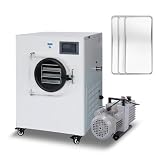
8. HNZXIB 3-Tray – Best Compact Freeze Dryer for a Small Test Batch Habit
HNZXIB Freeze Dryer, Home Freeze Dryer for Fruits & Vegetables, 3 Trays & 6lbs/Batch, Food Grade Freeze Drying Machine with Rotary Vane Vacuum Pump Home Use
6 lbs per batch
3 trays
250 lb
-35C Secop compressor
Rotary vane pump
1-year warranty
Pros
- Transparent chamber door allows visual cycle monitoring
- LCD screen described as simple for first-time users
- Secop compressor cools to -35C
- Rotary vane pump is a serviceable design
Cons
- Smallest batch capacity here at 6 lbs across 3 trays
- No customer reviews on this listing yet
- No dimensions published
This machine has the longest continuous listing availability of anything on the list, and it uses a Secop compressor rather than an anonymous unit. Named compressors are worth something in a category where most listings never name the part that does the hardest work, and a serviceable rotary vane pump is a design community owners consistently prefer.
The chamber door is clear plexiglass, which means you can watch the product dry without breaking vacuum. For a first machine, that visibility is worth more than it sounds, because it lets you learn what a finished batch looks like instead of guessing at a timer.
Capacity is the honest limitation here. At 6 pounds per batch across three trays, this is the smallest chamber in the comparison, and that is a real constraint if you want to preserve a garden rather than experiment with a hobby.
The listing also publishes no dimensions, which is a genuine planning problem. At 250 pounds you cannot simply try it in a corner and move on, so get the footprint from the seller before ordering, and confirm the room you plan to use stays cool through the season.
When a small chamber is the right choice
If you are still deciding whether freeze drying fits your household, a smaller chamber is a cheaper way to find out. You can run real batches, learn the process, and work out whether you actually enjoy it, all before committing to a machine sized for a full harvest.
It also suits foods that are small in volume and long in value. A season of herbs, a batch of seed stock, or a limited run of freeze-dried candy does not need 25 pounds of chamber space, and a small machine can process it between other chores rather than occupying a night.
Where the HNZXIB 3-Tray falls short
Six pounds per batch means many cycles for any real harvest, and each cycle carries the same overhead of pre-freezing, loading, and defrosting. For throughput this is the weakest vacuum machine in the group.
There are no customer reviews on this listing to validate long-term reliability, and the missing dimension data means you cannot plan the installation from the product page alone. It is also listed under lab freeze dryers rather than kitchen equipment, which tells you how the seller sees it.
9. Generic 12-Layer Drying Cabinet – Best Budget Machine for Jerky and Pet Treats, Not Sublimation
400W Freeze Dryer Machine for Fruits, Vegetables & Meat – 6/8/12 Layers, 0-12H Timer, 35-90℃ Temp, 6-Inch Blade & 360° Fan for Efficient Drying
400 W heated air
6, 8 or 12 mesh trays
0-12 hour timer
35-90C range
2.2 lb unit
Pros
- Lightweight at 2.2 pounds and easy to store
- Multiple tray counts let you match batch size
- Transparent window for monitoring
- Works well for jerky
- herbs
- fruit and pet treats
Cons
- Heated air dehydrator
- not a vacuum sublimation chamber
- Listing data looks unreliable
- No brand identity beyond Generic
We are including this machine with a clear label because the listing calls itself a freeze dryer and it is not one. It is a 400 watt heated air dryer with a 35 to 90C temperature range and a 0 to 12 hour timer. There is no vacuum chamber and no cold trap, so no sublimation happens, and the food it produces will not have the shelf life or texture that the name implies.
Used for what it actually is, it is a capable and very cheap dehydrator. A 6-inch fan blade moves air in a 360-degree pattern to reduce cold spots, and the 6, 8, and 12 layer stainless mesh tray options let you match the cabinet to the batch. Jerky, herbs, fruit chips, and pet treats are all straightforward with a machine like this.
The listing data is not reliable, and we want to be plain about that. The published package dimensions of 3.15 by 3.15 by 3.15 inches do not describe a 6 to 12 tier cabinet, and the copy references laundry drying and pet drying racks in ways that suggest it was assembled from a template. There is no brand identity beyond Generic.
Our recommendation is simple. If you want jerky and fruit chips, this class of machine is the right tool at a fraction of the cost of a vacuum unit. If you want food that keeps for decades in a sealed pouch, look past this list entirely and read the vacuum section above.
What a heated air dryer can and cannot do
Heat removes moisture by evaporation rather than sublimation, which means the food spends real time at a warm temperature. That is where the difference in stored quality comes from: heated air drying gives you a leathery, cook-flavored result with a much shorter usable life, while sublimation freezes the product first and removes water without ever warming it.
Neither process is better in the abstract. They are different tools. A dehydrator is a good fit for jerky and fruit chips that you intend to eat within a season or two. It is a poor fit for a 25-year pantry, no matter how the box is labelled.
Where this listing falls short
The unreliable specification data is the main problem. When the published dimensions do not match the described product, you have no basis for planning and no way to know what will arrive.
There is also no long-term durability evidence, and a cabinet with a fan motor and mesh trays is a machine you will run for many cycles over the years. Treat it as a low-cost dehydrator, not as an entry into long-term food storage.
10. Generic A-1 Food Dehydrator – Best Low-Cost Dehydrator for Herbs and Fruit Chips
Freeze Dryer Machine, 400W Food Dehydrator with 0-12H Timer & 35-90°C Temperature Control for Fruits, Vegetables, Meat, Herbs, Jerky & Pet Treats – Home & Commercial Use
400 W heated air
0-12 hour timer
35-90C with shutoff
Stainless mesh trays
6-inch 360-degree fan
Pros
- Digital timer and wide 35-90C range cover herbs through fruit chips
- 360-degree airflow reduces cold spots
- Stain and odour-resistant reinforced mesh edges
- Automatic shutoff for consistent results
Cons
- Heated air dehydrator
- not a vacuum sublimation chamber
- No brand identity beyond Generic
- No customer reviews on this listing yet
Like the previous machine, this is a heated air dehydrator with a freeze dryer name on the listing, and it will not produce food that stores for decades. What it does produce is good dried fruit, chips, and jerky, and it is a reasonable way to start preserving food at all.
The controls are where this one is more thoughtful. A digital 0 to 12 hour timer and a 35 to 90C range cover delicate herbs at the low end through fruit chips and jerky at the high end, and the automatic shutoff removes the last-minute guesswork. A 6-inch fan circulates heat in a 360-degree pattern specifically to cut cold spots, which is the single biggest cause of uneven batches in a heated dryer.
The stainless steel mesh trays have reinforced edges described as stain and odour-resistant, which matters over years of tomato and herb work. The transparent tempered window and four non-slip feet round out a machine that is easy to place anywhere on a counter.
It carries no brand identity beyond Generic and has no customer reviews on this listing, so durability across many cycles is unverified. As a first preserving tool for a household that will eat what it dries within a year, that is a reasonable trade. As a long-term storage investment, it is the wrong tool entirely.
Freeze dryer or dehydrator: a straight comparison
The question comes up constantly, so here is the short version. A freeze dryer freezes the food and removes ice under vacuum, which preserves texture, flavor, and nutrients far better and produces food that keeps for decades when sealed. A dehydrator warms the food and blows air across it, which is faster, cheaper, and completely adequate for jerky, herbs, and fruit chips.
If your goal is long-term food storage, the answer is not close. If your goal is jerky for the weekend, a dehydrator is the sensible purchase and you should not spend four figures on a vacuum chamber you will not use for that.
Where the A-1 falls short
It performs no sublimation, which is the whole point of this roundup, and the listing name oversells what it does. Anyone buying it for 25-year storage will be disappointed regardless of how good the dried output is.
There is no manufacturer identity behind the product and no owner feedback on the listing, so you are buying on the specification sheet alone. For a low-cost kitchen tool that is usually fine. For anything you expect to run continuously through a harvest season, we would want evidence first.
Home Freeze Dryer Buying Guide: Capacity, Power, Pumps and Placement
Most regret in this category comes from matching the machine to the wrong constraint. People buy on chamber size, or they buy on price, when the real deciding factors are how much food they need to put up, whether the room stays cool, and how much packaging they are prepared to buy. Work through these in order.
Match capacity to your harvest, not your family
The question is not how many people you feed, it is how many pounds of surplus you have in a short window. In this group, batch sizes run from 4 kg on the SINOPED up to 25 pounds per cycle on the Camellia River, with most of the middle machines landing between 6 and 13 pounds. Two or three times that figure is where a mid-size machine starts to earn its floor space.
Then multiply by cycle time, which runs from 20 to 40 hours for a typical batch. Owners who run machines nearly continuously through harvest describe it as a season-long project rather than an appliance they use occasionally, so if you have a large garden and a short frost deadline, throughput matters more than elegance.
Check the electrical requirements before you buy
Several machines in this comparison, including the two largest-capacity options, run on standard 120 V household power. Others in the wider category are commonly specified for a dedicated 20-amp circuit with a NEMA 5-20 outlet. The pages here do not publish a breaker requirement for most models, so confirm it with the seller and check your panel before the machine is delivered.
One widely repeated caution from owners in this category is to avoid GFI outlets and surge protectors on units that draw significant current. If you are wiring anything new, have it done properly rather than adapting an existing outlet, and treat electrical work as a job for a qualified electrician.
Placement: cool air, floor space, and drainage
Pumps need room air at 72F or cooler, and this is the requirement owners most often break. A freeze dryer in a hot garage, an attic, or a sunlit room will run long, work harder, and wear faster, and pump failures blamed on the pump are often just heat. Basements and interior rooms are the reliable choices.
Drainage is the second placement factor. Machines sit on a counter or a cart, and the drain line needs somewhere to go during defrost and drain. Leave clearance on the sides and back for airflow, and remember that several machines here weigh more than 200 pounds, so the route into the room matters as much as the final spot.
Pumps: oil versus oilless, and what maintenance costs
Rotary vane oil pumps are the dominant design in this category, and they are repairable rather than disposable. Owners across community forums consistently favor running an oil pump on a change schedule over paying for a maintenance-free oilless unit, because an oilless pump is treated as a consumable with a finite life while an oil pump can be kept running for years.
Budget for the consumables honestly. Pump oil, Mylar pouches, oxygen absorbers, and impulse sealers all add up, and a machine that runs many cycles a season uses them faster than most first-time buyers expect. Our guides to vacuum sealer bags and rolls cover the packaging side of that budget in more detail.
Is a home freeze dryer worth it? The honest math
It is worth it if you can put up roughly 100 to 200 pounds of food a year, and it is not worth it below that. Below the threshold, buying finished freeze-dried food is simply cheaper than owning a machine you run at a fraction of capacity. The break-even point moves with how much surplus you actually have, not with how good the machine is.
The honest drawback list is short and it does not change with model. Cycles take 20 to 40 hours, so a single batch ties up a machine for more than a day. Upfront cost runs into thousands across this category. You need a cool room and a dedicated place for it. There is a learning curve, and the foods that fail take a whole cycle each to discover. Buyers who enjoy all of that do fine, and buyers who resent it regret the purchase.
What to Actually Freeze Dry for Long-Term Storage (and What to Skip)
The best freeze-dried foods for long-term storage are starchy, low-fat, and low-sugar. Diced potato, onion, pepper, mushroom, tomato, pea, and carrot all rehydrate well and keep their character, and meat, eggs, and full cooked meals do well for the same reason. These are the foods worth committing cycle-hours to.
Fruit is more mixed. Berries and softer fruits rehydrate into something closer to their original form, which is why many owners freeze dry strawberries for smoothies and cereal, while higher-sugar fruits tend to become brittle or sticky. Test a small tray before committing a full batch to a variety you have never dried.
Now the list people want and rarely get: what not to freeze dry. Cruciferous vegetables, including broccoli, cauliflower, and cabbage, develop a concentrated sulfur taste that many people find unpleasant after rehydration. Green beans and cauliflower come back soggy and rubbery. High-fat and high-sugar foods do not reconstitute well, and foods with very high moisture can take a cycle to dry without reaching a stable result.
Freeze-dried candy is the exception everybody should know about. It is repeatedly cited in owner communities as the highest-margin, best-tasting payoff from a machine, and it is a small-business use case as much as a household one. If you sell at farmers markets or trade shows, it is the fastest path to making a machine pay for itself.
If you store heavy containers of dried food alongside your pouches, keeping the pantry itself organized is a separate job. Our picks for airtight food storage containers and waterproof home storage safes cover the storage side, and airtight glass containers for meal prep help on the rehydrating end.
How to Store Freeze-Dried Food So It Lasts Decades
This is where most home freeze-dried food is lost. The chamber does its job, the food comes out dry and light, and then it goes into a bag that was sealed badly or not at all. The packaging step is not an afterthought, it is the step that determines whether you have 25 years of food or a few months.
Use Mylar pouches, also called myop or MOP, as the primary barrier. They are a moisture and oxygen barrier that ordinary plastic bags and most vacuum-sealer bags do not provide. Vacuum-sealing a Mylar pouch is helpful but is not the same thing as sealing it properly, and a food vacuum sealer is not an impulse sealer, which is a different machine that makes a wider, flatter seal along the top of the bag.
Work through the workflow in this order. The food must be completely dry and cool before it goes in, because residual warmth and moisture trapped in a sealed pouch are the most common causes of failed storage. Add an oxygen absorber sized to the volume of the pouch, use more than one for a large bag of bulky items, and seal with an impulse sealer across the full width.
Label everything with the contents, the date, and the batch. In five years you will not recognise a pouch of pale yellow slices, and a storage system you cannot inventory is not a storage system. If you are putting up more than a few hundred pouches, write the label before you seal rather than after.
Store the sealed pouches somewhere dark, cool, and dry, and keep them away from concrete floors and exterior walls. Puddles and floods are the common cause of pantry losses, and a dry shelf in a climate-controlled room removes that risk almost entirely. For the containers and the room itself, our airtight container guide is a useful companion read.
Brands That Are Not Home Freeze Dryers – What to Skip and Why
If you have been researching this category, you have almost certainly run across pages recommending Labconco, Millrock Technology, and Holland Green Science. Those are laboratory and pharmaceutical lyophilizers. They are excellent at what they do, and what they do is preserving samples, reagents, and pharmaceutical material under validated conditions.
None of them are the right answer for long-term food storage in a home. They are built for sample vials rather than food trays, their chamber geometry and tray sizes do not match standard baking sheets, and they are not designed for the volume throughput a household harvest requires. A buyer who follows that advice ends up with an instrument, not a pantry.
What to look for instead is a food chamber with full-size trays, a compressor-driven cold trap, a rotary vane vacuum pump you can service, and a capacity in pounds per batch rather than milliliters of laboratory glassware. Every vacuum machine in our top eight meets that test, which is why they are here and the lab units are not.
Frequently Asked Questions
Are home freeze dryers worth it?
A home freeze dryer pays off when you can put up roughly 100 to 200 pounds of food a year from a garden surplus, a bulk meat buy, or a small food business. Below that threshold, buying finished freeze-dried food costs less than owning a machine you run at a fraction of capacity. Judge it on your own harvest volume, not on how good the machine is.
What are the drawbacks of using a food freeze dryer?
Cycles take 20 to 40 hours, so one batch ties up a machine for more than a day. Upfront cost runs into thousands, the machine needs a cool room below 72F, and it takes a season to learn. Several foods, including broccoli, cauliflower, and green beans, rehydrate badly and waste a full cycle.
How much does a Costco freeze dryer cost?
Retail figures for freeze dryers change constantly, and we do not publish pricing on any page because every number goes stale within weeks. Use the check price buttons in each review to see the current listing, and compare the total package contents, since some machines ship with Mylar bags and an impulse sealer while others do not.
What is the best freeze-dried food for long-term storage?
Starchy, low-fat, low-sugar foods rehydrate best and keep the longest. Diced potato, onion, pepper, mushroom, tomato, pea, and carrot are the reliable choices, along with meat, eggs, and full cooked meals. Berries work well too. High-sugar fruits, broccoli, cauliflower, cabbage, and green beans are the ones to skip.
Do I need a dedicated circuit for a freeze dryer?
It depends on the model. Several larger machines in this comparison, including the highest-capacity one, run on standard 120 V household power. Others in the category are commonly specified for a dedicated 20-amp circuit with a NEMA 5-20 outlet. Check the manual or the seller before delivery, and avoid GFI outlets and surge protectors on high-draw models.
Can you use a freeze dryer in an apartment?
Technically yes, practically rarely. Pumps need room air at 72F or cooler, a 20 to 40 hour cycle runs day and night, and a machine weighing more than 200 pounds needs a permanent spot. The published noise figure for the VEVOR model is 60 dB or less, which is library-quiet, but the constraint is usually space and noise tolerance rather than volume.
How long does freeze dried food last?
Properly freeze-dried and sealed in a Mylar pouch with an oxygen absorber, food is commonly claimed to keep for 25 years or more, and many owners report quality well beyond a decade. Unsealed or badly sealed pouches fail within months. The packaging step, not the machine, is what determines whether that shelf life is real.
Which Home Freeze Dryer Should You Buy?
For most people reading this, the answer is the VEVOR HFD-4, and it is the only recommendation here backed by a body of verified owner reviews. The 3.7 average from 48 owners tells you the hardware works when it works, and the split rating distribution tells you to check your machine carefully in the first month. It is the honest choice, not the shiny one.
Choose the Blue Alpine Medium if you are new to this and want the Mylar bags, oxygen absorbers, and impulse sealer in the box, and the Camellia River if your harvest volume is large enough that throughput matters more than everything else. The HNZXIB FD-05H is the pick for anyone who runs back-to-back batches and wants the deepest cold trap and the fastest water removal.
Skip the two heated-air dehydrators if your goal is long-term food storage. They are fine cheap tools for jerky and fruit chips, and buying one for a 25-year pantry is the most common mistake we see in this category. And whatever you choose, buy the packaging before the machine. The best home freeze dryers for long-term food storage are the ones paired with a sealing workflow you actually follow, and that part is entirely up to you.