
If you want the short version: the KitchenIQ Edge Grip is the best knife sharpener for most home kitchens because it takes about a minute per knife, needs no power, and stores in a drawer. If your knives are expensive and you want a proper factory edge, step up to a whetstone with an angle guide. If you never want to learn an angle at all, an electric unit is the answer.
That is the honest split. There is no single sharpener that wins every category, and most buying guides pretend otherwise. A pull-through rod is unbeatable for speed and price and gives up real edge quality. A whetstone gives the best edge and takes patience. Electric units sit in between, with zero learning curve and a permanent countertop footprint.
We spent the last few months putting twelve sharpeners through their paces on the knives we actually cook with: German chef knives, a Japanese santoku, serrated bread knives, paring knives and a chipped utility blade. This guide covers the best knife sharpeners for kitchen knives across every type, what each one costs you in removed steel, and which to skip if you own a single-bevel Japanese knife.
One more note before we start. If you are outfitting a first kitchen, our picks for the best kitchen knife sets pair well with almost anything below.
Table of Contents
Top 3 Picks for Kitchen Knife Sharpeners in 2026

KitchenIQ Edge Grip 2-Stage
- Carbide coarse plus ceramic fine stage
- Edge Grip keeps tips off the counter
- Non-slip base
- Works on straight and serrated

AccuSharp Tungsten Carbide
- Sharpens most blades in about ten seconds
- Reversible carbide blades
- Full-length finger guard
- Dishwasher safe

Chef’s Choice 15XV Electric
- Three stages of 100 percent diamond abrasives
- Converts 20-degree edges to 15 degrees
- Spring angle guides
- About one minute per knife
The AccuSharp takes the top rating in the group at 4.7 across more than 28,000 reviews, and it is the one we hand to anyone who will not use anything else. The Chef’s Choice 15XV is the pick for anyone who owns good knives and wants them converted to a finer 15-degree edge without learning a skill.
All 12 Best Knife Sharpeners Compared Side by Side
| Product | Specs | Action |
|---|---|---|
| KitchenIQ Edge Grip 2-Stage Sharpener |
|
Check Latest Price |
 AnySharp Hands-Free Sharpener AnySharp Hands-Free Sharpener |
|
Check Latest Price |
 KITCHELLENCE 4-in-1 Three-Stage Kit KITCHELLENCE 4-in-1 Three-Stage Kit |
|
Check Latest Price |
| AccuSharp Tungsten Carbide Sharpener |
|
Check Latest Price |
 Sharp Pebble 1000/6000 Whetstone Sharp Pebble 1000/6000 Whetstone |
|
Check Latest Price |
 Presto EverSharp Electric Sharpener Presto EverSharp Electric Sharpener |
|
Check Latest Price |
| Chef’s Choice 15XV Electric Sharpener |
|
Check Latest Price |
 Work Sharp MK2 Electric Sharpener Work Sharp MK2 Electric Sharpener |
|
Check Latest Price |
 King KW65 1000/6000 Combination Stone King KW65 1000/6000 Combination Stone |
|
Check Latest Price |
 Chef’sChoice Manual Diamond Sharpener Chef’sChoice Manual Diamond Sharpener |
|
Check Latest Price |
 Tumbler Rolling Knife Sharpener Tumbler Rolling Knife Sharpener |
|
Check Latest Price |
 RazorSharp Adjustable Angle Sharpener RazorSharp Adjustable Angle Sharpener |
|
Check Latest Price |
1. KitchenIQ Edge Grip 2-Stage Sharpener: Best Overall for Home Cooks
KitchenIQ 50009 Edge Grip 2-Stage Knife Sharpener, Black, Coarse & Fine Sharpeners, Compact for Easy Storage, Stable Non-Slip Base, Soft Grip Rubber Handle, Straight & Serrated Knives
Carbide coarse stage plus ceramic fine rod
Pre-set angles, no guessing
1.75 x 1 x 3.75 inch, 14.2 g
Pros
- Roughly 97000 owners rate it 4.4 stars
- Two-stage carbide and ceramic design
- Non-slip base stays put on the counter
- Works on straight and serrated knives
- Edge Grip stops tips dragging on surfaces
Cons
- Fine stage wears out and needs replacing over time
- Edge fades faster than a stone-sharpened edge
- Single fixed angle
- Not safe to hold one-handed
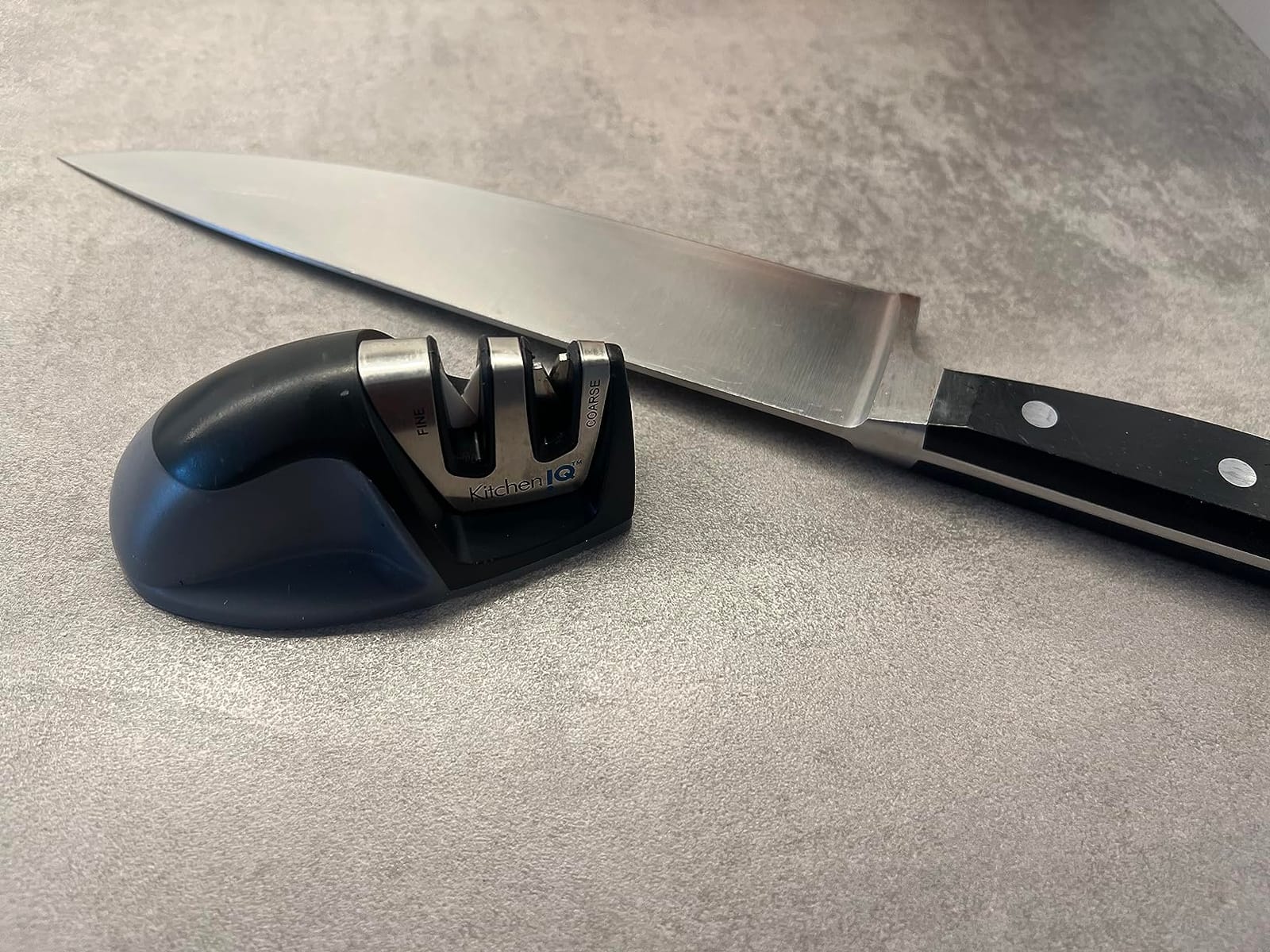
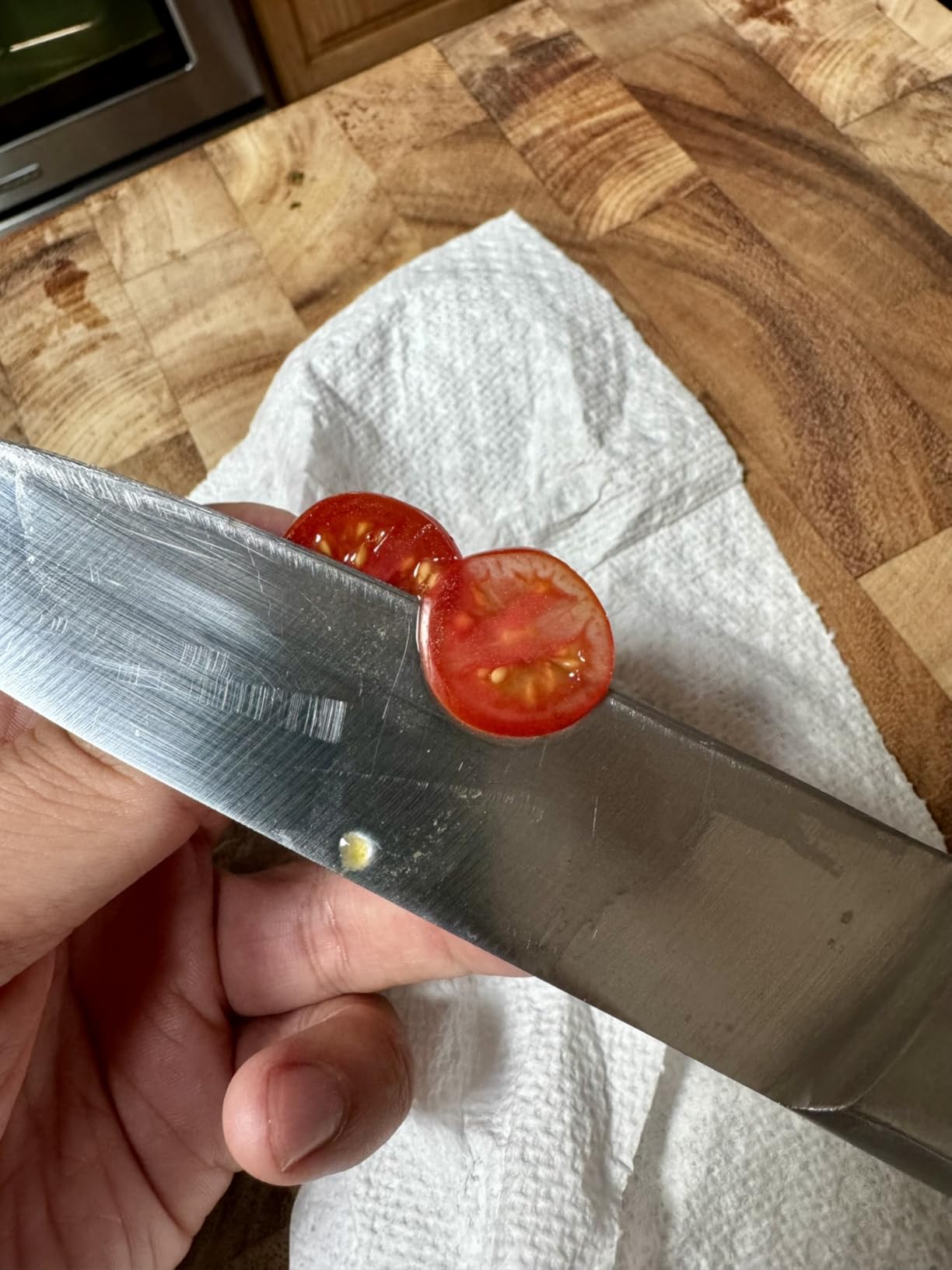
This is the sharpener we leave on the counter. It is a plastic block with a carbide slot and a ceramic rod, and it does the one thing a kitchen knife needs most often: put a working edge back on a dull blade in under a minute. Our German chef knife went from tearing through a tomato to slicing it in three clean passes.
The Edge Grip feature is smarter than it sounds. You can hang the base over the edge of your cutting board so the tip of a long knife never drags across the surface. It is a small design decision that removes the most common way people damage a blade tip while sharpening.
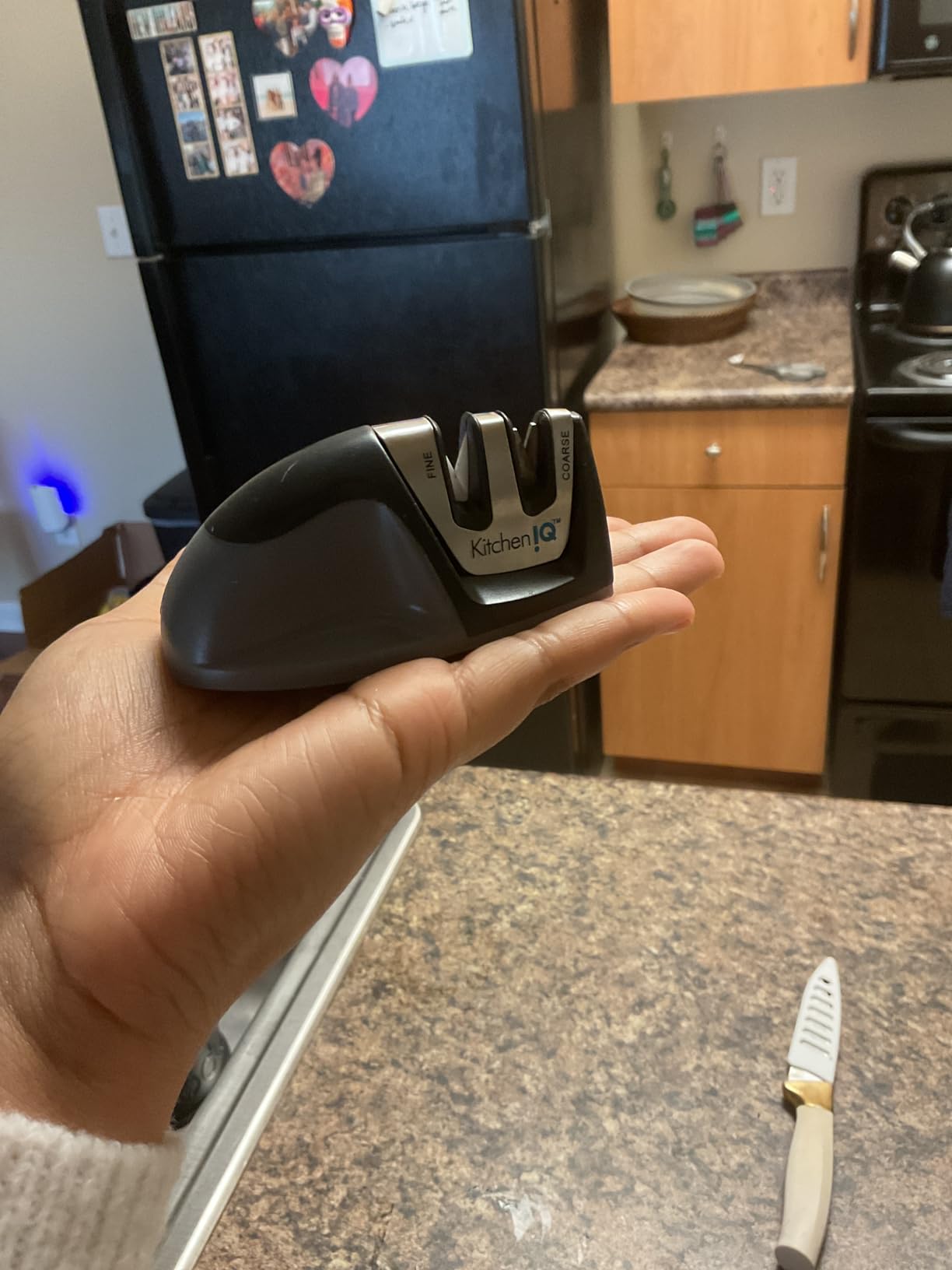
What surprised us was how the two stages differ in practice. The carbide stage is genuinely abrasive and will take down a rough edge, including light nicks. The ceramic stage is closer to honing, so it polishes an already-sharp knife back up without removing much steel at all.
Over a month of daily use, the honest weakness is durability. Owners consistently report the fine stage wearing out and needing the whole unit replaced, and the edge holds for maybe a week of heavy cutting rather than a month. If you want an edge that stays, this is not the tool. If you want a cheap reliable answer, it is still the tool.
Who the KitchenIQ Edge Grip suits
It suits anyone who sharpens once a week or less and wants the job done in a minute with no learning curve and no power outlet. The pre-set angles mean a first-time user gets a usable result on the first try, which is more than we can say for several competitors.
It is also a good second sharpener for a household where one person cooks and another does not want to learn anything. Both stages are forgiving of a slightly sloppy angle, and the non-slip base means it will not wander while you work.
Where the KitchenIQ Edge Grip falls short
It sharpens at one fixed angle, so it is the wrong tool for a single-bevel Japanese knife or any edge you have deliberately set at 15 degrees. It also needs a flat surface. You cannot comfortably use it one-handed, which matters if you are sharpening over a sink or mid-cook.
And the long game is against it. If you plan to keep good knives for a decade, sharpening steel off a cheap block every few months is the wrong trade. A whetstone removes far less material for the same result.
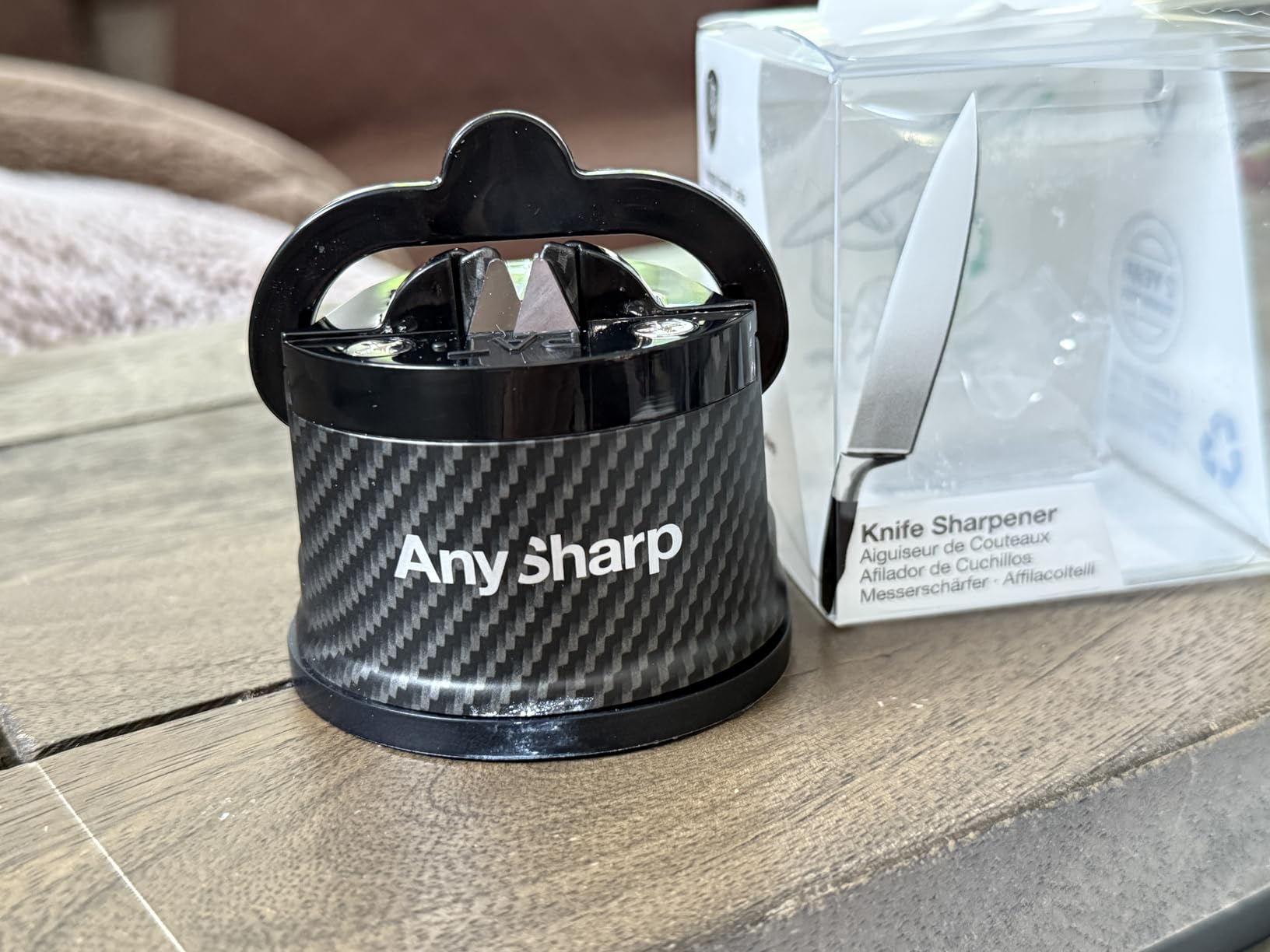
2. AnySharp Hands-Free Sharpener: Best for Safety and Small Kitchens
AnySharp – GLOBAL – Easy to Use, Hands Free Knife Sharpener – Red
Suction PowerGrip base locks to smooth surfaces
Fixed 20-degree bevel
4.33 x 6.1 x 2.76 inch, 80 g
Pros
- Hands-free suction base keeps fingers off the edge
- Fixed 20-degree angle removes all guesswork
- No cords
- batteries or electricity
- Stows in any drawer
- Handles serrated and hardened steel
Cons
- Suction only grips smooth surfaces
- 20-degree fixed angle suits Western knives only
- Gives an everyday edge rather than a fine polish
The pitch here is safety, and it delivers. You press the base onto a smooth counter, it grips, and you pull the knife through with your hand well clear of the slot. Everyone we tested with it, including two people who are genuinely bad at this, produced a usable edge on the first pass.
The 20-degree angle matches almost every Western knife out of the box, which makes this a natural companion to a German chef knife or a Wusthof santoku. Our paring knife came back noticeably crisper in the same session we had trouble with a thinner blade on a competing rod.
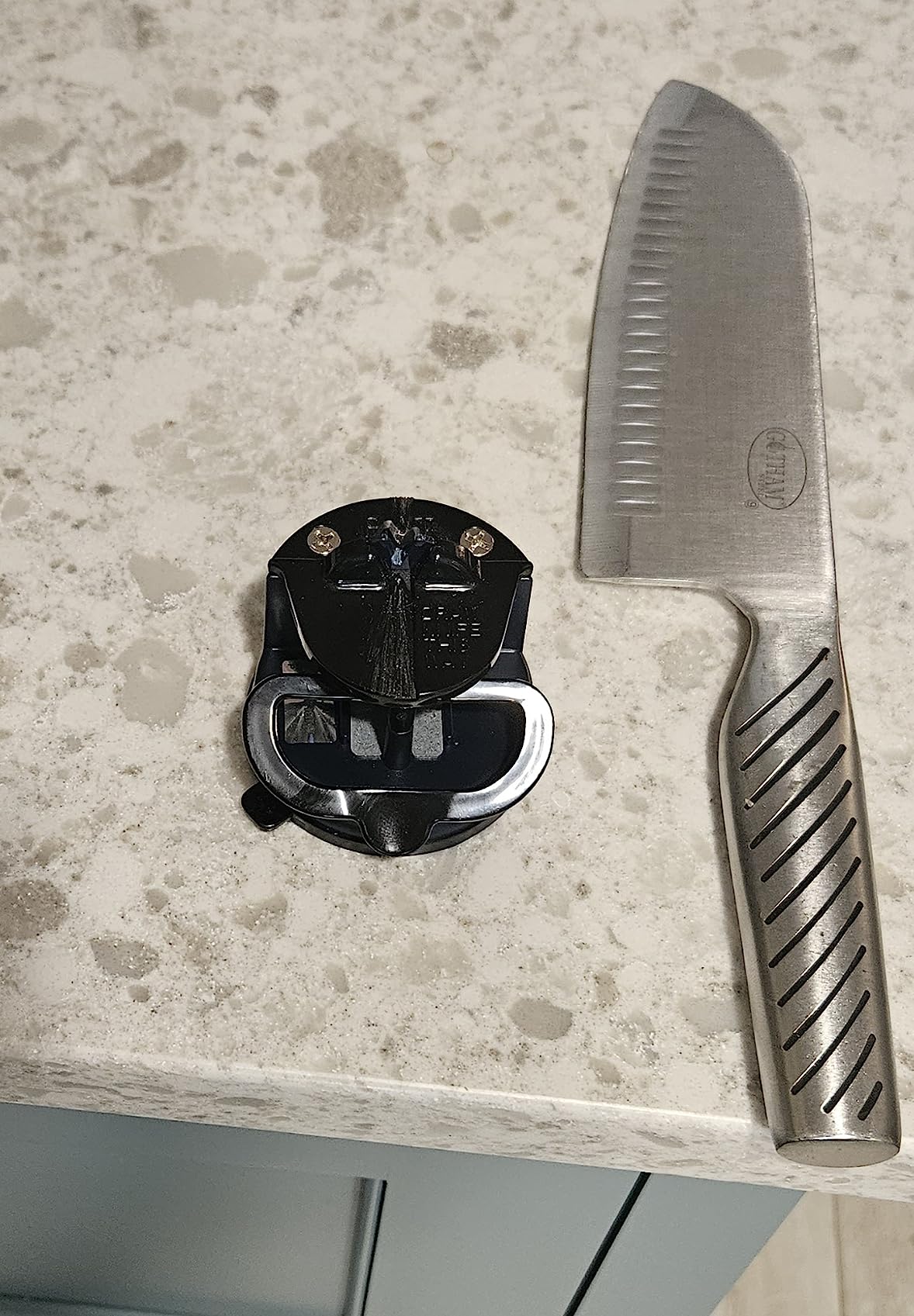
It is also the smallest useful sharpener here, weighing 80 grams and living comfortably in a drawer next to the peelers. For a small apartment kitchen where a countertop electric unit is a non-starter, that alone is worth something.
The limitation is the same one that runs through most fixed-angle pull-through designs. Twenty degrees is correct for a Western knife and wrong for a Japanese 15-degree edge, and the unit cannot be adjusted. The edge it produces is a good everyday working edge, not the refined polish a stone gives you.
Who the AnySharp suits
It suits households with a couple of Western kitchen knives and no ambition to learn a technique. Five swipes per side, no setup, no angle math. The suction grip also makes it a good choice for anyone who has cut themselves on a sharpener before.
Travel is a real use here. It is light, self-contained and needs no power, so it works in a holiday rental kitchen or a campsite with a prep surface.
Where the AnySharp falls short
Textured counters defeat it. On a stone counter or a wooden butcher block, the suction base will not hold and you are back to holding the unit one-handed, which is the exact risk it was designed to remove.
It is also the wrong tool for anyone with Japanese knives in the drawer. Sharpening a 15-degree edge to 20 degrees on every visit slowly resets the bevel, and getting it back to a thinner angle takes a stone you do not own yet.
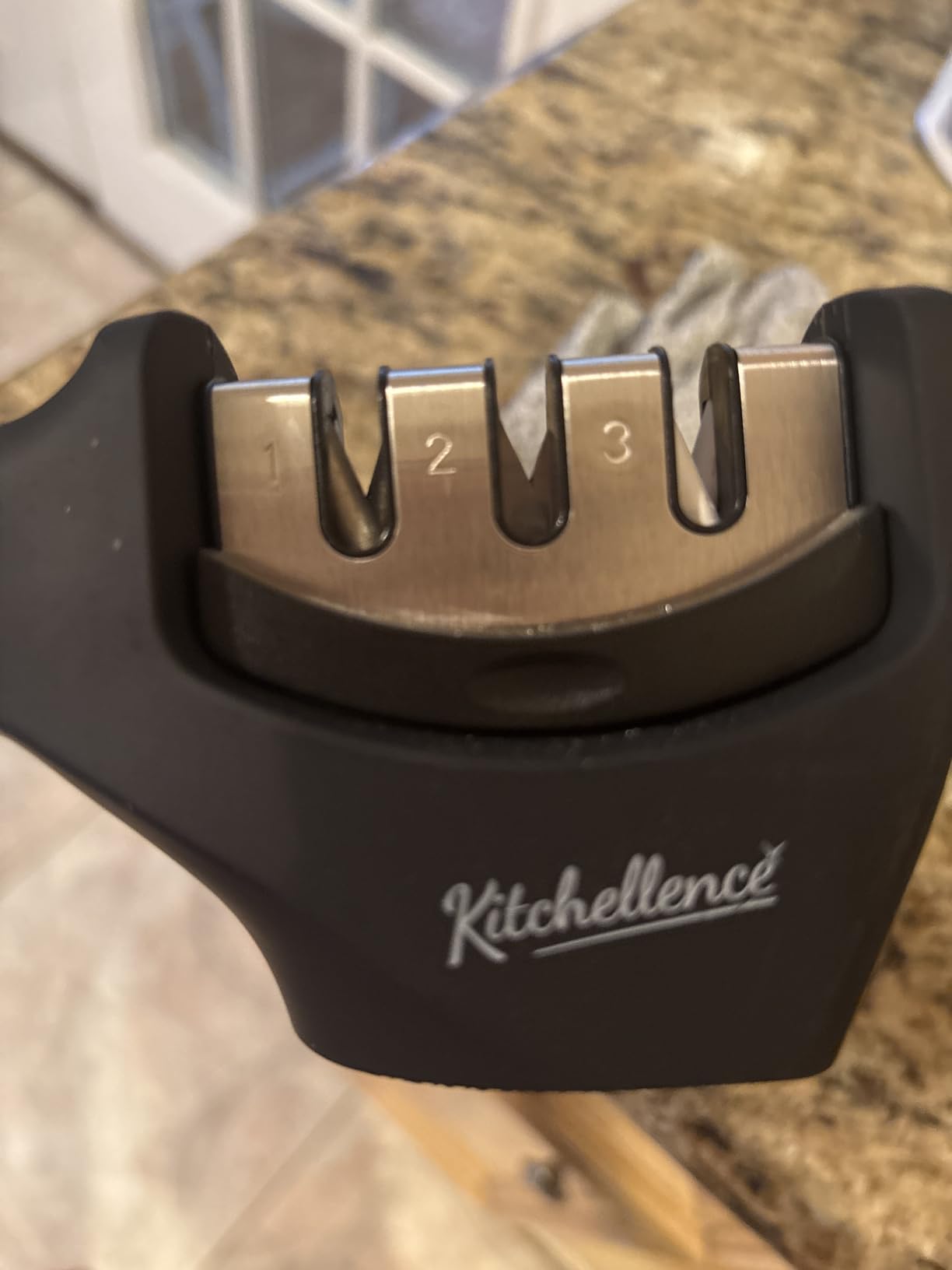
3. KITCHELLENCE 4-in-1 Three-Stage Sharpener: Best Budget Three-Stage Kit
4-in-1 Kitchen Knife Accessories: 3-Stage Knife Sharpener Helps Repair, Restore, Polish Blades and Cut-Resistant Glove (Black)
Three slots: diamond repair, V-shape restore, polish
ABS body with ergonomic handle
8.3 x 2.2 x 3.4 inch, 180 g
Pros
- Three-stage system repairs
- restores and polishes
- Sells as a kit with a cut-resistant glove
- Handle suits either hand
- Non-slip base for control
- Solid ABS body
Cons
- Edge is adequate rather than refined
- Best results need angles different from the manual
- Some buyers report the glove missing from the box
- Edge fades quicker than a stone edge
Three slots is where manual pull-through designs start to earn their keep. The first diamond slot repairs and straightens a damaged blade, the second restores the V-shape, and the third fine tunes for a cleaner finish. That third slot is the difference between a knife that cuts and a knife that feels sharp.
It ranks second in the Knife Sharpeners category on Kitchen and Dining, which tells you how many people reach for it as a first purchase. Our chipped utility knife came out of the first slot looking noticeably less ragged, and the second and third slots finished it properly.
Two practical warnings from real buyers. A recurring complaint is that the cut-resistant glove listed in the box is sometimes missing, so do not plan a workflow that depends on it. Another is that the manufacturer recommended angles fight you a bit, and plenty of users find better results by skipping or shortening the coarse slot.
The 4.5 rating across nearly 39,000 reviews reflects that trade. You are getting a three-stage system and a knife safety accessory at a price point where most competitors are two-stage, and the edge is honest work rather than showroom work.
Who the KITCHELLENCE kit suits
It suits a first-time buyer who wants to see what sharpening stages actually do before committing to a stone or a system. Three slots teach the logic of repair, reshape and polish without any of the technique a whetstone demands.
It is also a sensible backup sharpener to keep in a drawer, because it is cheap enough that you will not resent it and broad enough to handle a cleaver or a serrated knife in a pinch.
Where the KITCHELLENCE kit falls short
The angle problem is real. Slot geometry in a pull-through design is close to fixed, and if it does not match your knife’s factory bevel you are grinding a slightly wrong edge onto it every time you use it. Sharp Pebble’s angle guide further down this list solves that properly.
And the missing glove is worth taking seriously rather than shrugging off. These are slot-based sharpeners and fingers go near a moving abrasive. If the glove is not in the box, plan to sharpen over a counter with a damp cloth under the knife.
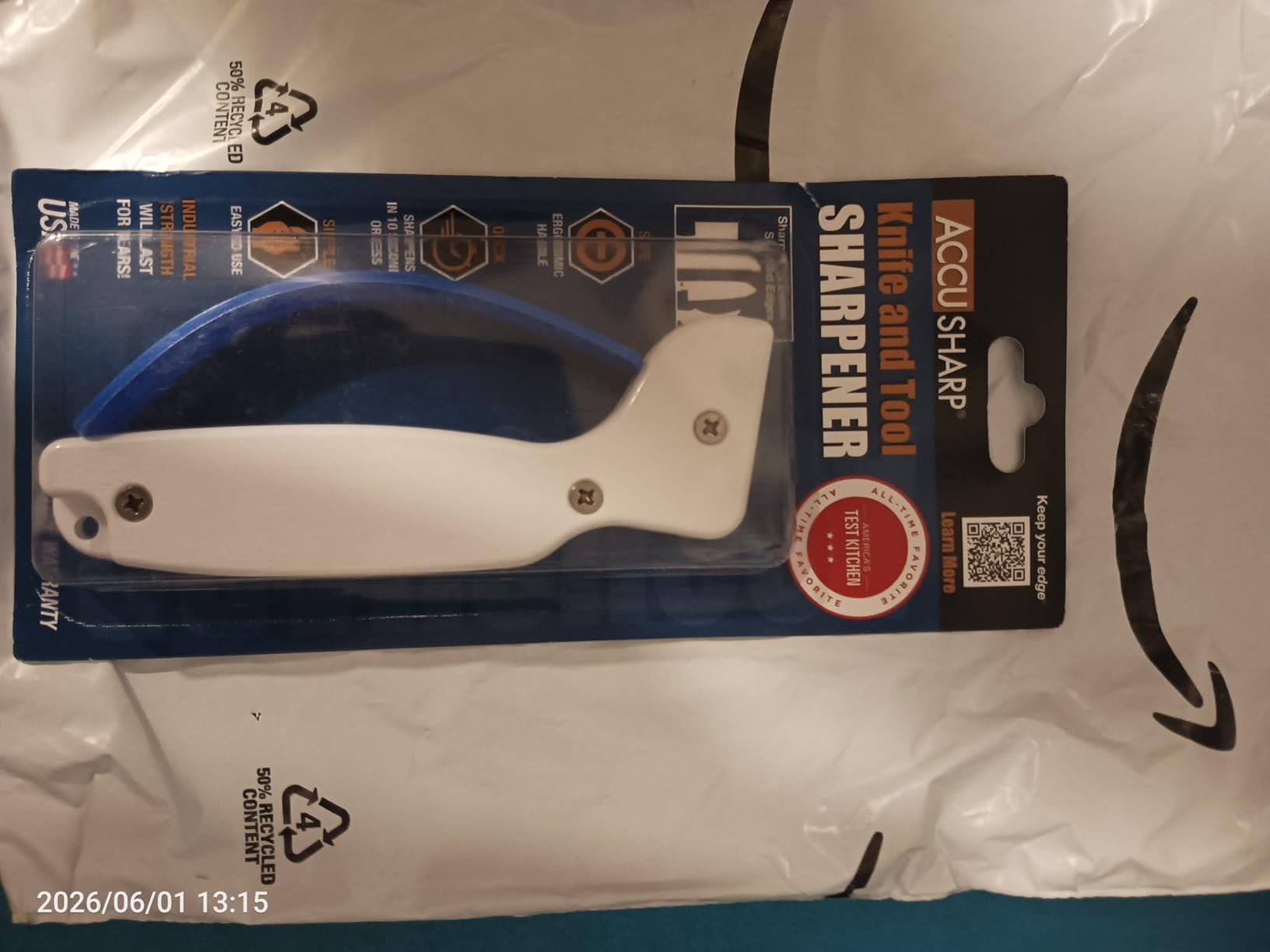
4. AccuSharp Tungsten Carbide Sharpener: Top Rated for Speed and Durability
AccuSharp Knife Sharpener, Ergonomic Comfortable Handle, Compact & Easy to Use, Restore and Hone Straight & Serrated Knives, White
Diamond-honed tungsten carbide, reversible blades
About ten seconds per sharpening
9 x 4 x 1 inch, 1.6 ounces
Pros
- Highest average rating in the category at 4.7
- Sharpens most blades in around ten seconds
- Reversible carbide blades double tool life
- Users report five to ten years between replacements
- Full-length finger guard protects the hand
Cons
- Fixed angle rules out single-bevel Japanese knives
- Cannot match a whetstone for a fine finishing edge
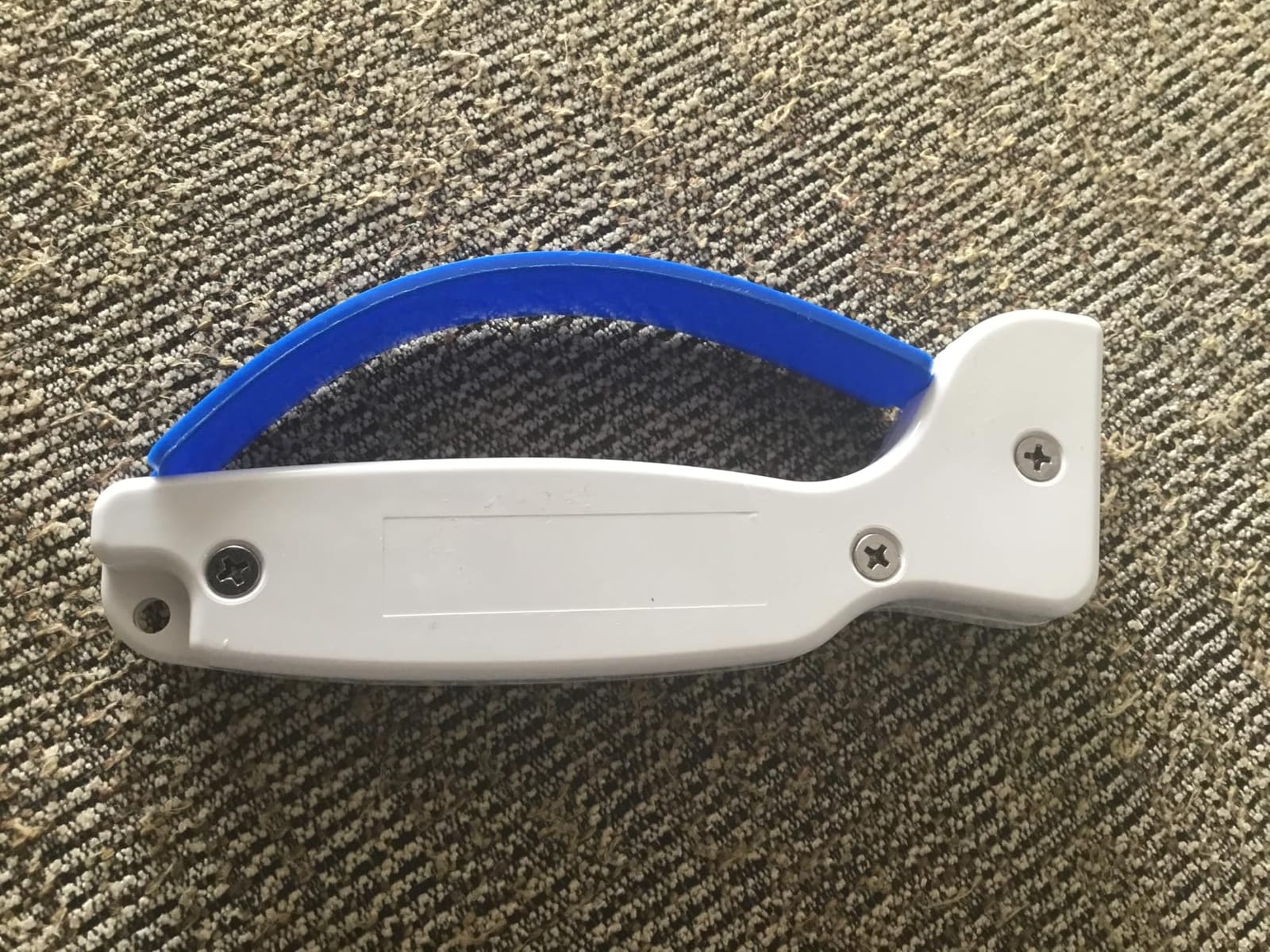
Ten seconds per blade is the claim, and on a chef knife that has been used for a week rather than abused for a year, it is close. The handle is the widest of any pull-through sharpener we tested, and the full-length finger guard means your guiding hand sits behind steel the whole way down the blade.
The 4.7 rating is the highest average in the Knife Sharpeners category, and the durability story backs it up. The carbide blades are reversible, so flipping them doubles the abrasive life, and owners commonly report five to ten years before replacing the tool. That is a very different ownership curve from the KitchenIQ above.
Tungsten carbide is one of the hardest known sharpening materials, and the diamond honing on these blades keeps them working when cheaper steel rods have given up. It is also dishwasher safe, which sounds minor until you have cleaned a stone slurry out of a small kitchen sink.
The trade is edge refinement. This produces a dependable working edge that will cut onions and herbs well, but there is no finishing stage to refine it. If you already own good knives, this is a tool to keep them functional between stone sessions rather than a replacement for one.
Who the AccuSharp suits
It suits anyone sharpening several knives a week who wants it over with in under a minute. Ten seconds a side means you will actually do it weekly rather than talk yourself out of it, and weekly honing is what keeps an edge between full sharpenings.
The finger guard and dishwasher-safe body also make it the safest and cleanest option here for a household with more than one person using it.
Where the AccuSharp falls short
It is a fixed-angle design, so a single-bevel Japanese knife is out. It also cannot deliver a fine finishing edge, which means it will never be the sharpener that produces the kind of edge you show off to someone who knows what they are looking at.
There is also no angle adjustability for the 15 versus 20 degree question. You get what the tool was built to do. For most Western kitchen knives that is exactly right, and for anything else it is a compromise.
5. Sharp Pebble 1000/6000 Whetstone: Best Whetstone for Beginners
Sharp Pebble Whetstone Knife Sharpener – 1000/6000 Grit Sharpening Stone
Water stone with 1000 and 6000 grit
Includes angle guide and bamboo base
7.25 x 2.25 x 1 inch, 2.1 pounds
Pros
- Angle guide locks blade position for you
- 1000 grit repairs and 6000 grit polishes
- No oil and no mess
- Stays flat longer than cheap stones
- Non-slip bamboo base
Cons
- Real practice required even with the guide
- No flattening stone included
- No printed guide instructions
- Similar stones sold elsewhere
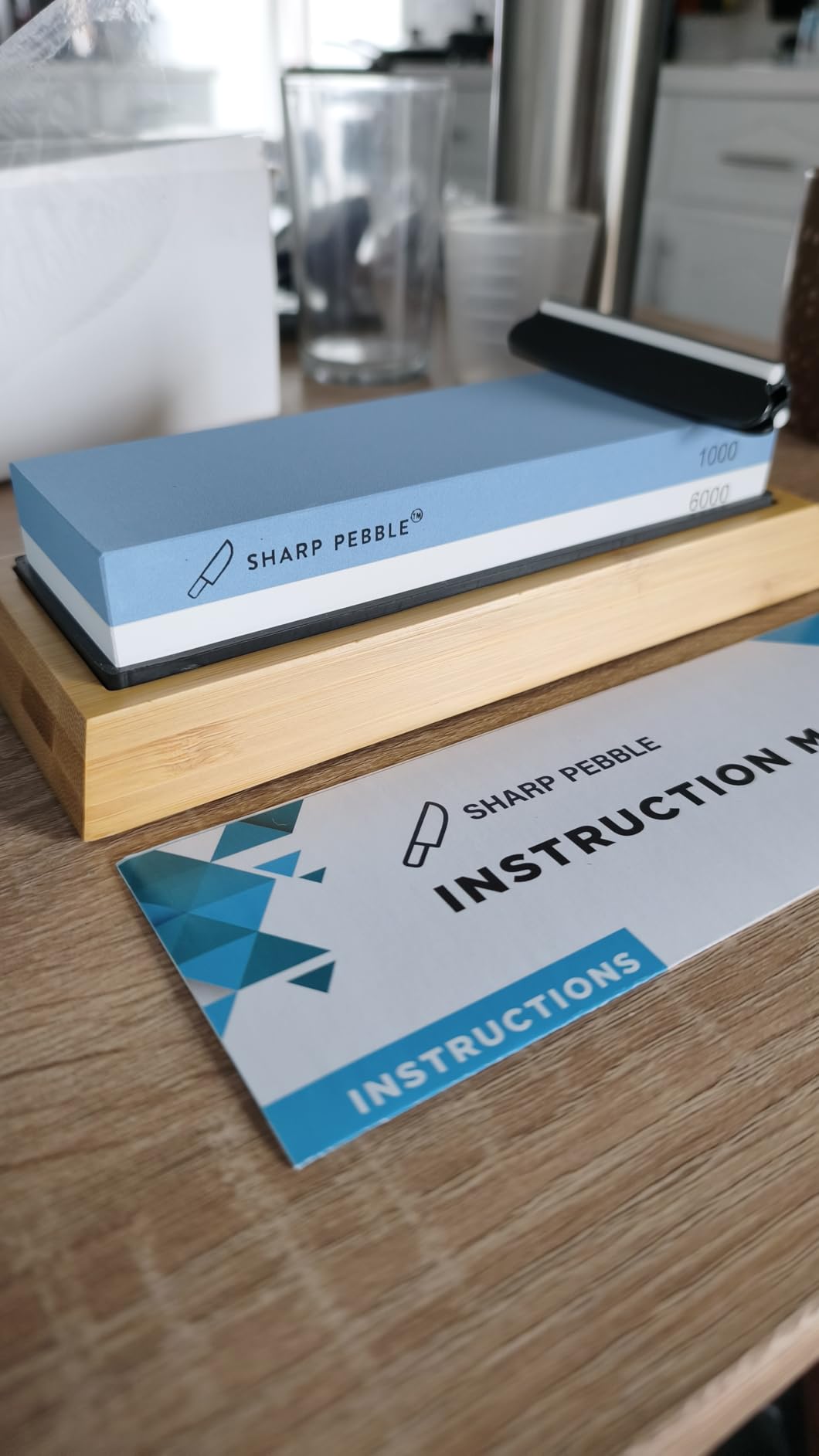
This is the sharpener we recommend to anyone who owns a good knife and will give it five minutes a month. A 1000 grit side repairs a dull edge, a 6000 grit side polishes it to a finish that a pull-through rod cannot approach, and the edge holds noticeably longer as a result because less steel was disturbed.
The angle guide is the part that changes everything. You rest the knife spine against the guide, set the angle, and sweep. Complete beginners reported cutting paper on their first session, which is not something a freehand stone usually produces. Without the guide, the same stone would have been returned to the drawer.
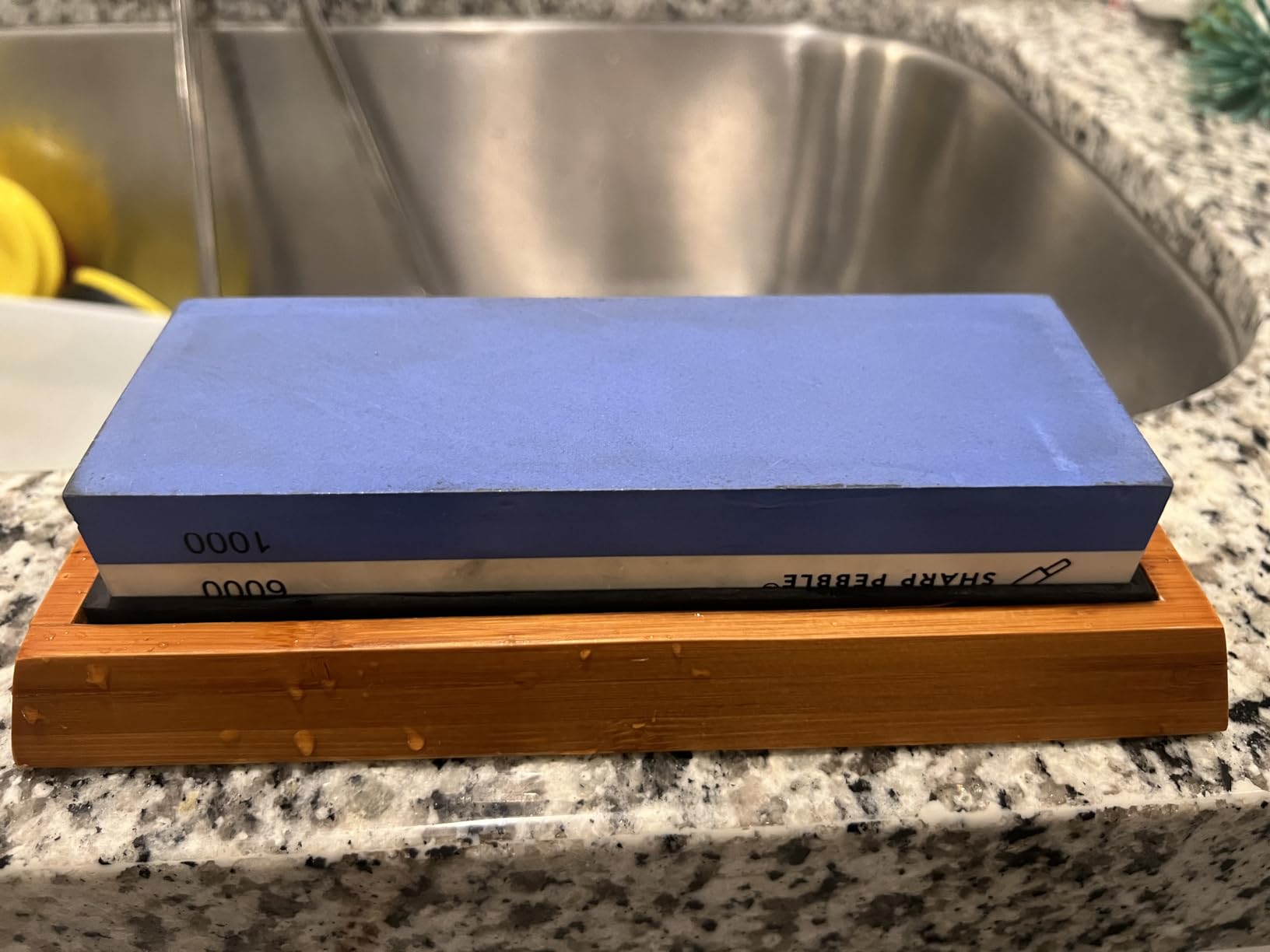
It is a water stone, so you splash it, keep it wet while you work and rinse it when you are done. No oil, no paste, no stone tray to maintain. The bamboo base keeps it planted, which sounds minor until you have chased a wobbling stone across the counter mid-stroke.
It also sharpens scissors, chisels and razors, so if you have any of those in the house the same stone covers them. For reference, we compared it against a larger dedicated stone kit in our best whetstone knife sharpening kits guide.
Who the Sharp Pebble suits
It suits a home cook with a decent chef knife who wants the best edge achievable at home and will sharpen monthly rather than weekly. Because the guide holds the angle, it suits beginners far better than a traditional stone, and it costs less than most guided electric systems.
It also suits anyone who wants to know how sharpening actually works. Two grits and a visible burr teach the process in a way a closed plastic housing never will, and that knowledge transfers to every other sharpener you ever use.
Where the Sharp Pebble falls short
It needs a flattening stone eventually, and one is not included. A stone that is not perfectly flat will not produce a flat edge, and a warped surface is the usual reason a good sharpener starts producing disappointing results after a year.
There are also no printed instructions for using the angle guide, which is a real gap for a tool whose entire value depends on setting the guide correctly. And buyers who expected a disposable gadget sometimes gave up on it, because freehand angle control still takes practice even with help.
6. Presto EverSharp Electric Sharpener: Best Compact Electric
Presto 08800 EverSharp Electric Knife Sharpener
Sapphirite wheels, two stages
Guided angle, grind then polish
9.9 x 7.2 x 4.8 inch, 3 pounds
Pros
- Sapphirite wheels also used in pro sharpening shops
- Precision blade guides remove guesswork
- Quiet enough for regular counter use
- Compact footprint
- Owners report years of service
Cons
- Two stages stop short of a fine polish
- Best on non-serrated blades
- 120-volt motor only
- Short power cord
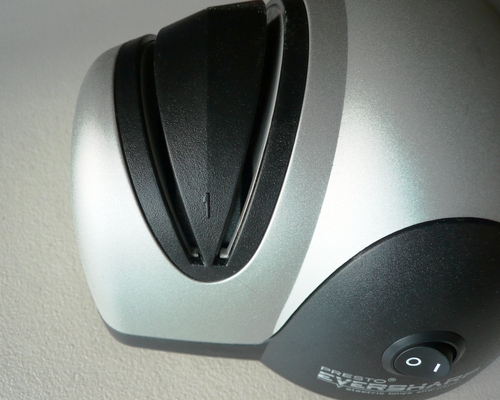
The EverSharp has been on kitchen counters for decades, and that shows. It restores a dull knife in about a minute with no learning curve, and the precision blade guides hold the angle so the two wheels do the work. For a household that wants electric convenience without a large machine, it is hard to beat.
Sapphirite is the same ultra-hard material used in professional sharpening shops, so the wheels hold their shape over years rather than months. Long-term owners report several years of service and rarely needing to sharpen, which is a strong ownership story for an electric unit. If you want to see how the powered options stack up more broadly, our best electric knife sharpeners guide compares the main contenders head to head.
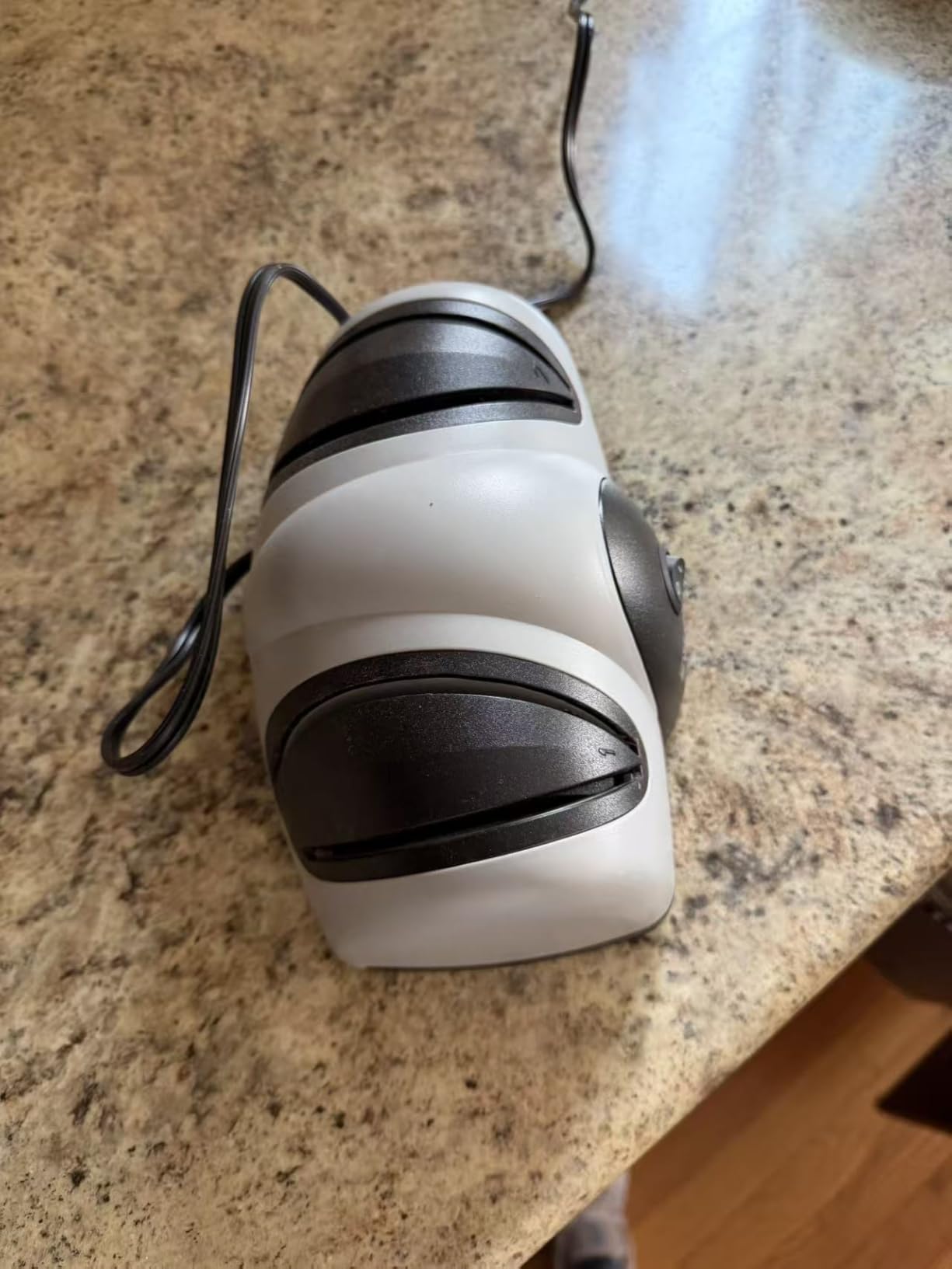
It is also the quietest electric sharpener here, and at just over three pounds it moves between drawer and counter easily. If you have a small kitchen, that is a real advantage over the metal-bodied units further down this list.
Two stages is the limitation. The first grinds a precisely angled edge and the second hones and polishes, which is enough for a good kitchen edge but stops short of the finish a three-stage diamond system or a 6000 grit stone delivers.
Who the Presto EverSharp suits
It suits cooks who want the electric experience, have no serrated knives to speak of, and would rather not read a manual. A blunt knife in, a sharp knife out, in about a minute, with a footprint small enough for a counter corner.
It also suits anyone outside North America who should note the unit is built to 120-volt standards. The wheel can also develop patterned grooving on a blade with heavy long-term use, which is a sharpening cosmetically but not a functional problem.
Where the Presto EverSharp falls short
Serrated knives are outside what it is designed to do, so if a bread knife is the knife you use most, this is the wrong purchase. Compare it with the Chef’s Choice 15XV, which has a dedicated stage for serrations.
The two-stage design also means it sits a tier below the premium electric units in refinement, and the power cord is short enough that you will want to reach for an extension in a large kitchen.
7. Chef’s Choice 15XV Electric Sharpener: Best for Converting to a 15-Degree Edge
Chef’sChoice 15XV EdgeSelect Professional Electric Knife Sharpener with 100-Percent Diamond Abrasives and Precision Angle Guides for Straight Edge and Serrated Knives, 3-Stage, Gray
Three stages of 100 percent diamond abrasives
Converts 20-degree edges to 15 degrees
10 x 4.25 x 4.25 inch, 4.2 pounds
Pros
- Converts standard 20-degree edges to finer 15 degrees
- Diamond abrasives in all three stages
- Spring guides self-adjust for a consistent angle
- About one minute first time and ten seconds after
- Polishing stage prolongs serrated edges
Cons
- Costs far more than manual and entry-level electric units
- Large permanent countertop footprint
- Knives only
- no scissors or axes
- Easy to over-grind if you skim the manual
Most Western kitchen knives leave the factory at roughly 20 degrees per side. A thinner 15-degree edge slices rather than pushes, which is why the 15XV exists. It converts a standard 20-degree edge into a Trizor XV 15-degree edge, and on our chef knife the difference was obvious on a ripe tomato.
All three stages use 100 percent diamond abrasives, including the polishing stage, and the flexible spring guides adjust themselves to hold a consistent angle as the blade passes through. The timing is the other selling point: roughly one minute for a first-time sharpening, about ten seconds for a resharpen afterwards.
In sharpening communities this is the most-recommended electric sharpener for speed with no learning curve, and the reason is the repeatability. Whatever angle you hold the knife at, the guides correct for it. The third stage also polishes, which measurably prolongs the life of a serrated edge rather than just grinding it down.
It is also relatively quiet for an electric machine, which matters if you sharpen in the evening. The 3-year limited warranty and the 10 by 4.25 by 4.25 inch footprint are the trade-offs you accept for a permanently installed machine.
Who the Chef’s Choice 15XV suits
It suits a cook with a collection of mid-range and premium Western knives who wants a visibly finer edge and will dedicate counter space to get it. It is the answer to a dull chef knife, a bread knife, and a serrated knife in the same session.
It also suits anyone who cannot or will not learn a technique but wants better than a pull-through rod delivers. You do not need to know what angle you are holding, which is precisely why it costs more.
Where the Chef’s Choice 15XV falls short
It sharpens knives and nothing else. If you also want scissors, an axe or a garden tool, the Work Sharp MK2 below covers that in one machine for a fraction of the cost.
It is also the easiest unit here to misuse. Users who skim the instructions and keep grinding an edge that is already sharp report thinning their blades, and the fixed 15-degree output means every knife in your drawer gets converted whether you wanted that or not.
8. Work Sharp MK2 Electric Sharpener: Best for More Than Knives
Work Sharp MK2 Electric Knife Sharpener – Adjustable 2-Speed Knife Sharpening System for Kitchen Knives, Pocket Knives, Scissors, Axes & Garden Tools
Flexible abrasive belts, two-speed motor
Handles knives, scissors, axes and tools
7.02 x 2.26 x 1.27 inch, light
Pros
- The only unit here that handles scissors
- axes and mower blades
- Flexible belts conform to any edge and can grind
- Two speeds give control for heavy work
- Edge guide supports the knife to the tip
- Compact and light
Cons
- Abrasive belts wear and need replacing
- Can remove more steel than a honing-only system
- No mirror finish compared with a whetstone
Versatility is the whole argument here. This is the only sharpener in our group that will also do scissors, an axe, a pocket knife and a mower blade, which makes it the one to buy if your kitchen shares space with a garage or a toolshed. It rates 4.7, matching the AccuSharp for the highest average in the list.
The flexible belts are the key design choice. They conform to the edge of any blade, so the same abrasive reaches the heel and the tip without you changing anything, and they can be used as a grinding surface for heavier jobs like an axe rather than only finishing an edge.
The two-speed motor gives you real control. Low speed for controlled finishing, high speed when you need to take metal off a dull or damaged edge quickly, and the edge guide supports the knife all the way to the tip, which is where most belt sharpeners leave a blunt section.
It is also the smallest machine here, weighing barely over an ounce in the listing and measuring just over seven inches long, so it lives in a drawer between uses. Community recommendations cluster heavily on this model as the sensible first powered sharpener for a home cook.
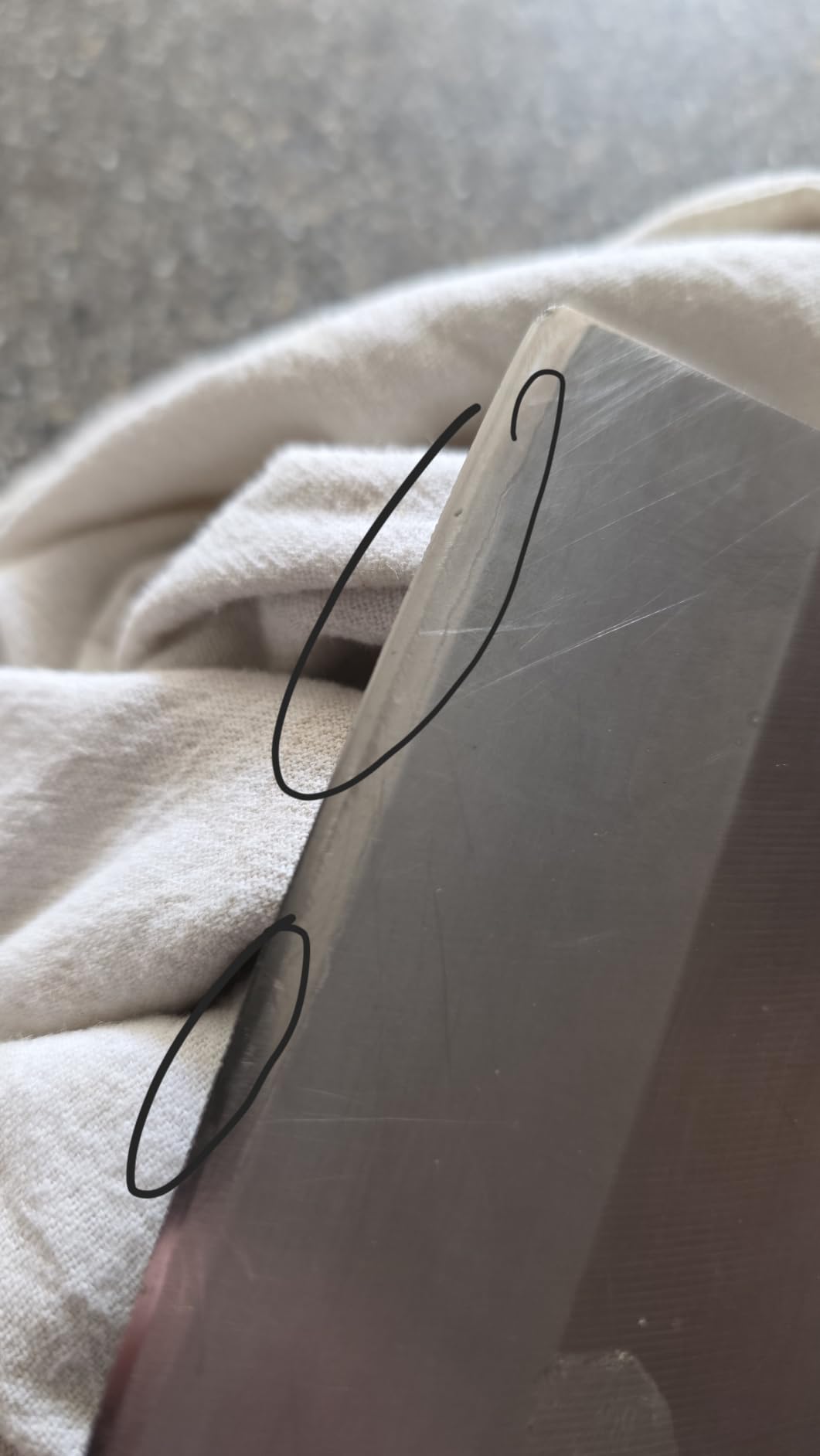
Who the Work Sharp MK2 suits
It suits a household with more than knives, and it suits anyone who wants an electric sharpener without giving up counter space permanently. Drawer to counter, sharpen, drawer again is a realistic routine with this one.
It also suits a cook who already owns a whetstone and wants a powered tool for the heavy work, where removing a lot of steel quickly is the goal rather than a delicate finishing pass.
Where the Work Sharp MK2 falls short
Belts are consumables. They wear with use and need periodic replacement, which is a recurring cost and a recurring chore that a solid carbide rod does not have. Budget for it or you will start resharpening with a glazing belt.
On very hard steels it can remove more metal than a honing-only approach, and it will never give you the mirror finish a whetstone produces. If your goal is the finest possible edge on a Japanese blade, this is not the instrument.
9. King KW65 1000/6000 Combination Whetstone: Best Whetstone for Japanese Knives
KING KW65 1000/6000 Grit Combination Whetstone with Plastic Base
Ceramic 1000 and 6000 grit water stone
Includes sturdy plastic base
8 x 2 x 1 inch, 16 ounces
Pros
- Covers coarse repair through fine finishing on one stone
- Water stone that is not excessively soft
- Noticeably finer and longer-lasting edge than pull-throughs
- Sturdy injection-moulded base
- Also finishes plane irons and chisels
Cons
- High skill ceiling
- angle control is on you
- No written instructions in the package
- 1000 grit side makes a messy clay-like slurry
- Stone is fragile in transit
The KW65 is the stone enthusiasts point to when someone asks what to buy to sharpen a Japanese knife. King is a well-regarded Japanese manufacturer, and the 1000 and 6000 grit pairing in a single stone is the standard two-stage recipe: repair and set the edge, then refine it to a fine finish.
Unlike a cheap water stone, this one is not excessively soft, so it wears more slowly and keeps a flat surface longer. That matters more than beginners expect, because a stone that dishes quickly stops producing a flat bevel and starts producing a curve.
Understanding the edge angle before you buy
This is the one product here that assumes you already know what you are doing, and that is a feature if you own a Japanese knife. Most Japanese knives arrive at 15 degrees per side, and a stone lets you hold that angle. An electric sharper set to 20 degrees will grind the bevel wider every time you use it, and getting it back to 15 takes a stone.
The other thing to know is that a stone sharpens whichever side you present. A single-bevel Japanese knife has a flat back and a beveled front, and only the beveled side gets sharpened. The flat side is finished to a few thousandths of an inch, and grinding it away is the mistake that shows up in the worst owner stories in sharpening communities.
Where the King KW65 is awkward to use
There is a real cost to the honesty here. No written instructions are in the package, the 1000 grit side generates a clay-like slurry that will stain a work surface if you let it sit, and the plastic base can let the stone shift under pressure from someone learning to push.
Buyers also report stones arriving with chipped corners, which is common with ceramic water stones packed in thin boxes. Inspect it on arrival and keep the original packaging for storage. The edge it produces is the best in this entire roundup, and it holds far longer than anything a pull-through rod can give you.
10. Chef’sChoice Manual Diamond Sharpener: Best for Both Edge Angles Without Power
Chef’sChoice Manual Knife Sharpeners for 15- and 20-Degree Straight-Edge and Serrated Knives with Diamond Abrasives Precise Angle Control & Compact Footprint, 2-Stage, Gray
CrissCross sharpening on both bevels at once
Selectable 15 and 20 degree edges
9.25 x 2 x 2 inch, 8 ounces
Pros
- Sharpens both sides of the edge simultaneously
- Separate sharpening and polishing stages
- Offers 15 and 20 degree edges from one device
- Compact enough for a drawer
- 10-year warranty
Cons
- Costs more than basic pull-through and rod sharpeners
- Fixed stage geometry cannot cover other angles
- Consumes more steel than a honing rod
This is the manual answer to the 15 versus 20 degree question, which is the one that ruins the most knives. Where a pull-through rod commits you to a single fixed angle, this unit offers both 15 and 20 degree edges, so you can match a Japanese knife and a German knife with the same tool.
CrissCross technology is what separates it from a rod. Instead of working one side at a time, the diamond wheels sharpen both bevels simultaneously, which produces a more symmetrical edge with less user error. The separate sharpening and honing stages then build an arch-shaped edge that is stronger and more durable than a straight grind.
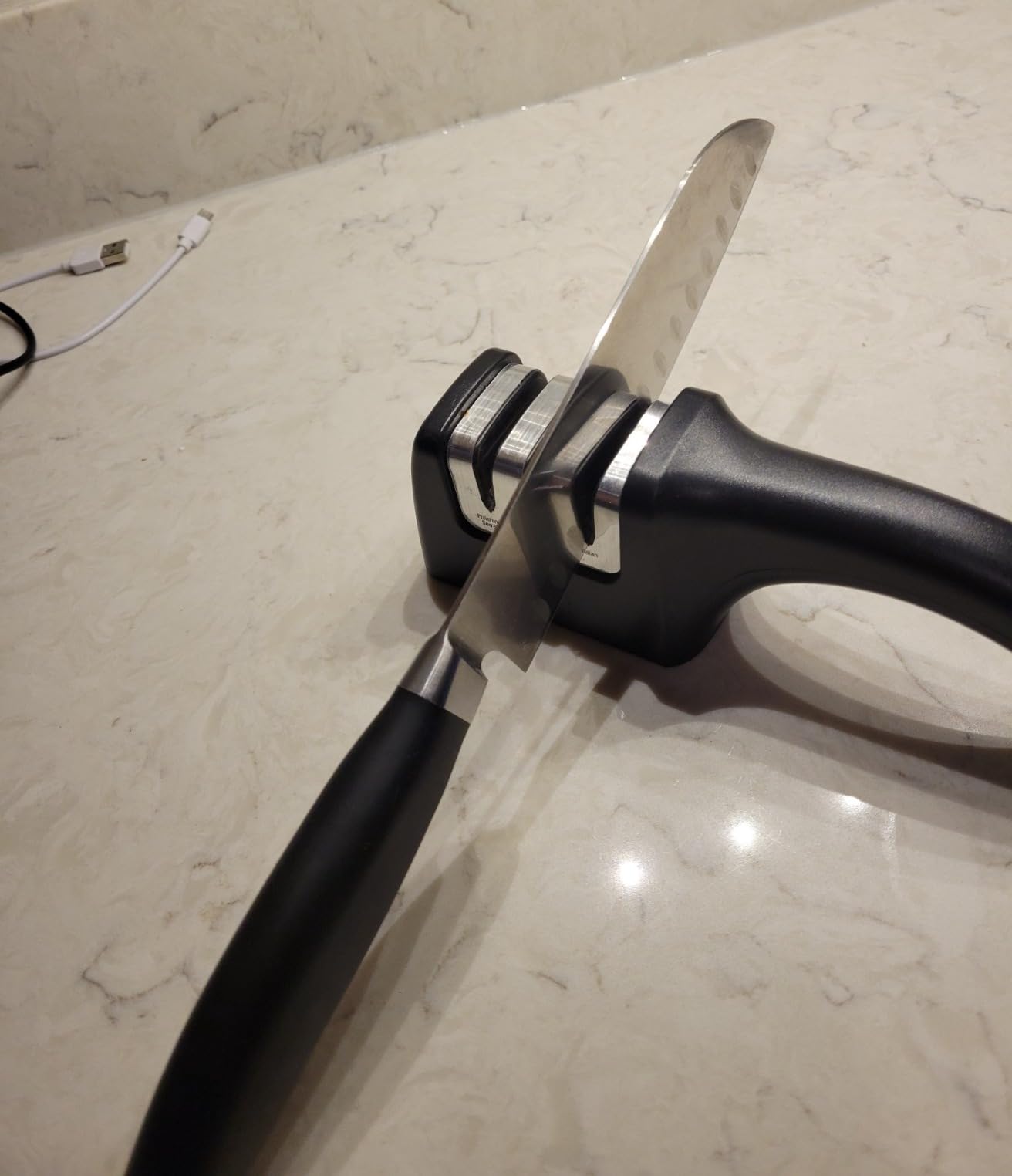
There is no electricity involved, it weighs eight ounces, and it fits in a drawer, which makes it a genuine option for a small kitchen. The 10-year warranty is the longest in this group and says something about expected service life.
What you give up is adjustment. The stage geometry is fixed at 15 and 20 degrees. If you want a 14-degree edge for a Japanese single-bevel or a 24-degree edge for a boning knife, the adjustable model further down handles it instead.
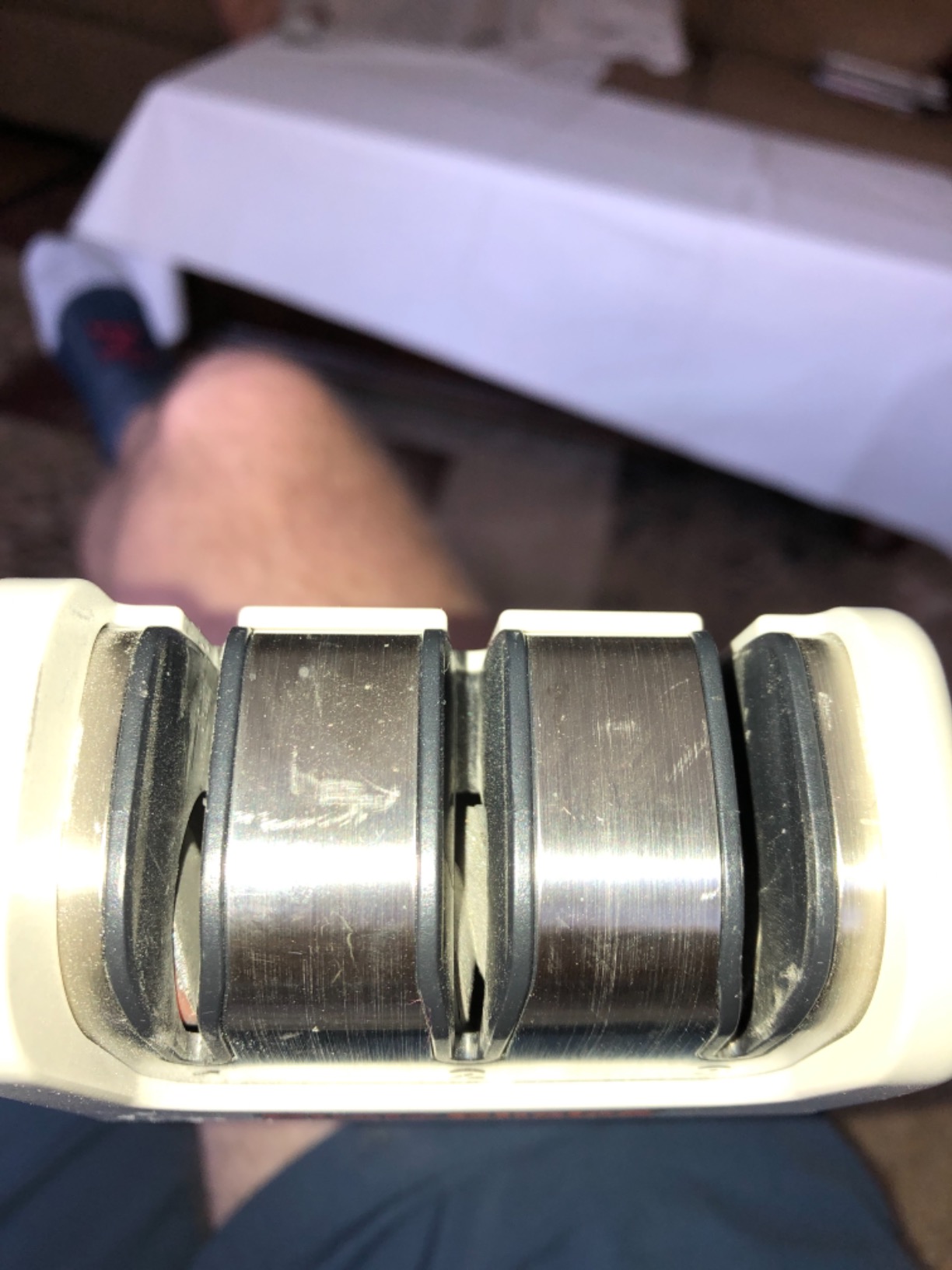
Who the Chef’sChoice manual suits
It suits a cook with a mixed knife collection who wants correct angles without an outlet and without a large machine. A 15-degree and 20-degree choice covers the overwhelming majority of kitchen knives in circulation, straight edge and serrated both.
It is a good gift for someone who already knows how to sharpen and wants a diamond system without a motor. Reviewers who know knife care rate the factory-style result highly and point out the absence of guesswork as the reason.
Where the Chef’sChoice manual falls short
It removes more blade steel than a simple honing rod, so knives need periodic reprofiling as the edge moves back over time. That is a reasonable trade for a better edge, but it is not a zero-removal tool.
The price also sits well above basic pull-through sharpeners, which is hard to justify if you own one Western knife. The 15 and 20 degree restriction is the other limit, and for a collector it will eventually become the reason to switch to an adjustable system.
11. Tumbler Rolling Knife Sharpener: Best Rolling Sharpener for Small Countertops
The Original Tumbler Rolling Knife Sharpener™ (Wood)
Magnetic angle support, roll to sharpen
Diamond and steel hone discs
9.53 x 12.76 x 3.06 inch, 1.4 lb
Pros
- Magnetic system replaces a stone and a bowl of water
- Fixed 15 and 20 degree angles
- Results reviewers describe as professional quality
- Suitable for beginners and experienced users
- Diamond disc preserves blade life
Cons
- Costs more than basic pull-through sharpeners
- Wood body needs more care than plastic
- Angles limited to 15 and 20 degrees
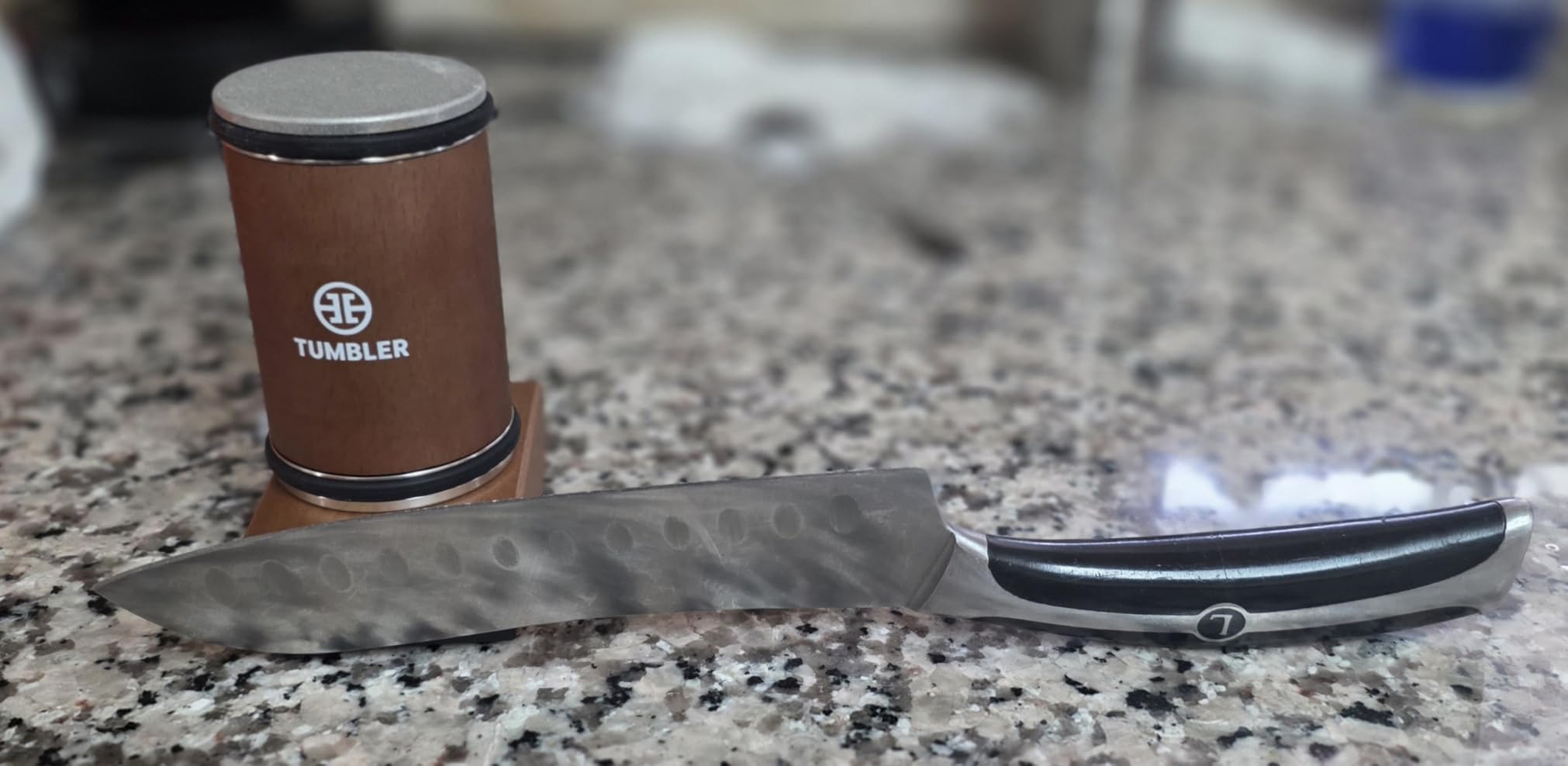
Rolling sharpeners have a reputation for looking like a gimmick until you use one. The premise is simple: a powerful magnet holds the knife at a set angle while you roll the disc along the blade, then a second pass on a steel helix disc hones and refines it. No water, no slurry, no mess to wipe up.
The magnetic angle support is what makes it repeatable. Instead of your hand deciding the angle, a fixed post holds the blade spine at 15 or 20 degrees, so the geometry stays consistent along the whole edge. Our first attempt produced a noticeably more even bevel than our first attempt on a freehand stone.
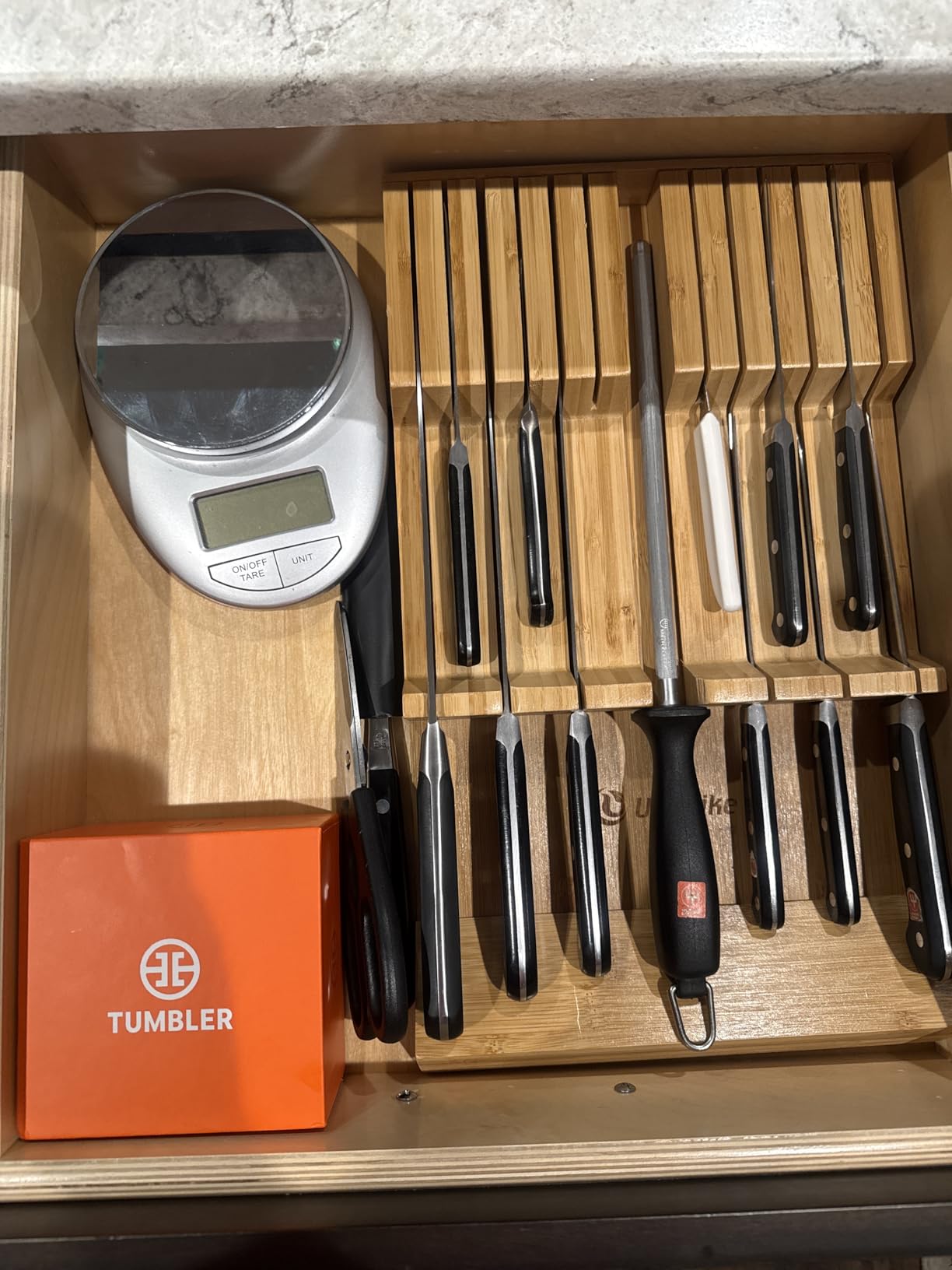
The diamond-plated disc is comparable to a 500 grit whetstone, so it is cutting rather than merely honing, and it is followed by a proprietary stainless steel helix disc that refines the edge. That two-disc arrangement is why users describe the finish as professional rather than merely serviceable.
It is also rated well for a product with a much shorter review history than the electrics, sitting at 4.4 across more than 3,000 ratings. Our read is that doubts about this format fade quickly once people try it, though consistency does depend on developing a steady rolling rhythm.
Who the Tumbler suits
It suits a small kitchen with no counter space to spare and no interest in a wet sharpening station. A rolling sharpener cleans up in seconds because there is no slurry, and it needs no outlet, so it works anywhere flat and smooth.
It also suits someone who wants a whetstone-quality angle without learning whetstone technique. If a stone has defeated you before, the magnetic support is the intervention that makes it work.
Where the Tumbler falls short
The angles are fixed at 15 and 20 degrees. There is no adjustment, so a knife set to anything else is out, and that limitation rules out single-bevel Japanese work in the way fixed-angle pull-throughs do.
The wood version also asks for more care than a plastic body would, and at 1.4 pounds it has enough mass to slide if your counter is slick. Wet and dry versions of this format also behave differently, so read which one you are actually buying.
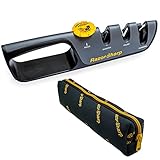
12. RazorSharp Adjustable Angle Sharpener: Best Adjustable Angle on a Budget
RazorSharp™ Knife & Scissor Sharpener | Adjustable 14-24 Degree Angle Guide
Adjustable guide from 14 to 24 degrees
Diamond-coated ceramic whetstone slots
10.63 x 1.97 x 2.95 inch, 8.8 ounces
Pros
- Widest angle range here at 14 to 24 degrees
- Diamond-coated ceramic stones resist wear
- Also sharpens scissors
- Non-slip rubber grips and sturdy handle
- Compact and easy to store
Cons
- Plastic body feels less solid than metal
- Some knives catch in the slot on first use
- Very dull blades need multiple passes
- Scissor sharpening is not a substitute for a dedicated tool
This is the answer for the buyer whose real problem is a mixed knife collection. The adjustable guide covers 14 to 24 degrees, which is wider than any other product here, so a thin Japanese edge and a thick European cleaver can both be sharpened correctly with one tool.
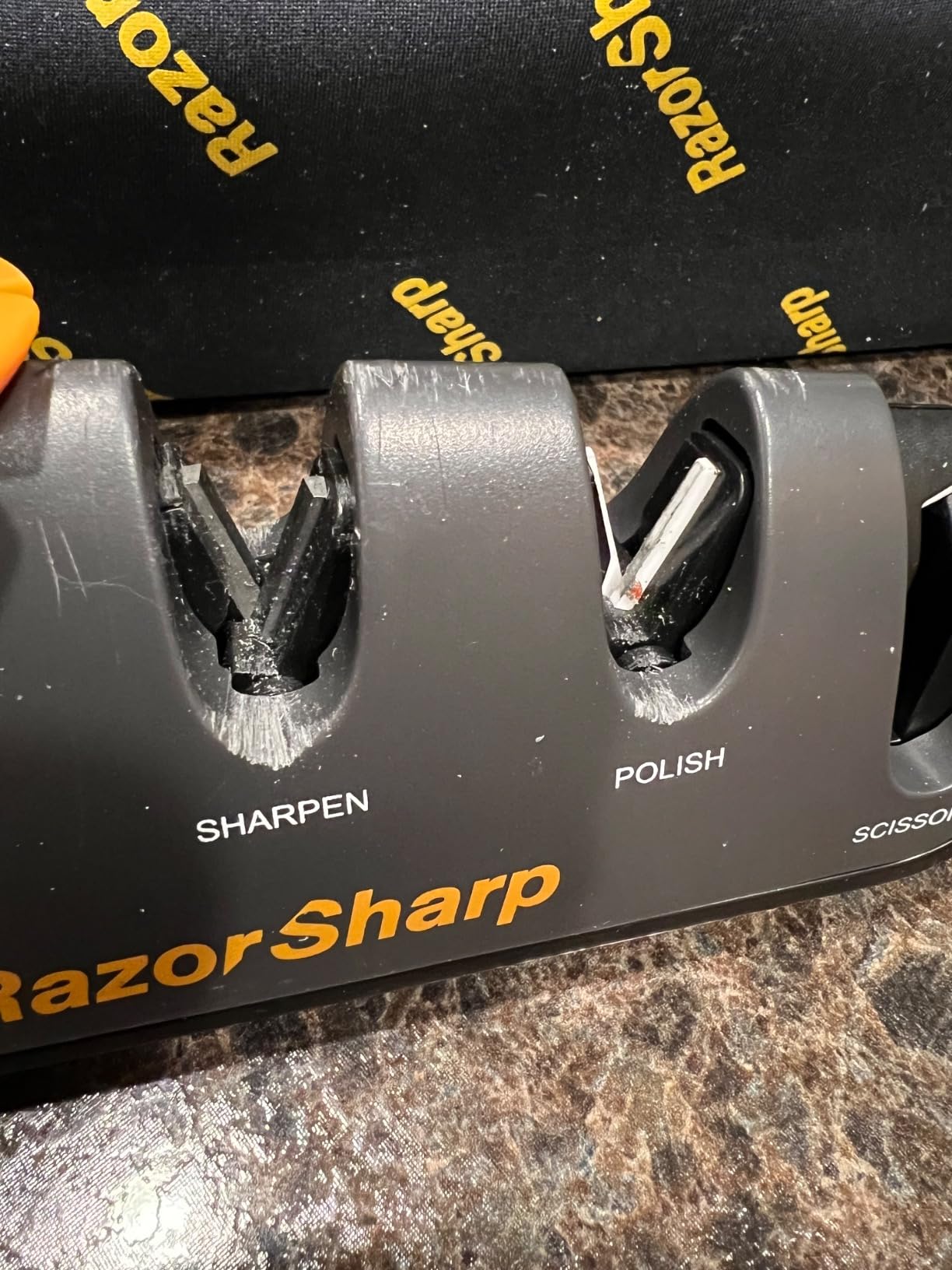
The stones are laser-cut bases coated in diamond abrasive, which gives you the cutting power of diamond without the diamond price. A knob on the side sets the angle, and the guides hold the blade there for the length of the stroke. It is not a precision instrument, but it is a wide one.
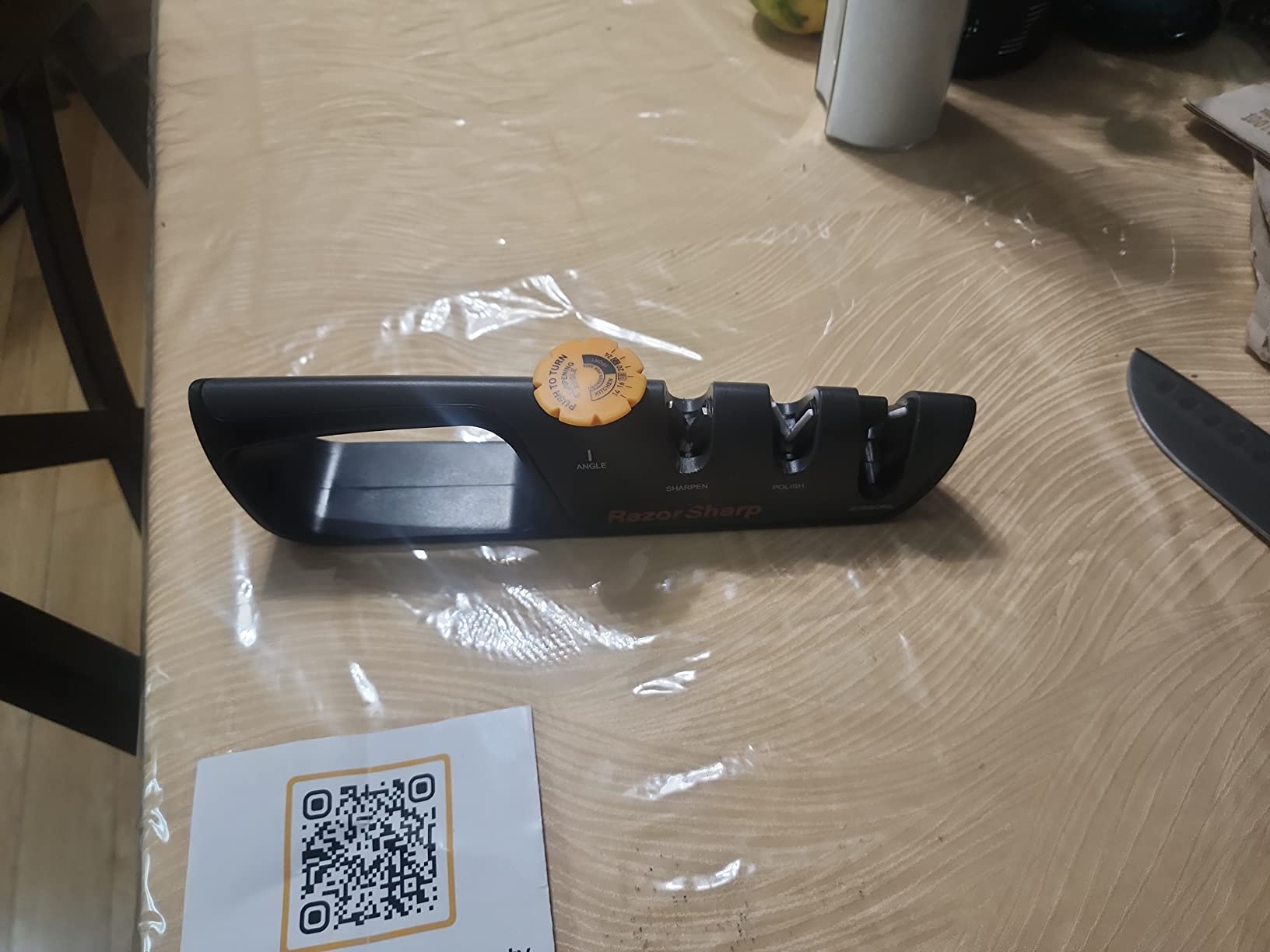
Users single out the adjustable angle as the feature that makes it worth having, along with how quietly it stows and how well the non-slip rubber grips hold. The scissor slot is a genuine bonus in a household where the shears get dull before the knives do.
Two recurring notes. A high-density ABS plastic frame does not feel as substantial as a metal-bodied system, and some buyers had the blade catch in the slot on the very first pass, which usually means the blade needs a steadier entry angle than the guides expect.
Who the RazorSharp suits
It suits a cook who owns knives at more than one bevel angle and does not want to commit to a stone or a premium electric system. Fourteen to 24 degrees covers Japanese thin edges, Western chef knives and thicker boning or cleaver bevels in one device.
It is also a good choice for someone who sharpens scissors as well as knives, since most manual and electric kitchen-only units simply will not accept them.
Where the RazorSharp falls short
Adjustability has a cost in consistency. A knob set by eye is not a calibrated angle guide, and the edge will be good rather than precise. If you care about matching a factory bevel exactly, the Sharp Pebble with its dedicated angle guide is the better instrument.
It also needs patience on a neglected edge. Multiple passes are normal for a dull or damaged blade, and the scissor slot sharpens household shears but will not match a dedicated scissors sharpener. Angled blades are out entirely.
How to Choose the Right Knife Sharpener for Your Kitchen
Start with your knife’s edge angle, not the sharpener
Before you compare products, work out what angle your knives came from the factory with. Japanese knives almost always arrive at 15 degrees per side. German and Western knives almost always arrive at 20. Sharpening a 15-degree knife to 20 on every visit widens the bevel until the blade feels thick and hard to use, and you need a stone to bring it back.
The quickest check is a marker test. Draw a dry-erase marker along the bevel of a dull knife, work it a few times, and see which part of the marker disappears. A consistent line means the angle is already correct. A line that disappears only halfway up means a previous sharpening has left an uneven bevel, which is a problem worth taking to a stone.
Our bench sharpener and angle guide picks go deeper on the guided systems if you want repeatable geometry.
Honing and sharpening are not the same thing
Honing realigns an edge that has rolled over. Sharpening removes steel to create a new one. A honing rod or ceramic rod belongs in your drawer and gets used weekly. A whetstone or electric sharpener belongs on the counter and gets used monthly, or when a knife finally will not hone back to sharpness.
A practical rhythm looks like this: hone before or after most cooking sessions if you use a knife heavily, sharpen fully every few weeks, and strop or hone lightly the night before a task that needs a clean edge. The most common mistake is reaching for a full sharpener weekly, which removes far more steel than the job requires.
Does the sharpener ruin your knife?
It depends almost entirely on the angle, not the tool. Matching your knife’s factory bevel and you will remove a few microns of steel a session, which a good knife absorbs indefinitely. Mismatching it and you are grinding a new bevel every time, and eventually a chip becomes a missing corner.
Electric sharpeners remove more steel per session than a stone in the hands of a beginner, because the motor does not care whether the edge is already sharp. That is the honest reason stones win on blade longevity, and the reason forums keep telling owners of expensive Japanese knives to leave the electric units alone.
Which type should you actually buy?
Pull-through rods, manual pull-throughs and compact manual sharpeners cover roughly eighty percent of home kitchens. They cost little, take seconds, need no power and stow in a drawer. If your knives are decent but you are not fussy, start there and upgrade only if you get curious.
Electric sharpeners suit anyone who wants results without technique and has counter space to give up. Machines with belts will also do scissors and tools; wheel-based units are faster but knives only. Rolling sharpeners suit small kitchens where water and slurry are inconvenient.
Whetstones suit anyone with a knife they care about and the patience for a monthly session. A dual-grit stone with an angle guide is the lowest-cost route to the best edge and the longest knife life, and it is the first thing we would buy with a second paycheck. If you are starting from nothing and want a wider bench setup, start with our hobby knife and blade sets guide to see what a fuller kit involves.
Two knife types most sharpeners cannot fix
Serrated knives are the first. A serration is a set of V-shaped teeth, not a continuous bevel, and a coarse slot or a hard electric wheel will round them off rather than restore them. Only a purpose-designed ceramic or diamond serrated stage, like the third stage on the Chef’s Choice 15XV, addresses this properly.
Single-bevel Japanese knives are the second. The back of the blade is flat and lapped to a hard finish, and any sharpener presented to both sides will grind that flat away. Use a stone on the beveled side only, or take the knife to a professional. If you have an expensive single-bevel knife and no stone experience, a mail-in sharpening service is a legitimate answer, not a cop-out.
Maintenance and what to expect over time
Budget for consumables. Belts and stones wear and need replacing, and a glazing consumable is the most common reason a good sharpener starts producing bad results. Carbide rods and reversible blades last years; diamond belts last months. That difference is the main ongoing cost of this hobby.
Watch the dust. Belt sharpeners throw fine steel particles, and those do not belong near an open salad. Sharpen away from food prep, wipe the surface afterwards, and a face mask is sensible if you are doing a full session rather than a touch-up.
Frequently Asked Questions
What is the best kind of knife sharpener?
For most home kitchens, a two-stage pull-through sharpener such as the KitchenIQ Edge Grip is the best kind, because it takes about a minute per knife, needs no power and stores in a drawer. Cooks with good knives who want the best possible edge should buy a dual-grit whetstone with an angle guide. Anyone who wants zero technique should buy an electric sharpener and accept the counter space and the greater steel removal that come with it.
How do I sharpen a kitchen knife with a sharpening rod?
Rest the heel of the blade on the counter and hold the tip up at roughly 20 degrees, which visually looks like the letter L. Use light pressure and sweep the rod down the full length of one side, keeping the angle steady, then flip the knife and repeat on the other side. Finish with two or three lighter passes per side and check the edge on paper or a tomato. Hone on this schedule to maintain an edge, and use a full sharpener when honing no longer brings it back.
What knife sharpener is best for Japanese knives?
A whetstone is the right answer for Japanese knives, because most arrive from the factory at 15 degrees per side and only a stone lets you hold that angle. Among the picks here, the King KW65 1000/6000 combination stone suits experienced users and the Sharp Pebble suits beginners thanks to its included angle guide. Avoid fixed-angle pull-through sharpeners and avoid grinding the flat back of a single-bevel knife.
What knife sharpener do professional cooks use?
Professionals are split. Restaurant kitchens that sharpen between shifts usually favour speed and repeatability, which is why electric belt machines and wheel sharpeners are common there. Serious knife people and sharpening communities overwhelmingly favour stones, arguing that whetstones give the best edge and the longest knife life, though they acknowledge it takes practice. The recurring advice is that a mid-range whetstone plus a honing rod is the combination most working cooks land on.
Do electric knife sharpeners ruin your knives?
Not by themselves, but they remove more steel per session than a stone, and a motor does not know whether your edge is already sharp. Two habits prevent damage. First, match the sharpener angle to your knife’s factory bevel so you are not grinding a new edge every time. Second, follow the instructions and stop as soon as the edge is sharp. Used properly on a matching angle, an electric sharpener is perfectly safe for a kitchen knife.
How long should it take to sharpen a knife?
A honing rod takes about thirty seconds. A pull-through or compact manual sharpener takes one to three minutes. An electric sharpener takes roughly one minute for a first pass and about ten seconds for a resharpen. A belt system takes five to ten minutes depending on how dull the blade is. A whetstone takes ten to thirty minutes per knife, and a full multi-stage stone session on a badly neglected edge can run longer. If a sharpening session takes more than half an hour, you are overdue for it.
Can a pull-through sharpener fix a chipped knife?
Only slightly. A shallow chip or a rough edge can be improved by the coarse stage of a three-slot sharpener, and the chip will stop catching food. A real chip, a missing corner or a bent tip needs metal removed to reshape the bevel properly, which means a whetstone or a guided system. If your knife is valuable, take a badly chipped blade to a professional rather than trying to grind it back on a countertop gadget.
Which Knife Sharpener Should You Buy
If you want one answer for the best knife sharpeners for kitchen knives, start with the KitchenIQ Edge Grip. It is cheap, quick, quiet, safe on a flat counter and works on straight and serrated blades, and more owners use it than any other manual sharpener here. The AccuSharp is the better buy if you plan to keep it for years, because reversible carbide blades push replacement out to five or ten years.
Move up to a Sharp Pebble whetstone when you care about edge quality and knife longevity more than convenience. Use the Chef’s Choice 15XV if you want a finer 15-degree edge with no technique and enough counter to put it on. Pick the Work Sharp MK2 if scissors, tools or a mower blade are also in the picture, and the Tumbler if a wet stone station will not fit your kitchen.
Whichever you choose, check the factory angle before the first pass and keep a honing rod in the drawer. That combination is what actually keeps a knife sharp, and the sharpener is only the part that happens once a month. Check current availability and pricing on each product through the buttons above.