
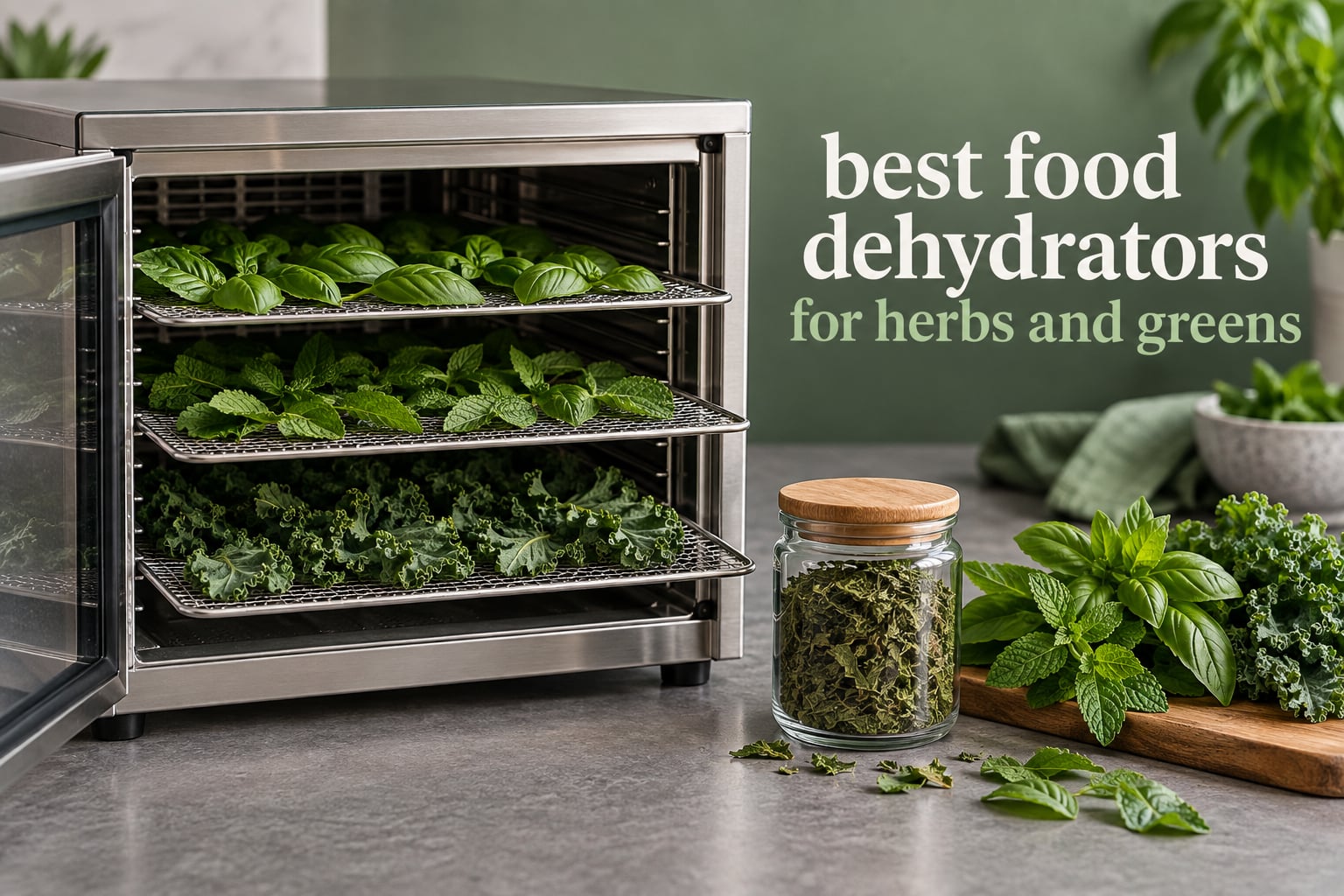
The best food dehydrators for herbs and greens are the boxes that can actually hold 95°F to 115°F without wobbling, because that low band is where chlorophyll and volatile oils survive. The Cosori 6-Tray Stainless Steel model is our top pick: 6.5 ft² of tray space, degree-by-degree control from 95°F, and a rear fan that dries every tray evenly so you never rotate at midnight.
Most roundups we read treat herbs as an afterthought and greens as a footnote. That is backwards if you grow either one, because herbs are small, delicate and quick to scorch, while greens are bulky, wet and prone to clumping into a moldy mat. Those two problems pull in opposite directions on tray design, and the machine that handles basil well is not always the machine that handles a full tray of kale.
So we lined up ten countertop dehydrators and judged them on the things that decide whether an herb batch succeeds or turns into brown dust. Temperature floor, tray type, fan placement, wattage, timer length and how much noise you can tolerate at 2 a.m. all went into the ranking. Several of these units also handle meat and fruit, and we cover that side in our separate guide to dehydrators for jerky and dried fruit.
One thing to know before you start shopping: an electric dehydrator is the right tool for a steady weekly harvest, and the wrong tool for a single bunch of parsley. A mesh hanging rack in a dry, breezy room does the same job for pennies and no electricity, which is why the best food dehydrators for herbs and greens are only worth the counter space once you are drying in volume.
Table of Contents
Top 3 Best Food Dehydrators for Herbs and Greens (October 2026)

Cosori 6-Tray Stainless Steel
- 6.5 ft2 of stainless tray space
- 95-165F in 1 degree steps
- Rear fan
- no tray rotation
- Under 48 dB

Cosori 5-Tray BPA-Free
- 95-165F digital control
- Adjustable tray height
- Expandable to 7 trays
- Under 47 dB

Hamilton Beach 32100A
- 100-160F with 48 hour timer
- Mesh herb screen included
- 4.2 sq ft of tray space
- Clear vented lid
Every Dehydrator in This Roundup Compared in 2026
The single most useful column in this table is the minimum temperature. Anything that starts at 104°F or higher is already working against you for tender greens, even if the rest of the spec sheet looks impressive.
| Product | Specs | Action |
|---|---|---|
| Cosori Food Dehydrator 6 Stainless Steel Trays |
|
Check Latest Price |
| Cosori Food Dehydrator 5 BPA-Free Trays |
|
Check Latest Price |
 Magic Mill Pro 7-Tray Stainless Steel Magic Mill Pro 7-Tray Stainless Steel |
|
Check Latest Price |
| Hamilton Beach Digital Food Dehydrator 32100A |
|
Check Latest Price |
 Magic Mill 5-Tray Stainless Steel MFD-5000 Magic Mill 5-Tray Stainless Steel MFD-5000 |
|
Check Latest Price |
 OSTBA 5-Tray 240W Food Dehydrator OSTBA 5-Tray 240W Food Dehydrator |
|
Check Latest Price |
 Commercial CHEF CCD100W6 5-Tray Commercial CHEF CCD100W6 5-Tray |
|
Check Latest Price |
 Elite Gourmet EFD319DKG 5-Tray Elite Gourmet EFD319DKG 5-Tray |
|
Check Latest Price |
 HOPERAN 12-Tray Stainless Steel BZ-1520 HOPERAN 12-Tray Stainless Steel BZ-1520 |
|
Check Latest Price |
 Cosori P501 5-Tray Stainless Steel Cosori P501 5-Tray Stainless Steel |
|
Check Latest Price |
1. Cosori Food Dehydrator with 6 Stainless Steel Trays and 6.5 ft² Drying Space
Cosori Food Dehydrator, 6 Stainless Steel Trays with 6.5 ft² Drying Space
6 stainless trays, 6.5 ft2 space
95-165F in 1 degree steps
600W rear fan, under 48 dB
48 hour timer
Pros
- Rear fan dries every tray evenly with no manual rotation
- 95-165F digital control in single degree increments hits the herb band precisely
- Quiet brushless motor under 48 dB for overnight batches
- Included mesh screen and fruit roll sheet
- Two year manufacturer warranty
Cons
- Large countertop footprint for its tray count
- 165F ceiling is low if you also make jerky
This is the unit we keep coming back to for herbs. The temperature panel goes down to 95°F and steps in single degrees, so you can hold basil at 100°F for four hours instead of guessing between two coarse settings. At 4.7 stars across more than twenty-one thousand reviews, it is also the most-proven machine in this roundup by a wide margin.
For leafy greens the story is capacity rather than precision. Six stainless trays at 6.5 ft² total means a full basket of kale or chard fits in one load, and the sliding trays make it easy to check the middle shelves without pulling everything out. Owners consistently call the trays easy to wash, which matters more than it sounds when you are handling a dozen batches of damp greens.
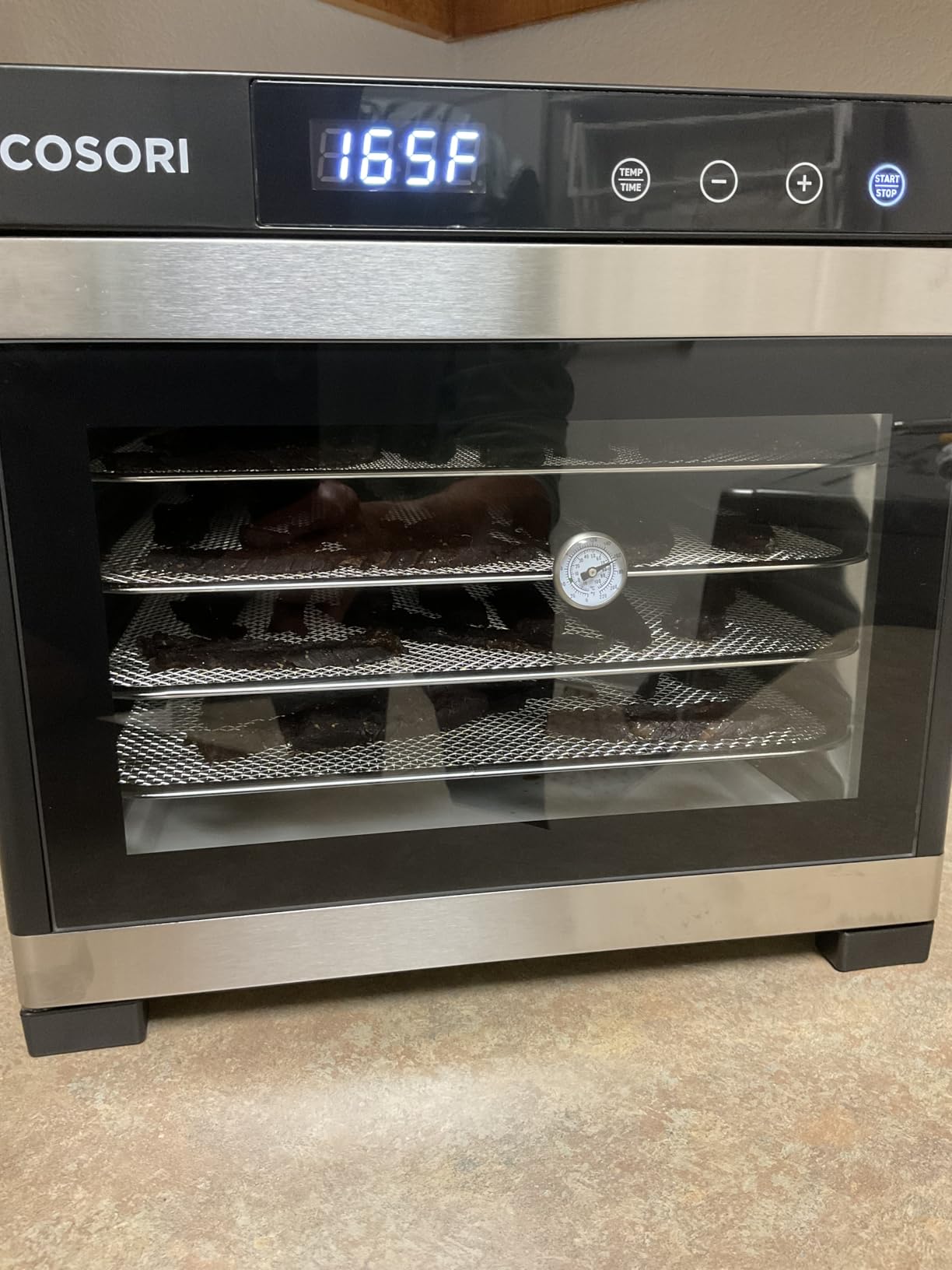
The rear-mounted fan is the part that earns the badge. Rear fan and rear heat mean the air loops through the whole stack rather than blasting upward from the bottom, so the top tray dries at the same rate as the bottom one. On bottom-fan models you learn to shuffle trays every few hours; here you load them and walk away.
It runs under 48 dB on a brushless motor, which matters more for a dehydrator than for almost any other appliance, because herb cycles are long and quiet runs happen at night. The included mesh screen gives small leaves something to sit on instead of dropping through the slots, and a fruit roll sheet and recipe book come in the box.
Who this dehydrator suits
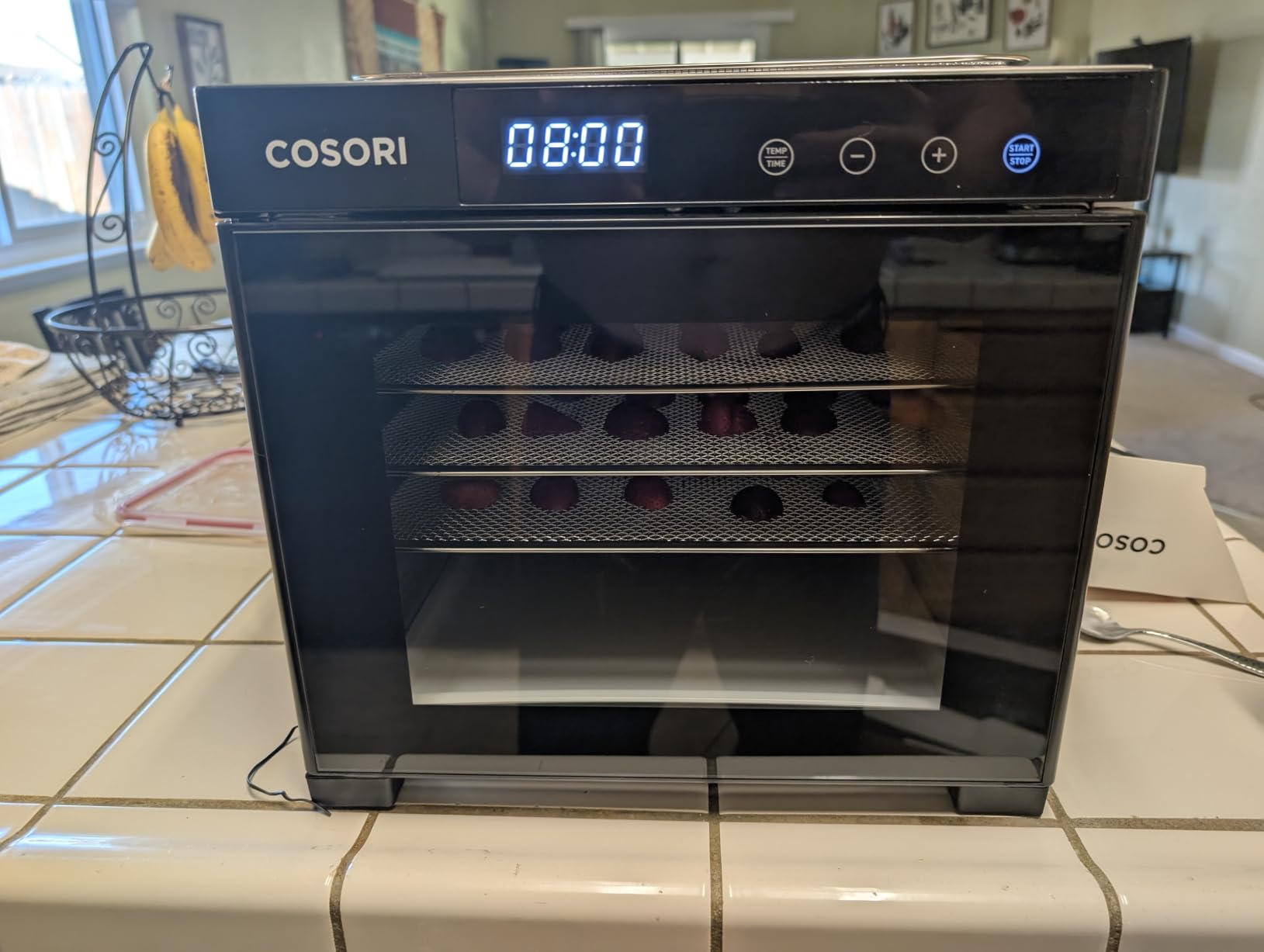
If you dry a weekly harvest of basil, oregano, mint or parsley, this is the safe buy. A six-tray box at degree-level control handles a whole week’s stems in a single run, and the quiet motor means you can start it before bed and store the results in the morning.
It also suits anyone who wants one appliance to cover greens, fruit and herbs without trading off. The wide 6.5 ft² of stainless surface is the widest tray area of the compact models here, and stainless trays will not crack the way plastic ones do after a season of wet spinach.
Where it falls short
The 165°F ceiling is the limitation. If your future plans include making jerky, you will eventually want the 176°F top end that the Magic Mill Pro and Cosori P501 offer, and you will end up running the higher-temp cycle in two stages.
It is also the biggest countertop footprint among the compact picks at 17.8 inches deep. Plan the shelf space before you buy, because the door needs clearance to open fully and the top needs room to vent.
2. Cosori Food Dehydrator with 5 BPA-Free Trays and Adjustable Tray Height
Cosori Food Dehydrator, 5 BPA-Free Trays, 165°F Temperature Control, 350W
5 BPA-free trays, expandable to 7
95-165F in 1 degree steps
Adjustable tray height
Under 47 dB
Pros
- Precise 95-165F control verified across tray positions
- Adjustable tray height suits thick-cut greens and herb stems
- Quiet enough to run overnight
- Expandable to seven trays as your harvests grow
- Two year manufacturer warranty
Cons
- Fruit leather and jerky mats sold separately
- Recipe book drying times are approximate so rotation helps
This is the value pick, and the reason it edges out the cheaper boxes is the adjustable tray height. Owners who dry thick-cut greens or long herb stems report that raising the gap between trays makes the difference between a good batch and a batch that dries unevenly. That one feature is worth more than a larger tray count for our purposes.
The temperature panel also runs 95°F to 165°F in single-degree steps with a 48-hour timer, and reviewers specifically note that the setting reads consistently whether a tray is at the top or the bottom. At 4.6 stars from roughly nine and a half thousand reviews, the consistency record is solid.
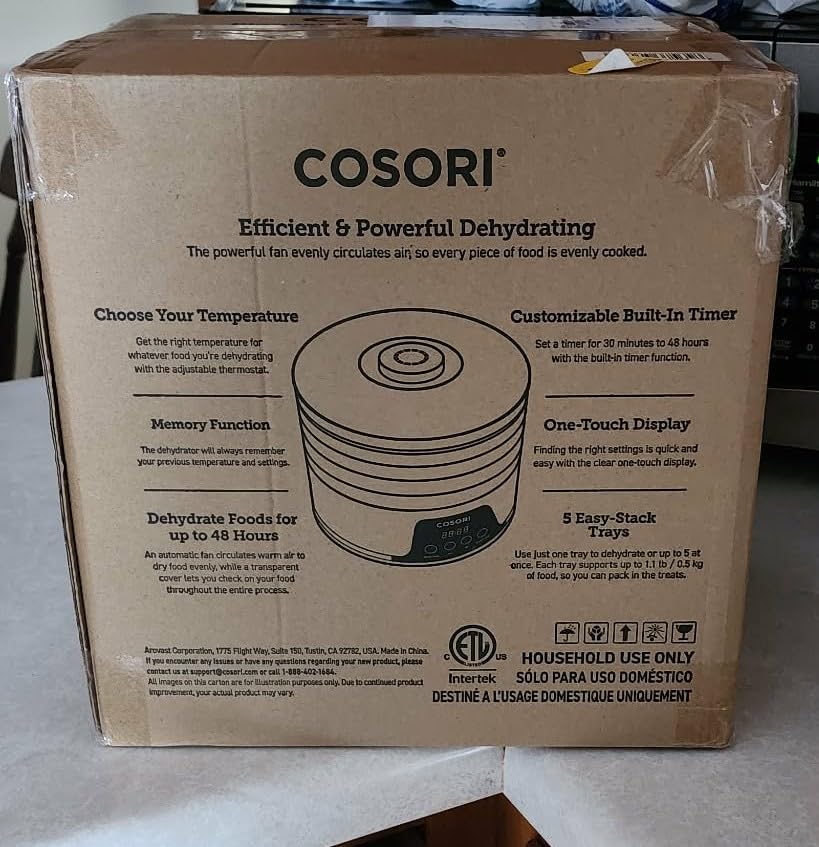
At under 47 dB it is the quietest unit in this roundup by measurement, and at 4.9 pounds it is also one of the lightest. If you only dry herbs and greens, the total weight is a real convenience: you can move the whole box to a warm shelf rather than carrying trays one at a time.
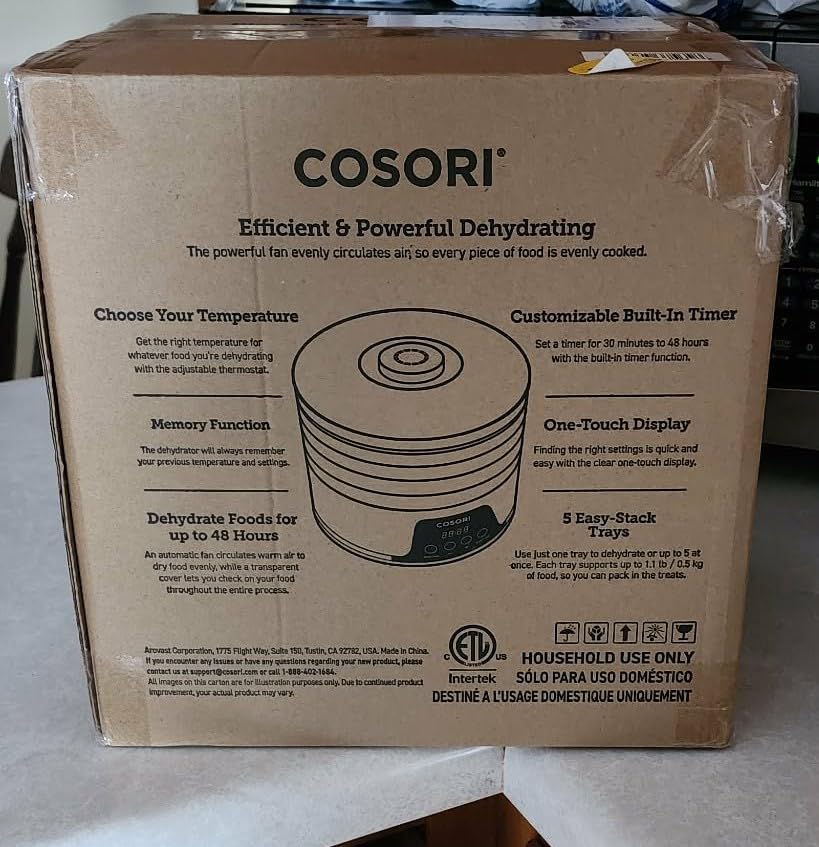
The unit starts as a five-tray machine and expands to seven with an add-on kit, which means you can start small and grow into a bigger harvest without replacing the appliance. The trays are BPA-free polypropylene rather than metal, and they release sticky fruit leather without much scrubbing.
Who this dehydrator suits
Choose this one if your herb drying is seasonal and your counter space is tight. It takes up very little room, stores flat between harvests, and the adjustable tray spacing handles both delicate basil leaves and larger kale strips in the same run.
It is also a sensible first machine for anyone who has never owned a dehydrator. The panel is straightforward, the trays come out for washing easily, and the included recipe book gives you a starting point without a steep learning curve.
Where it falls short
The accessories are sold separately. There is no mesh screen or fruit roll sheet in the box, so if you plan to dry small herb leaves you will want to buy the mesh insert rather than assume it is included.
Recipe book times are approximate, which is a mild complaint but a real one. Reviewers note that rotating trays improves results, and the touch panel can overshoot if you tap and hold at the same moment. Learn the tap pattern before a long cycle.
3. Magic Mill Pro 7-Tray Stainless Steel Dehydrator with 600W Rear Fan
Magic Mill Pro Food Dehydrator Machine | Powerful 600W Rear Fan Even-Drying System | 7 Full-Size Stainless Steel Trays | 95°-176° Temperature Control, 48H Timer, Keep Warm + Auto Shutoff | ETL Listed
7 full-size stainless trays
95-176F in 1 degree steps
600W rear fan, no rotation
Keep warm mode at 95F
Pros
- Seven full-size stainless trays hold about 5 lbs per batch
- Rear fan and rear heat dry every tray evenly
- Keep warm mode holds at 95F for up to 24 hours
- Two mesh screens included for herbs
- Full stainless interior and exterior
Cons
- Start and stop button is overly touch-sensitive
- Higher cost than entry-level units
When a garden produces more than you can eat, tray count becomes the deciding spec. Seven full-size stainless trays hold roughly five pounds in a single run, which is the difference between drying your basil in one session or three. Users on r/dehydratedfoodideas single out this machine for its heating element and even drying, and that reputation holds up in the specs.
The 600W rear fan handles both halves of this topic well. It reaches down to 95°F for herbs and climbs to 176°F, so the same box covers a low herb cycle and a safe jerky cycle. The keep warm mode holds at 95°F for up to 24 hours, which is genuinely useful when you want herbs ready but not jarred yet.
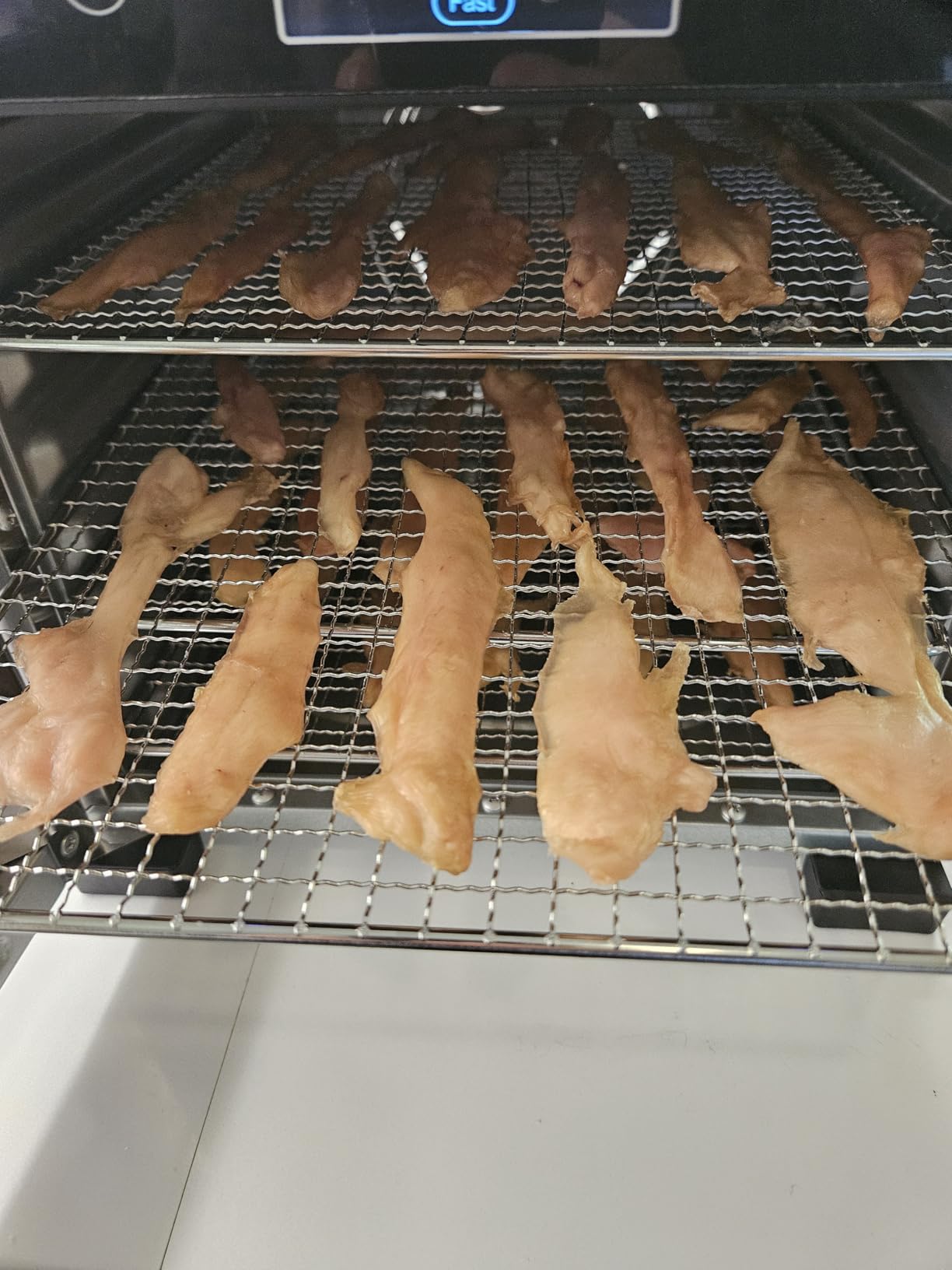
Two mesh screens ship in the box, which matters for herbs because small leaves such as chive tips and oregano fall through bare tray slots. For greens, the solid stainless surface gives you a clean surface that rinses and dries fast, and the 1.1-inch clearance between trays is enough for thicker strips.
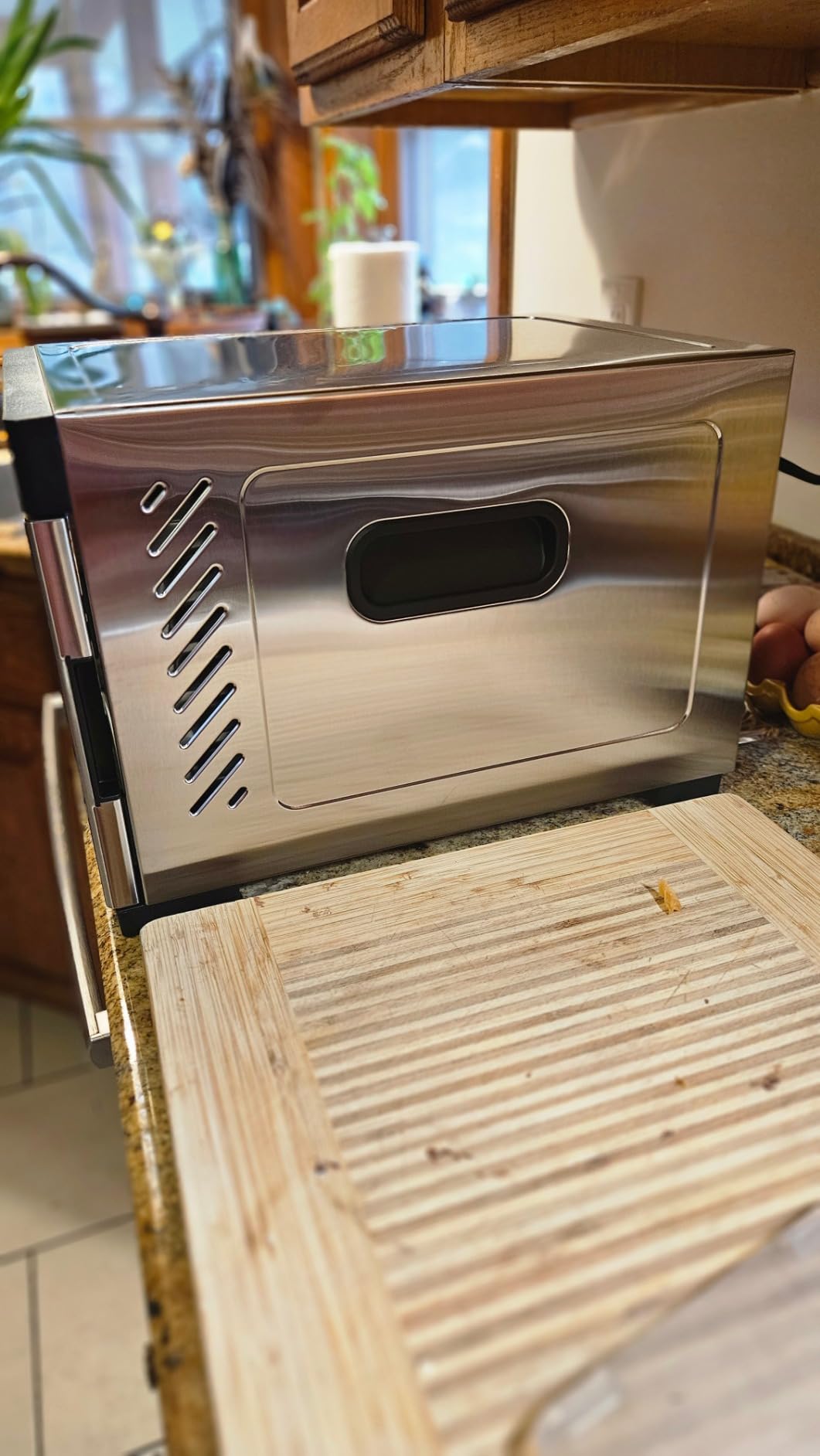
The whole chamber is stainless, inside and out, so there is no plastic contact with food anywhere in the drying space. At 16 pounds it is not a portable appliance, but it is stable and quiet enough that owners run it through the night without complaint.
Who this dehydrator suits
This is the batch machine. If you have a raised bed, a community garden plot or a wholesale buy of greens, seven trays means one load instead of three, and the stainless interior is built for a decade of damp produce rather than a season of it.
It also suits people who split their dehydrating between herbs and something hotter. A single unit covering 95°F through 176°F means you are not shopping for a second appliance when jerky season arrives.
Where it falls short
The start and stop button is the most-cited complaint in the reviews, and it is an irritating one: owners report that a brushed sleeve or a wet hand can kill a cycle mid-run. Get into the habit of touching it deliberately.
It also costs more than the entry-level models in this list, so if you are drying a few bunches of herbs a month the spend is hard to justify. Batch size is what makes this price reasonable.
4. Hamilton Beach Digital Food Dehydrator 32100A with Mesh Herb Screen
Hamilton Beach Digital Food Dehydrator for Fruit, Jerky, Vegetables & More
5 stackable BPA-free trays
100-160F adjustable
48 hour timer, auto shutoff
Mesh herb screen and fruit leather sheet
Pros
- Mesh herb screen included in the box
- Square shape maximizes tray space for its size
- Clear vented lid for checking progress without opening
- Dishwasher-safe trays and lid
- One year warranty and simple controls
Cons
- 100F floor is warm for the most delicate greens
- Coarse mesh lets small leaves fall through
- Fan noise comparable to a box fan
- Plastic trays
The Hamilton Beach is the one most owners recommend as a first dehydrator, and the reason shows up in the box rather than the spec sheet: a mesh screen for herbs ships in the carton. That is the tray surface small leaves actually need, and most competitors charge extra or omit it.
Its 100°F floor is close enough to the ideal 95°F to 115°F band for most herbs, and the digital panel adjusts in 100°F to 160°F with a 1-to-48-hour timer and automatic shutoff. The base-mounted heater and fan push air through the stack, and owners report that trays generally do not need rotating.
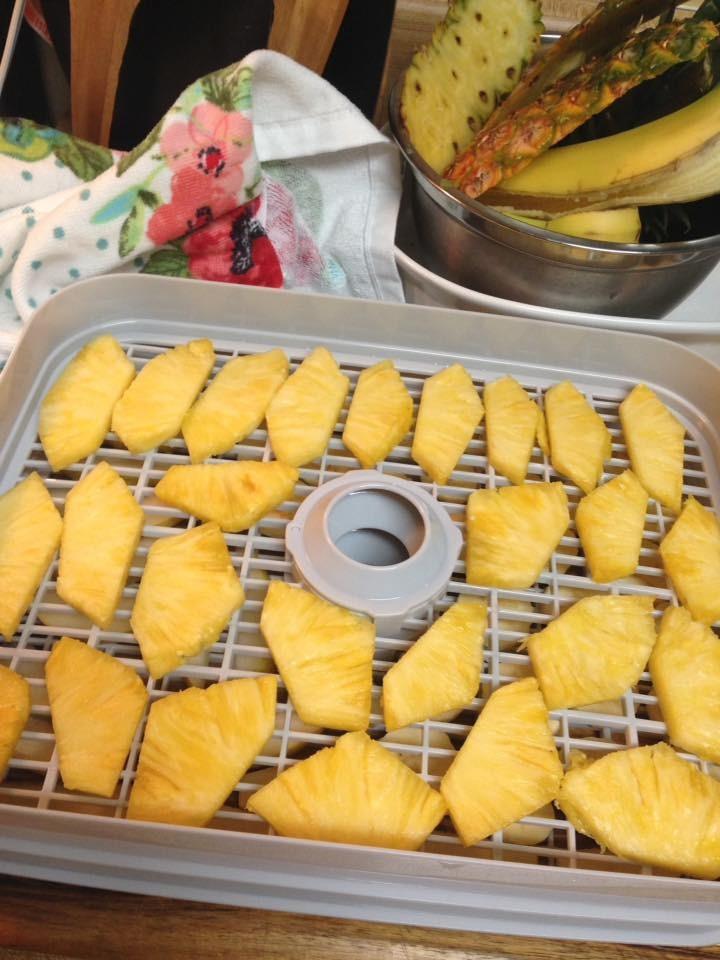
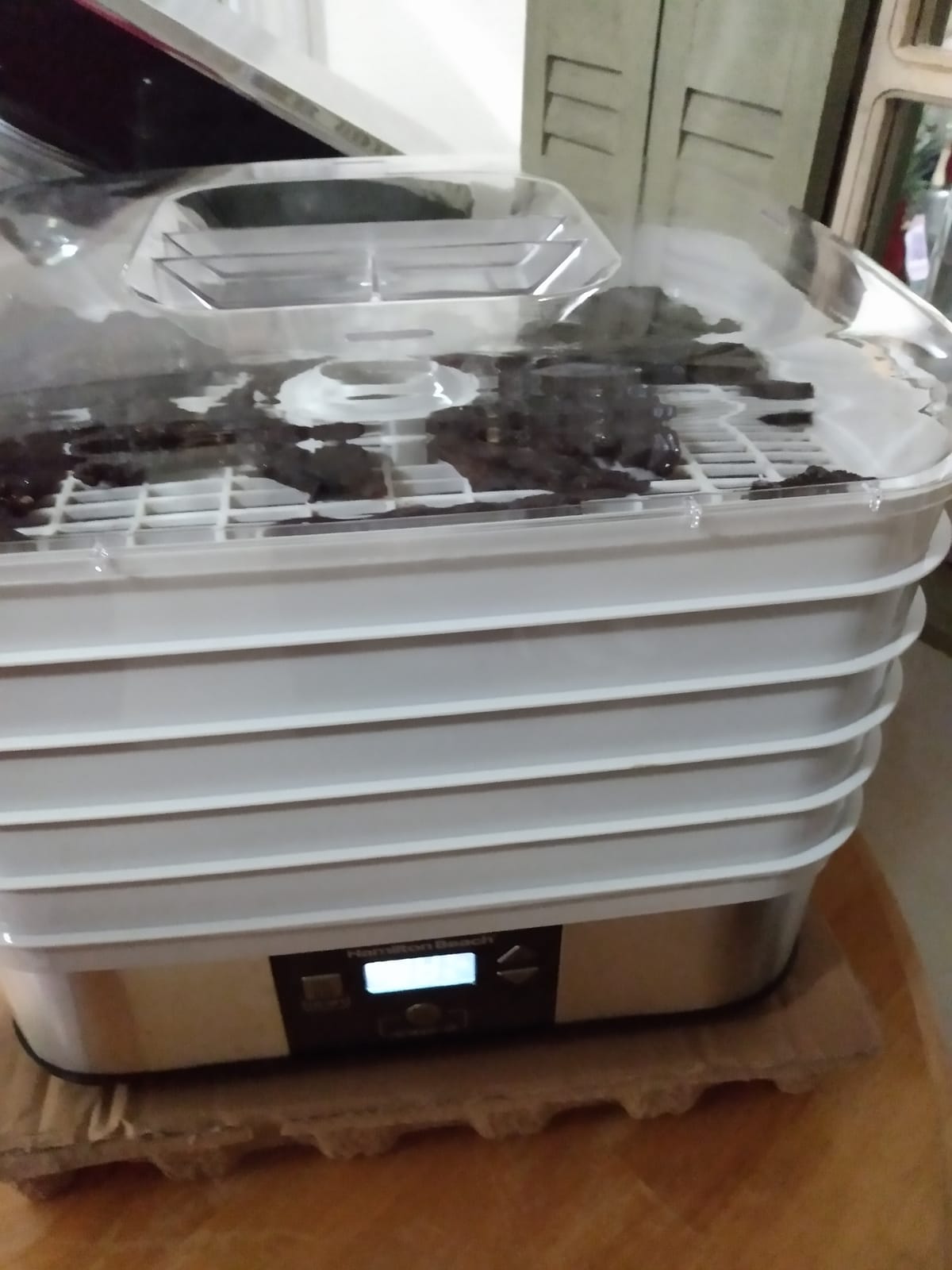
Two design details help in a small kitchen. The square footprint wastes less counter space than a rectangular box, so the 4.2 sq ft of drying area feels larger than the 10.4-inch depth suggests, and the clear vented lid lets you watch a batch without pulling the door open and letting warm moist air escape.
At eight pounds the whole unit is light, and both trays and lid are dishwasher safe. That matters for greens more than for fruit, because a tray that has held wet spinach all afternoon needs a real wash rather than a wipe.
Who this dehydrator suits
This is the right pick for a household that dries herbs and a few trays of greens, not a garden harvest. The included mesh screen, the compact square shape and the simple panel add up to a machine that works out of the box with no learning curve.
It is also a good first machine for a renter or an apartment where noise matters. It is not silent, but at eight pounds and a modest 500W element it is a reasonable neighbor for a daytime or early evening cycle.
Where it falls short
The 100°F minimum is the real herb caveat. Very tender greens and delicate herbs such as chervil do better with the extra five degrees of headroom that a 95°F unit gives you. The plastic trays also scratch and stain over time compared with stainless.
Fan noise is the other recurring complaint, and a few owners report a brief chemical smell on the very first run. Run one short empty cycle before loading food, and the issue resolves itself in most cases.
5. Magic Mill MFD-5000 5-Tray Stainless Steel Dehydrator with Adjustable Trays
Magic Mill Food Dehydrator Machine | 5 Stackable Stainless Steel Trays, 48H Digital Adjustable Timer & Temperature Control Upto 167° Electric Dryer & Preserver for Jerky, Fruit, Dog Treats & Much More
5 stainless trays, 240W
95-167F digital control
48 hour timer
Tray spacing 0.6 to 1.1 in
Pros
- Tray spacing adjusts from 0.6 to 1.1 inches
- Stainless steel trays with a stainless base
- Dishwasher-safe removable trays
- Digital timer and temperature control
- Lightweight at about 6 pounds
Cons
- 240W element means noticeably longer cycles
- BPA-free plastic body rather than an all-stainless chamber
The MFD-5000 is the model that shows up most often in enthusiast threads, and the reason is not raw power. It is the tray spacing, which racks from 0.6 inches to 1.1 inches, so you can load flat herb leaves on one run and thick-cut greens or vegetable slices on the next without buying a second machine.
Users on r/dehydratedfoodideas praise it for consistent performance across batches, and the digital panel runs 95°F to 167°F with up to 48 hours on the timer. For herbs specifically, the 95°F floor is exactly where you want to start.
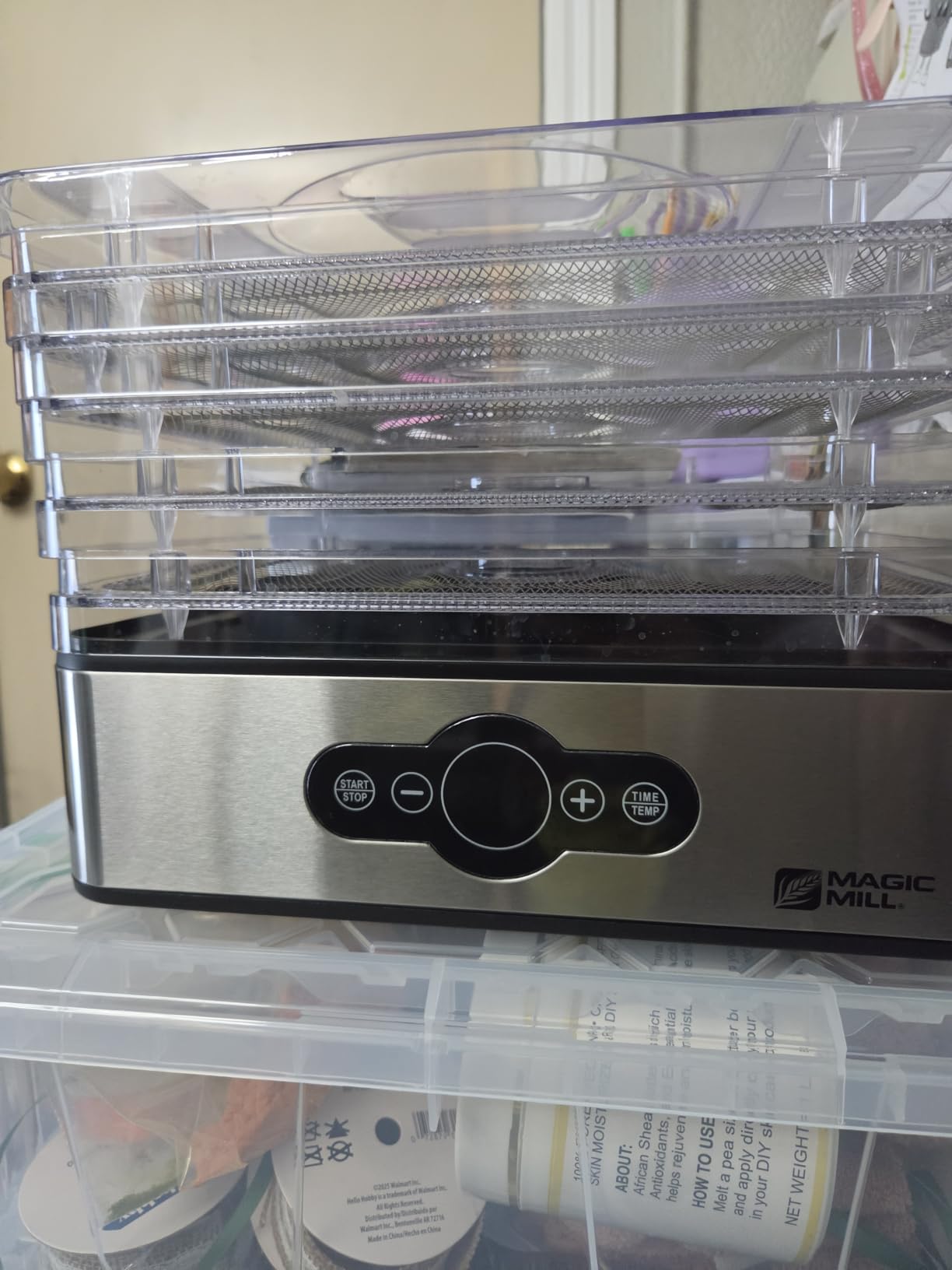
Wattage is the trade-off. At 240W this is one of the lowest-power elements here, which means long, gentle cycles rather than fast ones. For herbs that is arguably a feature, since slow low-heat drying preserves color and aroma, but for a big batch of greens you will be waiting.
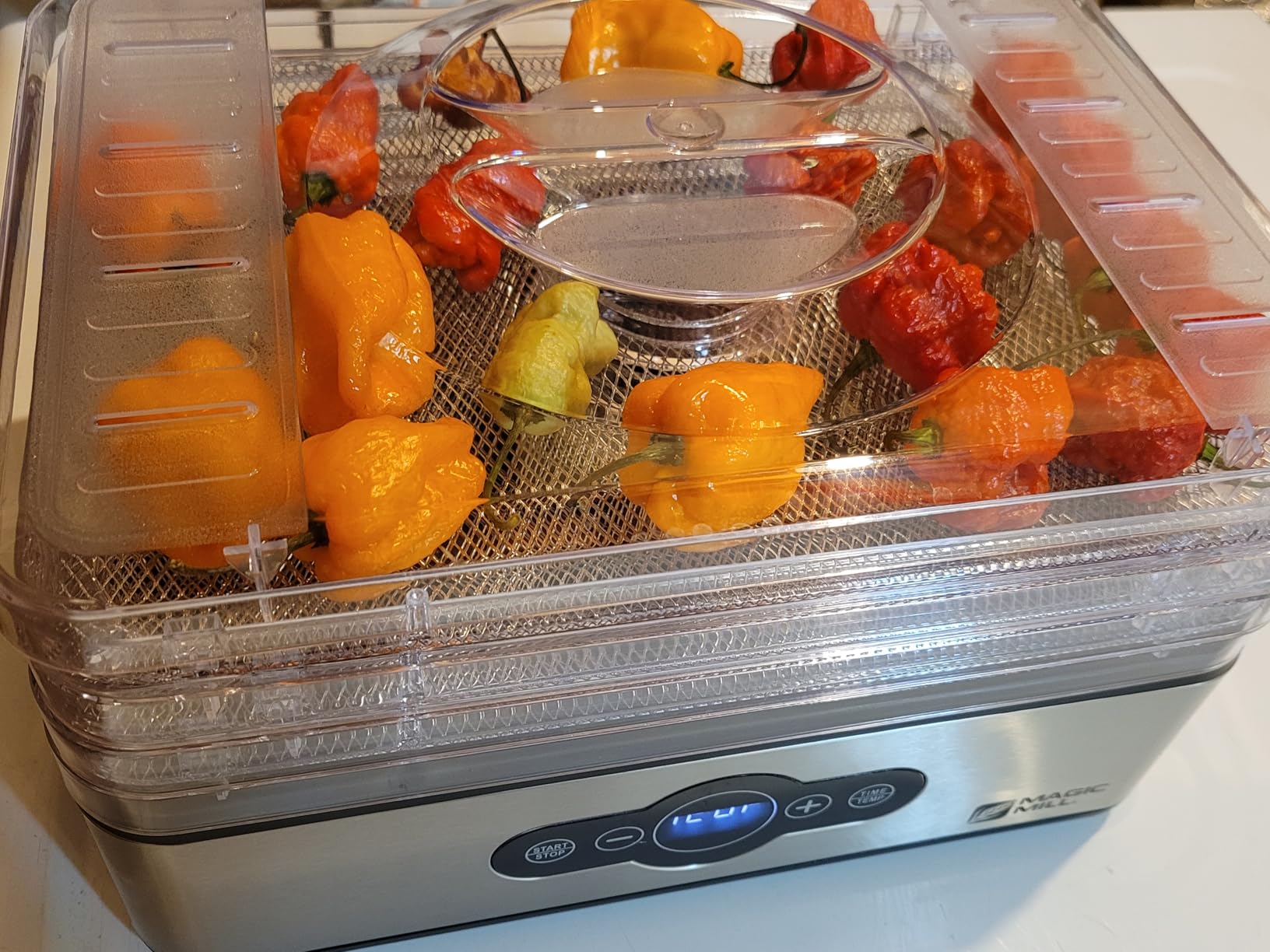
The build is a BPA-free plastic body with a stainless base and stainless trays, so the food-contact surface is metal even though the shell is not. Trays detach fully and go in the dishwasher, and the whole unit weighs about six pounds, which makes it easy to move.
Who this dehydrator suits
Pick this if you alternate between delicate herbs and thicker vegetable work in the same week. The adjustable spacing is the feature that makes it adaptable, and the 95°F to 167°F range covers both ends of home dehydrating without a second appliance.
It also suits anyone who prefers long, slow cycles over hot ones. The gentle 240W element is well matched to drying leafy greens at low temperature, where rushing is what causes scorched edges and damp centers.
Where it falls short
Patience is the cost. Owners consistently note that the modest element makes cycles run longer than on 500W or 600W machines, and on a large garden harvest that adds up across several sessions.
The plastic body also means the chamber is not fully stainless, which matters if you are sensitive to odors carrying over between batches. Wash the trays and air the chamber between strong-flavored runs.
6. OSTBA 5-Tray 240W Dehydrator with 72-Hour Timer
OSTBA Food Dehydrator, 5 Trays, 240W Dryer for Jerky, Fruit & Snacks
5 BPA-free dishwasher-safe trays
95-158F thermostat
1-72 hour timer, auto shutoff
360 degree circulation airflow
Pros
- 72 hour timer is the longest here
- 360 degree circulation dries stacked trays evenly
- Clear window for monitoring without opening
- Stainless surfaces and dishwasher-safe trays
- Compact 4.1 pound footprint
Cons
- 240W element means longer runs
- 158F ceiling is low for jerky-style drying
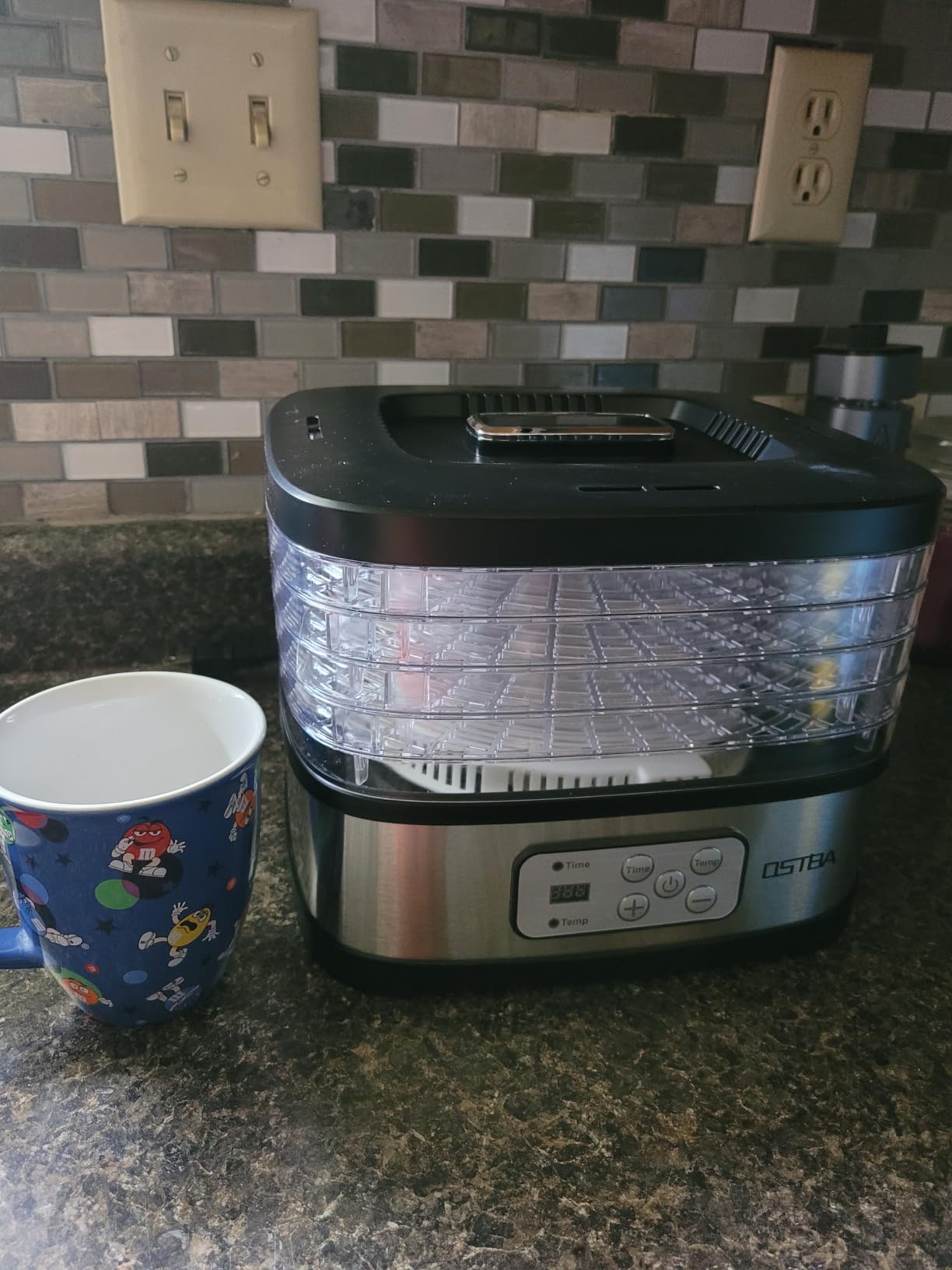
The 72-hour timer is the reason to look at this one. Long herb and vegetable cycles are exactly where a 48-hour limit becomes annoying, and the OSTBA gives you a full extra day of unattended running with automatic shutoff at the end of it.
The thermostat adjusts from 95°F to 158°F, so herbs and greens sit comfortably inside the range, and the 360-degree circulation airflow is designed to keep stacked trays drying at a similar rate. The 240W element is modest, so expect long cycles rather than quick ones, and the 24-month warranty is longer than most here.
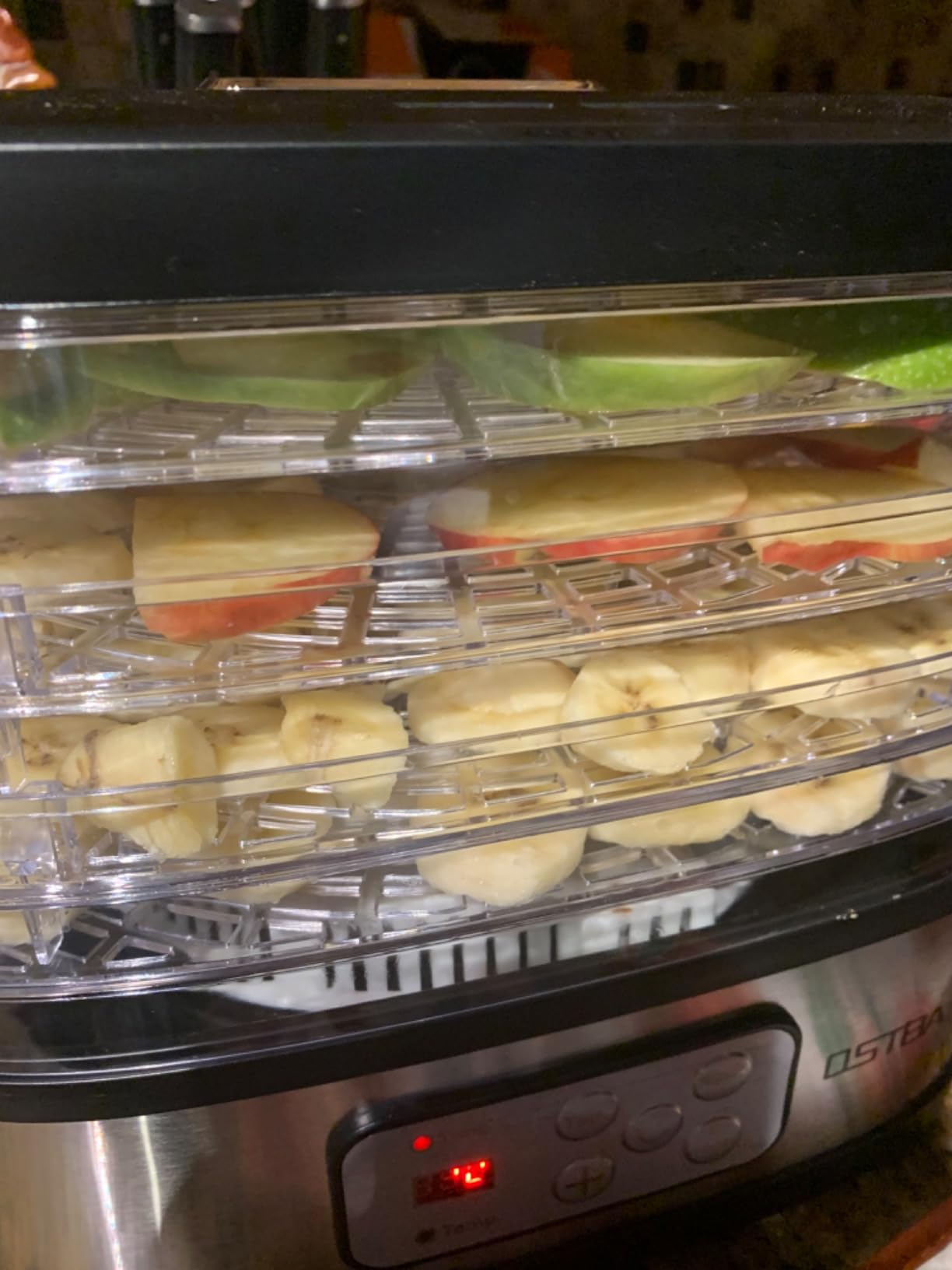
At 4.1 pounds and roughly ten inches square, this is one of the smallest units in the roundup, which makes it easy to keep in a cupboard between harvests. The see-through window means you can watch a tray of kale without opening the door and releasing the humidity you have been driving out.
Users on r/dehydratedfoodideas single this model out for consistent performance over repeated batches, and the reviews here back that up with a large body of feedback. The trays stack, detach and wash in a dishwasher, and stainless surfaces wipe down easily after a wet-green session.
Who this dehydrator suits
This suits anyone who wants to set a long cycle and walk away, whether that is a two-day herb run or a slow vegetable batch. The 72-hour window removes the anxiety of a cycle ending while the middle trays are still damp.
It is a good fit for small kitchens and for people drying in warm months when ambient humidity is high and cycles stretch. The compact body and the long timer together make unattended drying realistic.
Where it falls short
The 158°F ceiling rules out higher-temperature work, so a multi-purpose household that also wants jerky should look elsewhere. The 240W element also means a full tray of wet greens takes considerably longer than it would in a 600W box.
The touchscreen panel is responsive, but the recipe book times are generic. Treat them as a starting point and check the leaves yourself rather than trusting the printed hours.
7. Commercial CHEF CCD100W6 5-Tray Dehydrator
Commercial Chef Food Dehydrator, Five 9.25” BPA-Free Trays, CCD100W6, White
5 round 9.25 inch trays
104-158F adjustable thermostat
280W element
3.3 pound body
Pros
- Lightest and most compact body at 3.3 pounds
- Clear trays let you watch progress
- Instruction booklet includes a dehydration chart
- Five BPA-free trays in a small footprint
Cons
- 104F floor is too warm for the most delicate greens
- Dial thermostat is not precisely calibrated
- Clear plastic trays feel flimsy
- No built-in automatic shutoff on some units
This is the smallest and lightest machine here at 3.3 pounds, and for a specific situation that is the whole point. If you dry a few bunches of herbs at a time in a small kitchen, hauling out a fifteen-pound stainless cabinet for one tray of oregano is not a sensible trade.
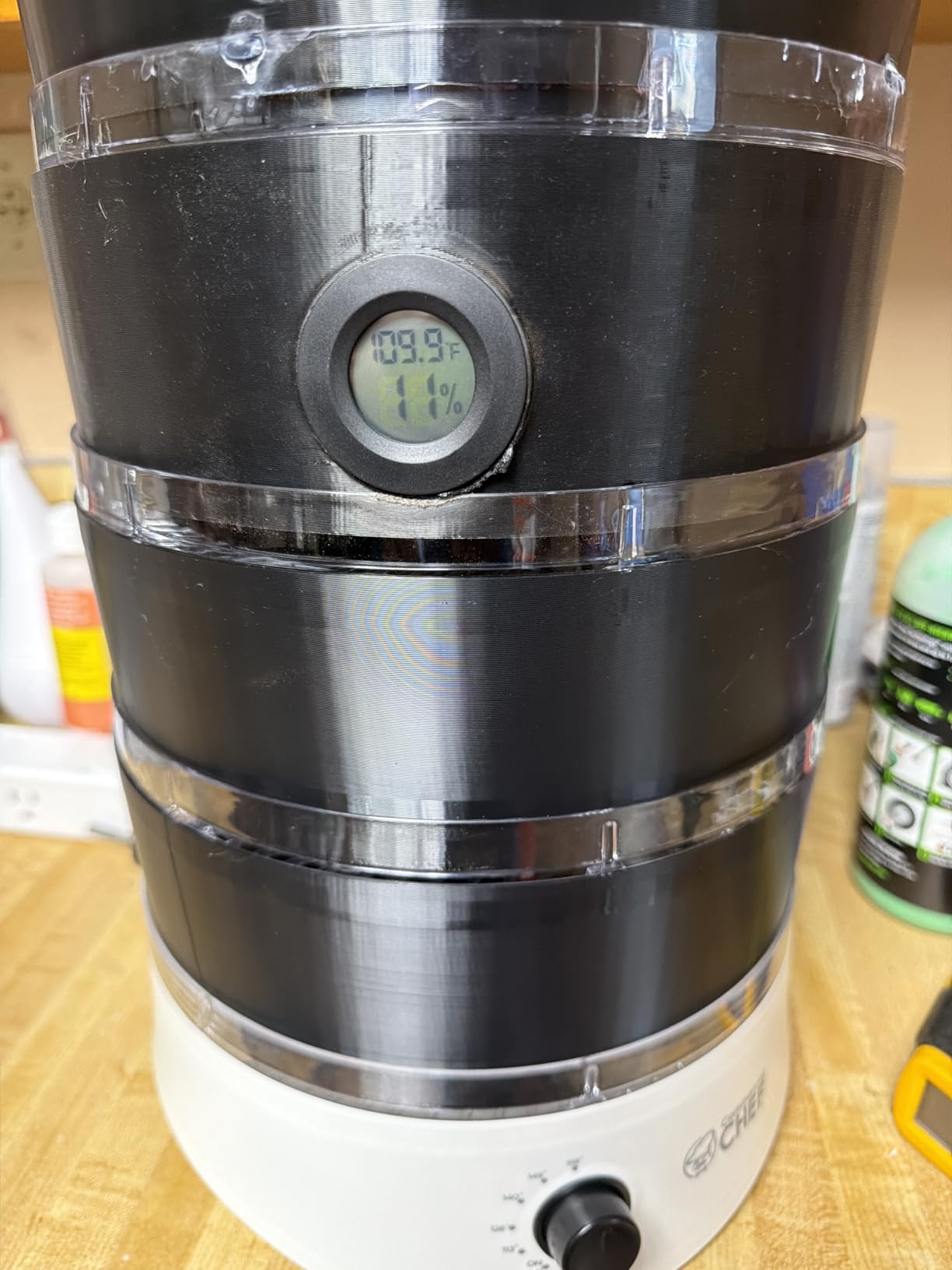
The round 9.25-inch trays are a different shape from the rectangular trays elsewhere, so plan your batches around a circular footprint. The adjustable thermostat runs 104°F to 158°F with a digital timer, and the instruction booklet includes a dehydration chart, which is a useful starting reference when you are learning.
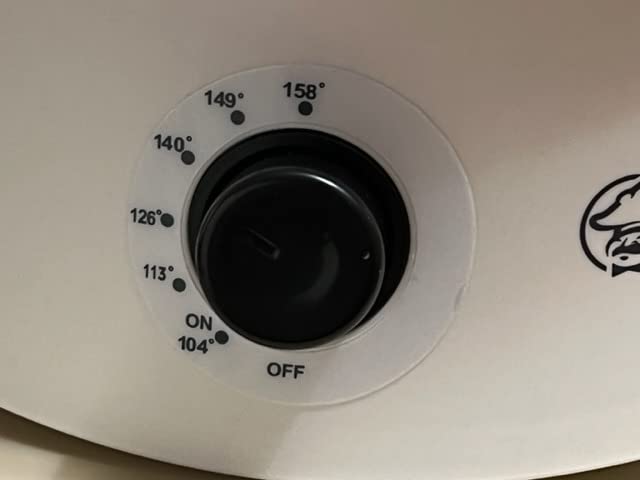
Clear trays let you monitor progress without opening the unit, which is genuinely helpful when you are watching for the moment leaves start to crumble rather than following a printed clock. Steady results for fruit, herbs and dog treats are what most owners report.
The 280W element is on the low side, so cycles are long and gentle. For herbs that works in your favor, since nothing is rushed, but a full load of wet greens will test your patience.
Who this dehydrator suits
This is the pick for a first, occasional batch. If you dry herbs a few weeks a year and want something you can pull from a high cupboard, the low weight and tiny footprint make it the least intrusive option in the roundup.
It also suits anyone testing whether dehydrating suits them at all. The results are reliable enough to build a habit around, and the included chart removes most of the guesswork from a first run.
Where it falls short
The 104°F floor is the honest problem. It sits above the 95°F to 115°F band that tender herbs and greens want, and combined with a dial thermostat that owners describe as imprecise, you have less control than any of the digital units here.
Several units also lack a built-in automatic shutoff, which means an external timer is a sensible accessory. Clear plastic trays feel flimsy and can crack, so treat them gently and replace them rather than pushing a warped tray back in.
8. Elite Gourmet EFD319DKG 5-Tray Dehydrator with Clear Trays
Elite Gourmet 5-Tray Food Dehydrator, BPA-Free 11.4″ Trays, Adjustable Temp
5 clear 11.4 inch trays
95-158F temperature dial
350W with bottom fan
Dishwasher-safe parts
Pros
- Very quiet operation for a 350W element
- Large review base of over 11000 ratings
- Transparent trays allow monitoring without opening
- Simple dial control and expandable tray stack
Cons
- No built-in timer or auto shutoff
- Brittle plastic trays that can crack
- Limited clearance between trays for thicker items
- Poor insulation means some users report a plastic taste
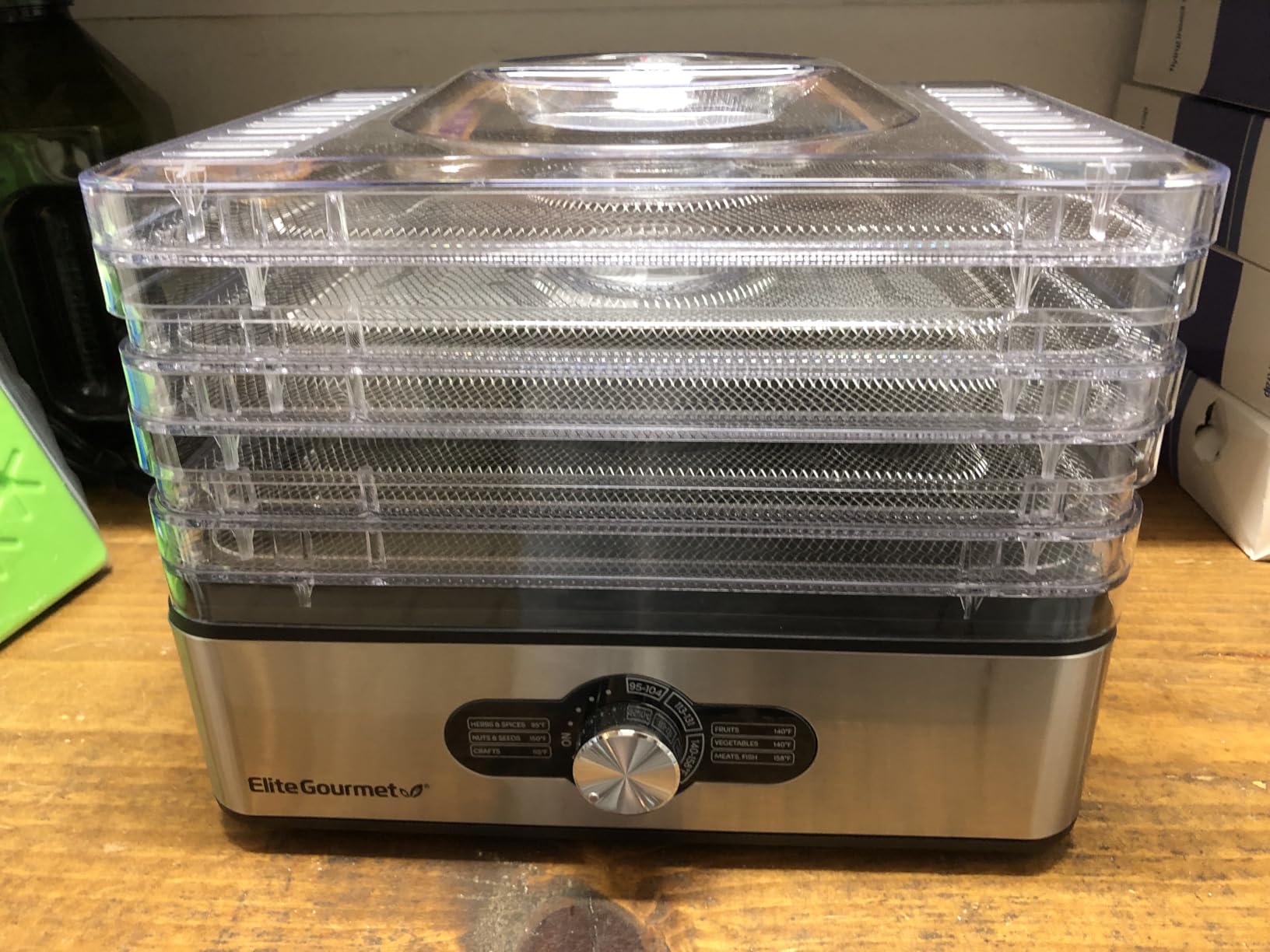
Quietness is the defining characteristic here. Owners describe this as quieter than a small laptop fan, and that matters for a machine that runs for six to ten hours on a herb batch. If your kitchen is next to a bedroom or you work from home, that ranking matters more than tray count.
The temperature dial adjusts from 95°F to 158°F, which covers the herb band properly, and a 350W element with a bottom-mounted fan distributes heat through the stack. The five 11.4-inch trays are larger in diameter than most here, so a good load of greens fits on a single shelf.
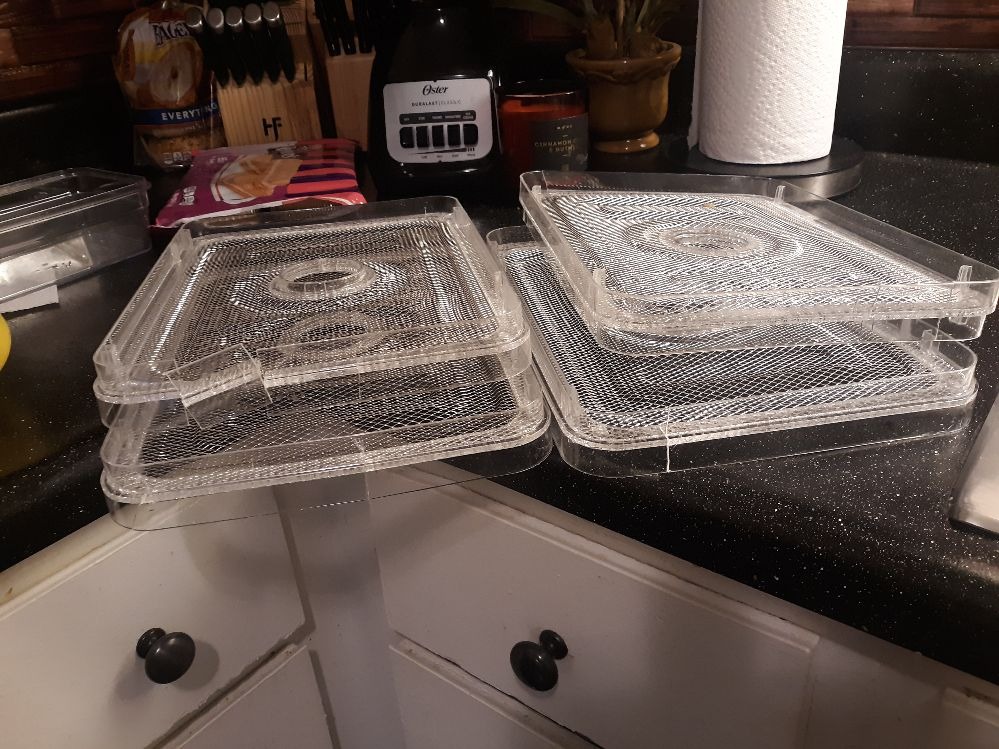
With more than eleven thousand ratings behind it, this is one of the most widely owned dehydrators in the category, and the consensus is consistent: it works well for fruit and herbs. The transparent trays are the feature owners mention most, because you can watch color change without opening the door.
Removable parts are dishwasher safe and hand washing is straightforward. At 4.6 pounds the unit is easy to reposition, and the stackable trays mean you can run a partial load on a weeknight instead of filling every shelf.
Who this dehydrator suits
This is the quiet option. If noise is the reason you have avoided owning a dehydrator, the bottom fan and modest 350W element are the combination that solves it, and the large tray diameter helps you finish batches in fewer runs.
It also suits anyone drying herbs mainly for flavor rather than bulk. The 95°F dial is fine for basil, thyme, oregano and mint, and a small load of greens can be run without a full stack.
Where it falls short
There is no built-in timer and no auto shutoff on this model. You will need an external timer, which adds a step to every run and is the single most common reason owners move on to a digital unit.
Clear plastic trays are brittle and can crack with repeated use, tray clearance is tight for thick items, and poor insulation means heat leaks out of the chamber. Some users report a faint plastic taste on early batches, and the blue light is only a power indicator, not a temperature readout.
9. HOPERAN 12-Tray Stainless Steel Dehydrator with Dual Rear Fans
HOPERAN 12 Tray Food Dehydrator Machine for Jerky, Fruit, Herb & Dog Treats
12 stainless steel trays
86-196F digital range
Dual rear fans, 360 degree airflow
Silicone mesh screens included
Pros
- Widest temperature range here with an 86F floor
- 12 removable 304 stainless steel trays
- Dual rear fans dry every tray without rotation
- Silicone mesh screens and fruit roll sheet included
- Two year manufacturer warranty
Cons
- Tallest and largest unit in the roundup
- 800W element raises running cost on long cycles
- 24 hour timer is shorter than most rivals
The 86°F floor is the number that sets this model apart for this article. Most dehydrators start at 95°F, which is fine for herbs, but the extra nine degrees of headroom is what you want for very tender greens and for flowers, and no other machine in this roundup goes lower.
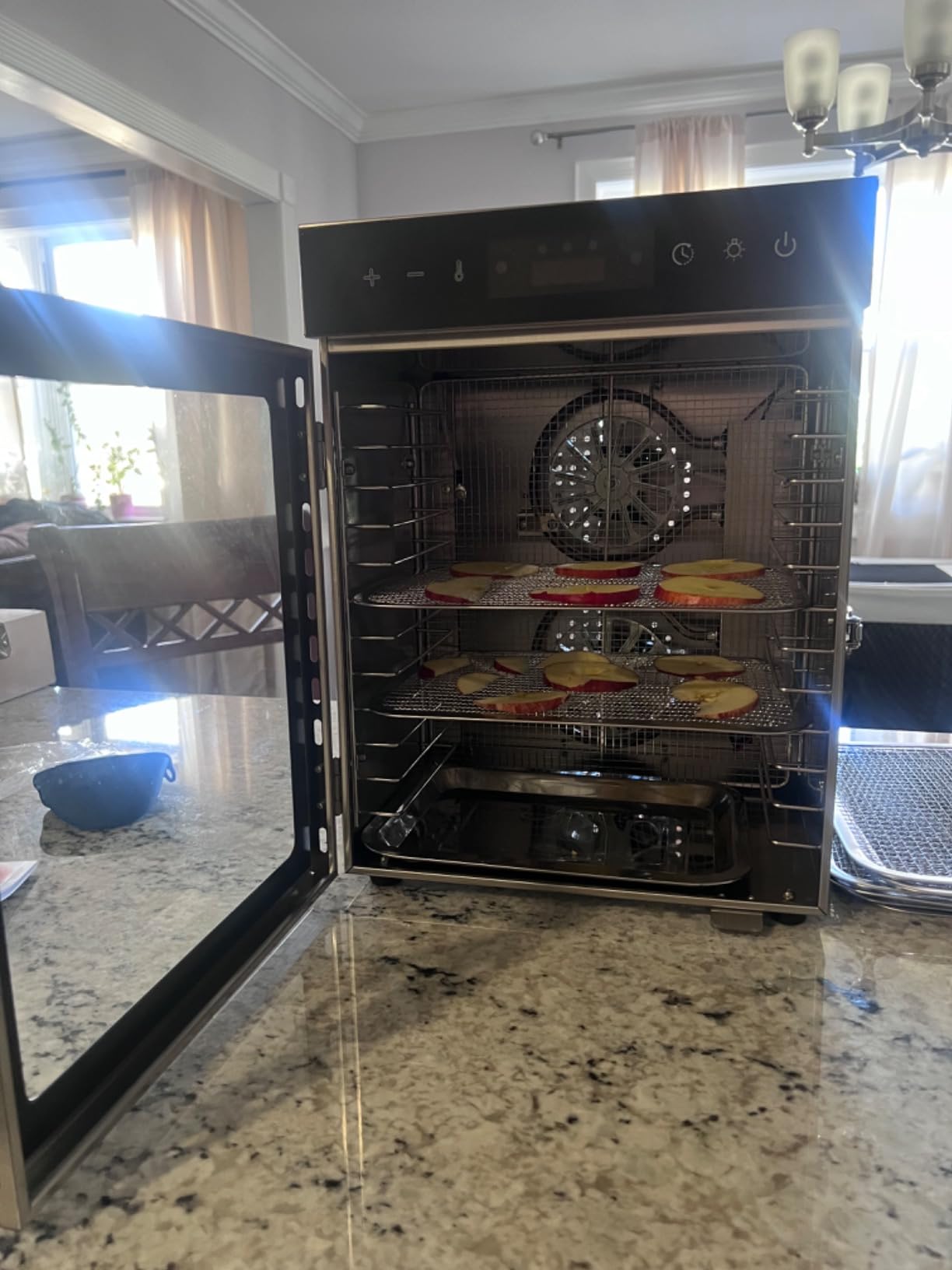
Twelve removable 304 stainless steel trays make it the largest by tray count, and the dual rear-fan system pushes air through the whole stack for 360-degree coverage without manual rotation. On r/dehydrating, the advice for large harvests is usually a mainstream box like this class of machine, and the capacity is why.
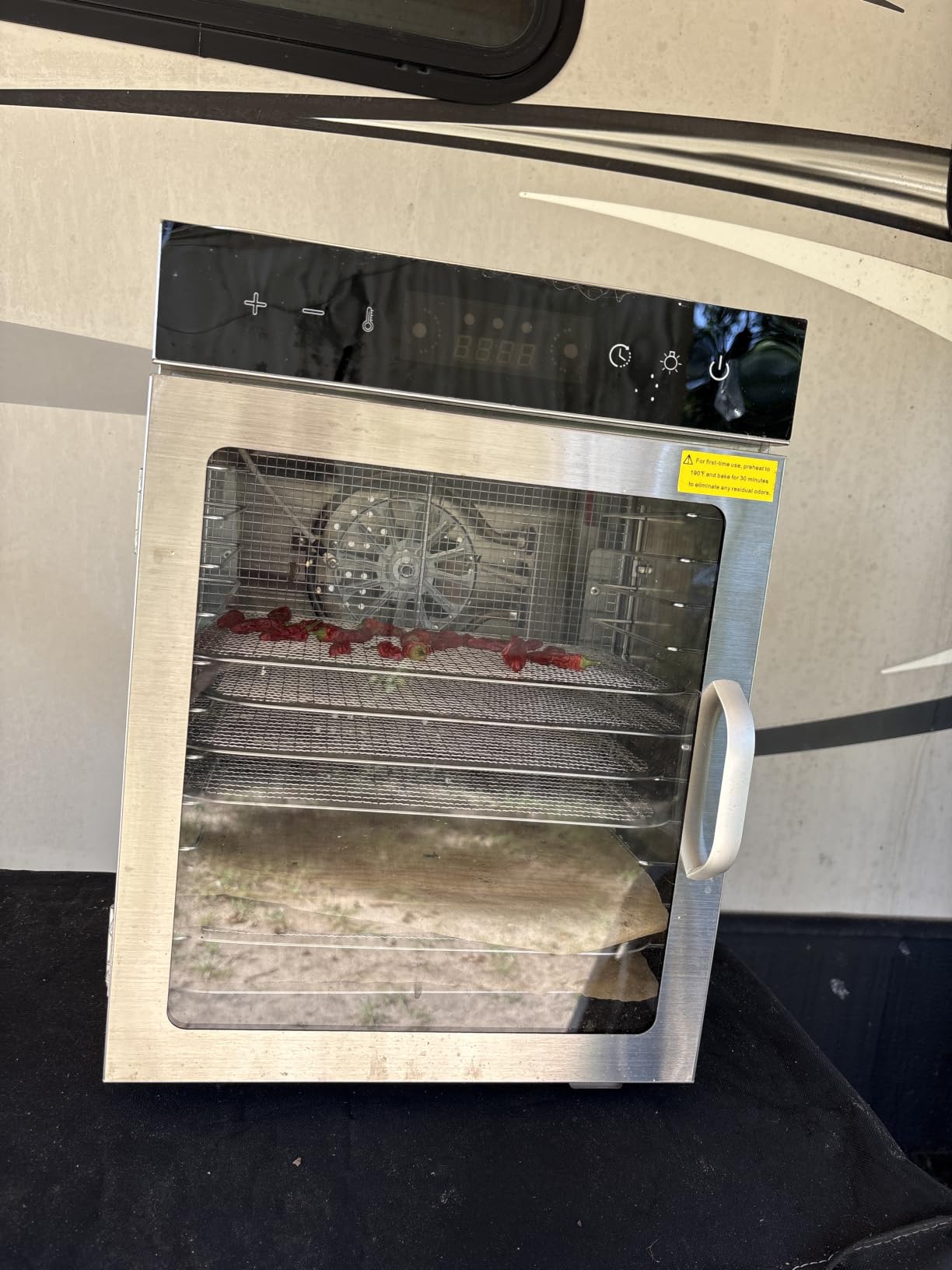
Two silicone mesh screens ship in the box alongside a fruit roll sheet and silicone gloves, so the herb setup is complete out of the carton. The clear glass viewing door lets you check a load without opening the chamber, and operation stays under 48 dB even with both fans running.
The stainless housing and dishwasher-safe trays handle wet greens without staining, and overheat protection is built in. The digital panel runs from 86°F to 196°F with a 24-hour programmable timer, so the range is the widest available and the runtime is the shortest of the group.
Who this dehydrator suits
This is the unit for a serious garden harvest or a small food-preservation project. Twelve trays of spinach is a real quantity of greens, and doing that in one load rather than four changes how often you have to be home while it runs.
It also suits anyone drying the full range of produce, since 196°F covers meat work and 86°F covers the gentlest greens. The glass door and included mesh screens make it a complete kit rather than a bare appliance.
Where it falls short
Size is the real constraint. At 16.1 inches tall it needs genuine counter or shelf space, and it is not a cabinet unit. Plan where it will live before buying, because moving it while loaded is awkward.
The 800W element is the highest here, which means long cycles draw real power, and the 24-hour timer is shorter than the 48-to-72-hour ranges on several cheaper models. It also has by far the smallest review base in this roundup at 327 ratings, so long-term ownership reports are thinner than the numbers elsewhere suggest.
10. Cosori P501 5-Tray Stainless Steel Dehydrator with 4 Presets
Cosori Food Dehydrator, 5 Stainless Steel Trays, 3.1 ft² Drying Space
5 stainless steel trays, 3.1 ft2
95-176F in 1 degree steps
4 presets plus manual control
Rear fan for even airflow
Pros
- 95-176F range covers delicate herbs through safe jerky temperatures
- All stainless trays with no plastic food contact
- Rear fan dries evenly with no tray rotation
- Four presets plus manual control
- Compact body that stores in a small kitchen
Cons
- Trays are small so batches per run are limited
- Included mesh screen and fruit roll sheet are plastic
- Dishwasher-safe trays
- Not compatible with 240V power
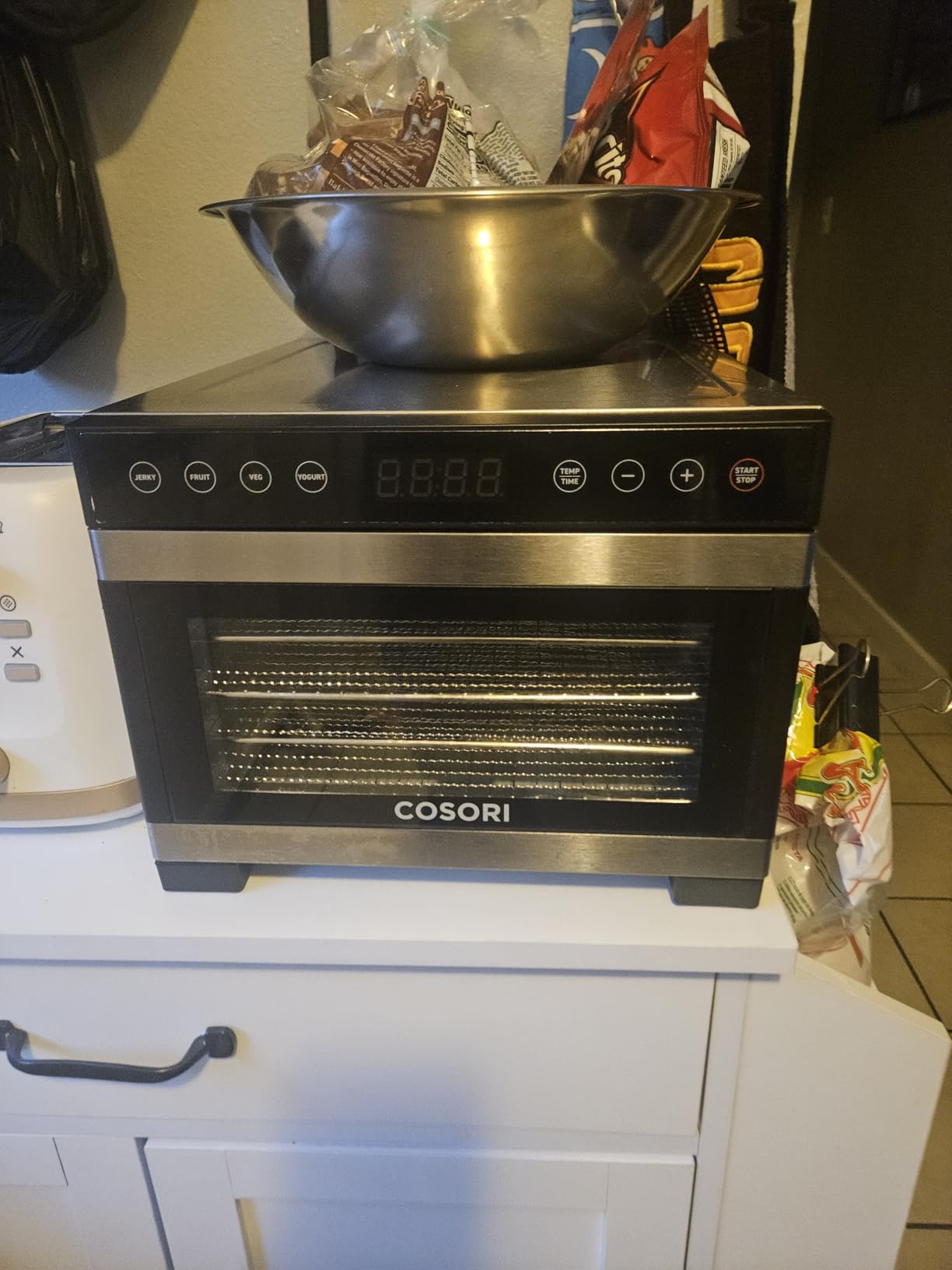
The P501 is the middle Cosori, and it fixes the one thing we would change about the compact stainless models: the temperature range runs to 176°F in single-degree steps. That means you can dry herbs at 95°F in the morning and safe jerky temperatures later on the same machine, with no compromise at either end.
Four presets for jerky, fruit, vegetables and yogurt take the guesswork out of a first run, and all of them are adjustable once you learn what your herbs need. Owners specifically call out herb use and small batches as the sweet spot for this machine, and at 4.6 stars the results back that up.
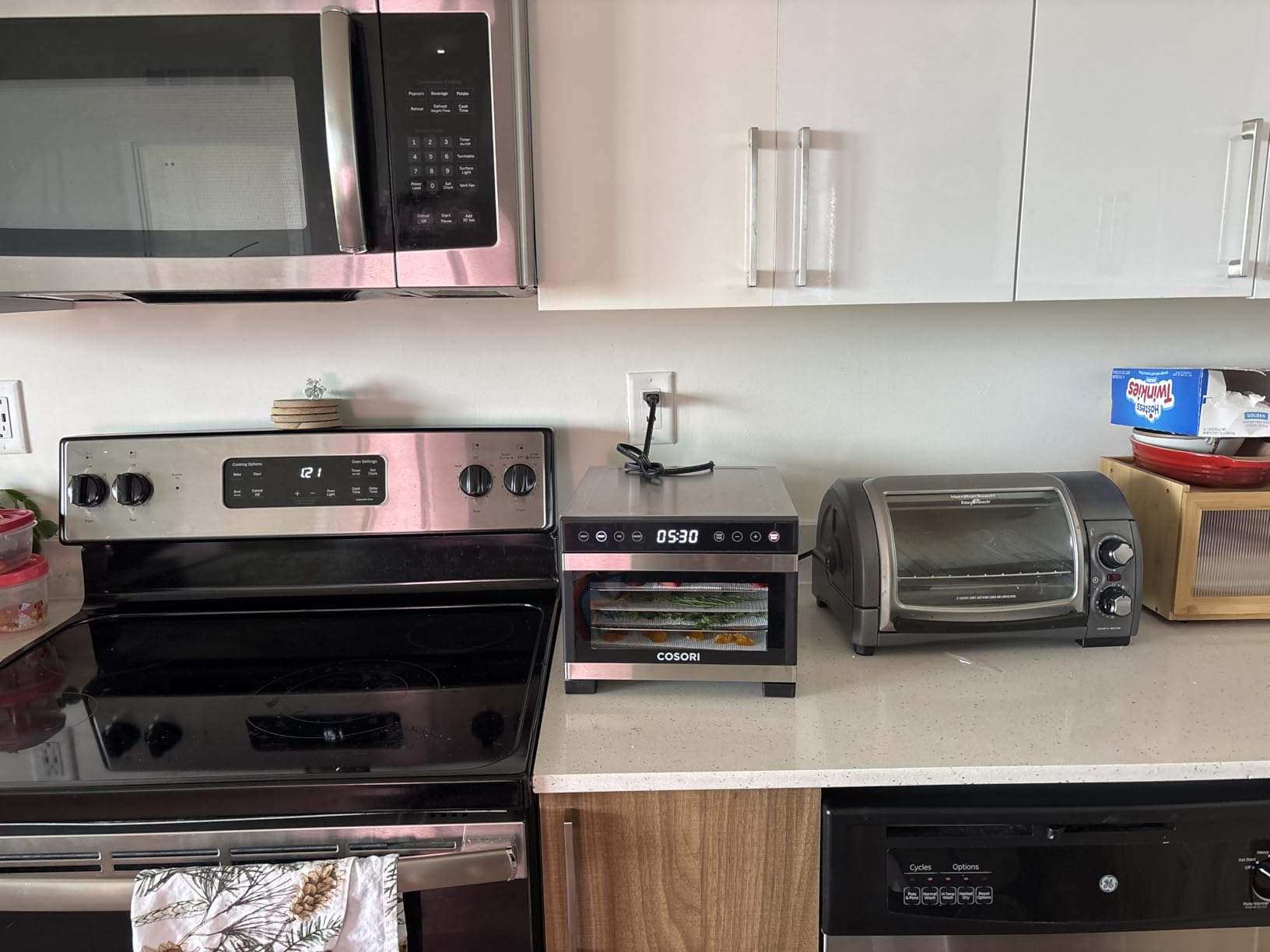
The rear fan gives even airflow through all trays, so you are not shuffling shelves at hour three. At 13.9 inches by 11.3 inches by 8.9 inches it is the most compact stainless option here, and the dishwasher-safe trays are a relief after a session with wet spinach or chard.
All five trays are stainless, so there is no plastic touching the food during drying. The included recipe book gives recommended times, temperatures and expected end textures, which is a genuinely useful starting point for anyone calibrating a new machine.
Who this dehydrator suits
This suits a small kitchen that still wants the full temperature range. It is short enough to live on a normal counter or a low shelf, and it covers everything from 95°F herb drying to 176°F high-heat work in one appliance.
It is also a good pick for someone drying a moderate weekly harvest rather than a bulk batch. The trade-off is tray size: 3.1 ft² total means smaller loads than the six- and seven-tray models, so you run more cycles.
Where it falls short
Small trays are the honest limitation here. If you are drying whole bunches of kale or chard, you will be running this machine several times in a session, and that offsets the space you saved on the counter.
The included mesh screen and fruit roll sheet are polypropylene plastic, which sits awkwardly with an otherwise all-metal selling point. Stainless also shows fingerprints quickly, and the unit is built for 120V only, so it will not run directly on 240V supply.
How to Dry Herbs and Greens Without Ruining Them
The machine matters, but technique decides whether a batch is good. A dehydrator removes moisture slowly with gentle, thermostatically controlled air, which is exactly the condition that preserves the volatile oils and chlorophyll in herbs. Push the temperature higher and you get faster drying at the cost of the aroma and color you were trying to keep.
Drying herbs: the eight-step method
Start at the harvest. Rinse herbs briefly in cold water to remove bugs and soil, then dry them thoroughly with a salad spinner or a towel. Residual surface water is the enemy of even drying, because it soaks into the leaves and extends the cycle.
Strip the leaves from the stems for tender herbs such as basil, mint and oregano, because a leaf on a stem dries from the outside in. Woody herbs like rosemary, thyme and sage can stay stem-on and hang or lay in a single layer, since the stem slows the moisture escape just enough to protect the leaf.
Load a single layer with no overlap. Overlapping leaves are the number one cause of clumping, and a clump dries unevenly: the center stays damp, traps moisture and eventually grows mold. If you have more than fits on one tray, run a second cycle rather than doubling up.
Set the temperature to 95°F to 115°F and start checking at two hours. Thin leaves such as thyme can finish in two to three hours; larger basil leaves run four to six. Rotate trays once at the halfway mark if your model has a bottom-mounted fan.
Test for doneness rather than trusting the clock. Take a leaf and crumble it between your fingers: it should snap and break apart cleanly, not bend or feel leathery. If it bends, give it another hour.
Cool the herbs completely before jarring them. Warm herbs packed into a jar release trapped moisture, and that is how a jar that looked perfect develops mold on the shelf a month later. This step is the one most often skipped and the one that matters most.
Drying leafy greens: the six-step method
Greens are wetter and bulkier than herbs, so they need a different plan. Skip the blender and the oven entirely: a dehydrator at low temperature keeps the color, and blending greens for storage is better done after drying into a powder with one of our tested food processors.
Wash the greens in a sink or a bowl of cool water rather than under a running tap, lift them out, and dry them completely. Every drop of surface water you remove now is an hour you do not spend on the clock later.
Blanching is optional. A short blanch softens the leaf tissue and shortens drying time, but it also darkens the color. If you want vivid green powder, skip it and accept a longer cycle; if you want the fastest route to dry, blanch briefly and drain well.
Spread a single layer with the leaves torn rather than folded. Torn edges expose more surface area and dry faster than a whole folded leaf, and they clump far less on the tray.
Run at 95°F to 115°F and expect three to six hours depending on how thick the pieces are. Rotate trays at the halfway mark on bottom-fan models, and check the ones closest to the heater first because they finish earliest.
Test the same way as herbs: a piece should snap rather than bend, and it should feel brittle along the rib. Let everything cool flat on a tray before blending or jarring.
Mesh trays versus solid trays
Mesh screens exist for small leaves. If you are drying chive tips, oregano, thyme or any leaf that could fall through a slot, a mesh insert is not optional. Only four of the ten units here include one, so check the box before you order.
Solid trays are the right surface for greens, fruit leather and anything you cut into pieces. They are easier to clean after a wet-green session and they hold leaves flat instead of letting them curl and shrink into the screen.
The Magic Mill Pro and HOPERAN both ship with mesh screens, and the Hamilton Beach and Cosori 6-tray include one as well. The other six units are solid-tray machines, which is fine for greens but means buying a screen separately if you plan on fine herbs.
Storing what you dried
Store herbs in airtight glass jars in a dark cupboard away from the stove, and label each jar with the herb and the month you packed it. For greens destined to become powder, blend them dry and keep the powder in smaller jars so you open them less often.
A piece of bread or a food-safe moisture absorber tossed in the jar helps in humid climates, where residual moisture is the main threat to a dried harvest. Check the jars once a month and move anything that feels soft back into the dehydrator for an hour.
If you want the flavor without a dehydrator at all, a mesh hanging rack in a dry, breezy room genuinely works for herbs in low-humidity conditions. In humid climates, people in the dehydrating Facebook groups report herbs molding on racks long before they dry, which is the moment to reach for a heated unit with a fan.
What Matters Most When Buying a Dehydrator for Herbs and Greens
If you remember one spec, remember the minimum temperature. The best food dehydrators for herbs and greens all reach 95°F, and the only one in this roundup that goes lower is the HOPERAN at 86°F. Anything starting at 104°F or above, like the Commercial CHEF, is working with less headroom than delicate greens want.
This is the point that forum users make most often. On r/preppers, the recurring argument is that the low end of the range is the hero spec for herbs, because heat drives off volatile oils and dulls the aroma. A machine that runs hot and holds steady is worse for herbs than one that runs cool and varies slightly.
Temperature floor and range
Aim for a 95°F floor and a top end that does not matter much if herbs are your focus. All ten units here land between 95°F and 104°F at the bottom. The spread at the top is wider, from 158°F on the OSTBA and Elite Gourmet to 196°F on the HOPERAN, which only matters if you also make jerky.
Digital controls beat dials for herbs. The Elite Gourmet and Commercial CHEF use mechanical dials that owners describe as imprecise, while the eight digital units hold a set temperature within a degree or two. For a six-hour basil cycle that difference compounds.
Fan placement decides whether you rotate trays
Rear fan with rear heat sends air through the entire stack in a loop, so every tray dries at a similar rate. Bottom-fan designs blast upward and warm air rises, which makes the top tray finish first and the bottom tray last.
On bottom-fan models you should swap tray positions at the halfway mark. That is why we picked the Cosori 6-tray, the Magic Mill Pro, the HOPERAN and the Cosori P501 as strong all-rounders: their airflow design removes a step that other machines make you do at midnight.
Wattage and runtime
Wattage decides how long a batch takes, not how well it dries. The two 240W units here, the Magic Mill MFD-5000 and the OSTBA, run long cycles, which for herbs is a mild advantage because low and slow protects color.
Here is the arithmetic. The 350W Elite Gourmet and the 500W Hamilton Beach are sensible middle points for a household, the 600W Cosori 6-tray and Magic Mill Pro move a large batch fastest, and the 800W HOPERAN is the most power-hungry unit in the roundup. Multiply the wattage by your hours of use and your local rate to get a per-batch figure, then compare that against how often you actually run it.
For most households, a six-hour herb cycle a couple of times a week costs less than a cup of coffee. That is the argument for buying a better machine only when you are drying in bulk.
Capacity, trays and batch size
Count usable tray area rather than tray number, since shapes differ. The Cosori 6-tray gives 6.5 ft², the Magic Mill Pro gives seven full-size trays, the Cosori P501 gives 3.1 ft² and the Hamilton Beach gives 4.2 sq ft. Circle trays like the Commercial CHEF hold less than their count suggests.
A useful rule from the forums: if you dry four to six trays of basil a week, buy for six. If you dry a bunch of parsley in August and nothing else, any of the five-tray units will serve you for years.
Timer, noise and cleaning
An automatic shutoff matters because it lets you leave a cycle overnight. The OSTBA’s 72-hour timer is the longest available, the Cosori units run to 48 hours, and the Elite Gourmet and Commercial CHEF have no built-in shutoff at all, which means an external timer.
Noise is a quality-of-life issue, not a spec sheet issue. The Cosori units measure under 47 and 48 dB, the HOPERAN runs under 48 dB, and the Hamilton Beach is compared to a box fan. If your kitchen adjoins a bedroom, the quieter units are worth paying for.
Finally, plan on washing trays. Greens leave residue, and trays that are dishwasher safe or fully removable will save you every week. Stainless trays outlast plastic ones, and the plastic trays in this roundup are the most common complaint about long-term durability.
Frequently Asked Questions
Can you use a food dehydrator for herbs?
Yes, and a dehydrator is better than an oven for herbs. Gentle thermostatically controlled air at 95-115F removes moisture without the oven heat that scorches leaves and drives off volatile oils. Wash and dry the herbs thoroughly, strip leaves from tender stems, load one layer with no overlap, and test for doneness by crumbling a leaf until it snaps.
Is a food dehydrator good for drying herbs?
A good food dehydrator is one that reaches 95F and holds it. The minimum temperature matters more than any other spec, because herbs are small, low in water and quick to scorch above 115F. Look for digital degree-level control, a rear-mounted fan so you do not rotate trays, and a mesh screen if you are drying small leaves such as chives or oregano.
What is the best dehydrator for herbs and vegetables?
For herbs and vegetables together, the Cosori 6-Tray Stainless Steel model is the strongest all-round pick, with 6.5 ft2 of tray space, 95-165F digital control and a rear fan. If your batch is a large garden harvest, the Magic Mill Pro with 7 full-size stainless trays and mesh screens handles more volume per run, while the HOPERAN reaches the lowest temperature at 86F.
What herbs are best for dehydrating?
Tender leafy herbs such as basil, mint, oregano, marjoram and tarragon dry well and keep their color at 95-115F, usually in two to four hours. Woody herbs including rosemary, thyme, sage and savory can be dried stem-on at slightly higher temperatures. Chives dry quickly on a mesh screen, while delicate herbs such as chervil need the lowest temperature your machine offers.
Can I put different herbs in the dehydrator at the same time?
Yes, as long as the herbs share a similar thickness and moisture level. Group quick herbs like thyme and oregano separately from slower basil or sage, or move the slow batch to lower trays where it finishes first. Avoid mixing strong herbs such as mint with delicate ones such as chervil, since flavors transfer through the shared airflow.
How long does it take to dry herbs in a dehydrator?
At 95-115F, thin herbs such as thyme, oregano and chives finish in two to three hours, while basil, mint and tarragon take four to six. Leafy greens run three to six hours depending on thickness and whether you blanch first. A low-wattage unit such as a 240W model will take longer than a 600W machine on the same load.
Is a food dehydrator better than drying herbs in the sun?
An electric dehydrator gives you temperature control, which sun drying does not. People in humid climates report herbs molding on racks and screens long before they dry, and direct sun can scorch delicate leaves. Air drying on a mesh hanging rack is still the sensible free option for a single bunch in dry, breezy weather, and for a steady weekly harvest a heated unit is the reliable choice.
Our Final Verdict on the Best Food Dehydrators for Herbs and Greens
After working through all ten, the Cosori 6-Tray Stainless Steel dehydrator is the one we would buy. Its 95°F floor in single-degree steps, 6.5 ft² of tray space and rear fan cover everything this topic demands, and its quiet motor means long herb cycles do not disturb the house.
Buy the Cosori 5-Tray BPA-Free model instead if counter space is tight or you want adjustable tray height for thick greens, the Hamilton Beach 32100A if you want a mesh herb screen in the box at a modest spend, and the Magic Mill Pro if a full garden harvest is the plan. Whichever you choose, buy for the 95°F floor, load one layer at a time, and cool everything fully before it goes into a jar.
Drying your own herbs and greens is the cheapest way to keep a season of flavor in the cupboard, and the machine you already own may handle more than you think. If you use it for meat or fruit too, our guide to the best food dehydrators for jerky and dried fruit covers the higher-temperature side, and airtight storage containers for the finished jars are covered in our large airtight storage container picks.