
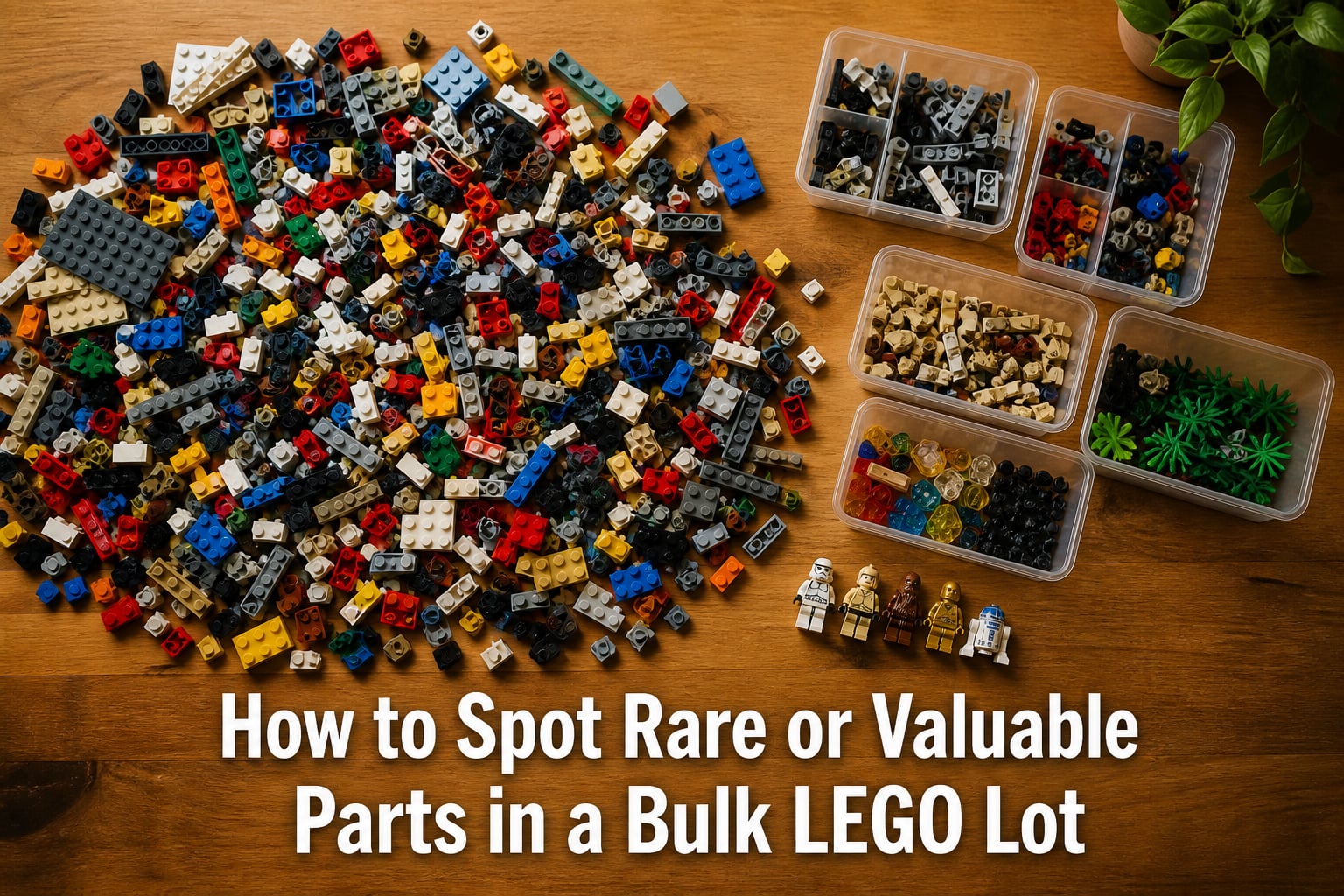
Buying a bulk LEGO lot feels like cracking open a pirate’s chest. Some are full of costume jewelry and rusted doubloons. Others hide a single gold coin worth ten times what you paid. I have spent more weekends than I would like to admit hunched over storage bins sorting through tens of thousands of loose bricks, and I can tell you the difference between a jackpot and a junk drawer almost always comes down to what you know before you buy and how you sort what you bring home.
This guide on how to spot rare or valuable parts in a bulk LEGO lot comes from those hours at the sorting table. I will walk you through the same checklist I use: pricing the lot, sorting by element rather than color, identifying minifigures, reading mold stamps, pricing on BrickLink, and avoiding the usual traps like Mega Bloks and yellowed pieces. Whether you want to resell, complete old sets, or just feed a building habit for less, these are the rules I follow.
Table of Contents
What Makes a Bulk LEGO Lot Worth Digging Through?
A “bulk LEGO lot” is a mixed bag of loose bricks sold by weight, by the box, or by the tote. Sellers post them on Facebook Marketplace, Craigslist, eBay, estate sale apps, and yard sale groups. Some lots are pure random pieces from a single owner. Others contain partial sets, retired inventory, and the occasional sealed surprise. The variation is enormous.
The hobbyists who consistently find value share one trait: they treat each lot like a tiny archaeology dig. They scan before they buy, they sort by element after, and they price with BrickLink instead of guessing. I have watched friends pull Star Wars UCS instruction books and original theme park minifigures from piles that looked like nothing at first glance.
The honest truth is that most bulk lots pay back less than minimum wage once you factor in sorting time. But the goal is rarely pure profit. Builders I know are looking to feed MOCs (My Own Creations) on a budget, complete long-discontinued sets, or stock a parts library for their kids. If you know how to spot rare or valuable parts in a bulk LEGO lot, even a “bad” lot often contains a few pieces worth more than the entire purchase price.
How to Value a Bulk LEGO Lot Before You Buy
The first decision is the easiest one: should you buy this lot at all? I use a quick pre-purchase checklist every time, and I never skip it. A lot that looks exciting in a Facebook photo can turn into a 40-pound regret the moment it lands in your garage.
Use the Price-Per-Pound Standard
The hobby has settled on price-per-pound as its primary valuation metric. In 2026, a clean random bulk lot generally runs between $8 and $12 per pound. Lots full of recognizable themes, original instructions, or visible minifigures can climb above that range. Anything priced under $5 per pound should make you suspicious about non-LEGO content or heavy yellowing.
When I see a 25-pound lot listed at $40, my brain does not think “deal.” It thinks “what is missing from the photo?” Sellers leave heavy elements, bags of common 2×4 bricks, and dirt out of the picture. They also sometimes forget to mention the non-LEGO bricks that came home in the same bin.
Look for Visible Treasure Before You Commit
Photos are your friend if you read them right. Scan for:
Minifigures with intact faces and accessories (these add up fast)
Original LEGO instruction booklets, even partial ones
Hard-to-find colors like dark turquoise, sand blue, or reddish brown
Translucent elements, especially windscreens and jewel pieces
Original boxes or sealed polybags
If you cannot see anything of value in the listing photos, ask the seller for three or four more angles. A seller who refuses is a red flag. A seller who sends extra photos usually knows they have something worth showing.
Calculate the Dead Weight
Every bulk lot contains filler. Common 2×4 bricks, basic plates, and 1×1 rounds are sold in such huge quantities that they are nearly worthless per piece. I subtract roughly 30 percent of any lot’s weight as “dead weight” before I estimate value. A 20-pound lot has about 14 pounds of searchable material in real terms.
This math keeps you from overpaying. Sellers who insist every pound is gold are either inexperienced or trying to move a bad lot quickly.
What Rare or Valuable Parts to Look For in a Bulk LEGO Lot
Once the lot is yours, the real work begins. Knowing how to spot rare or valuable parts in a bulk LEGO lot is mostly about training your eye for the categories that pay. Here are the five that consistently deliver.
Minifigures
Minifigures are the single highest-value category in any bulk lot. A single licensed theme minifigure can sell for $20 to $300 on BrickLink, and sealed sets of collectible minifigures go much higher. In a 30-pound random lot, even finding two or three nice figures can cover the entire purchase price.
Look for unique face prints, printed torsos, hairpieces in unusual colors, and accessories that do not belong to common City or Star Wars sets. Star Wars, Marvel, Harry Potter, and licensed collectible minifigures tend to carry the highest value. Castle, Town, and Pirates figs from the 1990s are also worth pulling.
Printed Pieces
Printed LEGO elements cost the company more to produce, so the secondary market values them higher. Examples include printed 1×2 tiles with road signs, decorated slopes with vehicle details, printed minifigure torsos, and unique patterned bricks. A single printed tile can sell for $2 to $15, while common unprinted versions of the same piece sell for cents.
Scan every slope, tile, and plate for ink. Even faded prints are usually worth more than the unprinted equivalent.
Translucent Elements
Translucent LEGO in clear, blue, red, green, yellow, and smoke colors is consistently valuable. Windscreens, canopies, jewel pieces, and specialty shapes are hard to source new and sell briskly on BrickLink. A single transparent cockpit canopy can be worth $5 to $40 depending on the part number.
These pieces are also the easiest to miss in a pile because they blend together visually. Set them aside in a separate tray as soon as you see them.
Rare Colors
LEGO has produced thousands of colors, but only a small fraction are common in any given year. Rare colors like dark turquoise, sand blue, sand green, olive green, dark purple, and medium blue from older eras command premiums. Many of these were only used in a handful of sets before being retired.
Sort by color once you have done a first pass by element. The colors that jump out as “different” are usually your most valuable pieces.
Vintage and Retired Parts
Parts that have not been manufactured for years are gold. Classic train parts, vintage boat hulls, old roof slopes, and Technic elements from discontinued lines often sell for surprising amounts. Any part with a design that looks “older” or chunkier than modern pieces is worth a quick BrickLink check.
The same is true for original LEGO baseplates. A 32×32 gray baseplate from the 1980s is worth significantly more than a current production piece.
How to Sort a Bulk LEGO Lot Step by Step
The method matters as much as the eye. I have tried sorting by color, by size, by theme, and by part. After hundreds of hours, the only approach that consistently works is element-based sorting: group identical parts together regardless of color.
Step 1: Pull Out the Trash and Non-LEGO First
Before you sort anything, remove non-LEGO elements. In an average lot, expect 10 to 20 percent of the volume to be Mega Bloks, K’NEX, Hot Wheels cars, loose Lincoln Logs, or damaged pieces. Set these aside in a “discard” bin. Once the LEGO is clean, your actual volume drops fast, and so does the overwhelm.
Non-LEGO pieces are easy to spot once you train your eye. Mega Bloks have wider studs, hollow backs on most bricks, and often visible mold seams. Knockoff brands also tend to feel lighter or have slightly off-color shades.
Step 2: Sort by Element, Not by Color
Sorting by color is the slowest and least useful method. You end up with a thousand red pieces and still have no idea what you own. Instead, group identical elements first.
I use small sorting trays or muffin tins, one slot per unique element. Lay out the most common pieces first: 2×4 bricks, 2×2 plates, 1×1 rounds. Once those are grouped, you can see how much of your lot is genuinely valuable versus basic filler.
Step 3: Set Aside Minifigures, Printed Pieces, and Translucents
These three categories deserve their own trays because they are highest value and easiest to damage. Sorting them out early protects them and speeds up your BrickLink lookup later.
Step 4: Identify Partial Sets
Once your pieces are sorted, look for clusters that suggest a specific set. A handful of unique pieces in matching colors plus a recognizable instruction booklet is a strong signal. Use the booklet to identify the set, then check BrickLink for which parts you are missing.
Step 5: Deal with the Leftovers
What remains after you pull out minifigs, partial sets, and high-value elements is “true bulk.” Common bricks, basic plates, and standard Technic pins. This material is the inventory of your future MOCs. Bag it by color and store in airtight bins for later use.
The 5/2 LEGO Rule Explained
The 5/2 rule is one of the most commonly asked questions in the LEGO investing community. Here is the direct answer: the 5/2 rule states that a LEGO set generally needs to appreciate by at least 5 percent per year (or 2 percent when adjusted for inflation) for at least two years after retirement to be considered a worthwhile investment.
The rule comes from tracking the resale performance of thousands of retired sets on secondary markets. Sets that hit this threshold tend to continue appreciating. Sets that flatline for two years after retirement usually do not recover.
For bulk lot hunters, the rule has a practical application. When you find a partial set in a lot, look up its retirement date on BrickLink. If the set has been retired for less than two years and shows no price movement, treat it as building material rather than an investment. If it has been retired for several years and prices are climbing, you may be holding something worth keeping sealed or selling intact.
The 5/2 rule is a guideline, not a guarantee. A handful of sets appreciate much faster, especially UCS Star Wars, Modular Buildings, and licensed themes. Many sets appreciate more slowly or not at all. Use the rule to filter out the obvious non-performers.
How to Identify Minifigures by Theme, Year, and Value
Minifigure identification is its own skill, and it is the one that pays the most per minute spent. With practice you can identify a fig’s theme, era, and rough value in under a minute.
Read the Face and Torso Print
The face print is the single most useful identifier. Star Wars figs have distinctive character faces. Harry Potter figs show wizarding details. Pirates and Castle figs from the 1990s have unique facial hair and eye designs. Even generic Town figs often have printed smiles or glasses that can be dated within a few years.
The torso print is the next best clue. A printed torso with a logo, badge, or pattern usually narrows the figure to a specific sub-theme and time period.
Check the Flesh Tone
Original LEGO flesh tone (often called “light nougat” today, but historically “flesh” or “peach”) was the standard for decades. Flesh tone figures tend to be older, often more valuable, and sometimes discontinued. Yellow minifigures are usually newer and common. Some themes like Pirates, Castle, and Western used yellow skin intentionally.
Identify Accessories
Accessories date figures almost as well as faces do. A printed sword with a unique hilt, a specialized hairpiece, or a tool that does not appear in modern sets usually places a figure in a specific era. Keep accessories with the figure. Selling a fig without its primary accessory often drops the value by half or more.
Look Up the Combination
Once you have a rough idea of theme and year, search BrickLink’s minifigure catalog. The site lets you browse by year, theme, and individual figure. Cross-referencing face, torso, and accessories will identify the figure in seconds. From there you can check the current average selling price and decide whether to sell, keep, or trade.
How to Date LEGO Parts Using Mold Stamps and Part Numbers
One of the most overlooked skills in bulk lot sorting is reading mold stamps. Almost every LEGO element has a small imprint on the inside or underside that includes the year it was made (or at least the year the mold was last updated). Once you know how to read these, you can date individual pieces without any external reference.
Where to Find the Stamp
On bricks, look at the underside of the studs. On plates, flip them over and look at the smooth back. On slopes and specialty pieces, check the bottom or the inside curve. Most LEGO elements have a copyright symbol followed by a year, often two digits (for example, “06” for 2006) and sometimes four digits.
What the Numbers Mean
The year on a mold stamp usually corresponds to the year the mold was created or last revised, not the year the piece was manufactured. A piece stamped “98” was made on a mold from 1998 but could have been produced last year. This makes mold stamps a rough dating tool rather than a precise one, but they are excellent for distinguishing pre-2000 vintage from modern pieces.
Parts with no stamp at all are unusual. They tend to be very early elements from the 1970s or specialty pieces made on legacy tooling. Treat unstamped parts as potentially vintage and worth checking.
Use the Part Number as Backup
LEGO’s part numbering system is more reliable than mold stamps for dating. Each element has a four- to six-digit design number. Newer numbers tend to be higher, and numbers below 3000 are usually associated with classic parts. Combine the part number with a BrickLink search and you can usually pin down when a part entered production.
Together, mold stamps and part numbers give you a strong picture of a piece’s era without needing an instruction booklet.
How to Use BrickLink and Pricing Databases
BrickLink is the gold standard for LEGO pricing. Run by the LEGO community for over two decades, it catalogs every official element, set, minifigure, and instruction booklet, with current and historical sales data. If you only learn one tool for bulk lot valuation, learn BrickLink.
Set Up a Free Account
Create a free account at bricklink.com. You do not need to buy or sell to use the catalog and price guide features. The price guide shows the average price the part has sold for over the last six months, broken down by condition (new, used) and color.
Search by Element or Color
The catalog lets you search for a part by element ID, name, or category. Once you find the part, choose the color you have in hand, then open the price guide. The “Current Average” line tells you what the part typically sells for. The “Last 6 Months Sales” list shows what real buyers have actually paid.
I treat the six-month average as my baseline. If a part has only sold once or twice in that window, the price is unreliable. If it sells consistently, you have a real number.
Check Minifigures and Sets Separately
Minifigures have their own catalog with face, torso, and accessory breakdowns. Use it whenever you find a fig you cannot immediately identify. Sets are searchable by number, name, or year, and the price guide shows retirement date plus recent sales.
For instruction booklets, the “Original Instructions” section is invaluable. Original instructions from retired sets often sell for $5 to $50 depending on the set. Even partial booklets have a market.
Track Your Lots Over Time
Once you have priced everything, log it in a spreadsheet. After a few months you will know which categories pay back and which do not. This data is what turns bulk lot hunting from a hobby into a consistent sourcing channel.
Red Flags: Non-LEGO, Mega Bloks, and Other Knockoffs
Knowing how to spot rare or valuable parts in a bulk LEGO lot also means knowing what is not LEGO at all. Knockoff brands and damaged pieces can quietly eat into your returns if you do not catch them early.
Mega Bloks and Other Clones
Mega Bloks is the most common imposter. Its bricks have wider studs (about 8mm versus LEGO’s standard 4.8mm), so Mega Bloks pieces will not actually stack properly on LEGO bricks. They often have visible mold seams, hollow interiors, and slightly softer plastic. The “M” logo or Mega Bloks wordmark usually appears on the underside.
Other knockoffs include Best-Lock, COBI (though COBI makes some licensed military sets that are their own brand), Coko, and various unbranded Chinese bricks sold in bulk bags. These are usually lighter in weight and feel “waxy” compared to genuine LEGO.
Yellowed Pieces
LEGO pieces yellow significantly when exposed to UV light and air. Yellowed white or light gray pieces can lose 70 to 90 percent of their value because they no longer match current LEGO colors. There are retrobrighting treatments involving hydrogen peroxide that can reverse yellowing, but they are time-consuming and not always successful.
If a lot is heavily yellowed, expect to be paid yellowed prices. Factor that into your purchase decision.
Damaged, Chewed, or Missing Pieces
Pieces with teeth marks, cracks, or missing clips drop dramatically in value. A chewed minifigure head is essentially worthless. Cracked Technic pins, broken clips, and chipped transparent pieces are also nearly unsellable.
Sort out damaged pieces early. Trying to “save” them by including them in otherwise good orders will tank your seller reputation on BrickLink.
Seller Behavior Red Flags
Some sellers mix knockoffs knowingly. Others are inexperienced and do not realize what they have. A few are outright deceptive. Watch for sellers who refuse additional photos, claim “all original LEGO, guaranteed” without evidence, or have lots priced far below market without explanation. These are signs to walk away.
Trust your eye and your spreadsheet. If the math does not work, the next lot will come along soon.
Frequently Asked Questions
How do I identify rare LEGO pieces in a bulk lot?
Start by removing non-LEGO pieces, then sort by element rather than color. Set aside minifigures, printed elements, translucent pieces, rare colors like dark turquoise or sand blue, and vintage parts with older mold designs. Cross-reference each high-value piece against BrickLink’s catalog and price guide to confirm identity and current market value.
What is the 5/2 rule in LEGO?
The 5/2 rule states that a retired LEGO set should appreciate by at least 5 percent per year (or 2 percent adjusted for inflation) for at least two years after retirement to be considered a worthwhile investment. Sets that meet this threshold have historically continued to appreciate, while sets that flatline for two years after retirement usually do not recover. The rule is a guideline, not a guarantee, and is most useful for filtering out obvious non-performers.
How much are 1000 LEGO pieces worth?
The value of 1000 LEGO pieces depends heavily on which pieces they are. 1000 common 2×4 bricks might be worth under $5 in total. 1000 random pieces from a bulk lot typically average $15 to $40 at current market rates. 1000 pieces from a curated mix including minifigures, printed elements, and rare colors can easily exceed $100 to $300. Always check current BrickLink averages for the specific parts you have.
What LEGO parts are worth money?
The highest-value categories are licensed minifigures (especially Star Wars, Marvel, Harry Potter, and theme exclusive figs), printed elements of any kind, translucent parts in unique shapes, retired or vintage parts from pre-2000 sets, and rare colors like dark turquoise, sand blue, sand green, and olive green. Original LEGO instruction booklets and original boxes also add significant value.
What is the best app for identifying LEGO pieces?
BrickLink’s own scanner and the Rebrickable database are the most reliable tools for identifying LEGO elements. Both let you search by part number, color, or category. AI-powered image recognition apps exist but are still inconsistent with rare or damaged pieces. For the most accurate pricing, use BrickLink’s price guide directly alongside whichever identification tool you prefer.
How do I tell if a bulk LEGO lot is worth buying?
Use the price-per-pound standard. In 2026, clean random bulk lots typically sell between $8 and $12 per pound. Anything under $5 per pound should raise questions about non-LEGO content, heavy yellowing, or hidden defects. Ask the seller for additional photos and look for visible minifigures, instruction booklets, and original boxes before committing. Always subtract roughly 30 percent of the listed weight as estimated dead weight before deciding.
Final Thoughts on Bulk LEGO Treasure Hunting
Knowing how to spot rare or valuable parts in a bulk LEGO lot is half eye, half discipline. The eye comes from handling thousands of pieces and training yourself to notice what is different. The discipline comes from always pricing before you commit, sorting by element rather than color, and trusting BrickLink over your gut.
If you are starting out, buy one small lot this month and run it through the full process. Log your findings. Note what surprised you. Within a few cycles you will start recognizing patterns faster than you ever expected, and the bins that once looked like chaos will start revealing their treasure.