
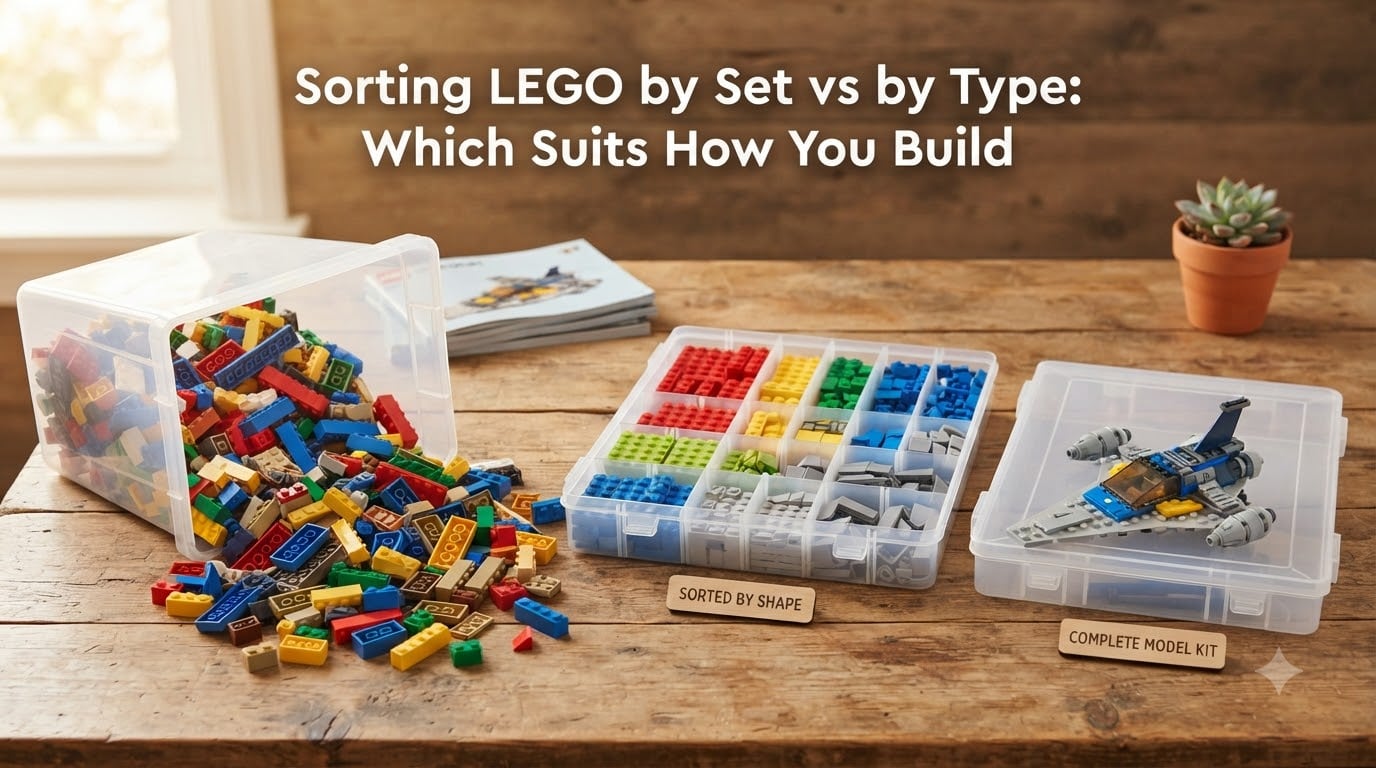
If you have ever opened a giant bin of mixed bricks and thought “I will never find that one piece in time for dinner,” you already know the real reason to sort your LEGO. The question most guides skip is the one that matters first: should you sort by the set each piece came in, or by the type of piece itself? After helping dozens of builders work through their collections, I can tell you the honest answer is that neither method wins on its own. The right pick depends almost entirely on how you build. In this guide I will walk you through Sorting LEGO by Set vs by Type the way I wish someone had walked me through it years ago, with real examples, the trade-offs nobody talks about, and a clear path to choosing your own method.
Table of Contents
What Sorting LEGO by Set vs by Type Actually Means
Sorting LEGO by set means you group every piece based on which retail set it originally shipped in. You bag up the contents of the 42115 Lamborghini Sián, label the bag, and shelve it. The pieces never leave their original family.
Sorting by type (sometimes called sorting by part, element, or category) means you group pieces by shape and function instead of origin. Every 2×4 brick ends up in one bin, every technic pin in another, every slope in a third, regardless of which set they came from. Color is usually a secondary sort inside each category, not the primary sort.
These are not the only two options. Color sorting is a distant third, and the “no sorting” pile on the floor is technically option four. But the real debate in the LEGO community, and the one that actually changes how your collection works for you, comes down to set vs type.
Sorting LEGO by Set: How It Works and Who It Suits
Set-based sorting is exactly what it sounds like. You keep each kit intact, ideally in the original numbered bags or in resealable bags you label with the set number. When you want to build, you pull the bag, dump it out, follow the instructions, and put any leftover pieces back into the same bag. Nothing mixes with anything else.
The benefits are real. If you build mostly from instructions, you already have a pre-sorted system handed to you by LEGO. Rebuilding a set two, five, or ten years later becomes possible because every piece is right where you left it. Resale value also stays high, since parted-out sets are worth less than complete sets on the secondary market.
The drawbacks hit you the moment you try to do anything else. Want to grab five black 1×2 plates for a quick MOC? You will be digging through twenty different bags. Want to freebuild something original? You will spend half the day opening bags and the other half trying to remember where every piece came from. As one Reddit user summed it up, “set sorting is great until you actually want to build.”
Best fit for set-based sorting
You are a strong candidate for sorting by set if you mainly build the kits you bought, you treat sets as collectibles, you care about resale or display value, or your collection is under roughly 3,000 pieces.
Sorting LEGO by Type: How It Works and Who It Suits
Type-based sorting is the approach most adult AFOLs eventually land on. You sort every piece into categories: bricks, plates, tiles, slopes, technic, minifigure parts, specialty pieces, and so on. Each category gets its own bin, drawer, or shelf. Color often becomes a sub-sort inside each bin.
The biggest win is flexibility. You stop thinking in sets and start thinking in parts. Need six 2×4 bricks in light bluish gray? Open the brick bin. Need a windscreen for a MOC? Open the specialty bin. Building becomes faster because every piece is findable in seconds.
You also unlock the parts library mentality that powers BrickLink, Rebrickable, and serious MOC work. Once your collection is type-sorted, you can actually inventory it, plan builds around what you have, and swap parts with other builders without a scavenger hunt.
The cost is time and storage. The first big sort can take days, and you will need a lot of containers. You also lose the “build the set again in ten years” option, unless you keep the instructions and accept that you will rebuild from your parts library instead of original bags.
Best fit for type-based sorting
You are a strong candidate for sorting by type if you build MOCs, you freebuild, you buy bulk lots, you regularly swap or sell parts, or your collection is over roughly 10,000 pieces.
Sorting LEGO by Set vs by Type: Head-to-Head Comparison
Here is the honest side-by-side. No spin, just the trade-offs I see play out in every collection I help organize.
Speed of finding a piece: Set sorting is slow because the piece you need might be in any of fifty bags. Type sorting is fast because every 2×4 brick lives in the same place.
Speed of rebuilding an old set: Set sorting wins easily. Everything is bagged and ready. Type sorting requires re-buying missing pieces or pulling them back out of your library.
Storage space needed: Set sorting uses less space initially because each set compacts into one bag. Type sorting needs many bins but can compress better at scale.
Time to do the first big sort: Set sorting is nearly free. Type sorting can take 10 to 40 hours depending on collection size.
Resale and collectible value: Set sorting protects value. Type sorting breaks up sets and reduces that specific resale path.
Flexibility for creative builds: Set sorting is restrictive. Type sorting is built for it.
Scalability past 25,000 pieces: Set sorting collapses under its own weight. Type sorting keeps working with deeper subcategories.
How Your Building Style Should Decide Your Sorting Method
This is the question I wish more sorting guides asked, because your building style is the single biggest predictor of which method will actually work for you. I have watched collectors suffer with the wrong sorting method for years simply because they picked the one a forum recommended, not the one that matched how they actually play with bricks.
If you are a set builder
You buy sets, you build them once or twice, you display them or store them, and you rarely tear them apart for parts. Sort by set. Your collection is already organized in the bag the manufacturer gave you. Adding type sorting on top will slow you down and steal joy from the relaxing hobby you signed up for.
If you are an MOC creator
You build original models, you sketch ideas, you raid your own collection for parts that fit your design. Sort by type, period. Set sorting will actively block your creativity because the part you need will always be in another bag.
If you are a hybrid builder
You build some sets, you modify some, and you freebuild occasionally. This is where most of us actually live, and it is where the simple “set vs type” question breaks down. The hybrid answer is a hybrid system. Keep your favorite and most valuable sets intact as set-sorted bags. Sort the rest by type into a parts library. The boundary between the two zones usually ends up being about 30 percent set, 70 percent type, but your numbers will vary.
If you are a parts seller or trader
Sort by type, full stop. You are running an inventory, not a hobby shelf. BrickLink has a standard category system that you can adopt directly so your parts are already organized the way buyers expect them.
Collection Size Thresholds That Change Everything
Sorting method does not stay optimal forever. As your collection grows, the math shifts. Tom Alphin at Brick Architect laid out thresholds that match what I see in real collections.
Under 3,000 pieces: Set sorting is usually fine. Your collection is small enough that you can find what you need by feel.
3,000 to 10,000 pieces: Hybrid zone. Many builders here start adding type sorting for small parts like plates and tiles, while keeping sets intact.
10,000 to 50,000 pieces: Type sorting becomes the only realistic option. Set sorting collapses because you cannot remember which of 200 bags contains a single tile.
Over 50,000 pieces: Type sorting with subcategories is mandatory. You also start needing digital inventory tools like BrickLink Studio or Rebrickable to keep track of what you own.
The Most Efficient Way to Sort LEGO: A Step-by-Step Process
Once you have chosen your method, the actual sorting job benefits from a repeatable process. This is the workflow I use with every collection I help organize, and it scales from a single big bin to several thousand pounds of LEGO.
Step 1: Dismantle and stack. Break down existing builds or unsorted piles into flat stacks by piece. Do not sort yet. Just expose every piece.
Step 2: Pull out large and specialty pieces. Minifigures, large baseplates, wheels, and motors go into their own bins first. These are easy wins that free up mental space.
Step 3: Sort by your chosen primary method. If you chose set sorting, bag and label per set. If you chose type sorting, route pieces into your category bins.
Step 4: Sub-sort where it helps. Inside each type bin, separate by color or size. Stop where further sorting adds more time than it saves.
Step 5: Hit 85 percent and stop. The community wisdom is real. Trying to sort 100 percent of your collection is a losing proposition. Get to about 85 percent sorted, label everything clearly, and call it good. The last 15 percent is usually rare parts you can pull out when you actually need them.
Step 6: Label everything. Unlabeled bins are the same as unsorted bins in six months. Spend the extra ten minutes writing on every container.
The 5/2 rule, explained
The 5/2 rule is a community shorthand for sorting depth: sort any category that has more than 5 distinct pieces into its own bin, and let categories with only 1 or 2 pieces stay combined. It keeps your bin count manageable while still giving you fast access to the high-volume parts that drive most builds.
Common Sorting Mistakes to Avoid
These are the traps I see every new sorter fall into. Skip them and you will save yourself weeks of rework.
Mistake 1: Sorting by color first. Color looks pretty on a shelf, but it makes finding a specific part slower, not faster. Use color as a secondary sort inside type categories.
Mistake 2: Trying to finish 100 percent. Perfectionism kills sorting momentum. Aim for 85 percent and move on with your life.
Mistake 3: Choosing the method a forum told you to choose. The right method is the one that matches how you actually build. Read advice, then apply only what fits your hands-on habits.
Mistake 4: Skipping labels. Six months from now you will not remember what is in that mystery bin. Label it now, future you will thank present you.
Mistake 5: Stacking bricks for long-term storage. Stacked bricks slowly lose clutch power. Store them loose or in shallow layers, not in tall columns.
Frequently Asked Questions
Is it better to sort LEGOs by color or type?
Sort by type first, then by color inside each type bin. Type sorting groups pieces by shape and function so you can find any part in seconds, while color sorting makes your shelf look pretty but buries small parts and slows you down when you actually need to build.
What is the best sorting method for LEGOs?
Type-based sorting is the best all-around method for most builders because it scales with your collection, supports MOC work, and makes any piece findable in seconds. Set-based sorting wins only if you primarily build kits from instructions and care about long-term resale or display value.
What is the 5/2 rule in LEGO?
The 5/2 rule says sort any category with more than 5 distinct pieces into its own bin, and leave categories with only 1 or 2 pieces combined. It keeps your bin count practical while still giving fast access to the high-volume parts that drive most builds.
What is it called when you sort LEGOs?
Sorting LEGO is just called sorting, but the act of breaking down sets into parts is sometimes called parting out a set. Builders who focus on this are often called parts collectors or AFOLs running a parts library.
What is the most efficient way to sort LEGOs?
The most efficient way to sort LEGOs is to dismantle into flat stacks first, pull out large and specialty pieces, sort by your chosen primary method (set or type), sub-sort only where it helps, label everything, and stop at about 85 percent complete rather than chasing perfection.
Conclusion: Pick the Method That Matches How You Build
The Sorting LEGO by Set vs by Type decision comes down to a single question: how do you actually use your collection? Set sorting protects kits and resale value but slows every creative build. Type sorting unlocks MOC work and scales with your collection but costs time upfront and breaks up sets. Most hybrid builders end up with a mixed system that keeps favorite sets intact and frees the rest into a parts library. Whichever path you choose, sort to about 85 percent, label every bin, and remember that the goal of sorting is more building, not a prettier shelf. Pick your method today, pull out your first bin, and get back to the bricks.