
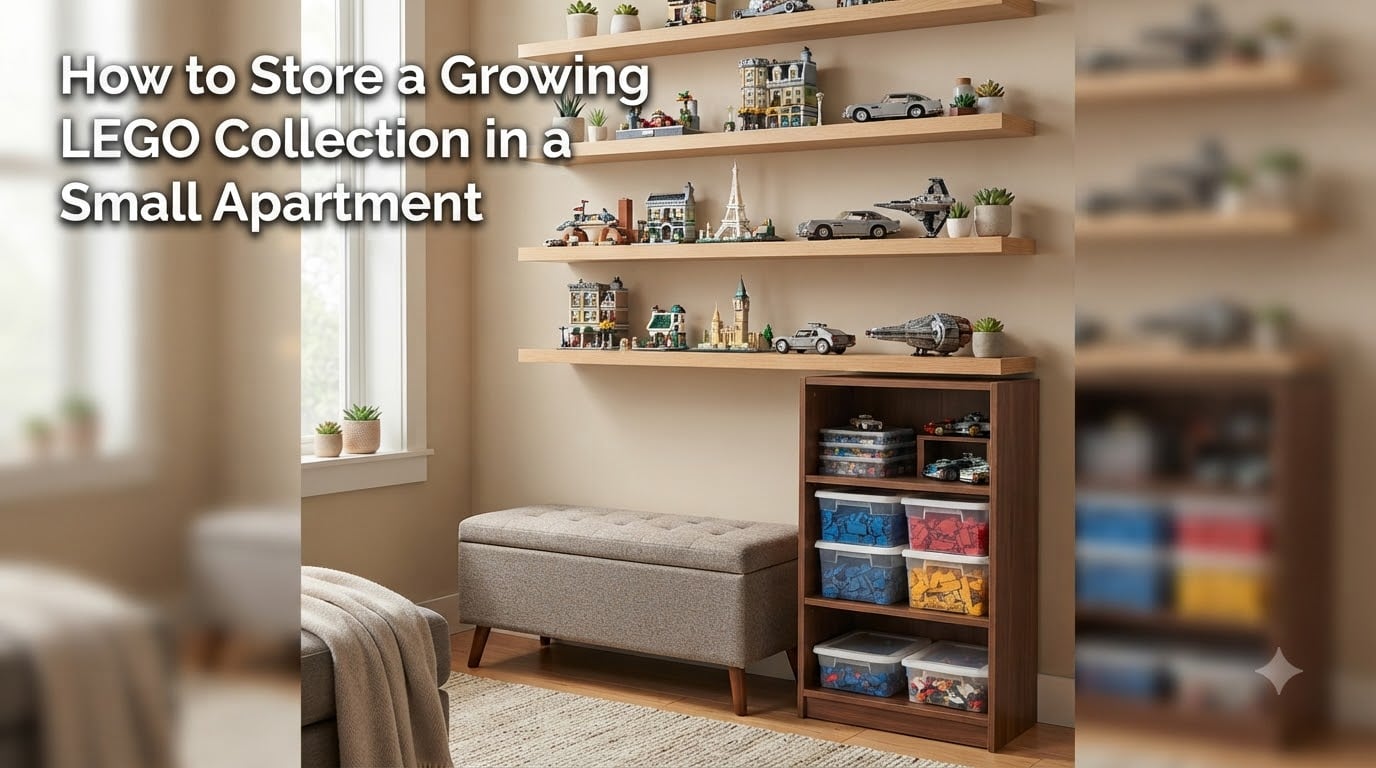
I get it. You love LEGO, but your studio apartment does not. After watching three sets pile up on my coffee table and a Millennium Falcon slowly colonize my bed, I knew something had to change.
Storing a growing LEGO collection in a small apartment is not about buying more bins. It is about using your existing space differently. Vertical space becomes your best friend, multi-purpose furniture replaces storage-only pieces, and you learn to love clear containers with labels.
In this guide, I will walk you through the exact system I developed after moving from a 3-bedroom house to a 600-square-foot apartment. You will learn how to assess your collection, choose the right sorting method, find vertical storage that actually works, and protect sets without drilling holes in your rental walls. Whether you are a parent of three kids or a 25-year collector, these strategies scale to fit your space and your budget.
Table of Contents
Step 1: Assess Your LEGO Collection Type
Before you buy a single bin, you need to know what you are storing. LEGO collections generally fall into three categories, and each one demands a different approach.
Built sets you want to keep together. These are your display pieces, your moc builds, or sets your kids cannot stop playing with. They take up visual space and need protection from dust and curious pets.
Loose bricks in active rotation. These get sorted for building, rebuilt, mixed, and remixed. They need quick access and a sorting system that makes sense to whoever uses them most.
Built sets you plan to take apart. These are finished sets destined for the brick pile, waiting for a rainy Saturday. They need sturdy containers that keep pieces contained but easy to retrieve.
I sat on my living room floor and physically divided my LEGO into three bins marked “Display,” “Sort,” and “Storage.” That 30-minute audit saved me from buying the wrong furniture three times. Know your mix before you choose your method.
How to Store a Growing LEGO Collection in a Small Apartment: The Framework
The framework I developed has four pillars: vertical storage, multi-purpose furniture, sorting by use frequency, and rental-friendly displays. Skip one and your system will fail within six months.
Vertical storage means going up, not out. Most apartments have 8-foot ceilings, which means roughly 4 feet of unused vertical space above your existing shelves. Multi-purpose furniture means choosing pieces that hold LEGO and serve another function: a bench with bins underneath, a coffee table with drawers, an ottoman that opens.
Sorting by use frequency means your kid’s favorite Star Wars set sits at eye level while the seasonal sets live on the top shelf. And rental-friendly displays mean no Command strip regrets when you move out.
This is not theoretical. I packed my entire collection into the footprint of one Billy bookcase, two Kallax cubes from IKEA, and three small Trofast bins. Here is exactly how.
Vertical Storage Strategies That Maximize Wall Space
Vertical storage is the single biggest unlock for small-apartment LEGO storage. When floor space is at a premium, the only direction left is up.
Floor-to-ceiling shelving. IKEA Billy bookcases with the extra-height extension give you roughly 93 inches of vertical storage in a 12-inch footprint. I installed two side by side in my living room, anchored them to the wall with the included tip-over restraints (one screw per bookshelf, fully reversible when I move out), and gained enough shelf real estate for 40+ built sets.
Stackable drawer systems. The LEGO community swears by the IKEA Trofast system for a reason. Each frame holds 6-9 shallow plastic bins, and the frames stack two high without wobbling. My nephew uses Trofast to sort pieces by color, and the bin labels make cleanup feel like a game.
Wall-mounted grid panels. IKEA Skadis or Elfa grids hold small built sets, minifigures, and accessories with hooks and clips. Mount them with Command Strips rated for the weight, and you have zero holes in your security deposit.
Over-the-door organizers. Pocket organizers that hang over closet doors or even over the back of a door hold flat instruction booklets, polybags, and small loose parts. This is the cheapest vertical LEGO storage you will find, and most under-$10 versions hold their shape for years.
One warning from experience: stacking sets higher than your own reach height means you will never play with them. Keep your favorites within arm’s length and store the rest up high.
Rental-Friendly Display Solutions (No Drilling Required)
Renters face a LEGO display problem. Most display solutions involve screws, anchors, or shelves that leave holes. Here is how to display built LEGO sets without losing your deposit.
Command Strip floating shelves. 3M Command Strips rated for 15 pounds hold properly-sized floating shelves for small to medium sets. I have a 12-inch shelf holding a Hogwarts Express set (about 4 pounds) that has stayed mounted for 18 months.
Tension rod shelves. Adjustable tension rods between two walls create instant floating shelves with no tools. They work best in closets, between cabinets, or in narrow hallway nooks.
Stackable display cases. Clear acrylic stackable display cubes let you build a LEGO display pyramid without any wall attachment. Each cube holds one or two medium sets, and you can reconfigure the stack as your collection grows.
Repurposed furniture. A secondhand glass-front cabinet becomes a LEGO display with adjustable LED puck lights added inside. I found mine at a thrift store for $25, removed three screws, and the cabinet was rental-safe.
The key rule: anything you mount must come off cleanly. Test your solution with a removable hook first, then escalate to Command Strips. Avoid anything that requires drilling into drywall, brick, or plaster.
Multi-Purpose Furniture With Hidden LEGO Storage
The best furniture in a small apartment does double duty. Here are four pieces that store LEGO while serving a primary function.
Storage ottomans. A leather or fabric ottoman at the foot of your couch holds 4-6 large sets in a single piece of furniture you would buy anyway. Lift the lid, drop in zippered bags of sorted bricks, and your LEGO disappears into your living room decor.
Coffee tables with drawers or lift-tops. Lift-top coffee tables hide LEGO bases, instruction booklets, and Works-in-Progress builds out of sight. Drawer-style coffee tables store loose bricks in labeled bins inside the drawers.
Window seats with storage. If your apartment has any kind of bench nook or window seat, the storage compartment underneath is prime LEGO real estate. Add a few canvas bins inside and label them by color or set.
Headboards with shelving. In a one-bedroom apartment, your bedroom headboard can hold floating shelves for sets you only enjoy at night. The 12-inch depth of most headboards fits medium-sized display sets perfectly.
Each piece of furniture should earn its footprint. If a storage ottoman holds LEGO but also gives your guests a place to sit, it is pulling double duty. If a bookshelf only holds LEGO and you already needed a bookshelf, count that as a win.
Sorting Methods Compared: By Set, By Color, By Type
Sorting is the part everyone argues about on Reddit. Here is how the three main approaches actually work in a small apartment.
Sort by set. Best for parents with kids and small collections under 30 sets. Each set gets a labeled bin or gallon zip bag, instructions stay with the pieces, and rebuilding is easy. Downside: it uses more bins and works less well as your collection grows past 50 sets.
Sort by color. Best for active builders and creative types. The Brick Architect LEGO storage guide recommends broad color categories (red, blue, black, yellow) rather than 50 individual color bins. Downside: finding specific pieces for a rebuild takes longer, and sorting into color categories initially takes 8-12 hours.
Sort by piece type. Best for Technic builders and serious AFOLs (Adult Fans of LEGO). Plates, bricks, slopes, tiles, and Technic pins each get their own drawer. The Brick Nerd opinionated guide to LEGO storage recommends this for collections over 100 pounds. Downside: requires the most drawer space and a real commitment to the system.
Most small-apartment collectors land on a hybrid. I sort by set for built displays, by color for loose bricks my kids use for free builds, and by piece type for Technic parts. Three systems, one collection, zero arguments.
The deciding factor is space. Sorting by piece type needs 15-20 labeled drawers. Sorting by set needs many small bins. Sorting by color needs just 4-6 large bins. Pick the one your apartment can actually hold.
Under-Bed and Closet Storage Solutions
Every small apartment has the same two dead spaces: under the bed and on top of the closet. Both work brilliantly for LEGO storage if you choose the right containers.
Under-bed storage. Flat, latching containers slide under most platform beds. I store seasonal sets (winter village in summer, beach sets in winter), large instruction manuals, and bulk-purchase boxes I have not yet opened. Anything you access less than once a month lives here. Tall under-bed containers do not fit; shallow ones do.
Closet top shelf. The top shelf of a closet is 7+ feet high in most apartments. Store built sets you love but rarely play with, complete with original boxes if you have them. Original boxes add collector resale value; storing them flat prevents crushing.
Closet floor. If your closet does not already hold clothes, line the floor with stackable bins. Each bin holds 2-3 sorted sets or a large loose-brick collection.
Over-the-door hanging organizers. The clear-pocket kind holds instruction booklets, small minifigure accessories, and polybags of sorted pieces. Hang one on the back of any door, and you have added a flat storage surface without touching the door itself.
Use clear containers and label everything. The worst mistake I ever made was storing 600+ loose bricks in an unmarked bin under my bed for two years. I had no idea what was in there, and I was afraid to sort it.
How to Keep Your LEGO Sets Together and Protected Long-Term
Once your storage system is in place, you need to keep sets together and protect them from dust, humidity, and the occasional curious cat.
Gallery gel or museum putty. A tiny dab on the bottom of a LEGO display prevents sets from sliding off shelves when you bump them. This is the single best $5 investment I made for my display cases.
Display cases or dust covers. Built sets collect dust within weeks if left open. Glass-front cabinets, acrylic display cubes, or even clear acrylic sheets cut to size keep dust off without hiding the set.
Silica gel packets. Humidity is the enemy of yellow bricks and crumbling plastic. Toss a few food-safe silica gel packets into each storage container. Replace them every six months.
Original boxes kept flat. If you plan to resell or gift your set, the original box with instructions doubles its value. Store boxes flat in under-bed containers, never standing on edge, and never nested in a way that requires folding.
Ziplock bags for set pieces. Before placing a completed set back into storage or display, seal the loose parts in a gallon zip bag. If a model falls apart during a move, all pieces stay in one place.
These five small habits cost almost nothing and extend the life of your collection by years.
Budget-Friendly LEGO Storage Under $50
You do not need a custom showroom to store LEGO well. I built my entire vertical system for under $200, and most of that was one Billy bookcase I still use daily.
Free solution: Repurpose what you already own. Glass jars from pasta sauce hold sorted pieces. Empty shoeboxes become bin-by-bin storage. A cardboard box with a lid and a label marker is a perfect “by-set” storage solution.
Under $20: A 6-pack of clear plastic shoeboxes, a label maker, and a sheet of Command Strip hooks. That gives you six labeled sets in storage with wall-mounted display space, all rental-friendly.
Under $50: A single IKEA Trofast frame with 6 bins, or a 3-tier mesh drawer organizer from any big-box store. Either one holds a small collection completely, with room to grow.
Best long-term value: A used Billy bookcase or Kallax cube from a thrift store or Facebook Marketplace. Expect to pay $30-50 instead of $80-180 new. Sand and touch up any scuffs, and you have an heirloom-quality storage piece.
The math always favors the system you will actually use. A $10 solution that keeps your LEGO sorted forever beats a $200 solution you abandon after a month.
Frequently Asked Questions About LEGO Storage in Small Apartments
What is the LEGO 5 2 rule?
The LEGO 5 2 rule is a way to sort and store LEGO where you keep 5 different brick types (plates, bricks, slopes, tiles, and Technic parts) separated and use 2 main containers for storage. It works well in small apartments because it reduces the number of bins you need while still keeping the most common brick types easily findable. The system is popular among adult collectors with limited space who want quick access to the parts they use most.
How do you store a LEGO collection in a small apartment?
Store a LEGO collection in a small apartment by going vertical, using multi-purpose furniture, and choosing rental-friendly solutions. Use floor-to-ceiling bookshelves for display sets, stackable drawer systems like IKEA Trofast for loose bricks, and storage ottomans for hidden storage. Sort your collection before you store it, label every container, and keep frequently used sets at eye level while seasonal pieces live up high or under the bed.
How do you display LEGO in a small house?
Display LEGO in a small house using Command Strip-mounted floating shelves, acrylic display cubes stacked into a pyramid, or a glass-front secondhand cabinet with puck lights added inside. For rentals, avoid drilling and stick to solutions that come off cleanly. Keep displayed sets away from direct sunlight, use museum putty to prevent sliding, and rotate your display pieces seasonally to keep the room feeling fresh.
What do you do with a large LEGO collection?
Manage a large LEGO collection by splitting it into three categories: display sets, active loose bricks, and stored sets you rarely play with. Use vertical space aggressively, sort by set or color rather than piece type, and protect investment sets in glass cabinets. For very large collections over 100 pounds, consider a small external storage unit for overflow. Above all, label everything and stop buying storage solutions that you cannot fit a growing collection into.
Final Thoughts on Storing LEGO in a Small Apartment
Storing a growing LEGO collection in a small apartment is not a furniture problem. It is a system problem. Once you assess your collection type, choose vertical storage, add rental-friendly displays, and invest in a few multi-purpose pieces, your LEGO will fit comfortably in 600 square feet or less.
Start with one shelf, one bin system, and one sorting method. Add more only when the current system fills up. The best storage is the one you actually use, and a simple method you stick with beats a beautiful showroom every time.
Your apartment is small, but your LEGO collection does not have to feel cramped. Get vertical, stay flexible, and enjoy the build.