
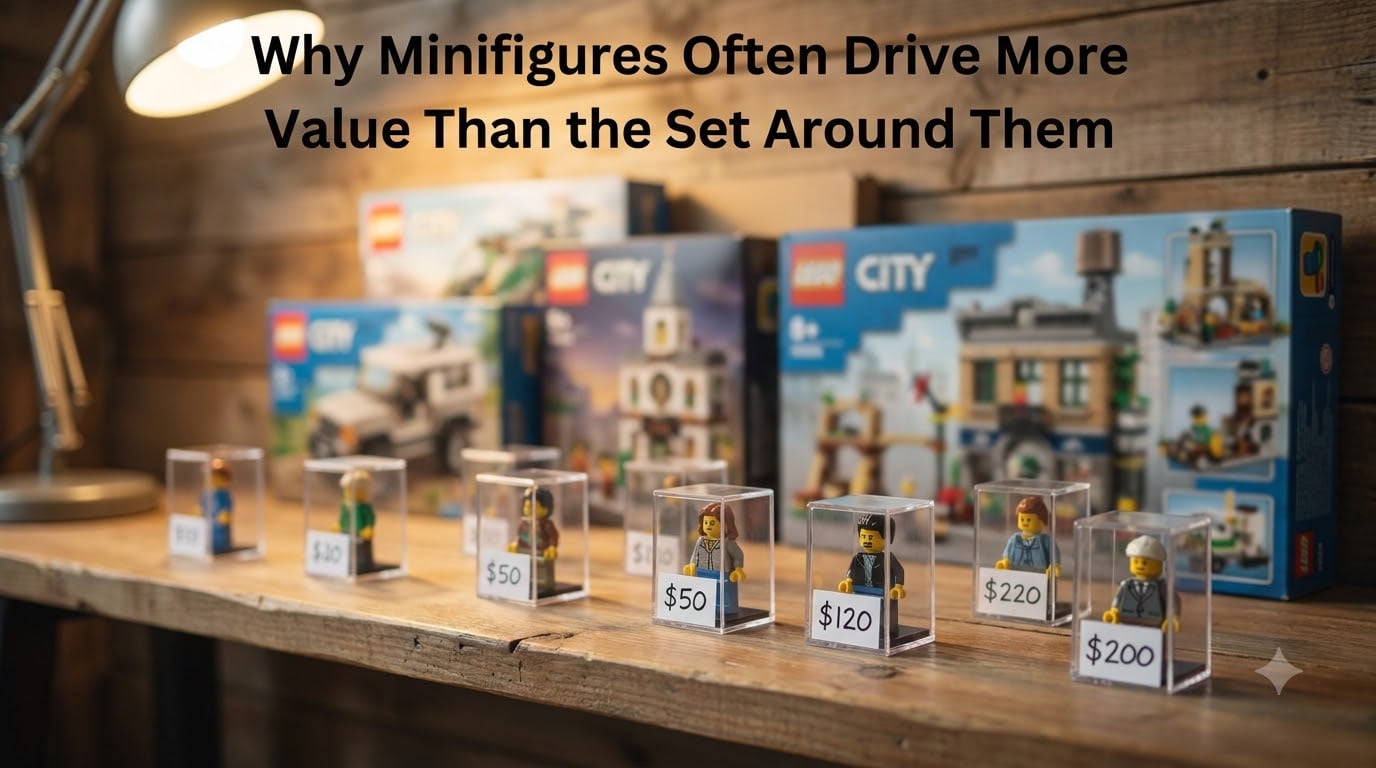
Minifigures drive more value than the sets around them because they carry the character identity, franchise nostalgia, and scarcity that collectors actually pay for. While a set is a finished product once built, a minifigure stays in circulation, gets traded, graded, and resold for years after the box hits the recycling bin. In our experience tracking the secondary market, we’ve watched single figures from retired themes appreciate 300% to 800% while their parent sets sat unsold at garage sales.
If you’ve ever wondered why some minifigures sell for more than the entire set used to cost, this guide breaks down the exact mechanics. We cover scarcity, character demand, variant prints, condition grading, and the practical comparison between set value and minifigure value over time.
Table of Contents
Why Minifigures Outpace Their Sets in Value Retention
Minifigures outpace their parent sets because they are portable, character-driven collectibles with a much longer market life. A completed set is a finished project. Once it’s built, displayed, and the novelty fades, the bricks get resold in bulk at fractions of retail.
Three structural factors explain the gap. First, the character carries emotional weight. Boba Fett means something to a buyer even without the cockpit around him. Second, minifigures are small and easy to ship, store, and trade. Third, retirement permanently cuts supply, while used sets always reappear in bulk lots.
We’ve seen this play out repeatedly. A 2007 Castle theme set might fetch 60% of retail today. But the individual King Mathias minifigure from that same set sells for triple its original combined part value on the aftermarket. The figure did the appreciating, not the bricks.
What Actually Drives Minifigure Value in the Collectible Market
Five core factors drive minifigure value: production scarcity from retirement, character demand tied to major IPs, variant prints and exclusive torsos, condition and print quality, and first-release premiums. Each factor compounds the others.
Scarcity creates the supply ceiling. When LEGO retires a theme, production stops and existing figures slowly disappear from shelves, store bins, and bulk lots. Character demand creates the buying pressure. Star Wars, Harry Potter, and Marvel characters have built-in fandoms that translate directly into collectible demand.
Variant prints multiply scarcity within scarcity. The same Darth Vader minifigure from 2018 might be worth $8, but a variant print from a 2005 convention exclusive sells for $400. Condition acts as a quality multiplier. A mint, sealed-polybag figure often commands 4x the loose version.
Production Scarcity and Retirement: The Supply Side of Value
Production scarcity drives minifigure value because LEGO retires themes every few years, permanently cutting off new supply of specific figures. Once a theme goes end-of-life, the only way to get those figures is through the secondary market.
LEGO operates on a roughly 3-to-5-year theme cycle. Pirates ran from 1989 to 1997. Castle had multiple waves that ended in the early 2000s. Each retirement wave removes a chunk of figures from production. A decade later, those figures are scarce enough that collectors pay premiums.
The BrickLink marketplace tracks this scarcity through its pricing guide. When you see a minifigure consistently listed above $50 with limited availability, retirement is usually the reason. We’ve watched themes like Legends of Chima and Nexo Knights cycle through this exact pattern.
Character and Theme Demand: Why Star Wars and Castle Minifigures Lead the Market
Character and theme demand drive minifigure value because recognizable IPs and nostalgic themes create built-in collector bases willing to pay above production cost. Star Wars consistently leads all themes in value appreciation, followed by Castle, Pirates, and Harry Potter.
Star Wars minifigures benefit from a 45-year-old franchise with continuous new content. A 2003 Clone Trooper is still relevant because new Star Wars media keeps the character visible. The fandom actively seeks specific variants for army-building and display purposes.
Castle and Pirates carry pure nostalgia weight. These pre-licensed themes represent the classic LEGO era for collectors who grew up in the late 80s and early 90s. Their figures weren’t tied to any external IP, but the themes themselves became cultural touchstones.
Variant Prints, Exclusive Torsos, and First Releases
Variant prints, exclusive torsos, and first releases drive minifigure value because they create artificial scarcity within an already limited supply. A single print variation can multiply a figure’s price by 5x to 10x.
LEGO frequently uses minor print changes between production runs. The torso pattern might shift slightly. A logo appears or disappears. The head print gets a subtle color tweak. Collectors who track these variants pay serious premiums for early or rare versions.
Exclusive torsos from limited sets command premiums even after the set retires. The San Diego Comic-Con exclusive Mr. Gold from the Collectible Minifigure series still sells for hundreds despite being a small gold figure. The torso was limited to a single production run of around 5,000 units.
How Condition and Print Quality Multiply Minifigure Value
Condition and print quality multiply minifigure value because collectors pay premiums for figures that look untouched. Mint condition with sharp, unfaded prints can mean a 4x price difference over a worn, sun-damaged version.
LEGO plastic holds up well structurally, but prints degrade. UV exposure, handling, and cleaning all wear down the silk-screened or pad-printed details on torsos and legs. A figure with crisp, bright prints looks display-worthy. A figure with cracked, faded prints looks used.
We recommend storing valuable figures away from direct sunlight in sealed bags or display cases. Sealed polybag figures command the highest premiums because they preserve mint condition permanently.
Set Value vs Minifigure Value: A Practical Comparison
Set value depreciates after completion while minifigure value appreciates over time, making figures the smarter long-term collectible. The same $100 set can lose 40% of its value in a year, but a key minifigure from that set might double in three years.
Sets depreciate because they’re bulky, require storage space, and become done projects. Minifigures appreciate because they’re small, tradeable, and stay relevant as long as the character or theme carries demand. The math shifts dramatically when you focus acquisition on the figures rather than the bricks.
Tips for Spotting Valuable Minifigures Before Everyone Else Does
Four practical signals help identify valuable minifigures early. Watch for retiring themes, track character popularity in current media, check for variant prints against BrickLink catalogs, and price-check regularly before prices spike.
When LEGO announces a theme’s retirement, buy key figures immediately. Clearance discounts mean you acquire appreciating assets at discount prices. We’ve done this with multiple themes over the years, and the early retirement signals consistently produced the best returns.
Track character popularity through franchise news. A new movie, show, or game featuring a specific character spikes demand for that minifigure. Compare prints carefully against BrickLink catalog images.
Are LEGO Minifigures Actually a Good Investment
Yes, LEGO minifigures are a good long-term investment when you focus on characters with strong franchise backing, retired themes, and preserved condition. Realistic returns range from 50% to 500% over 5-to-10-year periods for well-chosen figures.
The investment case rests on permanent supply cuts, durable physical quality, and proven collector demand. Unlike stocks or crypto, minifigures are physical objects with intrinsic display value beyond their market price.
For best results, treat minifigures as a focused collecting strategy rather than a pure financial play. Collect what you enjoy, focus on quality figures, and the value often follows naturally.
Frequently Asked Questions About Minifigure Value
Which LEGO sets increase most in value?
LEGO sets that increase most in value typically feature iconic licensed characters (especially Star Wars), limited production runs, UCS premium builds, and theme finales. Sets retiring with strong demand and limited reissues appreciate fastest. The UCS Millennium Falcon and original Boba Fett sets are classic examples of value appreciation driven by character demand and theme retirement.
Are minifigures a good investment?
Yes, minifigures are a good long-term investment when chosen wisely. Focus on figures from major franchises like Star Wars, Harry Potter, and Marvel, especially first releases and variants from sets that retire. Realistic returns range from 50% to 500% over 5-to-10-year periods. Sealed polybag figures and rare convention exclusives typically perform best.
What is the most overpriced LEGO set ever?
The most overpriced LEGO sets are typically licensed UCS flagship sets with high piece counts but limited playable features. Sets like the UCS Star Destroyer and certain Marvel/DC modulars carry premiums for display size rather than play value. Collectors often pay more for the build experience and shelf presence than for minifigure content, which inflates initial pricing relative to long-term value retention.
What is the lifespan of a LEGO minifigure?
LEGO minifigures have an indefinite structural lifespan. The ABS plastic doesn’t degrade significantly over decades, and properly stored figures remain intact indefinitely. Print quality is the lifespan limit. Silk-screened prints can fade with UV exposure over 10-to-20 years, but pad-printed modern figures last much longer. Sealed figures preserve print quality permanently.
Why do some minifigures cost more than others in the same set?
Some minifigures cost more than others in the same set because LEGO often places exclusive prints on key characters. Main characters like villains or protagonists get unique torso and leg prints, while background characters share generic prints. Variant prints, exclusive torsos, and first-release status create value differences even within a single set’s figures.
Final Thoughts on Why Minifigures Drive More Value Than Their Sets
Minifigures drive more value than the sets around them because they combine character identity, scarcity, portability, and condition-dependent grading in ways that finished sets simply cannot match. The set is the vessel. The minifigure is the treasure.
Our team has tracked this pattern across themes for years, and the conclusion stays consistent. Buy for figures, not bricks. Prioritize character-rich sets over piece-count bargains. Track retirement signals and variant prints. Store valuable figures properly. The minifigures value will follow.