
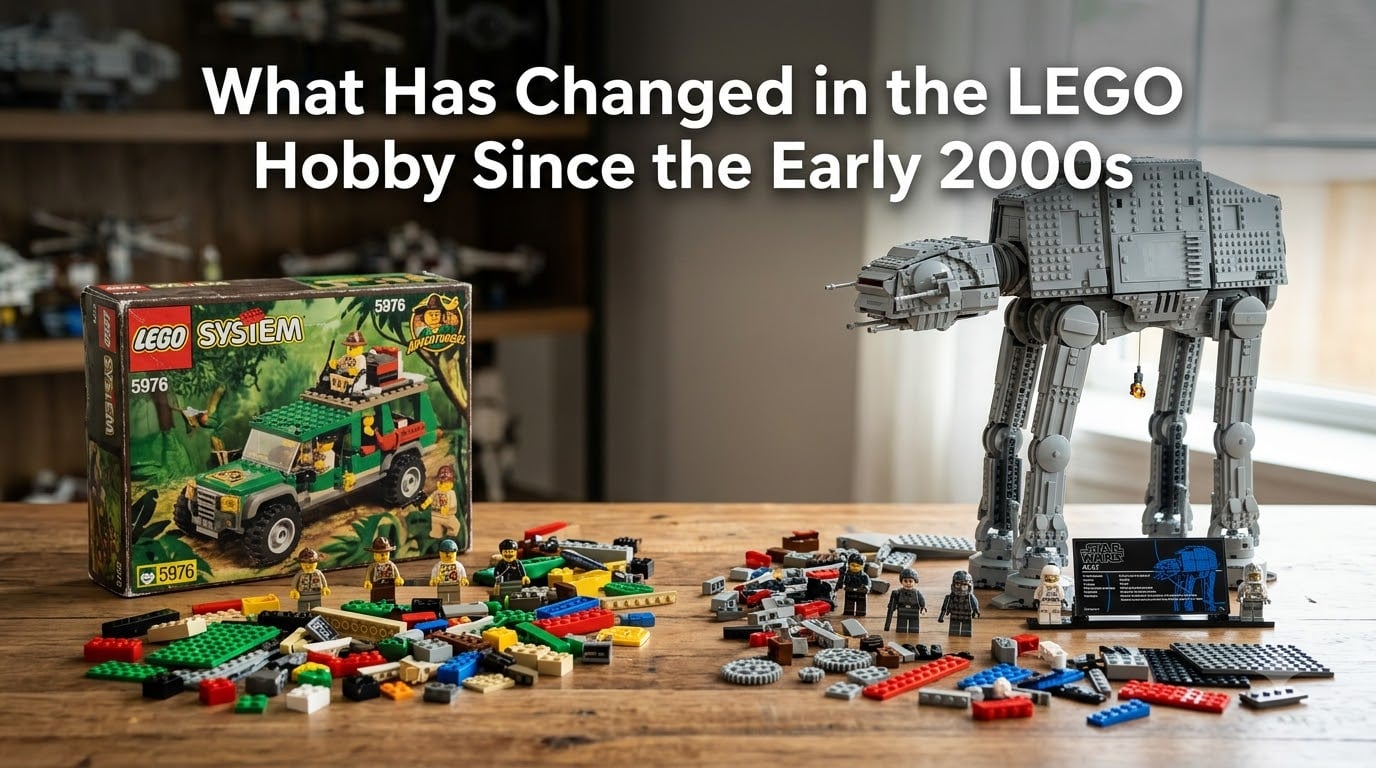
If you stepped away from LEGO around the year 2000 and came back today, you would barely recognize the hobby. Sets are bigger, themes are wilder, adults are a core audience, and the secondary market looks more like stock trading than toy collecting. The transformation has been that dramatic.
Our team has been tracking LEGO trends for years, and the question we hear most often from returning builders is simple: what has changed in the LEGO hobby since the early 2000s? The short answer is nearly everything. LEGO went from near-bankruptcy to becoming the most profitable toy company on the planet.
In this guide, we walk through every major shift in the LEGO hobby since the early 2000s. We cover the financial crisis that nearly ended the company, the licensed theme revolution, the rise of adult collectors, the explosion in set complexity, pricing trends, the secondary market, digital tools, and building technique advancements. Whether you are a returning fan or a new collector trying to understand the landscape, this timeline will bring you up to speed.
Table of Contents
What Has Changed in the LEGO Hobby Since the Early 2000s: A Quick Timeline
The LEGO hobby has undergone a sweeping transformation over the past two-plus decades. Here is a chronological look at the biggest milestones that reshaped how people build, collect, and engage with LEGO.
1999: LEGO Star Wars launches as the first major licensed theme, fundamentally changing the company’s product strategy.
1998-2004: LEGO enters its darkest period, with uncontrolled theme expansion, declining profits, and near-bankruptcy by 2003.
2004-2005: New leadership under Jorgen Vig Knudstorp cuts themes, refocuses on core brick play, and brings the company back from the brink.
2005-2010: Licensed themes expand rapidly with Harry Potter, Spider-Man, and Batman, while Bionicle carries the company financially.
2007: The Ultimate Collector’s Millennium Falcon releases with 5,195 pieces, setting a new benchmark for adult-oriented sets.
2010: Collectible Minifigure Series launches, creating a new collecting category focused on individual figures.
2011: LEGO Friends debuts, successfully expanding the hobby to a broader demographic and becoming one of the best-selling themes.
2014: The LEGO Movie hits theaters, cementing LEGO as a cross-media entertainment brand and drawing millions of new fans.
2017: The AFOL-designed Voltron set releases through LEGO Ideas, proving fan-designed sets could become official products.
2020-Present: Botanical Collection, dioramas, and display-focused sets target adult builders directly, while set complexity and piece counts continue climbing.
2026: LEGO offers more adult-oriented sets than ever before, with thousands of retired sets trading on a robust secondary market.
This timeline captures the headline events, but the details behind each shift tell a richer story. Let us dig into what happened.
The Early 2000s Crisis: When LEGO Almost Went Under
LEGO was in serious trouble by 2003. The company posted its largest-ever loss that year, and by early 2004 it was reportedly days away from bankruptcy. This is one of the most pivotal periods in understanding what has changed in the LEGO hobby since the early 2000s.
The crisis had several root causes. LEGO had dramatically expanded its theme portfolio, creating lines like Galidor, Jack Stone, and Clikits that strayed far from the core brick-building experience. Many of these themes featured specialized, single-use pieces that frustrated traditional builders and drove up production costs.
At the same time, LEGO was manufacturing too many unique element types. By 2004, the company was producing roughly 14,000 different element designs, a staggering number that created massive inventory and molding complexity. The company had also over-invested in theme parks, video games, and other ventures that drained resources.
The turnaround began when Jorgen Vig Knudstorp took over as CEO in 2004. He made the painful but necessary call to cut theme count dramatically, refocus on the classic brick system, and reduce the number of unique element designs. He famously told employees they needed to go back to what made LEGO special in the first place.
This period fundamentally reshaped LEGO’s entire approach to product development. The company became more disciplined about theme selection, piece design, and audience targeting. Every modern success the company enjoys traces back to the hard decisions made during this crisis.
Licensed Themes Changed Everything
The single biggest shift in LEGO’s product strategy since the early 2000s has been the embrace of licensed properties. It started with a bet that almost did not happen.
LEGO Star Wars launched in 1999, timed to the release of Star Wars: Episode I. It was the first time LEGO produced sets based on an external entertainment franchise. The line was an immediate commercial success and proved that fans would pay premium prices for builds connected to beloved characters and stories.
That success opened the floodgates. Over the following years, LEGO secured licenses for Harry Potter, Spider-Man, Batman, Indiana Jones, and many others. Each license brought in fans who might never have considered LEGO otherwise, dramatically expanding the hobby’s audience.
The Marvel and DC licensing deals, secured in the early 2010s, took things to another level. Combined with the explosion of superhero films, these themes became perennial best-sellers that appealed strongly to both kids and adult collectors.
Today, licensed themes make up a significant portion of LEGO’s annual catalog. The Star Wars line alone has produced hundreds of sets over more than two decades, ranging from small battle packs to massive Ultimate Collector Series models that are clearly aimed at adult builders and display enthusiasts.
For collectors, this shift means the hobby is now deeply interconnected with pop culture. A new film or show release can trigger an entire wave of LEGO sets, creating collecting opportunities and challenges that simply did not exist in the pre-licensed era.
Piece Count and Set Complexity: Bigger, More Detailed Builds
One of the most visible changes in the LEGO hobby since the early 2000s is the dramatic increase in set size and complexity. The data tells a clear story.
A detailed analysis of roughly 18,000 LEGO products found that average piece counts have climbed steadily over the past two decades. Sets that would have been considered massive in 2000 are now routine. The bar for what qualifies as a large set has shifted dramatically.
In the early 2000s, a 1,000-piece set was a significant event. Today, sets regularly exceed 3,000 pieces, and several have topped 7,000. The Art World Map holds over 11,000 pieces. This growth reflects a deliberate strategy to serve adult builders who want challenging, display-worthy builds.
Set complexity has also advanced substantially. Modern sets use advanced building techniques like SNOT (Studs Not On Top), complex sub-assemblies, and intricate internal frameworks that would have been rare two decades ago. The result is models with smoother surfaces, more accurate proportions, and far greater visual detail.
Instruction design has evolved alongside this complexity. Modern instruction booklets break builds into smaller sub-steps with clearer part callouts, and digital instructions add interactive features like piece rotation and progress tracking that make tackling massive sets more manageable.
For the hobby, this means building has become a more engaging, longer-lasting activity. A single large set can provide dozens of hours of building enjoyment, which has helped position LEGO as a legitimate leisure activity for adults rather than just a children’s toy.
The Rise of Adult Fans of LEGO (AFOL)
Perhaps no change has reshaped the LEGO hobby more than the rise of the adult fan community. AFOL stands for Adult Fan of LEGO, and this demographic has gone from a niche afterthought to a core pillar of LEGO’s business strategy.
In the early 2000s, LEGO was almost exclusively marketed to children. Adult builders existed, but they were scattered, had few resources for connecting with each other, and were largely ignored by the company itself. The idea of LEGO deliberately creating products for adults would have seemed absurd.
That began to change in the mid-2000s. Online communities like Eurobricks, Lugnet, and various forums gave adult fans a place to share creations, discuss techniques, and organize. The founding of BrickLink in 2000 created a dedicated marketplace for buying and selling individual pieces and sets, which powered increasingly ambitious custom builds.
LEGO noticed. The company began engaging directly with adult communities, launching programs like LUG (LEGO User Group) bulk ordering and eventually creating entire product lines aimed at adults. The Creator Expert line, starting with models like the Taj Mahal and Cafe Corner, signaled that LEGO was serious about serving mature builders.
By 2026, the AFOL community is enormous and organized. There are major conventions like BrickWorld, BrickFair, and SkaeRum that draw thousands of attendees. Adult builders share work on Instagram, YouTube, and Flickr. Fan-designed sets reach production through the LEGO Ideas platform, where community votes determine which creations become official products.
Reddit communities like r/AFOL, r/lego, and r/legoinvesting have tens of thousands of active members discussing everything from building techniques to investment strategies. Adult fans report being drawn to the increasingly complex, detailed sets that challenge their skills and look impressive on display.
This shift has fundamentally changed what it means to be in the LEGO hobby. It is no longer something you outgrow. For many adults, LEGO building is a primary creative outlet, a social activity, and even a form of stress relief.
Pricing Trends: How LEGO Costs Have Shifted
One topic that comes up constantly in LEGO communities is pricing. Many long-time builders feel that LEGO has become significantly more expensive over the years. The reality is more nuanced.
On a price-per-piece basis, LEGO has actually remained relatively stable. The Medium data analysis found that the average price per piece has not increased dramatically when adjusted for inflation. A typical LEGO set costs roughly 10 to 11 cents per piece, a figure that has held fairly steady.
What has changed is the ceiling. LEGO now produces sets at price points that would have been unthinkable in the early 2000s. Sets costing $200, $400, or even $700+ are now standard offerings in adult-focused lines like Ultimate Collector Series, Technic supercars, and large-scale dioramas.
This creates a perception of rising prices because the high-end options are far more visible than they used to be. A casual walk through a LEGO store in 2026 reveals sets at price points that would have shocked a 2002 shopper.
At the same time, LEGO has maintained accessible entry-level sets. Small sets in the $10 to $30 range are still widely available, particularly in themes like City, Friends, and Creator 3-in-1. The hobby has become more stratified, with options at nearly every budget level.
Collectors concerned about costs have noted that quality has generally kept pace with prices. Modern sets offer better piece variety, more detailed instructions, and higher display value than equivalent sets from two decades ago.
The Secondary Market: Retired Sets as Investments
The secondary market for LEGO has exploded since the early 2000s, transforming the hobby in ways that go well beyond building. This is one of the most frequently discussed topics on forums like r/legoinvesting.
When a LEGO set reaches the end of its retail life, it becomes retired. Once retired, the only way to obtain it is through the secondary market, primarily BrickLink, eBay, and various collector marketplaces. This scarcity dynamic can drive significant price appreciation.
Community analysis of approximately 4,000 retired LEGO sets shows interesting patterns. The median appreciation across all retired sets is roughly +0.3%, but the mean is +27.9% because outlier sets skew the average upward. Not every set appreciates, but certain categories perform dramatically better than others.
Retired Star Wars sets are among the strongest performers. Some Episode III sets have shown median returns of +143%, making them some of the most sought-after retired sets on the market. Large exclusive sets, particularly Ultimate Collector Series models, also tend to hold or increase their value well.
However, the investment angle comes with real caveats that experienced collectors are quick to point out. Storage conditions matter enormously, as sunlight and humidity can degrade both bricks and boxes. The market is also unpredictable, and some retired sets actually lose value over time.
Valuation tools like BrickLink’s price guide and BrickEconomy help collectors track current market values and historical trends. These resources did not exist in the early 2000s, and their emergence has made the collecting side of the hobby far more transparent and accessible.
For many adult collectors, the secondary market adds a layer of engagement beyond building itself. Tracking values, hunting for deals on retired sets, and managing a collection as a potential store of value are all activities that simply did not exist in the hobby landscape of 2000.
Minifigure Evolution: From Simple Smileys to Detailed Characters
The minifigure has undergone one of the most visible transformations in the LEGO hobby. If you compare a minifigure from 2000 to one from 2026, the difference is striking.
Early minifigures featured simple smiley faces with single-color body printing. Over the decades, printing technology has advanced enormously. Modern minifigures feature multi-color torso prints, dual-sided head prints, detailed leg printing, and elaborate accessories that create far more character-specific figures.
The introduction of licensed minifigures changed things further. Star Wars, Marvel, and Harry Potter figures require accurate representations of known characters, which pushed LEGO to develop new head molds, hair pieces, and accessory designs at a pace never seen before.
The launch of Collectible Minifigure Series in 2010 created an entirely new collecting category. These blind-packaged figures feature unique characters like historical figures, fantasy creatures, and pop culture archetypes that exist outside any traditional theme. The series has produced hundreds of figures and spawned an active collecting community.
Rare minifigures have become some of the most valuable items in the entire LEGO ecosystem. Certain promotional figures, gold-chrome C-3PO variants, and limited-edition characters command prices in the hundreds or even thousands of dollars on the secondary market.
Digital Innovation: Instructions, Apps, and LEGO Ideas
The digital side of the LEGO hobby has transformed completely since the early 2000s. What was once a purely physical experience now has a substantial digital layer that enhances every part of the hobby.
Digital building instructions are now standard for most sets. Instead of relying solely on printed booklets, builders can access instructions through the LEGO Builder app, which offers features like 3D model rotation, zoom, and progress tracking. For large sets with hundreds of steps, these features make building significantly more manageable.
The LEGO Ideas platform has fundamentally changed how fan creations reach the market. Launched in its modern form in 2014, Ideas allows anyone to submit a set design. If a project reaches 10,000 supporter votes, LEGO reviews it for potential production. Sets like the NASA Apollo Saturn V, Voltron, and various fan-designed buildings have become official products through this process.
This was unimaginable in the early 2000s. The idea that a fan-built model could become an official LEGO product, with the creator earning royalties, represents a complete shift in how the company relates to its community.
Digital building tools have also advanced. Software like LEGO Digital Designer (now retired) and its successor BrickLink Studio allow builders to design models digitally before purchasing parts. This has enabled a generation of custom builders to prototype, share, and refine designs that would have required significant physical experimentation in the past.
For collectors, digital tools like BrickLink and BrickEconomy provide market data, collection tracking, and inventory management that make organizing a large LEGO collection far easier than it was two decades ago.
How LEGO Building Techniques Have Advanced
The actual craft of LEGO building has evolved significantly since the early 2000s. New element types, refined techniques, and community knowledge sharing have pushed what is possible with the brick system.
The 5/2 rule, sometimes referenced in LEGO design discussions, refers to principles around structural stability and element placement that guide how sets are designed for durability and aesthetic coherence. Modern set designers apply these principles with a level of sophistication that early 2000s sets rarely achieved.
One major advancement is the widespread use of SNOT (Studs Not On Top) techniques. This involves positioning elements sideways or at angles to create smooth surfaces, curved shapes, and architectural details that would be impossible with traditional studs-up building. What was once an advanced community technique is now standard practice in official sets.
New element types have expanded the building vocabulary dramatically. Bracket pieces, modified tiles with clips and bars, specialized curved slopes, and specialized connector pieces give designers far more options for achieving specific shapes and structural connections.
Community knowledge sharing has accelerated technique development. YouTube channels, building tutorials, and online forums make advanced techniques accessible to anyone willing to learn. A builder starting today can access a depth of building knowledge that took previous generations decades to accumulate.
Long-time builders have also noted that bricks themselves feel slightly different. Many report that modern bricks have a subtly softer clutch than pre-2000 elements, which some attribute to changes in plastic formulation for environmental and safety reasons. The difference is minor but noticeable to builders with decades of experience.
What These Changes Mean for Collectors Today
Understanding what has changed in the LEGO hobby since the early 2000s is not just academic. It has practical implications for anyone building, collecting, or investing in LEGO today.
For new adult collectors entering the hobby, the landscape is richer than ever but also more complex. Here are the key takeaways to keep in mind:
Choose your focus. With dozens of active themes, trying to collect everything is both expensive and overwhelming. Most successful collectors specialize in one or two themes they genuinely love.
Understand retirement timing. Most sets are available for 1 to 3 years before retiring. If you want a set at retail price, track its release date and expected retirement window.
Use valuation tools. BrickLink and BrickEconomy provide free market data that helps you understand whether a set is fairly priced and how it has historically performed after retirement.
Consider storage early. A growing collection needs proper storage to protect both bricks and boxes from light, humidity, and dust. Plan for this before your collection outgrows your space.
Engage with the community. Reddit communities, local LUGs, and online forums are tremendous resources for learning, trading, and staying connected to the hobby.
Build for enjoyment first. While some sets appreciate in value, treating LEGO purely as an investment can lead to disappointment. The most sustainable approach is to build what you love and treat any value appreciation as a bonus.
The hobby has also become more accessible in important ways. The price-per-piece ratio remains reasonable for most sets, entry-level options are widely available, and digital tools make it easier than ever to find, build, and organize sets at any scale.
FAQs
What happened to LEGO in the early 2000s?
LEGO faced a near-fatal financial crisis from 1998 to 2004. The company over-expanded into unrelated themes, produced too many unique element types (roughly 14,000 designs), and lost focus on its core brick system. By 2003, LEGO posted its largest-ever loss and was reportedly days from bankruptcy. New CEO Jorgen Vig Knudstorp turned things around starting in 2004 by cutting themes, reducing unique elements, and refocusing on the classic building experience.
What is the 5/2 rule in LEGO?
The 5/2 rule in LEGO refers to structural design principles related to element placement ratios that help ensure builds are stable and structurally sound. It is referenced in discussions of how LEGO designers create sets that hold together reliably while maintaining clean aesthetics. The principle guides the relationship between connected elements to achieve both durability and visual coherence.
What were the key milestones in LEGO’s history?
Key milestones include the founding of LEGO in 1932 by Ole Kirk Christiansen, the patenting of the modern stud-and-tube brick design in 1958, the introduction of the minifigure in 1978, the launch of LEGO Star Wars as the first licensed theme in 1999, the near-bankruptcy crisis of 2003-2004, the turnaround under Jorgen Vig Knudstorp starting in 2004, the launch of Collectible Minifigures in 2010, the release of The LEGO Movie in 2014, and the ongoing expansion of adult-focused sets through the present day.
What LEGO piece sold for $18,000?
Rare LEGO pieces and minifigures have sold for remarkable sums on the secondary market. Certain promotional figures, limited-edition gold-chrome variants, and extremely rare test pieces have commanded prices in the thousands or tens of thousands of dollars. The most valuable LEGO items tend to be promotional or event-exclusive minifigures that were produced in very limited quantities and never sold at retail.
When was LEGO struggling?
LEGO struggled most severely from approximately 1998 to 2004. During this period, the company faced declining profits, uncontrolled theme expansion, overproduction of unique element types, and heavy investment in non-core ventures like theme parks and video games. The crisis peaked in 2003 with the company’s largest-ever financial loss. LEGO was reportedly close to bankruptcy before the leadership change in 2004 initiated a successful turnaround.
Why did LEGO stop making original sets?
LEGO did not actually stop making original sets. The company continues to produce original themes alongside its licensed properties. However, the perception exists because licensed themes like Star Wars, Marvel, and Harry Potter have become so dominant in the product lineup. During the early 2000s crisis, LEGO actually refocused on its original core themes as part of the turnaround strategy, cutting many experimental lines that had strayed from the classic building experience.
How has LEGO evolved over the years?
LEGO has evolved from a children’s toy company into a global entertainment and lifestyle brand. Major changes include the adoption of licensed themes starting in 1999, dramatic increases in set complexity and piece counts, the creation of entire product lines targeting adult builders, the development of a robust secondary market for retired sets, the introduction of digital building tools and instructions, and the launch of platforms like LEGO Ideas that let fans design official sets.
Are old LEGO sets worth more now?
Some old LEGO sets are worth significantly more than their original retail price, but not all sets appreciate. Analysis of roughly 4,000 retired sets shows a median appreciation of about 0.3% but a mean of 27.9% due to strong-performing outliers. Retired Star Wars sets are among the best performers, with some Episode III sets showing median returns of +143%. Large exclusive sets and Ultimate Collector Series models also tend to hold value well. Condition, completeness, and original packaging all significantly affect resale value.
Conclusion: Where the LEGO Hobby Goes From Here
Looking at what has changed in the LEGO hobby since the early 2000s, the throughline is clear. LEGO transformed from a children’s toy company on the brink of collapse into a multi-generational creative platform that serves builders of all ages. The near-bankruptcy of 2003 forced a refocusing that ultimately enabled every success that followed.
Licensed themes brought in new audiences, adult fans reshaped the product strategy, digital tools enhanced the building experience, and a robust secondary market added a collecting dimension that simply did not exist before. Set complexity, piece counts, and display quality have all reached levels that would have seemed impossible two decades ago.
For anyone entering or returning to the hobby in 2026, the landscape is richer and more accessible than ever. The changes covered here are not just historical footnotes. They shape every set on the shelf, every community interaction, and every collecting decision you will make going forward. The LEGO hobby has grown up alongside its fans, and that mutual evolution is exactly what makes it worth being part of today.