
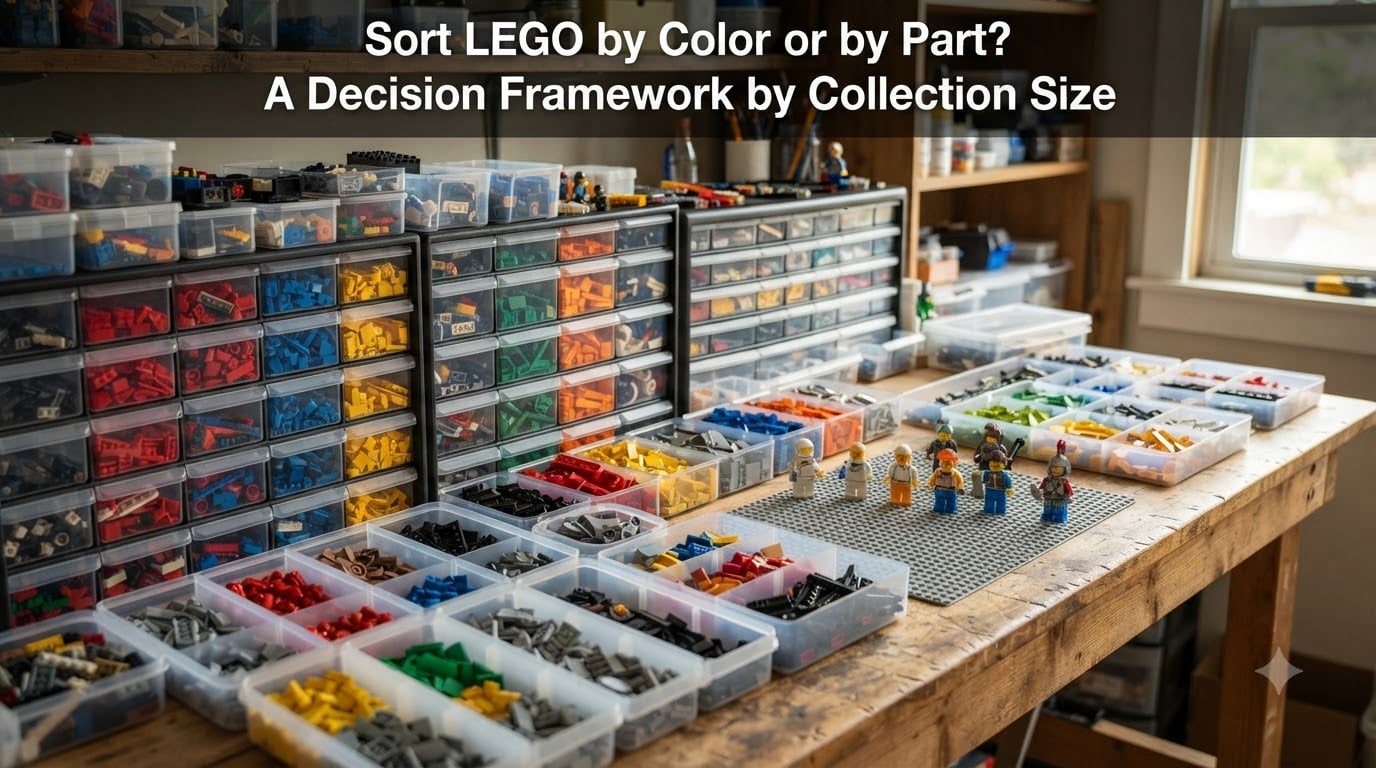
If you have ever dumped a fresh bulk LEGO haul on the floor and stared at a pile of mixed pieces wondering where to start, you are not alone. Almost every collector hits this wall. The question of whether to sort LEGO by color or by part is one of the most debated topics in the AFOL community, and the answer surprises a lot of beginners.
Here is the short version: sorting by part is better than sorting by color for almost every collection. But the right strategy actually depends on how many pieces you own and what you build. A kid with 500 bricks needs a different system than an adult MOC builder with 80,000 pieces.
We built this decision framework after studying sorting methods from collectors ranging from 500-piece starters to 250,000-piece archive builders. The goal is to help you skip the trial-and-error phase and land on a system that works for your collection size right now. Because honestly, re-sorting an entire collection is one of the most soul-crushing tasks in this hobby.
Table of Contents
The Quick Answer: Which Sorting Method Actually Works?
For most collectors above 1,000 pieces, sorting by part type outperforms sorting by color in every meaningful way. You will find pieces faster, build more efficiently, and avoid the dreaded “small part disappears into a sea of red” problem.
Color sorting feels natural because our brains love visual grouping. But the moment you need a specific 1×1 grille tile and have to dig through a bin of 4,000 red pieces to find it, the appeal wears off fast.
| Factor | Sort by Color | Sort by Part |
|---|---|---|
| Find specific pieces | Slow for small parts | Fast |
| Build from instructions | Frustrating | Smooth |
| MOC creativity | Limited | Excellent |
| Inventory tracking | Difficult | Natural fit |
| Best for collection size | Under 1,000 pieces | 1,000+ pieces |
Think of it this way. A hardware store does not organize screws by color. They organize by size and type, because that is how you actually search for them. LEGO bricks follow the same logic.
Why Color Sorting Is the Biggest Mistake Most Collectors Make
The Medium article “The Biggest Mistake You Can Make When Sorting LEGO” puts it bluntly: do not sort by color. The author argues that color-coding is your natural instinct, and that instinct will lead you astray. After talking with collectors on Reddit and Facebook LEGO groups, we found near-universal agreement on this point.
The core problem is piece scarcity within color bins. Say you sort everything by color and now you need a single black technic pin. You open the black bin and face a mountain of 2×4 bricks, plates, tiles, slopes, and brackets, all black. That pin is in there somewhere. Good luck.
Now reverse the scenario. If you sort by part type, all technic pins live together regardless of color. You open the pin drawer and immediately see every color variant lined up. Finding a black pin takes about three seconds.
Color sorting also breaks down when you build multi-color projects. Most MOCs and official sets use a dozen or more colors. If your pieces are split across color bins, every build turns into a scavenger hunt across your entire storage system.
There is one scenario where color sorting is fine: tiny collections under 1,000 pieces where you can see everything at a glance. Beyond that threshold, color sorting actively works against you.
How to Sort LEGO by Part: The Method That Actually Works
Part sorting means grouping bricks by their shape and function. All 2×4 bricks go in one container. All 1×2 plates go in another. All minifigure accessories go in a third. Color becomes a secondary attribute within each bin, not the primary organizing principle.
What “by Part” Means Exactly
A “part” in LEGO terms refers to a specific mold shape. The classic 2×4 brick is one part. A 2×3 plate is a different part. A 1×1 round tile with a hollow stud is yet another. Each of these gets its own grouping when you sort by part.
The BrickLink catalog is the gold standard here. BrickLink uses official part numbers and organizes them into categories like “Brick,” “Plate,” “Tile,” “Slope,” “Technic Pin,” and hundreds more. Many serious collectors structure their physical storage to mirror these categories.
What “by Element” Adds on Top
Tom Alphin, author of The LEGO Architect, draws a useful distinction between sorting “by part” and sorting “by element.” By part means all 2×4 bricks share one container regardless of color. By element goes one step further: each unique combination of part plus color gets its own compartment.
So a bin sorted by part might contain 2×4 bricks in red, blue, white, and gray all mixed together. A bin sorted by element would separate the red 2x4s from the blue 2x4s into different slots.
Element sorting only becomes worth the effort at very large collection sizes, usually above 50,000 pieces. For most collectors, part sorting with a bit of color sub-grouping is the sweet spot.
The Collection Size Decision Framework
This is where the framework comes together. Your collection size is the single biggest factor in choosing a sorting strategy. Here are the five tiers we recommend, based on community data and collector case studies.
Under 1,000 Pieces: Keep It Simple
At this size, do not overthink it. A single large bin or a few small drawers is perfectly fine. You can sort loosely by color if you want, or just keep everything in one container. The volume is low enough that you can find any piece in seconds just by digging.
This tier covers most casual builders, kids with a few sets, and adults just getting back into the hobby. Spend your time building, not sorting.
1,000 to 5,000 Pieces: Move to Part Sorting
This is the threshold where color sorting starts to hurt. At 3,000 pieces, a color bin can hold hundreds of mixed parts, and finding a specific small piece becomes painful. Switch to basic part sorting.
Start with broad categories: bricks in one bin, plates in another, slopes in a third, technic in a fourth. You do not need fine granularity yet. Five to ten containers will handle this range comfortably.
Reddit users consistently report that this is the collection size where they first regretted sorting by color. Many describe the moment of dumping all their color-sorted bins and starting over with part categories. Save yourself that headache and start with parts from day one.
5,000 to 20,000 Pieces: Add Category Buckets
Once you pass 5,000 pieces, broad categories are no longer enough. A single “bricks” bin becomes overwhelming. Break each category into sub-groups: standard bricks, modified bricks, and arch bricks each get their own container.
Plates split into standard plates, modified plates, and round plates. Slopes split by angle. Technic splits into pins, gears, beams, and connectors. You will likely need 20 to 40 containers at this stage.
This is also where a rolling drawer cabinet becomes worth the investment. Stackable drawers let you expand incrementally as your collection grows, and clear fronts make it easy to spot what is inside.
20,000 to 50,000 Pieces: Sub-Sort by Color Where Useful
At this tier, pure part sorting creates bins that are too large to search efficiently. A “1×2 plate” bin might hold 2,000 pieces across 30 colors. Now you add color as a secondary sort within specific high-volume part categories.
Split your 1×2 plates into warm colors and cool colors, or light and dark. Do the same for 1×1 tiles, 2×4 bricks, and other high-count parts. Leave low-volume parts in mixed-color bins since they are easy to search visually.
Jtooker.com’s case study of a 50,000-piece collection describes exactly this hybrid approach. The author groups similar colors together rather than creating a separate bin for every shade, which keeps container count manageable while improving search speed.
Over 50,000 Pieces: Full Taxonomy with Digital Tracking
Collections above 50,000 pieces require a serious system. Most collectors at this level sort by element, meaning each part-and-color combination gets its own compartment. This can mean hundreds of individual containers.
Digital inventory tools become essential here. BrickLink and Rebrickable both let you catalog your collection by part number and color, so you know exactly what you own and where it lives. Many large-scale collectors print labels with part numbers and images for every drawer.
Tom Alphin’s framework references collections up to 250,000 pieces, where the sorting system essentially becomes a miniature version of LEGO’s own warehouse logistics. At that scale, you need dedicated storage furniture, labeled shelving, and possibly a dedicated room.
The Hybrid Approach: When to Mix Part and Color Sorting
Most experienced collectors do not follow a rigid system. They use a hybrid approach that adapts to the realities of their collection. This is the approach we recommend for anyone in the 5,000 to 50,000 piece range.
The key insight is that not every part type needs the same treatment. High-volume common parts like 2×4 bricks and 1×2 plates benefit from color sub-sorting. Low-volume specialty parts like minifigure accessories or rare SNOT brackets do not.
Jtooker.com’s system uses color grouping rather than strict color separation. Instead of separate bins for dark gray, light gray, and white, those three similar colors share one bin. This cuts container count by 60% while keeping search time reasonable.
Special Cases: Technic, SNOT, and Minifigures
Technic pieces deserve their own sorting zone. Pins, axles, gears, beams, and connectors are functionally distinct and tend to be small. Mix them with standard bricks and you will lose them forever. Give technic its own set of small drawers sorted by function.
SNOT parts (Studs Not On Top) like brackets, jumper plates, and sideways-building connectors are another category that benefits from isolation. These are the parts that make advanced building techniques possible, and they tend to be scarce relative to standard bricks.
Minifigures and accessories are the third special case. Sort torsos, legs, heads, hairpieces, and accessories separately. Most collectors keep minifigure parts in small compartmented boxes since the pieces are tiny and valuable.
Storage Containers and Hardware for Each Collection Size
Choosing containers is almost as important as choosing a sorting method. The wrong containers can make even a good sorting system frustrating to use. Here is what works at each tier.
For collections under 5,000 pieces, simple stackable drawers or small tackle boxes work well. Look for containers with clear fronts so you can see contents without opening every drawer. Avoid deep bins for small parts, since you will end up digging through layers.
For 5,000 to 20,000 pieces, graduated drawer cabinets are the standard. Akro-Mils cabinets with 24, 44, or 64 small drawers are popular in the AFOL community because they are affordable, wall-mountable, and sized well for LEGO parts. Each drawer holds one part category neatly.
For 20,000+ pieces, you need a combination of large bins for bulk parts and small drawers for specialty pieces. Rolling storage carts, pegboard walls with hanging bins, and labeled shelving units all come into play. Many large-scale collectors use a mix of Sterilite containers for bulk storage and Akro-Mils drawers for active building parts.
Is There Such a Thing as a LEGO Sorter Machine?
Yes, but with caveats. Automatic LEGO sorting machines exist as hobbyist projects and commercial prototypes, but none are widely available as turnkey products in 2026. Most use a combination of camera recognition and mechanical sorting to separate pieces by color and shape.
For now, most collectors rely on manual sorting supplemented by simple tools like sorting trays, sieves for separating small pieces from large ones, and lazy susans for rotating access to multiple bins. These low-tech tools dramatically speed up the sorting process without the cost and complexity of automated systems.
Time Investment and ROI of Sorting Your Collection
One thing no competitor covers well is the actual time cost of sorting. We collected data points from forum discussions and our own experience to give you realistic numbers.
For an initial sort of a mixed collection, expect roughly 1 to 2 hours per 1,000 pieces if you are going from chaos to basic part categories. A 10,000-piece collection takes about 15 to 20 hours of focused work. That sounds like a lot, but you only do it once.
The payoff comes every time you build. Collectors who switch from color sorting to part sorting report saving 30% to 50% on build time for complex sets and MOCs. On a 10-hour build project, that is 3 to 5 hours saved. The initial sorting investment pays for itself within a few major builds.
For large collections that feel overwhelming, break the job into sessions. Sort one category per session rather than tackling everything at once. Many collectors on Reddit describe sorting as a background activity they do while watching TV or listening to podcasts.
Common Mistakes to Avoid When Sorting LEGO
We have seen the same mistakes repeated across dozens of collector stories. Here are the ones that cause the most frustration.
Sorting before counting. If you do not know your collection size, you will likely choose the wrong system. Take a rough inventory first, even if it is just weighing your collection and using the standard estimate of 300 to 400 pieces per pound.
Using too few containers. A common beginner move is to buy five big bins and call it sorted. Within weeks, each bin becomes a mini-chaos pile. More containers with fewer parts each is always better than fewer containers with more parts.
Ignoring special parts. Technic pins, minifigure accessories, and small tiles disappear instantly if mixed with larger pieces. Give these their own dedicated small containers from the start.
Sorting by color first. This is the mistake this entire article exists to prevent. If you take one thing away, let it be this: sort by part type, not by color.
Frequently Asked Questions About Sorting LEGO
Is it best to sort LEGO by color or size?
Sort by part type (shape), not by color. Color sorting creates bins where small pieces disappear among larger ones of the same color. Part sorting keeps identical shapes together, making any piece findable in seconds. The only exception is collections under 1,000 pieces where color sorting works fine due to low volume.
How many pieces do I need before I should sort my LEGO collection?
Start sorting when your collection reaches roughly 1,000 pieces. Below that threshold, a single bin or loose color grouping works fine. Above 1,000 pieces, the time spent digging for specific parts exceeds the time spent sorting, making part-based organization worth the effort.
Is there such a thing as a LEGO sorter?
Automatic LEGO sorting machines exist as DIY projects using cameras and mechanical sorters, but no mainstream commercial product is widely available. Most collectors use manual tools like sorting trays, sieves, and compartmented drawer cabinets to speed up the process.
What is the best way to sort a large LEGO collection?
For collections over 10,000 pieces, sort by part type first, then sub-sort high-volume categories by color groups. Use drawer cabinets for active building parts and large bins for bulk storage. Track your inventory digitally using BrickLink or Rebrickable so you know exactly what you own.
Final Verdict: Start Sorting by Part, Adjust as You Grow
The decision on whether to sort LEGO by color or by part comes down to one rule: sort by part type unless your collection is tiny. Color sorting is a trap that almost every collector falls into and then abandons. Part sorting scales with your collection and saves real build time.
Use the collection size framework to pick your starting point. Under 1,000 pieces, keep it loose. Between 1,000 and 5,000, go basic part categories. Above 5,000, add sub-categories. Above 20,000, layer in color grouping for high-volume parts. Above 50,000, go full element sorting with digital tracking.
The best time to start sorting by part was before you bought your first set. The second best time is today. Your future self, halfway through a complex MOC at midnight, will thank you.