
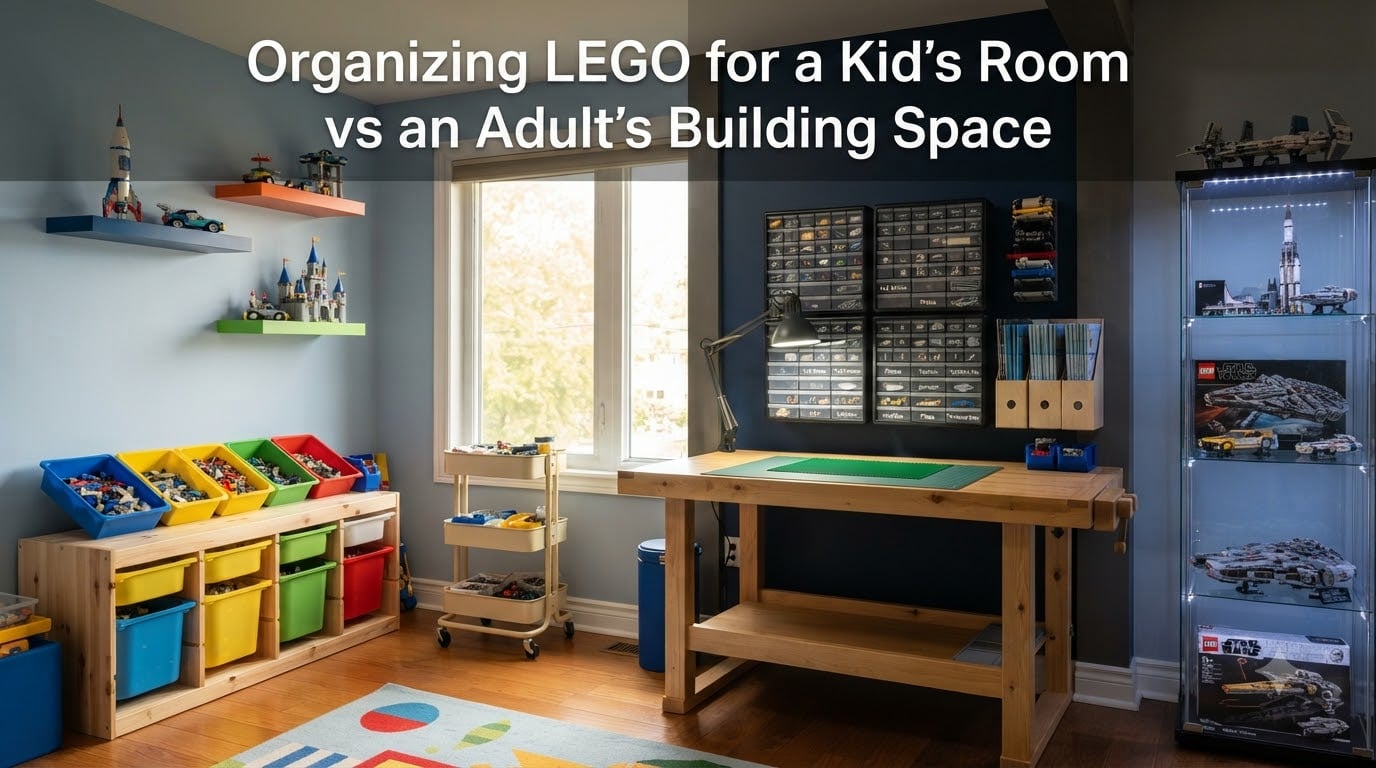
I have spent the last decade running LEGO workshops out of my garage, and I have set up more than 40 different LEGO spaces for both children and adult fans. What I learned surprised me: the storage system that works perfectly for a 6-year-old will frustrate a 30-year-old AFOL, and the hyper-organized drawer tower a hobbyist swears by will fall apart in a playroom within a week.
Organizing LEGO for a kid’s room versus an adult’s building space is not just a matter of style. The two audiences approach LEGO with completely different goals, and the best organization system grows directly out of those goals. Kids want speed, simplicity, and the freedom to make a mess. Adults want efficiency, precision, and a clean display when they are done.
In this guide, I will walk you through the exact differences, the sorting strategies that work for each, the storage containers I install most often, and a step-by-step plan for both spaces. I will also tackle the 5/2 rule, the IKEA Trofast setup, and the questions parents and hobbyists ask me most.
Table of Contents
Why LEGO Organization Differs Between Kids and Adults
The single biggest mistake I see in LEGO storage is treating both audiences the same way. A parent buys a pristine drawer organizer online, sets it up in the playroom, and three days later finds every drawer upside down on the floor. An adult hobbyist installs a beautiful open-bin system and quickly realizes they cannot find the right 1×2 plate in a sea of black bricks.
The core difference comes down to play patterns. Kids build for the joy of building, then tear down, then rebuild. Their pieces get mixed constantly. Adults, especially AFOLs (Adult Fans of LEGO), build specific sets, MOCs (My Own Creations), and often keep multiple builds in progress. They need their pieces sorted by function, not by color.
Here is the short version of the contrast:
- Kid’s room: prioritize easy cleanup, durability, and independent access. Children should be able to put their own bricks away without help.
- Adult’s building space: prioritize efficiency, precision, and a clean workspace. Adults want to find a specific piece in under 30 seconds.
Is LEGO more popular with kids or adults? According to the LEGO Group’s own annual reports, adult buyers now make up a significant share of the market, with the 18-plus segment growing every year since 2026. AFOLs account for roughly one-third of total sales, and adult-themed sets like the Botanical Collection and Icons series dominate the top-seller lists. That said, the average kid still goes through more pieces per week than the average adult, so the volume of disorganized bricks on a playroom floor is unmatched.
Understanding the Kid’s Room Setup
A kid’s room is a LEGO battlefield, and your organization system needs to accept that. I have set up spaces for toddlers who can barely stack two bricks, and I have set up spaces for 11-year-olds running full LEGO city layouts. The principles are the same: make it low, make it open, and make it forgiving.
Here are the rules I follow for any kid’s room setup:
- Keep storage at child height. If the bins are above their shoulders, they will not put pieces away. Trofast units work perfectly because the lowest drawer sits about 12 inches off the floor.
- Use open bins, not closed boxes. Kids need to see what is inside. A clear lid they can flip open is fine. A screw-top container is a brick graveyard.
- Sort by chunky categories. Wheels with wheels, minifigures together, big plates in one bin, regular bricks in another. Trying to sort by exact part number is a recipe for chaos.
- Use photo labels. Non-readers and early readers can match a printed picture to the contents. I print my labels on a color printer and laminate them with shipping tape.
- Add an unsorted overflow bin. Every working kid system has at least one bin labeled “LEGO” or “Mixed” where pieces can go when nobody knows what they are. This single bin prevents 80% of cleanup frustration.
Durability matters more than aesthetics. Kids will yank bins off shelves, drop heavy pieces into containers, and occasionally try to sit on top of the storage. Choose plastic over fabric, wide bases over tall towers, and rounded corners over sharp edges.
Understanding the Adult’s Building Space
An adult’s building space is closer to a workshop than a playroom. I run my own adult LEGO space out of a converted basement corner, and the system looks nothing like what I set up for kids. The drawers are smaller, the labels are more specific, and the whole layout is designed for finding pieces, not putting them away quickly.
Key principles for the adult builder:
- Sort by brick type, not color. A 1×2 plate in black looks identical to a 1×2 plate in dark gray, but they sit in different categories for an adult builder. Color sorting is too broad to be useful for complex sets.
- Use drawer organizers with many small compartments. Akro-Mills drawer cabinets are the gold standard here. Each drawer holds one type of piece, and the labels sit on the drawer fronts.
- Create a dedicated work surface. A flat, color-neutral baseplate or smooth tabletop with a task lamp above it. Without a workspace, your organization system just shifts the chaos to a different location.
- Keep instruction manuals flat and visible. Adult builders often have 20+ sets in rotation. A labeled binder or magazine file for current manuals saves hours of searching.
- Build a separate display area. Once a set is built, it should leave the building space. A curtained shelf, a glass cabinet, or a wall-mounted display case keeps finished builds out of the active workspace.
Adult builders also tend to care about dust. A displayed set left in the open for six months will collect a layer of fine gray dust that is annoying to clean. Glass-front cabinets solve this. If you prefer open shelving, plan on a monthly wipe-down with a soft microfiber cloth and a gentle brush for the small crevices.
Sorting Strategies: Color vs Type vs Set
There are three main ways to sort LEGO, and the right one depends on who is using the system. I have tested all three in dozens of homes, and here is how they stack up.
Color Sorting: Best for Kids
Color sorting is the easiest system to teach and the most intuitive for young children. Red bricks go in the red bin, blue bricks in the blue bin, and so on. Kids love the visual match, and cleanup becomes almost a game.
The downside is that color sorting is not very useful for actual building. If you need a specific 2×4 brick in dark gray, sorting by color only narrows it down to one bin. You still have to dig.
Use color sorting when the audience is under 10, when the collection is small enough to fit in one wall of bins, and when the main goal is fast cleanup rather than complex building.
Type and Size Sorting: Best for Adults
Type and size sorting is the adult builder’s standard. Plates in one drawer, bricks in another, slopes in a third, Technic pieces in a fourth, and specialty pieces like brackets, hinges, and modified bricks in their own labeled drawers. Within each drawer, you can sub-sort by size or color.
This is the most efficient system for finding pieces, but it takes time to set up and requires consistent maintenance. It also requires a lot of small compartments, which is why drawer organizers work better than open bins for adults.
Use type sorting when the audience is an adult hobbyist, when the collection is large or growing, and when the main goal is building specific sets or MOCs.
Set Keeping: A Hybrid for Families
Set keeping means keeping each set’s pieces together in its own labeled bin. This works well for families who buy LEGO sets as gifts and want to rebuild them later. It does not work well for kids who like to mix sets together.
If your child mixes sets (and most do), set keeping will fail. If you keep unopened sets for display, set keeping is the only way to preserve resale value and rebuild integrity.
The 5/2 Rule
The 5/2 rule in LEGO is a community saying that captures the trade-off between sorting and building. The idea is this: spend 5 minutes putting a piece away properly, and you will save 2 hours of searching later. The exact numbers are not scientific, but the principle is real. An organized collection makes building faster, even if the organization takes time to maintain.
This rule is the reason adult builders invest in drawer organizers. The 5 minutes of putting a piece in the right drawer pays back in 2 hours of avoided searching.
The Unsorted Bin
Every LEGO organization system, whether for kids or adults, should have an unsorted bin. This is the bin where pieces go when nobody knows what they are or when somebody is too tired to sort properly. Without it, the organization system becomes another source of friction. With it, the system can survive real life.
Storage Container Recommendations for Each Space
Here are the containers I recommend most often, split by audience.
For Kids’ Rooms
- IKEA Trofast bins: The most popular kid’s LEGO storage for a reason. The bins are open, sized for small hands, and come in a frame that grows with the collection. Most families I work with start with two frames and add more as needed.
- Clear stackable bins with latching lids: Useful for keeping sets together or for storing pieces that need to be out of reach. I recommend Sterilite or similar brands available at any big box store.
- Photo labels: Printed on cardstock, laminated with packing tape, and stuck to the front of each bin with removable adhesive. A photo of the contents beats any text label for non-readers.
- Rolling cart with three tiers: A simple utility cart holds a work surface on top, active bins in the middle, and overflow at the bottom. It moves out of the way when floor time is over.
For Adult Building Spaces
- Akro-Mills drawer cabinets: The hobbyist standard. Each drawer holds one piece type. The cabinets stack vertically to save floor space, and you can add cabinets as the collection grows.
- Stackable organizer boxes with adjustable dividers: Useful for medium-sized pieces like minifigures, accessories, or specialty parts. Look for boxes with clear lids so you can see contents at a glance.
- Magazine files for instruction manuals: A labeled file for each active set keeps manuals upright and visible. I use a simple cardboard file for current projects and store retired manuals in a labeled binder.
- Glass display cabinets: For displaying completed sets without dust. Choose a cabinet with adjustable shelves so you can fit builds of different heights.
Both audiences benefit from IKEA Trofast. Kids use the bins as they come. Adults often remove the bins and replace them with custom inserts or smaller drawers. The frame is the same; the inside is what changes.
Display Solutions: Kid-Friendly vs Adult Showcase
Displaying built sets is where the kid-adult split becomes most visible. Kids want their builds at eye level and within reach. Adults want their builds protected, dust-free, and styled like a gallery.
Kid-Friendly Display Ideas
- Floating shelves at child height. A row of 24-inch floating shelves at 40 inches off the floor holds current builds and rotates easily.
- Wall-mounted minifigure displays. Clear acrylic frames with individual compartments let kids show off their favorite characters. Look for frames designed for Lego minifigures.
- Play-and-display hybrid. A shelf with a tray edge that lets kids pick up builds to play and then return them to the same spot. This is the most-used display in my own home.
Adult Showcase Ideas
- Glass display cabinets with LED lighting. The classic hobbyist setup. Adjustable shelves, soft interior lighting, and a dust-proof seal make this the gold standard for serious collections.
- Curated gallery walls. Floating shelves arranged in a grid pattern, with each shelf holding one or two hero builds. This works well for Botanical Collection sets, modular buildings, and minifigure-scale scenes.
- Shadow boxes for minifigures. Framed shadow boxes with custom backgrounds turn small collections into wall art. Many hobbyists build entire star wars or city scenes in a single shadow box.
Cleaning Display Sets
Dust is the number one enemy of displayed LEGO sets. To clean a set, I use a soft makeup brush to remove loose dust, then a microfiber cloth lightly dampened with water for stubborn spots. Avoid compressed air, which can push dust into crevices. For deeper cleaning, a can of air works for hard-to-reach joints, but follow up with a brush.
Step-by-Step: Setting Up a Kid’s LEGO Space
Here is the exact process I walk parents through when setting up a kid’s LEGO space. Plan on a weekend for the full setup, and expect to refine the system over the next month.
Step 1: Round Up All Pieces
Gather every LEGO piece, instruction manual, and minifigure from around the house. The couch cushions, the car floor, the toy box, and the bathtub (yes, it happens) are all fair game. Dump everything into a single large container.
Step 2: Sort by Set or Large Group
Sort into broad categories: complete sets with manuals, loose bricks by color group, minifigures, and “mystery pieces.” Do not try for fine-grained sorting at this stage. You are teaching the system, not perfecting it.
Step 3: Place at Child Height
Set up an IKEA Trofast (or similar) frame with bins at the lowest level. Each bin gets a category: red bricks, blue bricks, wheels, minifigures, and so on. The unsorted bin goes at the very bottom for easy access.
Step 4: Add Photo Labels
Print photos of each bin’s contents, laminate them, and stick them to the front of the bin. For complete sets, use a photo of the finished build. Kids will learn to match bricks to the right bin in minutes.
Step 5: Build a Reset Routine
Set a 5-minute cleanup time at the end of each play session. Make it a game, not a chore. Use a timer and a fun song. Kids will maintain systems they enjoy using, and ignore systems they hate.
Step-by-Step: Setting Up an Adult Building Space
For adult builders, the setup is more involved but follows a clear pattern. Plan on a full weekend and a follow-up week to refine the system.
Step 1: Define Workspace Zones
Divide your space into four zones: a build zone with a flat surface and good lighting, a sorting zone with your drawer organizer, a reference zone for instruction manuals and digital resources, and a display zone for finished sets.
Step 2: Sort by Piece Type
Start with the most common pieces: 1×2 plates, 2×4 bricks, 1×1 round plates, slopes, and Technic pins. Each gets its own drawer. Add specialty drawers as the collection grows.
Step 3: Build the Drawer Tower
Stack your drawer cabinet vertically to save floor space. Keep the most-used drawers at waist height, and the rare-piece drawers higher up. Label every drawer front clearly.
Step 4: Set Up Reference Storage
Magazine files for current instruction manuals, a binder for archived manuals, and a tablet or laptop stand for digital instructions. Knowing where your instructions are is half the battle.
Step 5: Build the Display Area
Install your shelves, cabinets, or shadow boxes in a separate zone. Once a build is complete, it leaves the build zone and enters the display zone. This keeps your build space clean and your display growing.
Maintaining Organization Over Time
Organization is not a one-time project. It is a habit. The setups that last are the ones that fit into the user’s daily life, not the ones that look best on Instagram.
For Kids
- Refine the bins quarterly. As your child grows, their building style changes. Toddlers sort by color. Older kids sort by set or theme. Adjust the labels every few months.
- Celebrate cleanup, not perfection. If the bricks are in the right bin but not the right order, that is a win. The goal is to make cleanup easy, not to enforce museum-level sorting.
- Rotate sets to keep interest. Store some sets out of reach and swap them in every few weeks. This keeps the visible collection fresh and prevents the “I never play with that” pile.
For Adults
- Sort new pieces immediately. When you open a new set, sort the pieces into your drawers as you build. This prevents the pile of mixed pieces that always seems to grow on the workbench.
- Wipe down displayed sets monthly. Dust is inevitable. A quick monthly wipe prevents buildup and keeps the display looking sharp.
- Add drawers as the collection grows. Do not try to fit your entire collection into a fixed number of drawers. Add a new cabinet every year or two as new sets come in.
Transitioning From Kid to Adult Style
Many adult builders started as kids. The transition from a child’s open-bin system to an adult’s drawer system usually happens in the teenage years. I recommend keeping the kid’s color-sorted system for daily play, and adding a small drawer organizer for advanced builds. As the collection grows, the drawer system takes over, but the color bins remain useful for casual play.
Frequently Asked Questions
What is the 5/2 rule in LEGO?
The 5/2 rule in LEGO is a community principle that says spending 5 minutes putting a piece away properly saves 2 hours of searching later. The exact numbers are not scientific, but the trade-off is real. An organized collection makes building faster, even when the organization takes time to maintain.
What is the best way to organize LEGOs for kids?
The best way to organize LEGOs for kids is to use open bins at child height, sort by broad color or category, and add photo labels. Include an unsorted overflow bin for pieces nobody can identify. Use a sturdy frame like IKEA Trofast, and keep the system simple. Kids maintain systems that are easy to use and forgiving of mistakes.
How to display LEGOs in a kids room?
To display LEGOs in a kids room, install floating shelves at child height, use wall-mounted minifigure frames, and create a play-and-display hybrid that lets kids pick up builds and return them. Keep the display within reach so kids can rotate their favorites. Use clear ledges to prevent builds from falling.
Is LEGO more popular with kids or adults?
LEGO is popular with both kids and adults, but the adult segment has grown significantly in recent years. According to LEGO Group reports, adult buyers now make up roughly one-third of total sales, and adult-themed sets like Icons and Botanical Collection dominate the top-seller lists. Kids still go through more pieces per week, but adult hobbyists spend more per year on average.
What containers work best for adult LEGO storage?
The best containers for adult LEGO storage are small drawer organizers like Akro-Mills cabinets, stackable boxes with adjustable dividers, and clear bins for specialty pieces. Each drawer should hold one type of piece, with labels on the front. Glass display cabinets with adjustable shelves work best for completed sets.
How do you keep LEGO organized long-term?
To keep LEGO organized long-term, set a weekly reset routine and refine the system as your collection grows. For kids, celebrate cleanup over perfection and rotate sets to keep interest. For adults, sort new pieces immediately as you build, wipe down displayed sets monthly, and add drawer cabinets as the collection expands.
Final Thoughts on Organizing LEGO for a Kid’s Room vs an Adult’s Building Space
Organizing LEGO for a kid’s room versus an adult’s building space comes down to one question: who is using the system, and what are they trying to do? Kid’s rooms thrive on simple, open, low storage that turns cleanup into a quick game. Adult building spaces thrive on granular, drawer-based sorting that turns piece finding into a five-second task.
Pick the system that matches your goals, build in an unsorted overflow bin from day one, and refine the labels every few months. Whether you are a parent setting up a playroom or an adult hobbyist building your dream MOC, the right organization system will let you spend less time searching and more time building. That is the whole point of LEGO in the first place.