
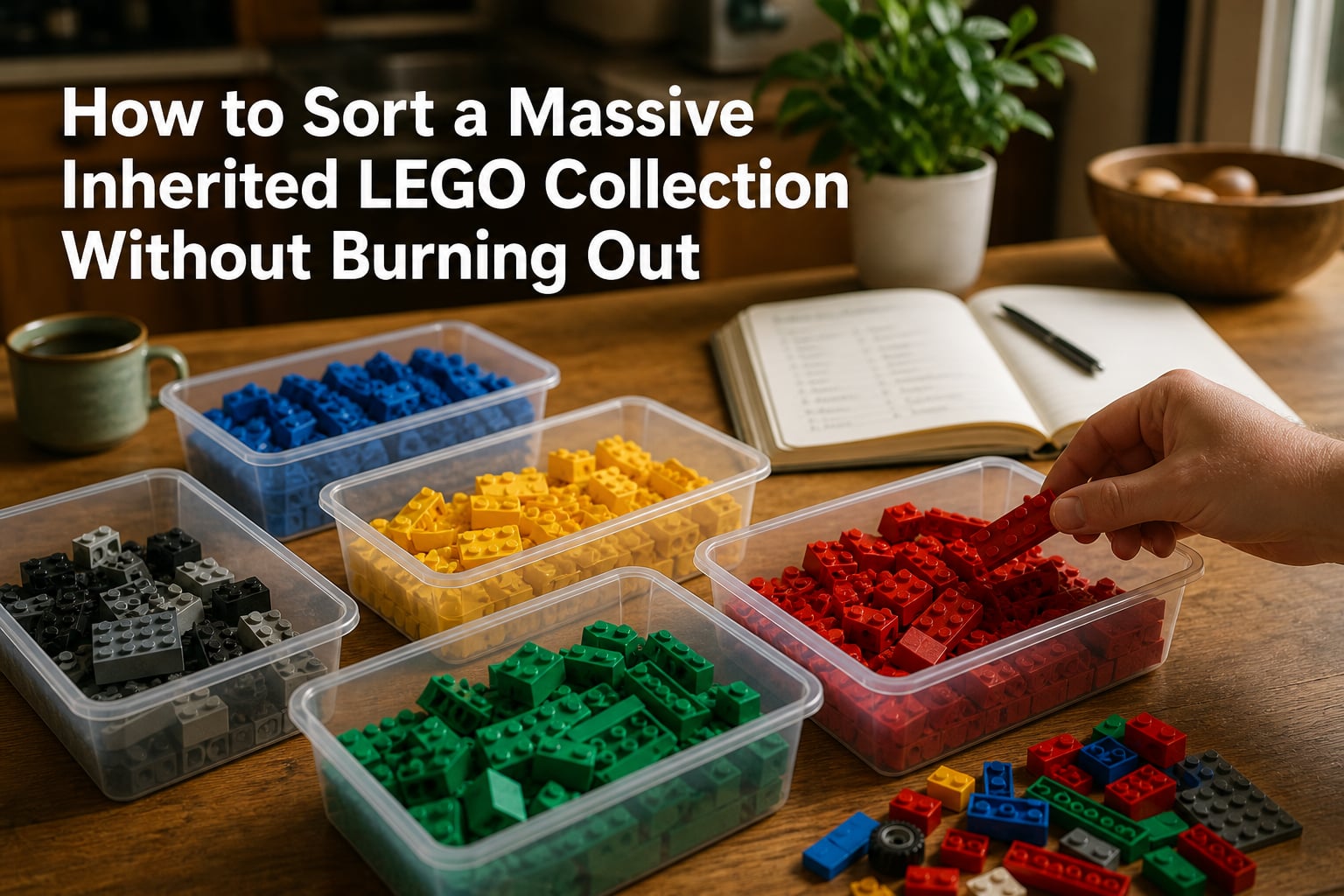
You opened a box, then another, then twelve more. Now there are LEGO bricks covering every flat surface in your home, and the idea of sorting them all feels like climbing a mountain in flip-flops. If you are trying to figure out how to sort a massive inherited LEGO collection without burning out, you are in the right place.
I have been there. Our team has talked with hundreds of collectors through Reddit, Eurobricks, and Facebook groups who inherited collections ranging from a few thousand pieces to over a quarter million. The pattern is always the same: excitement, then overwhelm, then paralysis.
Here is the good news. You do not need to sort everything perfectly. You do not need expensive storage systems. And you definitely do not need to finish in a weekend. What you need is a clear plan, realistic expectations, and permission to stop when the job is good enough.
This guide walks through every phase of sorting an inherited LEGO collection, from your first visual assessment to long-term storage. I will share the strategies that experienced collectors actually use, including the 85% rule, the color-versus-type debate, and how to involve your family without losing your mind.
Table of Contents
How to Assess Your Inherited LEGO Collection Size
Before you touch a single brick, you need a rough sense of what you are dealing with. Collection size determines your entire sorting strategy, so a quick assessment saves you hours of wasted effort.
Start by estimating volume rather than counting individual pieces. A standard 1-gallon zip-top bag holds roughly 400 to 500 loose bricks. A typical storage tote (about 10 gallons) holds around 4,000 to 5,000 pieces. If you have three of those totes, you are looking at a collection in the 12,000 to 15,000 piece range.
Here are the collection size thresholds that experienced collectors use to decide on a sorting strategy:
Under 3,000 pieces: Sort by color into a few bins. You can find anything by digging briefly.
3,000 to 10,000 pieces: Begin sorting by broad category (bricks, plates, slopes, technic). Color sorting alone starts wasting your time at this scale.
10,000 to 50,000 pieces: Sort by part type within categories. You need labeled compartments to find things efficiently.
50,000 to 250,000 pieces: Full part-and-element-level sorting with dedicated drawer systems. This is a months-long project.
Over 250,000 pieces: Professional-grade organization with potential BrickLink inventory integration for selling or trading.
Be honest with yourself about where you land. Overestimating leads to over-engineering your storage. Underestimating means you will outgrow your system in a month.
The 85% Rule: Why Perfect Sorting Is a Trap
The single most important thing I learned from the LEGO community is the 85% rule. It works like this: if your collection is 85% sorted, you are done.
That last 15% is where burnout lives. It is the drawer of weird hybrid pieces, the technic connectors you cannot identify, the partial assemblies you are not sure whether to dismantle. Chasing perfection in those corners is how people quit halfway through a sorting project and end up with a worse mess than they started.
The BrickNerd community validated this philosophy repeatedly. One collector put it perfectly: realize that sorting LEGO is a losing proposition. You will always generate new unsorted pieces as you build, dismantle, and acquire. Accepting that fact frees you from the trap of thinking you will ever reach 100%.
So set your target at 85%. When you hit it, stop and enjoy the collection. The remaining unsorted bits become your “sorting fund” for future rainy-day sessions, not a source of guilt.
Color vs Type Sorting: Which Approach Actually Works
This is the most debated question in LEGO organization, and I am going to give you a direct answer. For collections over 3,000 pieces, sorting by type beats sorting by color every single time.
Color sorting is tempting because it looks beautiful. A bin of bright red pieces, a bin of blue, a bin of white. The problem hits when you actually try to build something. You need a specific part, and now you are digging through 800 red elements looking for one 2×4 plate.
Type sorting means grouping by element category: all 2×4 bricks together, all plates together, all slopes together. When you want a specific piece, you go straight to its bin and grab it. The color variety within each bin does not slow you down.
Here is a quick comparison to help you decide:
Color sorting pros: Visually satisfying, easy for kids to help with, works fine for small collections under 3,000 pieces.
Color sorting cons: Terrible for building, every search becomes a dig, scales badly as collection grows.
Type sorting pros: Fast piece retrieval, scales to any collection size, aligns with how instructions reference parts.
Type sorting cons: Less visually striking, requires more containers upfront, harder for young kids to assist.
The best approach for most inherited collections is a hybrid system. Sort broadly by category first (bricks, plates, slopes, technic, minifigure parts, wheels, and specialty). Then within high-volume categories, subdivide by part type. Only use color sorting for small specialty categories like minifigure accessories or transparent pieces.
The 7-Phase Sorting Process for Massive Collections
This is the system I recommend for any inherited collection over 5,000 pieces. It breaks the job into manageable phases so you never face an overwhelming wall of bricks. Work through them in order, and take breaks between phases.
Phase 1: Gather Containers and Clear Your Workspace
Before you start, collect every container you already own. Shoe boxes, plastic tubs, zip-top bags, Tupperware, mixing bowls. You do not need to buy anything yet. Clear a table or floor space that you can dedicate to sorting for the next few weeks.
The kitchen table works well because you can sort in short bursts between other activities. Just sweep everything into a tote when you need the table for dinner.
Phase 2: Dismantle and Stack Everything Built
Inherited collections almost always include partially built sets, half-finished creations, and random stacked assemblies. Your first sorting task is to dismantle these. Use a brick separator if you have one, or pry pieces apart gently with your fingernails to preserve clutch power.
As you dismantle, stack identical pieces together. Two 2×4 bricks become a stack of two. This immediately reduces visual chaos and gives you a sense of your most common elements. Stacking also saves enormous space compared to loose pieces.
Phase 3: Pull Out Large and Awkward Pieces
Grab the big stuff first. Baseplates, large panels, boat hulls, train track sections, and oversized specialty pieces should come out of the pile immediately. These pieces take up disproportionate space and make sorting smaller elements harder.
Sort large pieces into one or two dedicated bins. You will subdivide them later if needed, but getting them out of the main pile clears your mental space.
Phase 4: Separate Minifigures, Instructions, and Special Pieces
Minifigures should come out early. They are valuable, fragile, and easy to lose in a sea of bricks. Set aside all minifigures, their accessories, and any instruction manuals you find. Check inside boxes and bags carefully because instructions are often tucked away.
Also pull out anything that looks rare, unusual, or sentimental. Chrome pieces, printed elements, transparent parts, and anything with personal meaning goes into a separate “handle with care” bin for later evaluation.
Phase 5: Coarse Sort by Broad Category
Now the real sorting begins. Set up 6 to 8 bins for broad categories: standard bricks, plates, slopes and curves, technic pieces, wheels and vehicle parts, small specialty elements, and “not sure yet.” Run through the pile and drop each piece into its category bin.
Do not overthink this phase. If a piece could go in two categories, pick one and move on. Speed matters more than precision here. You can always re-sort a category later.
Phase 6: Fine Sort by Part Type Within Categories
Take one category bin at a time and subdivide it. Within “bricks,” separate 1x1s, 1x2s, 2x2s, 2x4s, and so on. Within “plates,” do the same. Work on one category per sorting session so you stay focused.
This is the phase that takes the longest and where the 85% rule matters most. If you encounter pieces you cannot identify or categorize, toss them into a “mystery” bin and move on. Do not let puzzling pieces stall your progress.
Phase 7: Label Everything and Establish Your Storage System
Once your categories are established, label every container clearly. Use whatever labeling system works for you: masking tape and a marker, printed labels, or even a sharpie on the bin itself. The labels are for future-you, so make them obvious.
At this point, decide whether you need to upgrade from temporary containers to permanent storage. If your system works with shoe boxes and zip bags, keep it. Function beats aesthetics every time.
How to Handle Rare Pieces, Minifigures, and Instructions
Inherited collections often contain valuable pieces that deserve special treatment. Knowing what to set aside protects both financial value and sentimental meaning.
Minifigures are typically the most valuable part of any collection by weight. A single rare minifigure can be worth more than 50 pounds of common bricks. Keep all minifigures together in a dedicated container, ideally with their accessories matched up. If you plan to sell eventually, do not disassemble them because complete figures sell for more.
Watch for these high-value piece types as you sort: chrome and metallic elements, printed tiles and panels, transparent colored pieces, large boat and airplane hull sections, and anything with unusual stud configurations. Set these aside in a separate bin and research their value on BrickLink when you have time.
Instruction manuals are easy to overlook but matter enormously. They help you identify which sets are in the collection, which increases resale value if you choose to sell complete sets later. Store manuals flat in a folder or binder, sorted by set number if you can identify them.
Storage Solutions for Every Budget
You do not need to spend hundreds of dollars to store a massive LEGO collection. Here are three tiers of storage solutions that all work well, depending on your budget and space.
Budget tier (under $30): Dollar store shoe boxes are the unsung heroes of LEGO storage. They are uniform, stackable, and cheap enough to buy by the dozen. Zip-top gallon bags work inside boxes to subdivide categories. Label the outside with a marker and you have a functional system that costs almost nothing. Many Reddit collectors swear by this approach for collections up to 20,000 pieces.
Mid tier ($30 to $100): IKEA ALEX drawers and SORTSO boxes are the community favorite in this range. A single ALEX drawer unit holds a surprising volume of sorted pieces and rolls under a desk for space efficiency. Pair with small compartment boxes from craft stores for tiny elements like studs, tiles, and minifigure accessories.
Premium tier ($100 and up): Hardware drawer cabinets like Akro-Mils or Stanley provide the gold standard for part-level sorting. Each small drawer holds a specific element type, and clear fronts let you see contents at a glance. This is what serious collectors and BrickLink sellers use for collections over 50,000 pieces.
Whatever tier you choose, label everything. A labeling system is what separates a functional sorting setup from a pile of bins you still have to dig through. Use large, readable labels on the front of every container.
Keep, Sell, or Part Out: Making Decisions Without Regret
One of the hardest parts of inheriting a LEGO collection is deciding what to do with it. You might feel pressure to keep everything out of respect, or guilt about wanting to sell. Both feelings are valid, and there is no single right answer.
Start by identifying complete sets. If you have full sets with instructions, those hold the most value sold as complete units. Use BrickLink to identify set numbers from the instruction manuals or by matching piece combinations. Complete sets sell for significantly more than the same pieces sold as bulk loose bricks.
For pieces without matching sets, consider parting out on BrickLink. This means inventorying individual elements and listing them for sale by part number. It takes time but can generate meaningful income from a large collection. Many inherited collections fund their own storage systems this way.
If you just want the collection gone quickly, bulk selling on eBay or local Facebook groups is the fastest option. Expect lower returns per piece but immediate space recovery. Some collectors split the difference: keep the pieces and sets they love, sell the rest in bulk.
Whatever you decide, give yourself permission to change your mind. You can keep everything now and sell later, or sell now and keep a small sentimental bin. The collection belongs to you now, not to the person who left it.
How to Involve Family Without Starting a War
If you inherited the collection from a family member, emotions are already running high. Sorting together can be a beautiful way to process grief and share memories. It can also spark arguments about what to keep, sell, or give away.
Set ground rules before anyone touches a brick. Decide as a group what happens with complete sets, rare pieces, and the overall collection fate. Write it down so there is no confusion later.
Give kids age-appropriate sorting tasks. Young children love color sorting and pulling out minifigures. Older kids can handle category sorting and even dismantling built sets. Make it a shared activity rather than a chore, and keep sessions short enough to stay fun.
If family members disagree about what to do with the collection, consider dividing it. Each person takes a portion to sort, keep, or sell as they choose. This avoids power struggles and lets everyone process the inheritance in their own way.
Avoiding Burnout: Mental Strategies That Actually Work
Sorting a massive LEGO collection is a marathon, not a sprint. The collectors who finish are not the ones who work the hardest. They are the ones who manage their energy and expectations.
Time-box your sorting sessions. Set a timer for 30 or 45 minutes and stop when it goes off, even if you are on a roll. Short, regular sessions prevent the exhaustion that comes from marathon sorting days. Three 45-minute sessions per week will sort a 10,000-piece collection in about two months without ever feeling overwhelming.
Track your progress visually. Take a photo of your workspace at the start of each session. Over weeks, you will see the unsorted pile shrink and the sorted bins multiply. This visible progress is incredibly motivating when the job feels endless.
Accept that sorting is itself a hobby. Many collectors in the community say they enjoy the sorting process as much as building. Lean into that. Put on a podcast, pour a drink, and treat sorting as a relaxing activity rather than an obligation you need to power through.
If you hit a wall, stop completely for a week. Come back when you want to, not when you feel you should. The collection waited this long. It can wait a little longer.
Frequently Asked Questions
How to sort large LEGO collections?
Sort large LEGO collections in phases: start by dismantling built pieces, pull out large items and minifigures, then coarse sort by broad category (bricks, plates, slopes, technic). Finish by subdividing each category into specific part types. Use labeled containers and aim for 85% completion rather than perfection.
What is the LEGO 5 2 rule?
The LEGO 5-2 rule refers to the SNOT (Studs Not On Top) building ratio of 5 to 2, meaning five plates stacked equals the height of two studs sideways. It is a building technique guideline, not a sorting rule, but understanding it helps when categorizing plates and bricks during organization.
What to do with a large LEGO collection?
With a large LEGO collection you have three main options: keep and sort it for personal building, sell complete sets or bulk lots on eBay and BrickLink, or part out individual pieces for sale by element type. Many collectors combine approaches, keeping sentimental pieces and selling the rest to fund storage and new sets.
Is it better to sort or not sort LEGO?
Sorting is better for collections over 3,000 pieces because it makes finding specific parts dramatically faster. For smaller collections, minimal sorting by color works fine. Sorting by part type rather than color is the most practical approach for serious builders and large inherited collections.
How long does it take to sort a large LEGO collection?
A 10,000-piece collection typically takes 20 to 30 hours of sorting spread over several weeks. A 50,000-piece collection can take 100-plus hours over months. Working in focused 30 to 45 minute sessions, most collectors can sort a moderate inherited collection in two to three months without burning out.
You Can Sort This Collection
Sorting a massive inherited LEGO collection without burning out comes down to three things: a clear plan, realistic expectations, and permission to stop at 85%. The 7-phase process works for any collection size, and you can adapt it to whatever containers and space you already have.
Remember that the collection now belongs to you. Whether you keep it all, sell it, or somewhere in between, there is no wrong decision. Start with one bin, set a timer, and sort for 30 minutes. That is all it takes to begin.
The bricks are not going anywhere. Take your time, enjoy the process, and know that every session brings you closer to a collection you can actually use and enjoy.