
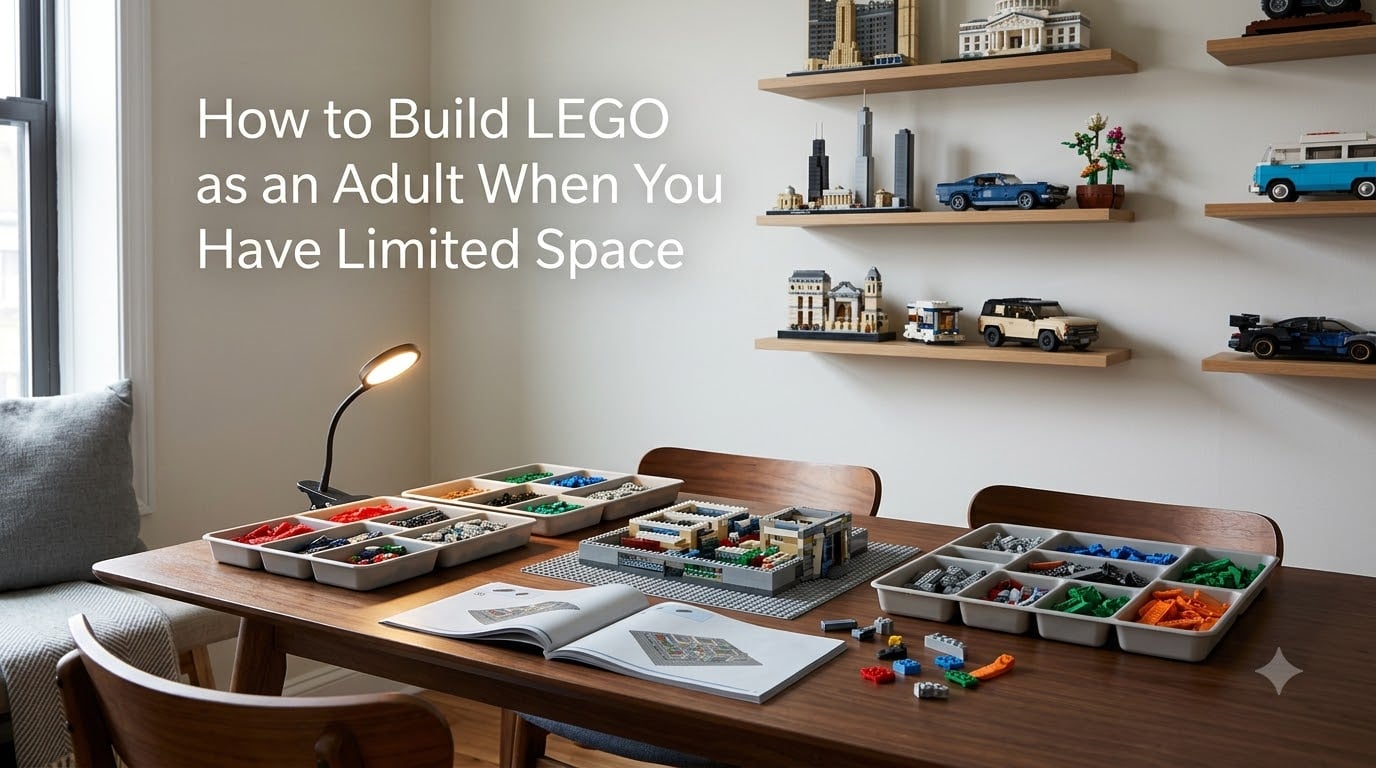
If you have ever stared at a 1,500-piece set and a kitchen counter that fits two mugs, you already know the problem. I lived in a 480-square-foot studio for two years while collecting LEGO, and I rebuilt my whole approach three times before it stopped feeling like a war with my own furniture. This guide is what I wish someone had handed me on day one.
Learning how to build LEGO as an adult when you have limited space is less about shrinking your hobby and more about designing a system that flexes with your apartment. In this guide, I will walk through the portable surfaces, the pack-up routine, the storage tricks, and the time-management moves that let adults in small homes actually finish big sets. You will also find community-tested solutions from Reddit builders who face the same walls, both literal and figurative.
Table of Contents
Why Adult LEGO Building Is Worth Making Space For
Adult LEGO building is no longer a guilty secret. AFOLs (Adult Fans of LEGO) make up a growing share of the market, and the reasons are surprisingly consistent across forums and interviews.
Building offers a rare pocket of mindfulness in a noisy day. Snapping bricks into place forces your brain to track bag numbers, sticker sheets, and a build sequence, which crowds out the open browser tabs and unread emails. Many builders describe the hobby as meditation they can actually finish.
The hobby also delivers real stress relief. A two-hour build session reliably drops my shoulders about two inches lower than when I started. The physical satisfaction of seeing a bag of parts become a recognizable shape is something few other hobbies can match.
Limited space is the one constraint that pushes adult builders out of the hobby before they ever finish a flagship set. Solving that constraint early unlocks every other benefit, which is why the rest of this guide exists.
Choosing Your Building Surface When You Have No Room
The single biggest upgrade you can make is choosing the right building surface. The wrong surface turns a relaxing hobby into a piece-cleaning chore. The right surface lets you literally pick up your build and move it.
I tested five surfaces over six months in three different apartments. Here is the honest comparison.
Shallow plastic trays work beautifully for one or two bags at a time. They are cheap, stackable, and almost every builder owns something that qualifies. The downside is sliding: a tray on a glossy table will migrate across the room as you push pieces.
Building boards are the sweet spot for most small-space adults. A standard 15×15 stud baseplate plus a 10×10 plate gives you a defined work area that catches dropped pieces and stops the whole project from drifting. You can also commit to keeping the set on the board and stack boards vertically between sessions.
Wedge-shaped sorting trays with raised lips keep parts visible and contained. They take a little more room than a flat board but dramatically reduce the time spent hunting for that one gray 2×4 plate. For sets above 1,000 pieces, they are almost mandatory in my workflow.
A cutting mat or silicone baking sheet is the budget hack that surprised me. The grippy surface stops pieces from sliding, and the flexible material lets you funnel leftovers into a bag with one bend. It is also easy to roll up and store behind a couch.
Modular storage caddies with multiple small bins work for builders who treat LEGO like a daily coffee ritual. You can dedicate one bin per bag and avoid the mental load of sorting during a session.
For most adults building in small homes, I recommend starting with one building board per active project plus two wedge trays. That combination fits inside a kitchen cabinet and handles roughly 80% of the sets you will ever open.
How to Set Up a Portable LEGO Building Station
A portable station is how you turn any flat surface in your apartment into a temporary build zone. It also means you can share space with a partner or roommate without leaving a brick graveyard behind.
Step 1. Pick a base. Choose a small lap tray, a foldable TV table, or the lid of a plastic storage bin. Anything 15×15 inches or larger will host most mid-size sets. The base needs to be rigid, because a wobbly table breaks the calm of a build.
Step 2. Add a building surface. Place a baseplate or cutting mat on top of your base. This stops pieces from sliding and gives you a known footprint. I keep two 10×10 plates taped together as a portable surface that fits in a shoebox.
Step 3. Stage your pieces. Open only the bags you need for this session. Pour them into shallow trays, with one bag per tray. Sort by size, not by color, when you start: it speeds up the first build and reduces mistakes.
Step 4. Stage the manual. Use a binder clip to hold the instruction manual open to the current page. Fold the sticker sheet into the manual so it does not get lost. A phone stand works as a second screen if you prefer the digital instructions.
Step 5. Light the area. A small clip-on LED light costs about the price of a coffee and prevents eye strain during late-evening sessions. Aim it from your non-dominant side to avoid hand shadows.
Step 6. Set a timer. Give yourself a defined stop point. Twenty-five minute focused blocks, with five minute breaks, work well and fit inside a TV commercial break for anyone sharing the space.
Your station should collapse into a single bin you can slide under a bed or behind a couch. If it does not, simplify until it does. The whole point is that LEGO stops competing for square footage with the rest of your life.
How to Build LEGO as an Adult When You Have Limited Space: The Pack-Up System
Pack-up is the moment most small-space builders quit the hobby. You finish a session, glance at the chaos of pieces, and decide to deal with it later. Later never comes. Here is the five-step system I use to end every session in under ten minutes.
Step 1. Stop at a bag boundary. Never end a session mid-bag. Finish the current bag’s steps and then seal what is left. This single rule cuts my pack-up time in half because nothing is half-built and half-sorted.
Step 2. Photograph the build. Take one photo of the current state from above and one from the side. If the build gets disturbed in transit, you can rebuild your place faster than re-reading the manual.
Step 3. Lock the build to the board. If you build on a baseplate, the set usually stays attached. If you build on a tray, slide the whole tray into a gallon-size zip bag. For tall sets, slide a large tray or baking sheet underneath and carry it flat.
Step 4. Bag the open pieces. All loose pieces go into a single labeled zip bag: set name, bag number, date. A simple label maker tape strip saves you from “what is this mystery brick” later. Toss spare pieces in a separate bag taped to the instruction manual.
Step 5. Stack vertically. Building boards stack neatly. So do flat trays in a milk crate. Vertical storage is the single biggest space saver in a small apartment, and it protects your WIP from accidental kicks or curious pets.
Two extra habits keep the system working. First, always store the manual inside the project bin, never loose on a shelf. Second, store the project in the same place every time. Forcing yourself to return it to a “home” stops the project from slowly colonizing your living room.
Organizing LEGO Pieces in Small Living Spaces
Piece organization is where small-space builders spend too much money and not enough thought. You do not need a wall of acrylic drawers. You need a system that fits in a closet and survives a move.
Use shallow containers rather than deep bins. The LEGO.com adult guide recommends shallow trays because they let you see everything at a glance. Anything deeper than three inches hides pieces and slows you down.
Sort by project, not by part, while you are mid-build. Once a set is complete and disassembled, sort by part type. The 18-compartment craft organizers from any big box store are perfect for sorted collections and slide under most beds.
Keep a dedicated spare pieces container. Every builder accumulates orphan bricks. A single shoebox-sized bin labeled “spares” prevents orphans from sneaking into active projects and keeps your part counts honest.
Number bags and stick the label to the container. The instruction manual’s bag numbers are your friend. A strip of painter’s tape with “Bag 3” written in marker is faster than reading the manual every time you open a new bag.
Reddit builders in small apartments report the same winning pattern: one rolling cart with three to four shallow drawers fits beside a desk, slides under a table when not in use, and handles the entire active collection.
Choosing Space-Friendly LEGO Sets
Not every set deserves your square footage. Choosing space-friendly sets is the difference between a curated hobby and a hoarding problem.
Smaller sets naturally fit small homes. The Iconic series, the Botanical Collection flowers, and the smaller Modular Buildings all stay under 1,500 pieces and finish in a weekend. They are also easier to pack up between sessions, which matters when you do not have a spare room.
Large sets are not off-limits, but they need a plan. Decide before you start where the finished build will live and what you will rotate out to make room. Reddit builders regularly disassemble older sets and store them in labeled bins to free up display space for the new build.
Skill level matters as much as piece count. A 3,000-piece Creator Expert set with repetitive steps often takes less space to build than a 1,200-piece Technic set with intricate sub-assemblies. The Technic set sprawls; the modular stacks.
For bored evenings, the hardest set is rarely the most fun. Most AFOLs recommend sets with a clear subject and a satisfying final reveal. Floral arrangements, display vehicles, and small Modular Buildings hit that note without demanding a guest bedroom.
Buying sets you can rotate is the long-term space strategy. Build it, enjoy it for six months, disassemble it, store the parts, and bring it back next year. Several builders I interviewed report that rotation actually increases their enjoyment of each set.
Building LEGO in Shared Living Spaces
Sharing an apartment with a partner, roommate, or family member changes everything. The hobby cannot be a solo activity that quietly takes over the dining table for a month.
Negotiate dedicated space before you open the first bag. A corner of the living room, one shelf in a shared closet, or a single kitchen cabinet is enough if you commit to it. Negotiated space beats assumed space every time.
Use clear bin discipline. If your housemate can stack your project under the bed in three moves, they will support the hobby. If your project sprawls across the dining table, the hobby has an expiration date.
Schedule your builds. Evenings after dinner, Saturday mornings, Sunday afternoons: pick times that do not collide with shared meals or guests. A simple recurring calendar block treats the hobby like a class, which housemates respect.
Build together when possible. Many adults find that joint builds solve the space problem by halving the time. A couple building one Botanical flower together needs roughly half the surface area and half the hours of a solo build.
Displaying Completed LEGO Sets in Small Spaces
Display is the part of the hobby where limited-space builders feel the squeeze most. A 32-stud Modular Building does not disappear into a closet. You need a plan.
Floating shelves are the workhorse of small-space LEGO display. Two or three 24-inch shelves hold the bulk of a small collection and add visual interest to a room. Choose shelves rated for the weight of your densest set.
Glass cabinets keep dust off your builds and look like furniture rather than toys. A narrow IKEA Detolf or similar cabinet holds six to eight small sets and fits along most walls.
Rotating displays solve the “I love them all” problem. Keep your three or four current favorites out and store the rest in labeled project boxes. Swap them quarterly. Many collectors report that rotation makes every set feel new again.
Renting adds a layer. If you cannot drill walls, use leaning shelves, tension-rod bookshelves, or freestanding glass cabinets. BrickFair builders in apartments routinely use 3M Command strips for small baseplates, which leave no marks on paint.
For severe space constraints, store overflow sets in a small plastic tub under the bed. Label it with the set name and number. You will rediscover builds years later and feel like you have new sets.
Time Management for Busy Adult Builders
The 5/2 rule is the most-cited time-management trick in the adult LEGO community. Build for five minutes, then take two minutes to stand up, stretch, and look at something farther than six feet away. The rule prevents eye strain and the dreaded “I have been hunched over this for three hours” backache.
Build sessions work better than build marathons. A focused 45-minute session on a weekday evening moves a 1,000-piece set forward about as much as a distracted four-hour weekend push. The short session also packs up cleanly, which matters in shared spaces.
Use the bag system as a time budget. Decide in advance how many bags you will open per session. Open them, build them, close them. This turns an open-ended hobby into a structured routine that fits inside a real life.
Pair builds with audio. LEGO’s own adult-building articles recommend soundtracking your session. A favorite album, a podcast you have already heard, or a long playlist removes the awkward silence without competing for your focus.
Finally, protect your hobby time. The hobby is the point. A set that takes six months is fine. A set that never gets opened because life got busy is a waste of money and shelf space. Block the time, defend the time, and your collection will grow.
FAQs
What is the 5/2 rule in LEGO?
The 5/2 rule means building for five minutes and then taking a two-minute break. Use the break to stand up, stretch, and look at something in the distance. It prevents eye strain and back pain during long build sessions.
What to build out of LEGO when you are bored?
Start with a small set from the Botanical Collection, a Modular Building, or an Iconic series set. These are space-friendly, finish in a weekend, and deliver a satisfying reveal without overwhelming a small apartment.
What is the hardest LEGO set to build for adults?
Sets with intricate Technic sub-assemblies, large Star Wars UCS models, and detailed Modular Buildings rank as the hardest. Difficulty comes from small pieces, complex sequences, and long instruction manuals, not just piece count.
What counts as an illegal LEGO build?
An illegal LEGO build uses pieces in a way the official instructions do not show, often gluing or modifying elements. The AFOL community uses the term for any technique that permanently alters a set or forces pieces together in unintended ways.
Can you build LEGO without a dedicated table?
Yes. Use a lap tray, a foldable TV table, or a building board on any flat surface. A portable station that collapses into a single bin lets you build on a couch, a bed, or even the floor of a small apartment.
Final Thoughts on Building LEGO in Small Spaces
Learning how to build LEGO as an adult when you have limited space comes down to three habits: choose a portable surface, pack up at every bag boundary, and store projects vertically. Those three habits turn a hobby that fights your apartment into one that fits inside it. The mindfulness, the stress relief, and the satisfaction of finishing a set all stay intact, even when your only spare square footage is the corner of a coffee table.
Start with one building board and one wedge tray this week. Build something small. Pack it up. Put it away. You have just proven the system works.