
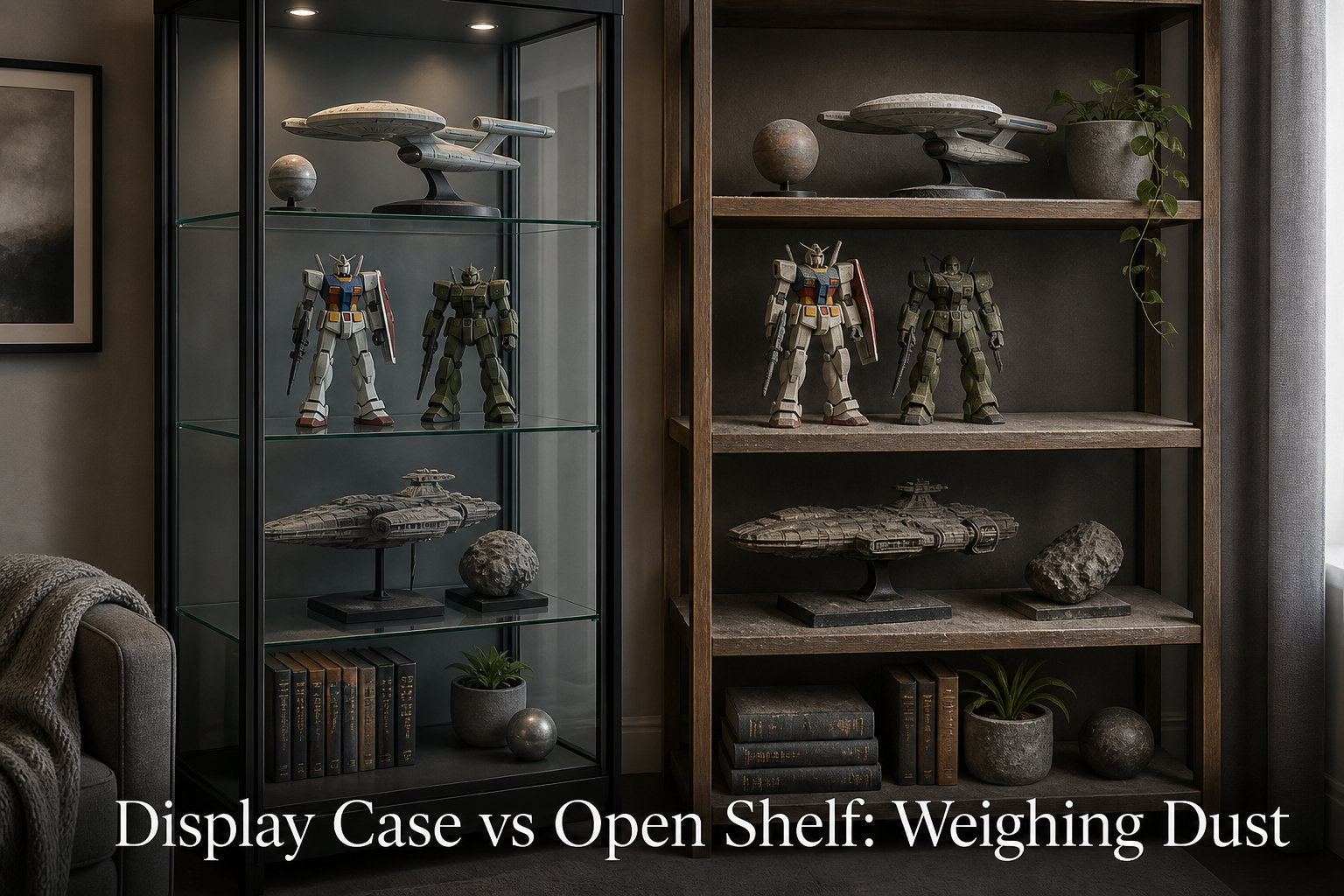
Every collector hits the same wall eventually. You spend years curating miniatures, action figures, LEGO sets, or trading cards, only to watch a fine gray film settle over everything you love. That is dust, and it is more than a cosmetic nuisance. It is abrasive, it traps moisture, and over time it dulls finishes and accelerates corrosion on the collectibles you worked hard to find.
This is where the Display Case vs Open Shelf dust protection debate really matters. I have spent years testing both approaches in my own collection, and I want to share what actually works. The choice you make determines whether you dust weekly or barely touch a cloth for months.
In this guide, you will learn how sealed enclosures block dust, why open shelves attract it so aggressively, which seal types actually work, and how to pick the right setup for your specific collectibles. I will also cover the topics most guides skip, like static electricity in acrylic cases, humidity inside sealed cabinets, and positive pressure systems borrowed from museum preservation.
By the end, you will have a clear framework for protecting your collection the way professionals do, without guesswork and without constant cleaning.
Table of Contents
What Is a Dustproof Display Case?
A dustproof display case is a sealed enclosure designed to keep airborne dust, dirt, and pollutants away from collectibles using closed doors, gaskets, and tight-fitting materials. Think of it as a controlled microclimate rather than just a shelf with walls.
The key word is sealed. A regular bookshelf with a glass front is not dustproof if air can circulate freely through gaps. A true dustproof case uses silicone gaskets, magnetic latches, or compression locks to create a barrier that stops particulates at the door.
Museum curators have relied on this principle for decades. The same sealed-cabinet logic that protects a 200-year-old textile in a gallery applies to your action figures at home. The scale changes, but the physics does not.
Display Case vs Open Shelf Dust Protection: The Core Difference
The core difference in Display Case vs Open Shelf dust protection comes down to one factor: air exposure. An open shelf leaves collectibles fully exposed to ambient room air and everything riding on it. A sealed display case creates a physical barrier that blocks the majority of airborne dust before it ever reaches your items.
Forum collectors who have tested both consistently report the same result. A well-sealed case can cut dust accumulation by up to 90 percent compared to an open shelf in the same room. One collector on the diecast aircraft forum put it bluntly: if nothing lives inside a sealed shelf, almost nothing gets in.
Open shelves, by contrast, are dust magnets by design. They rely on airflow for that clean, accessible look, which means every air current in the room deposits particles directly on your items. You become the dust filter, and you pay for it with weekly cleaning sessions.
Here is a quick comparison of how the two options stack up across the factors that matter most.
Display Case vs Open Shelf at a glance:
Dust protection: Sealed case blocks up to 90 percent of dust; open shelf blocks zero.
Cleaning frequency: Sealed case needs interior dusting every few months; open shelf needs weekly attention.
Access speed: Open shelf wins for grab-and-go access; sealed case requires opening a door.
Item safety: Sealed case protects against bumps, pets, and curious hands; open shelf leaves items exposed.
Visual clarity: Both look great, but glass cases add a premium museum feel.
Humidity control: Sealed case allows desiccant and microclimate management; open shelf offers none.
Upfront effort: Open shelf is instant; sealed case requires research and sealing work.
That last point matters more than people realize. The protection gap only appears after you invest in a properly sealed enclosure. A cheap, gap-ridden case performs closer to an open shelf than to a true dustproof cabinet.
Benefits of Display Cases for Dust Protection
Display cases earn their keep by doing something open shelves physically cannot: they isolate your collection from the room environment. The benefits go well beyond less dusting.
Drastically reduced dusting: A well-sealed case can cut dust accumulation by up to 90 percent, meaning you dust the interior a few times a year instead of every week.
Finish preservation: Dust is abrasive. Trapped between a cloth and a painted surface, it acts like fine sandpaper. Sealed cases keep that grit away from delicate finishes.
Moisture control: Because the interior is enclosed, you can add desiccant packs to manage humidity and protect metal, paper, and textile items from corrosion and mold.
UV and light filtering: Many quality cases use UV-filter glass or acrylic, which slows fading on printed cards, painted figures, and textiles.
Physical protection: Doors and locks shield items from pets, children, and accidental bumps that open shelves cannot prevent.
Museum-grade presentation: A sealed glass case elevates how a collection looks, giving it that gallery-quality display feel.
The combined effect is preservation and presentation in one package. You spend less time cleaning, and your items hold their condition and value longer.
Open Shelf Drawbacks for Dust Accumulation
Open shelves look fantastic on day one. By day seven, the dust tells a different story. Every surface is fully exposed to the air circulating through your home, and that air carries a constant stream of particles.
Collectors on open shelves consistently report needing weekly dusting to keep items presentable. One Reddit user in the r/hottoys community mentioned using a micro vacuum and Swiffer-style duster just to keep up, and even then a thin film persists.
The deeper problem is what that dust does over time. Dust is hygroscopic, meaning it absorbs and holds moisture from the air. When it settles on metal figures, painted surfaces, or electronic components, it traps humidity directly against the material and accelerates corrosion and tarnish.
Static electricity makes the problem worse on certain shelving materials. Plastic and acrylic shelves build up a static charge that actively attracts dust particles, pulling them in faster than gravity alone. Glass shelves avoid this issue, which is part of why serious collectors prefer them.
None of this means open shelves are useless. They excel for items you handle often, rotate frequently, or replace easily. But for anything you want to preserve long-term, the constant dust exposure is a real cost.
Seal Types and How Well They Work
Not all display cases seal equally. The seal is the single most important factor in how much dust actually gets inside, and understanding the options helps you choose or upgrade a case effectively.
Silicone gaskets are the gold standard. These soft rubber or silicone strips compress when the door closes, filling gaps that would otherwise let air through. High-end museum cases use them, and they are the reason those cases stay nearly dust-free for years.
Magnetic latch seals use magnets to pull the door tight against a gasket or magnetic strip. They are convenient because the door self-aligns, but their effectiveness depends entirely on the gasket quality. A magnetic latch with no gasket is just a fancy closure.
Compression locks physically crank the door against the frame, creating an airtight seal. You see these on premium archival cabinets and flight cases. They offer the tightest seal available but require more effort to open and close.
Weather stripping is the budget-friendly upgrade that forum collectors love. Applying foam or rubber weather stripping around the edges of an IKEA Detolf or similar case dramatically improves the seal. Multiple collectors report going from weekly dusting to essentially zero interior dust after this simple mod.
The flashlight test: Here is a practical way to verify any seal, shared across collector communities. Turn off the room lights, place a bright flashlight inside the closed case, and look for light leaking through gaps. Anywhere light escapes, dust can enter. Mark those spots and add gasket material or weather stripping until the leak stops.
This test works because dust particles are large enough that if light cannot fit through a gap, dust cannot either. It is a free, instant diagnostic that beats any guesswork.
Glass vs Acrylic Display Cases for Dust
The material your case is made from affects dust protection in two ways: seal quality and static behavior. Both matter, and they favor different materials.
Glass is the clear winner for dust control. It does not build up static charge, so it never actively attracts dust particles. It also tends to be used in heavier, better-engineered cases with proper gasket systems. Tempered glass and laminated safety glass both perform well, with laminated glass offering the bonus of UV filtering.
Acrylic, including clear acrylic and polycarbonate panels, has one major drawback: static electricity. As collectors repeatedly note, static in plastic and acrylic cases turns them into dust magnets. The charge builds up as air moves across the surface, and it actively pulls dust particles toward the case and through any small gaps.
Anti-static acrylic treatments exist and help, but they are not permanent and need reapplication. If dust protection is your top priority and budget allows, glass is the safer material choice.
Acrylic does have advantages. It is lighter, shatter-resistant, and less expensive, which matters for wall-mounted installations and large cases. Just plan to manage the static issue with anti-static spray or wipes if you go this route.
Humidity and Moisture in Sealed Cases
A sealed case does a great job keeping dust out, but it also traps whatever moisture is inside when you close the door. This creates a microclimate, and if you are not careful, that microclimate can cause problems dust never would.
Ambient moisture seeps in when doors open and close, especially in humid rooms or during rainy seasons. Once trapped, that moisture has nowhere to go, and it can lead to condensation, mold, and corrosion, particularly on metal items and paper collectibles.
The solution is active humidity management. Silica gel desiccant packs absorb excess moisture and are cheap, reusable, and easy to tuck into a case corner. For valuable collections, a small hygrometer lets you monitor humidity and aim for the 40 to 50 percent range that most collectibles prefer.
The irony is that a poorly managed sealed case can be worse for moisture-sensitive items than an open shelf. The shelf lets moisture equalize with the room, while the case traps it. The fix is simple, but it does require attention.
Positive Pressure and Advanced Dust Prevention
For collectors who want maximum dust protection, positive pressure is the technique museums and cleanrooms use, and it is more accessible than you might think.
In a positive pressure system, clean filtered air is gently pumped into the case at a rate slightly higher than air can leak out. Because the interior pressure is higher than the room pressure, dusty room air cannot flow in through gaps. Any leakage goes outward, carrying nothing but clean air with it.
You can build a basic version with a small PC fan, a HEPA filter, and a power supply, mounted to push filtered air into the case. Hobbyists in the Gunpla and AnimeFigures communities have shared builds that essentially eliminate interior dust entirely.
This is overkill for most collections, but for high-value items, archival textiles, or displays in particularly dusty environments, positive pressure offers protection that no passive seal can match. It is the ultimate answer to the dust question.
Placement Strategies to Minimize Dust
Where you place your display affects how much dust it encounters, regardless of whether you use a case or open shelves. Smart placement reduces the workload on any protection system.
Keep displays away from high-traffic areas and doorways. Every time a door opens or someone walks past, air currents stir up dust that settles on nearby surfaces. Corner positions and walls away from vents are ideal.
Avoid placing displays directly under or next to HVAC vents. Forced air is the single biggest dust delivery system in most homes. If you cannot avoid a vent, consider adding a deflector to redirect airflow away from your collection.
Floor-level displays collect dust faster than elevated ones, because heavier dust particles settle low. Wall-mounted cases and taller shelving units stay cleaner simply by being higher in the room where air carries fewer large particles.
Running a room air purifier near your display area cuts the overall dust load in the room, which benefits both sealed cases and open shelves. Fewer particles in the air means fewer particles that can reach your items.
How to Choose: 5-Step Decision Guide
Choosing between a display case and open shelves comes down to your collection, your environment, and your tolerance for maintenance. Here is the five-step framework I use.
Step 1: Assess your collectible types. High-value, delicate, or rarely handled items belong in sealed cases. Items you rotate, play with, or display temporarily can live on open shelves. Miniatures, trading cards, watches, and signed memorabilia almost always warrant a case.
Step 2: Evaluate your room environment. A dusty room with pets, carpet, and active HVAC needs sealed cases. A clean, low-traffic room with hard floors and an air purifier can tolerate open shelves more easily.
Step 3: Decide on your cleaning tolerance. If you do not want to dust weekly, go sealed. If you enjoy the ritual of tending your display and do not mind regular cleaning, open shelves work fine.
Step 4: Set your budget and effort level. Open shelves are cheap and instant. Sealed cases range from budget IKEA Detolfs with added weather stripping to custom museum-grade cabinets. Match the investment to the value of what you are protecting.
Step 5: Plan for upgrades. Start with a decent case and improve the seal over time. Weather stripping, gasket tape, desiccant, and even positive pressure fans can be added later. The best setup is usually the result of iteration, not a single purchase.
For specific collectible types, here are my recommendations based on community consensus and personal testing.
LEGO sets and builds: Sealed cases, ideally glass, to protect printed elements and stickers from dust and UV.
Action figures and Hot Toys: Sealed cases with weather stripping on doors. Detolf-style cases are the community standard.
Trading cards: Archival screw-downs or binders inside a sealed cabinet with desiccant.
Watches: Sealed watch boxes or winders with gasketed lids.
Textiles and jerseys: UV-filter sealed frames with acid-free backing.
Maintenance Tips for Both Options
Even sealed cases need occasional care, and open shelves need a smart cleaning routine to minimize damage. Here is how to maintain each without harming your collection.
For sealed display cases:
Dust the exterior weekly with a dry microfiber cloth to keep the case looking sharp and prevent dust from working its way into seals.
Open the case every two to three months and gently dust the interior with a soft brush or microfiber cloth.
Check and refresh desiccant packs every few months, or when a hygrometer reads above 55 percent humidity.
Inspect gaskets and weather stripping annually for compression set, cracking, or gaps, and replace as needed.
Run the flashlight test whenever you add or move items to confirm the seal is still intact.
For open shelves:
Use a soft microfiber cloth or a dedicated micro vacuum attachment designed for collectibles, never a regular duster that can snag details.
Dust weekly to prevent buildup, since thick dust is harder to remove and more likely to scratch when wiped.
Avoid spraying cleaners directly on or near items. Apply any cleaning product to the cloth first.
Consider anti-static spray on acrylic shelves to reduce dust attraction between cleanings.
Move items occasionally to clean beneath them, since dust accumulates fastest in undisturbed spots.
A consistent routine protects both the items and your enjoyment of them. The goal is preservation without turning your hobby into a chore.
FAQs
Do display cases keep dust out?
Yes, a well-sealed display case can block up to 90 percent of airborne dust compared to an open shelf. The effectiveness depends on the seal quality, so cases with silicone gaskets, magnetic latches, or added weather stripping perform best. Cheap cases with loose-fitting doors let nearly as much dust in as an open shelf.
How to dust proof open shelves?
You cannot fully dust-proof an open shelf, but you can reduce dust significantly. Run a room air purifier nearby, keep shelves away from HVAC vents and high-traffic areas, use anti-static spray on acrylic surfaces, and dust weekly with a microfiber cloth or micro vacuum. Adding acrylic or glass front panels to open shelving converts it into a semi-sealed case and offers the biggest improvement.
How to display Lego without it getting dusty?
The best way to display LEGO without dust is inside a sealed glass case with gasketed or weather-stripped doors. Glass avoids the static attraction that acrylic has, and a good seal means you may not need to clean the interior for months. Avoid open shelves for LEGO, since printed elements, stickers, and exposed studs trap dust and are tedious to clean.
Do open kitchen shelves get dusty?
Yes, open kitchen shelves collect dust quickly, and kitchen dust often includes grease particles that make it sticky and harder to remove. Kitchens are high-traffic, high-airflow spaces, so open shelving there typically requires weekly wiping. Sealed cabinets with doors are the lower-maintenance choice for kitchen storage.
Are display cases worth it?
For most collectors, yes. A quality display case reduces cleaning time dramatically, protects item condition and resale value, and adds a premium presentation. The investment pays off fastest for high-value, delicate, or rarely handled items. Budget options like an IKEA Detolf with added weather stripping deliver most of the benefit at low cost.
Do curio cabinets keep dust out?
Curio cabinets keep out more dust than open shelves, but their performance varies widely. Older or cheaper curio cabinets with loose-fitting doors and wooden frames let significant dust through gaps. A curio cabinet with a gasketed glass door, magnetic or compression latches, and tight seams performs well. Adding weather stripping to an existing curio cabinet is a cheap way to improve its dust protection.
Conclusion
The Display Case vs Open Shelf dust protection debate has a clear winner for anyone serious about preservation. A well-sealed display case blocks up to 90 percent of airborne dust, reduces cleaning from a weekly chore to an occasional task, and protects the condition and value of your collection for years.
Open shelves still have their place for items you handle often or rotate frequently. But for anything you want to keep pristine, sealed glass cases with quality gaskets or weather stripping are the answer, and upgrades like desiccant, anti-static management, and even positive pressure can take protection to museum levels.
Your next step is simple. Run the flashlight test on your current display, identify where dust is getting in, and start with the cheapest fix that closes those gaps. Your collection, and your free time, will thank you.