

A dull knife is the quiet reason a weeknight dinner takes twice as long as it should. The blade skates instead of cutting, the onion shreds into paste, and you reach for a sharper knife that does not exist in the drawer. Most home cooks deal with this by sharpening twice a year at a shop counter, or by simply living with it.
The best pull through knife sharpeners solve that problem in the drawer you already own. No water, no power, no learning curve, no messy slurry on the counter. You place the tool flat, draw the blade through a V-shaped slot, and repeat on the other side. For a handful of everyday kitchen knives, that is genuinely all the equipment most cooks will ever need.
We pulled review data on twelve of the most-used pull-through sharpeners on the market, weighed the stage counts, abrasive materials, angle settings and base designs, and looked closely at where owners say each one succeeds and where it falls short. This guide covers the compact two-stage models that fit in a knife drawer, the four-stage tools that also handle scissors and serrations, and the adjustable units built for people who own thinner European or Japanese edges. If you would rather plug something in, our guide to the best electric knife sharpeners covers that category, and the best bench knife sharpeners with angle guides is the right read if you have decided to learn stones. If you are outfitting a whole kitchen rather than a single drawer, our picks for the best gas ranges for home cooks and the best Dutch ovens for home cooks cover the rest of the list.
So, how good are pull-through knife sharpeners? Very good at restoring a working edge on everyday kitchen knives in under a minute, especially dull or slightly neglected blades. They are less good at producing a refined, long-lasting edge on thin premium steel, where fixed angles and coarse carbide stages can remove more metal than you intended.
That tension is the honest story with this whole category, and sharpening enthusiasts have been arguing about it online for years. On r/knives the verdict is blunt: pull-through sharpeners work at a single angle, and knives are not ground at a single angle, so they slowly change your bevel. On r/Cooking the counter-argument is just as common, and just as reasonable: the best sharpener is the one you will actually reach for, and a pull-through always beats a beautiful whetstone sitting in a cupboard.
Both sides are right about their own knives. Our position after reviewing all twelve is simple. A pull-through is the right tool for the large dull knives in your block, the serrated bread knife, the kitchen shears, and the pocket knife that lives in the junk drawer. It is the wrong tool for a thin Japanese yanagiba or a chipped edge that needs reshaping.
Table of Contents
Top 3 Pull Through Knife Sharpeners for Home Cooks
Three products stand out, and they stand out for different reasons. AccuSharp wins on finish, consistency and sheer ownership numbers. Chef’sChoice wins on edge quality and angle control if you can live with its size. KitchenIQ wins on proven reliability at a low price.

AccuSharp Original Knife…
- Diamond-honed tungsten carbide blades
- Reversible blades for years of service
- Full-length finger guard
- Works on straight and serrated knives

Chef’sChoice 4643009
- Three stages of 100 percent diamond abrasive
- CrissCross sharpens both sides at once
- 15 and 20 degree angle control
- Handles serrated sports and pocket knives

KitchenIQ 50825
- Diamond-coated coarse plus ceramic fine stages
- Patented V edge grip
- Non-slip base
- Compact drawer-friendly size
Best Pull Through Knife Sharpeners in 2026 at a Glance
Every model below covers a different need. Stage count, angle range and abrasive material matter far more than the brand on the front.
| Product | Specs | Action |
|---|---|---|
| AccuSharp Original Knife Sharpener |
|
Check Latest Price |
| Chef’sChoice 4643009 |
|
Check Latest Price |
| KitchenIQ 50825 |
|
Check Latest Price |
 Sharp Pebble 5 Precision Adjust Sharp Pebble 5 Precision Adjust |
|
Check Latest Price |
 Wusthof 2-Stage Hand-Held Sharpener Wusthof 2-Stage Hand-Held Sharpener |
|
Check Latest Price |
 Smiths Adjustable Manual S-50264 Smiths Adjustable Manual S-50264 |
|
Check Latest Price |
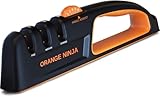
 Orange Ninja 4-Stage Sharpener Orange Ninja 4-Stage Sharpener |
|
Check Latest Price |
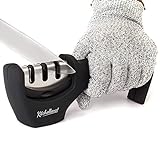 KITCHELLENCE 4-in-1 Knife Sharpener KITCHELLENCE 4-in-1 Knife Sharpener |
|
Check Latest Price |
 Longzon 5-in-1 4 Stage Sharpener Longzon 5-in-1 4 Stage Sharpener |
|
Check Latest Price |
 SHARPAL 191H Knife and Scissors Sharpener SHARPAL 191H Knife and Scissors Sharpener |
|
Check Latest Price |
 Work Sharp Pull Through Sharpener Work Sharp Pull Through Sharpener |
|
Check Latest Price |
 Smiths Pull-Thru Knife Sharpener Smiths Pull-Thru Knife Sharpener |
|
Check Latest Price |
1. AccuSharp Original: The Best Overall Pull Through for Home Cooks
AccuSharp Knife Sharpener, Ergonomic Comfortable Handle, Compact & Easy to Use, Restore and Hone Straight & Serrated Knives, White
Diamond-honed carbide
Reversible blades
Full finger guard
Pros
- Working edge in roughly 10 seconds
- Reversible carbide blades rated at 5 to 10 years
- Full-length finger guard keeps your hand clear
- Dishwasher-safe and easy to clean
- Highest average rating in this roundup
Cons
- Fixed single-stage angle with no adjustment
- Less suited to very thin Japanese-style edges
Our top pick is also the least complicated thing in this roundup. One slot, one abrasive, one motion. There is no coarse stage to overuse, no angle knob to misread and no second side to think about, which is exactly why it works for someone who does not want to think about sharpening at all.
The abrasive is diamond-honed tungsten carbide, and the blades are reversible. Flip them when the edge dulls and you effectively double the life of the tool. Owners report anywhere from five to ten years between replacements, which is a completely different maintenance horizon from the throwaway sharpeners in the budget aisle.
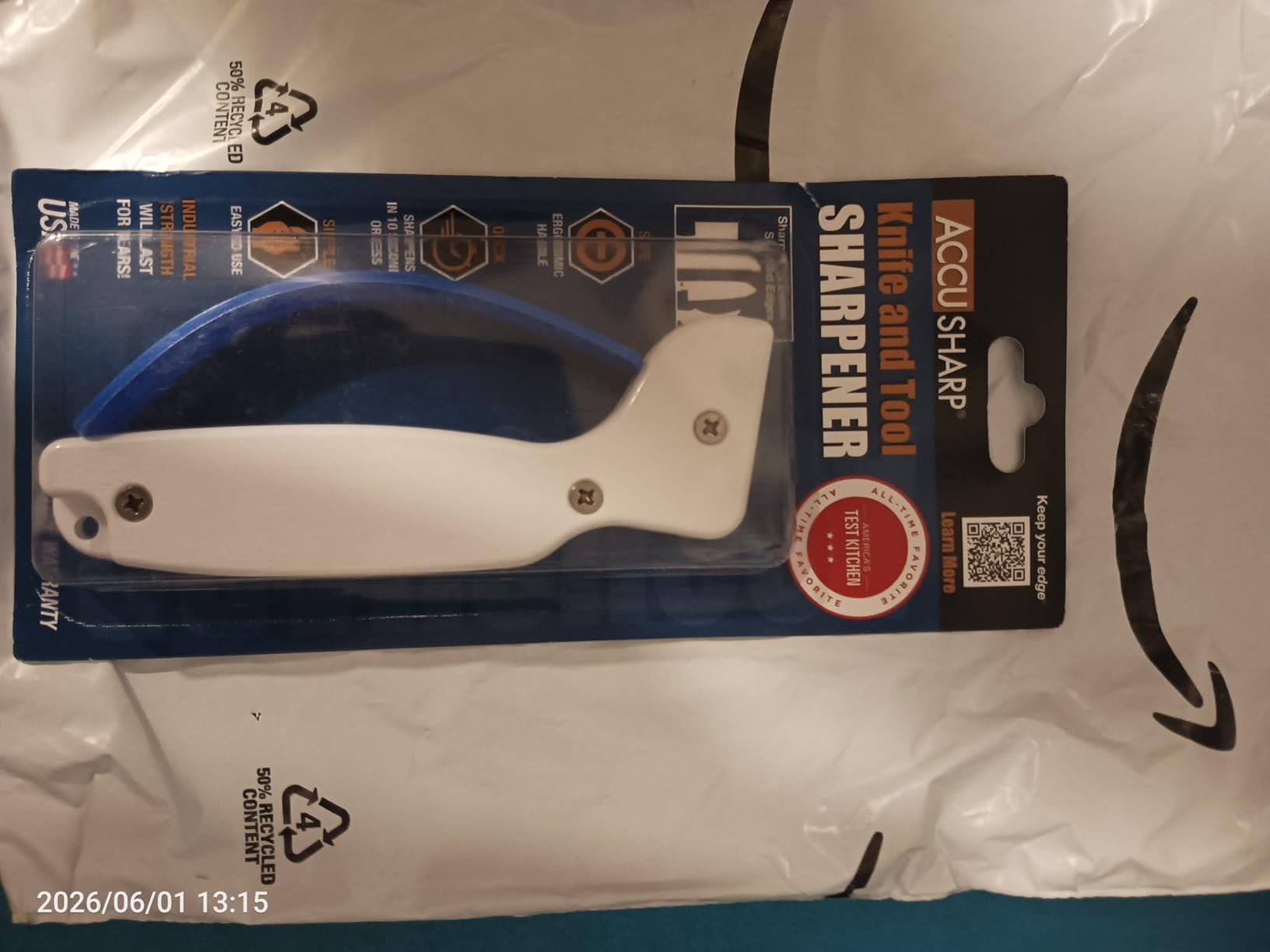
The handling is what surprised us most. The handle is ergonomic but the defining feature is the full-length finger guard, which keeps your knuckles behind the slot while the blade moves. For a tool that asks you to draw an exposed edge across an abrasive, that guard does more for confidence than any instruction manual can.
Owners sharpen most blades in roughly ten seconds, and they report the same thing we would: this is a working kitchen edge, not a razor edge. It will glide through onions and herbs and it will make a dull chef’s knife usable again. It will not split a tomato paper-thin on the first pull.
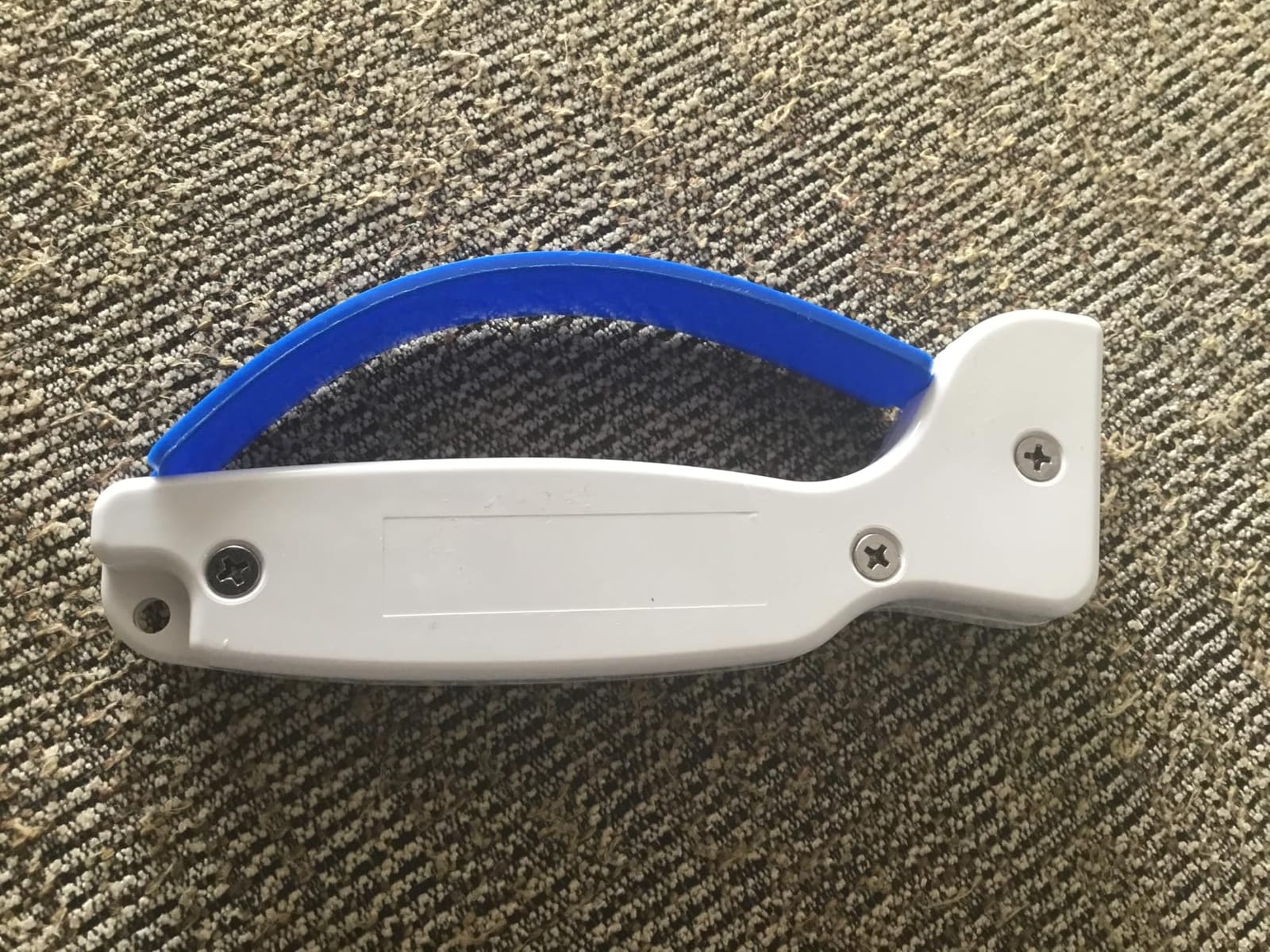
What works about the fixed angle
The single most common complaint in reviews is that the angle is fixed and cannot be adjusted. In practice that matters much less for general-purpose knives than you would expect, because most European chef’s knives, paring knives and utility knives are already close to this angle to begin with.
For a very thin Japanese-style edge, the fixed slot will slowly steepen the bevel over repeated sessions. If your collection is mostly those blades, skip to number four on this list. For everyone else, the predictability of one fixed angle is a genuine advantage, because you cannot set it wrong.
Who should skip it
If your knives are mostly Japanese single-bevel blades, or if you have a folder or hunting knife with a very acute edge, the fixed slot will fight you. Steel removal is faster on a thin edge than you expect, and there is no way to slow the process down.
Everyone else, including anyone who has never sharpened a knife in their life, gets a tool that works in the first ten seconds of use. The full guard makes it approachable, the reversibility means it stays in the drawer for years, and the review numbers behind it are the strongest in the category.
2. Chef’sChoice 4643009: Best Edge Quality and Angle Control
Chef’sChoice Manual Knife Sharpeners for 15- and 20-Degree Straight-Edge and Serrated Knives with Diamond Abrasives Precise Angle Control & Compact Footprint, 2-Stage, Gray
3 stages of diamond
CrissCross both sides
15 and 20 degree
Pros
- Among the sharpest edges from any manual pull-through
- Diamond abrasives in all three stages
- Third stage polishes to a durable arch-shaped edge
- Handles serrated sports and pocket knives
- Sharper geometry from both-side sharpening
Cons
- Highest price in this roundup
- Coarse stage needs light consistent pressure
- Larger and heavier than compact two-stage tools
This is the sharpener to buy if you already know what a good edge feels like and are not satisfied with the compromise every budget pull-through makes. It uses 100 percent diamond abrasive in all three stages, including a final micron-sized polishing stage that no other model here matches.
Its CrissCross technology is the detail that sets it apart. Instead of working one side and then the other, it sharpens both sides as the blade passes through, which keeps the geometry symmetric and produces that arch-shaped edge reviewers describe as noticeably more durable than a flat one.
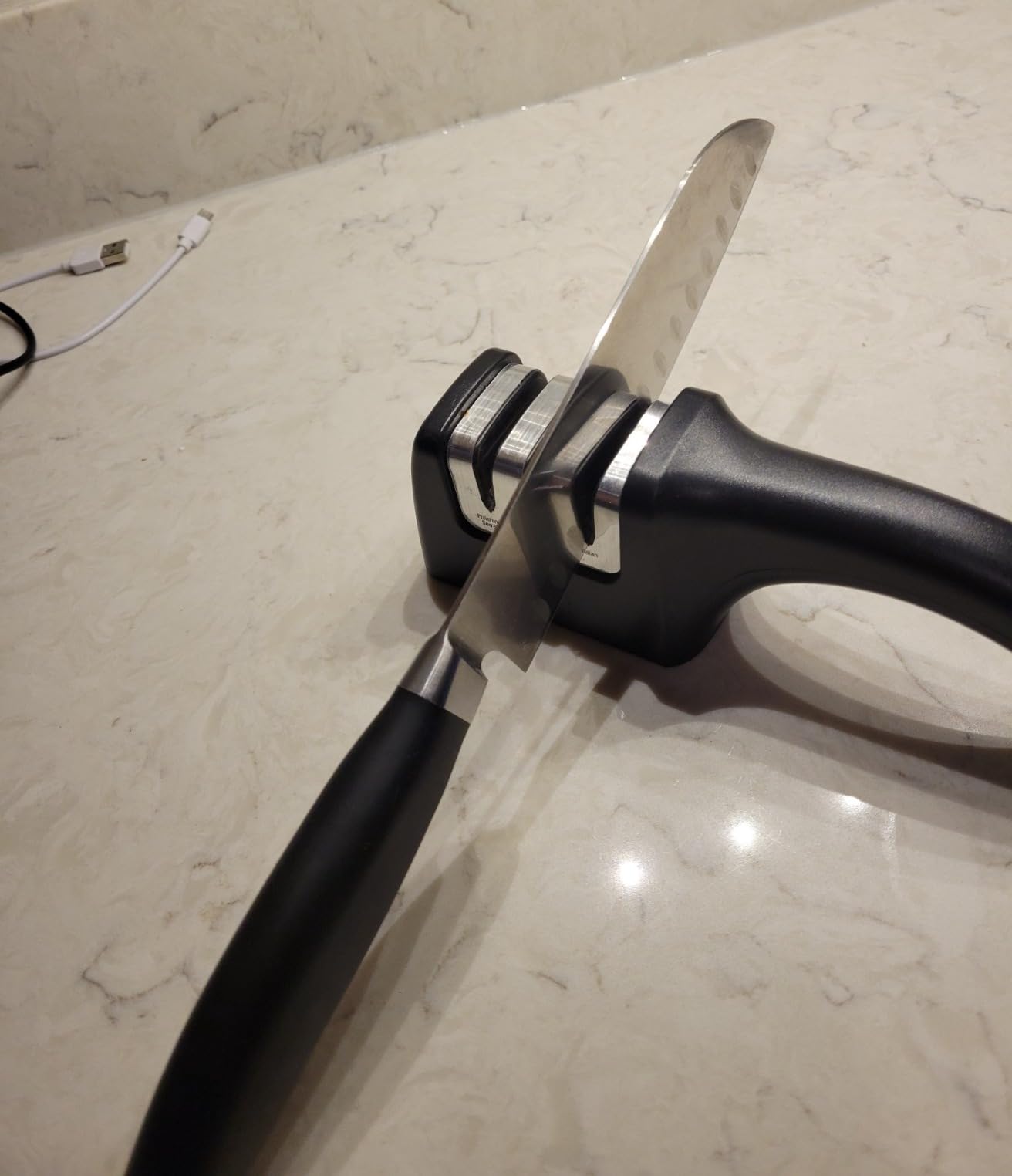
It also gives you real angle choice. Rather than one fixed slot, it handles both 15-degree and 20-degree edge classes, which covers thin Asian blades and European chef’s knives in the same tool. Serrated, sports and pocket knives are all within scope.
Reviews repeatedly place the finished edge close to what a wet stone produces, at a fraction of the effort. That is the honest reason this one earns a place at the top even though it does not take the number one slot.
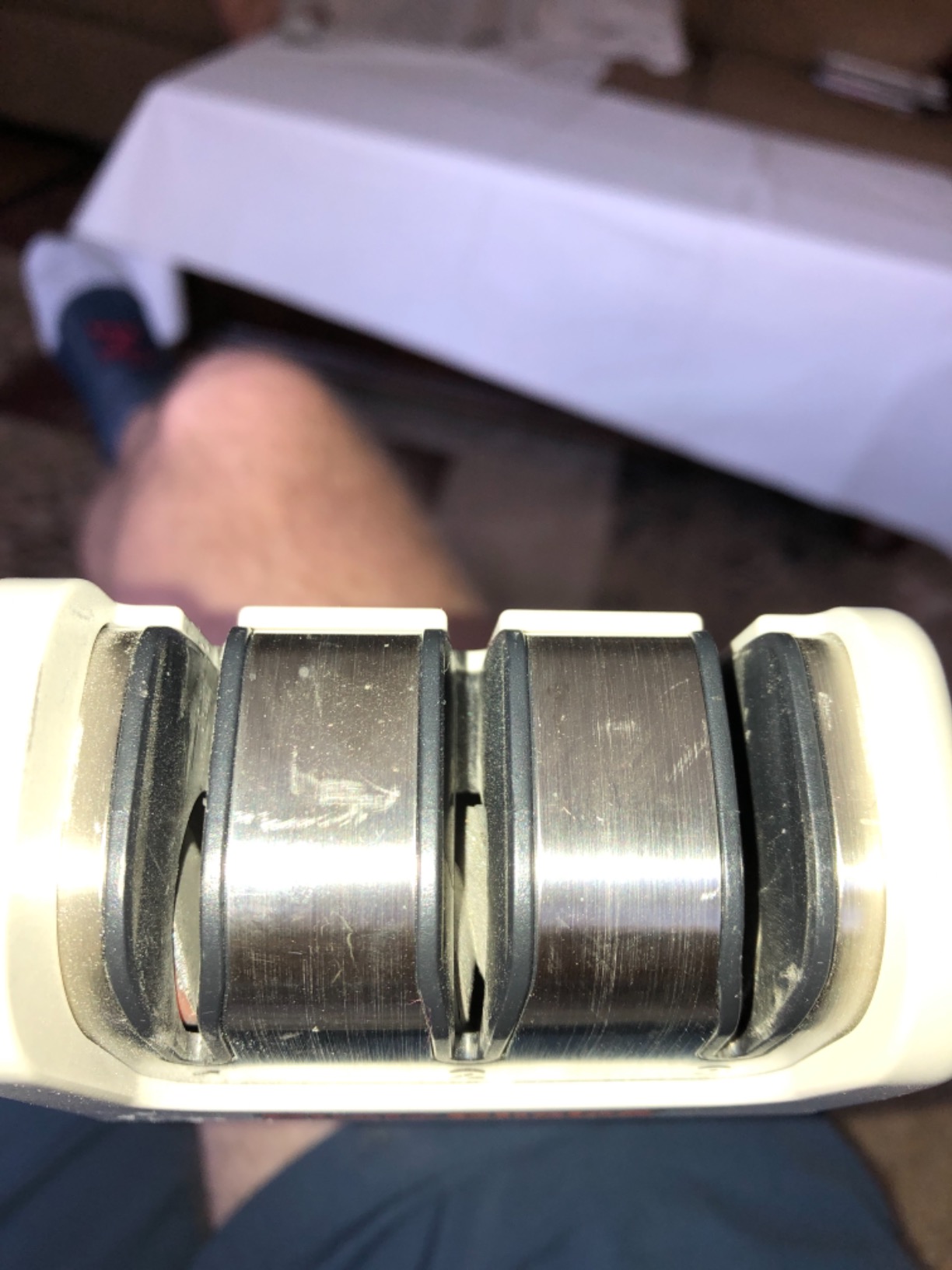
Where the extra cost goes
You are paying for diamond abrasive, a third polishing stage and two-sided geometry. None of those are marketing, and all of them show up in the edge.
Size is the real cost here. At 9.25 inches long and 8 ounces, it is the largest and heaviest tool in this roundup and it stays planted on the counter rather than in the drawer. If drawer space is the deciding factor, this is not the one.
The coarse stage needs respect
Because the first stage removes metal quickly, the common owner advice is to use light, even pressure and to skip that stage entirely when the knife is already in decent shape. Owners who treat it as an every-cooking-session habit report thinning edges over time.
Use it the way a stone sharpener gets used, and only when a blade is genuinely dull. Then this is the best result available without electricity, and the three-stage layout gives you plenty of room to find the right rhythm.
3. KitchenIQ 50825: Best Proven Value for Everyday Knives
KitchenIQ 50825 | Diamond Deluxe Edge Grip 2-Stage Knife Sharpener | Black | Coarse & Fine Sharpeners | Compact for Easy Storage | Non-Slip Base | Soft Grip Rubber Handle | Straight & Serrated Knives
Diamond coarse, ceramic fine
V edge grip
Non-slip base
Pros
- Foolproof
- no skill needed
- Compact enough to hide in any utensil drawer
- Non-slip base holds steady
- Works on knives and scissors
- Deep V-notch allows sharpening at the counter edge
Cons
- Fine stones wear out within a couple of years
- Sharpness fades faster than users would like
- Countertop use only
- Not a long-term solution compared with stones
With close to 98,000 reviews, this is the most proven budget two-stage sharpener on the market, and the review pattern is remarkably consistent. Buyers call it foolproof, compact and good value, and the coarse slot reliably revives knives they had written off.
The two-stage layout is the classic one. A diamond-coated coarse stage handles dull and mildly damaged blades, and a ceramic fine stage handles routine maintenance and light work on serrated edges. Nothing about the sequence requires thought.
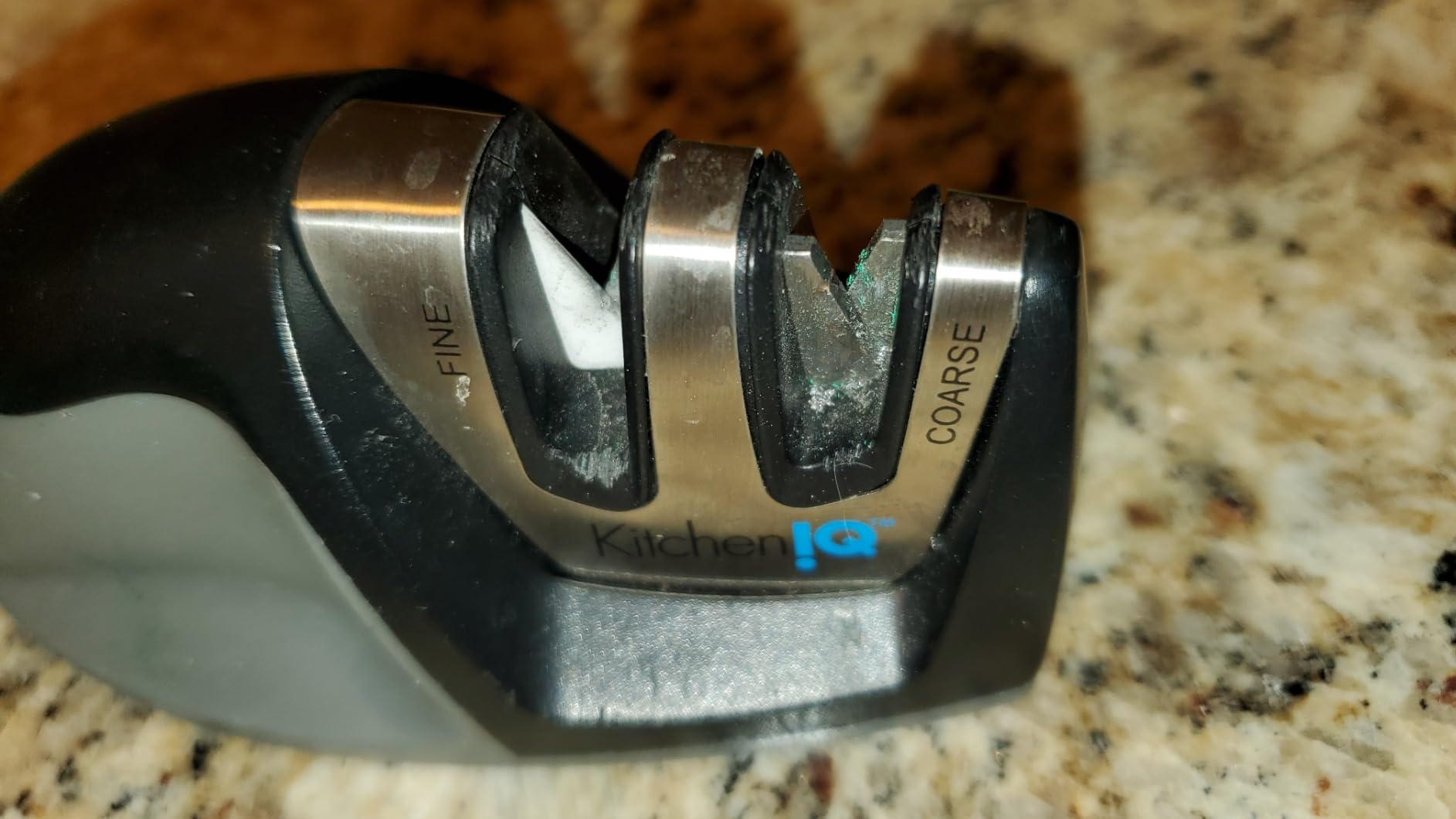
The patented V edge grip is the feature buyers mention second most. It holds the sharpener at the counter edge and stops longer knife tips from dragging on the surface, which sounds minor until you have sharpened a tall chef’s knife on a competitor that does not do this. The result is a more natural angle and a cleaner pass.
It is also tiny, at under four inches long and about two ounces, so it disappears into a utensil drawer. For a first sharpener, a housewarming gift or a small shared kitchen, that footprint is genuinely useful.
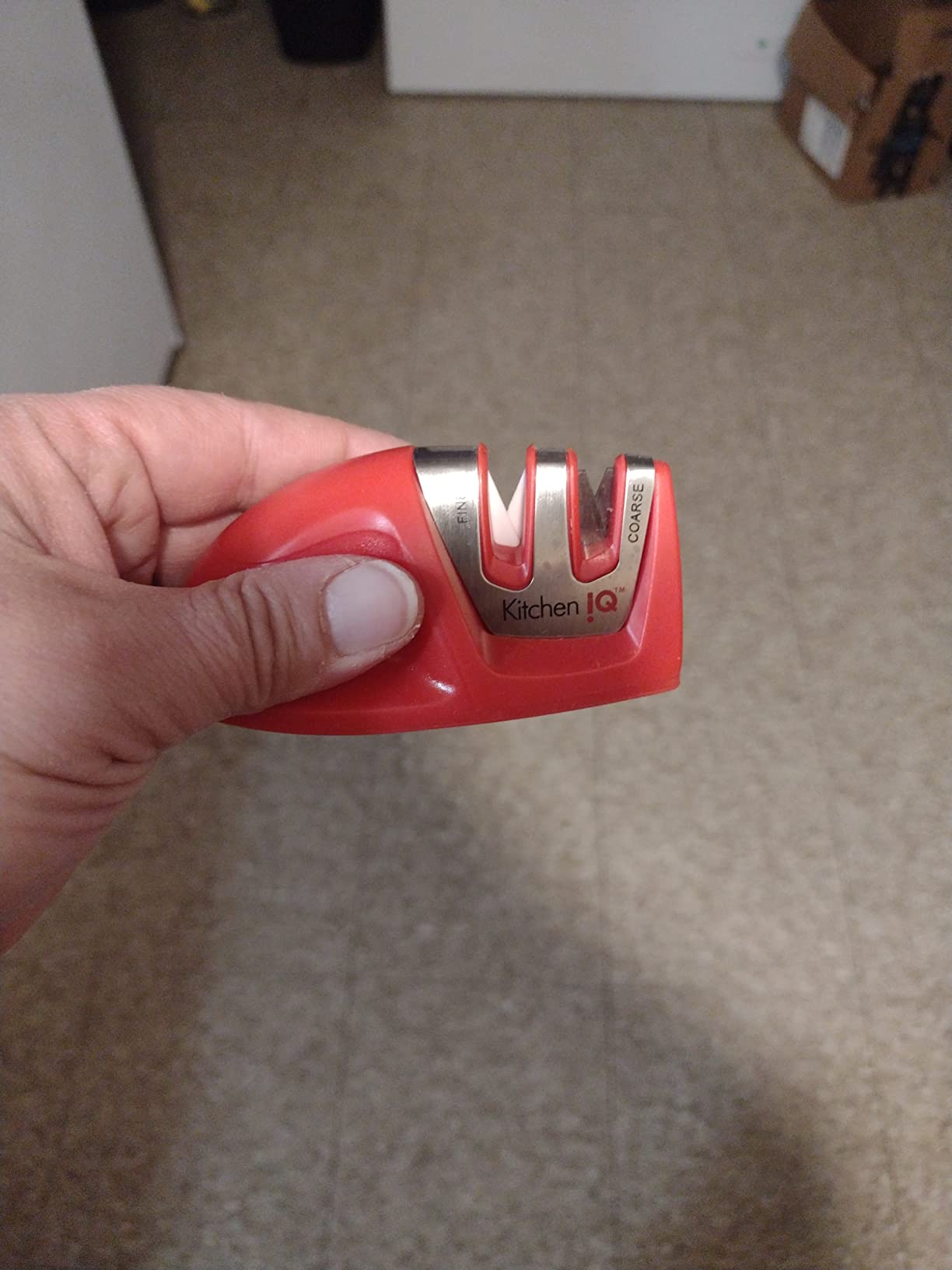
Why the reviews are so positive
It does the one job a home cook needs without any learning curve. The instruction is to draw the blade through, and the non-slip base keeps it from skating on the counter. Most first-time users get a usable edge on their first attempt, which is not something every sharpener in this list can claim.
Users also like that it handles scissors as well as knives, which makes it a two-tool purchase for the price of one.
The durability ceiling
The most common criticism in reviews is that the fine stones wear out and the whole unit needs replacing every couple of years. Edge retention is also shorter than people would like, meaning you will be back at it more often than with a stone or a belt system.
That is the honest trade. You get a working edge for very little money, zero setup and a tool small enough to always be within reach. If your knives are cheap and you sharpen them often, that math works. If you are protecting premium steel, look at models two, four or five instead.
4. Sharp Pebble 5 Precision Adjust: Best for Thin Japanese Edges
5 Precision Adjust Knife Sharpener- 3-Stage Premium Kitchen Knife Sharpener
5 angles, 12-24 degrees
Coarse, medium, fine
Rubberized grip
Pros
- Widest angle range in this roundup at 12 to 24 degrees
- Printed angle guide on the body
- Sharper edge than fixed-angle units
- Rubberized handle and base stop all sliding
- Sharpens a dull knife in under 30 seconds
Cons
- Straight-edge blades only
- Adjustment wheel can be stiff or lock up
- A few buyers received no grit in the coarse slot
- Unresponsive manufacturer support in some cases
Angle control is the entire point of this model, and it offers five selectable settings: 12, 15, 18, 21 and 24 degrees. That range covers Japanese wa-handled blades, thin European knives and straight pocket knives with one tool, and it is the reason this is the one we would trust with an expensive chef’s knife.
Set the dial to match the knife, and the three stages do coarse, medium and fine work in order. The angle guide is printed directly on the body, so you are not guessing or flipping back to instructions.

Owners report taking a dull knife to genuinely sharp in under a minute, and they consistently notice a sharper result than fixed-angle tools produce. The rubberized grip on both the handle and the base does a good job of stopping the tool from moving while you pull, which improves both safety and consistency.
At just over nine inches long and under two ounces, it is also one of the more portable options here, which matters if you sharpen away from home.

When adjustable angles matter most
If you own thin Japanese knives, a 15-degree setting keeps the existing geometry instead of quietly steepening it every time you use the tool. That is the single most valuable thing a pull-through can do for an expensive blade, and most fixed-angle models cannot do it.
The wider settings also suit thicker European edges and utility knives, so a mixed collection is not a problem.
The limitations to plan around
This is a straight-edge tool only. It does not handle serrated knives or scissors, so if you keep a bread knife or kitchen shears, this does not replace a separate tool for those.
There is also a small quality-control wrinkle. A few buyers report the adjustment wheel locking up, and a small number received a unit with no abrasive in the coarse slot, with unhelpful support when they complained. Most units are fine, but it is worth checking the wheel moves freely and the slots are filled before you put a good knife through them.
5. Wusthof 2-Stage: Best for German and Wusthof Knives
WÜSTHOF 2-Stage Hand-Held Sharpener, Black
Carbide then ceramic
Preset 34 degree
238 gram body
Pros
- Preset 34 degree angle matches Wusthof factory edges
- Solid build with a substantial 238 gram weight
- Non-slip base keeps it stable
- Portable enough for a knife roll or camping kit
- Comfortable ergonomic grip
Cons
- 34 degree angle is too blunt for thin European or Japanese edges
- Coarse stage removes steel fast if overused
- Not a substitute for professional sharpening
- Some buyers regret not buying a whetstone
Wusthof has made knives in Solingen for seven generations, and this hand-held two-stage tool is built to match what its own blades come with. Stage one is carbide for blunt knives, stage two is ceramic slats for finishing, and the whole thing runs at a preset 34-degree edge angle.
For a Wusthof owner, that angle is the whole pitch. The geometry matches the factory edge, so you are restoring what was there rather than changing it. Owners report a smooth, fast cutting edge restored in a few pulls.

The build supports that. It is also one of the most substantial-feeling tools here at 238 grams, and the ergonomic handle plus non-slip base keep it planted on the counter.
It is also genuinely portable. A hand-held format with no base to remove means it drops into a knife roll or a camping kit without becoming dead weight.

Why the angle is the whole story
A 34-degree total edge is blunt by the standards of modern kitchen knives. That is a deliberate choice for a German-style knife built to take a lot of use, and it gives this tool a wide margin of forgiveness on the knives it suits.
It is also the reason to look elsewhere if your knives are thinner. Running a Henckels blade or a Japanese knife through a 34-degree slot does not sharpen it, it reprofiles it, slowly and while removing a great deal of steel.
Best use and worst use
Use stage two for maintenance and stage one only when a knife is genuinely blunt. Owners who lean on the coarse stage out of habit report thinning edges, and a few buyers regret not buying a whetstone instead, particularly if they own premium steel.
For anyone whose collection is German-weighted or Wusthof-branded, though, this is a very well made answer to a simple problem, built by a manufacturer that has been in the business for a very long time.
6. Smith’s Adjustable S-50264: Best for Pocket and Outdoor Blades
Smiths Adjustable Manual Knife Sharpener Gray/Yellow S-50264
Coarse and fine
14-24 degree knob
Serrated slot
Pros
- Adjustable from 14 to 24 degrees across six settings
- Separate fixed slot for serrated blades
- Replaceable carbide and ceramic components
- Soft grip handle with non-slip base
- Handles fillet pocket and hunting knives and hooks
Cons
- Adjustment knob takes practice to dial in correctly
- Longer body than most two-stage sharpeners
- Less drawer-friendly than compact models
This is the most versatile tool in the roundup for anyone whose blade collection extends past the kitchen. Six angle settings from 14 to 24 degrees cover European, Asian and outdoor grinds, and the components are replaceable, so you are not throwing away a whole tool when the carbide wears down.
It also handles serrated blades, through a separate fixed-angle slot that works differently from the adjustable straight-edge slot. Fillet knives, pocket knives, hunting knives and even various hooks are all listed as within scope.
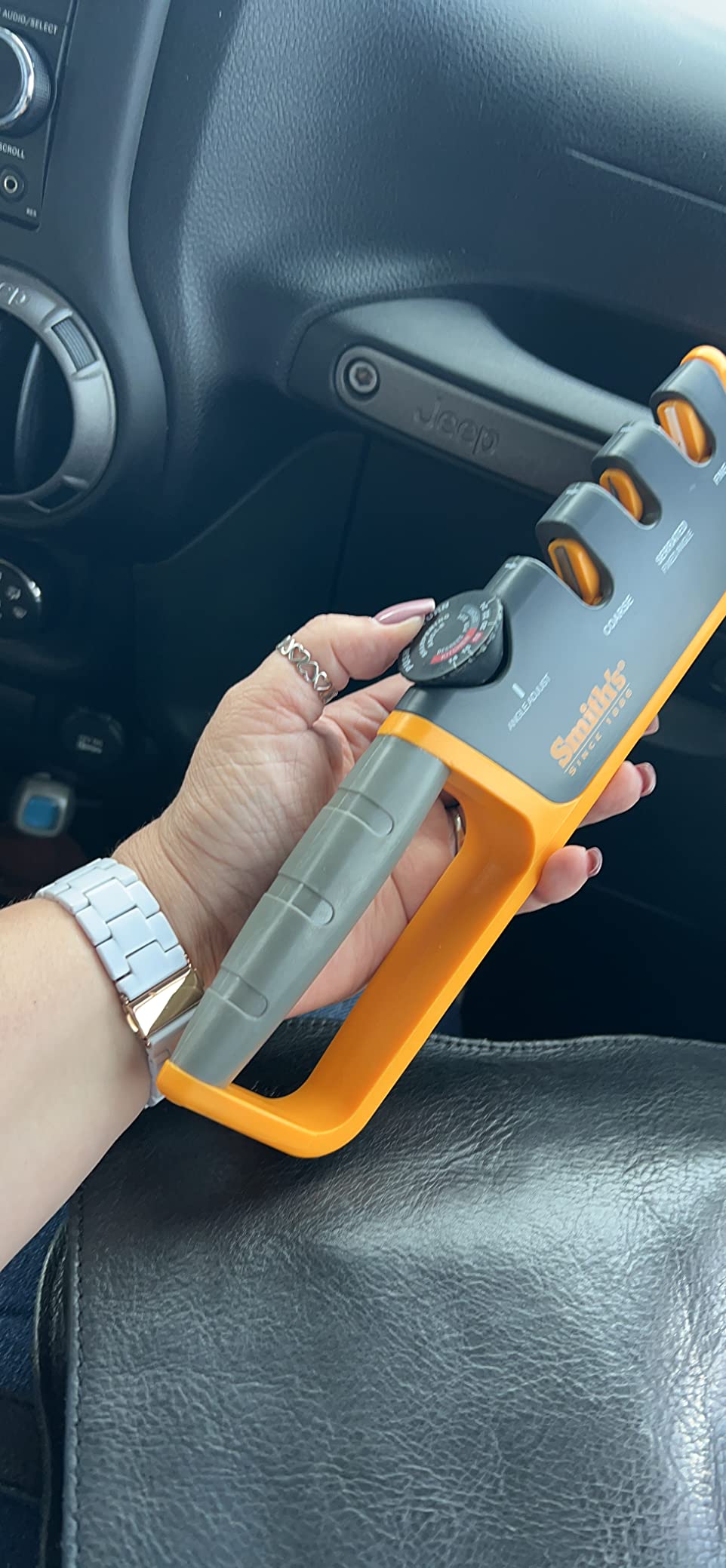
The replaceable parts matter more than they might seem. Carbide and ceramic rods wear at different rates, and being able to swap one rather than replace the unit is the single best answer to the durability complaint that dogs most budget sharpeners in this list.
Owners like the soft grip handle and non-slip base, and the adjustable range is consistently cited as the reason the tool feels like it was designed by someone who owns more than one knife.
When the extra range earns its keep
You feel the difference immediately if you own a folder with a shallow edge and a hunting knife with a thick one. Setting the knob to match means the tool sharpens rather than reshapes, and that is the whole argument for spending more than a fixed-angle slot costs.
It is also the only tool here that covers straight edges, serrations and outdoor blades with settings rather than a compromise.
What to expect day to day
The adjustment knob needs a little practice before you trust it, and getting the setting roughly right matters more than getting it perfect. Learn it once and it stops being an issue.
The other trade-off is size. At 10.75 inches long, it is the biggest tool in this roundup and the least drawer-friendly, so it earns a permanent spot on the counter rather than in a utensil drawer. If portability is your priority, this is the wrong shape for the job.
7. Orange Ninja 4-Stage: Best for Serrated Knives
Orange Ninja Serrated & Kitchen Knife Sharpener – 4-Stage Sharpening Tool
Coarse, medium, fine
Dedicated serrated slot
ABS body
Pros
- Dedicated serrated slot unlike most rivals
- Coarse carbide stage repairs damaged edges
- Handle works for either hand
- Covers kitchen paring filet pocket and hunting knives
- Strong ABS plastic body
Cons
- Edge is a working edge rather than a razor finish
- Heaviest tool here at nearly 11 ounces
- Coarse carbide stage needs care on hard steels
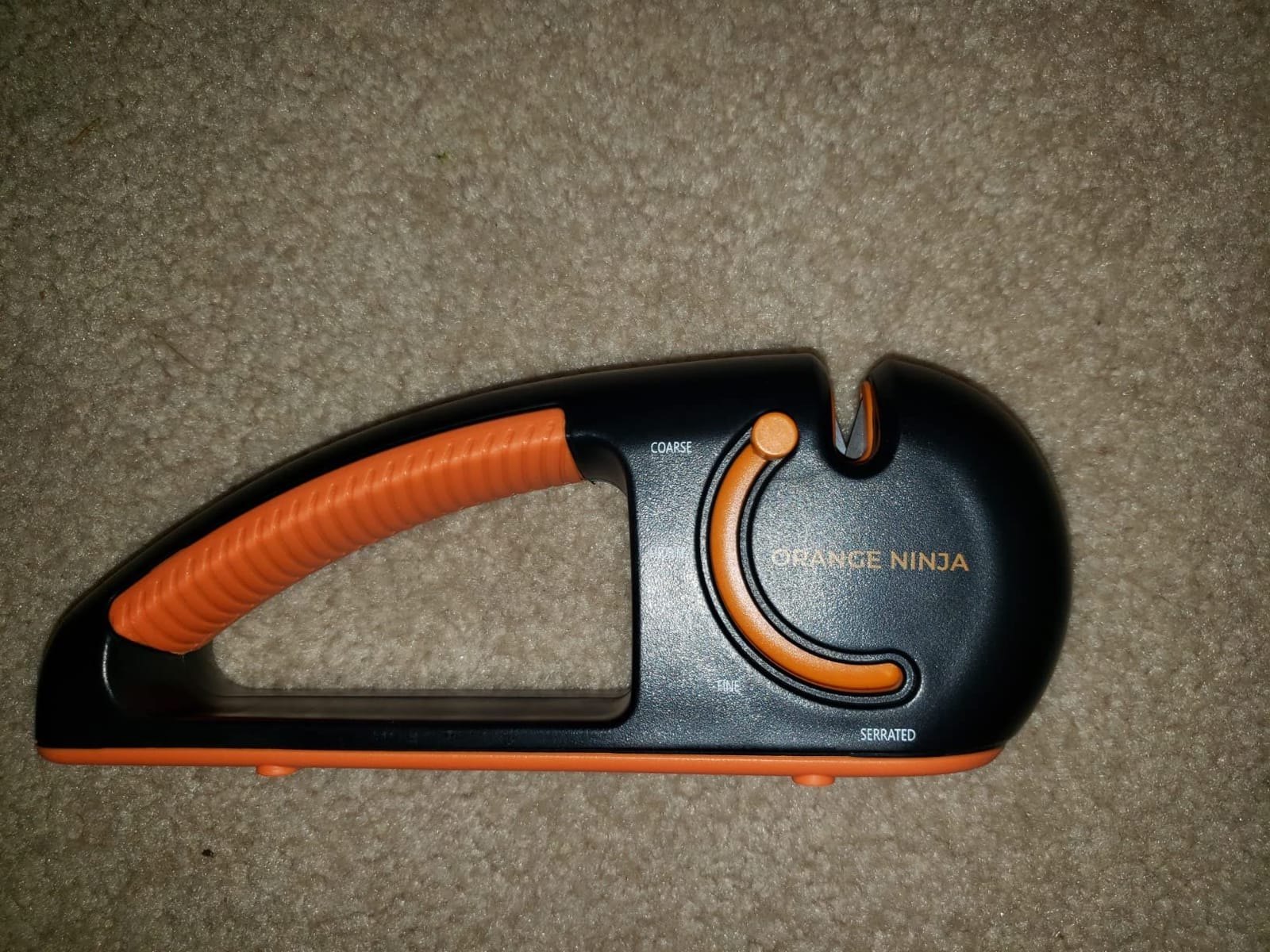
Most multi-slot sharpeners claim to handle serrations, which usually means a slightly wider slot that rounds the teeth over rather than a real solution. This one has a dedicated serrated slot, and that single design decision is the reason it earns a place on this list.
It runs four slots in total. A coarse carbide stage straightens and repairs damaged edges first, a medium diamond-rod stage sharpens, a fine slot cleans up the result, and the fourth is reserved for serrated blades.
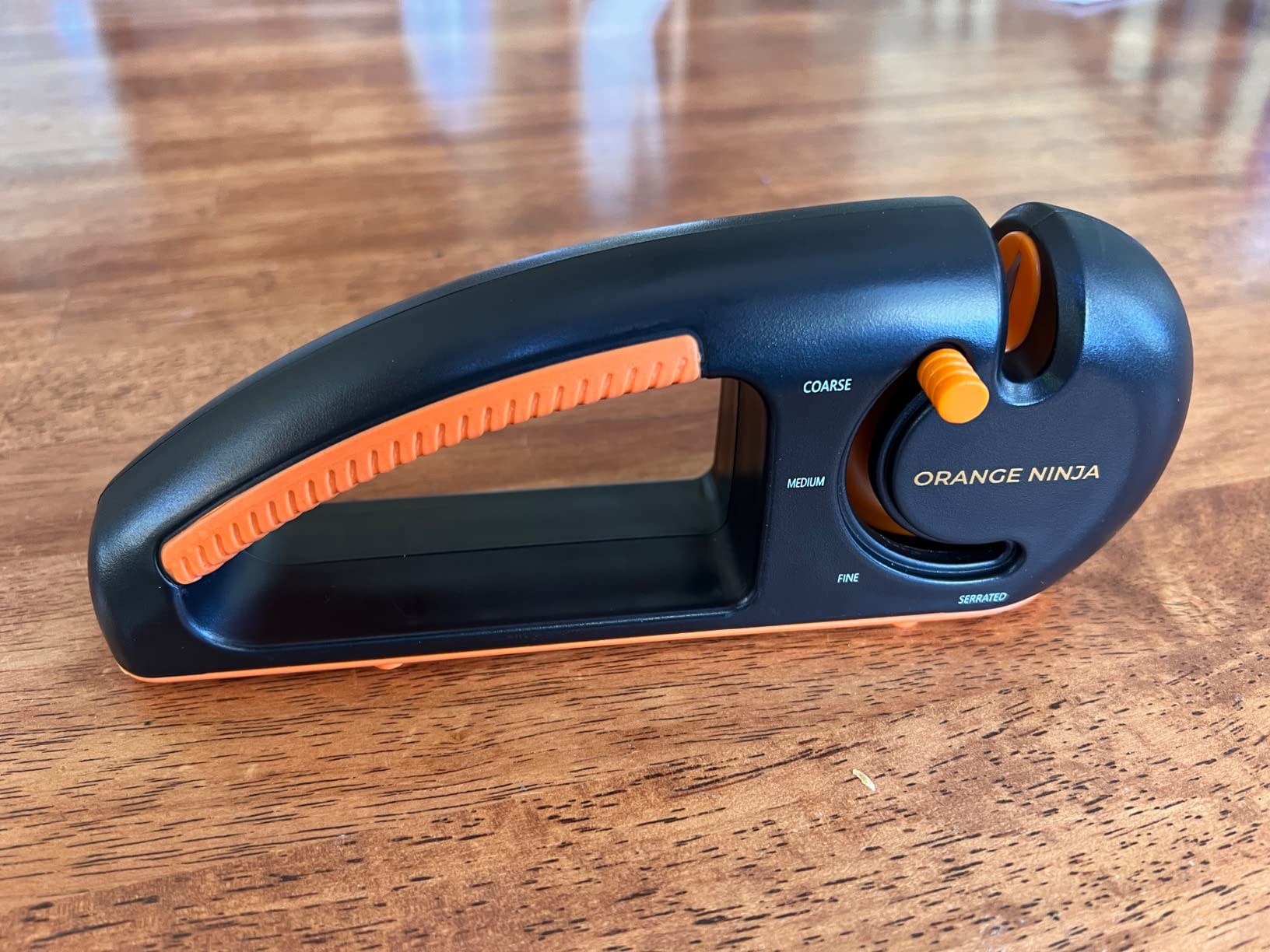
Reviewers single out the serrated slot, and they also credit the coarse stage for rescuing knives that had been neglected badly enough that they had stopped cutting well. The ergonomic handle works for either hand, and the coverage runs from kitchen knives to pocket and hunting blades.
The result is a reliable working kitchen edge across a lot of blade types, which for most homes is exactly the goal.
What the serrated slot actually does
A serrated blade has no continuous edge to hone. Each tooth has its own geometry, and what a sharpener can do is clean the valley between the teeth and straighten the tips, which is what this slot is shaped to do. It will not turn a worn-out serrated knife into a new one, but it noticeably improves a serviceable one.
That makes this a good companion to a bread knife that has started dragging through the crust rather than cutting it.
Where the weight and the coarse stage come in
At nearly 11 ounces, this is the heaviest tool we tested, and reviewers notice. It stays planted on the counter, which is a fair trade, but it is not something you will pack into a drawer or a travel kit.
As with the other carbide-stage tools here, the coarse slot needs care on very hard steels, and the finish it produces is a solid working edge rather than a razor one. If serrations are not part of your knife collection, the Smith’s adjustable model covers more ground for the same money.
8. KITCHELLENCE 4-in-1: Best Budget Three-Stage
4-in-1 Kitchen Knife Accessories: 3-Stage Knife Sharpener Helps Repair, Restore, Polish Blades and Cut-Resistant Glove (Black)
Diamond rod, sharpen, polish
Glove
Non-slip base
Pros
- Three distinct stages for repair sharpening and polishing
- Learned in seconds by most first-time users
- Solid ABS construction
- Compact and easy to store
- Handle works for either hand
Cons
- Results are temporary and need refreshing often
- Many buyers had to adjust the recommended technique
- Cut-resistant glove missing from some orders
Three stages, one glove, no dials. The first slot holds a diamond rod that repairs and straightens damaged blades, the second restores the V shape of the edge, and the third gives it a clean polish. For a cook who wants one more stage than a basic two-stage tool, this is the cheapest way to get it.
Reviewers describe it as a labour saver that produces an adequate edge quickly and without skill, and one long, heavily upvoted review credits it with rescuing very old cutlery. That review also admits the owner had to find a better angle and pressure than the manual recommends before it worked properly.
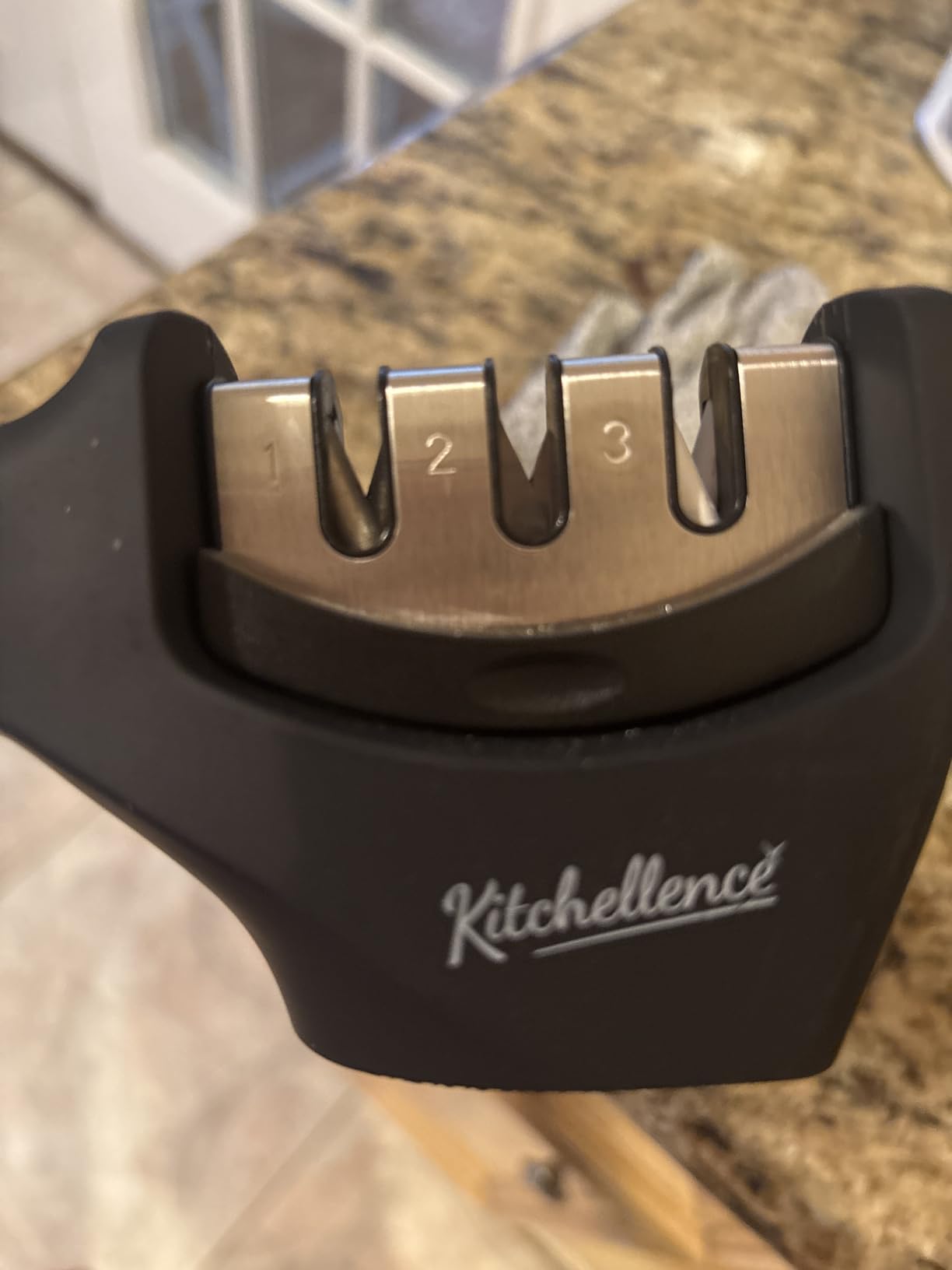
That last point is worth repeating. The technique is simple but not automatic, and treating the tool gently and letting the pull do the work matters more than any setting you choose.
The build is solid ABS plastic rather than something flimsy, and the non-slip base keeps it steady. The included cut-resistant glove is a nice safety addition, and the handle works equally well for either hand.
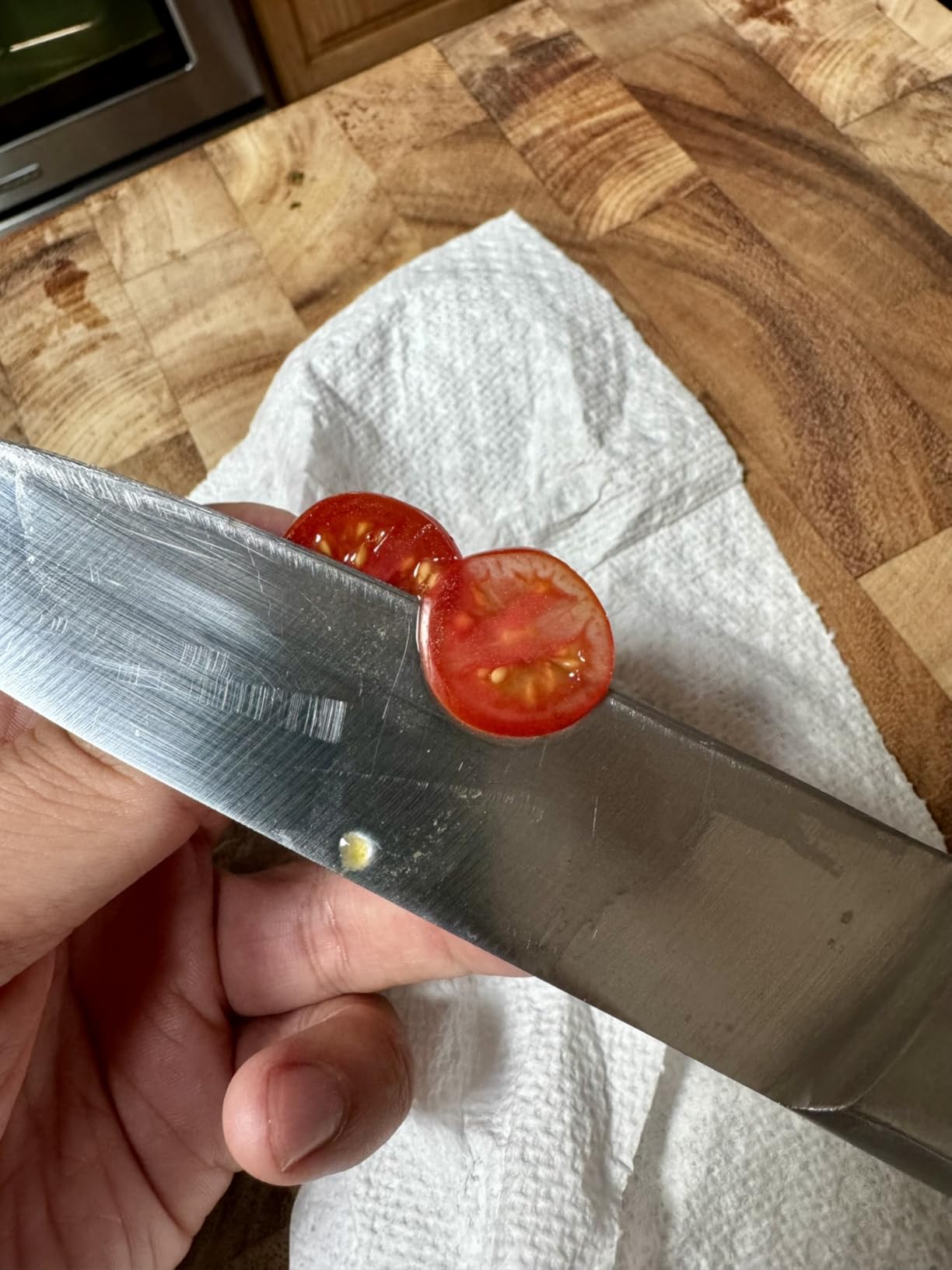
What the three stages actually buy you
The first slot is a repair tool. It takes a rolled or bent edge and straightens it, which is genuinely useful on a knife that has been dropped or used as a pry bar. The second does the sharpening. The third smooths the result so the edge feels cleaner on food.
That progression is a little more useful than a plain two-stage setup, particularly on older knives that need straightening before they can be sharpened at all.
Where the budget shows
The recurring complaint is that edges do not last long between sessions. You will be refreshing before most cooking sessions rather than once a month, which is fine for a busy household and unsatisfying if you want a set-and-forget edge.
Some deliveries also arrived without the cut-resistant glove, so if that matters to you, check the box on arrival. Overall this is a capable starter tool that does a lot for very little, and the review numbers behind it are among the strongest here.
9. Longzon 5-in-1 4 Stage: Best for Knives and Scissors Together
Longzon 5-in-1 Knife Sharpener 4 Stage with Cut-Resistant Glove, Quickly Sharpens & Restores Dull Blades, Easy & Safe for Home Manual Kitchen Use, Fits Most Knives and Scissors, Black+Silver
4 stages plus scissor slot
Glove
Non-slip base
Pros
- Four stages plus a scissor slot at a low price
- Very stable non-slip base
- No settings or dials to fiddle with
- Scissors sharpen effectively
- Lightweight and easy to store
- Cut-resistant glove included
Cons
- Smaller than expected for large knives
- Coarse tungsten slot can chip hard Japanese steels
- Leaves a burr that a second tool must smooth
- Scissor slot instructions are unclear
- Metal builds up on the rods over time
If you want a single tool for knives, kitchen shears and pocket blades, this has more going on than anything else at this level. Four stages cover a scissor slot, coarse grinding, fine grinding and precision grinding, with no dials and no settings to learn.
Owners particularly like that the scissors actually sharpen properly rather than just going through the motions. That is a real gap in most multi-stage tools, and this one fills it.
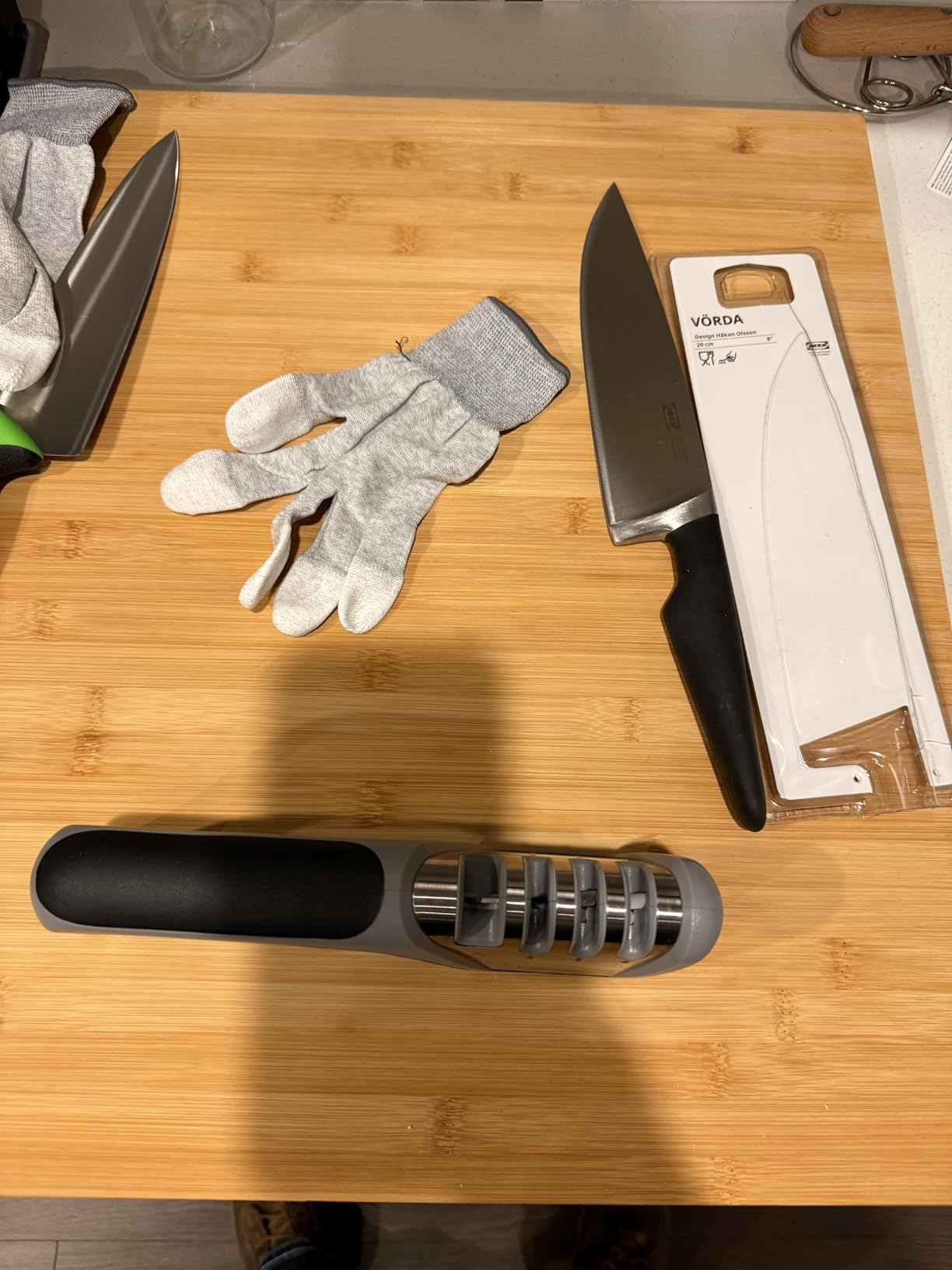
The wide non-slip base is the other thing reviewers praise, because a rock-solid tool means a more consistent pull and less chance of the blade catching. It weighs 150 grams and has a slim profile that fits in a drawer without being noticed.
A cut-resistant glove comes in the box, which adds a safety layer for people who are genuinely nervous about the exposed abrasive.
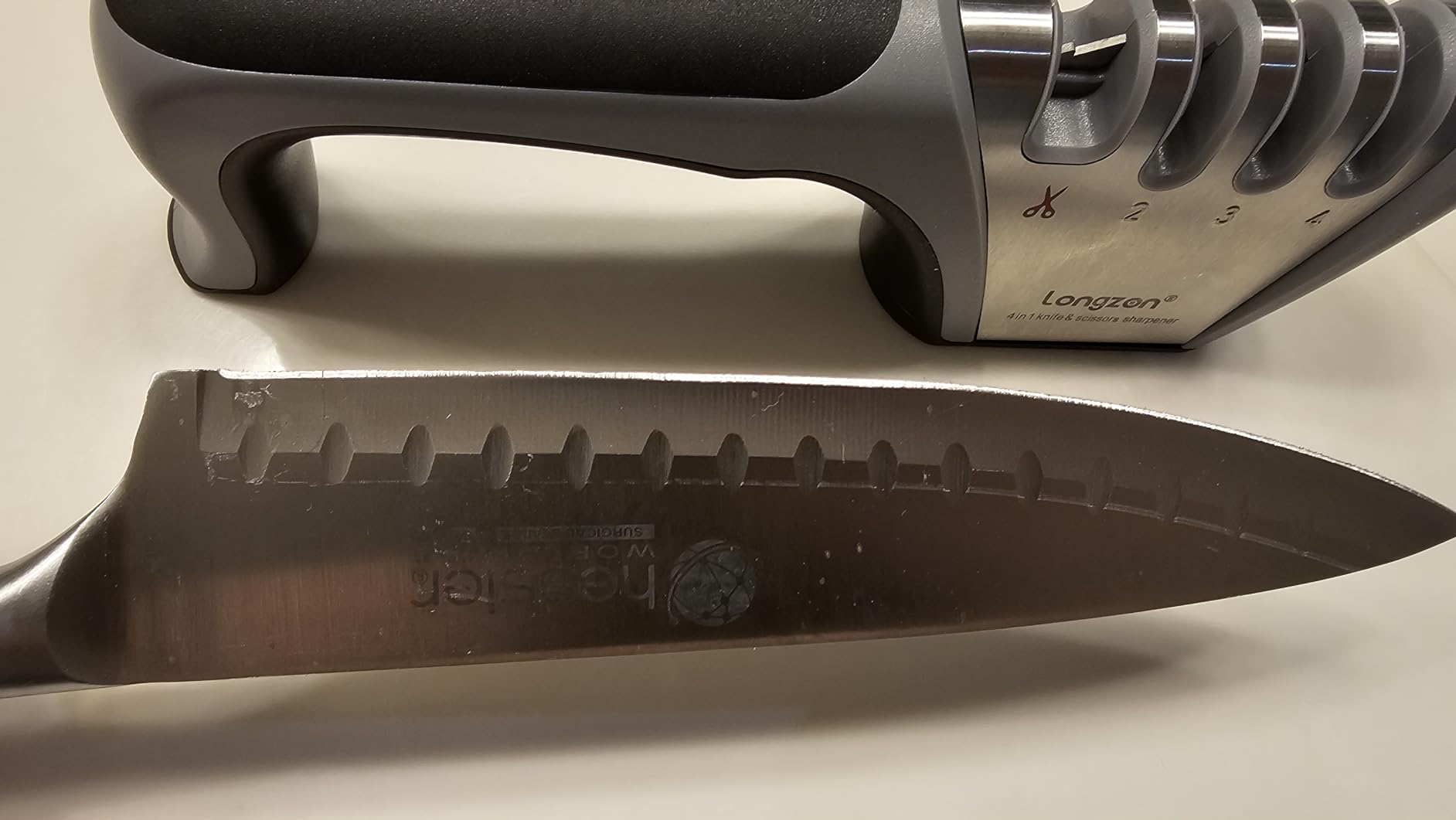
Four stages versus three
The difference between this and the KITCHELLENCE model is mostly the extra precision stage and the scissor slot. If sharpening shears is on your list, that extra coverage is the reason to pick this one. If not, either does the same job on knives.
The fine stages produce a working edge for everyday prep rather than a razor finish, and detailed reviewers are candid about that limit.
Three things to know before you buy
It is smaller than expected, so if you have very large hands or a long chef’s knife, the ergonomics may feel cramped. The coarse tungsten slot is aggressive, and reviewers specifically warn against running hard Japanese steels through it. And the final stage can leave a burr that a honing rod or a stone is needed to smooth off.
Metal also builds up on the rods over time, and a damp cloth every few sessions keeps the tool working properly. None of these are dealbreakers, but they are the details that separate it from the sharper models higher on this list.
10. SHARPAL 191H: Best for Stability and Left-or-Right Handed Use
SHARPAL 191H Knife Scissors Sharpener
Carbide, ceramic, scissors
Suction base
Switch to activate
Pros
- Suction base holds firm without a hand on the tool
- Three stages including a scissor slot
- Works for either hand
- Compact enough to store out of the way
- Press one switch to activate the suction
Cons
- Edge is a working kitchen edge rather than a razor one
- Results vary by starting condition
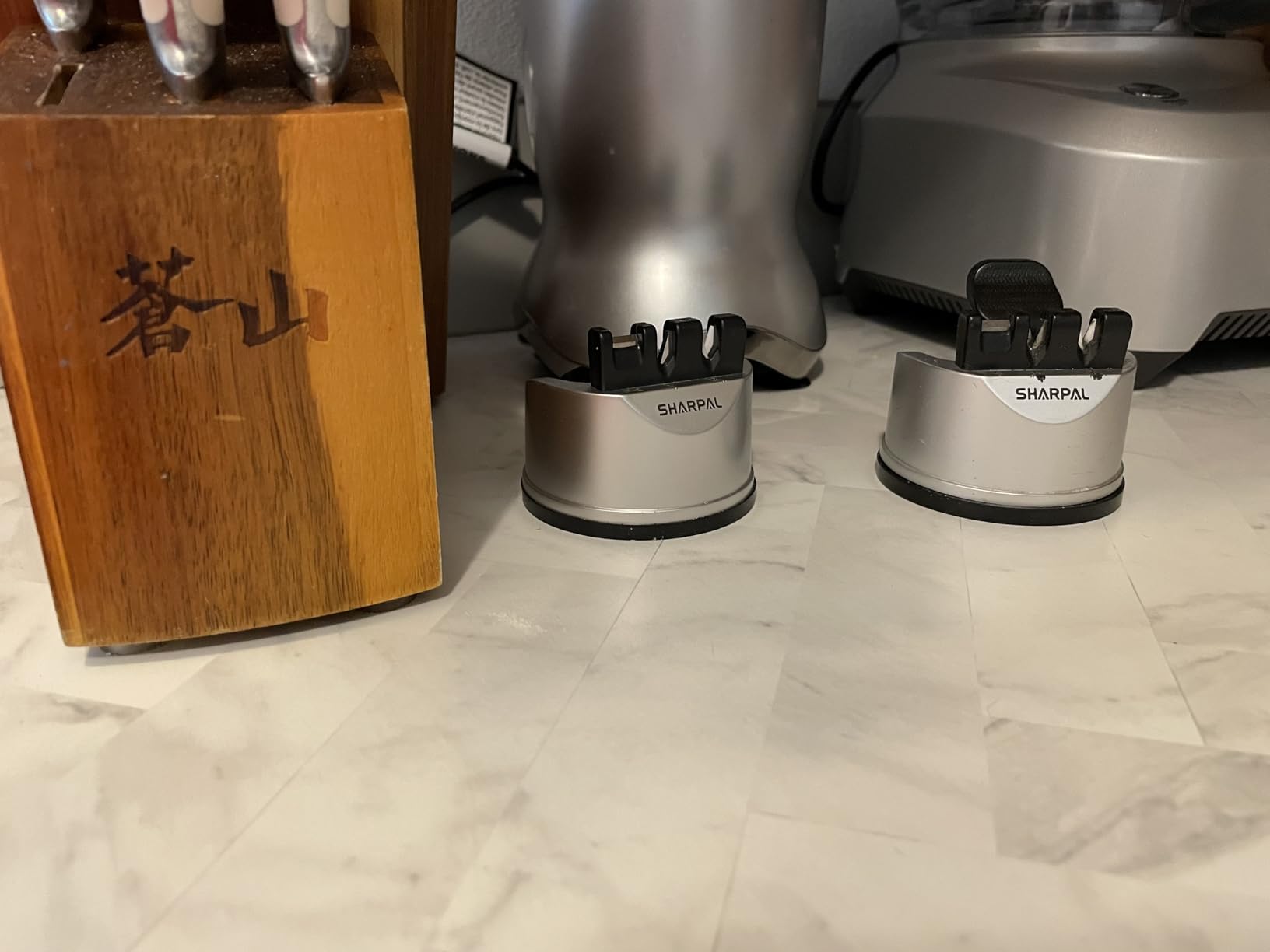
The defining feature of the SHARPAL 191H is stability. A switch on the base activates a suction cup that grips the counter, and reviewers describe it as roughly twice as strong as comparable products. Once it is on, you are not holding the tool at all, which improves both the quality of the pass and your confidence with an exposed blade.
That safety benefit is not cosmetic. Many home cooks find pull-throughs frightening precisely because the tool can move while the blade is exposed, and a base that refuses to budge removes the reason for that hesitation.
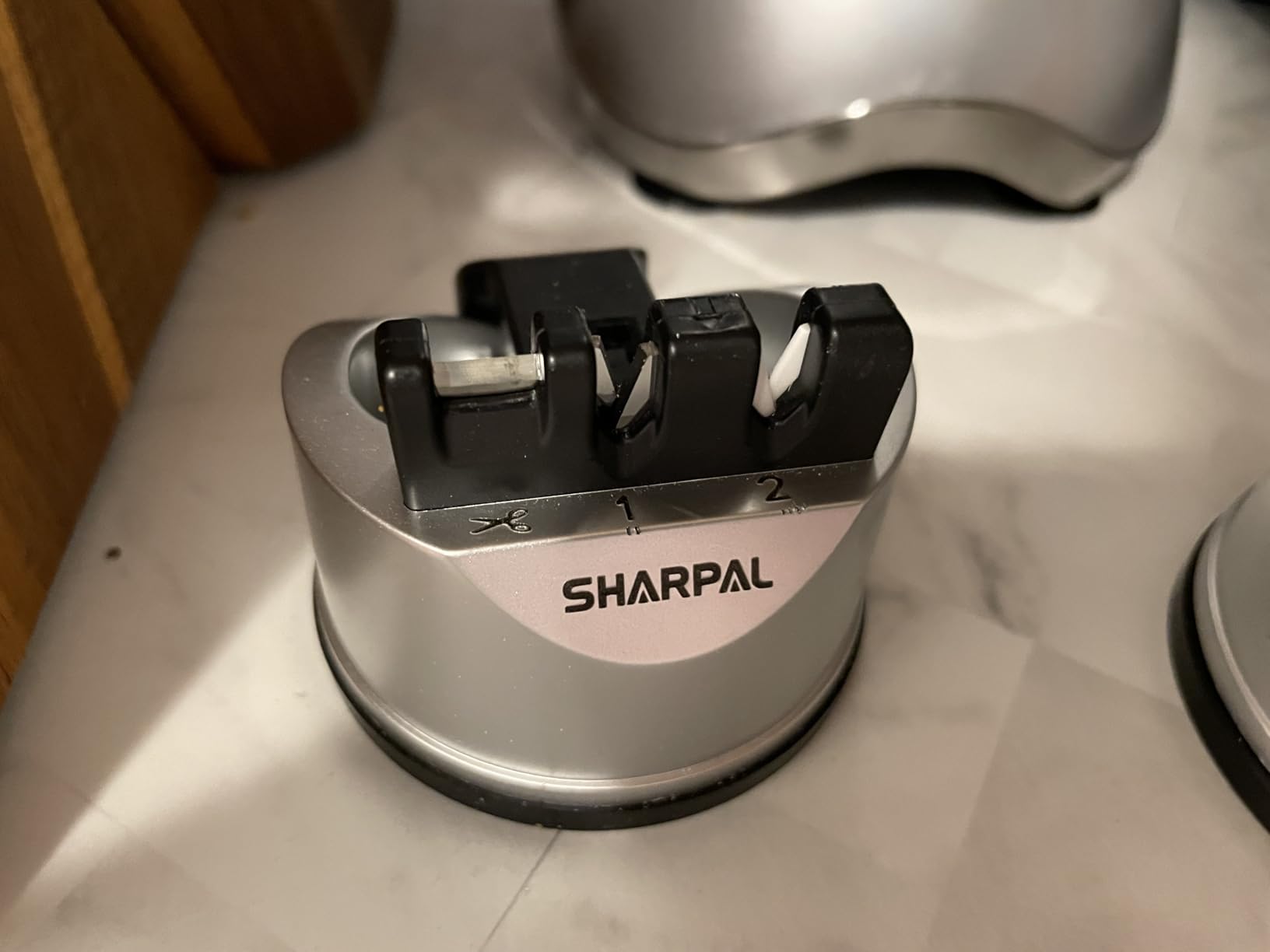
It handles three jobs. Tungsten carbide blades do the quick edge setting, ceramic blades do the precision honing, and a dedicated tungsten slot sharpens scissors. It suits either hand, and at under three inches across it stores without taking counter space.
Why stability changes the result
Every pull-through depends on the blade travelling straight through the slot. If the tool shifts mid-stroke, the abrasive meets the edge at a slightly different angle each time, and the result is an uneven bevel. A suction base removes that variable entirely, which is why owners of this model describe the edge as consistent.
It is the same principle as the non-slip bases on the other tools here, just achieved more firmly.
What the reviews are measured about
The ratings are solid rather than exceptional, and the reason is consistent: this produces a good working kitchen edge rather than a razor one. Some users also report that results vary depending on how rough the starting condition of the blade was.
If you are nervous about sharpening, want to use one hand, or have a small kitchen where a loose tool on a wet counter is a real risk, the suction base is worth more than another stage would be. It is also one of the few tools here that explicitly suits either hand without any adjustment.
11. Work Sharp Pull Through: Best for a Drawer or a BBQ Kit
Work Sharp Pull Through Kitchen Knife Sharpener
Diamond then ceramic
6.29 inch body
Gentle on steel
Pros
- Roughly 15 passes noticeably improved dull knives
- Diamond and ceramic wheels in sequence
- Compact enough for a drawer or BBQ kit
- Large rubber handle and rubber base
- Removes very little metal per pass
Cons
- Edge suits kitchen tasks rather than professional sharpening
- Disks darken over time with no easy cleaning method
- Some users needed practice to get comfortable
This is the newest tool in the roundup and it takes a different approach. Rather than the usual V-slot grind, it uses a pair of diamond and ceramic wheels that the blade is drawn across, and it is noticeably gentler than most pull-throughs on steel removal.
Owners report that roughly 15 passes noticeably improved knives they had given up on. That is more passes than the budget two-stage tools need, and it is the reason the wheel design is worth knowing about: it takes longer but removes less.

The physical design is the other selling point. At 6.29 inches long, it is compact enough to live in a utensil drawer or travel in a BBQ kit, and the large rubber handle plus rubber base make it stable and safe to use one-handed.
It is one of the cleanest-looking tools here, with modern construction that sits at home on a counter as much as in a drawer.

Best for knives you are worried about
The low metal removal rate is the practical reason to choose this one. If you have a knife you value but are wary of sharpening, a gentler mechanism is easier to commit to than a coarse carbide slot, and 15 light passes is a low-risk way to find out how a blade responds.
It also means the tool suits regular maintenance better than emergency repairs. A knife that is only slightly dull is the ideal candidate.
The honest limits
Owners describe the finished edge as good for kitchen work rather than professionally sharp, and that is the consistent characterisation across reviews. The abrasive wheels also darken with use and there is no easy cleaning method for them, which is a maintenance detail most people learn to ignore.
With a smaller pool of owner feedback than the budget models here, treat the durability story as promising rather than proven. If you want the sharpest possible edge, go up the list. If you want a compact, gentle, good-enough sharpener for everyday knives, this one earns its place.
12. Smith’s Pull-Thru: Best for Routine Touch-Ups
Smith’s Pull-Thru Knife Sharpener
Carbide then ceramic
Replaceable parts
Non-slip base
Pros
- Carbide and ceramic components are replaceable
- Improved soft grip handle over the basic model
- Non-slip rubber base keeps it stable
- Very compact next to a knife block
- Pre-set angles in both slots
- Pocket and sports knives as well as kitchen
Cons
- No knife guide
- so alignment relies on your hand
- Practice needed to keep the blade vertical
- Coarse side is aggressive and best used sparingly
This is Smith’s higher-end pull-through, and the reason it costs more than the basic version is the handle and the replaceable parts. A soft grip handle makes a real difference to control, and the carbide and ceramic components can be swapped instead of replacing the whole tool.
It runs two pre-set slots, carbide for dull and damaged straight edges and ceramic rods for final honing plus light work on serrated blades. Because the angles are pre-set in both slots, results are consistent without any adjustment.

At 2 by 1 by 6 inches it is among the most compact tools here, and reviewers like that it sits next to a knife block without being noticed. The non-slip rubber base holds it in place on the counter.
Common owner advice is to run a knife through it three or four times before cooking as a matter of habit, keeping the blade vertical and saving the coarse side for genuinely dull blades.
What makes it a touch-up tool
There is no knife guide, so alignment depends entirely on your hand staying vertical through the slots. In practice that is an easy habit to build, but it does mean the tool rewards practice rather than working perfectly on the first try.
It also has no angle adjustment, so it shares the same limitation as the other fixed-angle tools here. What it does have is replaceable components, which fixes the durability problem that sends owners shopping for a new budget sharpener every couple of years.
When it is the right buy
Buy this one if you already own a good whetstone setup and want a quick, cheap way to touch up knives between stone sessions. That is exactly how owners use it, and it is why the edge it produces does not need to be the sharpest available.
It is also compact and reasonably priced for the feature set, which makes it a sensible second tool. Just keep the blade vertical, use the coarse side sparingly, and the replaceable components will keep it working for years.
Buying Guide: How to Choose a Pull Through Knife Sharpener
Pull-through sharpeners look similar from across the counter and behave quite differently in the hand. The four things that actually change your result are stage count, angle control, abrasive material and whether the tool covers the blades you own.
Two stages, three stages or four: what actually changes
A two-stage tool gives you one abrasive for setting an edge and one for finishing. That is the minimum useful configuration and it covers 90 percent of home kitchens, which is why the KitchenIQ and AccuSharp designs have sold for decades.
A third stage typically adds either a repair function, like the diamond rod on the KITCHELLENCE model, or a dedicated serrated slot, like the Orange Ninja. A fourth stage adds precision finishing or a scissor slot, as on the Longzon.
More stages are not automatically better. Each extra stage is another abrasive that can be misused, and the real gains come from covering the blade types you own rather than from the count itself.
Edge angles: 15 degrees versus 20 degrees and why it matters
Edge angle is the single most important compatibility question, and it is where expensive knives get damaged. Most Japanese knives are ground at 15 degrees per side, most European chef’s knives at around 20 degrees per side, and specialty outdoor blades can go steeper or shallower still.
Sharpening a 15-degree knife in a 20-degree slot does not sharpen it. It reprofiles it, removing a great deal of steel to build a bevel you did not want. The same thing happens in reverse, though far less damagingly, on a European knife put through a 15-degree slot.
That is why the adjustable models in this roundup exist. If your knives span more than one angle, choose a tool with settings, and choose the fine stage for maintenance. If all your knives are the same general style, a fixed slot is easier and perfectly fine.
Abrasive material: tungsten carbide, diamond or ceramic
Tungsten carbide is the workhorse. It removes metal fast, is cheap, is available in reversible blades, and is what most budget sharpeners use. The trade is a toothier, more ragged edge that a honing rod helps to tidy up.
Diamond abrasive cuts faster and finer than carbide, works on harder steels, and produces a smoother edge, which is why the Chef’sChoice model uses it in all three stages. It is the more expensive option and the one that matters most if you own hard Japanese steel.
Ceramic is the finishing abrasive. It is smooth and fast on an already-sharp edge and it is what you want in the last slot, but it is a poor choice for a knife that needs metal removed. Most good tools combine carbide or diamond with ceramic. Tools that are ceramic only, in a single stage, are not doing what you need.
Serrated knives: what pull-throughs can and cannot do
A serrated knife has no continuous edge to hone, so a normal slot cannot sharpen it. What a sharpener can do is clean the valley between each tooth and straighten the tips, which restores cutting performance on a serviceable blade.
Look for a dedicated serrated slot rather than a slot that simply happens to be wider. The Orange Ninja, the Smith’s adjustable model and the Chef’sChoice all have specific provision for serrations, and that is the difference between cleaning the teeth and rounding them off.
When a pull-through is the wrong tool
A pull-through is a maintenance tool, not a reprofiling tool. It is the wrong choice for a knife with chips or a missing section of edge, where a stone or a belt system can remove steel without wasting it, and it is the wrong choice for a thin single-bevel Japanese blade unless the angle matches.
It is also the wrong choice if you want a razor-sharp, long-retention edge. Every model here produces a working kitchen edge, and the enthusiasts who complain that pull-through edges fade within weeks are describing a real limitation, not user error.
What it is always the right choice for is the dull set of everyday knives you already own, plus scissors, pocket knives and serrated bread knives. Keep a honing rod in the drawer and run it after each pull-through session and the toothy carbide edge gets a noticeable cleanup.
Frequently Asked Questions
What is the best knife sharpener for serrated knives?
The best sharpener for a serrated knife is a pull-through model with a dedicated serrated slot rather than one that simply widens a straight-edge slot. The Orange Ninja 4-Stage, the Smith’s Adjustable S-50264 and the Chef’sChoice 4643009 all have specific serrated provision. That slot cleans the valley between each tooth and straightens the tips, which restores performance on a serviceable blade. It will not replace missing teeth or restore a badly worn serration, which needs a professional. For a first-time buyer with a bread knife in the drawer, a two-stage model with a wide serrated slot is a workable budget option.
What angle are pull through sharpeners at?
Most fixed-angle pull-through sharpeners sit somewhere between 20 and 26 degrees per side, and many manufacturers do not publish the figure. The Wusthof 2-Stage is explicit at a preset 34-degree total edge, and the adjustable models let you choose: the Smith’s S-50264 covers 14 to 24 degrees and the Sharp Pebble 5 Precision Adjust offers 12, 15, 18, 21 and 24. The Chef’sChoice 4643009 handles both 15 and 20 degree classes. Matching your knife’s angle matters most on thin Japanese steel, where a steeper slot will reprofile the edge.
How good are pull-through knife sharpeners?
Pull-through knife sharpeners are very good at restoring a working edge on everyday kitchen knives in under a minute, especially blades that are dull or mildly neglected. They are much less good at producing a refined, long-retention edge on thin premium steel, because a fixed angle and a coarse carbide stage remove more metal than most enthusiasts want. Across thousands of owner reviews, they prove to be excellent maintenance tools for the knives in your block and poor reprofiling tools for expensive Japanese blades.
What knife sharpener does America’s Test kitchen recommend?
America’s Test Kitchen’s manual sharpener coverage has historically leaned toward models with real angle control and replaceable abrasives rather than basic fixed-slot units, and their top manual pick has long been the Chef’sChoice Pronto Diamond Hone for its 15-degree accuracy. In this roundup, the model closest in approach is the Chef’sChoice 4643009, which uses diamond abrasive in all three stages and handles both 15 and 20 degree edges. Their testing also stresses slot depth, and recommends finishing with a honing rod.
Which pull-through knife sharpener is the best?
The AccuSharp Original is the best pull-through knife sharpener for most home cooks, with the highest average rating in this roundup and reversible carbide blades owners rate at five to ten years of life. If you want the sharpest edge available without electricity, the Chef’sChoice 4643009 leads on its three diamond stages. If you match your knife to a thinner Asian grind, the Sharp Pebble 5 Precision Adjust, with five angle settings, is the right choice. Each of these takes a dull knife to a working edge in under a minute.
Are AccuSharp sharpeners good?
Yes, and they are the best-rated pull-through in this roundup at 4.7 stars across more than 28,000 reviews, with 81 percent of buyers giving five stars. Owners credit the diamond-honed tungsten carbide blades, the reversible design that extends tool life to five or ten years, and the full-length finger guard that makes an exposed-blade tool far less intimidating. The one recurring criticism is that the sharpening angle is fixed, which makes it less suited to very thin Japanese-style edges than an adjustable model.
Is a Zwilling knife sharpener good?
Zwilling pull-through sharpeners are solid, well-made tools and a sensible choice if you already own Zwilling or Henckels knives, though we did not find one strong enough to make this roundup of twelve. The main caution is the same one that applies to the Wusthof included here: many fixed-angle models are set blunter than the fine European and Japanese edges people actually own. Sharpening a thin 15-degree blade in a 20-plus degree slot reprofiles it rather than sharpening it. Check your knife’s grind before using any fixed-angle model.
Which Work Sharp sharpener is considered the best?
Among pull-through models, the Work Sharp pull-through in this roundup is the gentlest option, using diamond and ceramic wheels rather than a coarse carbide slot and removing very little metal per pass. Owners report needing roughly 15 passes to noticeably improve a dull knife, which is more work than budget units need but far less steel removed. It is also among the most compact and portable designs here, making it a strong choice for a utensil drawer or a BBQ kit, though the edge is a kitchen edge rather than a razor one.
Conclusion: The Sharpener You Will Actually Use
After working through all twelve, the answer to which of the best pull through knife sharpeners is right for you depends on one question: what is in your knife drawer, and what are you willing to lose if you get the angle wrong.
For most home cooks the answer is the AccuSharp Original. It has the highest rating in this roundup, reversible blades rated at five to ten years, a finger guard that makes it the least intimidating option, and it produces a working edge in about ten seconds. That combination of quality and simplicity is why it is our top pick for 2026.
Own thinner Japanese or European edges, and the Sharp Pebble 5 Precision Adjust or the Smith’s S-50264 let you match the angle instead of guessing at it. Want the sharpest edge possible without electricity, the Chef’sChoice 4643009 earns its cost. Want to spend as little as possible, the KitchenIQ 50825 has almost 98,000 reviews behind it and does the job properly.
Whatever you choose, keep a honing rod in the same drawer and use it after each session. That one extra habit removes the toothy burr that carbide leaves behind and stretches the life of every edge on this list.