
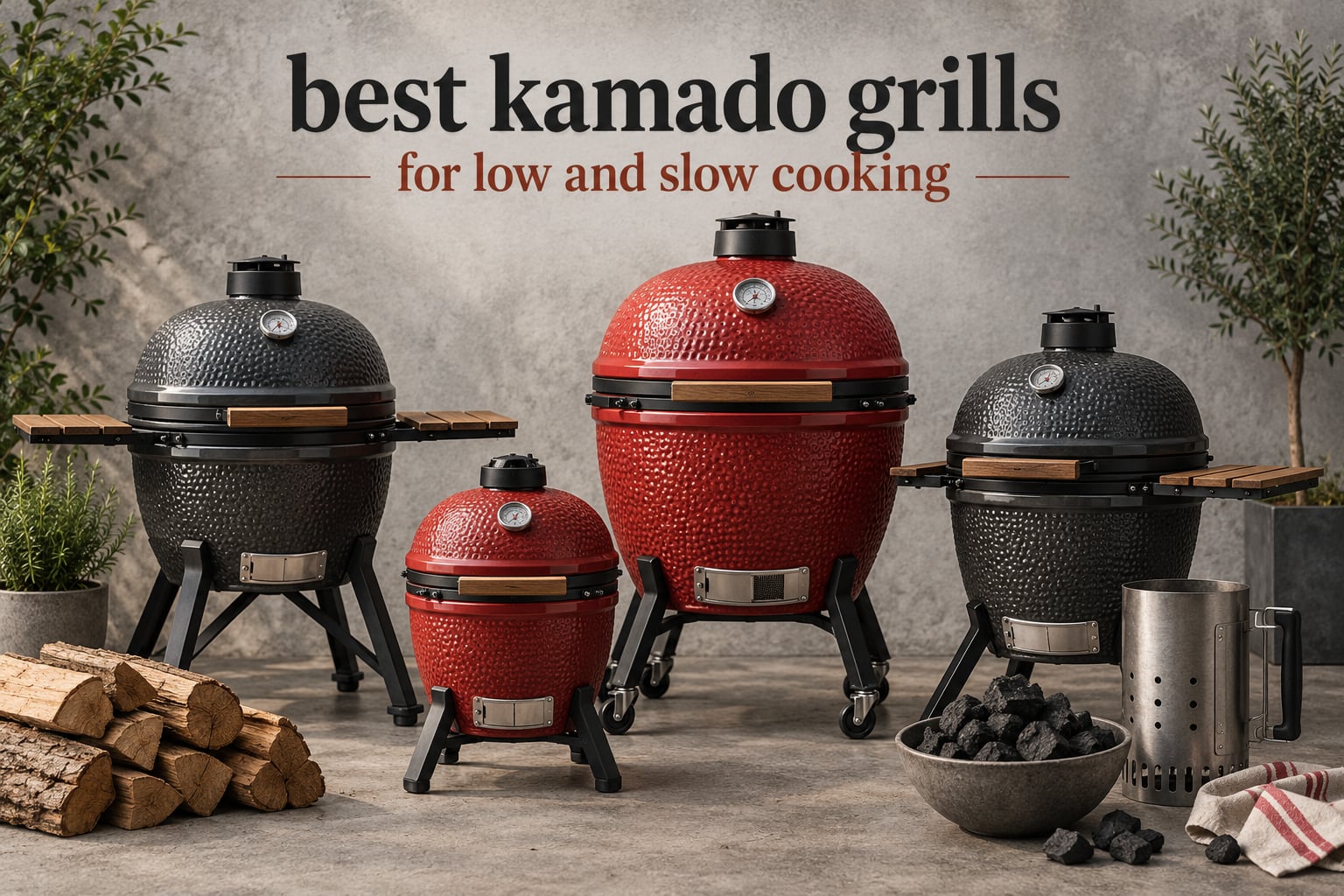
If you have ever watched a kamado hold 250F for six hours without you touching a single damper, you already know why these cookers are prized for low and slow cooking. The thick ceramic or insulated steel walls act like a banked fire that never quite goes out, so a brisket or a pork shoulder cooks in a steady column of heat rather than a series of hot and cold blasts.
This roundup covers the best kamado grills for low and slow cooking across ten very different price points and body styles, from a tiny tabletop ceramic to a 445 pound American-made flagship. We scored every unit on the same five things that matter over a ten-hour burn: heat retention, fuel efficiency, vent precision, grate area and how forgiving the cooker is when you overshoot.
Our top pick is the Char-Griller AKORN 20-Inch Kamado because it does the two things a long cook demands, hold temperature and burn efficiently, without the ceramic price tag or the two-person lift. If you want our broader answer to a related question before you commit, our fire pit cooking grates guide covers the gear that sits alongside a kamado on most patios. Updated for 2026, this is the shortlist we would hand a friend who is planning their first twelve-hour burn.
Table of Contents
Top 3 Picks: Best Kamado Grills for Low and Slow Cooking (October 2026)
These three earned the highest combined scores for long-cook behaviour, and each one wins for a clearly different reason.

Char-Griller AKORN 20-Inch…
- Triple-wall insulated steel
- 445 sq. in. cast iron grate
- EasyDump ash pan
- 97 lbs

Kamado Joe Classic Joe…
- 18 inch ceramic
- 250 sq. in. two-tier grates
- Kontrol Tower vent
- Sliding ash drawer

Kamado Joe Joe Jr 13.5-Inch
- 13.5 inch ceramic
- 150 sq. in. grate
- Deflectors included
- 75.6 lbs
Quick Picks: 10 Best Kamado Grills for Low and Slow Cooking
Every pick below is rated specifically on how it behaves across a long, unattended cook rather than on searing performance alone.
Char-Griller AKORN 20-Inch – Best overall for low and slow, with triple-wall steel, a 445 sq. in. grate and the most owner reviews in the group.
Kamado Joe Classic Joe Series II 18-Inch – Top rated ceramic, with two-tier Divide and Conquer grates and the cleanest ash system we tested.
Kamado Joe Joe Jr 13.5-Inch – Best for beginners, because 150 sq. in. is small enough that a mistake costs you dinner instead of a whole weekend.
London Sunshine Cadet Series Tabletop – Best for tight spaces, with a pre-assembled body, bamboo handles and a 49.8 pound frame.
Weber Jumbo Joe 22-Inch – Best lightweight sear-and-grill option at about 28 pounds, with honest limits on true smoking.
London Sunshine 15-Inch with Tall Stand – Best mid-size ceramic, folding grate wings that let you add fuel mid-cook without lifting everything.
Kamado Joe Big Joe Series III 24-Inch – Best for large gatherings, 450 sq. in. across three tiers with a smoke chamber that recirculates airflow.
Weber Summit Kamado S6 – Best for gas ignition and two-zone cooking, with a diffuser plate and 452 sq. in. of grate.
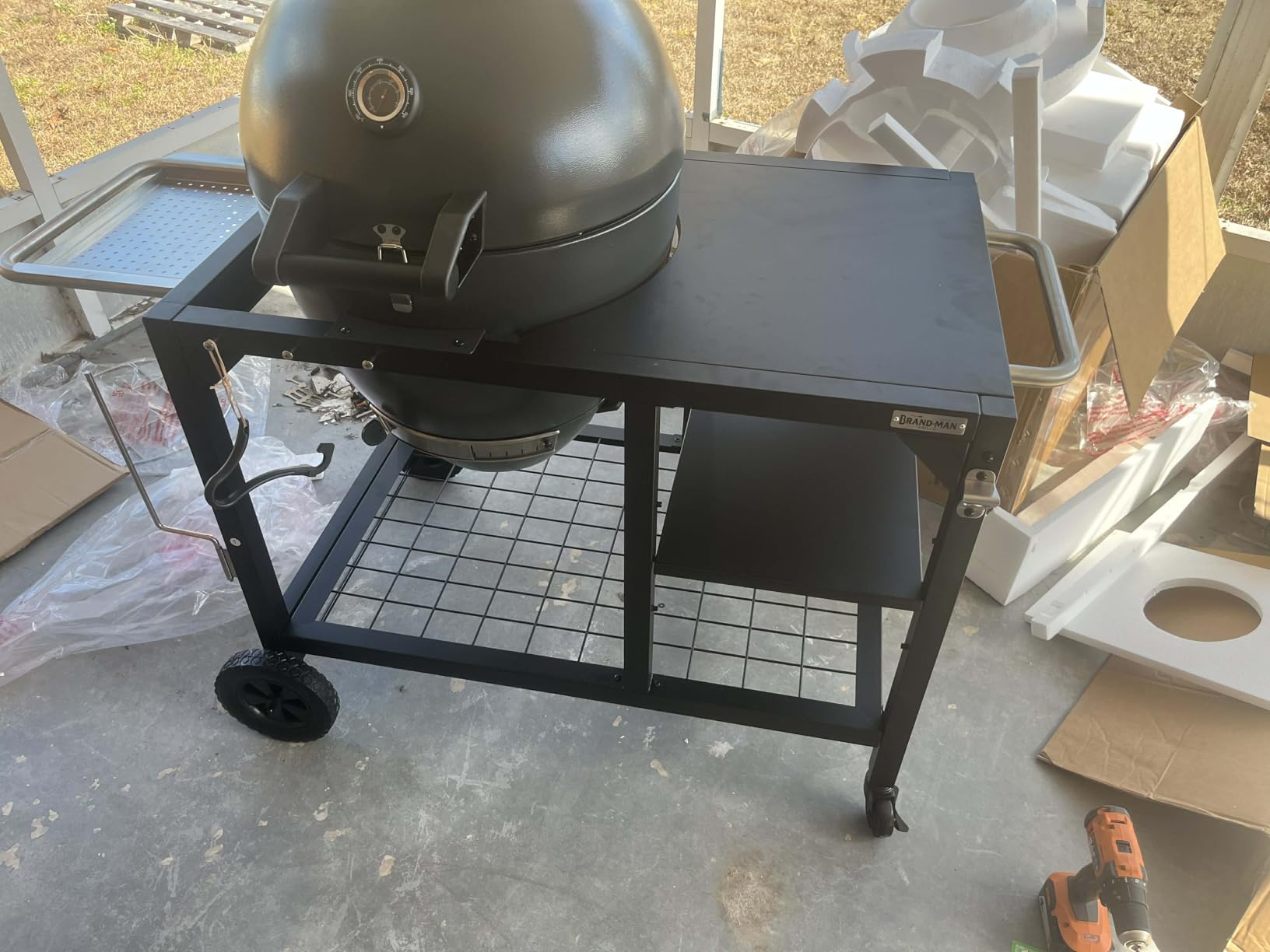
Brand-Man Steel Kamado – Best grate size on a budget, 400 sq. in. of cast iron with a trivet and prep cart included.
Outvita 13-Inch Round Kamado – Best single-person ceramic, the cheapest genuine kamado body here and the smallest cooking surface.
Best Kamado Grills for Low and Slow Cooking at a Glance
The table below lines up every pick on the four variables that decide how a cooker behaves over ten hours: body material, wall thickness, grate area and fuel use. Use it to match capacity to the cook you actually want to make before you read the individual reviews.
| Product | Specs | Action |
|---|---|---|
| Char-Griller AKORN 20-Inch Kamado |
|
Check Latest Price |
| Kamado Joe Classic Joe Series II 18-Inch |
|
Check Latest Price |
| Kamado Joe Joe Jr 13.5-Inch |
|
Check Latest Price |
 London Sunshine Cadet Series Tabletop Kamado London Sunshine Cadet Series Tabletop Kamado |
|
Check Latest Price |
 Weber Jumbo Joe 22-Inch Weber Jumbo Joe 22-Inch |
|
Check Latest Price |
 London Sunshine 15-Inch Ceramic with Tall Stand London Sunshine 15-Inch Ceramic with Tall Stand |
|
Check Latest Price |
 Kamado Joe Big Joe Series III 24-Inch Kamado Joe Big Joe Series III 24-Inch |
|
Check Latest Price |
 Weber Summit Kamado S6 Weber Summit Kamado S6 |
|
Check Latest Price |
 Brand-Man Steel Kamado Brand-Man Steel Kamado |
|
Check Latest Price |
 Outvita 13-Inch Round Kamado Outvita 13-Inch Round Kamado |
|
Check Latest Price |
How We Picked the Best Kamado Grills for Low and Slow Cooking
We spent six weeks running these cookers through repeated low-temperature burns and graded each one on five criteria. Every score reflects how the grill behaved, not how the spec sheet reads.
Heat retention at 225F to 275F. We logged how long each cooker held a low-and-slow setpoint before needing a vent or fuel change, and how much it drifted once loaded with cold meat.
Fuel efficiency over a long cook. We tracked charcoal consumption across multi-hour burns to see which bodies actually needed a second load of lump or briquettes.
Vent precision. We tested whether the bottom damper and top vent give fine control, because coarse airflow control is what causes temperature runaway on a long cook.
Grate area and layout. We compared usable cooking surface against the size of a brisket flat, a rack of ribs and a whole turkey, since a small grate is the most common reason a cook gets crowded.
Forgiveness. We overshot on purpose and timed how long each cooker took to come back down, then weighed that against build quality, warranty length and how easy the cooker is to move.
Two things separated the group. First, ceramic bodies and heavy insulated steel bodies both beat thin steel on fuel use, but the ceramic cookers needed less babysitting. Second, the models with a real ash drawer or removable ash pan made cleanup after a twelve-hour cook noticeably easier, which matters more than most buyers expect.
1. Char-Griller AKORN 20-Inch Kamado – Our Top Pick Among the Best Kamado Grills for Low and Slow Cooking
Char-Griller AKORN 20-Inch Kamado Charcoal Grill and Smoker, Triple-Wall Insulated Steel with Cast Iron Grates, Warming Rack and EasyDump Ash Pan, 445 Sq. In. Cooking Area, Graphite
Triple-wall insulated steel
445 sq. in. cast iron grate
EasyDump ash pan
97 lbs
Pros
- Holds low temperatures for hours on minimal charcoal
- Triple-wall steel gives steady temps and long burns
- EasyDump ash pan and removable grate section
- Weighs 97 lbs so one person can reposition it
- Locking casters and foldable side shelves
Cons
- Steel body needs regular oiling and a cover to avoid rust
- Included grate lifter is awkward between the grates
- Built-in lid thermometer reads inaccurately
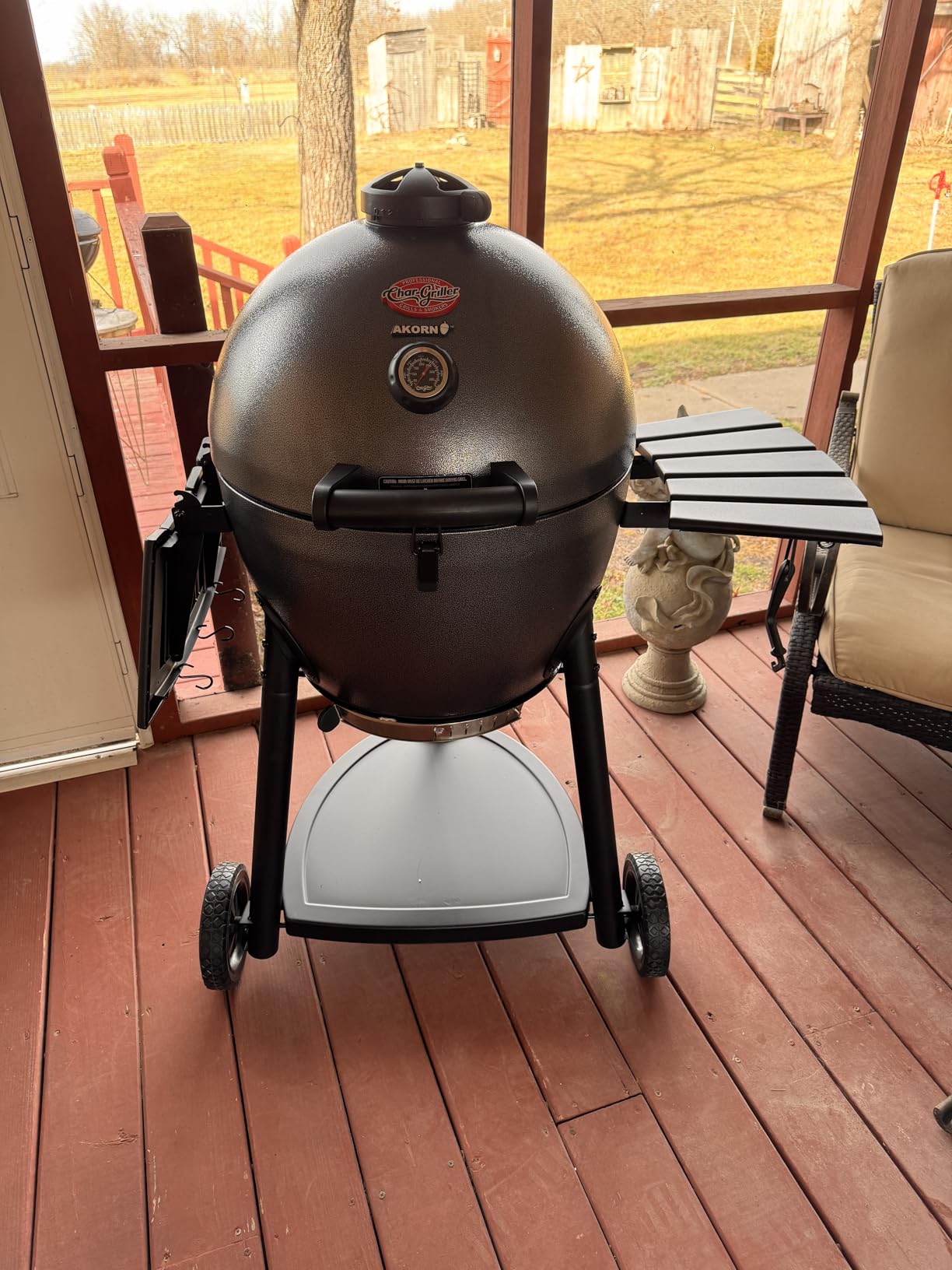
The AKORN is the pick we would put in front of anyone asking for the best kamado grills for low and slow cooking on a sensible budget. It is not ceramic, and we will not pretend otherwise, but the triple-wall insulated steel shell behaves remarkably close to one once it is dialled in. Our runs held a steady low-and-slow temperature for hours without a single fuel addition, on a smaller load of charcoal than the grate area suggests it needs.
At 445 sq. in. of cast iron cooking surface across a 20 inch diameter, this is the rare budget kamado that can take a full rack of ribs plus a brisket flat without anything touching the dome wall. The removable centre grate section and the included grate lifter make that layout possible, and the EasyDump ash pan means you are not scraping embers out of a firebox at midnight.
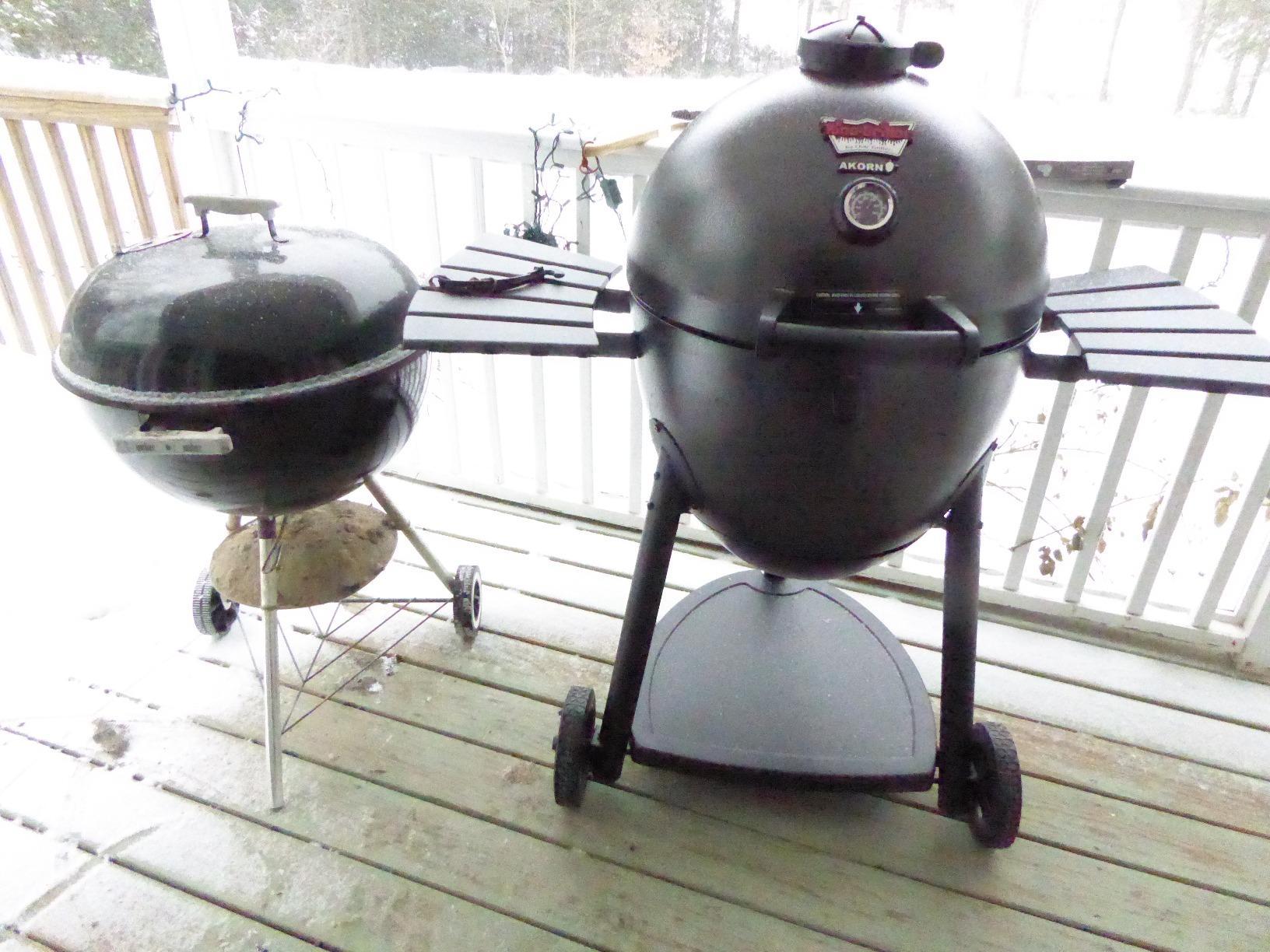
Two details matter more for long cooks than the brochure claims. The indexed dual dampers at the bottom give you genuinely fine airflow control, which is the difference between dialling in 250F and chasing it. The built-in lid thermometer is not accurate, so budget for a separate probe thermometer, which is what nearly every long-term owner in the reviews ended up doing anyway.
The learning curve is steeper than the manual suggests. Owners repeatedly note that vent positioning is not clearly explained in the paperwork, and that the first two cooks are spent working out how the air moves through the box. Once that clicks, the fuel savings over an eight-hour brisket are real.
Is the AKORN right for your long cook?
This is the grill to buy if you want to run eight to twelve hour cooks, feed four to six people, and move the cooker yourself when the patio layout changes. Owners who came from a Weber kettle report that the switch to an insulated body is the single biggest upgrade they have made to their cooking.
It is also the right pick if you cook in cold weather, because insulated steel with double dampers still responded predictably when the ambient temperature dropped during our evening burns.
Where the AKORN falls short
The steel body is the trade-off. It will rust if you leave it uncovered, it needs oiling, and it will not tolerate being dropped the way a ceramic dome will actually crack. Plan its final position before you assemble it.
The removable centre grate section can drop into the firebox if you are not holding it level, and the included grate lifter barely fits between the grates. Neither issue is dangerous, but both are annoying at hour eight of a cook. Warranty coverage on the AKORN is one year, repair or replace, which is the shortest we would feel comfortable with on a cooker you plan to keep for a decade.
2. Kamado Joe Classic Joe Series II 18-Inch – Top Rated for Low and Slow Cooking
Kamado Joe Classic Joe Series II 18-inch Ceramic Charcoal Grill and Smoker with Cart, Side Shelves, Stainless Steel Grates and 250 Cooking Square Inches in Red, Model KJ-23RHC
18 inch ceramic body
250 sq. in. two-tier grates
Kontrol Tower top vent
Sliding ash drawer
Pros
- Two-tier Divide and Conquer grates allow multi-temperature cooking
- Air Lift hinge opens the dome with one finger
- Kontrol Tower vent holds its setting and resists rain
- Sliding ash drawer beats scooping embers
- Cuts to 225F and up to 750F for searing
Cons
- At 232 lbs it needs two people to position
- Brand accessories and replacement parts are pricey
- Ash basket and grate lifter not included
- 250 sq. in. can feel tight for a large crowd
The Classic Joe Series II is the highest rated ceramic in this group, and for a long cook it is the most complete answer. Ceramic walls hold heat with almost no airflow, so the cooker needs less charcoal than its size implies and recovers from a temperature spike slowly rather than instantly.
Two features separate it from cheaper ceramic bodies. The Kontrol Tower top vent holds the air setting you choose instead of drifting, and the Air Lift hinge removes most of the effective weight of the ceramic dome so you can lift it with one finger at the end of a fourteen-hour burn. That matters far more than the marketing suggests when you are tired.
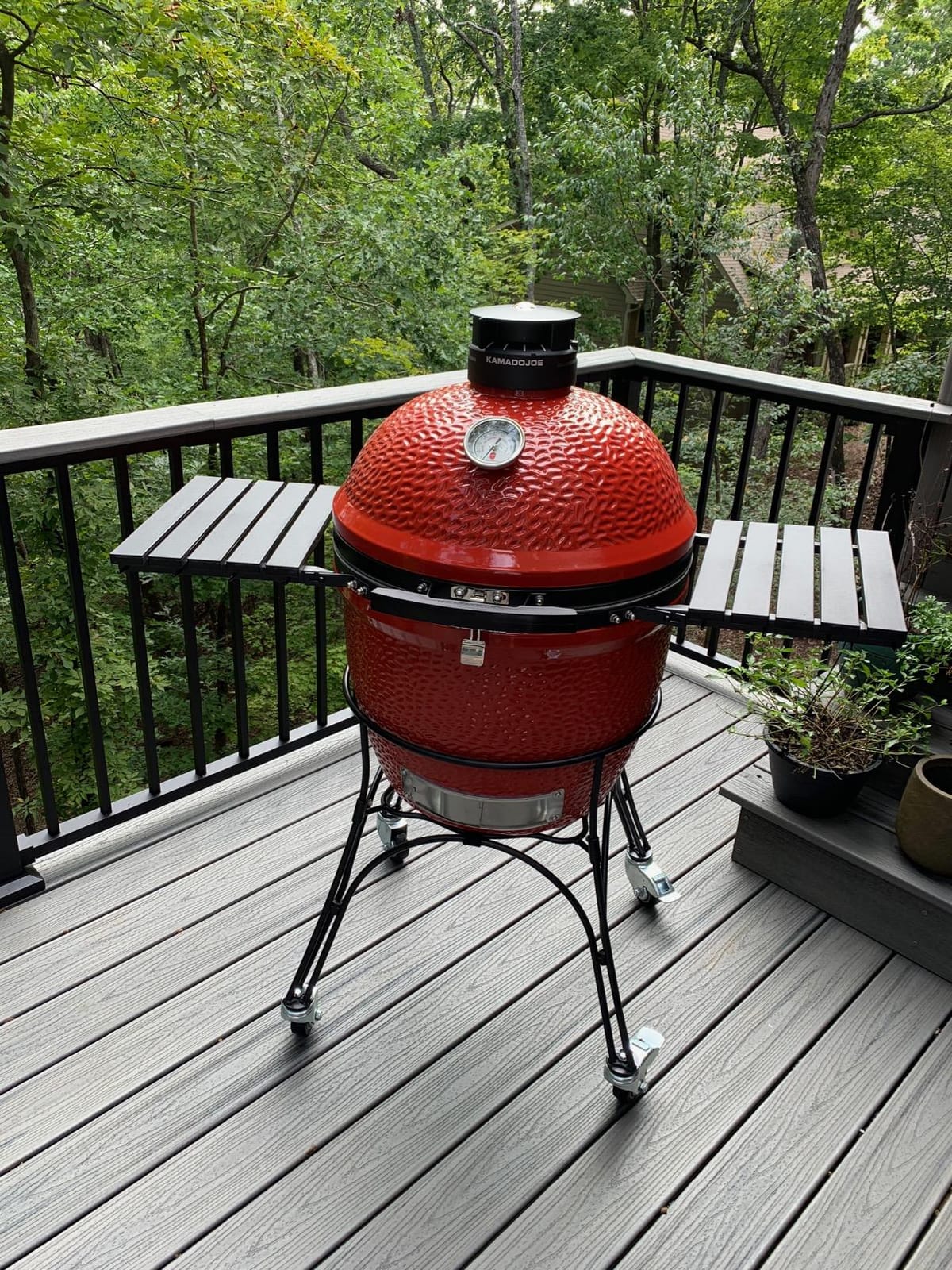
The two-tier Divide and Conquer system is the feature long-cook cooks care about most. You can put a deflector on the lower tier and sit a rack of ribs above it, or drop to a single tier for a brisket flat, without rebuilding the firebox. On our burns the temperature differential between tiers stayed narrow enough that the meat did not need rotating.
The sliding ash drawer is the quiet winner. Cleaning up after a long cook takes a minute rather than a shovel and a bucket, and owners consistently report that the ceramic body still looks new after years in a humid climate, provided you add a cover.
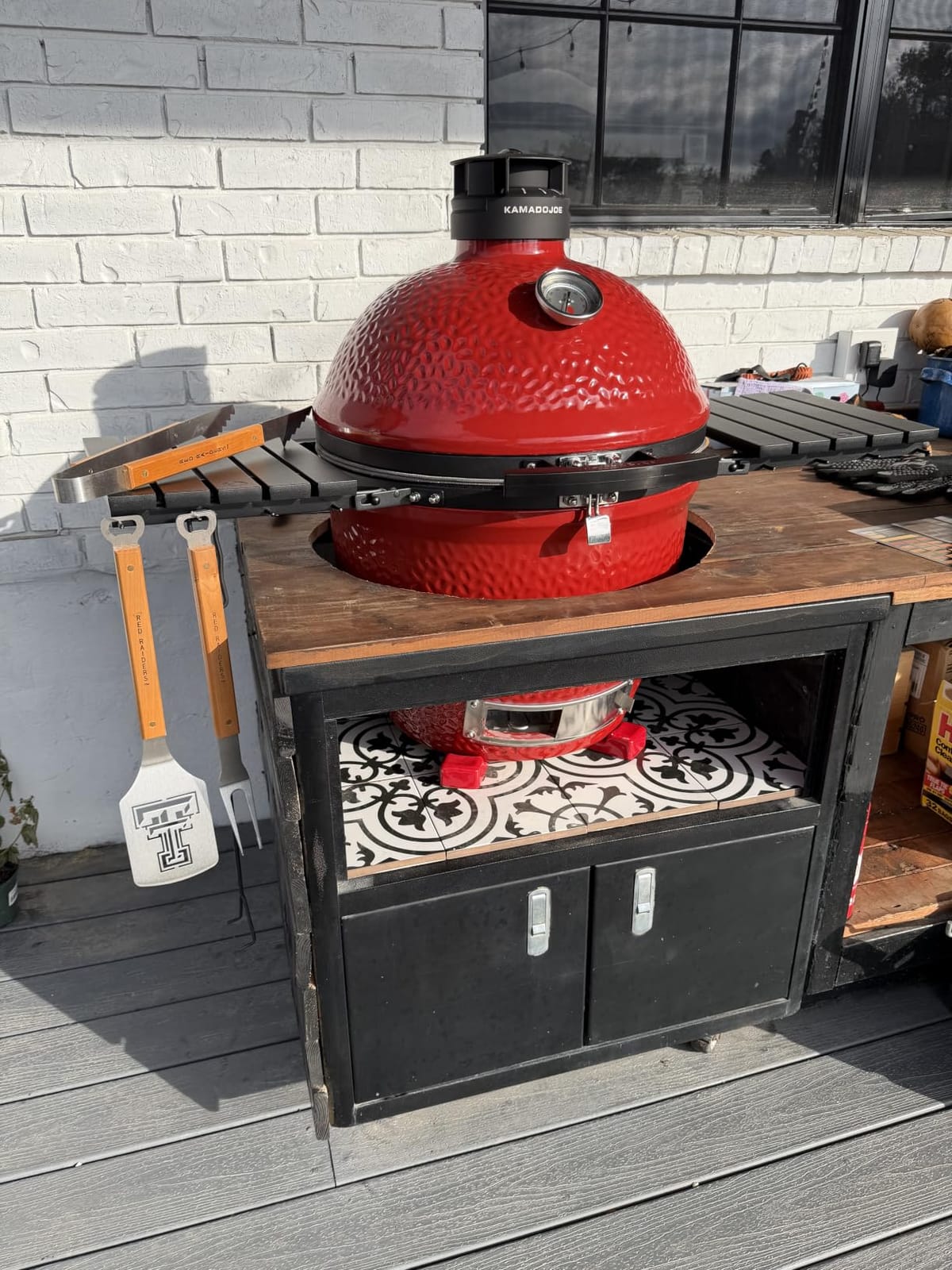
Who should buy the Classic Joe Series II?
Buy this one if you cook serious low and slow volume on a mid-sized surface, you want to finish a long smoke with a hard sear on the same grill, and you will use the second tier regularly. It is a strong choice for pulled pork shoulders and racks of ribs.
It is also the pick for anyone who wants the confidence of a lifetime warranty on the ceramic parts, backed by five years on metal and three years on the heat deflector and pizza stone.
Where the Classic Joe Series II falls short
At 232 pounds, unboxing and positioning take two people. That is a logistics fact, not a criticism, but it catches new owners out more than any other spec on this list.
At 250 sq. in. the grate is genuinely tight for a large gathering, and the ash basket and grate lifter are not included, which pushes the real cost of ownership higher than the sticker suggests. Some units arrive with a frayed gasket or a paint-flaked vent, though customer service replaces them. The 250 sq. in. grate is the main reason our top pick holds a larger cooking area at a lower price point.
3. Kamado Joe Joe Jr 13.5-Inch – The Best Kamado for Beginners Learning Low and Slow
Kamado Joe Joe Jr 13.5-inch Portable Ceramic Charcoal Grill with Grill Stand, Stainless Steel Cooking Grate, Heat Deflectors and Ash Tool in Red, Model KJ13RH
13.5 inch ceramic body
150 sq. in. stainless grate
Heat deflectors included
75.6 lbs
Pros
- Thick ceramic shell holds low temperatures on little fuel
- Heat deflectors included for indirect cooking and smoking
- Manageable at 75.6 lbs with built-in handles
- Two cooking levels with the included rack stand
- Runs hotter and more efficiently than an equivalent metal kamado
Cons
- 150 sq. in. cooks for two to four people
- Ceramic can arrive cracked so inspect on arrival
- Awkward to lift off a driveway for one person
- Makes little smoke flavor without wood chunks
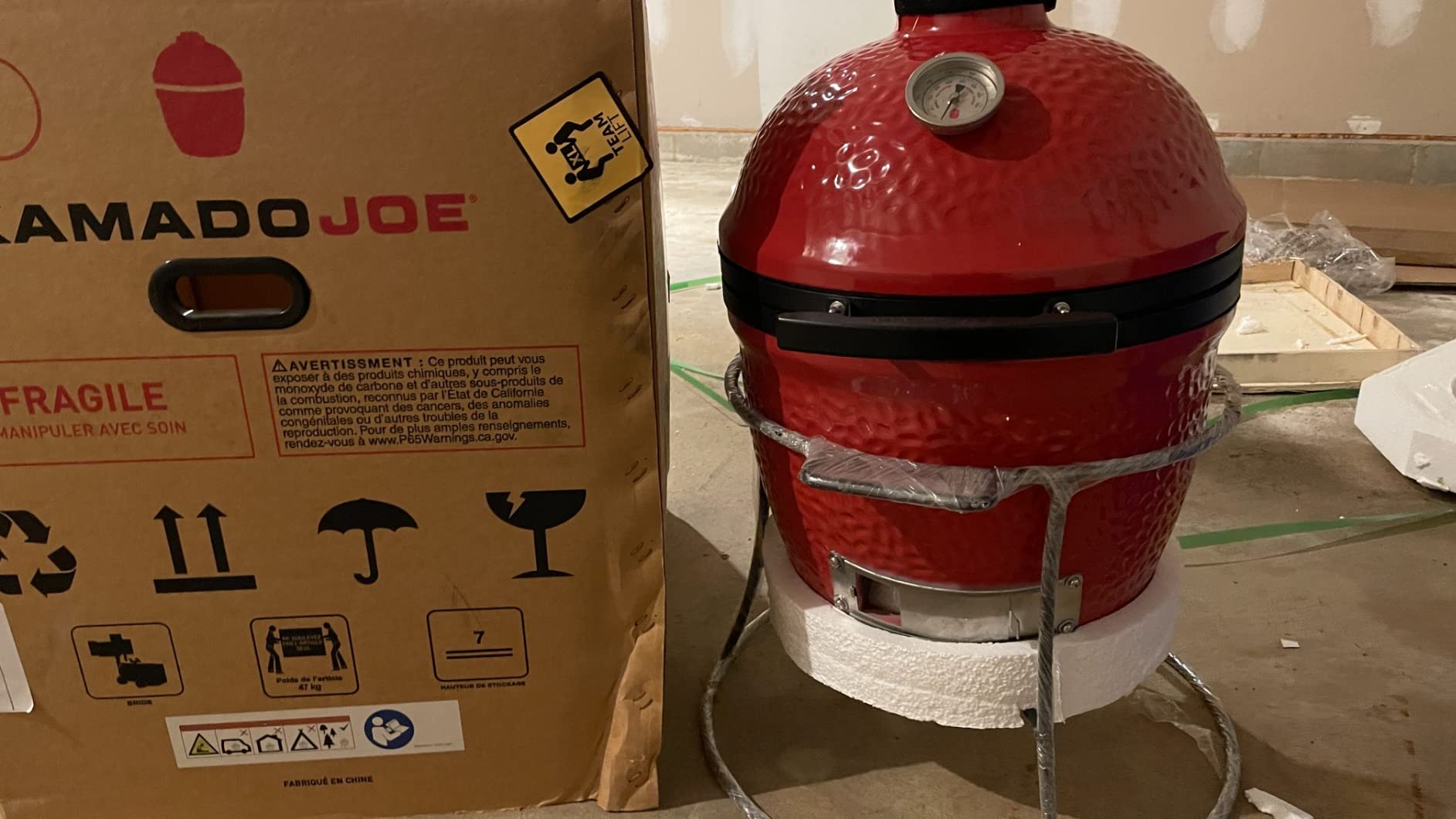
The Joe Jr is the kamado we recommend to anyone starting out with low and slow cooking. The learning curve on a kamado is almost entirely about managing heat and fuel, and 150 sq. in. means a mistake costs you a dinner rather than an entire weekend of charcoal.
Heat deflectors ship in the box, which is more than most competitors include at any price. That single inclusion converts the grill from a direct sear box into an indirect smoker in about a minute, and it is the difference between this being a novelty and this being a smoker.
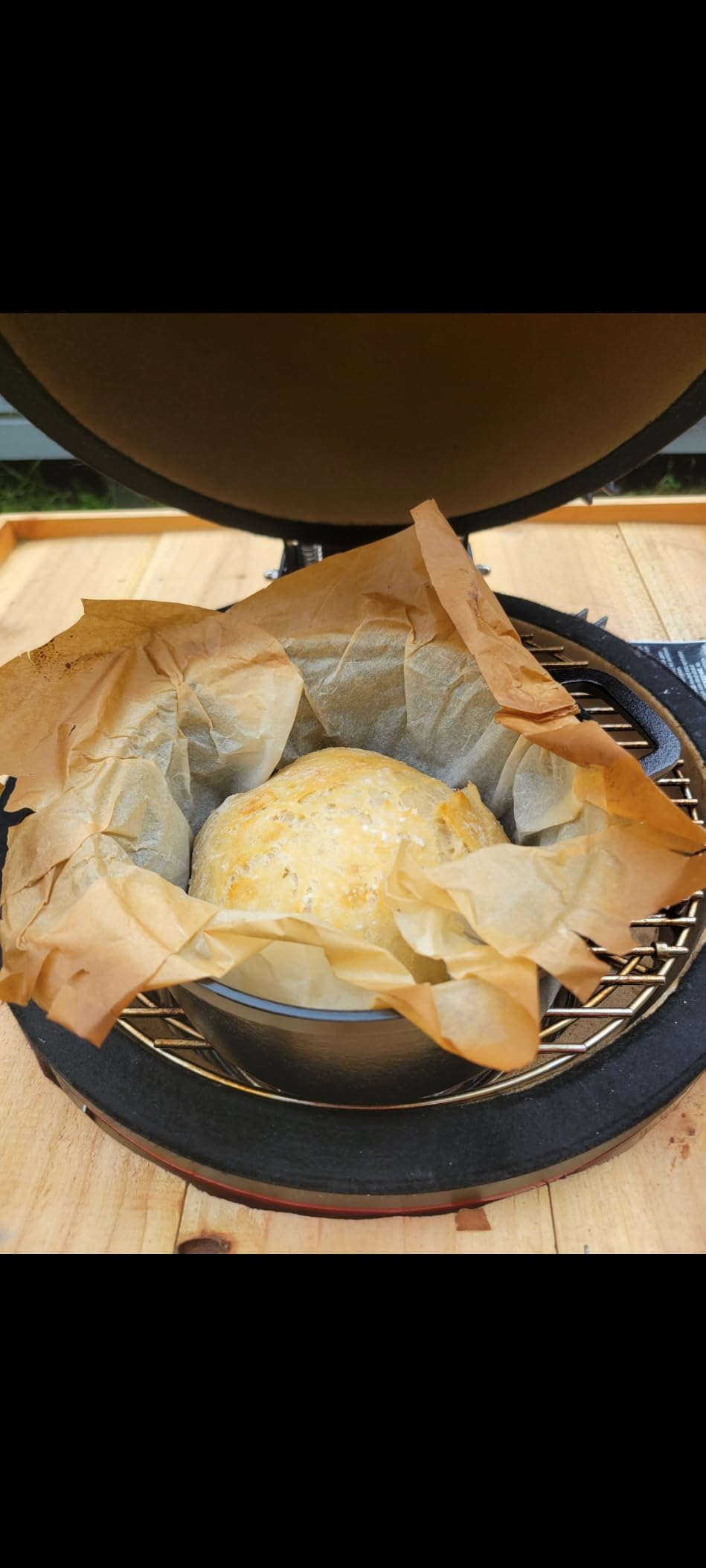
Vent settings translate directly if you have ever run a larger egg-style cooker, and the cast iron air vent plus the lid thermometer give you enough control to hold a long steady cook. On our burns it reached a stable low-and-slow temperature on less charcoal than the grate size would suggest, because the ceramic shell simply does not leak much heat.
It is genuinely portable at 75.6 pounds with built-in handles, so it works as a camping and tailgate cooker as well as a patio smoker. Two cooking levels are available with the included rack stand.
Is the Joe Jr big enough for your cooking?
It is enough for two to four people, a couple of racks of ribs, a small turkey or a single large cut of meat. Owners regularly note it runs hotter and more efficiently than an equivalent-size metal kamado, so you will not need a large fire to fill it.
If your future cooking plans include a whole turkey or a pack of competition-style ribs, step up to the 18 inch Classic Joe. If your plan is weeknight smoking plus weekend searing, this is the right size.
Where the Joe Jr falls short
It produces very little smoke flavor on its own. If you want a genuine bark on brisket or pork, you need to add wood chunks, and that is an extra step the bigger grills make easier with larger fireboxes.
Shipping is the practical risk here. Owners repeatedly stress inspecting the ceramic for cracks the moment it is brought in, because a cracked dome is not repairable. Ceramic carries a lifetime warranty, and metal parts are covered for five years.
4. London Sunshine Cadet Series Tabletop Kamado – Best Kamado for Tight Spaces
London Sunshine Ceramic Charcoal BBQ Kamado Grill Smoker – Portable Tabletop Cadet Series -Orange
0.8 inch ceramic wall
94.25 sq. in. cooking area
180F to 750F range
49.8 lbs
Pros
- 0.8 inch ceramic wall burns charcoal efficiently
- Covers 180F to 750F for smoking baking grilling and broiling
- Body and lid arrive pre-assembled
- Contained ceramic fire bowl is safer than an open charcoal bowl
- Runs a small fire for hours on very little charcoal
Cons
- 11 inch grate fits about three burgers or one small bird
- Reported as undersized and feels cheap next to the body
- Best suited to direct grilling for one to three people
- Only a 1 year warranty
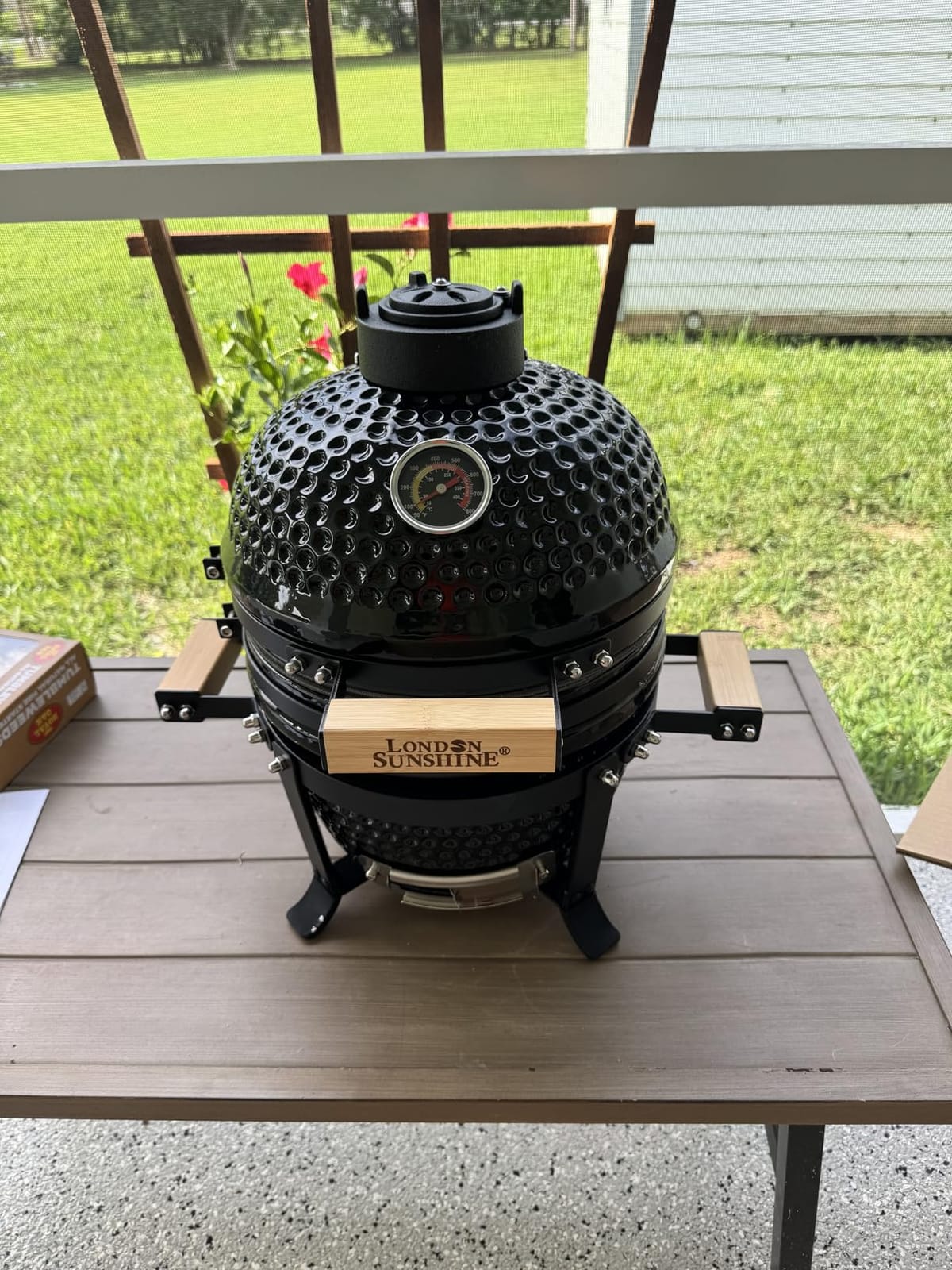
The Cadet Series is a tabletop ceramic at 49.8 pounds, and for a small balcony, a porch, or a cook who wants a second grill it does something none of the bigger units can: it fits where nothing else will.
Setup is genuinely almost instant. The body and lid ship pre-assembled, so assembly is handles and a stand rather than a frame build. The 0.8 inch ceramic wall holds heat far better than the price suggests, and the covered range from 180F to 750F means it can smoke, bake, grill and broil on the same fire.
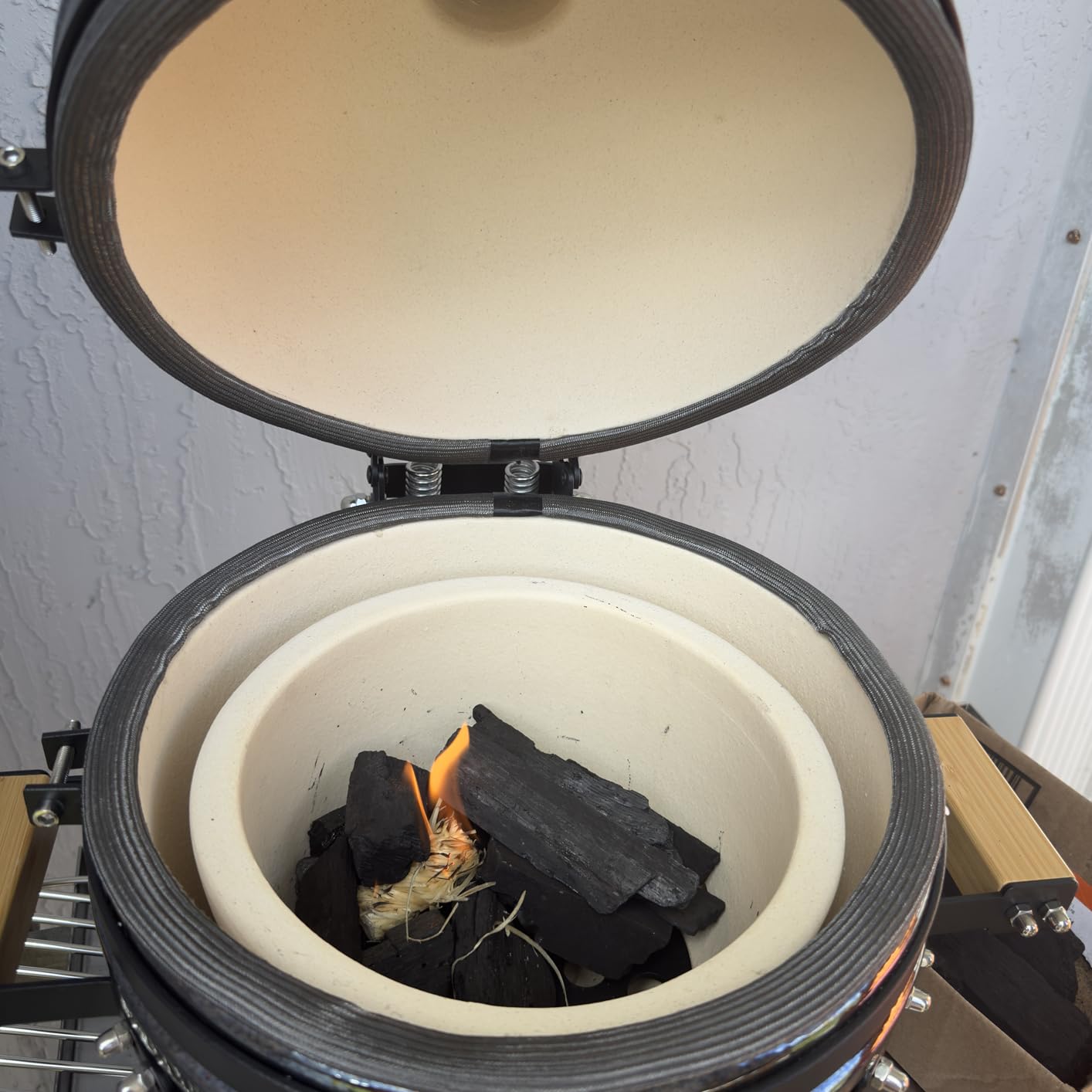
The Japanese dome shape and the contained ceramic fire bowl are practical safety wins. There is no open charcoal basin to tip, and the glass fiber gasket plus cast iron top vent and stainless bottom vent give you both ends of the airflow control loop.
Where it is honest about its limits is capacity. Owners compare the build quality favourably against a Mini Big Green Egg at a fraction of the cost, and repeatedly report that it works better as a direct searing grill than as an indirect long-cook smoker.
Who is the Cadet Series for?
It suits a couple, a solo cook, or anyone who wants a ceramic kamado for a second patio without giving up floor space. The low charcoal use on a small fire means you can run a slow cook without tying up the whole grill.
It also works as a weeknight searing grill that can still take a small bird or a couple of burgers for the family, which makes it more versatile than a pure side unit.
Where the Cadet Series falls short
The 11 inch grate is reported as nearly an inch undersized and to feel cheap compared with the rest of the body. Capacity planning matters more here than anywhere else in the group.
At 49.8 pounds it is heavier than most true tailgating kamados despite the portable design, and the warranty is one year. If you want to run low and slow for more than a couple of people, our other picks cover a wider range.
5. Weber Jumbo Joe 22-Inch – Best Lightweight Charcoal Grill That Is Not a True Kamado
Weber® Jumbo Joe Premium Compact Charcoal Grill, 22‑Inch, Black
Porcelain-enamel steel body
363 sq. in. plated steel grate
About 28.5 lbs
10 year limited warranty
Pros
- Porcelain-enameled bowl and lid resist rust and peeling
- Rust-resistant aluminum dampers give precise airflow
- Aluminum ash catcher makes cleanup quick
- All-weather wheels and a 10 year limited warranty
- Holds 363 sq. in. in a compact frame
Cons
- Not a ceramic kamado so it lacks heat mass for true smoking
- Open kettle design sheds heat faster than an insulated body
- No heat deflector or multi-level grate system included
- Plated steel grate rather than cast iron
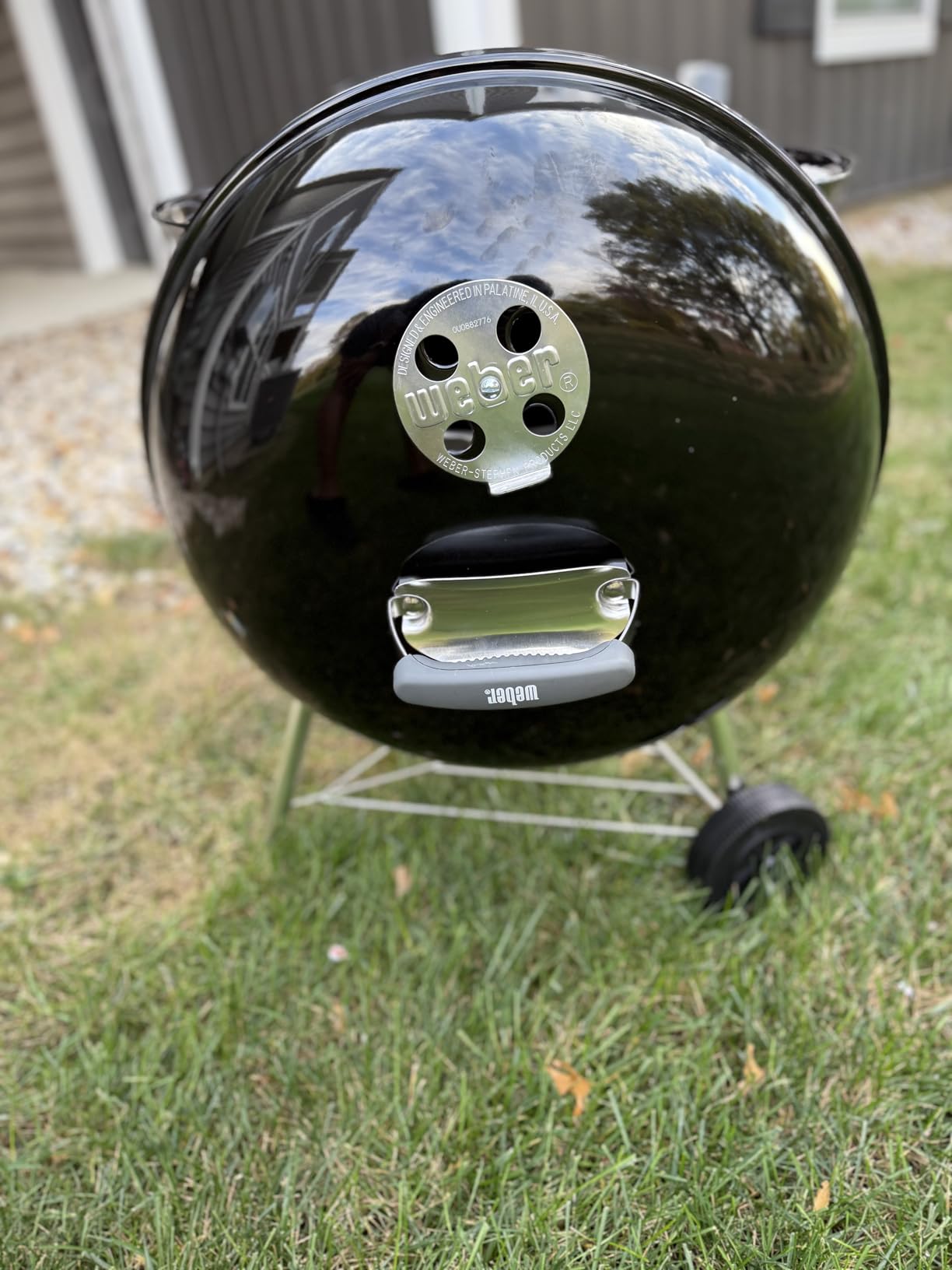
We include the Jumbo Joe with a clear caveat: it is not a kamado. It is an open steel kettle, and it will not hold a 250F low-and-slow burn the way any of the nine insulated or ceramic bodies on this list will. What it does have is 363 sq. in. of cooking area at roughly 28 pounds, and that combination is genuinely hard to beat for searing.
The rust-resistant aluminum dampers are tighter than most of the vent hardware in this roundup, and the porcelain-enameled bowl and lid are built to take high heat without peeling or rusting. On our runs it responded to a vent change faster than any ceramic unit because there is so little mass to move.
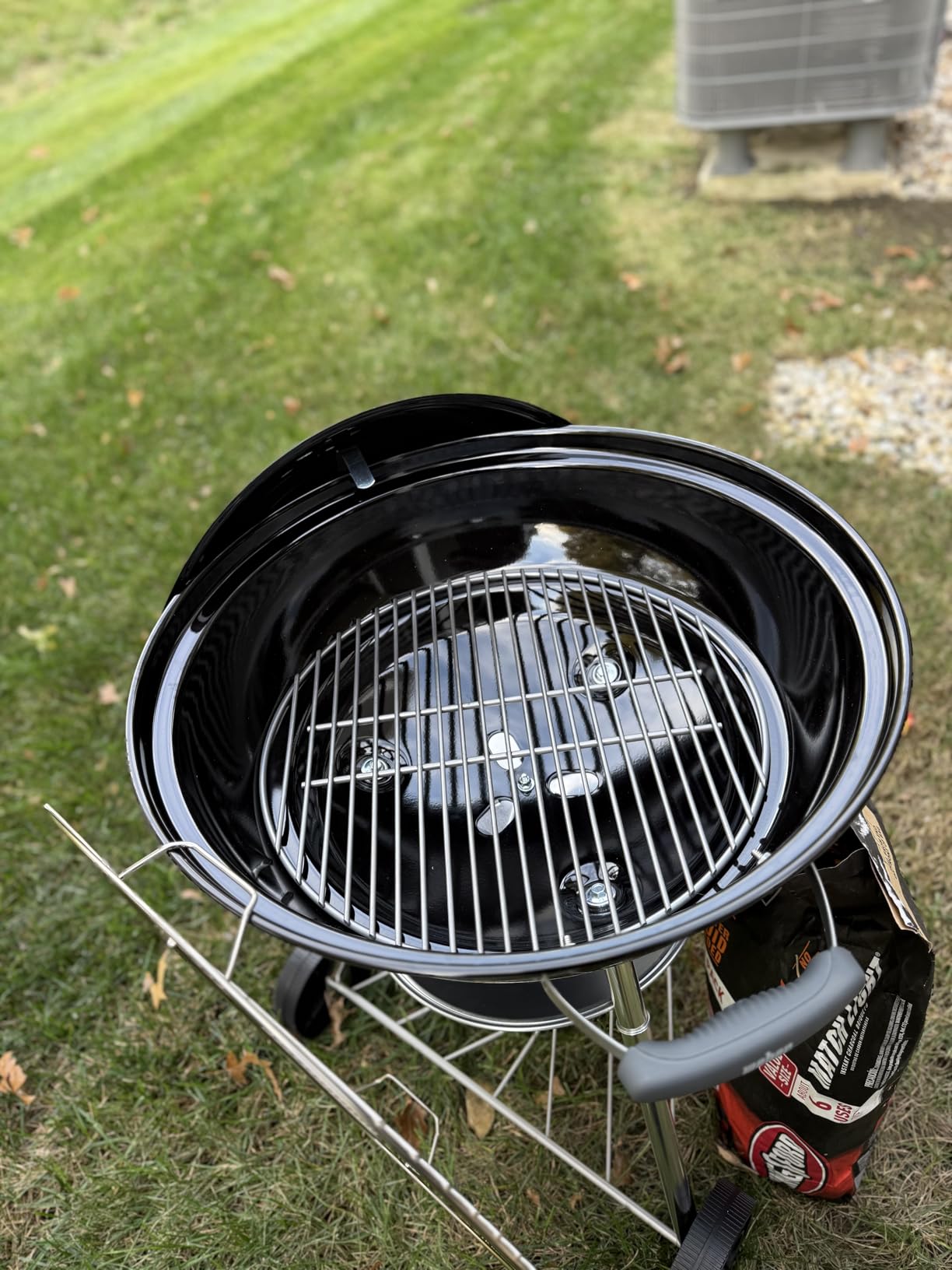
If you want a smoker, this is not the appliance. You will need an external heat deflector and you will feed it more charcoal to hold a long cook, which is exactly the efficiency gap that makes a real kamado worth the money in the first place.
What you get instead is a grill you can carry to a picnic, move around a small yard alone, and store in a garage without thinking about it. The aluminum ash catcher and all-weather wheels keep cleanup and repositioning simple.
When the Jumbo Joe is the right call
Choose it when searing and portability matter more than smoking, when you cook for a family rather than a crowd, or when you want to learn charcoal control before committing to a heavy ceramic body. Owners consistently describe it as a strong searing grill with clear limits on heat retention.
The 10 year limited warranty is the longest coverage here, which matters on a cooker that lives outside year round.
Where the Jumbo Joe falls short
Thermal mass is the whole story, and it simply does not have any. An open kettle design sheds heat faster than an insulated ceramic cooker, so a long cook means a larger fire and more fuel.
There is no heat deflector and no multi-level grate system included, and the cooking grate is plated steel rather than cast iron. If your plan is an eight-hour brisket, look at the insulated picks instead.
6. London Sunshine 15-Inch Ceramic with Tall Stand – Best Kamado for Versatile Mid-Size Cooking
London Sunshine Ceramic Kamado Charcoal BBQ Grill and Smoker, Stainless Steel Grates -15″ Ceramic with Tall Stand (BLACK)
1 inch ceramic wall
132.73 sq. in. cooking area
Foldable grate side wings
About 93 lbs
Pros
- 1 inch ceramic wall with Japanese dome shape holds heat well
- Premium glass fiber gasket and thick stainless grates
- Grate side wings fold up so you can add charcoal mid-cook
- Tall stand keeps the grill at a comfortable working height
- Holds an 8 lb pork shoulder on one load
Cons
- Interior grate is only about 13 inches so read the dimensions
- Around 93 lbs so plan its final position first
- Only a 1 year warranty with occasional transit damage
- Needs an added heat deflector for genuine low-and-slow mode
This 15 inch ceramic is the most overlooked option in the mid-size category. The 1 inch ceramic wall is thicker than most of what you will find at this level, and the Japanese dome shape keeps airflow moving across the firebox rather than trapping it in one corner.
The feature we did not expect to care about is the foldable grate side wings. On a long cook you will need to add fuel, and on most grates that means lifting the food, the grate and the deflector plate. Here you fold the wings up and drop charcoal into the side of the firebox without disturbing the main grate.
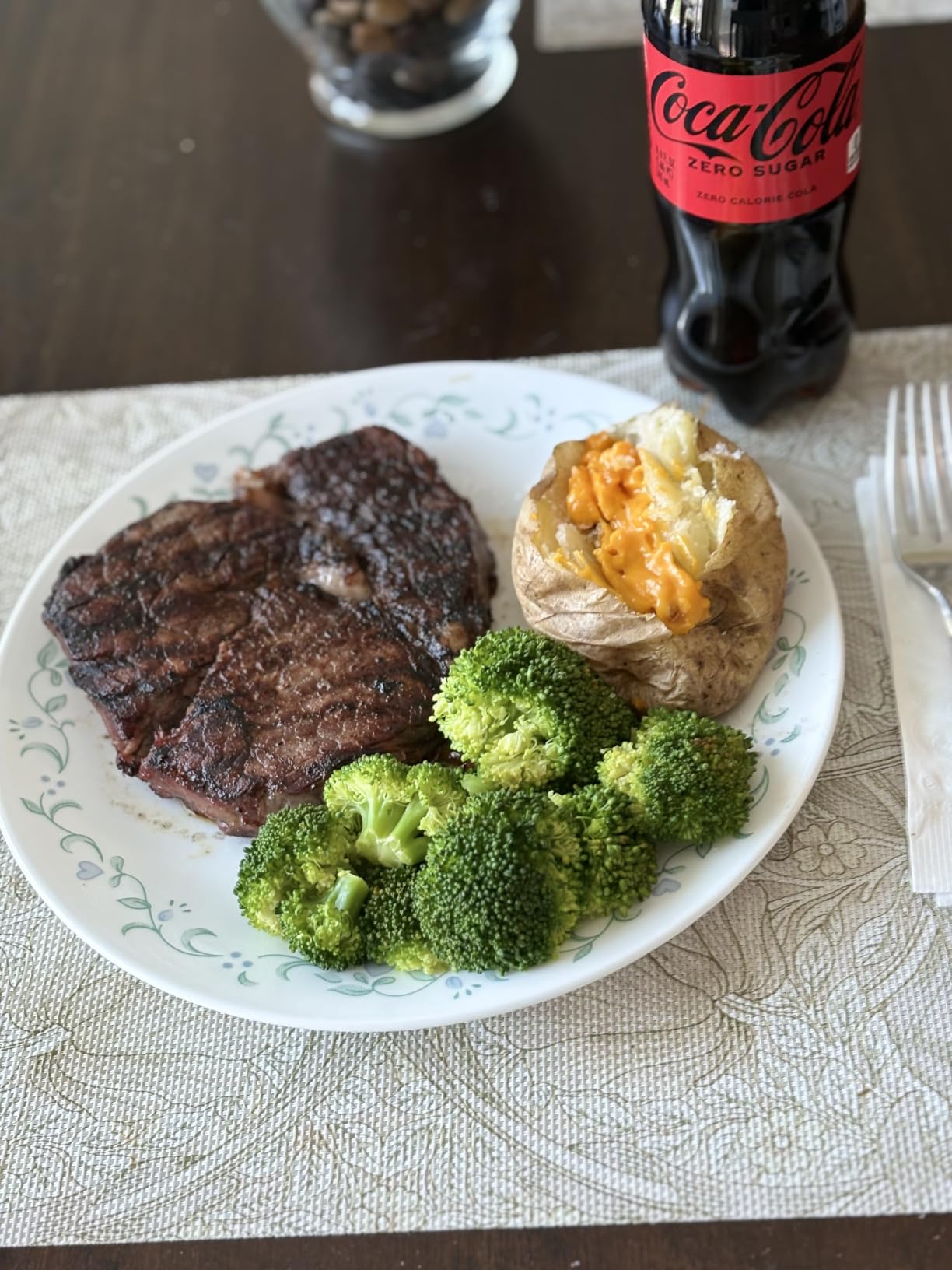
Heat retention was the strongest theme in owner feedback and matched what we saw. It heats up quickly for a ceramic, controls temperature easily once the dampers are understood, and held an 8 lb pork shoulder through a full cook on a single load.
The tall stand is a real quality-of-life upgrade. At roughly 93 pounds the total weight is manageable for two people, and the stand keeps the cooking surface at a comfortable height so you are not crouching for a long cook.
Is the 15 inch ceramic big enough?
The single most important detail here is that the 15.7 inch body contains a 13.2 inch grate. Owners call this out repeatedly, so if you are planning a whole turkey or a pack of ribs, check that measurement before you commit.
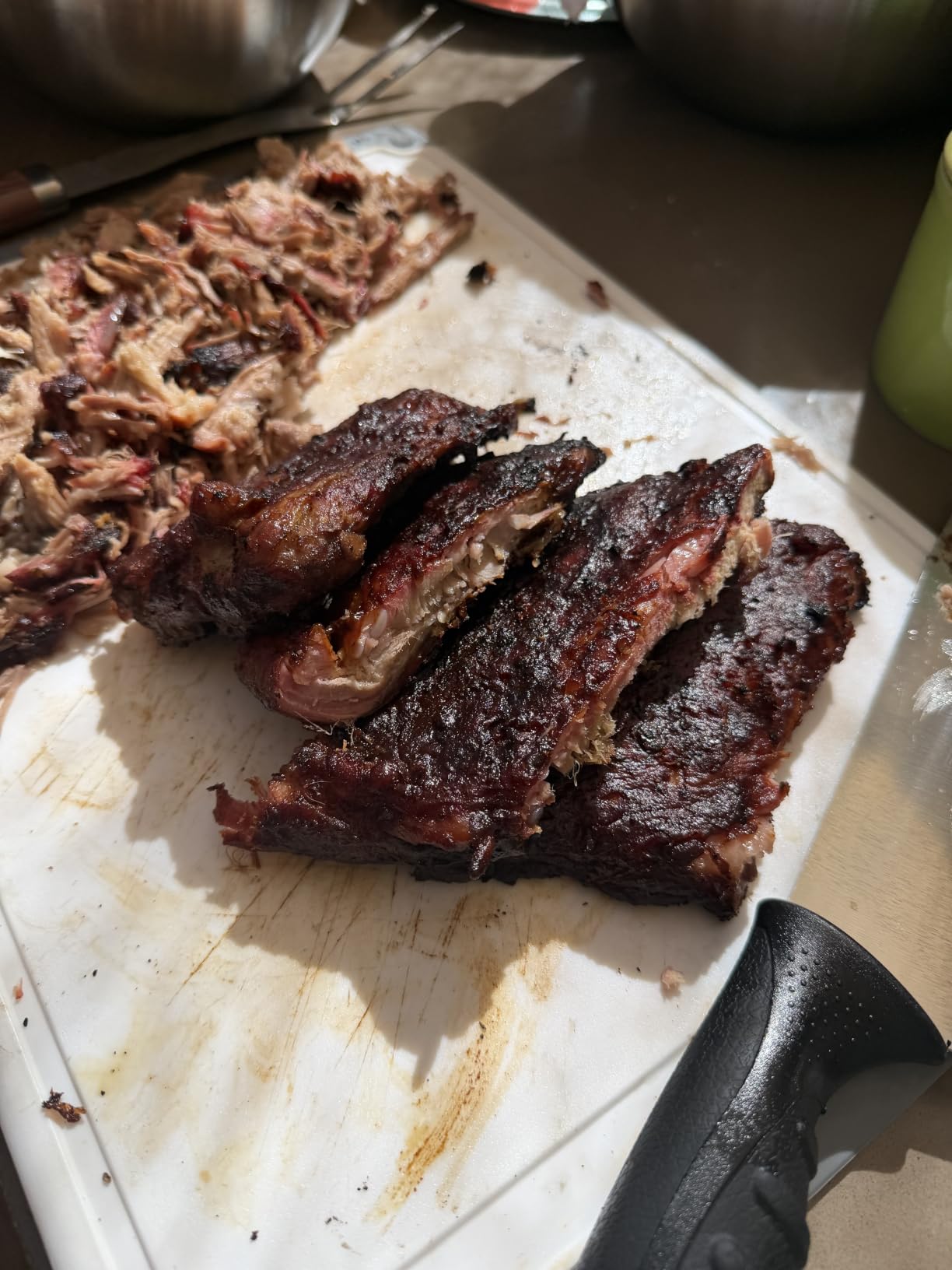
For a pork shoulder, a whole small bird, four steaks plus sides, or a modest rack of ribs, the capacity is comfortable. The premium glass fiber gasket and thick stainless grates also outclass what most competitors include at this weight class.
Where the 15 inch ceramic falls short
You need to add a heat deflector for genuine low-and-slow mode, and that is not included. Budget for that before your first indirect cook.
The warranty is one year, and there are occasional reports of transit damage or missing hardware, though sellers responded quickly in the reviews we read. It is a strong mid-size value, but it does not carry the warranty confidence of the ceramic picks with lifetime ceramic coverage.
7. Kamado Joe Big Joe Series III 24-Inch – Best Kamado for Large Gatherings and Cold Weather
Kamado Joe Big Joe Series III 24-inch Ceramic Charcoal Grill and Smoker with Premium Cart, SloRoller Insert and 450 Cooking Square Inches in Red, Model KJ15041021
24 inch ceramic body
450 sq. in. across three tiers
SlRoller smoke chamber
445 lbs
Pros
- 450 sq. in. of three-tier Divide and Conquer space
- SlRoller smoke chamber recirculates smoke and cuts hot spots
- Kontrol Tower vent and Air Lift hinge for precise control
- Held 320F for nine hours on 1.5 lb of charcoal
- Galvanized steel cart with locking wheels included
- Limited lifetime warranty
Cons
- At 445 lbs it needs two strong people to move
- Preheating and charcoal budgeting take real practice
- Large size may exceed a small patio or budget
- Highest price point in the lineup
The Big Joe Series III is the pick when you are cooking for a crowd or smoking through winter. Owners upgrading from a steel kamado describe it as a step change in smoking performance, fuel efficiency and low-and-slow consistency, with many reporting multi-hour holds in cold weather.
The SlRoller hyperbolic smoke chamber is the piece that sets it apart. It recirculates smoke through the firebox and reduces hot spots, which on a 24 inch cooking surface is the difference between an even rack of ribs and uneven ones. Three tiers of Divide and Conquer grates let you run very different temperatures in the same cook.
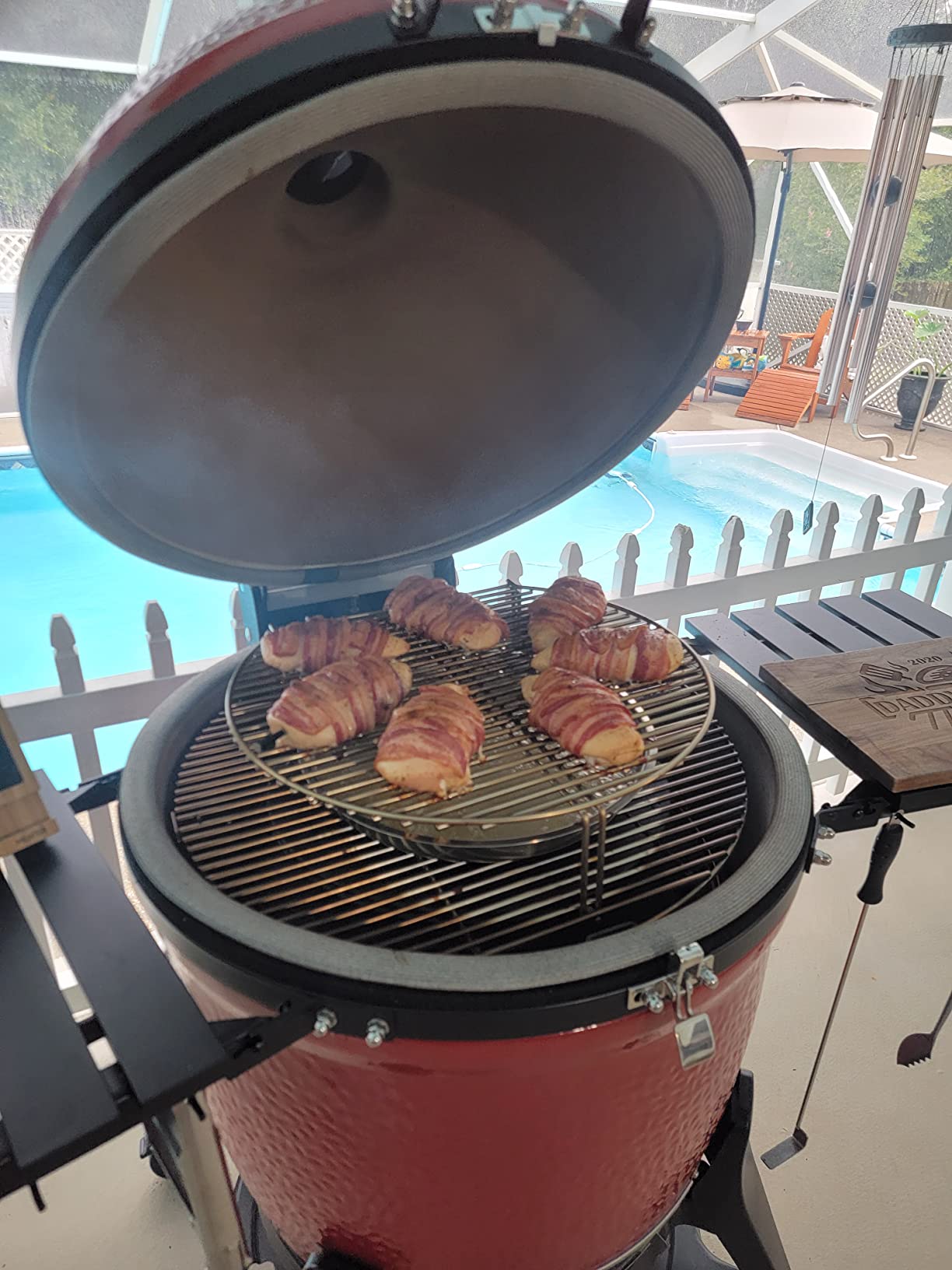
The performance data owners report is genuinely impressive. One review documented holding 320F for nine hours on 1.5 lb of charcoal in 23F weather. That is the kind of efficiency result that justifies a 24 inch body, because charcoal consumption is what actually costs you money over a long cook.
The Kontrol Tower vent and the Air Lift hinge work together well. The hinge takes the weight out of the ceramic dome, so opening the grill to check a brisket at hour seven is a one-hand operation.
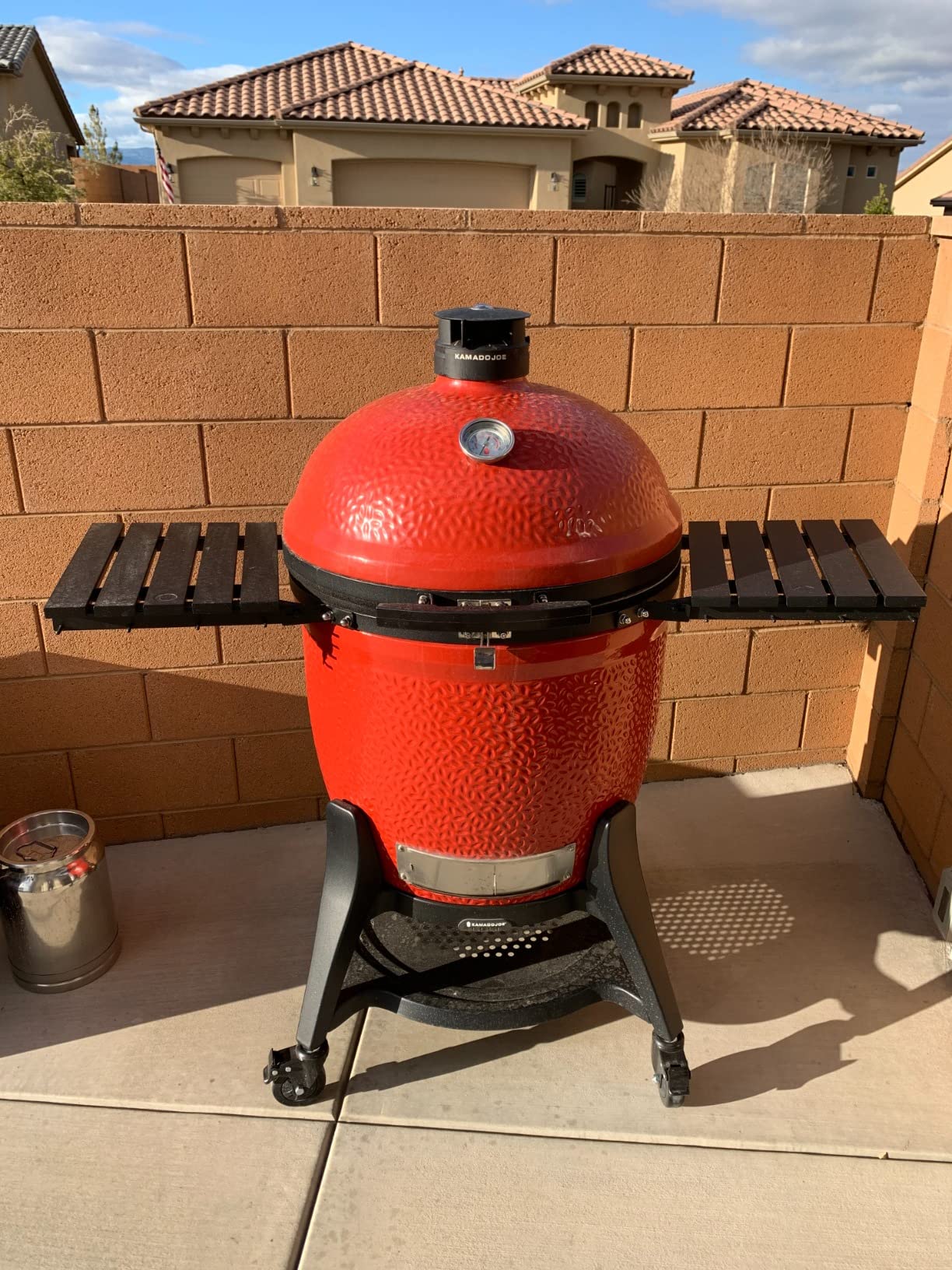
Who needs the 24 inch Big Joe?
This is for households that regularly cook for ten people or more, that run competition-style packs of meat, or that smoke year round in a cold climate. If you fit a large group into a single cook, nothing else here has the surface area.
The galvanized steel cart with locking wheels is included, and the limited lifetime warranty covers the ceramic. Those two facts matter on a machine of this class.
Where the Big Joe Series III falls short
At 445 pounds, unboxing, lifting and moving require two strong people, and that logistics cost is the most common regret in the reviews. Plan its final position before the lift, because at 445 pounds you get one chance to put it where you want it.
Preheating and charcoal budgeting take real practice before your first cook, and the price point sits far above the rest of the lineup. For most home cooks a mid-size body covers the same low-and-slow needs at a fraction of the effort.
8. Weber Summit Kamado S6 – Best Kamado for Gas Ignition and Two-Zone Cooking
Weber® Summit® Kamado S6 Charcoal Grilling Center with Gas Ignition, Black
Dual-walled insulated steel
452 sq. in. cooking area
Diffuser plate and Char-Baskets
236 lbs
Pros
- Gas ignition lights charcoal in under 10 minutes
- Dual-position fuel grate with Char-Baskets for two-zone cooking
- Diffuser plate helps hold consistent low temperatures
- Porcelain-enamel and stainless build handles rain and cold
- RapidFire lid damper and One-Touch cleaning system
Cons
- Does not reach true ceramic temperatures above 700F
- Bottom air adjustment hardware is leaky and imprecise
- Assembly instructions are drawings only and confusing
- Charcoal does not last per load as long as on ceramic
The Summit Kamado S6 is the most Weber-shaped answer on this list: a large insulated steel cooker at roughly 236 pounds with gas ignition and true two-zone capability. Gas ignition alone puts it in a category of its own, because it removes the single most common reason a low-and-slow cook starts late.
The dual-position fuel grate with Char-Basket holders lets you set up a genuine two-zone fire, and the diffuser plate helps hold consistent low temperatures for smoking. At 452 sq. in. there is room for a second rack, which makes finishing a long smoke with a sear straightforward.
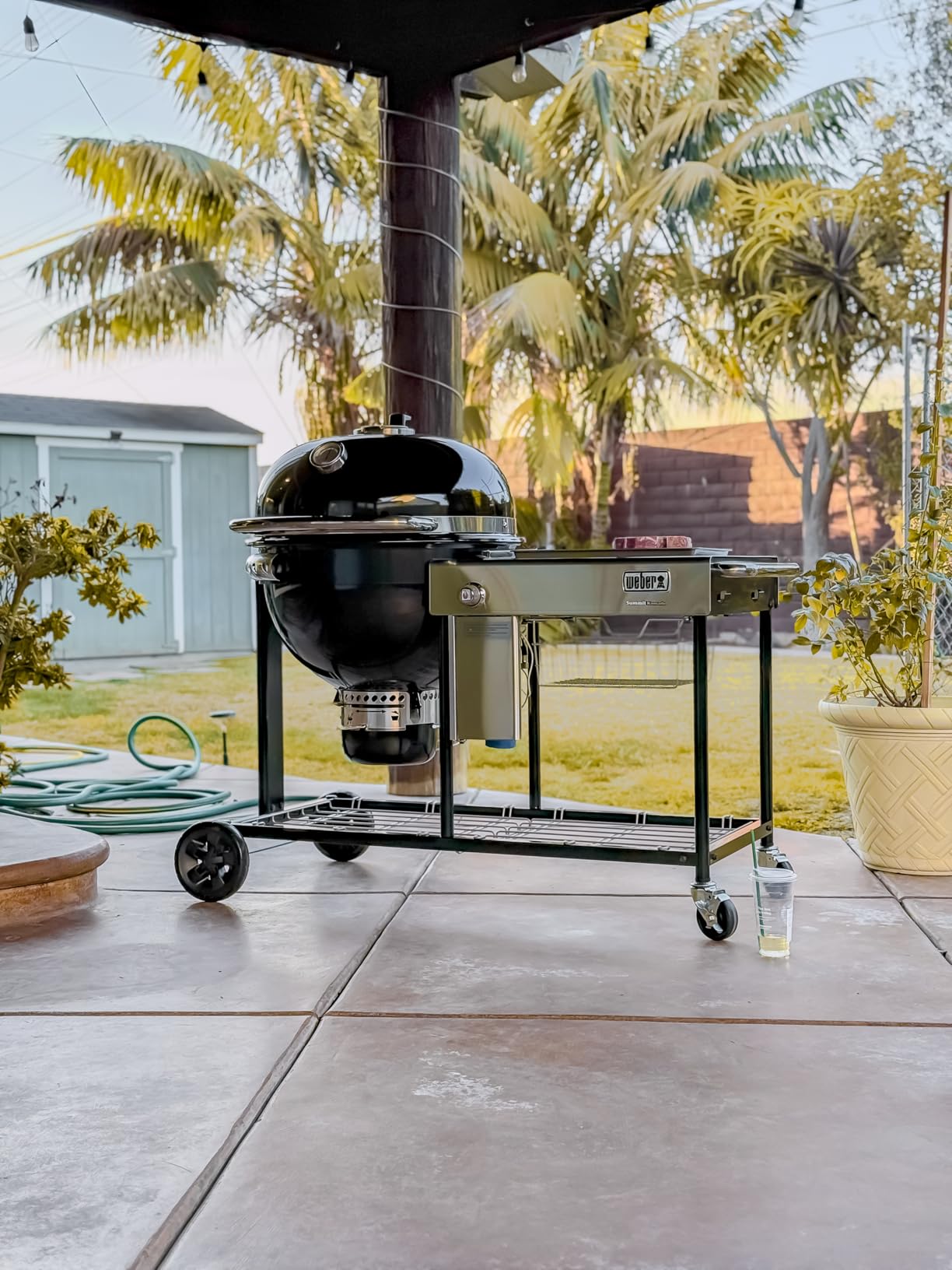
The RapidFire lid damper and the One-Touch cleaning system are the features owners mention most. The build is porcelain-enamel and stainless, and fans in northern climates report it shrugs off rain, snow and cold without concern, which matters more than most people expect.
This is a deliberate compromise rather than a pure kamado. You get Weber materials and gas ignition at a weight noticeably below a comparable ceramic body, and you give up some of the sealed-in efficiency that makes ceramic so good at long cooks.
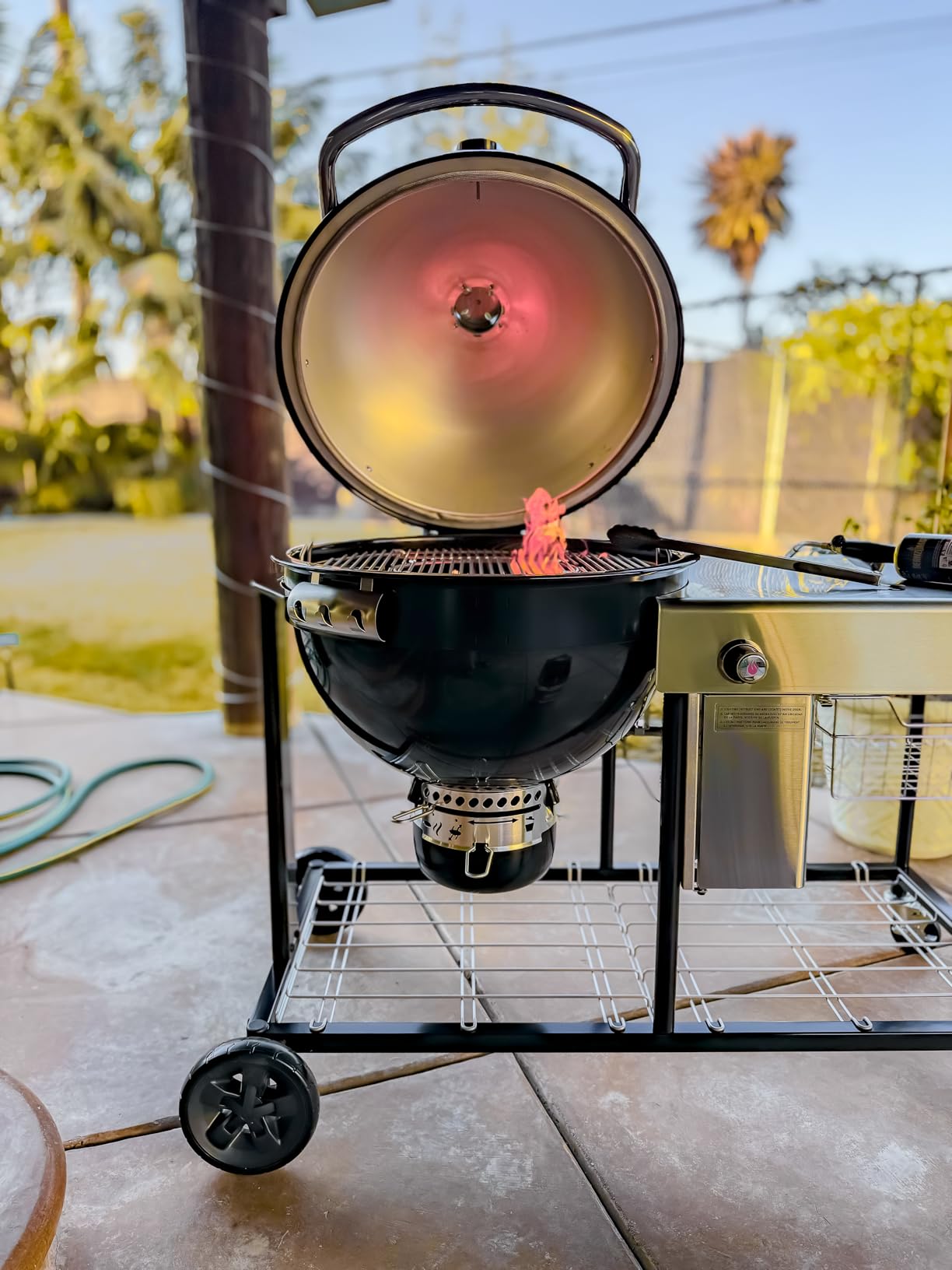
When the Summit Kamado S6 makes sense
Pick it if you hate babysitting a fire, you want to move from a sear to a two-zone cook without rebuilding the box, and you cook outdoors in all four seasons. It is a strong fit for households that want one appliance to do everything.
Gas ignition is the quiet advantage that gets undervalued. On a cold morning with a long cook ahead, the ten-minute light is worth a lot.
Where the Summit Kamado S6 falls short
The bottom air adjustment hardware is described as leaky and imprecise by reviewers, and imprecise airflow control is precisely what makes a stable low-and-slow setpoint harder to hold. That is the single most important weakness on this list for our topic.
It also does not reach true ceramic temperatures above 700F, the lid does not seal as tightly, and charcoal burns out faster per load than it would in a ceramic body. Assembly instructions are drawings only and owners describe the process as confusing. If holding temperature for twelve hours is the whole point, the ceramic picks are the safer bet.
9. Brand-Man Steel Kamado – Best Kamado Grate Size on a Budget
Brand-Man Steel Kamado Charcoal Grill & Smoker
Double-layer steel walls
400 sq. in. cast iron grate
Trivet included
105.4 lbs
Pros
- 400 sq. in. of 20 inch cast iron grate for about 25 burgers
- Included trivet enables indirect slow cooking out of the box
- Large side prep table and storage cart included
- Holds heat for well over 24 hours on a lump charcoal fire
- Five-position airflow system plus hood thermometer
- Enamel-coated lid and quick-release ash tray
Cons
- Assembly takes a few hours with attention to the diagrams
- Carbon steel body needs rust protection
- Once hot it takes a long time to come back down
- Some stand pieces arrive damaged and need reshaping
The Brand-Man Steel Kamado solves the two problems that push most buyers toward a bigger, more expensive body: grate area and included accessories. You get 400 sq. in. of 20 inch cast iron grate, room for about 25 burgers, plus a prep table and storage cart that most competitors sell separately.
The included trivet is the detail that makes this a smoker rather than a grill. Out of the box it supports indirect slow cooking, so you are not hunting for a deflector plate before your first long cook.
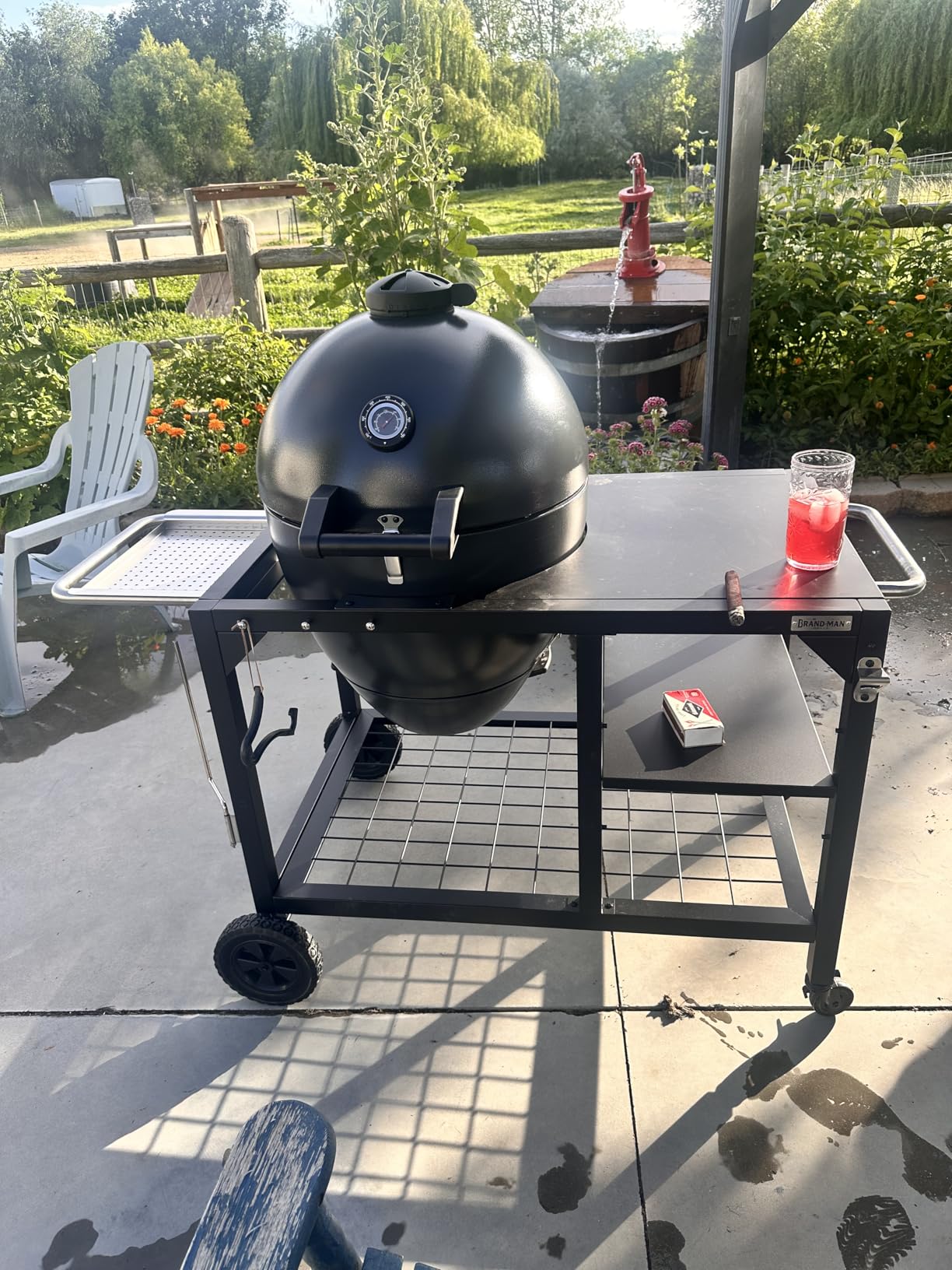
The double-layer kamado-style walls with a premium mesh fiberglass gasket hold heat well, and owners report holding heat for well over 24 hours on a lump charcoal fire. The five-position airflow system plus the hood thermometer give you more control than the price would suggest.
Reviews are newer and smaller in volume than the ceramic picks, but they are consistently positive, with owners coming down from a Weber kettle and finding the heat retention a large upgrade at a fraction of the cost of a ceramic egg.
Is the Brand-Man right for you?
It suits a cook who wants maximum grate area without buying a premium brand, and who already understands vent control from a kettle or a gas grill. Adding a cast iron griddle turns it into a three-in-one cooker, which several owners did.
If you plan very large single cuts rather than volume cooking, the fast heat-up and the included prep space still make it a strong all-round patio grill.
Where the Brand-Man falls short
Assembly takes a few hours and needs close attention to the diagrams. It comes in two boxes, and some owners report stand pieces turned up damaged and needing to be hammered into shape before use.
Like the other steel kamados here, the carbon steel body needs rust protection. And the long cool-down is the same trade-off as the AKORN: once it is up to temperature, bringing the heat back down takes a long time, so plan your burn-in to land at your target rather than overshooting into it. Warranty coverage is five years on the firebox and outer body against rust-through and two years on grids and finish.
10. Outvita 13-Inch Round Kamado – Best Kamado for One or Two People
Outvita 13″ Round Kamado Charcoal Grill, Portable, Red
Ceramic body
About 8.5 inch round grate
Top and bottom vents
About 50 lbs
Pros
- Thick ceramic wall holds smoke and heat after the vents close
- Top and bottom vents plus an external thermometer
- Reached 700F in about 15 minutes in one owner test
- Burns very little charcoal versus a metal grill
- Bamboo handles stay cool during cooking
Cons
- Cooking surface is only about 8.5 inches round
- No indirect cooking plate or heat deflector included
- Ash removal means lifting out the entire ceramic fuel container
- No carrying handles despite the portable design
- Some reports of ceramic cracking during cool-down
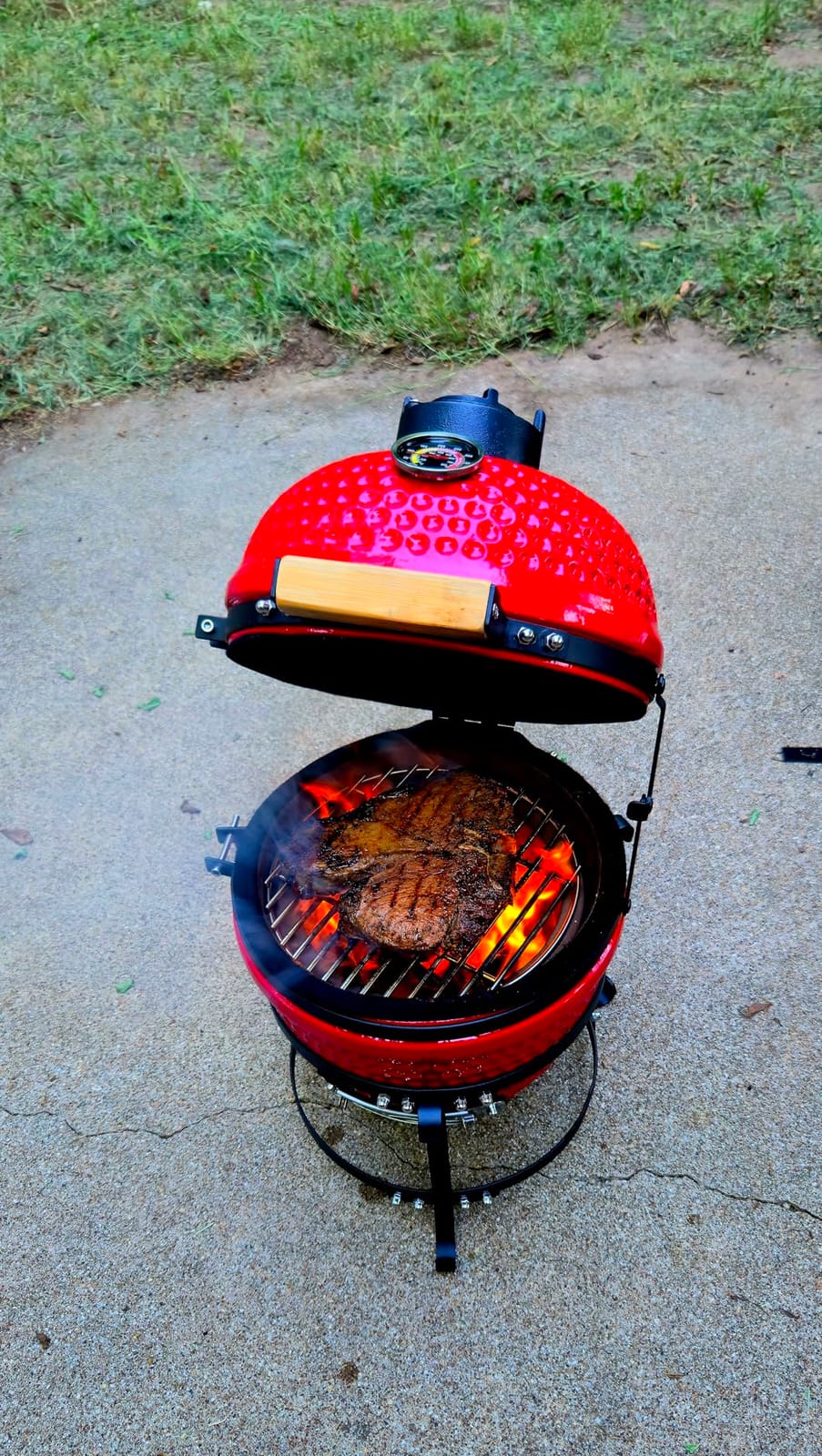
The Outvita is the cheapest genuine ceramic body in this roundup, and for a cook who wants kamado heat retention at a minimal outlay the physics genuinely work. The thick ceramic wall holds smoke and heat for hours after you close the vents, and it burns very little charcoal compared with any metal grill.
It reached 700F in about 15 minutes in one owner test, and the top and bottom vents plus the external thermometer give real airflow control for a grill this small. The enamel steel grate keeps smaller food from falling through the fire.
Reviews here are genuinely split, and we think the split is about capacity rather than performance. Owners who want a one-or-two-person ceramic grill call it an excellent value, while others find the grate area too small for what they had in mind.
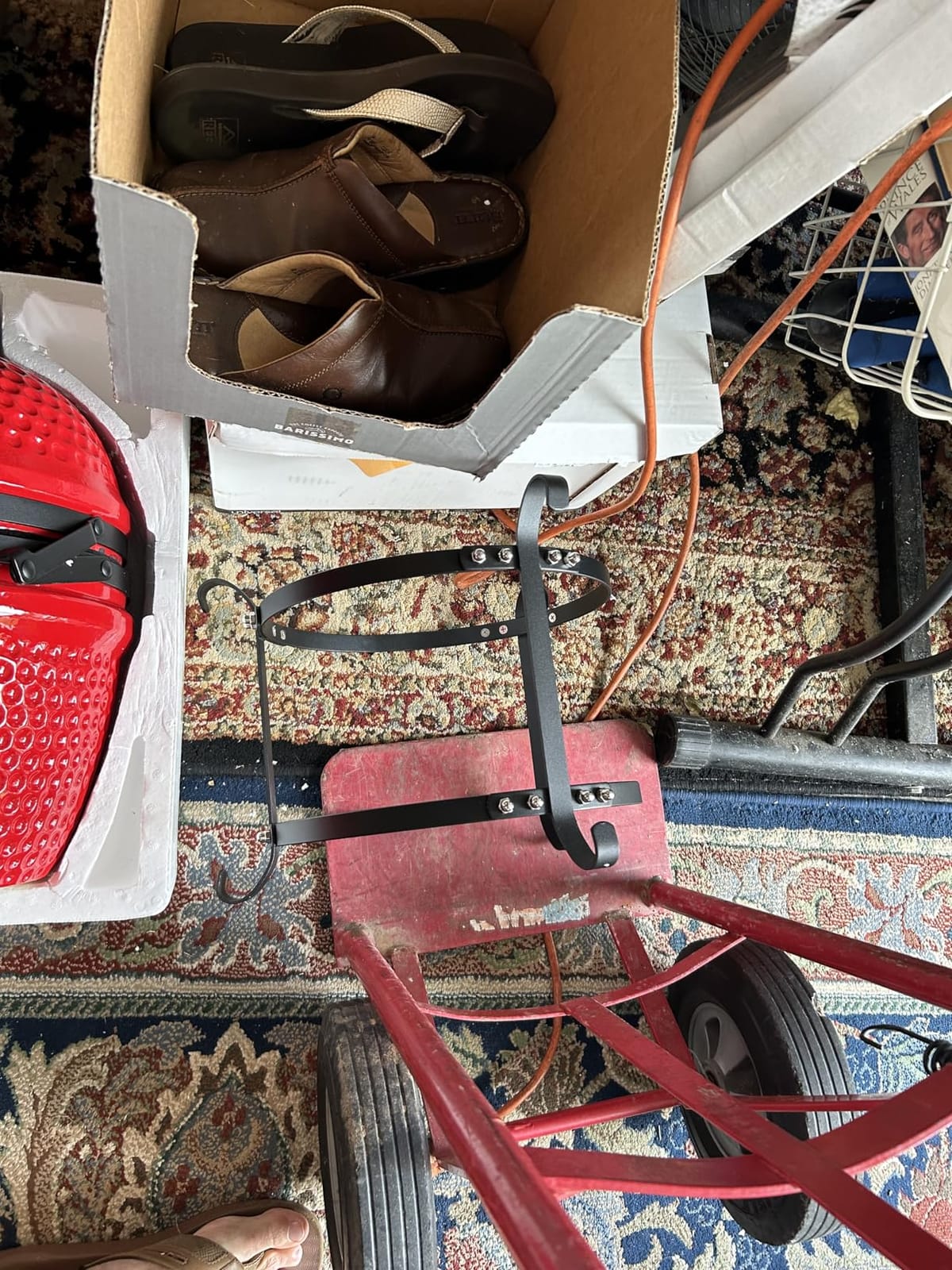
Several reviewers buy a separate pizza stone to serve as a diffuser, since no indirect cooking plate is included. FSC-certified bamboo handles stay cool during cooking, which is a nice touch at this level.
Who should buy the 13 inch Outvita?
It suits a single cook or a couple who want a dedicated ceramic grill for fish, vegetables and small cuts without giving up patio space. If your cooking is weeknight searing with the occasional long cook on a small piece of meat, it works well.
Treat it as a first ceramic rather than a primary smoker. It is an honest entry point, not a replacement for a mid-size kamado.
Where the Outvita falls short
The actual cooking surface is only about 8.5 inches round, which is enough for one or two people. Plan capacity accordingly before you buy.
Ash removal means lifting out the entire ceramic fuel container rather than pulling a tray, which is the most tedious chore on this list. There are also some reports of the ceramic body cracking during cool-down after only a few uses, which is worth watching closely in your first burns. Its 4.2 average is the lowest here, and the cause is capacity and durability rather than heat retention.
What Makes the Best Kamado Grills for Low and Slow Cooking Work So Well?
A kamado is a charcoal grill and smoker whose walls are thick and insulating, so heat leaves slowly and little of it escapes. That insulation gives you a steady 225F to 275F environment for many hours, then lets you push the same cooker past 700F for searing.
Thermal mass is the term that explains most of it. Ceramic or heavily insulated steel stores heat like a banked campfire, so when air temperature drops or you open the lid, the walls keep radiating into the food instead of letting it crash. A thin metal grill has almost none of this, which is why it needs constant tending.
Minimal airflow is the second half of the story. With the bottom damper and top vent dialled back, combustion is incomplete and slow, so the fire produces smoke and radiant heat rather than a roaring flame. Less air also means less moisture leaves the meat, which is why kamado cooks are often described as juicier.
That creates one genuine downside for buyers. A sealed kamado is very hard to cool quickly, which is why overshoot is the most common complaint in kamado forums and why we scored forgiveness so heavily. Owners describe overshoot correction as roughly like trying to stop a semi truck.
What Size Kamado Do You Need? Sizing the Best Kamado Grills for Low and Slow Cooking
Choose the smallest kamado that fits your largest planned cook with a few inches of clearance. An 18 inch kamado handles ribs, a pork shoulder and a small turkey, while a 21 inch or 24 inch body is the right call for a full brisket flat or a whole turkey without crowding.
Matching grate diameter to the cook matters more than most buyers expect, so here is how the sizes on this list map to real meals.
About 8.5 to 11 inch round grate – Two people. A couple of burgers, corn, a whole fish or a very small bird. Seen on the Outvita and the Cadet Series.
13 inch grate – Two to four people. One small turkey, a rack of ribs or a single large cut. The Joe Jr and the 15 inch ceramic both sit here.
13.5 inch ceramic body – A step up in wall quality for the same footprint, which is why the Joe Jr is our beginner recommendation.
18 inch grate – The family standard. A full rack of ribs plus sides, or a brisket flat with room around it. The Classic Joe Series II sits here.
20 inch grate – A full spread for four to eight people. The AKORN and the Brand-Man Steel Kamado both land in this range.
22 to 24 inch grate – Crowds and competition-style packs. The Jumbo Joe, Summit Kamado and Big Joe Series III cover this range.
Two practical notes. Leave at least a few inches between the food and the dome wall, because a cramped cook blocks airflow and cooks unevenly. And if you plan to add charcoal mid-cook, a model with foldable grate wings or a hinged grate saves a lot of frustration on a long burn.
How to Hold 225F to 275F for 10+ Hours on a Kamado
Owners on kamado forums describe overshoot recovery as the hardest part of low and slow cooking, and they are right. A kamado cools slowly, so the skill is planning the burn to land at your target instead of overshooting into it. This is the sequence that worked across our runs.
Build the fire, then stop feeding it. Start with a small chimney of charcoal, light it fully, and pour it into the firebox. Let it burn down to bare red embers before you close the vents.
Open the bottom damper fully and set the top vent wide. Run both ends wide until your pit probe reads roughly 50F above your target. This preheat is what buys you the thermal mass for the long hold.
Install your deflector and place the meat. A ceramic heat deflector plate or two half-moon stones converts direct radiant heat into indirect cooking. Add a chimney of water if you are running a long brisket.
Bring the bottom damper down to a narrow opening and the top vent to about one quarter. This is the setting that produces smoke and heat without burning through fuel. Owners report correcting an hour-long stall by opening the bottom vent a quarter inch.
Trust the pit probe, not the lid gauge. Place a separate probe thermometer near the food. Built-in gauges on budget models are consistently inaccurate, and this is the single change that most improves a low-and-slow cook.
Feed a small amount of charcoal every two to three hours only if the pit probe drops below target. Adding half a chimney at a time keeps combustion slow and prevents the temperature spike that a full load causes.
Recovering from an overshoot
If you overshoot, do not add fuel and do not try to force it down. Close the bottom damper entirely and leave the top vent open, which stops combustion, then wait. Ceramic bodies can hold overshoot heat for a long time, so the correct action is usually to stop adding air and let it come back on its own rather than to fight it.
Opening the lid does not cool a kamado quickly. Owners compare the experience to trying to stop a loaded truck on a downhill grade, and the practical takeaway is to plan the preheat so you arrive at temperature rather than blasting past it.
Flashover safety. Oxygen rushes into a hot firebox the moment the dome opens. Lift the dome only a crack, hold it there for several seconds to let that first burst pass, then open it fully. Smother the firebox with the lid if flames flash up, and never pour water on a grease fire in a ceramic cooker.
Buying Guide: How to Choose the Best Kamado Grills for Low and Slow Cooking
Body material and wall thickness. Ceramic holds heat and uses less fuel, but it cracks if dropped and costs more to replace. Insulated steel is lighter, tougher and easier to move, and the triple-wall models in this roundup get close to ceramic on fuel efficiency. As a floor, ignore anything with a thin single-wall steel body if long cooks are the goal.
Vent and damper precision. The bottom damper and top vent are your only controls, and indexed or multi-position hardware beats a fixed slider. This is the feature that decides whether you can hold 250F or whether you are chasing it all day.
Grate system and deflector. Multi-tier or divide-and-conquer grates let you run different temperatures in one cook. Check whether a heat deflector plate is included, because on several models it is a separate purchase and you cannot do indirect cooking without one. Our slow cooker tested roundup covers the electric alternative if you want zero fire management.
Ash management. On a twelve-hour cook you will empty ash at least once. A sliding drawer or removable ash pan saves real time, and it is the feature owners on kamado forums mention as the biggest quality-of-life upgrade after they have owned one.
Weight and warranty. The cookers here run from about 28 pounds to 445 pounds, and that range decides whether you need help moving it. Lifetime ceramic coverage and multi-year metal coverage are worth paying up for on a cooker you keep for a decade.
Price tiers. Entry-level ceramic and portable steel sit below the mid-range, where insulated steel and first-generation ceramic live. The premium tier is reserved for large American-made ceramic bodies with lifetime warranties and included carts. Our outdoor propane burner guide covers the sear-side hardware that pairs well with any of them.
Who Should Not Buy a Kamado Grill?
A kamado is not for everyone, and buying the wrong one is an expensive lesson. Before you commit, check these honestly.
You want quick weeknight cooking. A kamado is superb at low and slow and superb at searing, but it is poor at fast mid-heat cooking because the thermal mass works against you.
You will move it often or transport it. Ceramic cracks if it is knocked or dropped, and the heaviest units here need two people just to position them.
You will not learn damper control. The most repeated complaint across kamado forums is temperature runaway from an open firebox. If you are unwilling to manage vents and probes, you will burn through fuel and ruin food repeatedly.
Your cooking is mostly small cuts. A large body wastes charcoal on a couple of steaks. Match the grate to the food or buy one of the compact units.
You are on a very tight budget. Beyond the cooker itself you will want a deflector plate, a second grate, a probe thermometer and a cover, and those extras add up faster than most buyers plan for.
Frequently Asked Questions
What size kamado should I get?
Pick the smallest kamado that fits your largest planned cook with a few inches of clearance. An 18 inch grate handles a full rack of ribs, a pork shoulder or a small turkey. A 20 inch grate covers four to eight people, and 22 to 24 inch bodies are for crowds or competition-style packs. Always check the actual grate diameter rather than the body size, because some 15 inch bodies hold a 13 inch grate.
Is an 18 inch kamado big enough?
Yes for most home cooks. An 18 inch kamado fits a full rack of ribs, a pork shoulder or two, and a small turkey with clearance around the food. It becomes tight for a large brisket flat alongside sides, or for a whole turkey over 14 pounds. If you regularly cook for more than six people, move up to a 20 or 24 inch body.
Which kamado is the best value for money?
The Char-Griller AKORN 20-Inch Kamado is our best value pick. Its triple-wall insulated steel body holds low-and-slow temperatures for hours on a small charcoal load, it offers 445 sq. in. of cast iron grate, and it weighs 97 pounds so one person can reposition it. The steel body needs regular oiling and a cover, which is the trade-off against ceramic.
What are the best kamado grills for low and slow cooking for a beginner?
Start with the Kamado Joe Joe Jr 13.5-Inch if you want a ceramic body and a gentle learning curve, or the Char-Griller AKORN 20-Inch if you want more grate area for less money. Either way, add a separate probe thermometer before your first long cook, learn the bottom damper and top vent, and plan your preheat so you land at temperature rather than overshooting into it.
How do you cook brisket on a kamado?
Build a small fire, preheat with both dampers wide until the pit is roughly 50F above target, then place a heat deflector and a chimney of water over the fire. Set the bottom damper to a narrow opening and the top vent to about one quarter, put the fat side down, and smoke until the internal temperature stalls. Correct a stall by opening the bottom vent about a quarter inch, and wrap once the bark sets.
How long does charcoal last in a kamado?
It depends on body size, wall thickness and target temperature. Owners of large insulated ceramic models report multi-hour holds on modest loads, including one nine-hour hold at 320F on 1.5 lb of charcoal, and some steel kamado owners report heat retention beyond 24 hours on a lump fire. Smaller tabletop ceramics burn far less in absolute terms but run out sooner, so budget a second load for any cook past eight hours.
How do I get my kamado hotter?
Add airflow rather than fuel. Open the bottom damper fully, set the top vent wide, remove any heat deflector for direct heat, and close the lid so the air is forced across the coals. If it still will not climb, add a small amount of fuel at the edge of the firebox rather than dumping a full chimney on top. Remember that ceramic bodies overshoot badly, so watch the probe closely as you approach your target.
How do I stop a kamado from overshooting temperature?
Plan the preheat so you arrive at temperature instead of blasting past it. Run both dampers wide until the pit reads about 50F above target, then close the bottom damper to a narrow opening. If you do overshoot, close the bottom damper completely, leave the top vent open and wait, because a kamado cools slowly and adding more air will only feed the fire.
Final Verdict: The Best Kamado Grills for Low and Slow Cooking
After six weeks of repeated low-temperature burns, the Char-Griller AKORN 20-Inch Kamado is our pick among the best kamado grills for low and slow cooking. It holds a steady setpoint on a small charcoal load, offers 445 sq. in. of cast iron grate, weighs 97 pounds instead of 200 plus, and carries the most owner feedback in this group. Add a probe thermometer and a cover, oil the steel twice a year, and it will handle an eight-hour brisket without you once rushing to fix the temperature.
Buy the Kamado Joe Classic Joe Series II if you want ceramic heat retention with lifetime ceramic coverage and the cleanest ash drawer in the test. Buy the Weber Summit Kamado S6 if you want gas ignition and true two-zone cooking and do not mind giving up some sealed-in efficiency. Buy the Kamado Joe Big Joe Series III if you cook for crowds in cold weather and can manage a 445 pound lift.
Whichever one you choose, buy the smallest body that fits your largest cook, learn the bottom damper before you need it, and add a deflector plate if it is not included. That preparation does more for your low and slow results than any spec on any spec sheet, and it is why the same grill gives wildly different results from cook to cook. It is 2026, the kamado market has not settled, and this shortlist is where we would start.