
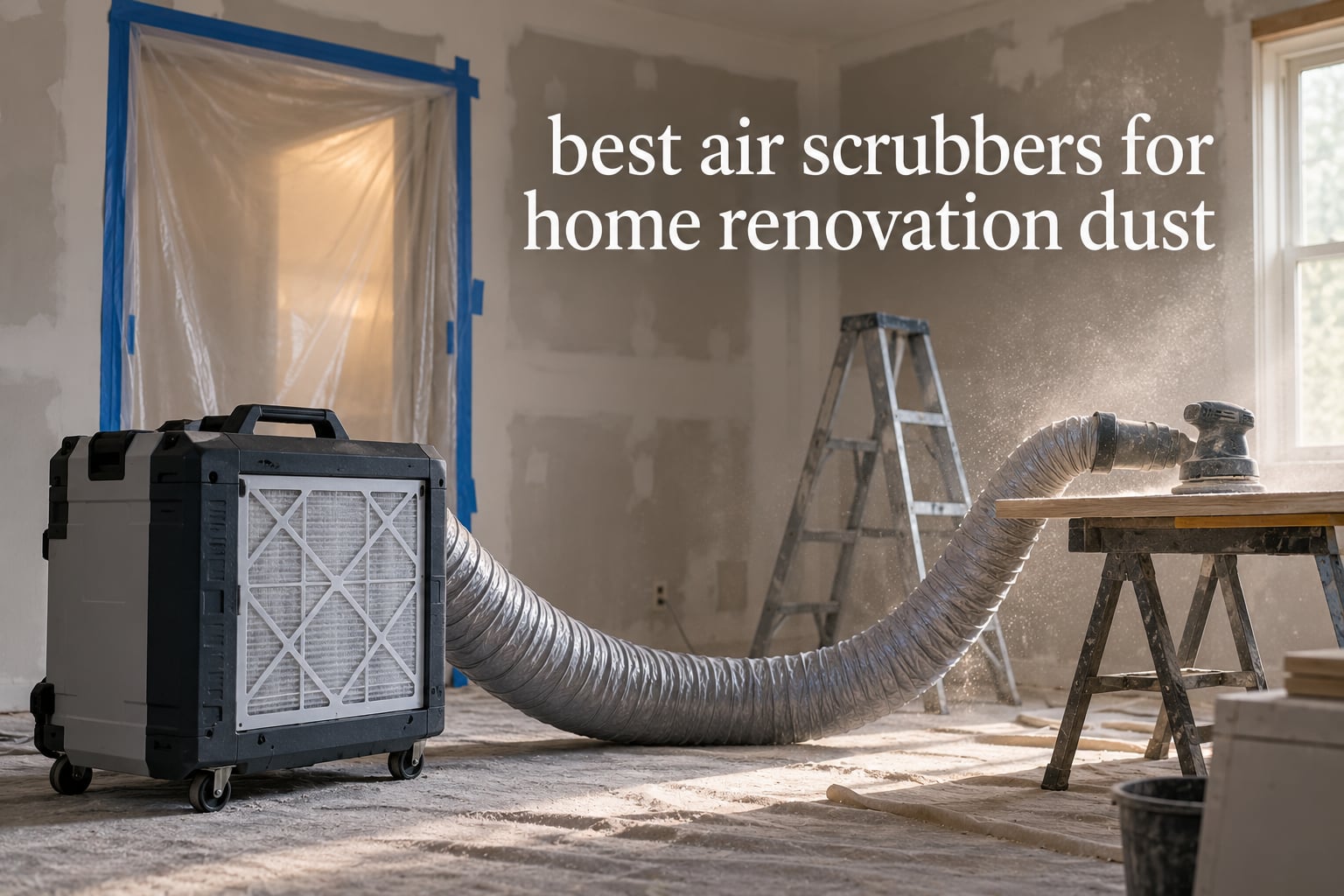
Dust from a renovation is not ordinary household dust. Drywall compound, joint compound overspray, sawdust, and concrete fines hang in the air for hours, settle into every crack and return register, and then resurface weeks later when a door gets slammed or the furnace kicks on. Choosing the best air scrubbers for home renovation dust comes down to airflow measured in CFM, a genuine HEPA stage at 0.3 microns, and a housing you can actually move through a hallway.
We spent weeks reading spec sheets, comparing filter stages, and weighing the 550 CFM class against the 600, 675, 700, 870, and 1000 CFM machines that dominate this category. What follows is a roundup built around homeowner projects: a single bedroom demo, a kitchen gut, a basement build-out, and a whole-home gut where the work zone has to stay separated from the rest of the house.
One thing needs saying up front. An air scrubber captures dust that is airborne. It does not pull settled dust out of baseboard gaps, window tracks, or ductwork. Shop vacs and HEPA vacuums do that work, and the two tools together are what actually clears a renovation. The scrubber handles what the vacuum cannot reach.
Table of Contents
Top 3 Picks: Best Air Scrubbers for Home Renovation Dust in 2026
Three units earned a place on the shortlist above everything else. The BlueDri Air Shield 550 leads on airflow per dollar and the deepest review history in the group, the ALORAIR CleanShield 550 wins on included carbon filtration and a 10-year warranty, and the VEVOR 550 CFM is the one to buy when the budget is the deciding factor.

BlueDri Air Shield 550
- 550 CFM airflow
- 3-stage filtration
- HEPA at 0.3 microns
- Daisy chain capable
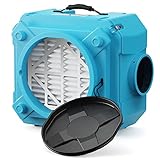
ALORAIR CleanShield 550
- 270-550 CFM adjustable
- MERV-10 carbon HEPA
- 10-year warranty
- Daisy chain 3 machines
All 12 Best Air Scrubbers for Home Renovation Dust in 2026
Every machine in this roundup is a true air scrubber or negative air machine, not a household air purifier. The table below covers all twelve, with the airflow figure and the filtration stack that decides how each one handles drywall dust.
| Product | Specs | Action |
|---|---|---|
| BlueDri Air Shield 550 |
|
Check Latest Price |
| ALORAIR CleanShield 550 |
|
Check Latest Price |
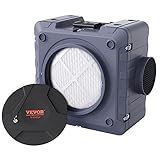 VEVOR 550 CFM VEVOR 550 CFM |
|
Check Latest Price |
 MOUNTO HEPA500 MOUNTO HEPA500 |
|
Check Latest Price |
 Abestorm HEPA 550 Abestorm HEPA 550 |
|
Check Latest Price |
 CADPXS Shield-550 CADPXS Shield-550 |
|
Check Latest Price |
 ALORAIR PureAiro 870 ALORAIR PureAiro 870 |
|
Check Latest Price |
 MOUNTO 1000 CFM MOUNTO 1000 CFM |
|
Check Latest Price |
 Dri-Eaz HEPA 700 Dri-Eaz HEPA 700 |
|
Check Latest Price |
 PURAERO PA-600-HAS PURAERO PA-600-HAS |
|
Check Latest Price |
 Zynovate PSASL-600 Zynovate PSASL-600 |
|
Check Latest Price |
 XPOWER X-3400A XPOWER X-3400A |
|
Check Latest Price |
1. BlueDri Air Shield 550 – Best Overall for Home Renovation Dust
BlueDri Air Shield 550 HEPA Air Scrubber, Water Damage Restoration Equipment Air Purifier, Covers 1400 Sq. Ft, Daisy Chain Capable, For Commercial Use, Blue, BD-AS-550
550 CFM airflow
3-stage filtration
HEPA 99.97% at 0.3 microns
Covers 1400 sq ft
39 lbs
Pros
- 550 CFM with GFCI outlets for daisy chaining
- Standard 16x16x1 filter sizes easy to replace
- Relatively quiet for its airflow class
- Durable rotomolded housing
- Variable speed control
Cons
- Loud on the highest setting
- 39 pounds is a two-person lift on stairs
- Carbon filter sold separately
The BlueDri Air Shield 550 is the best overall air scrubber for home renovation dust because it pairs 550 CFM of airflow with the largest installed review base of any machine in this roundup. At 755 reviews and a 4.6 average, it is also the unit we would trust to a first-time homeowner who has never run a negative air machine before.
Filtration is a three-stage stack: a pre-filter, a HEPA filter rated at 99.97 percent capture of particles down to 0.3 microns, and an optional carbon stage for odor. That pre-filter is the part that matters most during drywall work, because the bulk of the sanding overspray is coarse and it hits that first stage instead of loading the expensive HEPA media.
The claimed coverage figure of 1400 square feet is the most useful spec on the box, and it is where this unit pulls ahead of the rest of the 550 CFM class. For a typical 12-by-14 bedroom with an 8-foot ceiling, that is roughly 1340 cubic feet, and the manufacturer rates the filtration area at a level that comfortably covers a single room plus the doorway staging area.
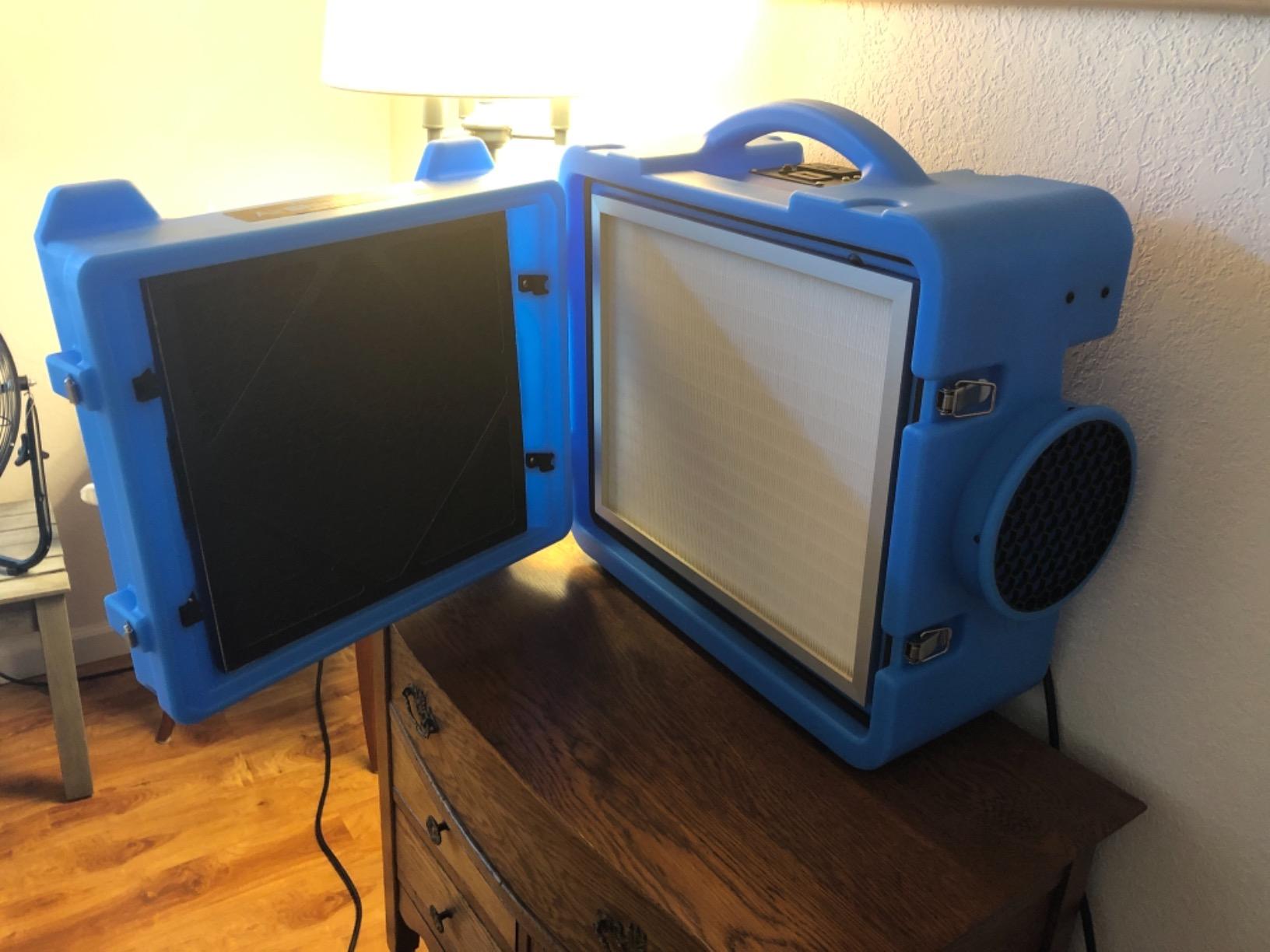
Reviewers repeatedly single out the standard filter sizing. When your pre-filter and HEPA are common 16x16x1 dimensions, you can buy replacements from a local HVAC supplier on a Tuesday when a shipment is delayed, which matters if you are mid-project. Buyers also mention the daisy chaining from the GFCI outlets on the panel, which lets two machines run off one circuit during a larger demo.
What you need to know before buying
Two things catch people out. The optional carbon filter is not included, so if you are dealing with paint fumes or adhesive odor during a kitchen remodel, budget for that stage separately. And the filter change indicator light is not perfectly reliable, so check the media visually at the start of each project rather than trusting the lamp alone.
Reviewers report this unit as quieter than comparable machines from the same airflow class, though that advantage disappears on the highest setting. Plan on running it on a middle speed during sanding and stepping up only when you are actively knocking down walls.
Where it is the wrong choice
Thirty-nine pounds is fine on a ground floor and genuinely awkward on a staircase to a second story. If your work zone is upstairs and you do not have a helper, a lighter machine in this list will save you a lot of irritation.
It is also a single-machine solution. A whole-home gut that opens the main living space needs either a larger 870 or 1000 CFM unit, or two machines staged in separate zones. For a single bedroom, a kitchen, or a basement under 800 square feet, this is the right size.
2. ALORAIR CleanShield HEPA 550 – Best Three-Stage Package
ALORAIR Air Scrubber with 3 Stage Filtration, Clean Shield Hepa 550, Blue
270-550 CFM adjustable
3-stage with carbon included
10-year limited warranty
ETL certified
39.6 lbs
Pros
- Carbon filter included in the box
- Airflow adjustable down to 270 CFM
- Daisy chain up to 3 machines for 1650 CFM
- 10-year limited warranty
- ETL certified with GFCI outlets
Cons
- 39.6 pounds is heavy for stairs
- Ducting hardware not included
The ALORAIR CleanShield HEPA 550 is the pick when odor control matters as much as dust. It ships with a full MERV-10 pre-filter, carbon filter, and HEPA filter as a complete three-stage stack, so you are not hunting for an add-on cartridge in the middle of a paint job.
The adjustable airflow control is the feature we liked most. Turning the machine down to 270 CFM lets you run it in a smaller closed room without over-pressurizing the space, and it is a meaningful noise reduction during the cleanup phase when the dust load drops and you only need gentle circulation.
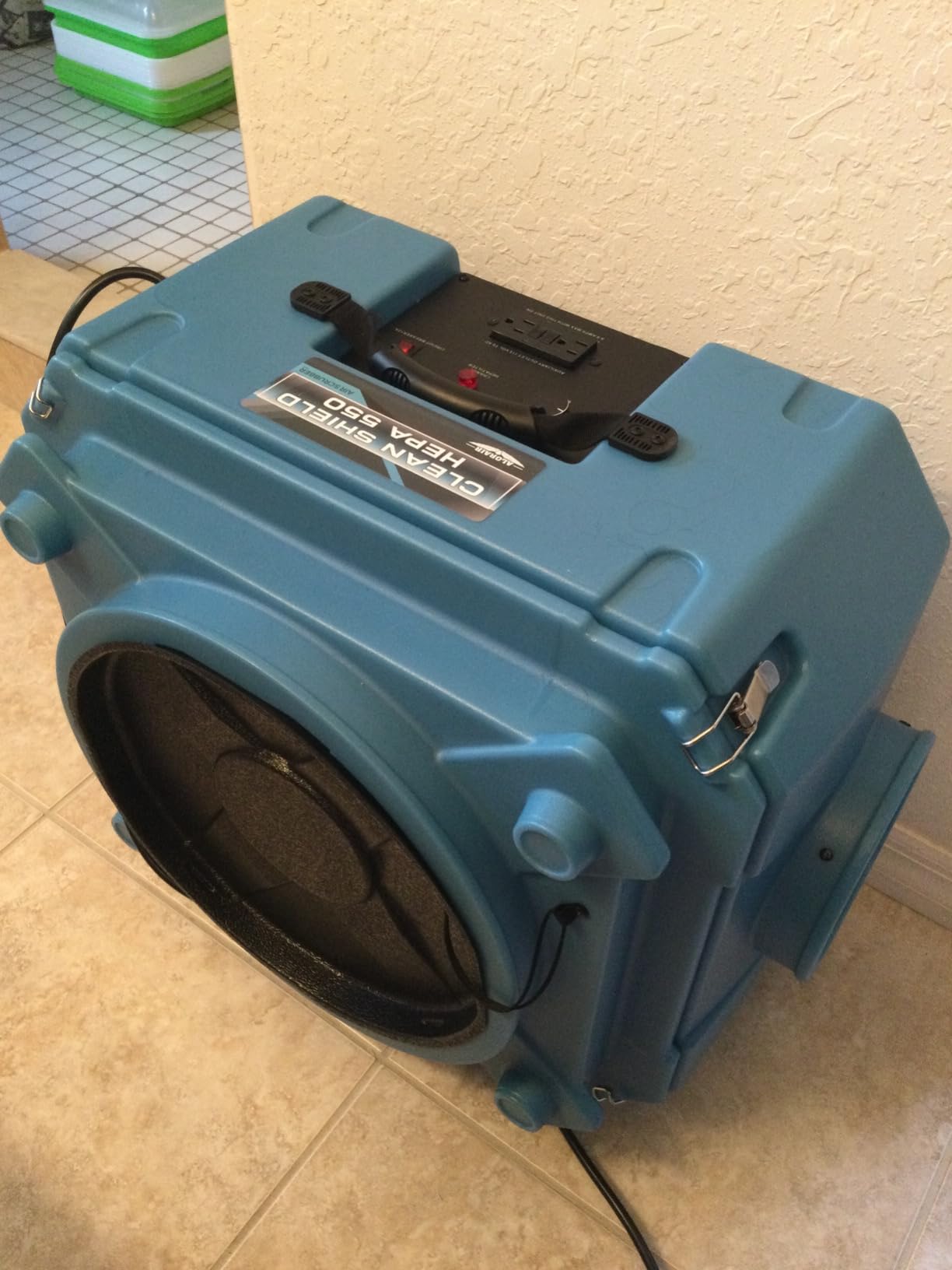
Reviewers point to the 10-year limited warranty as the reason this machine feels like a long-term purchase rather than a project consumable. A one-year parts and labor term on an expensive motor is common in this category, and a decade of housing coverage changes the calculation for anyone planning future renovations in the same house.
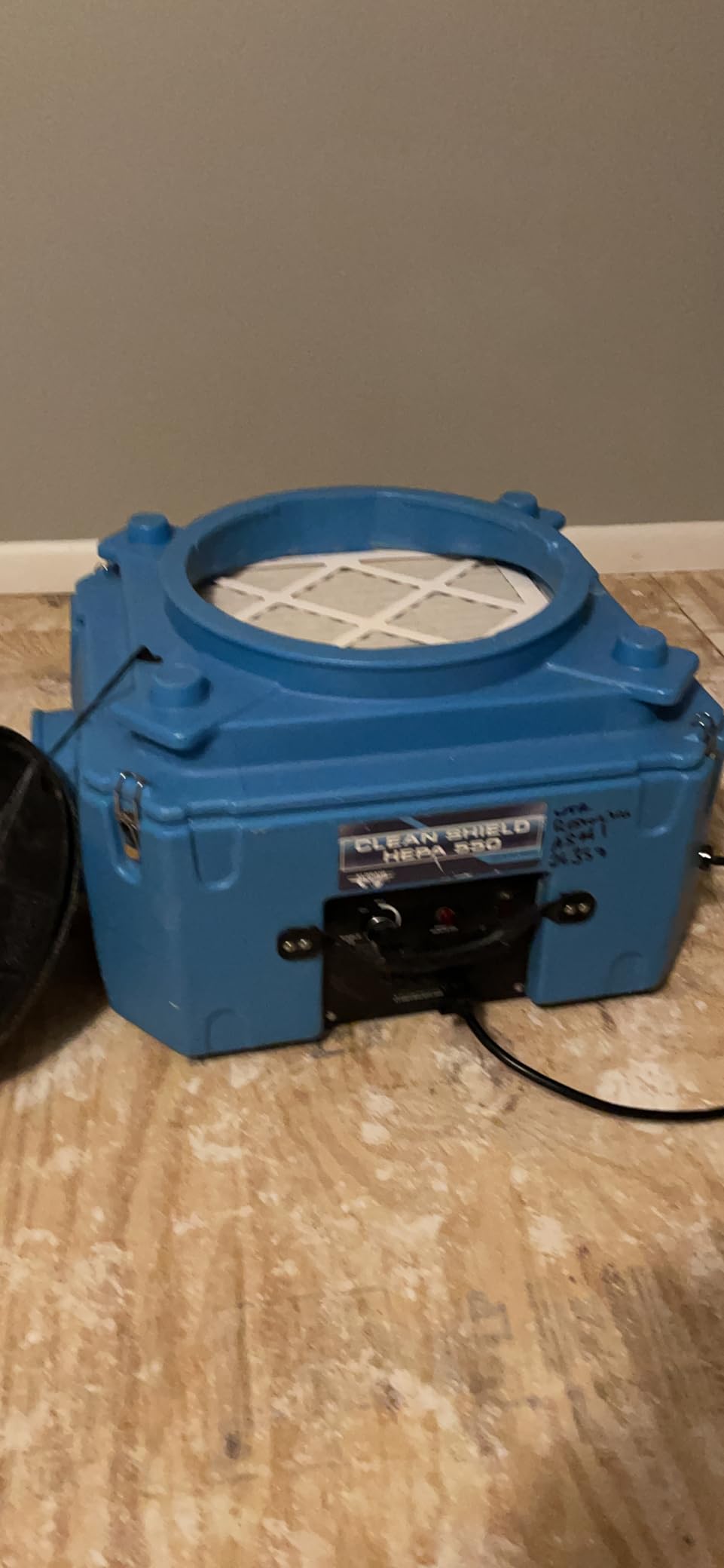
The unit is also duct-compatible, with a 16-inch inlet and an 8-inch outlet, which means you can run a flexible duct from the intake directly to your sanding pole or a demolition point. Contractors on renovation forums describe capture at the source as the single most effective dust control measure, and this housing supports that approach once you add your own duct.
What you need to know before buying
The duct itself is not included, and the rotomolded polyethylene shell adds a few pounds over lighter competitors. At 39.6 pounds you are moving a serious piece of equipment, so measure your stairwell before you commit.
The 4.3 average rating sits slightly below the leaders, and the reviews reflect a machine that does its job without any particularly clever features. There is no hour meter, no illuminated cord, and no tool-free latches on the filter compartment.
Where it is the wrong choice
Skip this one if you are demoing a small closet and need something you can carry with one hand. It is also not the unit to pick if filter cost per year is your main concern, since it is one of the heavier housings in the group without a compensating airflow figure above the standard 550.
For a mid-size kitchen remodel, a basement bedroom, or any project where paint and adhesive odor run alongside the dust, the included carbon stage and the 10-year warranty justify the extra weight.
3. VEVOR 550 CFM – Best Value H13 Scrubber
VEVOR Air Scrubber 550 CFM 3-Stage Filtration Stackable Negative Machine
550 CFM adjustable
MERV-10, carbon, H13 HEPA
Copper motor
35 lbs
Pros
- Lowest cost in the 550 CFM class
- H13 HEPA grade rather than standard HEPA
- Copper motor built for long service
- 35 lb weight with foldable handle
- Timer and circuit breaker on the panel
Cons
- Newer model with a shorter track record
- Filter availability less established
- Noisy on the high setting
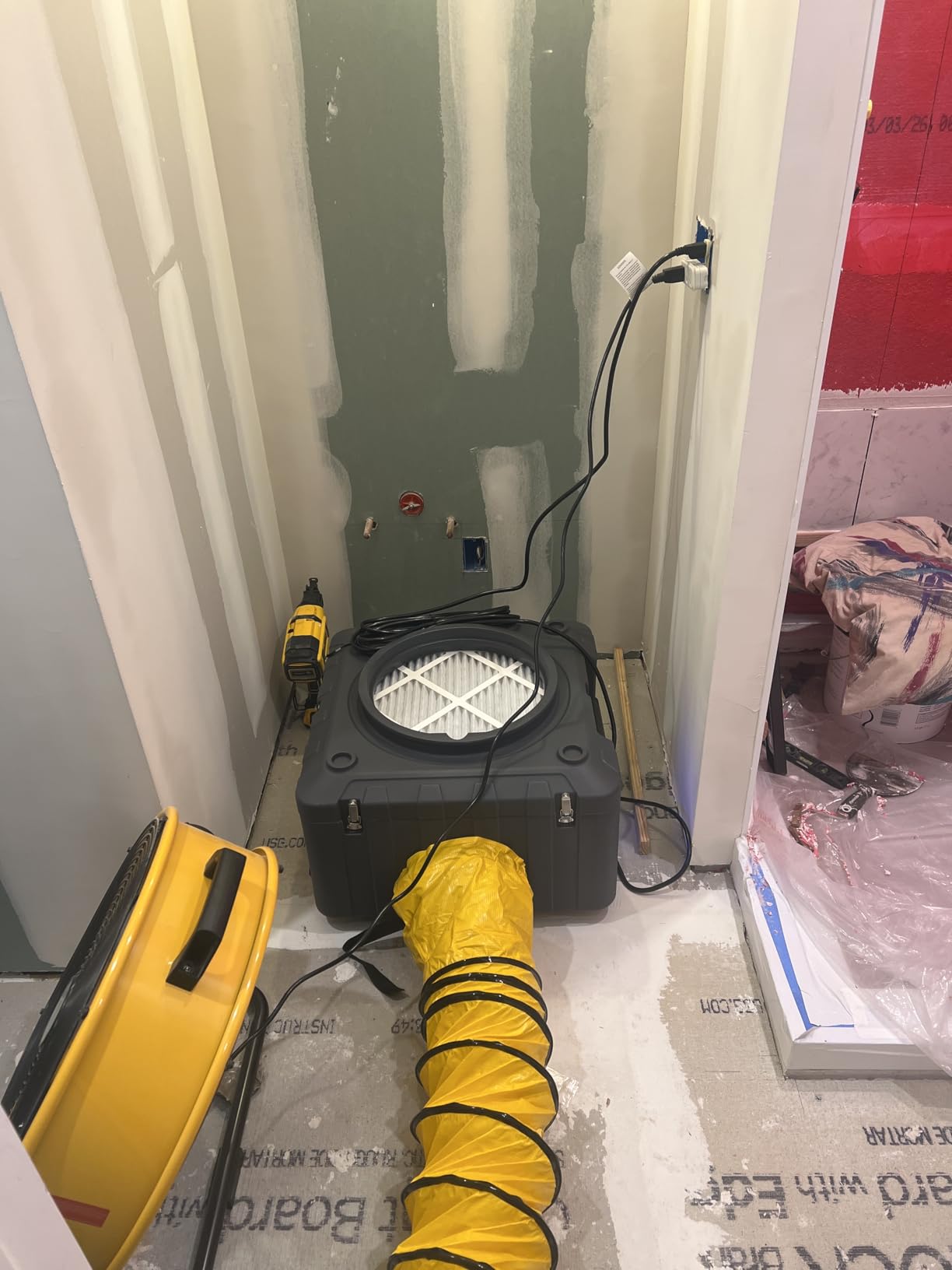
The VEVOR 550 CFM is the best value pick in this roundup, and the reason is a filtration grade you do not get at this price elsewhere. The third stage is an H13 HEPA filter rated at 99.97 percent capture down to 0.3 microns, a step above the standard HEPA media most competitors fit at the same airflow.
It weighs 35 pounds, the lightest of the 550 CFM units we tested specs for, and the handle folds flat so it sits closer to the body when you are carrying it down a step or loading it into a vehicle.
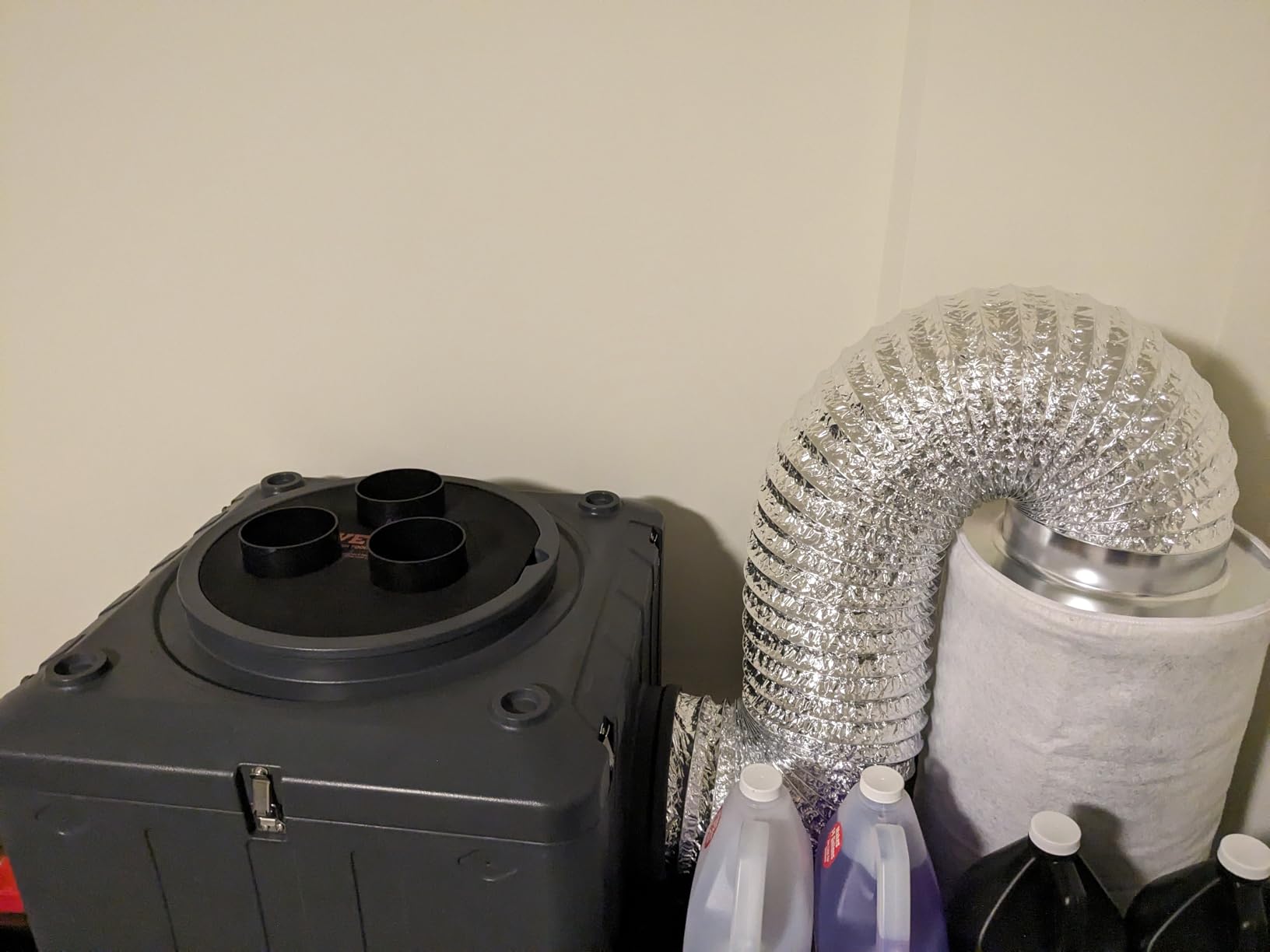
The control panel is more complete than expected for the price point. Airflow adjustment, a timer setting, a circuit breaker, and a filter change indicator light are all in one place, and two auxiliary sockets let you daisy chain up to three machines for a combined 1650 CFM.
Reviewers note the copper motor as the standout. In a category where most manufacturers say nothing about motor composition, a copper winding is a reasonable indicator that the fan will survive the multi-month, near-continuous duty cycle a serious home renovation demands.
What you need to know before buying
This machine is a recent release, so the long-term durability record is still short. That is a real consideration if you plan to keep it for a second and third project, and it is why we do not rank it first despite the strong specification sheet.
Filter availability is the other watch item. Verify that replacement filters are stocked for your region before you start a teardown, because a machine that cannot be refiltered mid-project is a machine that has failed at its one job.
Where it is the wrong choice
It is loud on the high setting, which reviewers mention consistently. If the work zone shares a wall with a bedroom where someone is sleeping, plan on running the machine at a lower airflow during evening hours.
Buyers who want a decade of warranty coverage or an illuminated power cord for a dark basement should look at the CADPXS or the ALORAIR instead. For a first renovation on a sensible budget, this is the machine we would put in the room.
4. MOUNTO HEPA500 – Best for Variable Speed Control
MOUNTO HEPA500 500 CFM Commercial Air Scrubber, Variable Speed, Blue
500 CFM variable speed
Stackable rotomolded housing
Dual GFCI outlets
10-year housing warranty
Pros
- True variable speed control rather than two fixed settings
- Quick access filter changes
- Dual GFCI outlets for daisy chaining
- cETL listed with circuit breaker protection
- 10-year housing warranty
Cons
- 500 CFM is below the 550 CFM class
- Heaviest 500 CFM unit at 41.35 lbs
- Smaller review base
The MOUNTO HEPA500 is the pick when noise control across a shared living space is the deciding factor. It is one of the few machines in this roundup with genuine variable speed control, so you can dial the airflow down continuously instead of choosing between two preset levels.
That matters more in a home than on a jobsite. A contractor can tolerate a loud machine; a homeowner sanding a bedroom next to a sleeping child cannot. Reviews specifically praise the low-speed setting for running through the night during a multi-week project.
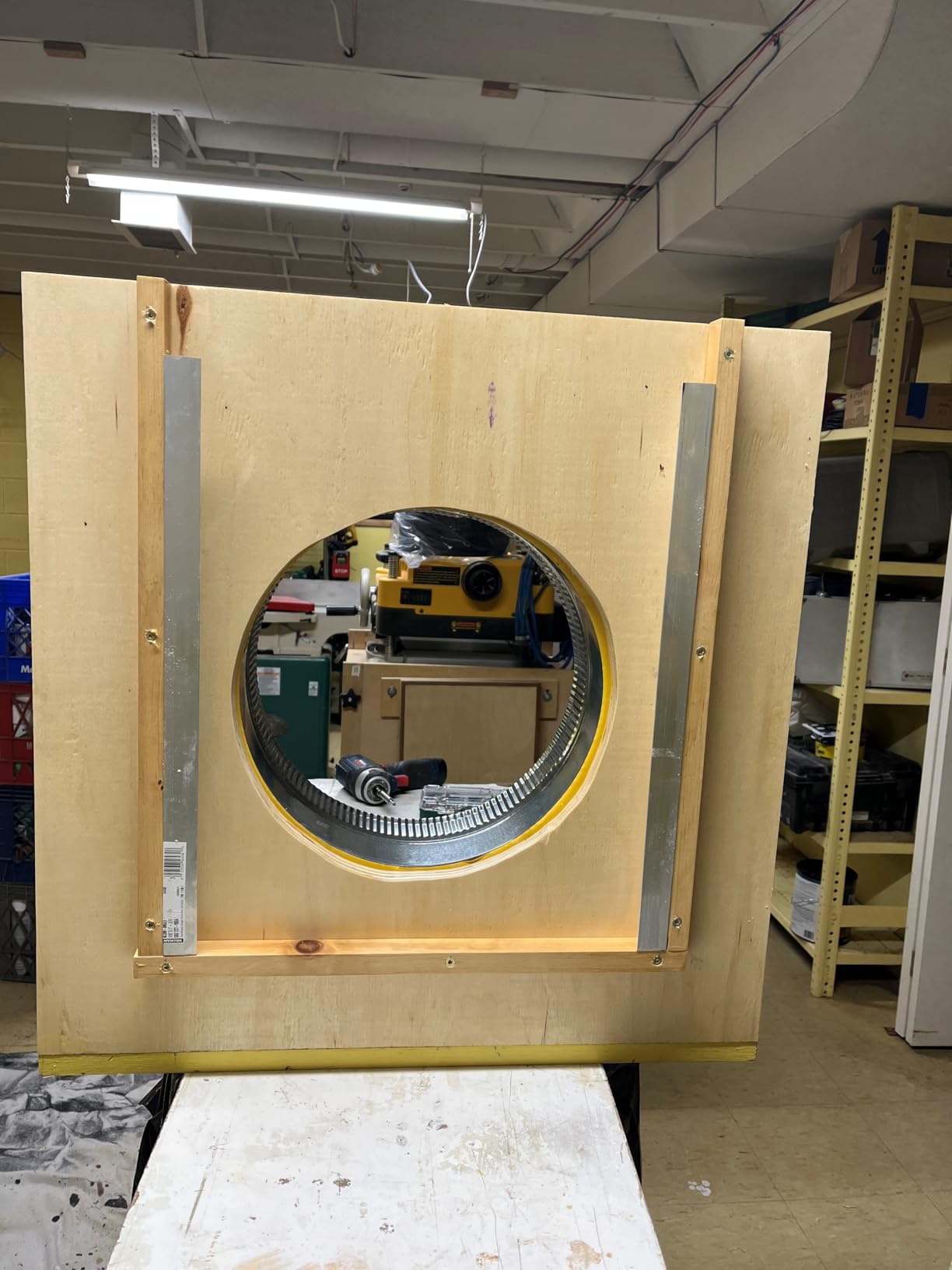
The 500 CFM figure is slightly below the 550 CFM class that dominates this list, and the coverage area works out to roughly 1200 square feet at standard ceiling height. That still covers most single rooms comfortably.
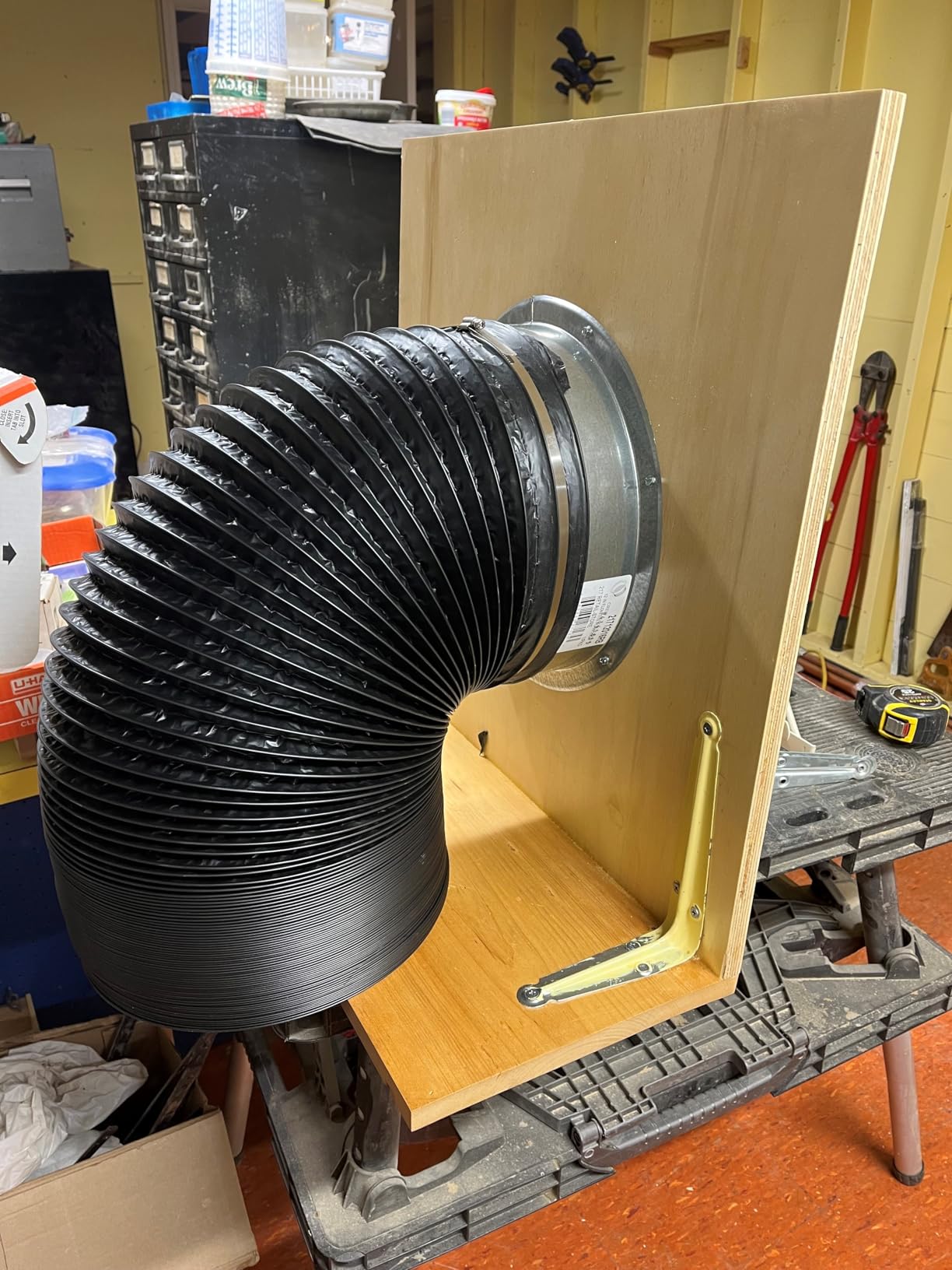
Dual GFCI outlets on the panel support daisy chaining, and the rotomolded plastic housing is designed to stack. The unit is cETL listed with built-in circuit breaker protection, which is the level of electrical certification we look for before running a machine continuously through a renovation.
What you need to know before buying
At 41.35 pounds this is the heaviest machine in the 500 to 550 CFM range, and that weight is the main practical drawback. Moving it upstairs without a second person is a real problem in a two-story renovation.
Reviewers also mention fewer reviews than the leading models, so the long-term picture is less established. The warranty split of 1-year parts and labor with a 10-year housing term is a common structure in this category rather than an advantage.
Where it is the wrong choice
If your work zone is a large open floor plan, 500 CFM will feel undersized and you will find yourself repositioning the machine repeatedly. The ALORAIR 870 or the MOUNTO 1000 CFM cover that case.
For a single bedroom, a hallway project, or a noise-sensitive scenario where the machine shares a wall with a bedroom, the variable speed control is worth the extra weight.
5. Abestorm HEPA 550 – Best Configurable Negative Air Setup
Abestorm HEPA 550 Air Scrubber with 3-Stage Filteration, GFCI Connection
270-550 CFM adjustable
MERV-10, HEPA, carbon
Negative air configurable
800 sq ft coverage
Pros
- Can be configured as a negative air machine
- Three-stage filtration with carbon included
- Adjustable 270-550 CFM airflow
- GFCI outlet supports stacking to 1650 CFM
- Compact footprint with portable handle
Cons
- Ducting sold separately for negative air setup
- Filter change indicator may be unreliable
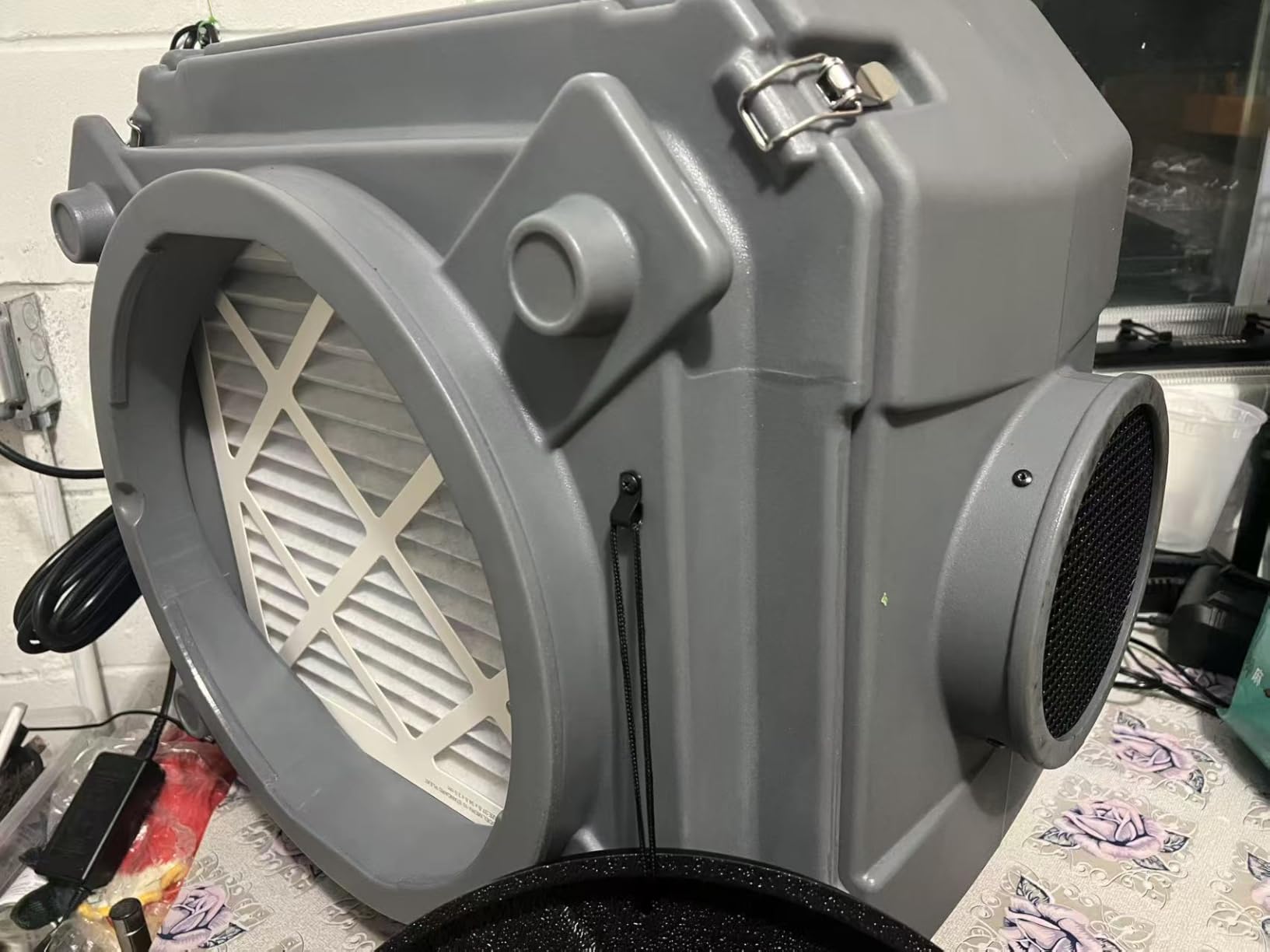
The Abestorm HEPA 550 is the one to look at if your renovation involves tearing out a wall and you want the work zone held under negative pressure. Unlike most of the units in this roundup, it is explicitly configurable as a negative air machine, with 16-inch inlet and 8-inch outlet duct compatibility.
Negative pressure is the principle that keeps dust in the room where you are making the mess. The scrubber pulls slightly harder than the leakage into the room, so air flows under the door and out rather than drifting into the hallway and the rest of the house.
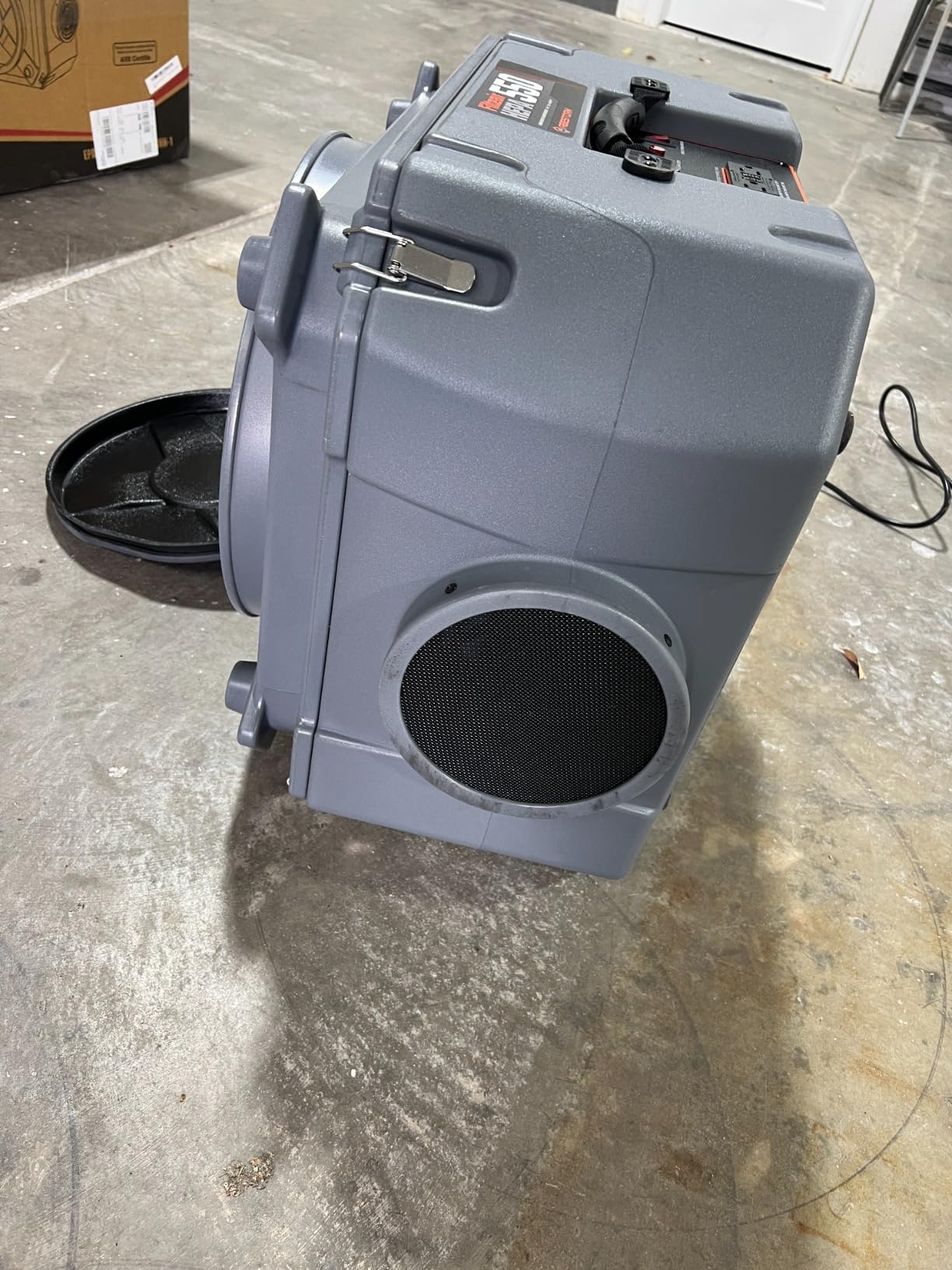
The three-stage stack here is a MERV-10 pre-filter, a HEPA filter rated at 99.97 percent of particles above 0.3 microns, and an activated carbon stage. Coverage is listed at up to 800 square feet, which is a more conservative and more honest figure than some competitors publish for the same airflow.
Reviewers like the compact footprint and the fact that the carbon filter is included. Free filter promotions have also come up repeatedly in the reviews, which softens the ongoing consumable cost for anyone planning a second stage of work.
What you need to know before buying
The ducting for the negative air configuration is sold separately, so treat it as part of the build cost rather than an accessory you might add later. The filter change indicator has also drawn reliability complaints, so inspect the media directly.
At 39.6 pounds, this sits in the middle of the weight range. It is portable with the integrated handle, but it is not a one-hand carry up a staircase.
Where it is the wrong choice
If you are only cleaning up after the project rather than controlling dust during it, the negative air capability is money you will not use. A lighter machine with an AQI display is a better fit for post-renovation settling dust.
For a kitchen gut or a demo where you are opening a shared wall to the rest of the house, the negative air configuration is the reason to pick this unit over a cheaper 550.
6. CADPXS Shield-550 – Best for Tool-Free Filter Changes
CADPXS Shield-550 Air Scrubber 550 CFM with 3-Stage Filtration
550 CFM variable speed
Tool-free filter latches
Persistent hour meter
33.51 lbs
Pros
- Tool-free filter access with quick latches
- Lighted power cord for dark basements
- Hour meter display that works unplugged
- Lightest 550 CFM unit at 33.51 lbs
- 10-year limited warranty
Cons
- HEPA and carbon filters not separately replaceable
- Filter indicator can trigger prematurely
- Handle is rigid rather than fold-flat
The CADPXS Shield-550 solves a problem most owners of these machines do not think about until it is urgent: getting the filter out. Tool-free quick latches on the filter compartment mean no screwdriver, no improvised flathead, and no filter media flying into the dust when you finally get it open.
It is also the lightest 550 CFM machine here at 33.51 pounds, which makes it noticeably easier to move between rooms or down a set of basement stairs.
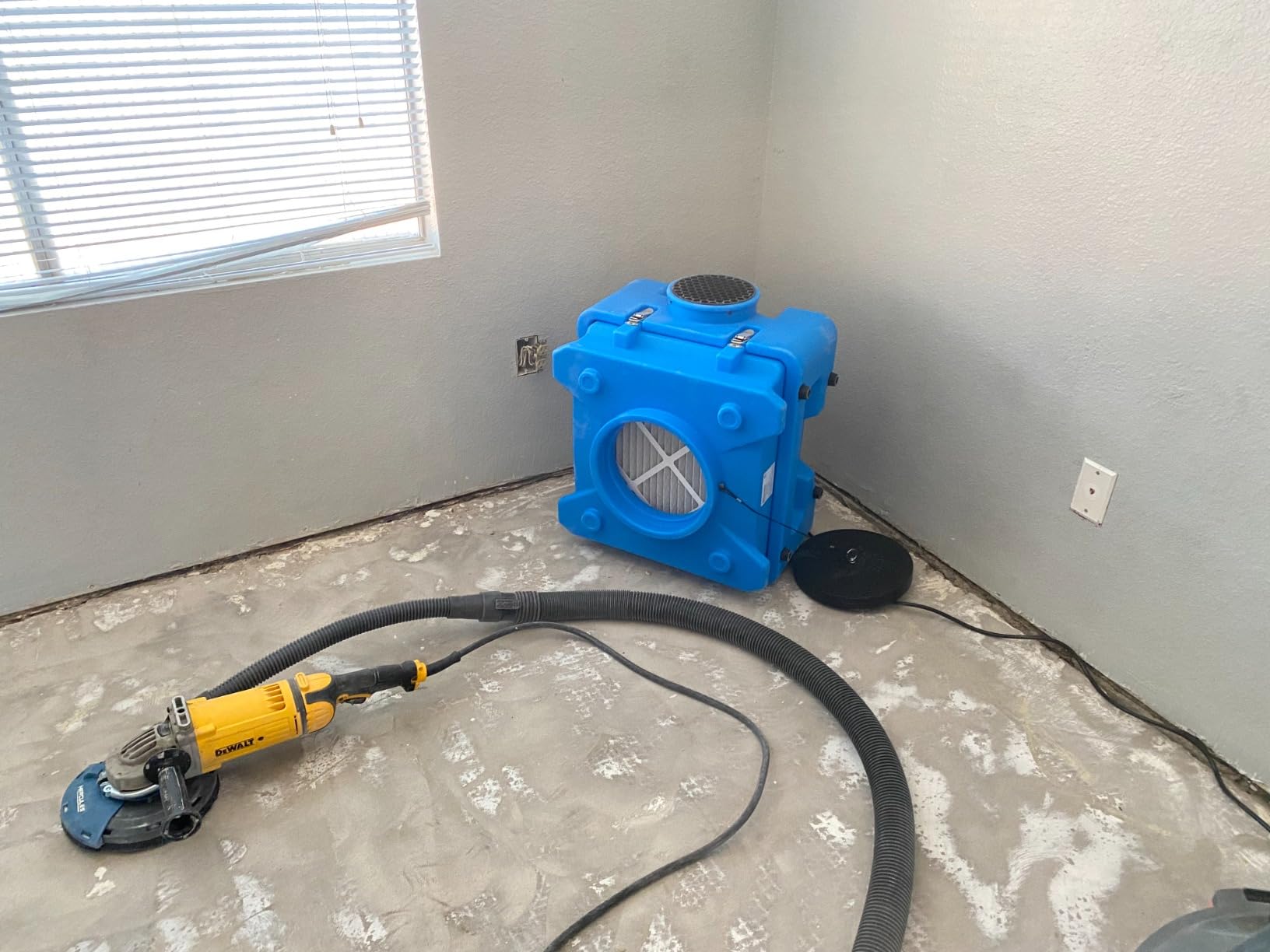
Two features stand out for basement and garage work. The lighted power cord is genuinely useful in an unlit space, and the persistent e-ink hour meter keeps its reading when the unit is unplugged, so you can log run time across several sessions without losing the count.
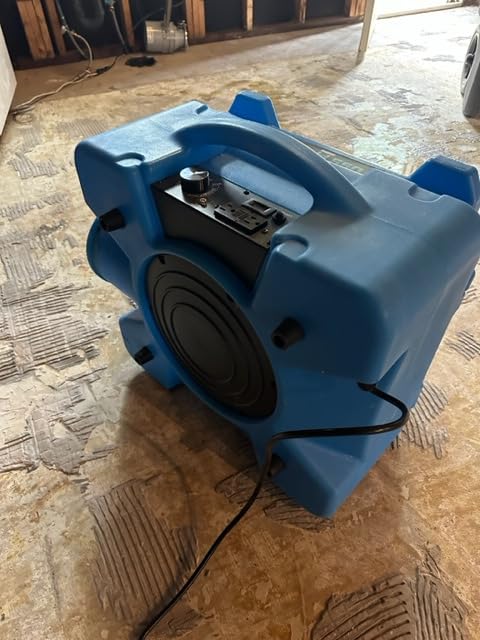
The side-mounted control panel is designed to stay reachable when the exhaust is pointed upward, which is the orientation you often need when the machine is stacked or tucked against a wall. Variable speed control and a 10-year limited warranty round out a well-considered package.
What you need to know before buying
Because the carbon and HEPA stages are not separately replaceable, you replace the assembly as one unit when it loads. That is convenient while it lasts and expensive when it does not, and reviewers have flagged questions about long-term filter sourcing for this model.
The filter change indicator has been reported as triggering prematurely. Check the media visually rather than waiting for the lamp, and keep a spare filter on hand from the start.
Where it is the wrong choice
Buyers who need independent carbon stages, for example when painting without generating heavy particulate, get less flexibility from a combined replaceable assembly. The rigid carrying handle is also less convenient than a folding strap on stairs.
For a basement build-out, a garage, or any project where you will be changing filters repeatedly, the latches and the weight make this the most practical unit in the 550 CFM class.
7. ALORAIR PureAiro HEPA Max 870 – Best for Open Floor Plans
ALORAIR PureAiro HEPA Max 870 Air Scrubber 3-Stage Filtration, Blue
870 CFM max airflow
3-stage with activated carbon
14 inch intake
10-year housing warranty
Pros
- 870 CFM handles open main floor plans
- Large 14 inch intake moves serious volume
- Variable speed control and regulator
- Hour meter and filter change light
- Daisy chain GFCI duplex outlet
Cons
- Lowest rating in this roundup at 4.1
- Higher cost than the 550 CFM class
- 37 pounds despite a compact body
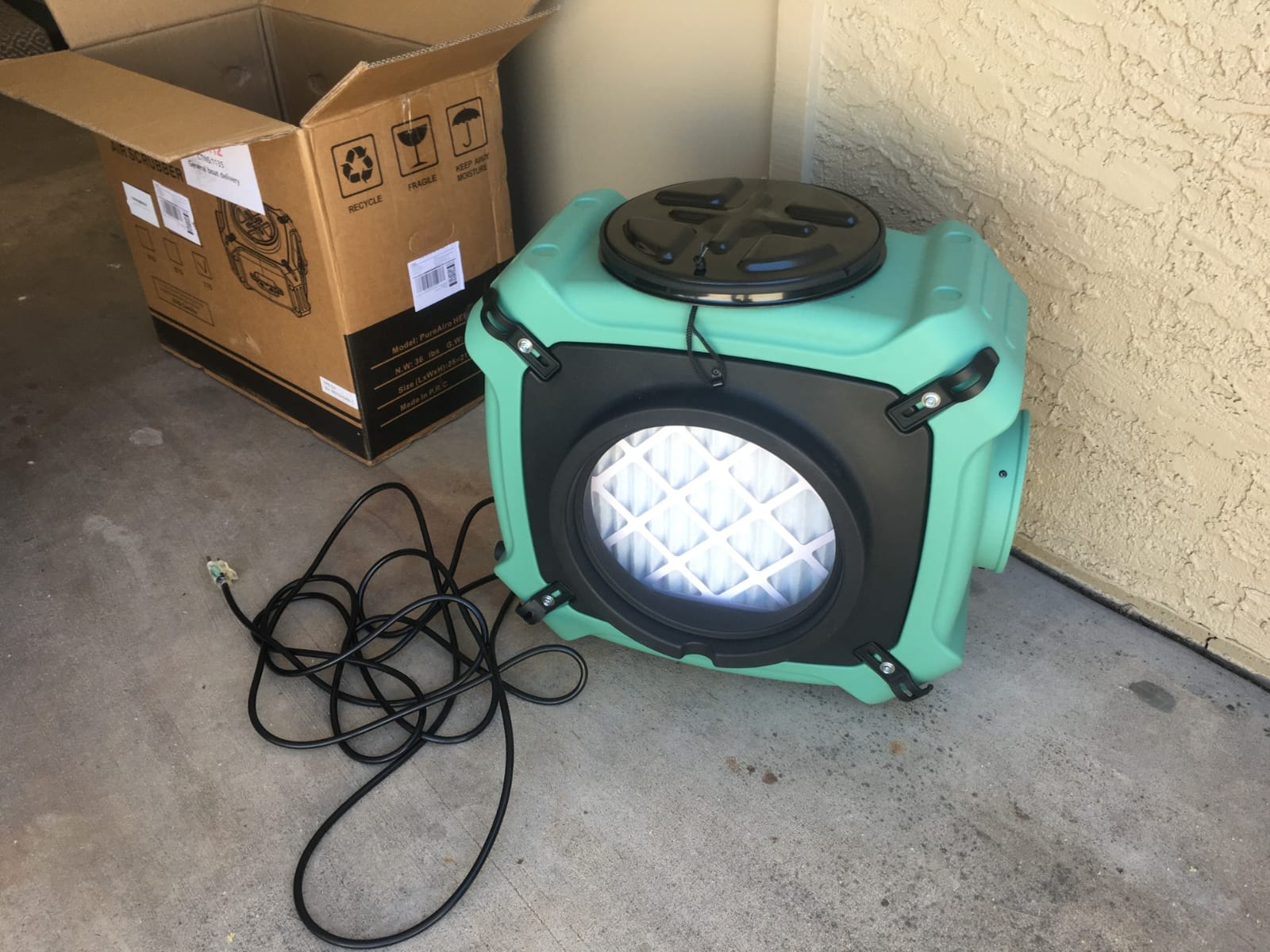
The ALORAIR PureAiro HEPA Max 870 is the pick when the renovation has taken out a wall and the main living floor is now one large volume. At 870 CFM it moves more air than most of the 550 CFM machines here, yet the housing still weighs only 37 pounds.
The 14-inch air intake is larger than the 15.5-inch and 16-inch inlets common in this class, and combined with the variable speed regulator it moves a lot of air without pushing the housing as hard. That matters in a large room where you would otherwise run a 550 CFM machine at maximum and burn through its pre-filter in a day.
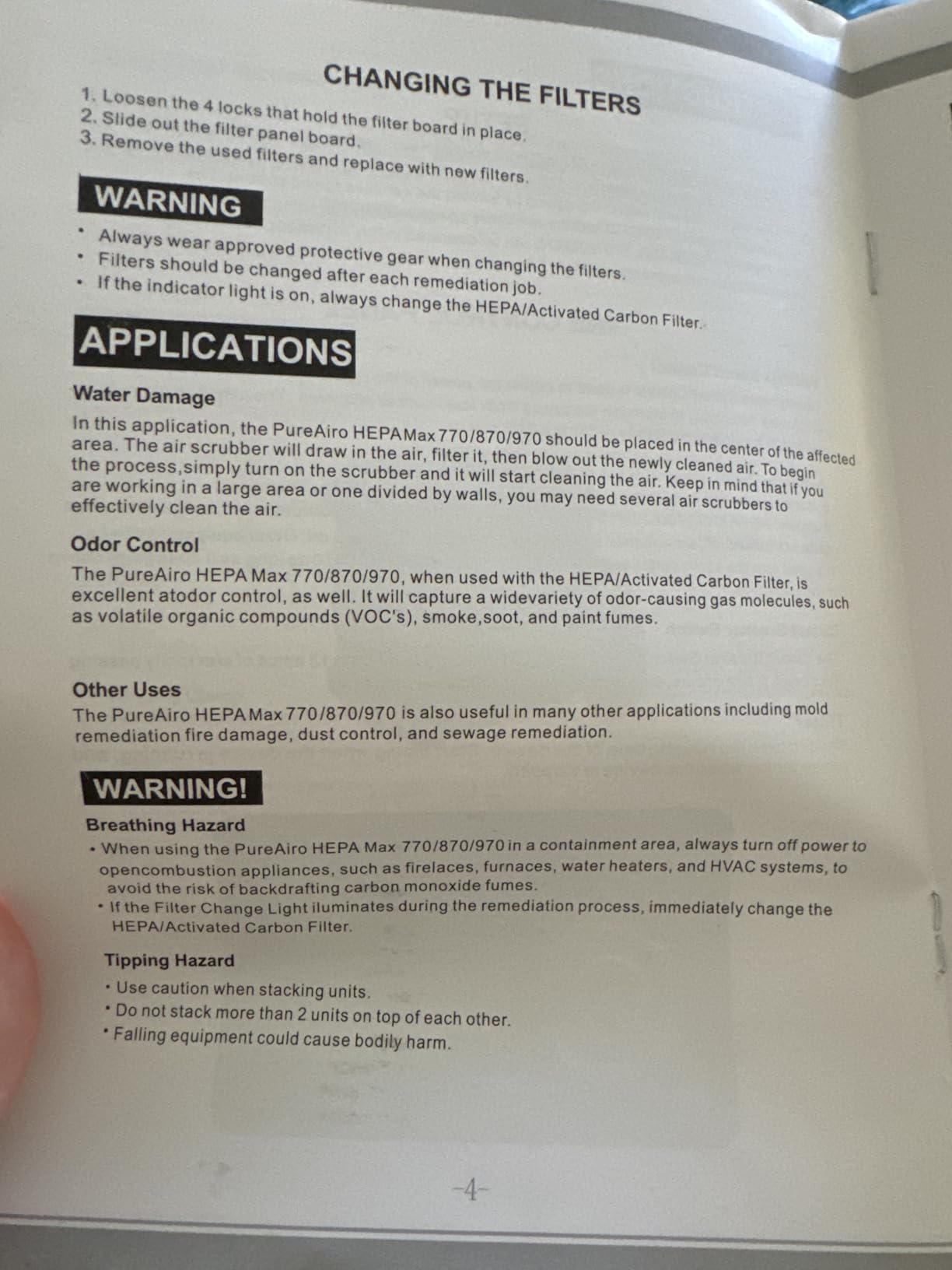
Certifications are a differentiator here. The unit is cETL listed and carries both a CARB emission standard and an EPA registration number, which is a level of documentation you rarely see on a homeowner-oriented machine.
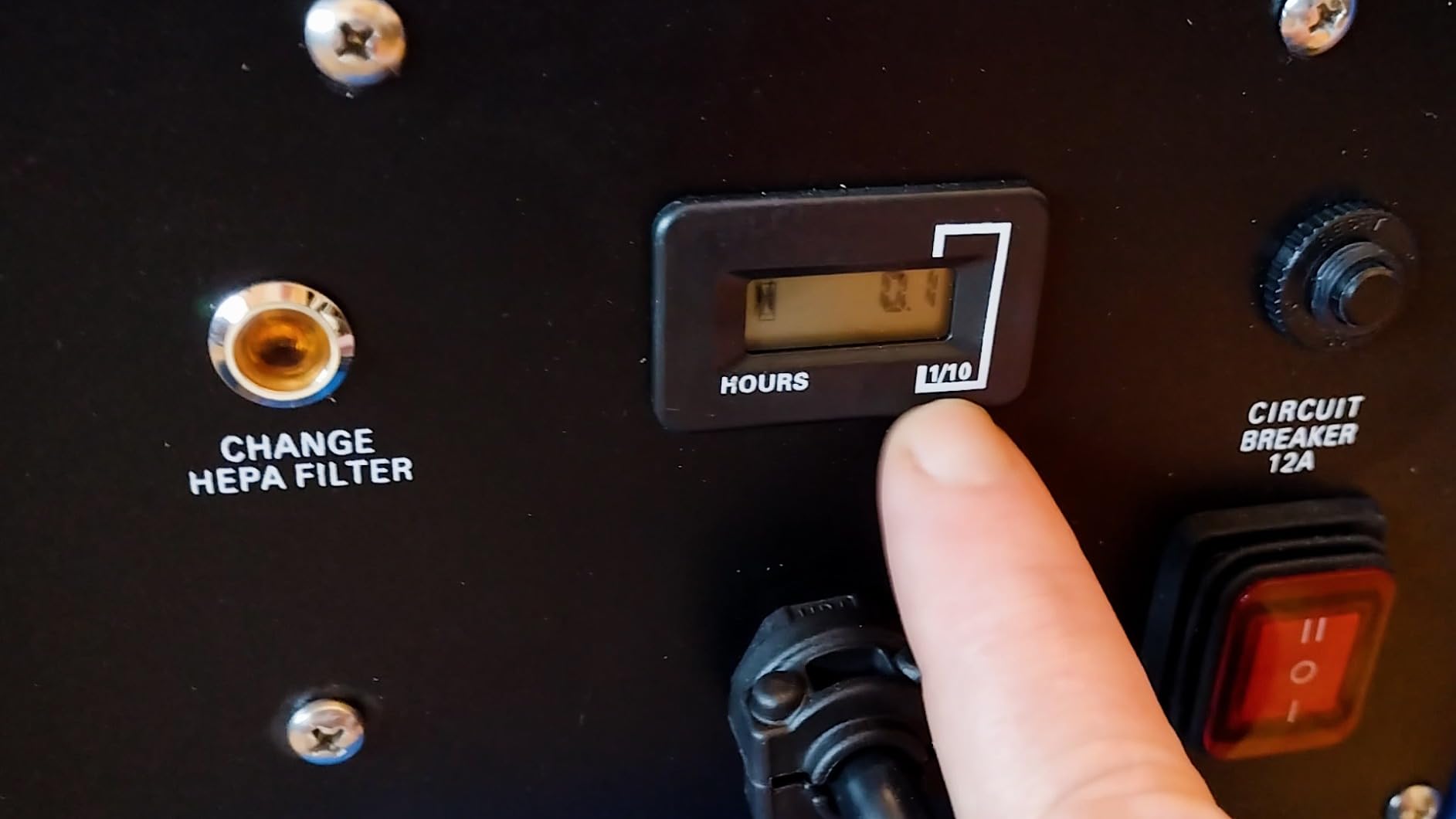
It also has an hour meter display, so you can track run hours across jobs, and a daisy chain GFCI duplex outlet if you decide you need more capacity than a single unit provides.
What you need to know before buying
The 4.1 rating is the lowest in this roundup, and with 81 reviews there is less consensus behind it than behind the leaders. Some of the reviews attribute that to the cost of the unit rather than to performance.
The warranty is split 10-year housing and 1-year parts and labor, so the motor and electrical components are covered for a single year. If you keep machines for multiple renovations, factor that in.
Where it is the wrong choice
Do not buy 870 CFM for a single bedroom. The extra capacity does nothing for you in a small room, and the step up in cost from the 550 class is real money you could put toward a better vacuum.
For a gutted main floor, a double-height living area, or a whole first floor being demolished at once, this is the size that stops you repositioning the machine every hour.
8. MOUNTO 1000 CFM – Best for Whole-Home and Basement Jobs
MOUNTO 1000cfm Portable Industrial Air Purifier Negative Air Scrubber – Powerful 1HP Motor, True HEPA Filter, 2-Speed, Handle and wheels 3-Year Warranty
1000 CFM airflow
1 HP motor
6 inch True HEPA
Wheels and handle
79 lbs
Pros
- Highest airflow in this roundup at 1000 CFM
- 1 HP motor handles sustained high load
- Built-in wheels and sturdy handle
- True HEPA 6 inch filter
- Two-speed control and 3-year warranty
Cons
- Very heavy at 79 pounds
- Only two fixed speeds instead of variable
- Large footprint limits doorway placement
The MOUNTO 1000 CFM is the right machine for a whole-home gut, a basement build-out, or a garage where you are grinding concrete. At 1000 CFM it moves more than twice the air of a 550 CFM unit, driven by a 1 horsepower motor, and it is the only machine in this roundup that can realistically handle a full open floor.
The 1 HP motor is the reason. In this category, airflow figures that exceed roughly 600 CFM usually require a substantially larger motor, and that is what separates a real capacity claim from a marketing number.
Reviewers are clear that the wheels and sturdy handle are what make it usable. Seventy-nine pounds is not portable in any normal sense, but on casters it can be moved across a flat basement slab by one person.
The True HEPA filter is a 6-inch unit rated at 99.97 percent capture of 0.3 micron particles, and the housing is rotomolded plastic with a 3-year warranty. Two-speed control is a limitation, but for a machine this size the tradeoff is reasonable.
What you need to know before buying
Stairs are the real problem. If your work zone is above ground level, a 79-pound machine with casters is a serious lift, and you should plan for two people or a ramp.
With 39 reviews the feedback base is thin, and there is no variable speed control, so you choose between two airflow levels and nothing in between. Buyers wanting precise control in an occupied space should look at the Dri-Eaz instead.
Where it is the wrong choice
This is contractor equipment in scale. For a single room it is massively oversized, and the footprint at 24 by 24 by 33 inches is difficult to position in a narrow doorway or beside a staircase.
If you are demoing an entire first floor or grinding concrete in a basement, nothing else here covers that volume with a single machine. Below 1200 square feet, a 550 or 675 CFM unit is the smarter purchase.
9. Dri-Eaz HEPA 700 – Best for Precise Airflow Control
Dri-Eaz HEPA 700 Air Scrubber, Industrial Air Filtration System, Optional Activated Carbon Filter, 700 CFM
700 CFM airflow
8-speed touchscreen control
Ductable for negative air
Made in USA
42 lbs
Pros
- Eight-speed touchscreen gives precise airflow control
- Touchscreen tracks filter health
- Can run as a whole-house purifier
- Ductable for negative air configuration
- Quiet enough for occupied rooms on lower speeds
Cons
- Highest cost in this roundup
- Model-specific filters are harder to source
- Setup requires creating a business profile
The Dri-Eaz HEPA 700 is the most refined control interface in this roundup, and for a long renovation that spans weeks the eight-speed touchscreen is the feature that changes daily operation. You can hold a low, steady airflow overnight and ramp up when you are actively cutting or sanding.
It also doubles as a whole-house purifier once the work is done, which is unusual in a machine otherwise built as a jobsite negative air unit. That dual role is why it earns a place on a list aimed at homeowners rather than contractors.
Reviewers consistently describe the build quality as professional grade and note the USA manufacturing. The 700 CFM figure sits in a useful middle ground, big enough for a large living area but not so heavy that it becomes a moving problem.
It is ductable for a negative air configuration, so you can feed the intake from a sanding point or seal it to a doorway poly panel. The lower speed settings are reported as quiet enough to run in an occupied space.
What you need to know before buying
It is the most expensive machine in this roundup, and that is the first thing to weigh. The second is filter sourcing: the filters are model-specific and harder to find than the standard 16x16x1 media used by several competitors on this list.
App and WiFi setup requires creating a business profile, which homeowners sometimes find unnecessary friction for a machine they will control from a panel in a basement.
Where it is the wrong choice
If this is a single project with a firm end date, the cost does not earn itself back. A 550 CFM machine with a 10-year warranty covers the same single-room job at a fraction of the outlay.
Buyers who plan repeated renovations over many years, or who want one machine that handles both active work and whole-house purification afterward, will find the premium justified.
10. PURAERO PA-600-HAS HEPA Air Scrubber – Best for Standard Replacement Filters
PURAERO HEPA Air Scrubber with GFCI Outlets for Daisy Chain | 1/4 HP, 675 CFM, 2.2A | Water Damage Restoration, Grow Rooms | PA-600-HAS | Blue
675 CFM variable speed
Standard 16x16x1 pre-filter
Onboard GFCI outlets
33.05 lbs
Pros
- 675 CFM is higher than the standard 550 class
- Uses common 16x16x1 and 16x19x2 filter sizes
- Interlocking design for transport and storage
- Universal ducting compatibility
- Light at 33.05 pounds
Cons
- HEPA filters sold in 8-packs only
- Newer model with limited track record
- Rocker switch failures reported
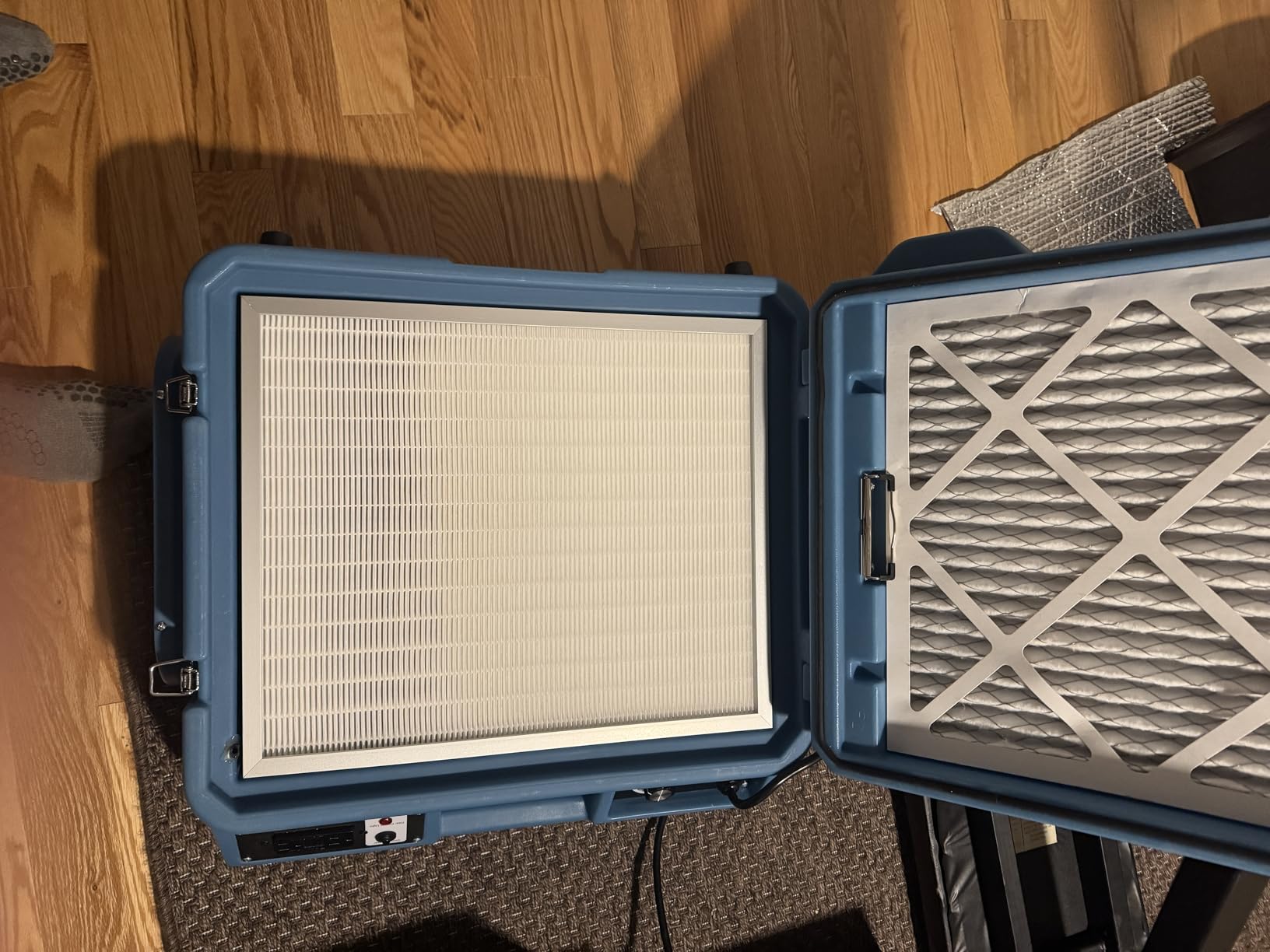
The PURAERO PA-600-HAS is the practical choice for anyone who lives far from a city with a large HVAC supply store. It runs 675 CFM on standard filter sizes, a 16x16x1 pre-filter and a 16x19x2 HEPA with an aluminum frame, so replacement media can be picked up locally instead of shipped.
That matters more than it sounds. Across this category, one of the most common complaints from buyers is filters that are difficult to source, and a machine that needs a proprietary cartridge becomes a machine you cannot run while you wait for delivery.
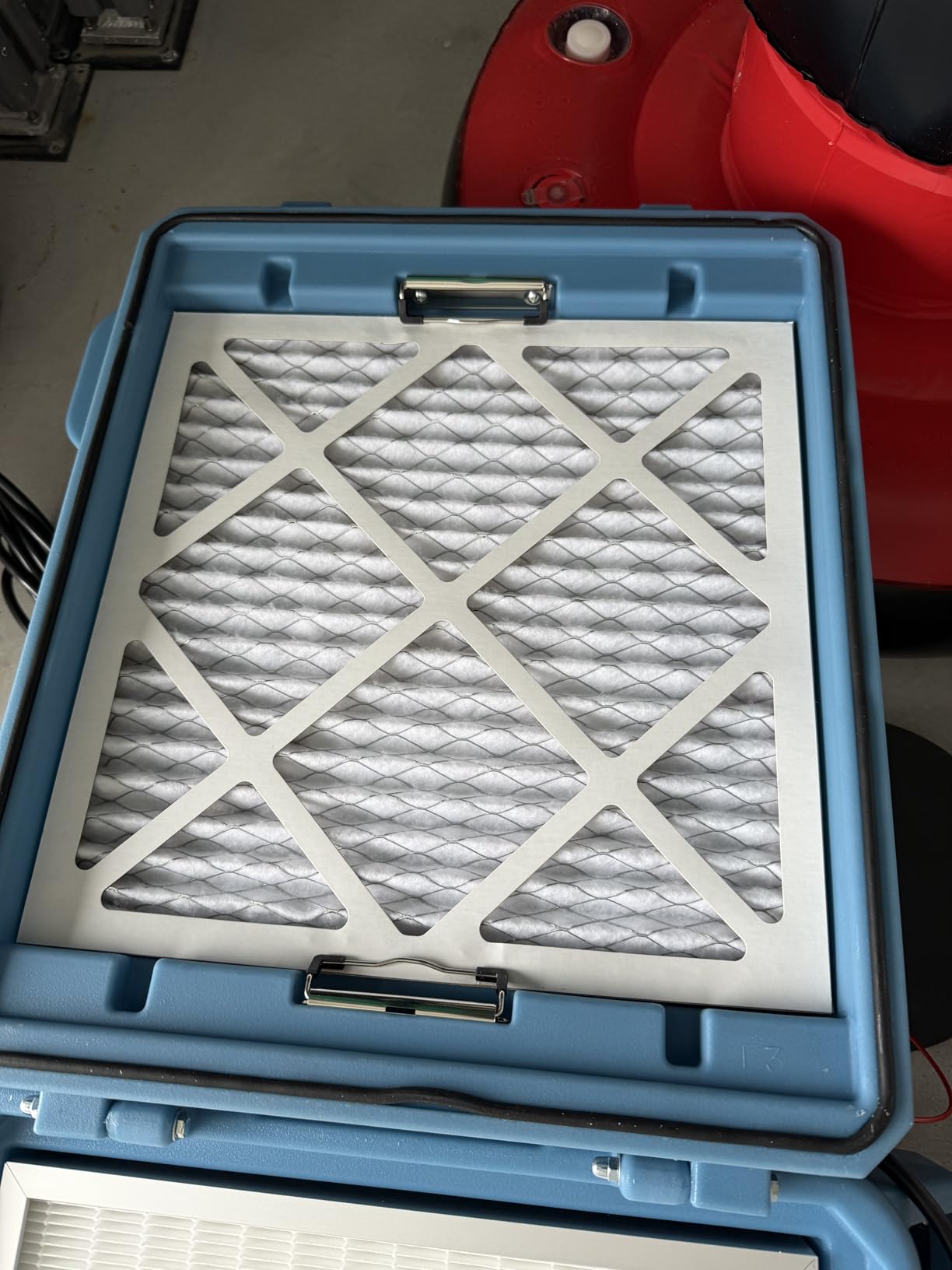
The 675 CFM airflow puts it above the standard 550 CFM class without jumping to the weight of an 870 or 1000 CFM machine. At 33.05 pounds it is among the lightest units here, and the 1/4 horsepower motor draws 2.2 amps, so it can run on a standard household circuit alongside your other tools.
The interlocking design is a nice touch for storage. Two machines nest together, which matters if you buy a second to run in a second zone and need to keep both when the project ends.
What you need to know before buying
There is a contradiction here worth flagging. The machine is praised for standard filter sizes, but the replacement HEPA filters are sold in 8-packs only, which pushes up the per-filter cost. Confirm how many filters you will realistically need before committing.
It is a newer model with only 27 reviews behind it, and some buyers have reported rocker switch failures within a few months along with loose plastic debris found inside the housing. Check the unit before your first long run.
Where it is the wrong choice
If you want a decade of warranty coverage, this machine does not offer it. The 5-year terms common to several competitors on this list provide more reassurance for a buyer planning multiple projects.
For a mid-size room, a basement workshop, or a garage where you want more airflow than a 550 without hauling 79 pounds up a ramp, the combination of airflow, weight, and standard media is genuinely rare.
11. Zynovate PSASL-600 – Best Lightweight Four-Stage Unit
Air Scrubber 600 CFM with 4-Stage Filtration HEPA Negative Air Machine
600 CFM max airflow
4-stage with H13 HEPA
EC motor
25.5 lbs
5-year warranty
Pros
- Lightest machine in this roundup at 25.5 pounds
- Four filtration stages including carbon
- H13 HEPA capture rated at 99.99 percent
- EC motor supports long quiet runs
- Stackable with dust cover included
Cons
- Non-standard 16x19 inch HEPA size
- No replacement filters included or directly offered
- Too loud for sleeping spaces
The Zynovate PSASL-600 is the machine to buy if weight is your binding constraint. At 25.5 pounds it is the lightest unit in this roundup by a wide margin, roughly a third less than the 39-pound class it competes with on airflow, which makes stairs and second-floor work a one-person job.
Filtration is four stages rather than three: a washable nylon mesh filter, a MERV-10 filter, a carbon filter, and an H13 HEPA stage rated at 99.99 percent capture of particles as small as 0.3 microns. The washable mesh first stage is a genuinely useful addition for a machine that will see plaster, sanding grit, and drywall paper.
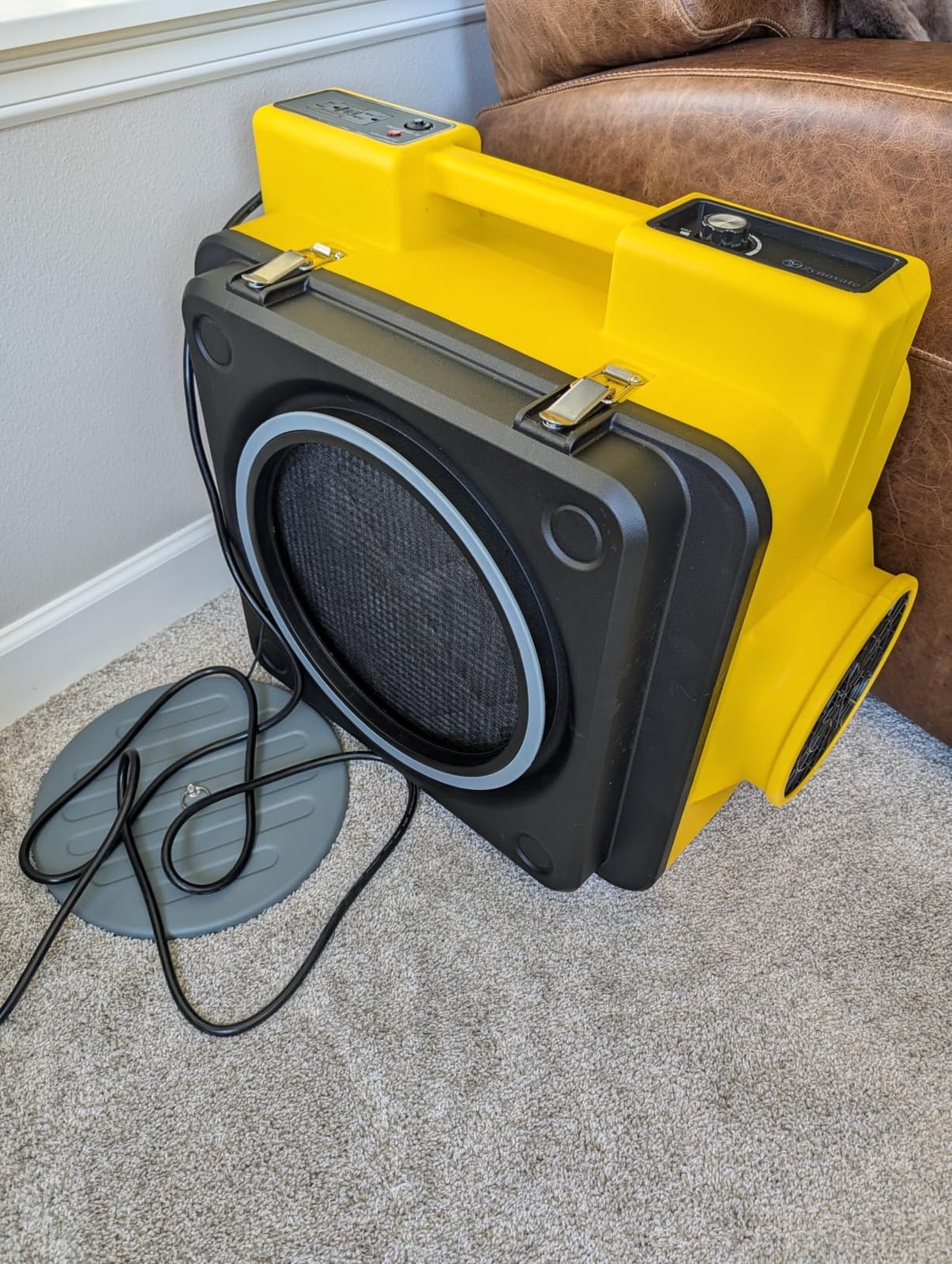
The EC motor is the other differentiator. Reviewers describe it as quiet enough for long-duration operation, and the control panel handles both wind speed adjustment and a timer setting, so you can program runs without babysitting the machine.
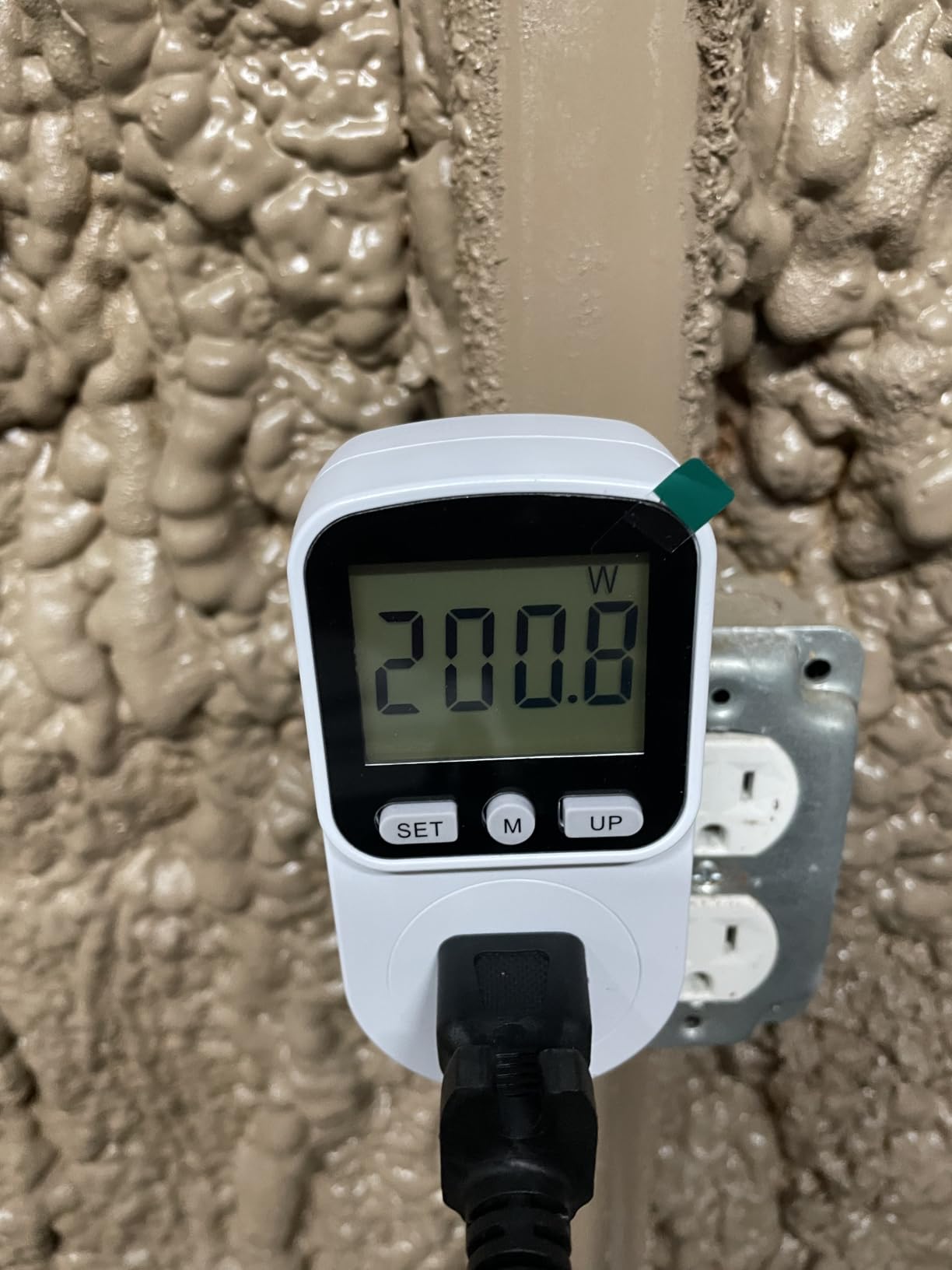
Auxiliary sockets let you connect three machines for 1800 CFM total, the housing stacks horizontally or vertically, and a dust cover is included for storage. The warranty is 5 years with a 30-day return window.
What you need to know before buying
Filter sourcing is the real catch. The HEPA filter is 16 by 19 inches, which is not a common retail size, and reviewers report that no replacement filters were included with the purchase and that the manufacturer does not appear to sell them directly.
Buyers also note the unit is not quiet enough for a sleeping environment. It is fine in a working room, but this is not a bedroom machine.
Where it is the wrong choice
If you cannot source replacement filters, do not buy this machine. A scrubber with no available media is a very expensive box, and that risk is higher here than with any other unit on the list.
For an upstairs renovation, a rental property turnover, or any job where you need to move the machine between rooms constantly, the 25.5 pound weight outweighs the filter sourcing question once you have confirmed a supply route.
12. XPOWER X-3400A – Best Long-Running Water Damage Unit
XPOWER X-3400A Air Scrubber 3 Stage Filtration, Negative Air Machine w/Power Outlets, 3 Stage Airbourne Cleaner, Scrubber HEPA Filter System for Water Damage Restoration, Commercial & Home Use, Blue
600 CFM airflow
3-filter HEPA system
Variable speed
Built-in power outlets
28.8 lbs
Pros
- Long-established model with a proven service record
- Three separate filters sized by particle type
- Pre-filters extend HEPA filter life
- Built-in power outlets on the housing
- Variable speed control for noise management
Cons
- Replacement filters are expensive
- Loud on maximum setting
- Plastic housing
The XPOWER X-3400A is the oldest machine on this list, a long-established model, and that longevity is the argument. Anyone who wants a unit they can keep for a decade of projects can look at machines that have already proven they are still running.
It moves 600 CFM through a three-filter HEPA system with separate stages for different particle sizes. That staged approach is the design detail reviewers praise most, because the coarse filter catches the bulk of the debris and protects the fine media behind it.
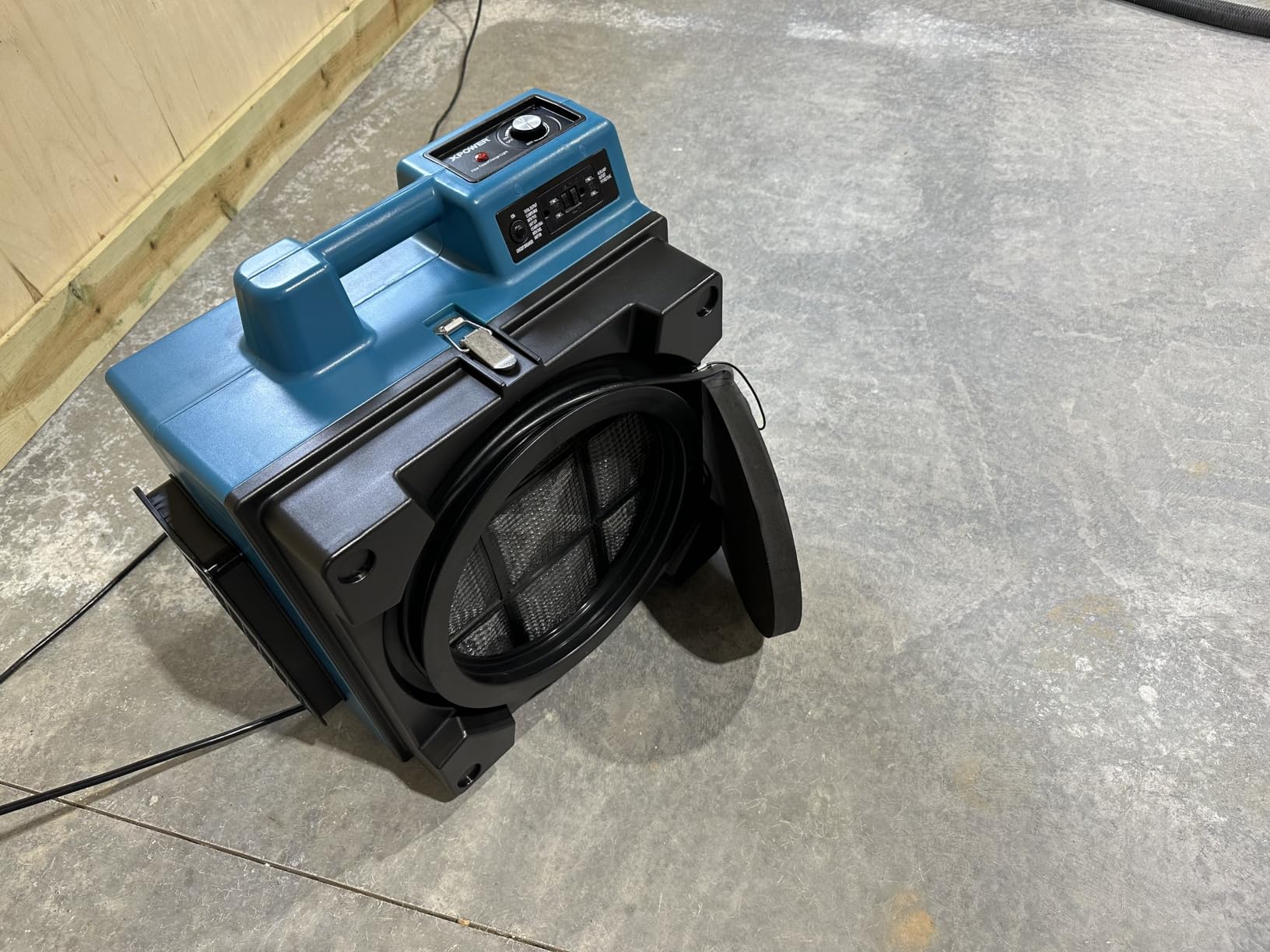
The built-in power outlets on the housing are more practical than they sound. On a restoration job you can run a small dehumidifier or work light off the machine without hunting for a free outlet in an unfinished basement.
At 28.8 pounds it is the second-lightest unit here, and reviewers describe the construction as industrial grade and solidly built. It handles water damage restoration and renovation dust equally well.
What you need to know before buying
Replacement filters are expensive, and that running cost is the most common complaint. Budget for several sets if you are planning a multi-month project rather than a single weekend demo.
It is loud on maximum setting, and reviewers who use it in occupied spaces drop to a middle speed. One buyer noted it can struggle with very fine powder in a small enclosed room, which is a fair caution if your dust is unusually fine.
Where it is the wrong choice
The housing is plastic, and some buyers expected metal at this price point. If you want a decade warranty with modern controls and a touchscreen, the Dri-Eaz 700 is the alternative at the opposite end of the category.
For a flood or water damage restoration, or for a homeowner who values proven longevity over the latest feature set, this machine has a track record that nothing else on the list can match.
How to Choose an Air Scrubber for Home Renovation Dust in 2026
Sizing is where most buyers go wrong, and the fix is arithmetic rather than brand loyalty. The formula is room volume in cubic feet multiplied by the number of air changes per hour you need, divided by 60. For renovation dust, target 4 to 6 air changes per hour; for post-project settling dust, 2 to 3 is enough.
So a 12 by 14 foot bedroom with 8-foot ceilings is about 1344 cubic feet. At 4 air changes per hour you need roughly 90 CFM, and at 6 you need about 135 CFM. Every 550 CFM machine on this list is therefore massively oversized for that room, which is not a problem, because oversized airflow is a benefit for handling a sudden dust load.
Scale up for open plans. A 20 by 30 foot main floor with 9-foot ceilings is 5400 cubic feet, and at 4 air changes per hour that requires 360 CFM. Add a second machine or move to the 870 and 1000 CFM class when you are working across that whole volume at once.
Two rules of thumb cover most home projects. A single closed room under 400 square feet is well served by a 550 CFM machine. Anything above 800 square feet, or any room with an open connection to the rest of the house, needs 675 CFM or more.
Filtration stages explained
Three stages is the standard and correct configuration. A MERV-10 pre-filter catches drywall paper, sanding grit, and coarse debris. A HEPA filter then captures fine particles at 0.3 microns. Activated carbon handles paint fumes, adhesives, and odors, and it is the stage most often omitted or sold separately.
True HEPA means 99.97 percent capture of 0.3 micron particles, and H13 is the higher grade you will see on the VEVOR and the Zynovate. Media labeled HEPA-type is not the same thing, and no machine in this roundup uses that label.
Activated carbon is worth adding whenever paint, primer, or polyurethane is part of the project. It is not a substitute for the HEPA stage, and it will not remove dust.
During renovation versus after renovation
These are two different jobs and the equipment should differ. During the build, you want a negative air machine: high airflow, a GFCI outlet on the panel, a ductable inlet, and a rotomolded housing that survives being dragged around.
After the project, you want something quieter with a large room capacity and a filter indicator you can read at a glance. That is a different purchase, and it is where a household HEPA purifier fits. Our guide to HEPA air purifiers for dusty workshops covers that side of the timeline.
Users on renovation forums make this split explicitly. A scrubber is a line of defense for airborne dust during work; a purifier is the tool for the residual weeks of settling dust afterward. Buying one machine and expecting it to do both jobs well is the most common category mistake we see.
Renting versus buying
Rental makes sense for a single project measured in days. If you need the machine for a weekend teardown, a rental avoids the filter cost entirely and there is no downside. The case for buying starts when you have multiple rooms, multiple stages of work, or a project that runs past a few weeks.
Reviews on the BlueDri consistently compare the purchase against the cost of renting the same class of machine, and the arithmetic favors buying once you pass roughly a month of continuous use. Below that threshold, rent.
A hybrid approach also works well. Rent a 1000 CFM machine for the demolition days when the dust load is heaviest, then buy a 550 CFM unit you will keep for every project that follows.
Work zone safety
An air scrubber manages airborne dust. It does not make silica dust safe, and no machine in this roundup replaces a properly fitted respirator when you are grinding concrete or cutting masonry. Any homeowner posting about moving large volumes of air through a building on renovation forums raises the same concern about static electricity, and the answer is to ground the machine and keep combustible material clear of the intake.
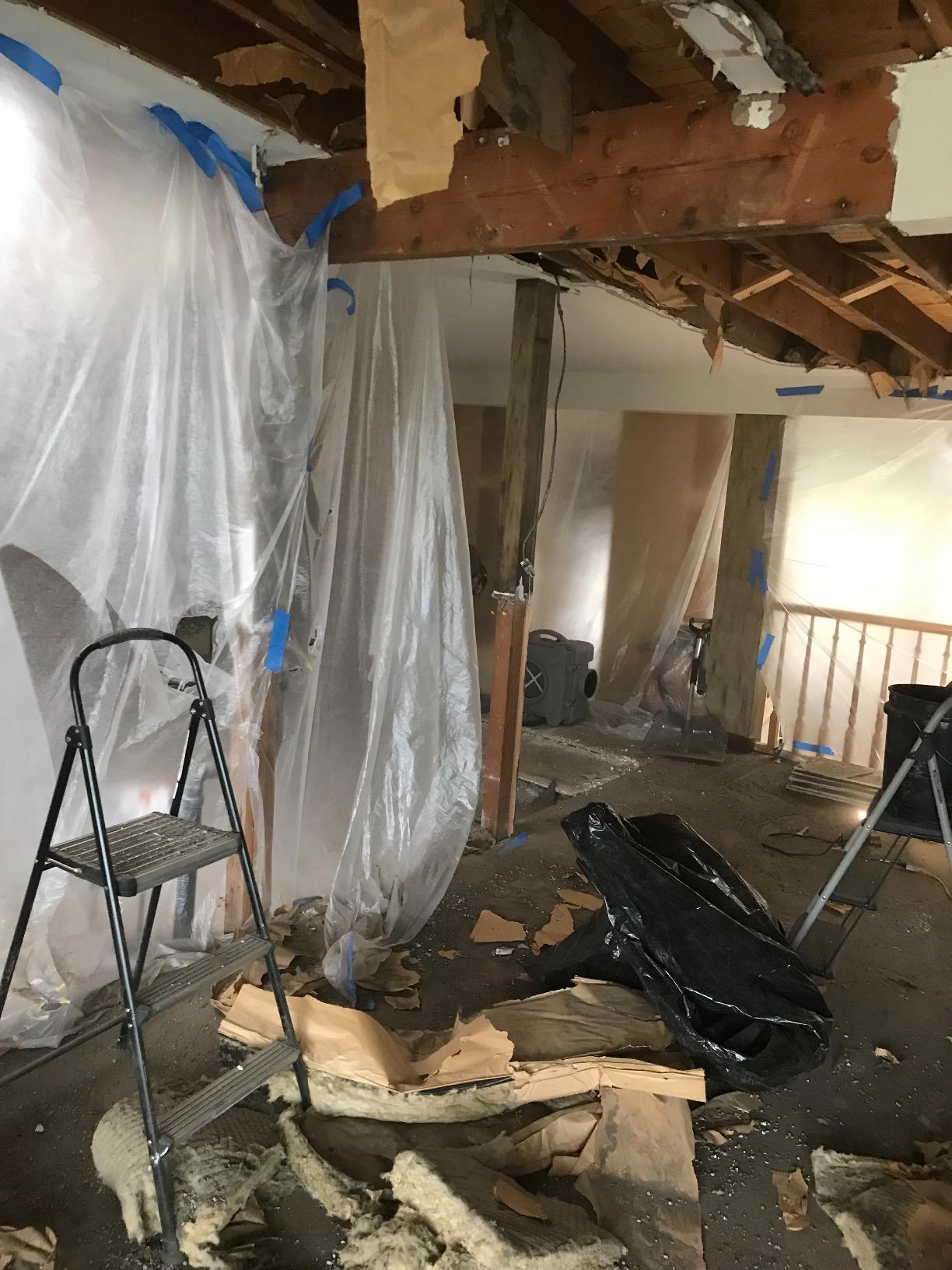
Run a negative air setup when the work zone shares walls with finished rooms, and seal the doorway with taped plastic sheeting. Keep the machine running whenever dust is being generated, and do not rely on it to clean up dust that has already settled.
Forced air movement, including the air funnel approach some people propose, is not a substitute for source capture. A dust hood or a vacuum at the sanding point removes the dust before it enters the room. Our picks for air blowers and dusters are worth a look for the non-airborne debris that a scrubber will never touch.
Post-renovation clearing protocol
Once the work is done, do not expect the machine to finish the job. Start by running the scrubber on maximum for a day to pull down anything still suspended, then ventilate the space completely for a day or two. After that, switch to a quiet purifier on high for the next several weeks.
Vacuum everything with a HEPA vacuum before you run the machine, not after, and wash any uncovered fabrics, cushions, and window treatments. Dust that has settled into baseboard gaps, return air grilles, and ductwork will resurface for weeks, and that residue is a vacuuming problem rather than an air cleaning one.
Expect the first two weeks after a renovation to be the heaviest for your filter. Budget a spare set, and check the pre-filter visually every few days during the heaviest week. If you need to strip paint or scrub tile afterward, our electric spin scrubber guide covers that stage of the cleanup.
Frequently Asked Questions
Do air scrubbers really work to control dust?
Yes, but only for airborne particles. An air scrubber pulls room air through a pre-filter, a HEPA filter, and usually a carbon stage, capturing 99.97 percent of particles down to 0.3 microns. It cannot remove dust already settled into baseboard gaps, window tracks, or ductwork, so a HEPA vacuum is still required. The most effective setup combines source capture at the dust point, a sealed work zone, and continuous scrubber operation during the work.
How many CFM for an air scrubber?
Multiply your room volume in cubic feet by 4 to 6 air changes per hour, then divide by 60. A 12 by 14 foot bedroom with 8-foot ceilings is about 1344 cubic feet, which needs roughly 90 to 135 CFM. A 20 by 30 foot main floor with 9-foot ceilings is about 5400 cubic feet and needs around 360 CFM. Most homeowners should buy 550 CFM for one room and 675 to 1000 CFM for open plans or whole-home work.
What is the best air scrubber for home renovations?
The BlueDri Air Shield 550 is our top overall pick. It delivers 550 CFM with three-stage filtration, covers up to 1400 square feet, uses common 16x16x1 filter sizes that are easy to replace, and has the deepest review history of any machine in this roundup at more than 750 reviews. It also includes GFCI outlets so two machines can be daisy chained for larger demolition work.
What is the best air scrubber for home use?
For a single room, a 550 CFM unit such as the BlueDri Air Shield 550 or the ALORAIR CleanShield 550 is the right size, and both can be moved by one person across a ground floor. For upstairs work, the 25.5 pound Zynovate PSASL-600 is the easiest to carry, but confirm you can source its replacement filters first. Household air purifiers are not a substitute during active work.
What are the best HEPA air scrubbers for commercial use?
The MOUNTO 1000 CFM leads on raw capacity, driven by a 1 horsepower motor and a 6 inch True HEPA filter, and it comes with built-in wheels for moving it across a slab. The Dri-Eaz HEPA 700 offers eight-speed touchscreen control and ductable negative air capability. The MOUNTO HEPA500 and the ALORAIR CleanShield 550 cover the contractor mid-range with daisy chaining for stacked capacity.
How to clean construction dust from air?
Run the scrubber on maximum for a full day to clear suspended particles, then ventilate the space completely for a day or two. Vacuum every surface with a HEPA vacuum before running the machine, not after, and wash uncovered fabrics, cushions, and window treatments. Switch to a quiet large-room purifier on high for the following three to four weeks to handle residual settling dust.
Final Verdict for Home Renovation Dust in 2026
The BlueDri Air Shield 550 is the best all-round choice for home renovation dust, combining 550 CFM, a three-stage stack, standard filter sizes, and the strongest review record here. The ALORAIR CleanShield 550 is the better buy when odor control and a 10-year warranty matter more than weight. The VEVOR 550 CFM is the value pick, with H13 media and a copper motor at the lowest cost in its class.
Beyond those three, match the machine to the room. The ALORAIR PureAiro 870 covers an open main floor, the MOUNTO 1000 CFM handles a whole-home gut or basement, the Dri-Eaz 700 suits precise airflow control over months of work, and the Zynovate PSASL-600 is the answer when you need to carry the machine upstairs.
Whichever you choose, remember the sequence: capture at the source, seal the work zone, run the scrubber while you work, then vacuum before you let the air settle. The machine handles what the vacuum cannot reach, and nothing replaces that pairing. This roundup of the best air scrubbers for home renovation dust is updated for 2026, and every spec figure here comes from the manufacturer data and owner reviews for the exact model listed.