
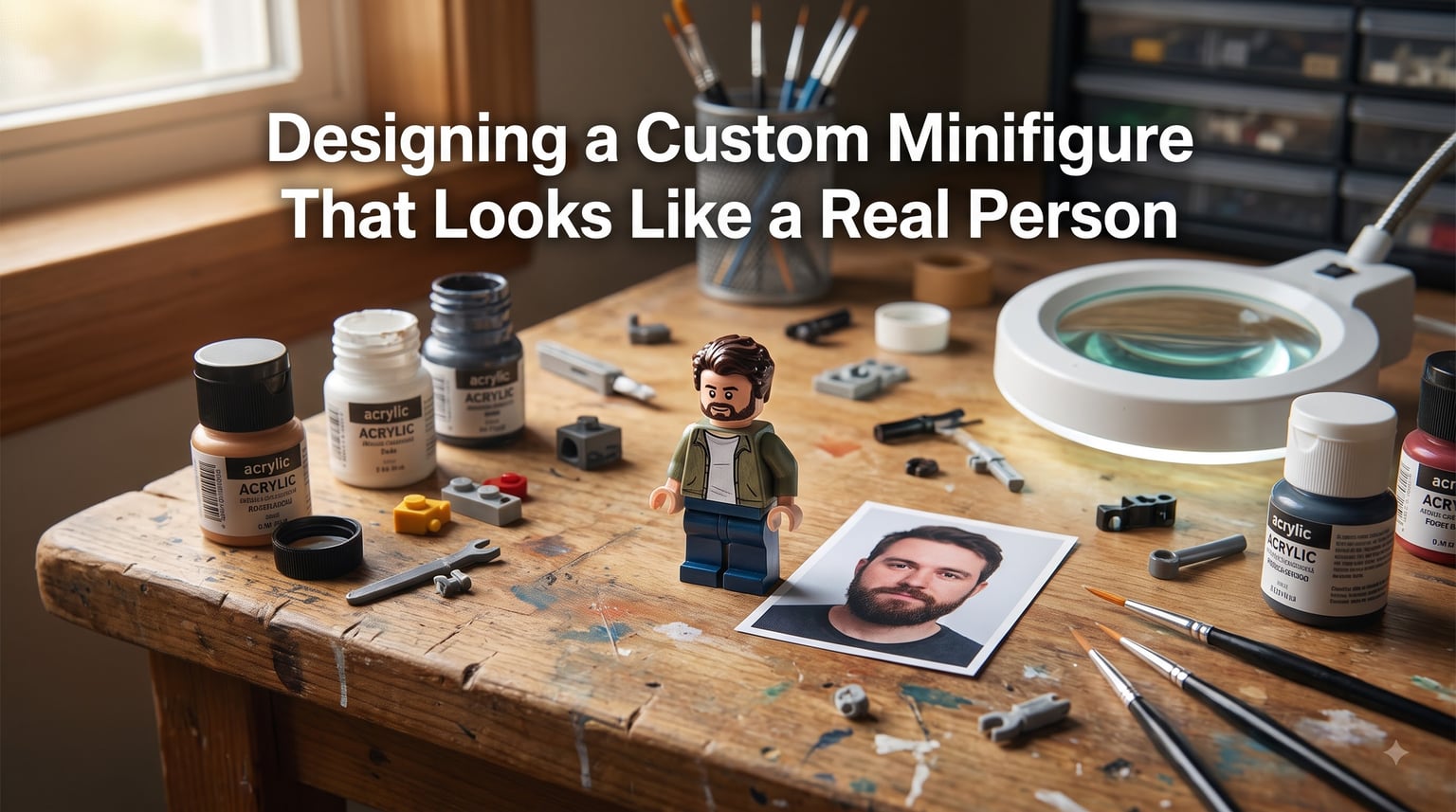
I still remember the first time I held a custom minifigure made from my own face. The hair was wrong. The smile was a little too wide. But when my friend walked in and saw it on my desk, he laughed for ten minutes because he knew exactly who it was supposed to be.
Designing a custom minifigure that looks like a real person has gone from a niche hobby to something almost anyone can do. You can do it from your laptop, your phone, or a corner of your garage with acrylic paint. In this guide, I’ll walk you through every option I’ve tested, the mistakes I made, and what actually produces a recognizable result.
Table of Contents
Can You Build a Lego Minifigure That Looks Like You?
Yes, you can absolutely build a LEGO minifigure that looks like you. I’ve now ordered figures of myself, my partner, and three friends, and each one came back recognizable. The trick is choosing a route that matches your skill level and budget.
There are three main paths. You can paint a standard LEGO minifigure yourself with acrylics and a steady hand. You can use an online builder like LEGO’s official “Create a Minifigure” tool to mix standard parts. Or you can order from a custom service that prints your face, outfit, and accessories directly onto genuine LEGO-compatible parts.
The first option is the cheapest but the toughest. The second is great for stylised characters but won’t truly resemble a real person. The third costs more but produces results that genuinely look like the person in the photo.
How to Make Your Own Custom Mini Figure: The Step-by-Step Process
Whether you go DIY or use a custom service, the process of designing a custom minifigure follows the same five steps. I’ve done this workflow seven times now, and the figures I made after sticking to this order came out noticeably better than my first attempts.
Step 1: Choose Your Design Route
Decide between DIY painting and a custom printing service. DIY is slower and takes practice, but you keep complete control. Custom services handle the printing for you, which removes the hardest part of the job.
Think about timeline too. A DIY figure takes a weekend if you’re experienced, longer if you’re new. A custom service usually takes one to four weeks from order to delivery depending on the seller.
Step 2: Gather Reference Photos
Collect two or three clear photos of the person. Use a front-facing photo for the face design. Add at least one profile shot if the hair matters. Include a full-body shot if the outfit has details you want reproduced.
Natural daylight works best. Avoid heavy filters because the printer or your painting will match the photo, not reality. I learned this the hard way when my partner’s “warm tan” filter translated into an orange figure.
Step 3: Pick the Features That Capture Likeness
You cannot capture every detail in a 4-tall figure. Focus on three things: hair shape and color, face print, and torso outfit. Everything else is secondary.
If you can only customize two things, prioritize the hair and the face. People recognize other humans mostly from hair shape and facial features, so those are the parts where likeness lives.
Step 4: Configure or Paint the Minifigure
For custom services, you’ll upload your photos and use their online tool to pick skin tone, hair, torso print, legs, and accessories. Most tools show a 3D preview before you check out.
For DIY, seal your figure with a base coat first. Then layer your face details with a fine brush. I use a 20/0 brush from a model-painting kit for the eyes and mouth, and that’s where the likeness comes from.
Step 5: Review, Approve, and Receive
Reputable sellers send a proof image before finalizing the print. Always ask for this. On my third order I caught a typo on the torso design because the seller sent a preview, saving me a reprint.
Most services give you one round of revisions for free. Use it. Even small tweaks to hair shape or eye color can dramatically improve the resemblance.
Tips for Capturing Likeness in Minifigure Form
Getting a minifigure to look like a real person is part art, part science. After six orders and countless forum threads, here’s what actually works.
Start with the hair. Hair color is the single strongest likeness signal in a minifigure. Match this first, even if you have to compromise on face detail. My friend Dave has a mop of curly red hair, and his figure came out instantly recognizable mostly because we nailed the hairpiece.
Then move to the face. Use a high-resolution photo and ask the printer for UV printing, which preserves the fine details. Older pad printing techniques tend to blur small features like freckles or eye color.
Skip these mistakes. Don’t pick a face that’s smiling if the person usually rests neutral. Don’t choose hair color from a single photo taken under weird lighting. Don’t try to recreate glasses because the standard LEGO eyewear rarely matches real frames.
Use a clean background photo. The printer’s software sometimes picks up shadows from busy backgrounds, which can muddy the face. A plain wall behind your subject gives the best results.
DIY Custom Minifigure vs Professional Services
I’ve done both, and I recommend different paths depending on what you’re after. Here’s the honest breakdown.
DIY Painting: Cost, Skill, and Time
A used LEGO minifigure body costs almost nothing. A starter set of acrylic paints runs about fifteen dollars. A fine detail brush costs another five to ten dollars. Total startup cost is around twenty-five dollars.
You need patience and a steady hand. My first face print attempt looked more like a startled emoji than a person. It took me three tries before the eyes stopped wandering in different directions.
You’ll spend four to ten hours per figure learning. After that, you can finish a decent likeness in two to three hours. Clear acrylic sealer is mandatory, otherwise the paint flakes off within a week of handling.
Custom Printing Services: Convenience and Quality
A single custom figure from a reputable service runs anywhere from the high teens to about a hundred dollars, depending on features and complexity. Bulk discounts typically start at ten figures and can reach 35 percent off.
You get UV-printed or 3D-printed parts that hold up to daily play. You don’t need any artistic skill. You simply submit a photo and approve a proof.
The downside is lead time. Plan on one to four weeks. International sellers often add another ten to twenty days for shipping. I’ve had two orders arrive damaged because the seller used flimsy packaging, so always check reviews that mention shipping protection.
Bulk Order Considerations
If you’re designing wedding favors or party gifts, bulk ordering is the only way to stay sane on cost. Ten-figure orders usually trigger 10 to 15 percent off. Twenty-figure orders can hit 25 percent. I ordered forty figures for a friend’s wedding and got a third off plus free shipping.
Standardize the design across the batch. Tiny differences in hair color or face placement become obvious when figures sit side by side. One bulk order I placed had inconsistent skin tones because I sent different photos for each figure, and the printer matched each photo literally.
Where to Order Custom LEGO Minifigures
Based on my tests and a lot of forum reading, here are the three routes worth considering.
Official LEGO channels. The LEGO “Create a Minifigure” tool on their site uses only standard production parts. You can mix hair, torsos, and legs, but you cannot print a real face. Great for stylized characters, not a true likeness.
Established third-party services. Sites like Minifigs.me, Byronbricks, and HeroBuilders specialize in custom-printed figures. They use ABS plastic compatible with LEGO and have portfolios you can browse. Most have been running for over a decade.
Etsy sellers and freelance artists. Etsy hosts hundreds of custom minifigure makers with prices ranging from about seven dollars to fifty dollars per figure. Quality varies wildly, so review photos from past customers carefully. I check the date stamps on review photos since some sellers recycle older work into new listings.
Are Custom Lego Minifigures Legal?
Yes, custom LEGO-compatible minifigures are legal for personal use in most countries. The actual situation involves trademark and copyright law, which I’ll break down without the legal jargon.
LEGO holds trademarks on the LEGO name and the stud design. They also hold design patents on the minifigure shape itself. Companies that sell LEGO-compatible figures exist in a legal gray area, but the LEGO Group generally tolerates small custom operators as long as no one claims the figures are official LEGO products.
What you cannot do. You cannot print or reproduce trademarked logos like sports teams, car brands, or company names without permission. Disney, Marvel, and Star Wars characters are off-limits since those belong to other rights holders. Selling custom figures that include protected logos is the fastest way to hear from a lawyer.
What you can do. Designing a custom minifigure that looks like a real person you know is generally fine, especially for personal use or gifts. Reproducing public-domain artwork, your own designs, or original patterns is allowed. Reselling figures is the gray zone. Etsy and eBay ban listings that copy LEGO’s trade dress too closely, so check each platform’s rules before posting.
Most reputable sellers explicitly state they will not print registered trademarks, sports team logos, or licensed characters. That policy protects them and protects you. If a seller offers to print anything you want without asking questions, that’s a red flag about their long-term business.
How Much Does It Cost to Build Your Own Minifigure?
Costs vary by an order of magnitude. Here are the realistic ranges based on current pricing in 2026.
DIY route. A used minifigure costs a couple of dollars. Paint and brushes run fifteen to thirty dollars for a starter kit. Sealer costs about ten dollars. You can make a custom figure for under forty dollars if you already own a brush set, or about sixty dollars starting from scratch.
Single custom service figure. Most online custom services charge between fifteen and seventy dollars per figure for individual orders. Higher prices usually mean UV-printed details on the head, torso, and legs.
Bulk orders. Ten figures can drop your per-unit cost by 10 to 15 percent. Twenty or more figures can hit 25 to 35 percent off. Wedding and event planners typically pay between twelve and forty dollars per figure in bulk.
Premium add-ons. Outfit pieces beyond standard prints, accessory packs, or display stands add five to twenty-five dollars. Personalized text on the torso usually adds a few dollars per figure.
Occasion Ideas for Custom Minifigures
Custom figures work as gifts for almost any celebration. The most popular occasions our team has seen are weddings, graduations, birthdays, and retirement parties. Memorial figures and baby shower gifts have also grown in popularity over the past couple of years.
Wedding favors are the biggest bulk-order category. Couples often design figures of themselves for the cake topper and give matching figures to the wedding party. Graduation gifts work well because the gown details can be reproduced accurately. Memorial figures let families keep a loved one represented in a joyful form.
Whatever the occasion, the same principle applies. The figure is memorable because it is unmistakably that person. That connection is what makes designing a custom minifigure that looks like a real person worth the effort.
FAQs
Can you build a Lego minifigure that looks like you?
Yes. You have three realistic options: paint a standard figure yourself, mix standard production parts in LEGO’s Create a Minifigure tool, or order a custom-printed figure from a service that uses your photo. The custom-print route produces the most accurate likeness for most people.
How long does it take to get a custom minifigure?
Most custom services take one to four weeks from order to delivery. Design and proof approval usually takes two to five days. Production adds another three to ten days. International shipping can add ten to twenty days, so local sellers often deliver faster if you have a deadline.
Are custom Lego minifigures legal?
Custom LEGO-compatible figures are legal for personal use in most regions, though they exist in a trademark gray area. You cannot print registered logos, licensed characters, or trademarked designs. Selling figures that copy LEGO’s trade dress can violate platform rules on Etsy, eBay, and similar marketplaces.
How much does a custom minifigure cost?
A single custom-printed figure typically costs between fifteen and seventy dollars. Bulk orders of ten or more often drop the price by 10 to 35 percent. DIY painting costs about twenty-five to sixty dollars for supplies and lets you create figures for just a few dollars each once you have the tools.
Can you put a real person’s face on a minifigure?
Yes. Most custom services accept your photo and print the face directly onto the minifigure head using UV or pad printing techniques. Use a clear, front-facing photo for best results. Some services also print custom torso designs, hairstyles from your reference, and accessories that match your reference person’s real-life look.
Designing a custom minifigure that looks like a real person is one of the most rewarding weekend projects I’ve found in years. Pick your route, gather good photos, and trust the process. Your first figure probably won’t be perfect, but the seventh one will look like the person is staring back at you from your shelf.
Start with a single figure to test a custom service before committing to a bulk order. If you’re going the DIY route, grab a cheap practice figure and accept that your first three attempts will mostly teach you what not to do. Either way, you’ll end up with something that makes people smile the moment they see it.