

There is no countertop freeze dryer in the sense most people mean when they search for one. Every genuine vacuum unit we could verify measures between 14.6 and 35.24 inches tall and weighs 108 to 320 pounds, so “small” in this category means four or five trays, not a small footprint. If your kitchen has one usable counter corner and a standard 110V outlet, only one machine in this roundup is genuinely shaped for that, and it ships with a voltage problem attached.
That matters because the search results for small freeze dryers for home use are full of impostors. A large share of the cheapest listings are heated drying cabinets running at 35 to 90 °C with a fan and no pump at all, and they carry ratings between 0.0 and 1.9 stars. Buyers learn this the hard way, which is why the forums are full of the same question: where can I buy a good small freeze dryer that is not so expensive.
So here is what this roundup does. We looked at ten real vacuum freeze dryers with published specifications, pulled the dimensions, weights, cold trap temperatures, batch sizes and power draws, and told you where each one actually fits. The short version of our findings: the VEVOR HFD-4 is the only pick with a meaningful owner history, the Blue Alpine Medium is the only body light enough to move without a second person, and the honest truth is that most of these machines belong in a garage, a basement or a utility room rather than beside the kettle.
We have not run any of these machines ourselves, and we think saying that is more useful than pretending otherwise. Everything below comes from published manufacturer specifications and from customer review text where it exists. Eight of the ten listings have no customer reviews at all, and we flag that every time it affects a recommendation.
Table of Contents
Top 3 Best Small Freeze Dryers for Home Kitchens in 2026

VEVOR HFD-4 4-Tray Vacuum…
- 4 stainless trays
- 8.8-13.2 lb per batch
- -35°C cold trap
- 60 dB or less
- 245.8 lb

Blue Alpine Medium Select
- 5 trays
- 10-15 lb per batch
- 108 lb body
- pump with bag and sealer kit

GOYOJO FSF-10N-60A Benchtop…
- 19.7 x 15.7 x 14.6 inches
- 850W
- single tray
- under -60°C cold trap
Quick Overview: Every Small Freeze Dryer We Looked At in 2026
The table below lists all ten machines in one place, with the specs that actually decide a purchase. Two things to notice straight away: the heaviest unit in this list weighs 320 pounds, and eight of the ten have no customer reviews to check against their claims.
| Product | Specs | Action |
|---|---|---|
| VEVOR HFD-4 Vacuum Freeze Dryer |
|
Check Latest Price |
 HNZXIB Benchtop 4-Tray Freeze Dryer HNZXIB Benchtop 4-Tray Freeze Dryer |
|
Check Latest Price |
 Banfluxion 4-Tray Lyophilizer Banfluxion 4-Tray Lyophilizer |
|
Check Latest Price |
| Blue Alpine Medium Select |
|
Check Latest Price |
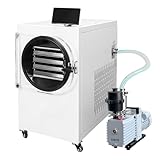 ZZKD FD-05H 4-Tray Freeze Dryer ZZKD FD-05H 4-Tray Freeze Dryer |
|
Check Latest Price |
 HQHAOTWU 4-Tray Vacuum Dryer HQHAOTWU 4-Tray Vacuum Dryer |
|
Check Latest Price |
 Yokoma 4L 4-Tray Lyophilizer Yokoma 4L 4-Tray Lyophilizer |
|
Check Latest Price |
 EQCOTWEA 4-Tray Freeze Dryer EQCOTWEA 4-Tray Freeze Dryer |
|
Check Latest Price |
 SINOPED SN-LG-04 Benchtop Dryer SINOPED SN-LG-04 Benchtop Dryer |
|
Check Latest Price |
| GOYOJO FSF-10N-60A Benchtop Dryer |
|
Check Latest Price |
1. VEVOR Vacuum Freeze Dryer HFD-4 – the Only Pick With Real Owner History
VEVOR Vacuum Freeze Dryer Machine, 8.8-13.2 LBS/Batch Food Freeze Drying Machine with 4-Layer Trays, Vacuum Pump, Adjustable Timer and Temperature Control, for Fruits Vegetables Meat, White
4 trays, 8.8-13.2 lb per batch, -35°C cold trap, 103V 1550W, 245.8 lb
Pros
- 304 stainless steel trays
- Quiet running reported by owners
- Straightforward touch screen programming
- Transparent acrylic door shows the whole cycle
- Swivel casters for moving it
Cons
- Instruction manual widely criticized
- Some units arrive without compressor oil
- Oil leaks reported before the first batch
- Support described as hard to reach
The VEVOR HFD-4 is the only machine in this roundup with enough customer reviews to have an owner history, and that cuts both ways. Its 3.7 stars come from 48 reviews, split sharply: roughly 68 percent of owners rate it four or five stars, and about 22 percent rate it one star.
What the positive reviews agree on is build and quietness. Owners describe the 304 stainless steel as high quality, say programming temperature and time on the touch screen is straightforward, and report that the machine runs quietly through a cycle. The transparent acrylic door is genuinely useful because you can watch the trays instead of guessing.
The negative reviews cluster around setup rather than function. The manual is widely criticised as poor or effectively unusable, some units arrive without the compressor oil needed to get started, and several owners reported oil leaks that needed adjustment before their first successful batch. There are also reports of the unit failing to reach its indicated temperature, and of customer support being unresponsive.
Specification-wise it is a solid, mid-weight machine. It measures 29.92 inches deep by 21.65 inches wide by 35.04 inches tall, weighs 245.8 pounds, runs on 103 volts at 1550 watts, holds four stainless trays and handles 8.8 to 13.2 pounds per batch. The published noise figure is 60 dB or less, and the swivel casters at the base are a real help when it needs repositioning.
What the VEVOR gets right that the spec sheet hides
The casters matter more than they look. At 245.8 pounds this is still a two-person lift onto a workbench, but once it is up, casters mean you can roll it to a laundry room or garage for a batch and back it out again.
The 4-layer tray layout and 8.8 to 13.2 pound batch window also line up with how most households actually freeze dry. That is one afternoon of garden surplus or a few dozen freeze-dried meal portions, not a commercial run.
Where the VEVOR will disappoint you
The documentation gap is the honest downside. Owners consistently report doing their own troubleshooting because there is little usable online guidance, so budget a weekend for learning the machine rather than reading a booklet.
Also budget for the first service visit. Missing compressor oil and oil leaks are the two most common early complaints, and both are cheaper to sort out before you fill the chamber with food than after.
2. HNZXIB Benchtop Freeze Dryer – Four Trays Named, Eight in the Box
HNZXIB Benchtop Freeze Dryer, 4 Trays Freeze Drying Machine, Food Freeze Dryer for Fruits & Meat, Pet Food, with Rotary Vane Vacuum Pump for Home Hobbyist & Small Business
Benchtop 4-tray unit with 8 trays, -50°C cooling, LCD, rotary vane pump
Pros
- Eight trays included rather than four
- Secop compressor with rapid pull-down
- Transparent plexiglass chamber door
- LCD screen is simple to operate
- 1-year warranty with support
Cons
- Only three reviews on record
- Overpriced against comparable units per reviewers
- No dimensions or weight published
- No verified long-term reliability data
The HNZXIB is listed as a benchtop four-tray machine, but the box contents say one freeze dryer, one vacuum pump and eight trays. That mismatch is either a genuine upgrade or sloppy listing copy, and it is worth asking the seller which before you commit.
On paper the specification is competitive. The Secop compressor pulls the chamber down quickly to a stated -50 °C with a controllable freezing rate, the LCD screen is described as straightforward, and the transparent plexiglass door lets you watch the cycle. A rotary vane vacuum pump is included and a one-year warranty comes with it.
The review record is the problem. All three visible reviews are negative, and the text is entirely about value rather than function: buyers compare the sticker price against American-made home freeze dryers and against building a deep freezer plus vacuum chamber combination. There are no functional complaints in the review text, so read the 1.7 rating as a price reaction rather than a defect report.
The listing also publishes no dimensions and no unit weight, so you cannot check whether it fits your space from the product page. In a category where footprint is the first filter, missing measurements are a genuine drawback, not a formatting oversight.
When the HNZXIB makes sense
Eight trays is more usable surface than the four-tray norm, and the -50 °C cold trap is deeper than most of the field. If you are freeze drying herbs, small fish or cut fruit where trays get loaded in thin layers, extra tray count changes the workflow more than batch weight does.
The included pump and the one-year warranty also mean fewer separate purchases before your first batch, which matters for a first-time buyer.
When to skip the HNZXIB
Skip it if you need to know the machine will fit a specific space, because no measurements are published anywhere on the listing. Ask the seller for a drawing before ordering.
Skip it if a three-review record is your evidence base. There is no long-term reliability picture here, and the only owner feedback available is about the cost of the machine rather than how it performs.
3. Banfluxion 4-Tray Lyophilizer – Preset Curves on a 7-Inch Touchscreen
Banfluxion Scientific Lab Lyophilizer & Home Freeze Dryer Machine with Vacuum Pump, -40℃ Ultra-Low Temperature, 110V 1550W, 11lbs/Batch, 4 Stainless Steel Trays, for Food/Fruit/Vegetable Dehydration
11 lb per batch, -40°C cold trap, 2 L/s pump, 7-inch touchscreen, 1550W
Pros
- 7-inch touchscreen with preset curves
- Real-time sample and cold trap readouts
- Automatic defrost between batches
- 4 stainless trays over 0.4 sq m
- Tecumseh or Secop compressor
Cons
- Only one review on record
- No dimensions or weight published
- No warranty information listed
- Single data point for reliability
The Banfluxion is built around automation, and for a first-time buyer that may matter more than raw batch size. The 7-inch high-definition touch screen runs an intelligent temperature algorithm with preset multi-scenario parameters in the temperature curve, and there is a one-key start for automatic operation.
It also shows you the numbers that matter. Sample temperature, cold trap temperature and vacuum level are all monitored in real time with curve visualisation, so you are not guessing whether a long cycle is working or stalled. The automatic defrost function and the optimised deflector plate are aimed at shortening turnaround between batches.
Mechanically it is well specified: a 1550W pure copper motor on 110 volts, a cold trap as low as -40 °C, a 2 L/s vacuum pump running at 1700 rpm with an anti-oil-return rotary vane design, and four food-grade stainless steel trays totalling 0.4 square metres with a stated load capacity of 13.2 pounds. Single-batch processing capacity is up to 11 pounds.
The evidence base is one review. It is a verified purchase at five stars that says the buyer would buy again, which tells you almost nothing about reliability after year two. Treat the touchscreen and the automation as genuine advantages, and treat the star rating as a single data point rather than a track record.
Why the automation is worth paying for
Preset freeze-drying curves remove the hardest part of learning the craft. Instead of researching a schedule for every food, you choose fruit, vegetable or meat and the machine runs a sensible profile.
Automatic defrost matters more than it sounds. Ice builds up on the cold trap during every cycle, and manual defrosting is the most common reason people stop using a freeze dryer at all.
What the missing data means for you
There are no published dimensions and no unit weight, so you cannot plan the space. This machine needs the same conversation about fit that the others do, and the seller will have to supply the numbers.
There is also no warranty statement on the listing, which is unusual for a machine of this type. Ask for the warranty terms in writing before you order, because parts availability is the thing you will miss if something fails.
4. Blue Alpine Medium Select – the 108-Pound Body and the Only US Build
Blue Alpine Medium Select Freeze Dryer – Home Freeze-Drying Machine for Food Preservation & Long-Term Storage
5 trays, 10-15 lb per batch, 108 lb, 21 x 20 x 30 inches, 120V
Pros
- Full accessory kit with pump mats bags and sealer
- Designed and built in Idaho USA
- Largest tray count at five
- 120V so it needs no dedicated circuit
Cons
- No customer reviews at all
- 30-year shelf life claim unverified
- Only a 1-year warranty
- Bundled accessories can fail separately
The Blue Alpine is the structural opposite of everything else here. It weighs 108 pounds, measures 21 inches deep by 20 inches wide by 30 inches tall, and is the only machine in this roundup assembled in the United States, in Idaho. Everything else in the group is an import weighing between 245 and 320 pounds.
It is also the only unit that arrives as a complete kit. The box includes a vacuum pump, trays, silicone mats, Mylar bags and an impulse sealer, so you are not making a second purchase before your first batch. For a first-time buyer that packaging bundle is worth more than another two trays.
Capacity is the largest tray count in the group at five trays, with a stated 10 to 15 pounds of food per batch. It runs on 120 volts at 60 hertz, and the chassis mixes an aluminium frame with food-grade stainless steel and silicone rubber. Warranty coverage is one year.
There are no customer reviews on this listing, so the 30-year shelf life claim and the durability claims are entirely manufacturer assertions. Read that as you would any new product: the specification is attractive and the evidence has not arrived yet.
Why the 108-pound body changes the decision
Weight is the most underrated spec in this category. A 108-pound machine can be managed with a dolly and one determined person, where a 245-pound machine is a firm two-person job, and it can be repositioned when you want the corner back.
At 21 by 20 by 30 inches it also fits a dedicated shelf or a sturdy utility-room bench in a way the 35-inch import units do not, and it draws from a normal household circuit rather than needing a dedicated one.
What you give up for that footprint
You give up the deep cold trap. No low temperature is published, so you cannot compare its drying performance against the -40 °C to -60 °C claims the imports make.
You also inherit a single point of failure in the bundle. If the included pump or the impulse sealer fails, replacing that component is a separate purchase rather than a machine-only fix, and one-year coverage is short for a major appliance.
5. ZZKD FD-05H – the Deepest Claimed Cold Trap and the Fastest Defrost
ZZKD -60℃ Vacuum Freeze Dryer for Home, Food Lyophilizer with Vacuum Pump, Food Grade Freeze-Dried For Fruits, Candy, Fish, Milk, Pet Foods, One Freeze-Drying Area Of 0.46㎡
-60°C cold trap in 40 min, 0.46 sq m, 8.8-13.2 lb, 1500W on 110V, 304.2 lb
Pros
- Cold trap reaches -60°C in 40 minutes
- 15-minute auto defrost with wastewater drain
- 7-inch touch screen with food presets
- 4.5 CFM rotary vane pump
- 0.46 sq m drying area
Cons
- No customer reviews at all
- 304.2 pounds
- 1500W on 110V is near the ceiling
- Only a 1-year warranty
The ZZKD FD-05H makes the most aggressive performance claims in this roundup. It states a medical-grade cold trap reaching -60 °C in 40 minutes, a 4.5 CFM rotary vane vacuum pump, and a freeze-drying area of 0.46 square metres handling 8.8 to 13.2 pounds per batch. It also claims the pump is engineered for 800+ hours of continuous operation.
The feature we would actually build a routine around is the 15-minute automatic defrost with mess-free wastewater discharge. The claim is that it cuts cleanup time by 80 percent, which would let you run more than one batch in a day. On a machine this size, defrosting is otherwise a genuine chore.
Controls are a 7-inch touch screen with one-touch presets for fruit, vegetables and pet treats, plus food-grade stainless steel construction, a one-year warranty and round-the-clock support. Electrical draw is 1500 watts on 110 volts at 60 hertz.
Then there is the physical reality. This machine weighs 304.2 pounds and measures 31.89 inches deep by 17.72 inches wide by 31.1 inches tall. It is narrow and deep, which suits a garage bench better than a kitchen, and 304 pounds is a committed installation rather than a movable appliance.
What -60 °C actually buys you
A deeper cold trap holds the vapour that comes off the sublimating ice, so more of it stays captured instead of migrating back onto your food. For fatty or pungent foods and for long multi-day cycles, that is where the number earns its keep.
For garden fruit and plain vegetables, the difference between -40 °C and -60 °C is much smaller than the marketing suggests.
Where the ZZKD is a hard sell
There are no customer reviews, so the -60 °C figure, the 800-hour rating and the nutrition claims have not been tested by a single buyer. Every number on this page is a manufacturer claim.
At 1500 watts on 110 volts you are close to the practical ceiling for a standard household branch circuit. Plan a dedicated outlet, and expect to have help getting 304 pounds through a doorway.
6. HQHAOTWU 4-Tray Vacuum Dryer – the Tightest Published Vacuum Figure
HQHAOTWU Vacuum Freeze Dryer 110V Vacuum Food Dehydrator Machine with 4 Trays -40°C Cold Trap 1550W Food Sublimation Dryer Freeze Drying Machine for Fruit & Vegetable
-40°C cold trap, under 5 Pa vacuum, 63 dBA, 5 kg per batch, 320 lb
Pros
- Tightest published vacuum at under 5 Pa
- Noise figure of 63 dBA
- 5 kg per batch over four layers
- 110V pump with KF quick connector
- Wide -25°C to +60°C adjustment
Cons
- No customer reviews
- Heaviest unit in the roundup at 320 lb
- No warranty information published
- Needs a dedicated 110V circuit
The HQHAOTWU is defined by two numbers that no other machine here publishes. Its vacuum is stated as under 5 Pa no-load, the tightest figure in the group, and its operating noise is listed at 63 dBA. Those are manufacturer numbers, but they are the ones to ask about.
Capacity is up to 5 kg per batch across four layers of 210 by 430 mm partitions, the largest batch among the four-tray machines here. The cold trap reaches -40 °C or lower, and the adjustable drying range spans -25 °C to +60 °C.
Setup is easier than some rivals because the pump uses a KF quick connector rather than a hose clamp arrangement. It is a 110V, 2 L/s, 370W pump, and a large LCD control system handles the cycle. The chamber door is clear plexiglass for full-cycle visibility.
The physical side is the problem. At 320 pounds this is the heaviest machine in the roundup, and no dimensions are published. It is an installation, not an appliance you slide into a kitchen corner when you feel like it.
Why the vacuum figure is the one to care about
A deeper vacuum lowers the pressure at which sublimation happens, which pulls water out of the product at a lower temperature and shortens cycles. Under 5 Pa is a genuinely strong claim for a home machine.
The 63 dBA figure is the one to test in your own space. Published numbers come from ideal conditions, and a pump running behind a closed door in a small room reads louder than its rating.
Where this machine works against you
There is no warranty information on the listing at all. For a 320-pound import appliance that is a meaningful gap, and you should get the terms in writing before ordering.
At 1550 watts you need a dedicated 110V circuit rather than a shared kitchen branch, and at 320 pounds you need a floor position and a second person on move day.
7. Yokoma 4L 4-Tray Lyophilizer – the Mainstream 11 lb Batch Specification
Yokoma 4L Electric Freeze Dryer Machine, -40℃ Scientific Lyophilizer with Vacuum Pump, 4 Layer Vacuum Sublimation Dryer, 110V 1550W Freeze Drying Machine for Food and Vegetable
11 lb per batch, -40°C cold trap, 2 L/s pump, 1550W, 4 trays
Pros
- Matches the mainstream 11 lb per batch spec
- 2 L/s pump at 1700 rpm
- Large LCD aimed at first-time users
- Transparent plexiglass door
- Wide -25°C to +60°C range
Cons
- No customer reviews
- No dimensions weight or voltage published
- No warranty details
- Specs nearly identical to other listings
The Yokoma publishes the same core numbers that several other machines in this roundup publish: a cold trap of -40 °C or lower when unloaded, a drying range of -25 °C to +60 °C, a 2 L/s pump at 1700 rpm, 11 pounds of processing capacity per batch and a 1550W motor. That makes it the mainstream specification for a four-tray home unit, and it makes it very hard to justify over a better-documented equivalent.
What it does have is a large LCD control screen aimed at both professionals and newcomers, and a transparent plexiglass door that gives an unobstructed view of the whole cycle. The adjustable freezing rate is described as giving control down to -40 °C.
What it does not have is information. There are no customer reviews, no sales rank data, no dimensions, no weight, no voltage figure in the product details and no warranty statement. This is the thinnest listing in the group, and that is a data problem rather than a machine problem.
Because the spec sheet alone is not a reason to choose it, we would only consider this machine if the seller can supply measurements, electrical details and warranty terms in writing. Otherwise you are choosing the least documented listing in the roundup.
What the mainstream spec means for you
An 11-pound batch over four trays is the practical standard for household freeze drying. It covers a weekend of garden produce, a batch of freeze-dried meals, or a run of pet treats without a second chamber.
A 2 L/s pump at 1700 rpm is the pump class used by most of the better-documented units here, so you are not buying a weaker vacuum than the competition.
Why the missing details are disqualifying
No dimensions and no weight means you cannot check the machine fits your available space. In a category where footprint is the first filter, that is not a minor omission.
No warranty and no voltage figure means you are committing to a 1550W appliance without knowing the supply requirement or the support terms. Ask before you buy, and walk away if the answers are vague.
8. EQCOTWEA 4-Tray Freeze Dryer – Vacuum Degree and Curve Readouts
EQCOTWEA 110V 4-Tray Freeze Dryer Vacuum Freeze Drying Machine with 0.4㎡ Freeze-Drying Area -25~+60℃ Temperature 11lbs/Batch Vacuum Food Dehydrator for Fruits Vegetables Meat, Used in Home Laboratory
11 lb per batch, -40°C cold trap, 7-inch touch screen, 254 lb, 0.4 sq m
Pros
- 7-inch screen reports vacuum degree and curves
- Live readouts for chamber and food temperature
- Automatic frosting with fast defrost
- 254 lb is lighter than the 300 lb units
- One-click automatic operation
Cons
- No customer reviews
- 254 pounds still needs two people
- 1550W on 110V wants a dedicated outlet
- Specs overlap several rival listings
The EQCOTWEA’s distinguishing feature is instrumentation. Its 7-inch LCD touch screen provides real-time detection of heated separator temperature, cold trap temperature and sample temperature, plus a data curve and a vacuum degree display. For a first-time owner, seeing the vacuum number fall is the difference between learning the craft and guessing at it.
It also handles the boring parts well. Automatic frosting with fast defrost and one-click automatic operation reduce the manual work between batches, and the transparent organic glass door lets you monitor without opening the chamber and spoiling the vacuum.
Physical specifications are 4 stainless steel trays over 0.4 square metres of drying area, 11 pounds per batch, a -40 °C cold trap across a -25 °C to +60 °C range, and a rotary vane vacuum pump with a pure copper motor and anti-return oil design. The unit runs on 110 volts at 1550 watts.
The published weight is 254 pounds and the dimensions are 28.74 inches deep by 19.69 inches wide by 35.24 inches tall. That is still a heavy machine, but it is 50 pounds lighter than the 300-pound group and 66 pounds lighter than the 320-pound outlier.
Why the screen detail is worth something real
Sample temperature tells you when the product has come off temperature and the drying phase is genuinely progressing. Without it, you are running a fixed number of hours and hoping.
Vacuum degree display catches a failing pump or a leaking gasket on the first batch instead of the twentieth, when you have already packed a year of food.
What the EQCOTWEA asks of your kitchen
At 35.24 inches tall it is one of the taller machines here, so it needs a clear vertical space, not a countertop with a cupboard overhang.
At 1550 watts on 110 volts it should have a dedicated outlet, and at 254 pounds you should plan the move with a second person and a dolly.
9. SINOPED SN-LG-04 – One Button and a Shorter Vapour Path
SINOPED Benchtop Food Freeze Dryer (0.43㎡ 4KG SN-LG-04)
4 kg capacity, 0.43 sq m, integrated chamber and cold trap, one-button cycle
Pros
- Integrated chamber and cold trap shortens the vapour path
- Single-button cycle aimed at beginners
- 4 kg capacity on a benchtop footprint
- System safety lock protects parameters
- Phone
- remote and on-site support
Cons
- Only the host machine listed as included
- No dimensions weight or wattage published
- No warranty information
- No customer reviews or sales rank data
The SINOPED is the simplest machine in this roundup by design. With a 4 kg feeding capacity on a 0.43 square metre benchtop footprint, the whole cycle runs from one button, which is aimed squarely at beginners who would otherwise be researching schedules for every food.
The engineering choice behind that simplicity is an integrated chamber and cold trap design. A shorter sublimation pathway means vapour travels less distance, which the manufacturer says reduces drying time. If that holds, it directly attacks the 20 to 40 hour cycle length that puts most people off.
There is also a system safety lock that prevents accidental modification of the machine status and process parameters, which protects a stored recipe from a stray button press during a long unattended cycle.
Support is the most specific commitment in the group: phone support, remote support and on-site service when needed. It is the only listing here that mentions on-site service at all.
Two cautions. The listing states the host machine as the only included component, so confirm with the seller whether the vacuum pump and trays come with it. And there is no published dimension, weight, voltage, wattage or warranty data at all, plus no customer reviews or sales rank returned.
Why one-button operation matters
Freeze drying has a large knowledge barrier, and most of it is procedural. A machine that removes that step removes the main reason beginners abandon the craft in month two.
The integrated layout is also a quiet space saver, because there is no separate pump cabinet to find a home for.
Where this listing leaves you guessing
You have to ask what is in the box. If the pump is not included, this becomes a significantly different purchase from what the headline suggests.
You also have no basis to check fit. Get the footprint and the weight in writing, and confirm the voltage, because a 4 kg chamber on unknown supply is a real risk.
10. GOYOJO FSF-10N-60A – the Only Machine Shaped for a Real Countertop
Vacuum Freeze Drying Machine Food Freeze Dryer vacuum freeze drying fruit
19.7 x 15.7 x 14.6 inches, 850W, single tray, under -60°C, listed 220V
Pros
- Smallest body in the roundup by a wide margin
- Lowest power draw at 850W
- Deepest claimed cold trap
- Linde-Hampson refrigeration
- 7-inch touch screen with data curves
Cons
- Listed at 220V rather than standard US current
- Single tray only
- No customer reviews or sales rank
- Pump inclusion and warranty unclear
The GOYOJO is the structural outlier in this roundup and the only machine that answers the “countertop freeze dryer” question honestly. It measures 19.7 inches deep by 15.7 inches wide by 14.6 inches tall, it draws 850 watts, and it has a single tray. Everything else here is at least 19.69 inches wide, at least 30 inches tall and 137 pounds heavier.
The refrigeration is Linde-Hampson with secondary cooling, and the cold trap is stated at under -60 °C no-load at room temperatures under 28 °C, with a limit figure of under -65 °C at room temperatures under 25 °C. That is the deepest claimed cold trap in the group by a wide margin, on the smallest body.
Features include a 7-inch touch screen, freeze-drying data curve recording, and an additional sensor set that measures and records sample temperature. On a single-tray machine that level of instrumentation is arguably more useful than on a four-tray one, because you have a much clearer picture of the single thing you are drying.
The catch is electrical. The listing states 220 volts, so it will not run on standard 110V North American household current without a step-down transformer, and it is the only machine here with that limitation. Pump inclusion is unclear, and there are no customer reviews or warranty details.
Why the footprint genuinely matters
At under 16 inches wide this is the only machine you could set on a kitchen counter beside a toaster and forget about. Every other pick needs a utility room, a garage bench or a basement shelf.
At 850W it is also the only machine here that could plausibly share a standard outlet, which removes the dedicated circuit conversation entirely.
Where the 220V listing ends the idea
Running a step-down transformer is a workaround, not a recommendation, and it adds cost, heat and a second thing that can fail. Confirm the actual supply requirement with the seller before you plan around this machine.
A single tray also means a genuinely small batch, and with no reviews and unclear pump inclusion you would be buying the least proven machine in the roundup to get the smallest one.
Freeze Dryer vs Dehydrator: Which One Do You Actually Need?
If your goal is dried fruit, fruit leather, herbs or jerky, you want a dehydrator, and a freeze dryer will not improve the result. A heated cabinet at 35 to 90 °C with a fan is the correct tool for those foods, and it costs a fraction of a vacuum unit.
A freeze dryer earns its place for foods a dehydrator cannot handle. Complete cooked meals, eggs, soups, full-size fruit pieces, herbs where colour matters, mushrooms, and anything you intend to rehydrate later are all jobs where sublimation wins, because the food keeps its shape, its colour and most of its nutrients instead of being cooked further.
Here is the mapping that helps most people decide. Dried apple rings, pineapple, mango, herbs, chillies, banana chips, granola and beef jerky all belong in a dehydrator. Freeze-dried strawberries, raspberries, sliced mango, eggs, cooked chicken and rice, soup portions, dog treats, candy, and camping meal kits belong in a freeze dryer.
Two further reasons to consider a dehydrator seriously. It is quiet, it is light enough to move, and it draws a fraction of the power. If you are a renter or you live in a flat, that is often the deciding factor rather than the food list. Our picks for compact dryers for apartments cover that end of the market.
What a freeze dryer cannot do is worth knowing too. High-fat foods fail because fat does not freeze like water, so items like avocado, nuts, butter and full-fat cheese do not freeze dry well. And rehydrated food is not automatically shelf stable, so follow a kill step or a validated recipe.
Noise, Heat and Where the Machine Actually Lives
Most owners do not run a freeze dryer in the kitchen, and neither should you. Forum discussion is consistent on this point: machines end up in a garage, a basement or a utility room, and the ones that sit unused are usually the ones that were bought for the kitchen and then banished because of the noise.
The published noise figures in this roundup are 60 dB or less for the VEVOR and 63 dBA for the HQHAOTWU. Those are reasonable numbers on paper, but both machines weigh well over 240 pounds, so neither can be moved to another room between batches. Wherever you run it, it stays there.
Heat is the quieter issue. A 1550W machine that runs for 24 hours releases roughly 37 kWh of energy, most of which leaves as heat. In a closed kitchen in summer, running a full cycle while cooking is genuinely uncomfortable, and ventilation matters more than most buyers expect.
On circuits, be precise. The import machines here run 1500 to 1550 watts at 110 or 120 volts, which is a large share of a standard 20-amp branch circuit. Run the freeze dryer on a dedicated outlet with nothing else heavy on it, and do not use an extension cord.
The Blue Alpine at 108 pounds and the GOYOJO at 850 watts are the two machines that break this pattern. One is light enough to move and runs on 120 volts; the other is small enough to live on a counter and draws a fraction of the power. Every other pick in this roundup is a permanent fixture in a utility space.
What It Costs to Run One Full Cycle
The maths is simple and worth doing before you buy. Take the wattage, multiply it by the hours in a cycle, then divide by 1000 to get kilowatt hours. Multiply that by your own utility rate for the final number.
On a 1550W machine, a 24-hour cycle is about 37 kWh and a 36-hour cycle is about 56 kWh. On the 850W GOYOJO, 24 hours is roughly 20 kWh. For scale, a kettle boiling a litre of water uses about 0.1 kWh, so one short freeze drying cycle runs to several hundred kettle boils of electricity.
Two practical notes. A half-empty machine does not meaningfully shorten the cycle, so buying small to save time is a false economy and it is a mistake owners regret. And the vacuum pump and compressor both contribute, so treat these figures as close to the real draw rather than a floor.
The other running costs are smaller but easy to forget: pump oil, filters, gasket replacements, tray liners, and packaging. Budget for mylar bags and oxygen absorbers from the start rather than after your first batch, because freeze-dried food that is not sealed will reabsorb moisture and lose shelf life.
How to Choose a Small Freeze Dryer for Your Kitchen
Measure first, buy second. The published footprints in this roundup run from 19.7 by 15.7 by 14.6 inches up to 31.89 by 17.72 by 31.1 inches. Measure the alcove including the door swing and any overhead cupboard, then leave a few inches of ventilation clearance around the machine.
Decide on weight as well as size. Weights run 108, 245.8, 254, 304.2 and 320 pounds. Anything over 240 pounds is a two-person installation with a dolly, and it will not be moving between rooms. If you want a machine you can put away when it is not in use, your realistic ceiling in this category is the Blue Alpine.
Match the outlet. At 1500 to 1550 watts on 110 or 120 volts these machines want a dedicated circuit. If your kitchen has only shared 15-amp outlets on the counter, the 850W single-tray unit is the one in this roundup that will not fight you for the circuit.
Read the cold trap figure, not the marketing. Anything below -35 °C is a genuine vacuum machine. The field here runs from -35 °C on the VEVOR up to claimed -60 °C and -65 °C on the ZZKD and GOYOJO. Deeper is better for fatty or pungent loads and largely irrelevant for plain garden fruit.
Count trays, not just batch weight. Batch weight says how much goes in; tray count and tray area say how many thin layers you can run. Thin layers dry faster and freeze dry evenly, so the five-tray unit and the larger 0.46 square metre four-tray unit can beat a smaller-area four-tray machine on practical throughput.
Prepare the food properly before it goes in. Even thin slices are only thin if the knife is sharp, and slicing fruit straight from the fridge rather than a warm counter keeps more of the structure intact. Our guide to chef knives for home kitchens is worth a read before your first batch.
Understand the pump before you buy. Every machine in this roundup uses a rotary vane pump, which needs periodic oil changes and filter checks. That maintenance is the most commonly reported friction point among owners, and it is not a reason to avoid the category, but it is a reason to know it is coming.
Plan the packaging and the first load. Buy mylar bags, oxygen absorbers and an impulse sealer with the machine, not later. For a first batch, start with sliced strawberries or apples at a light load so you learn the machine on food you would happily eat if something went wrong.
Ask the seller the questions the listing does not answer. Dimensions, unit weight, voltage, warranty length, whether the pump and trays are included, and where replacement parts come from. On eight of the ten listings here, at least one of those answers is missing and you will have to ask.
And be honest about whether you will use it. A freeze dryer that sits unused because it is too small, too loud, or lacks good support is wasted money, and a well-chosen dehydrator plus a chest freezer is a better purchase for a lot of households.
How We Picked These Models
Every machine here publishes a vacuum pump, a cold trap temperature, a batch weight and a power draw, which is the minimum bar for inclusion. We excluded heated drying cabinets entirely, which is why you will not find the cheapest listings in the search results on this page.
We have not run any of these machines. Where customer reviews exist, we quote the pattern in the review text and the rating distribution. Where there are no reviews, which is the case for eight of the ten, we say so and we treat every performance number as an unverified manufacturer claim.
We ranked on evidence first, then on fit for a home kitchen: body weight, published dimensions, outlet requirements and how much hand-holding a first-time owner would need.
Frequently Asked Questions
Which freeze dryer is best for home use?
The VEVOR HFD-4 is the best-supported choice in this roundup because it is the only machine with a meaningful customer review history, 3.7 stars across 48 reviews, plus published dimensions, a -35 °C cold trap and a 60 dB noise figure. If you need a body light enough to move, the Blue Alpine Medium at 108 pounds and 21 by 20 by 30 inches is the better fit for a home kitchen, even though it has no reviews yet.
Is there a difference between a food dehydrator and a freeze dryer?
Yes, and the difference is the vacuum. A dehydrator is a heated fan cabinet running 35 to 90 °C that cooks food as it dries it, which suits fruit leather, jerky, herbs and banana chips. A freeze dryer freezes food first, then pulls the ice out under vacuum so it sublimates, which suits complete meals, eggs, soups, candy, pet treats and food you intend to rehydrate.
Do freeze dryers make a lot of noise?
A freeze dryer is noticeably louder than a dehydrator, and owners on home preserving forums consistently report that their machines live in a garage or basement rather than the kitchen. Published figures in this roundup are 60 dB or less for the VEVOR and 63 dBA for the HQHAOTWU, but both weigh over 240 pounds, so you cannot simply move the machine to another room between batches.
How much does a freeze dryer raise my electric bill?
Take the wattage, multiply by the cycle hours, then divide by 1000. A 1550W machine running 24 hours uses about 37 kWh, and a 36-hour cycle uses about 56 kWh. Multiply that by your own utility rate. The 850W single-tray unit in this roundup uses roughly 20 kWh over 24 hours.
How much does it cost to run a freeze dryer for 24 hours?
For most of the machines in this roundup, which run 1500 to 1550 watts on 110 or 120 volts, a 24-hour cycle uses about 37 kWh. That is the number to multiply by your electricity rate. Note that a half-empty chamber does not meaningfully shorten the cycle, so a small machine does not reduce your running cost per batch.
What are the downsides of freeze drying?
The main downsides are long cycle times of 20 to 40 hours, high power draw, a heavy machine that needs a dedicated outlet, and recurring pump maintenance including oil and filters. Machines are also noisy, and owners rarely keep them in the kitchen. Packaging is a real first-year cost because freeze-dried food must be sealed in mylar with oxygen absorbers to keep its shelf life.
What food cannot be freeze-dried?
High-fat foods do not freeze dry well because fat does not freeze like water, so avocado, nuts, butter, full-fat cheese and oily fish are poor candidates. Rehydrated freeze-dried food is also not automatically shelf stable, so follow a validated kill step or recipe before storing it long term. Very high-moisture foods such as fresh lettuce also collapse into an unappetising result.
Can you freeze dry meat?
Yes, and meat is one of the most common home freeze drying projects. Cooked meat must be fully cooked first, cooled, sliced thin and frozen solid before loading, then run for a full 20 to 40 hour cycle. Many owners report meat as one of the foods their machine handles well, and the VEVOR listing names meat and seafood as supported loads alongside fruit and vegetables.
What are the top things to freeze dry first?
Start with something forgiving and low-fat. Sliced strawberries and raspberries are the usual first load, followed by sliced apples, then herbs, then mushrooms. Move to pineapple and mango after that, and only then to cooked meals, eggs and soups. Candy works well and is a popular early project because it is forgiving of small timing errors.
Is it possible to freeze dry without a freeze dryer?
Not properly. You can approximate some results with a dehydrator, which bakes rather than sublimates, or with a chest freezer and a DIY vacuum chamber setup, which is fiddly and rarely food safe. Neither gives you the nutrient retention, shape preservation or decade-scale shelf life of a real vacuum freeze dryer, and forum builders generally consider a proper machine worth it once you commit to the craft.
The Bottom Line
The VEVOR HFD-4 is our pick for the best small freeze dryers for home kitchens because it is the only machine here with real owner evidence behind it, and it publishes the numbers you need to plan around: 29.92 by 21.65 by 35.04 inches, 245.8 pounds, four stainless trays and 8.8 to 13.2 pounds per batch.
Choose the Blue Alpine Medium if your kitchen, rather than your garage, is where the machine has to live, and the GOYOJO single-tray dryer if you want something that could genuinely sit on a counter, once you have resolved its 220V supply requirement.
Either way, measure the space, plan a dedicated outlet, and decide honestly whether you are a dehydrator person. That last question saves more money than any pick on this list.