
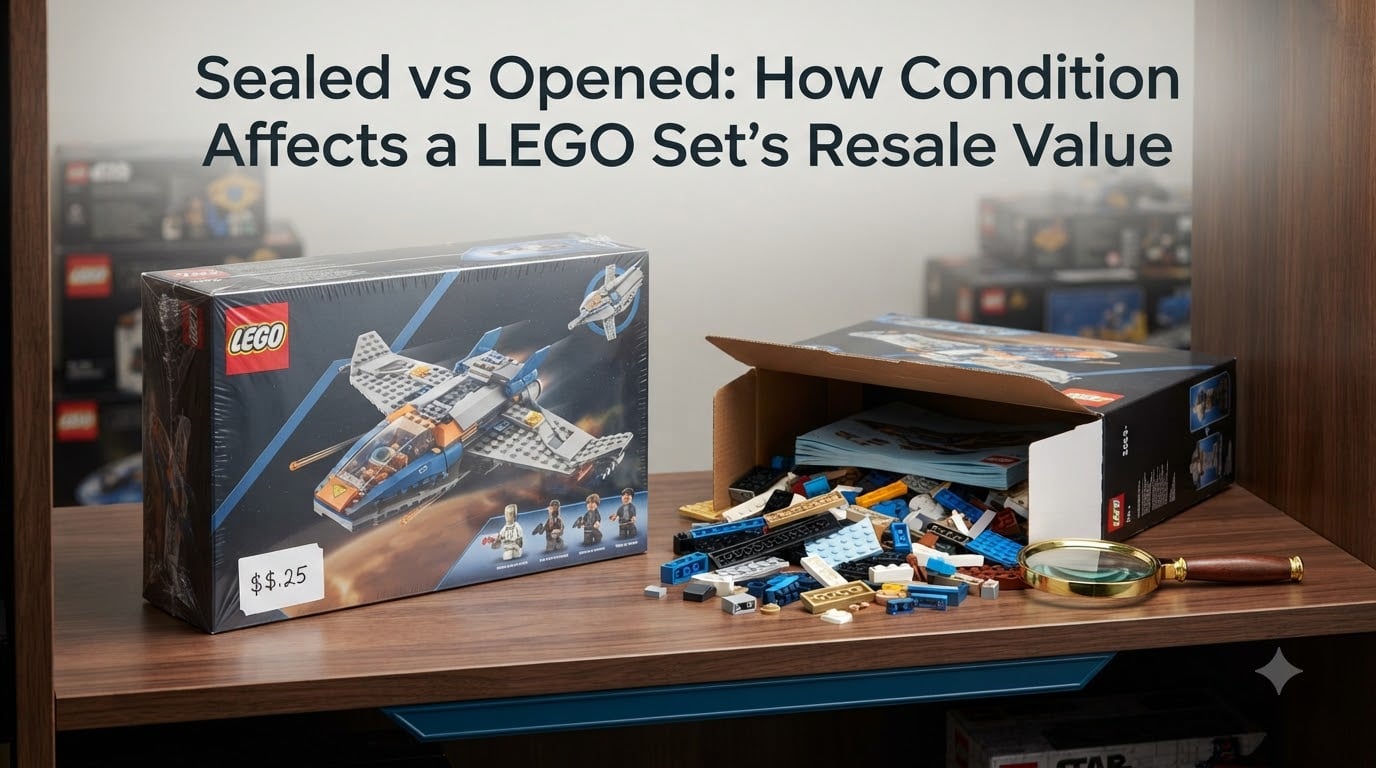
If you have ever stood in your LEGO room staring at a boxed set wondering whether to crack it open or leave it sealed, you are asking the right question. The condition of your LEGO sets resale value sealed vs opened can mean a difference of hundreds or even thousands of dollars per set, especially after retirement.
Our team has tracked LEGO secondary market prices across BrickLink, eBay, and collector communities for years. The patterns are clear: condition is the single biggest factor you control as a seller. Everything else, theme popularity, retirement timing, and market trends, happens around you.
In this guide, I will break down exactly how much value a LEGO set loses when opened, why buyers pay a premium for sealed boxes, and how to make smart decisions about building versus investing. I will also cover the 5/2 rule, platform-specific selling tips, and the scenarios where even sealed sets can lose money.
Whether you are a collector deciding whether to build that Star Wars UCS set or a reseller pricing inventory, this guide will give you the specific numbers and strategies you need.
Table of Contents
What Condition Grades Mean in the LEGO Resale Market?
Before comparing values, you need to understand how the LEGO resale market actually grades condition. Buyers and sellers on BrickLink and other platforms use specific terminology that directly maps to price tiers. Getting these terms wrong when listing a set can cost you money or lead to disputes.
Here are the four condition grades that matter most for LEGO sets resale value sealed vs opened.
Factory Sealed (MISB)
Factory sealed, often called MISB (Mint in Sealed Box), means the set has never been opened. The original factory shrink wrap or tape seals are fully intact with no signs of tampering. This is the gold standard for LEGO investment and commands the highest prices on the secondary market.
Genuine factory sealing has telltale signs: consistent shrink wrap pattern, factory tape with specific adhesive patterns, and no excess glue or repositioning marks. I will cover how to verify these later in the guide.
New in Box (Opened, Unbuilt)
New in Box (NIB) means the box has been opened but the contents inside remain untouched. The bags are still sealed, the instructions are pristine, and the sticker sheet is unapplied. The only difference from factory sealed is the broken outer seal.
This condition grade sits in an interesting middle zone. Our research found community reports of only a 10% difference between sealed and open-box-sealed-bags in some cases. However, skeptical buyers often discount NIB sets because they cannot verify the bags were never swapped or tampered with.
Complete and Used (Built with All Pieces)
This grade covers sets that have been opened, built, and disassembled, with all original pieces, instructions, and packaging present. Buymybricks reports that sealed LEGO sets have approximately 98% piece completion versus 85% for used sets on average. That 13% gap in piece completeness is a major reason used sets sell for less.
A complete used set typically retains 65 to 80% of its sealed value, depending on theme and condition. Built sets with pristine pieces, unmarked instructions, and undamaged boxes land at the higher end of that range.
Incomplete or Damaged
Sets missing pieces, instructions, or original packaging fall into this category. Missing minifigures are especially devastating to value since figures often account for 30 to 50% of a set’s worth on themes like Star Wars and Marvel. A UCS Millennium Falcon missing its main figures loses far more than half its value.
Damaged boxes, sun-discolored pieces, chewed bricks, or applied stickers that are peeling also knock sets down into this tier. These sets sell for 30 to 50% of sealed value, sometimes less if key components are missing.
Sealed vs Opened: How Much Value Does a LEGO Set Lose
This is the question every LEGO collector asks. The answer comes down to specific, trackable percentages that the community has validated through thousands of real transactions. Understanding LEGO sets resale value sealed vs opened starts with hard numbers.
The Sealed Premium Explained
Sealed LEGO sets typically command a 60 to 80% premium over opened and built versions of the same set after retirement. For high-demand licensed themes, that premium can exceed 100%. A sealed set that retires at $200 might sell for $400 while its complete built counterpart sells for $180 to $220.
Reddit’s r/legoinvesting community puts it bluntly: “Building the sets loses basically most of the gains the sealed set would gain.” This is not an exaggeration for investment-focused buyers. The moment you break that factory seal, the investment trajectory changes.
Here is a general breakdown of value retention by condition grade:
Factory Sealed: 85 to 95% of MSRP at minimum, with significant upside after retirement. Many retired sets appreciate 10 to 11% annually in sealed condition.
New in Box (Opened, bags sealed): 75 to 85% of sealed value. The discount reflects buyer uncertainty about contents.
Complete Used (all pieces, instructions, box): 65 to 80% of sealed value. Condition of pieces and packaging affects where you land in this range.
Incomplete or Damaged: 30 to 50% of sealed value. Missing minifigures or instructions push values to the bottom.
Why Buyers Pay More for Sealed
The sealed premium exists for concrete, rational reasons. When you buy a sealed set, you are paying for certainty. Every piece is guaranteed to be present. Stickers are pristine. Instructions are unmarked. There is zero verification work required.
With used sets, buyers take on real risk. Buymybricks found that used LEGO sets average only 85% piece completion. That means on average, a used set is missing roughly 15% of its pieces. Counting and verifying a 3,000-piece set takes hours, and missing pieces must be sourced individually on BrickLink at additional cost.
Sealed sets also carry display value for box collectors. Many investors and display collectors want the box itself in mint condition as part of their collection. A pristine box with factory seals is a collectible in its own right.
Open Box Sealed Bags: The Middle Ground
One community finding surprised me. A Facebook LEGO group reported that there is “usually only a 10% difference between sealed and open box sealed bags.” This suggests that if you must open a box but want to preserve value, keeping the inner bags sealed is the next best thing.
However, this 10% gap assumes buyers trust that the bags are genuinely factory-sealed and untampered. Some resellers have been caught re-sealing bags after swapping valuable minifigures. Because of this risk, many serious buyers still insist on factory-sealed boxes for high-value sets.
If you are selling NIB sets, be transparent about the condition. Photograph the sealed bags clearly, show the unbroken bag seals, and document that the sticker sheet is intact. Honesty builds trust and can help you close the gap toward sealed pricing.
Factors That Affect LEGO Resale Value Beyond Condition
Condition is king, but it is not the only variable. Several other factors interact with condition to determine final sale prices. Understanding these helps you predict which sets will hold value and which might disappoint.
Theme and Set Type Drive Demand
Not all LEGO themes appreciate equally. Licensed themes with passionate fan bases, Star Wars, Marvel, Harry Potter, and Lord of the Rings, consistently outperform generic themes. A sealed Star Wars UCS set will almost always command a higher premium than a sealed City set of comparable piece count.
Collector-base size matters. Themes with adult collectors who have disposable income see stronger secondary market demand. The LEGO Ideas line also performs well because sets are produced in limited quantities with a known production window.
Retirement Status and the Post-Retirement Pop
The biggest value jumps happen after a set retires. The “retirement pop” refers to the price increase that occurs when a set leaves retail shelves and supply becomes fixed. Brickzonehub tracks this pattern extensively.
Sealed sets see the largest post-retirement pops because no new sealed supply enters the market. Used sets also benefit but at a reduced rate. The retirement pop can add 20 to 50% to a sealed set’s value within the first 6 to 12 months after EOL (End of Life).
Timing matters. Sets retiring during high-demand periods (holiday seasons, movie releases) see stronger pops. Sets retiring alongside a theme’s decline may see weaker or delayed appreciation.
Box Condition and Shelf Wear
Even among sealed sets, box condition creates price tiers. A sealed set with a pristine box sells for more than an identical sealed set with dented corners, creases, or shelf wear. Serious collectors grade boxes on a scale similar to comic book or trading card grading.
Common box damage that reduces value includes crushed corners from shipping, creases from rough handling, water damage, sun fading on the artwork, and price sticker residue. Sets purchased from retailers with poor shelf practices often arrive with cosmetic damage that reduces their sealed premium.
Minifigure Value Extraction
Minifigures can account for a massive share of a set’s total value. In Star Wars and Marvel sets, exclusive minifigures sometimes represent 30 to 50% of the set’s resale value. This is why opened sets with missing figures lose so much worth.
Some resellers practice “minifigure extraction” from opened sets. They sell the figures individually and then sell the remaining parts separately. This strategy can sometimes recover more value than selling the opened set as a whole, but it requires effort and market knowledge.
The 5/2 Rule for LEGO Investing
The 5/2 rule is a community guideline for LEGO investment returns. It suggests that a well-chosen sealed LEGO set purchased at retail should appreciate approximately 5% per year minimum, with strong picks averaging closer to 10 to 11% annually over a multi-year hold.
The “2” refers to holding for at least two years post-retirement before selling. This gives the market time to absorb the retirement pop and for supply to tighten. Selling too early, within the first few months of retirement, often means leaving money on the table.
These are guidelines, not guarantees. Theme popularity shifts, re-releases, and broader economic conditions all affect actual returns. But the 5/2 rule gives you a baseline expectation for how long to hold and what kind of return to anticipate.
Premium Variations by LEGO Theme and Set Type
The sealed premium is not uniform across all sets. Different themes and set sizes see different premium patterns. Knowing where your set falls helps you price accurately and set realistic expectations.
Licensed Themes Command the Highest Premiums
Star Wars, Marvel, Harry Potter, and other licensed themes see the largest sealed premiums. These sets have massive collector bases, many of whom are adult fans with significant budgets. A sealed Star Wars UCS set can command a 100% or greater premium over its built counterpart after retirement.
Exclusive or rare minifigures drive much of this premium. Sets with unique figures that appear nowhere else become especially valuable sealed, because the buyer knows the figures are untouched and authentic.
Technic and UCS Models
LEGO Technic sets and Ultimate Collector Series (UCS) models attract a dedicated adult audience. These buyers value the building experience but also prize sealed examples for collection displays. Technic sets with complex functions (pneumatics, motors, gearboxes) see strong sealed demand because buyers worry about missing small mechanical parts in used sets.
UCS Star Wars sets are among the strongest performers in the entire LEGO secondary market. The Millennium Falcon, AT-AT, and Star Destroyer models have historically shown exceptional post-retirement appreciation in sealed condition.
Small and Mid-Range Sets
Smaller sets under $50 see thinner sealed premiums. The absolute dollar difference between sealed and used on a $20 set is small enough that many buyers just buy used to save money. Sealed premiums on small sets typically run 20 to 40%.
Mid-range sets ($50 to $150) fall in between. They see solid sealed premiums but not the dramatic spreads of UCS or large licensed sets. These sets are often good entry points for new investors learning the market.
Creator Expert and modular building sets occupy a unique space. They appeal strongly to adult collectors who display them, creating reliable sealed demand. The modular building series consistently performs well post-retirement.
Practical Tips for Sellers: Maximizing Resale Value
Knowing the numbers is half the battle. The other half is execution. How you store, verify, and sell your sets directly impacts your actual returns. Here is what our team has learned from tracking real seller experiences.
How to Store Sealed Sets Properly
Storage mistakes destroy sealed value faster than almost anything else. Heat, humidity, and sunlight are the three biggest threats to sealed LEGO sets.
Store sealed sets in a climate-controlled environment between 60 and 75 degrees Fahrenheit with relative humidity below 50%. Avoid attics, garages, and basements prone to temperature swings or moisture. Heat can warp boxes and degrade the shrink wrap. Humidity causes box warping and mold.
Keep boxes upright and avoid stacking heavy items on top. Corner crush is the most common box damage and it directly reduces value. If you must stack, place larger heavier sets at the bottom and use rigid supports between layers.
Keep sets away from direct sunlight. UV exposure fades box artwork over time, and once faded, that damage is permanent. Store sets in opaque bins or on shelves away from windows.
Choosing the Right Selling Platform
Where you sell matters. Different platforms attract different buyer pools and charge different fees. Understanding these differences helps you maximize net returns.
BrickLink is the dedicated LEGO marketplace. It attracts serious collectors and investors who know exactly what they want. BrickLink fees are relatively low, and buyers tend to be knowledgeable and less likely to dispute condition. The downside is a smaller buyer pool than general marketplaces.
eBay reaches the largest audience but charges higher fees and carries more risk of returns or disputes. eBay works well for high-profile sets with broad appeal, like popular Star Wars or Marvel sets. Use detailed photos and accurate condition descriptions to protect yourself.
Facebook LEGO groups and forums like Eurobricks connect you directly with collectors. These platforms often have no fees but require more effort to find buyers. They are excellent for mid-range sets and for building a reputation as a trusted seller.
How to Verify Genuine Factory Sealing
Resealed sets are a real problem in the secondary market. Unscrupulous sellers open boxes, swap valuable parts or minifigures, then re-seal the box to sell it as new. Knowing how to spot genuine factory seals protects you as both buyer and seller.
LEGO uses specific sealing methods that vary by region and era. European factory boxes often use pull-tabs or tape strips. North American boxes typically use heat-shrink wrapping. Learn the correct seal type for the set you are examining.
Signs of resealing include uneven shrink wrap, excess adhesive, misaligned tape, box flaps that show signs of being pried open, and shrink wrap that lacks the consistent pattern of factory application. Compare against known-genuine examples when possible.
If you are selling, document the original seals with close-up photos. This transparency helps justify your asking price and builds buyer confidence.
Pricing Your Set with Comps
Never guess at pricing. Use recent sold listings, not asking prices, to determine market value. Asking prices on marketplaces often sit unrealistically high for months.
On BrickLink, use the sold listings data to find the last several actual transaction prices for your set in your condition grade. On eBay, filter by “sold items” to see what buyers actually paid. Average the last 3 to 5 sales for a realistic comp.
Adjust for condition. A sealed set with a dented corner should be priced below one with a pristine box. A complete used set with perfect pieces and instructions commands more than one with play wear. Honest condition grading builds trust and prevents disputes.
When Sealed LEGO Sets Actually Lose Value
Sealed does not mean guaranteed profit. There are real scenarios where even sealed sets lose value or underperform expectations. Knowing these risks helps you avoid costly mistakes.
Re-releases are the biggest threat to sealed set values. When LEGO re-releases a popular set, the original sealed version often drops in value because buyers can get a new version at retail. The original 2007 Millennium Falcon (10179) dropped temporarily when the 2017 version (75192) was announced before recovering due to its ultimate rarity.
Market saturation hurts too. When too many investors buy and hold the same sealed set, the post-retirement supply flood can suppress prices. If everyone expects a set to appreciate and holds for the same exit window, everyone tries to sell at once.
Theme decline can also tank values. A sealed set from a theme that loses popularity or gets cancelled will struggle to find buyers regardless of condition. Monitor theme health and community sentiment to avoid investing in declining lines.
Finally, short-term fluctuations are normal. Prices dip and bounce in the months around retirement. Patience is key. The 5/2 rule exists because holding through the initial volatility typically produces the best returns.
Building vs Investing: The Emotional Equation
Not everything is about money. This is the angle most competitors skip, but it matters enormously. LEGO sets are designed to be built, and the building experience has genuine emotional and psychological value that no resale calculator can capture.
Building a LEGO set is a meditative, satisfying experience. For many fans, the joy of assembling a 3,000-piece model, displaying it, and sharing it with family outweighs the financial difference between sealed and used values. That joy has real worth.
The popular “buy two” strategy attempts to solve this tension. You buy one copy to build and one to keep sealed as an investment. The built set gives you the experience. The sealed set preserves your financial upside. This strategy requires more upfront capital but lets you enjoy both worlds.
My recommendation: be honest with yourself about why you buy LEGO. If you love building, build your sets without guilt. The money you “lose” compared to keeping them sealed is the cost of enjoying your hobby. If your primary goal is investment returns, keep them sealed and stored properly. Trying to do both with one set usually leads to regret either way.
Frequently Asked Questions
Do LEGO sets lose value when opened?
Yes, opening a LEGO set reduces its resale value. A complete built set with all pieces, instructions, and original box typically retains 65 to 80% of its sealed value. The exact loss depends on theme, condition, and completeness. Sets with missing pieces or damaged components lose significantly more value, sometimes dropping to 30 to 50% of sealed prices.
Are unopened LEGO sets worth anything?
Yes, unopened sealed LEGO sets are worth more than opened versions of the same set. Sealed sets typically command a 60 to 80% premium over complete built sets after retirement. High-demand licensed themes like Star Wars and Marvel can see sealed premiums exceeding 100%. Retired sealed sets have historically averaged 10 to 11% annual appreciation.
What is the 5/2 rule in LEGO?
The 5/2 rule is a community guideline for LEGO investing. The 5 suggests a well-chosen sealed set should appreciate at least 5% per year, with strong picks averaging 10 to 11% annually. The 2 means you should hold for at least two years post-retirement before selling to capture the full retirement pop and allow supply to tighten.
Does sealed LEGO ever depreciate?
Yes, sealed LEGO sets can lose value in specific scenarios. Re-releases of popular sets can cause original sealed versions to drop in price. Market saturation, when too many investors hold the same set, can suppress post-retirement prices. Theme decline or cancellation also reduces demand. Short-term price dips around retirement are normal and usually recover with patience.
How much more is a sealed LEGO set worth compared to opened?
A sealed LEGO set is typically worth 60 to 80% more than the same set opened and built, assuming the opened set is complete with all pieces, instructions, and original packaging. For high-demand licensed themes like Star Wars UCS, the sealed premium can exceed 100%. New in Box sets with sealed inner bags typically see only a 10% discount compared to fully factory sealed sets.
Should I build my LEGO set or keep it sealed?
It depends on your goals. If your primary aim is investment returns, keep sets sealed and stored properly in a climate-controlled environment. If you love the building experience, build without guilt because the enjoyment has real value. The buy two strategy, purchasing one copy to build and one to keep sealed, lets you enjoy both the experience and the investment upside.
Conclusion
Understanding LEGO sets resale value sealed vs opened comes down to a few clear principles. Sealed sets command 60 to 80% premiums over complete built versions because buyers pay for certainty, piece completeness, and pristine condition. Opening a set immediately shifts it into a lower value tier, though complete used sets still retain 65 to 80% of sealed value.
Theme, retirement status, box condition, and minifigure completeness all interact with condition grade to determine final prices. Licensed themes like Star Wars and Marvel see the strongest sealed premiums. The 5/2 rule gives you a practical framework for hold time and return expectations.
If you are investing, store sealed sets in climate-controlled conditions, verify factory seals, and price using recent sold comps. If you are building, enjoy the experience without regret. The buy two strategy offers a middle path for those who want both.
Start by checking the current value of sets in your collection using BrickLink sold data. Knowing what you have is the first step toward making smart decisions about building, holding, or selling.