
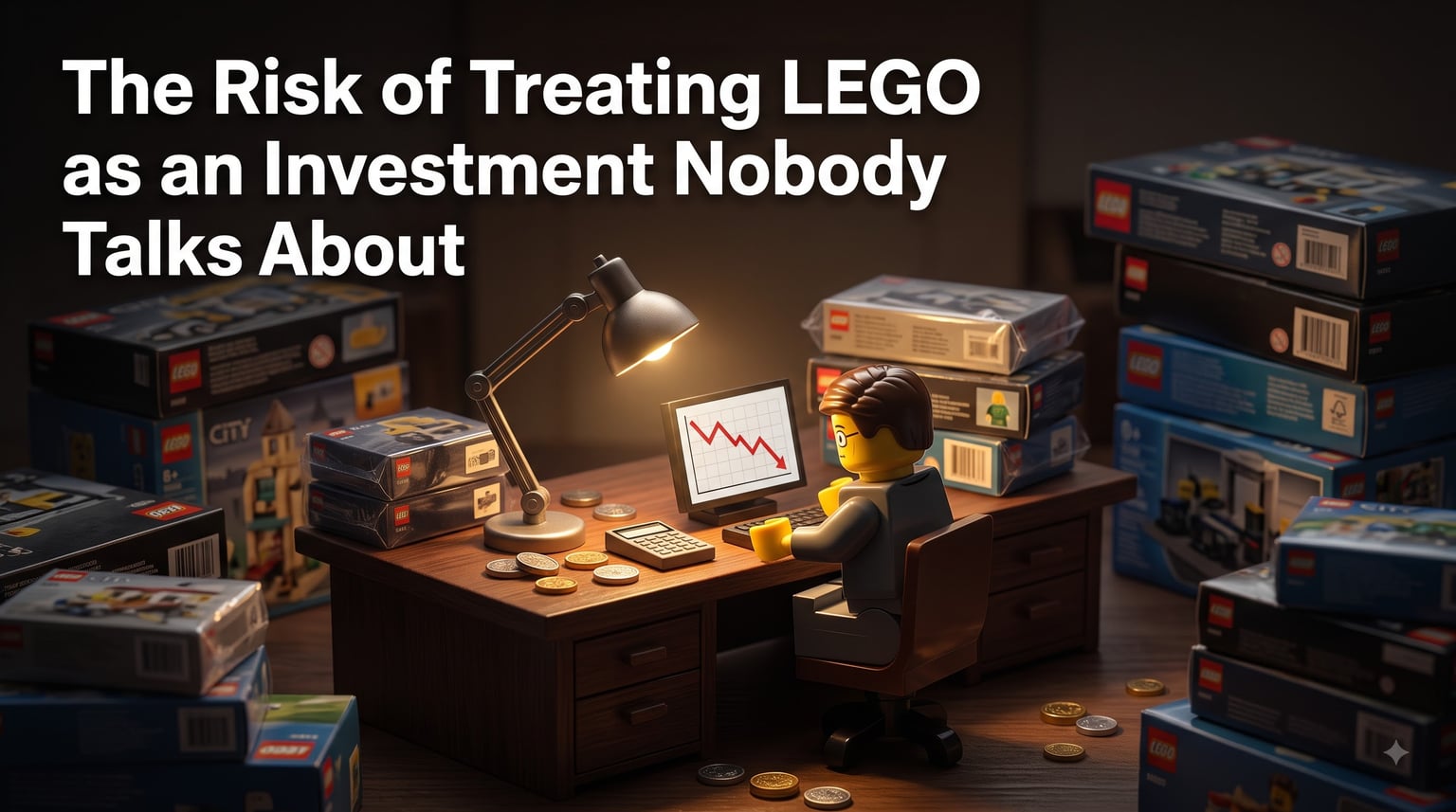
You have probably seen the headline. “LEGO beats gold.” “LEGO outperforms the stock market.” “LEGO delivers 11% annual returns.” These claims bounce around finance blogs and YouTube channels with the confidence of established fact, and they make LEGO investing sound like a secret money-making cheat code hiding in plain sight.
But the risk of treating LEGO as an investment nobody talks about is not that you might lose money. That is the obvious risk, and every cautious blog post eventually gets around to mentioning it. The real risks are the ones that do not fit neatly into a spreadsheet. They are the costs that compound quietly in spare rooms, in the back of your mind, and in the slow erosion of a hobby you once loved for its own sake.
I have been building, collecting, and yes, occasionally speculating on LEGO sets for over a decade. In that time I have watched the LEGO investing conversation shift from a niche corner of collector forums to a mainstream financial talking point. And the louder the conversation gets, the more the important details get drowned out.
Here is what the hype articles skip, what the numbers do not tell you, and why treating LEGO like a stock portfolio might be the worst thing you do to both your wallet and your hobby.
Table of Contents
The Headline Stat Everyone Quotes (And Why It Misleads You)
Let us start with the number that started all this talk: LEGO sets delivered an average annual return of around 11% between 1987 and 2015, according to a study published in the Research in International Business and Finance journal. Some sources, including BrickFact, cite even higher figures, claiming 15.63% average annual returns from 2011 to 2023. These are the stats that make it into every listicle and every YouTube thumbnail.
Here is the problem. That 11% figure is an average across thousands of sets, and averages in collectible markets are deeply misleading. A small number of standout sets, the Cafe Corner, the Millennium Falcon, the Taj Mahal, pull the average up dramatically. Meanwhile, the median return, the experience most actual buyers will have, tells a very different story.
Survivorship bias warps the data even further. The sets tracked in these studies are sets that still exist in collectible databases. Sets that were forgotten, damaged, or simply unwanted by anyone are invisible. You are looking at the winners and drawing conclusions as if they represent the whole field.
When Reddit users on r/legoinvesting share their actual experiences, the picture gets clearer. Most retail sets do not appreciate at all. Many sit at or below MSRP for years after retirement. The ones that do appreciate often take four to five years to see meaningful returns, and that is before you subtract the costs of storing, protecting, and eventually selling them.
The headline stat is not wrong. It is just useless for making individual decisions. It tells you what happened to the best performers over a multi-decade window. It does not tell you what will happen to the three sets you bought last month from your local LEGO Store.
How LEGO Appreciation Actually Works Behind the Scenes
LEGO appreciation is not magic. It is supply and demand, the same forces that move every market from real estate to baseball cards. When a LEGO set goes End of Life, often abbreviated as EOL, it is no longer available at retail. The supply becomes fixed. If demand continues, prices on the secondary market rise.
That is the simple version. The complicated version involves understanding which sets create sustained demand after retirement, and that is where most aspiring investors get it wrong.
Not all retired sets appreciate. In fact, most do not, at least not meaningfully. A mid-range City police station that sat on shelves for two years is not suddenly going to become a collector’s grail because it retired. The sets that appreciate are the ones people wanted but missed, the ones tied to beloved licenses, and the ones with unique parts or minifigures that cannot be found elsewhere.
Timing matters enormously. Buying a set at full MSRP the week before it retires gives you almost no margin for profit. Buying it on clearance months earlier gives you a head start, but clearance sets are clearance for a reason. Often, they are sets nobody wanted in the first place.
The retirement cycle itself is getting harder to predict. LEGO has expanded its product line dramatically, and sets now have wildly different shelf lives. Some exclusives last 18 months. Some standard sets run for four years. LEGO does not publish retirement dates in advance, and the community-driven retirement lists on sites like BrickEconomy are educated guesses, not official schedules.
Then there is the re-release problem. When LEGO reissues a popular set, the aftermarket value of the original often collapses. The Apollo Saturn V is the textbook example. When the original rocketed to significant aftermarket premiums, LEGO re-released it, and the original’s value dropped as the supply constraint disappeared. If you were holding the original as your big investment play, that single corporate decision erased your gains.
Which Sets Hold Value and Which Ones Quietly Lose Money
If you spend any time in LEGO investing communities, you will hear a familiar pattern in the themes that tend to hold value. Large-scale Star Wars sets, particularly Ultimate Collector Series models. Modular Buildings, the detailed city structures aimed at adult builders. Iconic exclusives and high-piece-count Creator Expert sets. These are the categories that have historically rewarded patient holders.
What you will hear less about are the categories that quietly bleed value. Most City sets. Most Friends sets. Most Speed Champions. Most anything from a theme that LEGO produces in massive quantities and replaces annually with a near-identical version. These sets flood the market, and when they retire, nobody is scrambling to buy them.
The uncomfortable truth is that the sets most likely to appreciate are also the most expensive to buy. The Cafe Corner cost $150 at retail. It now sells for thousands. But to get those returns, you needed $150 in disposable income in 2007, the knowledge to buy that specific set, the space to store it sealed for 15 years, and the discipline not to open it or sell it early.
The Reddit community puts this bluntly. As one user on r/legoinvesting summarized it, you need capital to make capital. The people who make serious money in LEGO investing are the ones who were already spending serious money on LEGO. They are not flipping $20 sets for $40. They are holding $400 sets that become $800 sets over five years, and they are doing it across dozens of sets simultaneously.
If you are buying small or mid-range sets hoping for appreciation, you are playing a game where the odds are stacked against you. Most of those sets will never move beyond MSRP, and many will end up selling below retail when you eventually try to unload them.
The Storage Cost Nobody Adds to Their Spreadsheet
Here is where the math gets genuinely painful, and where most LEGO investing guides get suspiciously vague. Storing sealed LEGO sets is not free. It is not even cheap. And the longer you hold, the more those costs compound against any potential profit.
A single large LEGO set, say a Millennium Falcon or a Technic supercar, takes up roughly two to three cubic feet of shelf space when you account for the box and protective margins. If you are holding twenty sets, that is a full shelving unit in a climate-controlled room. If you are holding fifty or more, which serious investors often do, you are looking at dedicating an entire room of your house to sealed boxes you cannot touch.
Climate control matters more than people realize. LEGO boxes warp in high humidity. Stickers peel. Instructions discolor. A set stored in a damp basement or a sweltering attic is not collector grade, no matter how carefully you packed it. The premium paid for sealed, mint-condition sets disappears the moment a buyer spots water damage on the box.
Then there is insurance. Most homeowner’s or renter’s insurance policies have sublimits for collectibles, and LEGO sets often are not itemized. If you have thousands of dollars in sealed sets and a pipe bursts, you may discover your coverage falls well short of replacement value. Adding a collectibles rider or scheduling individual high-value sets costs money, often hundreds of dollars per year.
Now factor in opportunity cost. Every dollar tied up in a sealed box sitting on a shelf is a dollar not earning returns elsewhere. If you spent $500 on a set and it sits for five years before you can sell it for $700, that $200 gross profit looks a lot less appealing when you realize the same $500 in a broad market index fund would have earned roughly the same amount with zero effort, zero storage, and zero risk of a toddler finding your investment.
Selling Realities: Fees, Effort, and the Waiting Game
The selling platforms available to LEGO investors each come with trade-offs that eat into your margins in ways that are easy to underestimate until you are actually doing it. Here is a breakdown of the major platforms and what they actually cost you.
BrickLink is the dedicated LEGO marketplace and where most serious collectors shop. Fees run roughly 3% on the total transaction including shipping. The buyer base is knowledgeable, which means they expect accurate condition descriptions, complete inventories, and fair pricing. Listings can sit for months. You are competing with hundreds of other sellers holding the same retired set.
eBay offers the largest audience but takes a significant cut. With final value fees and the cost of promoted listings, you can lose 13% to 15% of your sale price. That is before PayPal processing fees and shipping costs. eBay buyers are also more likely to file disputes, which adds risk and stress.
Facebook Marketplace and local groups eliminate platform fees but introduce their own problems. Lowball offers, no-shows, scammers, and the time spent coordinating meetups all have a real cost. For high-value sealed sets, meeting strangers in parking lots with hundreds of dollars of merchandise is not most people’s idea of a good time.
The platform comparison that matters is not just fees. It is fees plus time plus risk plus liquidity. BrickLink has low fees but slow sales. eBay has high fees but faster turnover. Facebook has no fees but high friction. There is no free lunch.
And then there is shipping. Sealed LEGO sets are bulky and fragile. Shipping a large set in a way that protects the box from damage can cost $20 to $40 in materials and postage alone. If you are selling a set for a $50 profit, shipping alone can eat half of it.
The waiting game is the part that breaks most casual investors. You list a set and it does not sell for weeks. You lower the price. Still nothing. You lower it again. Eventually you sell at a price that, after fees and shipping, barely covers what you paid. This is the normal experience, not the exception.
The Sealed vs Opened Tension That Keeps Collectors Awake
This is the tension that every LEGO investor eventually faces and that no financial analysis can resolve. The sealed premium is real. A factory-sealed set in mint condition commands a significant price advantage over an opened but complete set, sometimes double or more for desirable sets. If you want maximum resale value, you do not open the box.
But LEGO is a toy. It is a building experience. The entire point of the product is to open it, sort the pieces, follow the instructions, and create something with your hands. Buying LEGO and not building it is, in a very real sense, not using it for its intended purpose.
I have talked to dozens of collectors who fell into the investment trap and ended up with rooms full of sealed boxes they were afraid to open. They bought sets they were excited about, then convinced themselves those sets were too valuable to build. Years passed. The sets sat. The excitement faded into anxiety about condition, value, and timing.
The Reddit threads on this topic are quietly heartbreaking. People describe buying sets for their kids, then not letting the kids open them because they might be worth something someday. People describe having hundreds of sealed boxes and realizing they have not actually built anything in years. The hobby became a warehouse operation.
This is the cost that does not show up in any ROI calculation. It is the cost of transforming a source of joy into a source of stress. It is the moment you realize you are not a LEGO fan anymore. You are a warehouse manager for plastic boxes.
Reality Check: Real Numbers From Real Investors
Let us walk through what LEGO investing actually looks like when you account for all the costs, using experiences shared across r/legoinvesting and other collector communities.
One common scenario: an investor buys $2,000 worth of mid-range sets across various themes, aiming for 20% to 30% returns over two years. Two years pass. Some sets appreciated. Some did not. After selling fees, shipping materials, and the hours spent photographing, listing, packing, and shipping each set individually, the net profit is closer to 8% to 12%, not the 20% to 30% projected. That is before taxes.
Another scenario: an investor loads up on a single hot set right before retirement, expecting the classic post-EOL bump. The set retires. The secondary market gets flooded with other investors who had the same idea. Prices stay flat or dip below retail for a year before slowly climbing. The investor finally sells after three years for a modest gain that barely beats a savings account.
The community consensus, repeated across dozens of threads, is sobering. Most people who try LEGO investing as a side hustle do not stick with it beyond two or three years. The effort-to-return ratio is brutal once you factor in the actual work of selling. The people who succeed long-term tend to be those who were already deep collectors, who understand the market intuitively, and who view investment gains as a bonus rather than the goal.
One Reddit comment that stuck with me: “You are not going to get rich off LEGO investing unless you are already rich.” The capital required to buy enough sets to generate meaningful returns, the space required to store them, the knowledge required to pick the right ones, and the patience required to wait out multi-year hold periods are all barriers that exclude most casual participants.
The Emotional Cost Nobody Wants to Admit
This is the section no competitor writes, and it is the one that matters most. The emotional cost of treating a hobby as an investment is real, it is significant, and it compounds in ways that no spreadsheet can capture.
When you start viewing every LEGO purchase through an investment lens, something shifts. You stop buying sets that look fun and start buying sets that look profitable. You stop building because building reduces resale value. You stop enjoying the hobby because the hobby has been replaced by a low-margin logistics operation.
I have watched friends go through this cycle. They start as passionate builders. They read about LEGO investing. They buy a few sets to hold. Then a few more. Within a year, their LEGO room has transformed from a creative space into a storage facility. They track prices daily on BrickEconomy. They stress about box damage during shipping. They argue with buyers over condition disputes.
The joy is gone. What remains is a second job that pays poorly and takes up space in your house.
There is also a community cost. The LEGO hobby has always been about sharing, building together, and celebrating creativity. When investment mindsets dominate, the community shifts. Sets get hoarded instead of built. Prices get inflated for people who just want to build and display. Newcomers get priced out of sets they would love because investors swept the shelves at retail.
This is not a moral judgment. There is nothing wrong with selling sets you no longer want, or picking up a clearance set to fund future purchases. The line between smart collecting and stressful speculation is where the hobby stops being fun and starts feeling like work. And most people do not realize they have crossed that line until they are standing in a room full of sealed boxes wondering why they stopped building.
The Market Saturation Problem Nobody Sees Coming
There is a structural risk to LEGO investing that almost nobody discusses, and it gets more pressing every year. The more people who treat LEGO as an investment, the worse the investment becomes.
Here is why. The appreciation model depends on scarcity after retirement. When a set retires, supply is fixed and demand pushes prices up. But if thousands of investors are buying extras of every promising set and storing them sealed, the post-retirement supply is not actually scarce. It is just distributed across thousands of spare rooms instead of one warehouse.
We are already seeing this play out. Sets that would have appreciated significantly ten years ago now see muted post-retirement growth because the secondary market is immediately flooded with sealed copies from investors all trying to sell at the same time.
As the LEGO investing community grows, the dynamics that made it profitable in the past weaken. The early adopters who bought Cafe Corners and original Millennium Falcons benefited from a time when almost nobody was thinking about LEGO as an investment. The same opportunity does not exist at the same scale today.
This does not mean LEGO investing is dead. It means the bar for success is higher, the margins are thinner, and the competition is fiercer than the headline statistics suggest. Treating historical returns as a predictor of future performance in a market that is fundamentally changing is a mistake that finance professionals warn about in every other asset class. LEGO is not exempt.
Frequently Asked Questions
Is LEGO worth buying as an investment?
LEGO can be worth buying as an investment only if you are already an experienced collector with deep market knowledge, adequate storage space, and patience for multi-year hold periods. For most people, the returns after fees, storage, and selling effort are modest and unreliable compared to conventional investments.
Is LEGO a safer investment than gold?
No. While one study showed LEGO delivering comparable or higher average returns than gold over a multi-decade period, gold is a highly liquid, globally traded asset with established markets. LEGO is illiquid, dependent on finding individual buyers, vulnerable to condition issues, and subject to platform fees that gold does not carry. LEGO is not safer than gold as an investment.
What are the disadvantages of Legos as an investment?
The main disadvantages include illiquidity, high storage costs, platform selling fees of 3% to 15%, shipping expenses for bulky items, risk of box damage reducing value, long hold periods of 3 to 5 years, market saturation from other investors, vulnerability to LEGO re-releases, and the emotional toll of transforming a hobby into a logistics operation.
How do you know when LEGO sets retire?
LEGO does not publish retirement dates in advance. Collectors track retirement signals through community databases like BrickEconomy and BrickLink, retailer stock patterns, and LEGO Store clearance behavior. Common signals include sets marked as retiring soon on LEGO.com, stock running low at multiple retailers, and sets appearing in clearance sections. These are educated guesses, not confirmed dates.
Is sealed or opened LEGO better for investment?
Sealed sets command a significant premium, often double or more over opened but complete sets, because they guarantee original condition and full contents. However, keeping sets sealed means you cannot experience the building process, which is the primary purpose of the product. Many collectors find the sealed premium does not compensate for losing the enjoyment of building.
What This All Means for You
The risk of treating LEGO as an investment nobody talks about is not about losing money. It is about losing something harder to quantify: the joy of a hobby, the freedom to build without calculating ROI, and the community spirit that made LEGO special in the first place.
None of this means you should never sell a set or never think about resale value. Buying smart, taking advantage of clearance deals, and occasionally selling sets you no longer want are all part of a healthy collecting life. The danger is when the investment tail wags the hobby dog, when every purchase becomes a calculation, and when sealed boxes replace built creations on your shelves.
Here is my honest advice after years in this space. Build what you love. Buy what excites you. If a set happens to appreciate and you decide to sell someday, treat it as a pleasant surprise, not a retirement strategy. The best LEGO investment is the one you actually enjoy owning, building, and displaying. Everything else is just a warehouse operation with worse returns and better packaging.