
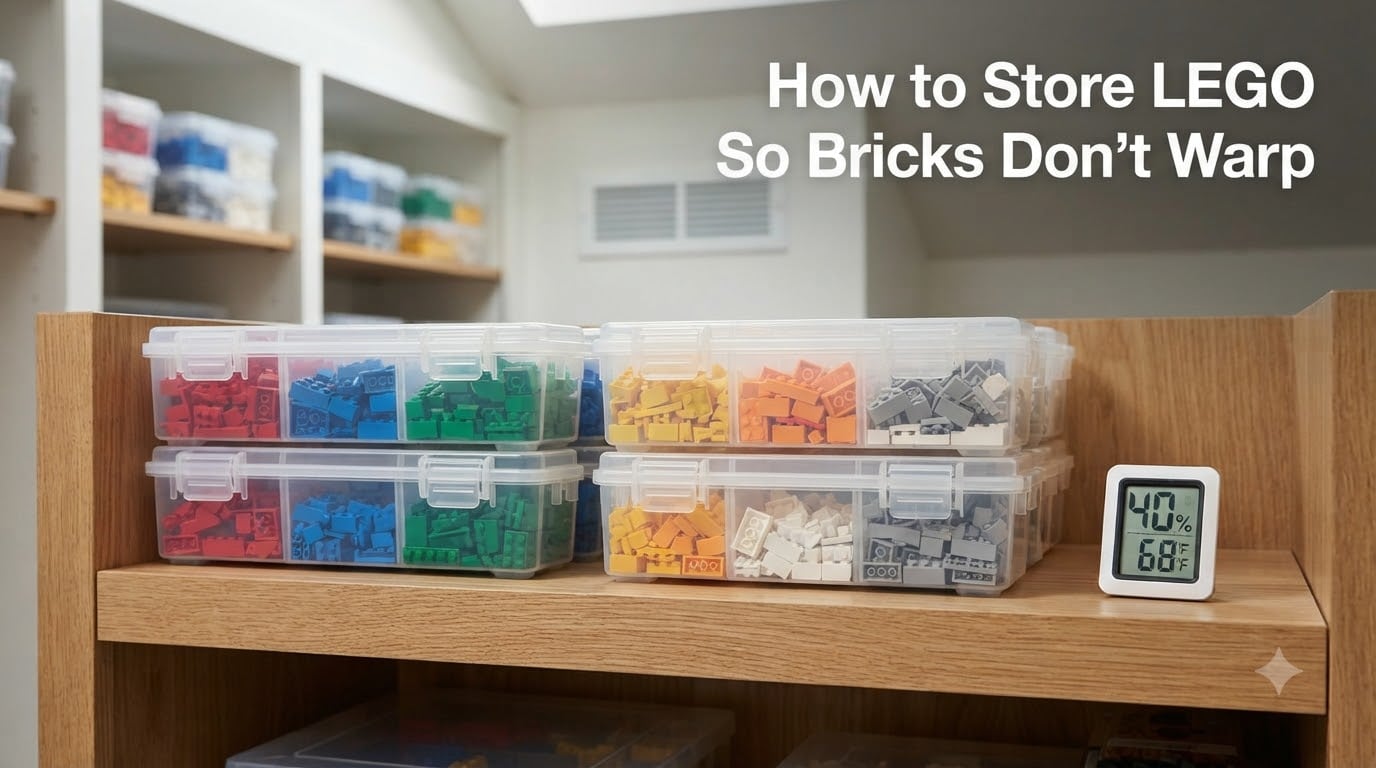
I’ve spent years collecting LEGO, and one question keeps coming up in every forum I visit: how to store LEGO so bricks don’t warp. The short answer involves temperature control, proper containers, and a little common sense. The long answer is what this guide covers from start to finish.
Warped bricks are a real problem. They won’t click together properly, they ruin display builds, and they can destroy the resale value of collectible sets. Whether you’re a parent cleaning up after a kid’s Saturday build session or an AFOL with thousands of dollars in sealed sets, the same principles apply. I’ll walk you through what causes warping, the exact climate conditions to maintain, and the practical steps our team uses to keep collections intact for decades.
By the end, you’ll know the 104°F warning threshold, the 30-50% humidity sweet spot, which containers actually work, and how to fix the few pieces that have already bent out of shape.
Table of Contents
Why LEGO Bricks Warp in the First Place
LEGO bricks warp when their ABS plastic exceeds a critical temperature threshold. The LEGO Group itself warns against exposing bricks to temperatures above 104°F (40°C). Above that point, the plastic becomes soft enough to deform under even modest pressure, and the brick sets in whatever warped shape it cooled into.
The Science Behind ABS Plastic
LEGO bricks are made from acrylonitrile butadiene styrene, better known as ABS. It’s a tough, rigid plastic that handles impact well and holds tight tolerances, which is why your bricks still click after 30 years. But ABS has two weaknesses that matter for storage.
First, heat softens it. The plastic starts losing rigidity around 104°F, becomes noticeably pliable near 185°F, and reaches its melting point at roughly 221°F (105°C). A sun-baked attic, a car trunk in July, or a shelf above a radiator can all push bricks into that danger zone.
Second, UV light breaks it down. Prolonged sunlight exposure makes ABS brittle and discolors it. That’s why translucent and transparent bricks are especially vulnerable. They show UV damage faster and warp more easily under heat because their thinner walls absorb more radiant energy.
Pressure is the third culprit, and it often works with heat. A heavy stack of bricks sitting on a flat plate in a warm room can bend that plate slowly over time. The lower bricks compress under the weight, and the upper bricks heat up faster because air can’t circulate around them.
Optimal Storage Conditions for LEGO
Climate control is the single most important factor in preventing warping. Get this right and almost any container will work. Get it wrong and even expensive storage systems fail.
Temperature Range
Keep your collection between 60°F and 80°F (15°C to 27°C). This range is comfortable for humans, which makes it easy to remember. Avoid attics, garages, and unheated basements where temperatures swing seasonally.
If you’ve ever pulled a brick out of a hot car and noticed it felt slightly soft, that’s exactly the warning sign. At around 90°F the surface feels fine, but the internal structure of the plastic is already starting to relax. By 104°F the brick is officially outside LEGO’s safety range.
Humidity Levels
Humidity matters just as much as heat. Aim for 30% to 50% relative humidity. Below 30%, the air dries out stickers and can cause paper instructions to curl. Above 50%, you risk mold on boxes, mildew on manuals, and corrosion on any metal parts in specialty sets.
A $15 hygrometer from any hardware store tells you what your room is doing. Most climate-controlled homes sit naturally in the 35-45% range, which is perfect. If you live somewhere humid, a small dehumidifier in your storage room is a smart investment.
Choosing the Right Storage Containers
The right container protects against dust, moisture, and accidental pressure. The wrong container traps heat and creates the very conditions you’re trying to avoid.
Here’s what actually works for LEGO storage, based on what AFOLs and parents have tested for years.
Original LEGO boxes: Best for sealed sets and valuable collectibles. They were designed for that product. Keep them flat, never on their sides where boxes can bow.
IKEA Trofast: The gold standard for loose brick storage. Plastic bins slide into a frame, so you can pull one out without disturbing the rest. Frames come in multiple sizes and the bins are cheap to replace.
IKEA BYGGLEK: LEGO’s official collaboration with IKEA. Boxes stack and interlock, and the clear lids let you see contents. Great for active play storage.
Watertight plastic bins: Sterilite and similar brands keep moisture out. Use these for long-term storage in basements or anywhere humidity creeps up.
Ziploc bags for sorted sets: Safe for long-term storage as long as the bags are clean and stored in a climate-controlled space. Many builders report decades-old bricks in original bags still in perfect condition.
What to avoid: cardboard boxes in humid rooms, sealed glass display cases in direct sunlight, and any container that doesn’t allow some airflow. Air circulation is important because it prevents heat from building up around your bricks.
Sorting and Organization Strategies That Prevent Warping
Sorting isn’t just about finding pieces faster. It’s a warping prevention strategy when done right. The key is preventing heavy stacks from pressing down on flat pieces.
Sort by piece type rather than by set if you have loose bricks. Use shallow sorting trays with multiple compartments. Plates go in shallow trays so they don’t stack. Bricks, slopes, and specialty pieces each get their own compartment. This prevents the weight problem entirely because no single piece is bearing the load of dozens of others.
Sort by set only if you’re keeping sets intact. In that case, store each set in its own container rather than stacking multiple sets in one bin. A heavy UCS Millennium Falcon sitting on a smaller polybag set is asking for trouble, especially if any warmth creeps in.
Sort by color if you want to display pieces. This is the slowest method but works for active builders who want to find specific colors fast. Just keep the weight distributed and avoid filling any compartment more than halfway.
The LEGO 5:2 Rule: Clearing Up the Confusion
If you’ve searched for how to store LEGO so bricks don’t warp, you’ve probably stumbled across the “LEGO 5:2 rule.” Let me clear this up because it has nothing to do with storage.
The 5:2 rule is a building technique. It means using a 5:1 ratio of “studs” to “anti-studs” (the bottom of a brick) when joining sections, then adding a 2-brick reinforcement for stability. It’s about structural engineering in your builds, not about how you put bricks away.
Where the confusion comes from: people mix up the “5:2 rule” with the 5:2 ratio of storage space to display space that some collectors recommend. There’s no official LEGO rule about that either. It’s just a popular organizing principle floating around the AFOL community.
So when you see the LEGO 5:2 rule in a storage article, you’re reading content that doesn’t know the difference. Use the 5:2 building rule when you design MOCs. Use the 30-50% humidity and 60-80°F range when you store your collection.
How to Fix Already Warped LEGO Pieces
Not all warped bricks are lost. Some can be salvaged with a careful heat-and-press method. This won’t work for severely twisted pieces, but it can flatten mildly bowed plates and slightly bent tiles.
Here’s the process our team has used successfully on plates with gentle warps:
Preheat your oven to 170°F (77°C). This is well below the 104°F warning threshold for the plastic to deform, but warm enough to relax internal stress.
Place the warped piece on a flat ceramic tile or sheet of glass. Never use plastic surfaces, which can melt or stick.
Put the tile with the piece in the oven for 10 minutes. This warms the ABS evenly without softening it.
Remove the tile (use oven mitts) and place a second flat tile on top of the piece. The pressure should be gentle but firm.
Let it cool to room temperature under the weight. Don’t rush this. Rapid cooling can create new stress points.
Check the piece after 30 minutes. If it’s still warped, repeat once. If it hasn’t improved after two attempts, the piece is too far gone.
A hair dryer on a low setting can also work for small, lightly warped pieces. Hold the dryer 6 inches away, rotate the piece so it warms evenly, and flatten it with your fingers (carefully) once it becomes slightly flexible. Stop the moment the piece feels soft. Overheating ruins it instantly.
For severely warped bricks, replacement is your only option. BrickLink has nearly every LEGO piece ever made, and individual parts often cost just a few cents.
Long-Term Storage Best Practices
Long-term storage means anything beyond a year. Sealed collectibles, investment sets, and inherited collections all fall into this category. The principles are the same as short-term storage, but the stakes are higher because you may not check on the bricks for years.
Pick a stable indoor location. Climate-controlled living spaces are ideal. Closets work well because they’re dark, temperature-stable, and out of direct sunlight. Avoid anywhere with temperature swings: attics, garages, and outdoor sheds are all unsuitable.
Keep boxes flat and supported. Store horizontal, never vertical. Box stacks should be limited to three or four boxes high, and the bottom box should be on a flat, sturdy surface. A sagging shelf creates pressure points that bow cardboard and can warp the bricks inside over time.
Wrap instructions and stickers separately. Paper-based materials are more sensitive to humidity than plastic. A gallon-size Ziploc bag protects them without trapping moisture. Some collectors include a small silica gel packet to absorb any residual humidity.
Check on your collection once a year. A 5-minute visual inspection catches problems early. Look for bowing boxes, musty smells, and any visible discoloration. If something’s off, you can move the collection before damage spreads.
Common Mistakes That Cause Warping
A few habits show up over and over in forums as warping culprits. Avoiding these is half the battle.
Storing LEGO in the attic is the number one mistake. Attics routinely hit 130°F to 150°F in summer, well above the 104°F danger line. If you have any LEGO up there, move it now.
Leaving bricks in cars is the second. Even a few hours in a parked car on a 90°F day can push interior temperatures past 120°F. Bricks left in cars soften, stick together, and warp permanently.
Stacking heavy builds on flat plates puts sustained pressure on those plates. A UCS Star Wars set weighing 8 pounds on a single 1×6 plate will bend that plate slowly, even at room temperature. Use storage methods that distribute weight.
Displaying bricks in direct sunlight causes both warping and UV damage. Even indirect daylight through a window adds up over years. If you display builds, use LED lighting that produces minimal heat and zero UV.
Sealing bricks in airtight containers in hot rooms is a subtle trap. The bricks themselves don’t off-gas much, but a sealed bin in a hot room traps heat. Airflow matters even when moisture protection is your goal.
FAQ
What is the best way to store LEGO bricks?
The best way to store LEGO bricks is in a climate-controlled indoor space between 60-80°F with 30-50% humidity. Use shallow sorting trays for loose pieces, original boxes for sealed sets, or plastic bins with airflow for bulk storage. Keep containers away from direct sunlight and avoid attics, garages, and car trunks where temperatures exceed 104°F.
What is the LEGO 5:2 rule?
The LEGO 5:2 rule is a building technique, not a storage rule. It refers to using a 5:1 ratio of studs to anti-studs when joining sections, with 2-brick reinforcement for stability. It applies to MOC design and structural engineering, not to how you put bricks away.
Do LEGOs warp in heat?
Yes, LEGO bricks warp in heat. ABS plastic starts losing rigidity at 104°F, becomes noticeably pliable near 185°F, and melts at approximately 221°F. Bricks stored in attics, cars, or direct sunlight can permanently deform. Translucent and transparent pieces are especially vulnerable because they absorb more radiant energy.
How do you flatten warped LEGO?
To flatten mildly warped LEGO, preheat your oven to 170°F and place the piece on a ceramic tile. Warm it for 10 minutes, then sandwich the piece between two flat tiles and let it cool under gentle pressure for 30 minutes. Repeat once if needed. Severely warped pieces should be replaced through BrickLink or similar sources.
Storing Your LEGO Collection the Right Way
Learning how to store LEGO so bricks don’t warp comes down to three things: climate control, smart containers, and avoiding pressure. Keep the temperature between 60-80°F, humidity at 30-50%, and your collection in a stable indoor space. Use containers that allow airflow while keeping dust out. Distribute weight so no single piece is bearing the load of dozens more.
Skip the attic, never leave bricks in a hot car, and remember the 5:2 rule is for building, not storage. Follow these principles and your bricks will still be in perfect shape for the next generation of builders.