
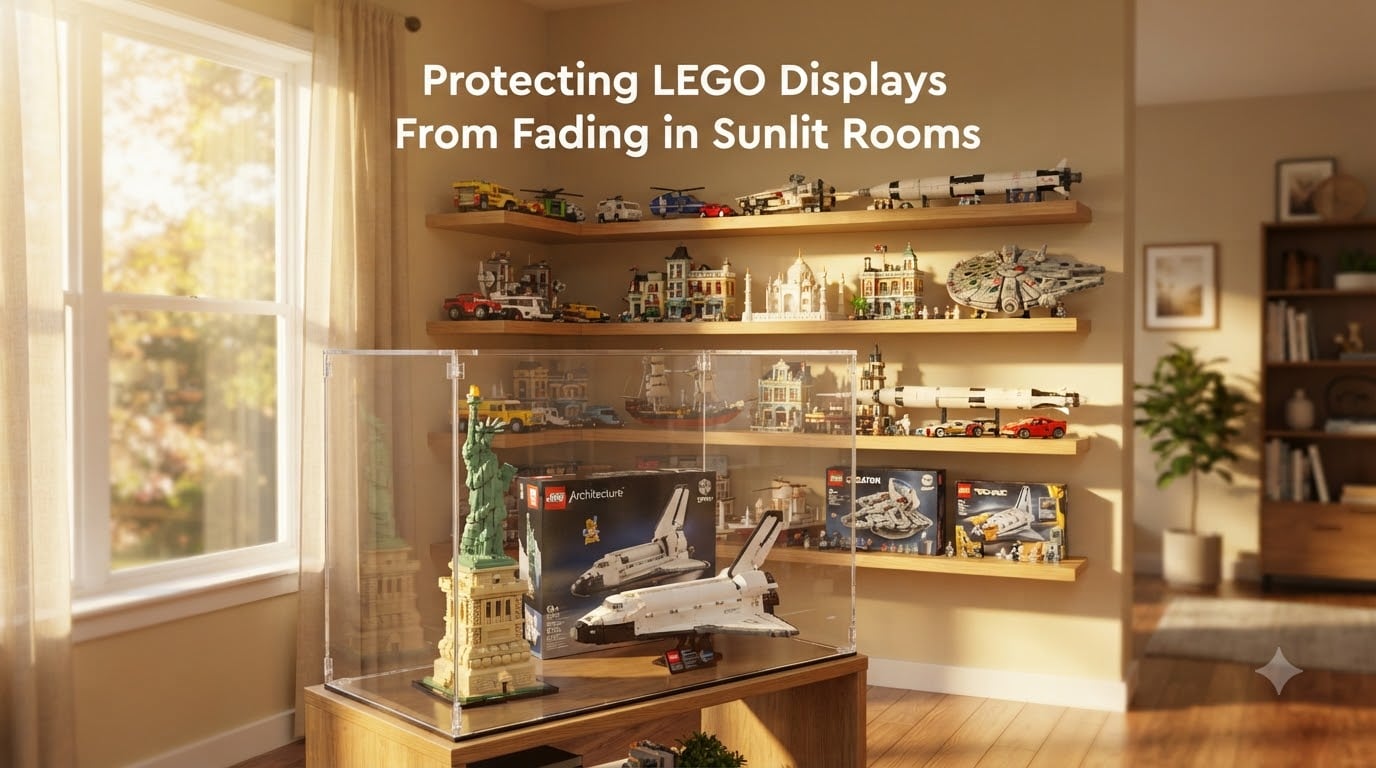
I noticed it on a Wednesday afternoon. Sunlight cut across my living room display shelf at just the right angle, and I realized the white panels on my Millennium Falcon had taken on a yellow tint I had never seen before. Two years of indirect exposure and it happened so gradually I never caught it.
That moment kicked off a six-month deep dive into protecting LEGO displays from fading. I talked to collectors on r/lego, tested different setups in my own home, and dug through every credible source I could find on ABS plastic degradation. What I learned changed how I display my entire collection.
The hard truth is that LEGO bricks fade in sunlight. UV radiation breaks down the pigments inside ABS plastic, and once that damage occurs, the original color is gone for good. But the good news is that fading is almost entirely preventable with the right approach.
This guide covers what causes the damage, which colors are most vulnerable, and how to assess your room’s risk level. I will walk through window treatments, display case options, DIY fixes, and even restoration methods for pieces that have already faded. Whether you have a single prized set or a wall-sized collection, protecting LEGO displays from fading starts with understanding the threat.
One collector I spoke with put it bluntly: “I wish someone had told me about UV film before I lost three Clone Troopers to yellowing.” That sentiment comes up again and again in collector communities. So let’s start with the science, then move into practical steps you can take this weekend.
Table of Contents
How UV Light Damages LEGO Bricks
UV radiation from sunlight is the primary cause of LEGO fading and yellowing. The process, called photodegradation, breaks down the chemical bonds inside ABS plastic where LEGO bricks are made.
LEGO bricks are manufactured from acrylonitrile butadiene styrene, or ABS plastic. This material is durable and impact-resistant, which makes it ideal for snapping and unsnapping thousands of times. But ABS plastic has a weakness: its molecular structure is vulnerable to ultraviolet light.
When UV rays hit a LEGO brick, they penetrate the surface and disrupt the chemical bonds that hold the pigment molecules together. The colors you see are created by pigments mixed into the plastic during manufacturing. As those pigment molecules break apart under UV exposure, the color literally degrades at a molecular level.
This process is cumulative and irreversible. Each hour of UV exposure does a tiny bit of damage, and over months or years, the color visibly shifts. Reds fade toward pink. Whites turn yellow or cream. Blues lose their saturation. The damage never reverses on its own.
Two types of UV light matter here. UVB rays are the more intense variety, and standard window glass blocks most of them. But UVA rays pass through ordinary glass with ease. That means your LEGO bricks are still being damaged even when they sit behind a sealed window away from direct sunbeams.
This is the detail that catches most collectors off guard. I have seen forum posts from people who placed their sets in what they thought was a safe indirect-light spot, only to discover yellowing a year later. One Stack Exchange contributor reported that white bricks yellowed even behind modern double-glazed windows over time.
The takeaway: any room with natural light carries some risk. The question is not whether damage happens, but how fast. Direct sunlight accelerates fading dramatically. Indirect sunlight slows it down but does not eliminate it. Total darkness is the only way to stop UV damage completely, which is obviously impractical for displaying your collection.
Which LEGO Colors Fade Fastest
Not all LEGO colors respond to UV light the same way. Through collector reports and material science, a clear pattern emerges about which colors are most vulnerable.
White bricks are the most notorious for fading. They do not so much fade as yellow, taking on a cream or beige tint that is immediately noticeable. This is because the white pigment shows even slight discoloration against a clean baseline. Collectors of Clone Troopers, Stormtroopers, and white architectural sets report this problem most frequently.
Bright reds are another high-risk category. The red pigment used in LEGO bricks breaks down relatively quickly under UV exposure, shifting toward pink or orange over time. Sets with large red surfaces, like fire trucks and certain Technic models, often show this damage first.
Saturated blues also fade noticeably. The deep blue pieces tend to lose their intensity and drift toward a lighter, washed-out shade. Lighter blues are somewhat more stable but still degrade over extended exposure.
Yellow bricks hold up better than reds and whites but can still shift toward a greenish or brownish tone with prolonged UV exposure. Lime green and other neon shades are similarly vulnerable to color shifting.
Blacks and dark grays are the most UV-resistant colors in the LEGO palette. Dark pigments absorb light more effectively and tend to maintain their depth longer. That said, black pieces can develop a chalky surface haze with enough exposure.
If you are displaying sets with white, bright red, or saturated blue elements in a sunlit room, those are the pieces that need the most aggressive protection. Prioritize your display placement around the most vulnerable colors in your collection.
Room Orientation and Risk Assessment
Before you invest in protection, figure out how much risk your display room actually carries. Not all sunlit rooms are equally dangerous, and understanding your exposure helps you prioritize.
Start by noting which direction your display room faces. South-facing windows in the Northern Hemisphere receive the most direct sunlight throughout the day, making them the highest-risk orientation for LEGO displays. These rooms get intense light for the longest hours.
West-facing windows are the second riskiest. Afternoon sun tends to be the hottest and most UV-intense because it has traveled through less atmosphere. East-facing rooms get morning sun, which is gentler but still damaging over time. North-facing rooms receive the least direct sunlight and are generally the safest option for displaying LEGO.
Next, track how many hours of direct sun hit your display shelves. A set that gets two hours of morning sun is in far less danger than one baked in afternoon light for five hours. Spend a day watching how light moves across your room and mark the spots where sunbeams land.
Window glass type also matters. Older single-pane windows filter very little UV light. Modern double-glazed windows block more UV but still let UVA rays through. If your home has older windows, assume your LEGO is getting nearly the full UV dose.
One detail collectors often miss is reflected light. UV rays bounce off floors, walls, and nearby surfaces, meaning a shelf that never sees direct sun can still receive significant UV exposure from reflections. One forum contributor noted that UV rays scatter around rooms even after initial contact with surfaces.
Here is a simple test I recommend. Place a small stack of sacrificial bricks, ideally in white or bright red, in your intended display spot. Check them every couple of months against identical bricks stored in a dark box. If you see any color difference after six months, that location needs better protection.
What Is the 5/2 Rule in LEGO
The 5/2 rule is a display and storage guideline used by experienced LEGO collectors to manage light exposure and preserve brick condition over time. The rule suggests displaying your LEGO sets for a maximum of five years, then rotating them into dark storage for at least two years before returning them to display.
This cycle gives bricks a recovery period away from light and environmental stress. While fading itself does not reverse during storage, removing the set from light exposure halts further damage. The rotation also reduces dust buildup and gives you a chance to inspect pieces for wear.
The 5/2 rule is not an official LEGO Company guideline. It comes from the collector community, where AFOLs (Adult Fans of LEGO) developed it through decades of trial and error. The specific timeframes can be adjusted based on your display conditions and how concerned you are about preservation.
For collectors in low-risk rooms with north-facing windows and good UV protection, you might stretch display time to seven or eight years. For sets in bright, south-facing rooms with minimal protection, consider a shorter cycle of three years on display with two years in storage.
The rule is especially valuable for limited edition sets, retired models, and pieces with high aftermarket value. Rotating these through dark storage protects your investment while still letting you enjoy them on display for the majority of their lifespan.
I apply a modified version in my own collection. My most valuable sets live in UV-filtering display cases and stay out year-round. My everyday display sets rotate on a roughly five-year cycle into opaque storage bins in a closet. This system has kept my collection looking fresh for over a decade.
Window Treatments and Positioning Tips
Window treatments are your first and most cost-effective line of defense against UV damage. You do not need to renovate your room. Small changes to how you cover and position relative to windows make an enormous difference.
UV-blocking window film is one of the best investments for a LEGO display room. These transparent films adhere directly to your window glass and block up to 99 percent of UV rays while letting visible light through. The film is inexpensive, available in rolls at most hardware stores, and you can apply it yourself in an afternoon.
Look for films rated to block both UVA and UVB rays. Many products advertise a 99 percent UV block, but check whether that rating covers the full UV spectrum. Some cheaper films only block UVB, which standard glass already handles, while letting UVA pass through freely.
Blackout curtains offer another layer of protection. Closing heavy curtains during peak sunlight hours, typically late morning through late afternoon, dramatically reduces UV exposure. The downside is that closed curtains also hide your display, so this works best for rooms you are not actively using during the day.
Sheer curtains provide a middle ground. They soften and diffuse incoming light without blocking it entirely, reducing UV intensity while keeping the room bright. Pair sheer curtains with UV window film for solid protection without sacrificing the display experience.
Blinds work well for directional control. Angled slats let you redirect light away from specific shelves while still illuminating the room. Vertical blinds are particularly useful for large windows near display walls.
Beyond window coverings, repositioning your shelves is free and effective. Move display cases as far from windows as the room allows. Even a few feet of distance reduces UV intensity because light scatters as it travels. A shelf six feet from a window receives significantly less UV than one directly beside it.
My own setup uses UV film on two south-facing windows, sheer curtains during peak hours, and shelves positioned on the opposite wall from the windows. This combination cut visible fading to nearly zero over three years of testing.
UV-Protective Display Case Solutions
Display cases add a second layer of protection beyond window treatments. The right case can filter UV light before it reaches your bricks while also keeping dust off your sets.
The key feature to look for is UV-filtering acrylic. Standard acrylic and standard glass both let most UV light through. But specialized UV-filtering acrylic contains additives that absorb ultraviolet radiation before it passes through the case walls. These cases can block 90 to 98 percent of UV rays.
UV-filtering acrylic is more expensive than standard acrylic, but the cost is justified for valuable or sentimental sets. Look for cases explicitly labeled as UV-protective rather than just clear acrylic. The difference in protection is significant.
Acrylic versus glass is a common debate among collectors. Standard glass actually blocks more UVB than standard acrylic, but neither material stops UVA effectively without special coatings. UV-filtering acrylic outperforms standard glass for LEGO protection. Glass has the advantage of being more scratch-resistant and chemically inert, but it is heavier and more dangerous if broken.
Enclosed cases with solid backs and sealed edges offer better protection than open shelving. An enclosed case creates a microenvironment that limits air circulation and dust infiltration while the UV-filtering panels do their work. Look for cases with tight-fitting doors and minimal gaps.
For large displays, consider UV-filtering acrylic panels mounted directly in front of your shelving. This approach protects multiple shelves at once without needing individual cases for each set. Several companies sell cut-to-size UV acrylic sheets for exactly this purpose.
One important caveat: display cases reduce light exposure but do not stop it entirely. A UV-filtering case in a bright south-facing room still lets some visible light and residual UV through. Cases work best as part of a layered approach, combined with window treatments and smart positioning.
I use UV-filtering acrylic cases from a specialty retailer for my most valuable sets. For my everyday display, I rely on standard enclosed shelving behind UV window film. The combination of case protection and room-level UV blocking has been effective across my entire collection.
DIY Protection Methods That Actually Work
You do not need to spend hundreds on specialty display cases to protect your LEGO. Several cost-effective DIY methods deliver real protection for collectors on a budget.
UV-blocking window spray is a lesser-known option. These clear sprays apply a UV-filtering coating directly to window glass or acrylic panels. A single can treats multiple windows and costs far less than professional window film installation. The coating typically lasts one to two years before needing reapplication.
If you already have display cases without UV protection, you can apply UV-filtering film to the case panels themselves. The same adhesive film used on windows works on acrylic and glass case walls. This upgrades standard cases to UV-protective ones for a fraction of the cost of buying new.
Positioning matters more than most people realize. Simply moving your display to a wall perpendicular to your windows, rather than parallel, can cut UV exposure dramatically. Light intensity drops off quickly as it changes angle, so a shelf at ninety degrees to a window receives far less direct radiation.
Strategic use of furniture helps too. A bookshelf or room divider placed between your window and display shelf acts as a light baffle, blocking direct UV paths. This is especially useful in rooms where you cannot apply window film or change curtain arrangements.
For temporary or rotating displays, consider UV-opaque dust covers. A simple cloth cover thrown over your display during peak sunlight hours costs almost nothing and provides complete protection for those critical hours. Remove it when you want to show off your collection in the evening.
LED display lighting is the safest way to illuminate your sets. Quality LED lights emit essentially zero UV radiation, making them ideal for highlighting your display without adding to the fading risk. Use warm white LEDs to avoid the blue light that can cause minor color shifting in some pigments over very long periods.
Avoid halogen and fluorescent lights near your display. Halogen bulbs emit significant UV, and fluorescent tubes can produce both UV and blue light that contributes to gradual fading. If you must use these light types, position them away from direct aim at your LEGO sets.
How to Restore Sun-Damaged LEGO
If you are reading this because your LEGO has already faded, you are not alone. This is one of the most common questions in collector communities. The good news is that some damage can be partially reversed, though expectations need to be realistic.
The most widely discussed restoration method is called retrobright, also known as the hydrogen peroxide method. This technique uses hydrogen peroxide gel or solution combined with UV light to reverse yellowing in white and light-gray ABS plastic. It works by breaking down the yellowed surface compounds that form during photodegradation.
The basic process involves coating the yellowed pieces in a hydrogen peroxide solution (typically 6 to 12 percent concentration) and exposing them to sunlight or a UV lamp. The UV activates the peroxide, which then bleaches the yellowed compounds back toward the original color. Results are often visible within four to eight hours of exposure.
Many collectors report excellent results on white bricks that have yellowed. Clone Troopers, Stormtroopers, and old gray Technic pieces respond particularly well to this treatment. Before and after photos in collector forums show dramatic improvements that bring pieces close to their original appearance.
However, retrobright has real limitations. It primarily works on white and light gray pieces. Colored bricks that have faded, like reds and blues, do not respond well because the peroxide cannot rebuild the broken pigment molecules. It can only address the yellowing of the base plastic.
There are also risks. Over-treating pieces can cause surface brittleness or a blotchy, uneven appearance. Some collectors report that retrobrighted pieces re-yellow faster than originally, requiring repeated treatments. The long-term effects of repeated peroxide treatments on structural integrity are not well documented.
If you decide to try retrobright, start with a sacrificial test piece. Use a low hydrogen peroxide concentration, monitor closely, and stop as soon as the color improves. Never treat pieces you cannot afford to damage, and avoid getting peroxide on printed or painted surfaces, which can smear or fade.
For colored pieces that have faded, there is unfortunately no reliable restoration method. Faded reds, pinks, and blues are permanently altered. Your best option is to replace those specific pieces through BrickLink or LEGO’s replacement parts service, then apply better protection to prevent recurrence.
One collector I spoke with shared a strategy I now follow: photograph your sets when you first build them. If fading happens, you have a baseline reference for how much color has shifted. It also helps you catch damage early before it becomes severe enough to need restoration.
FAQs
Will Legos fade in sunlight?
Yes, LEGO bricks fade in sunlight. UV radiation from the sun breaks down pigment molecules in the ABS plastic, causing colors to shift over time. White pieces yellow, reds fade toward pink, and saturated colors lose intensity. Direct sunlight causes the fastest damage, but indirect sunlight also fades LEGO over months and years.
Do display cases prevent LEGO fading?
UV-filtering display cases significantly reduce fading by blocking up to 98 percent of ultraviolet rays before they reach your bricks. Standard acrylic and glass cases without UV coatings offer minimal protection. Display cases work best when combined with window treatments and smart room positioning as part of a layered approach.
Does indirect sunlight damage LEGO?
Yes, indirect sunlight damages LEGO over time. While standard window glass blocks most UVB rays, UVA rays pass through easily and continue to degrade ABS plastic pigments. Reflected UV light also bounces off walls and surfaces, meaning even shelves that never receive direct sun are exposed to harmful radiation.
How to restore faded LEGO bricks?
White and light gray LEGO bricks can be partially restored using the retrobright method, which involves coating pieces in hydrogen peroxide and exposing them to UV light. This reverses yellowing in the base plastic. Faded colored bricks like reds and blues cannot be reliably restored because the pigment molecules are permanently broken down.
What is the 5/2 rule in LEGO?
The 5/2 rule is a collector guideline suggesting you display LEGO sets for a maximum of five years, then rotate them into dark storage for at least two years before returning them to display. This cycle halts further light damage during storage and extends the visual lifespan of your collection, especially for valuable or vulnerable sets.
Protecting LEGO Displays From Fading: Final Thoughts
Protecting LEGO displays from fading comes down to one core principle: reduce UV exposure as much as possible. No single solution eliminates the risk entirely, but a layered approach gets you close enough that your collection stays vibrant for decades.
Start with the basics. Apply UV-blocking window film to your display room windows. It is the single highest-impact step you can take for the lowest cost. Position your shelves away from direct window sightlines, and use curtains or blinds to control light during peak hours.
Add UV-filtering display cases for your most valuable and most vulnerable sets. White pieces, bright reds, and saturated blues deserve this extra protection. Use the 5/2 rule as a guideline for rotating valuable sets through dark storage to give them a break from light exposure.
Switch your display lighting to LED. Avoid halogen and fluorescent lights anywhere near your collection. And if you already have faded pieces, try retrobright on white bricks while accepting that colored pieces may need replacement.
Most importantly, do not wait until you notice fading to act. By the time damage is visible, it has already been happening for months or years. Take a few hours this weekend to assess your room, apply window film, and reposition your most vulnerable sets.
Your LEGO collection represents years of building, investment, and memories. A little prevention now keeps those colors looking the way they did the day you finished building. That is worth an afternoon of work.