
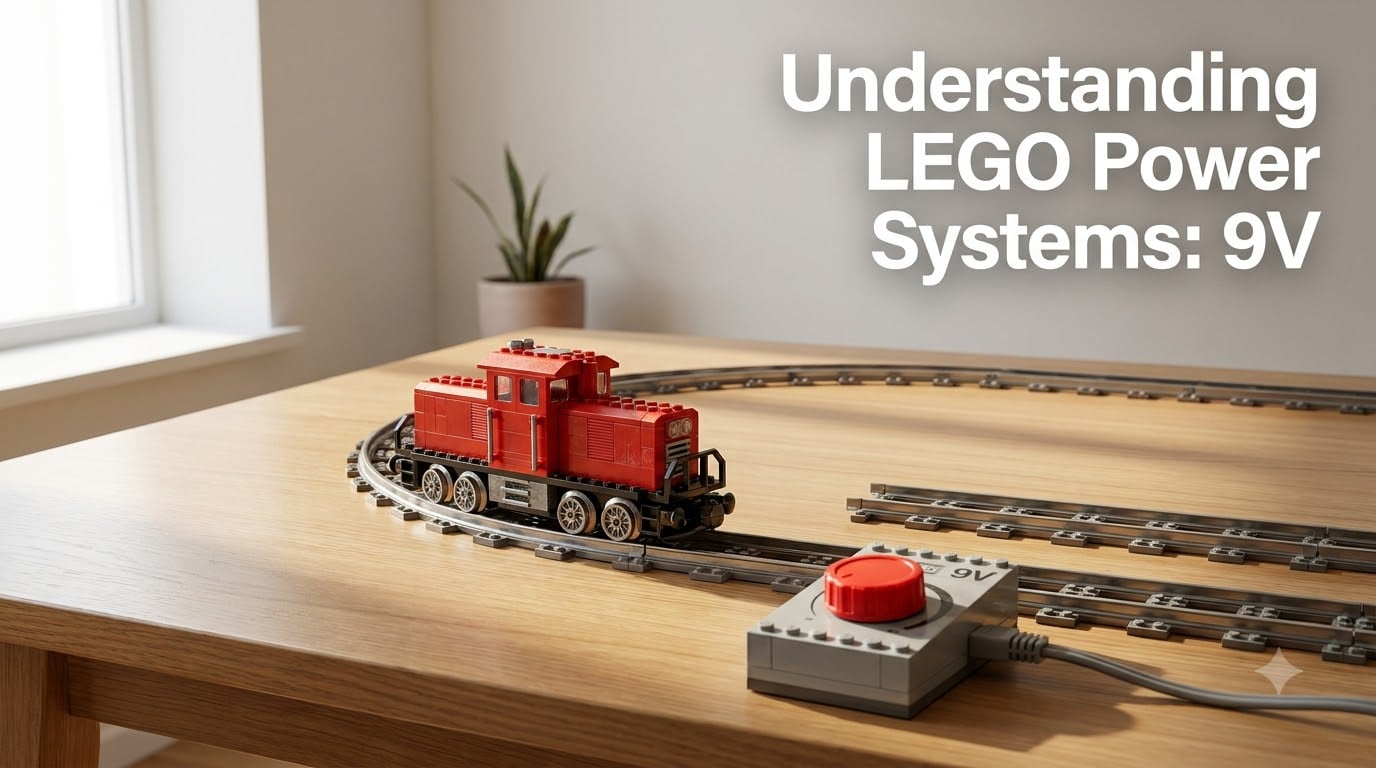
If you have ever run a LEGO train around a track and watched it glide through tunnels and stations, you have experienced the legacy of the LEGO 9V Power System. This power standard powered some of the most beloved LEGO sets ever made, from the Metroliner to the BNSF locomotive. For over two decades, 9V was the backbone of motorized LEGO building.
The 9V system debuted in the mid-1980s and served as LEGO’s primary electrical standard until the late 2000s. It replaced the earlier 4.5V battery system and the complex 12V system with something that combined reliability, simplicity, and creative flexibility. Trains, Technic sets, Space themes, and even Mindstorms all relied on 9V power at some point.
In this guide, we break down everything you need to understand about the LEGO 9V Power System. We cover its history, how the track-powered trains worked, the key components that made it run, and why LEGO eventually moved on to Power Functions and Powered Up. We also explore how modern hobbyists are keeping 9V alive with third-party adapters and hybrid layouts.
Whether you are dusting off a vintage collection, deciding whether to invest in 9V parts, or simply curious about how LEGO used to do electricity, this guide has you covered.
Table of Contents
What Was the LEGO 9V Power System?
The LEGO 9V Power System was a voltage standard for electrical components introduced in 1985, using conductive studs built into bricks to deliver power to motors, lights, and sound modules across a wide range of LEGO sets. It was later marketed as the Electric System or the 9V Power System depending on the country.
What made 9V different from everything before it was the connection method. Earlier LEGO electric systems used pinned plugs that were fragile and awkward to integrate into builds. The 9V system replaced these with special 2×2 conductive brick connectors that used LEGO’s signature stud-and-tube clutch design. This meant electrical connections could be built directly into any model just like regular bricks.
The system operated at 9 volts, which provided enough power to drive motors reliably while remaining safe for children. Power came from two sources: track power for trains, where electricity flowed through metal rails, and battery boxes for standalone models. Both used the same 9V connector standard, making components interchangeable.
The 9V system was arguably LEGO’s most elegant electrical design. It combined the best aspects of the LEGO system of clutch-connected elements with reliable electrical connections. You could build a motorized crane, a train station with working lights, or a monorail without ever dealing with exposed wires or soldering.
The History and Timeline of LEGO 9V (1985-2009)
The story of LEGO 9V begins with the systems it replaced. Before 9V, LEGO offered a 4.5V battery-powered system starting in 1966 and a more powerful 12V system starting in 1969. The 4.5V system was simple but underpowered, while the 12V system was capable but required a separate transformer and complicated wiring.
In 1985, LEGO introduced the 9V system as a unified replacement. The 2×2 stud connector design immediately solved the fragility problems of older plug-based systems. By the late 1980s, 9V components appeared across Town, Space, Technic, and Castle themes.
The real turning point came in 1991. LEGO launched the 9V train system, which used metal-railed track that delivered power directly from a speed regulator through the rails to a motor bogie. This eliminated the need for battery changes mid-run and enabled continuous operation. The first 9V train sets included the iconic Metroliner (10001) and several passenger and freight locomotives.
Through the 1990s and early 2000s, 9V became the gold standard for LEGO train enthusiasts. The system expanded with remote-controlled switches, level crossing signals, and trackside accessories. Even the LEGO Monorail, technically a separate system, shared some 9V-era design philosophies.
The end came gradually. In 2006, LEGO began shifting toward the new Power Functions system, which used battery-powered infrared remote control. The last 9V train sets were released around 2006-2007, and by 2009 the 9V standard was effectively retired. Despite this, the community never stopped using it.
Key Components of the LEGO 9V Power System
The 9V system was built around a family of interconnected components, each designed to plug together using the signature 2×2 stud connector. Understanding these parts is essential for anyone working with vintage LEGO electric sets.
9V Train Motors
The heart of the 9V train system was the motor bogie. This was a self-contained unit combining a brushed DC motor, wheels with metal electrical pickup contacts, and a drive mechanism. The motor bogie drew power directly from the track’s metal rails and transferred it to the wheels for propulsion.
LEGO produced the 9V train motor in one primary form factor that fit standard train bogies. The unit featured die-cast metal components for the electrical pickups, which provided reliable conductivity. Weighing less than the older 12V motor, the 9V bogie was more efficient but sometimes struggled with traction on steep grades.
Standalone Motors
Beyond train motors, LEGO produced several standalone 9V motors for Technic and general use. These included the classic 9V Technic motor (part 2838), which was a versatile unit used in everything from cranes to conveyor belts. Philohome’s comprehensive motor comparison charts remain the gold standard for specifications on these units.
These motors connected to the power system via the standard 2×2 connector and could be driven by either a battery box or a track-powered transformer. Their compact size made them ideal for integration into complex builds.
Power Sources: Battery Box, Transformer, and Speed Regulator
For standalone models, the 9V battery box held six AA batteries to deliver 9V power. The box had a built-in 2×2 connector output and a polarity switch for reversing motor direction. It was the power source of choice for Technic, Space, and Town motorized sets.
For trains, power came from the speed regulator. This wall-plug transformer converted household AC to 9V DC and featured a rotary knob for speed control. The regulator connected to the track via a special track connector piece that fed power into the metal rails. Hobbyists on forums frequently note that the speed regulator offered only discrete speed steps rather than fully variable control, which was a minor frustration for smooth operation.
Extension Wires and Connectors
The 9V extension wire was the glue holding everything together. These cables featured 2×2 stud connectors on both ends and came in multiple lengths. They allowed builders to route power across complex models and connect multiple components to a single power source.
Later 9V-era components also introduced a 4-wire connector system that provided both a permanent 9V supply for control elements and a controlled power feed for motors. This 4-pin design is what people are referring to when they ask why LEGO motors have four wires.
Lighting and Sound Modules
LEGO produced 9V light bricks with integrated connectors that could illuminate buildings, vehicles, and train stations. Sound modules were also available in some sets, playing pre-recorded effects. These accessories drew from the same power network as the motors, so builders had to balance their total current draw against the capacity of the power source.
How the 9V Track System Works
The 9V train track was the defining feature of the system and what set it apart from every LEGO power system that followed. Instead of relying on batteries inside the train, power was delivered through the track itself.
The track used metal rails embedded in plastic ties, similar to real model railroading. These rails were electrically conductive and carried 9V DC current from the speed regulator. The train’s motor bogie had spring-loaded metal pickup contacts that rode along the rails, drawing power continuously as the train moved.
This track-powered architecture was a major advantage over battery-powered systems. Trains could run indefinitely without stopping for battery changes. Speed was controlled externally by the speed regulator, allowing smooth, consistent operation. Multiple trains could even share the same track if the power supply was adequate.
The trade-off was cost and flexibility. Metal-railed track was expensive to produce, and it limited track design to what LEGO could manufacture. The track came in straights, curves, and flexible track sections, but the metal rails meant every piece was pricier than the plastic track that would come later with Power Functions. Clean electrical contact was also essential, meaning oxidation and dirt could interrupt power flow.
Why LEGO Discontinued the 9V System
LEGO discontinued the 9V system primarily due to manufacturing costs and the desire for more flexible, modern play experiences. The metal-railed track was expensive to produce, and the cost was passed on to consumers, making 9V train sets some of the priciest LEGO products on the market.
The speed regulator system also limited how children could interact with their trains. Control was limited to a single knob on a stationary box. As remote control technology became cheaper and more accessible in the mid-2000s, LEGO saw an opportunity to offer something more engaging.
In 2007, LEGO introduced Power Functions, which used battery-powered motors controlled by infrared remote. This eliminated the need for metal track entirely and allowed motorization of any LEGO set, not just trains. The switch to Power Functions also aligned with LEGO’s broader push toward more interactive, remote-controlled play experiences.
The final 9V train sets shipped around 2006-2007. LEGO never officially announced a specific discontinuation date, but by 2009 the system was fully retired. For many train fans, this was the end of an era, and the community has been finding creative ways to keep 9V alive ever since.
9V vs Power Functions vs Powered Up: A Comparison
Understanding how 9V compares to its successors helps clarify what each system offers and why the transitions happened. Each generation brought new capabilities but also trade-offs.
Voltage and Power Delivery: All three systems nominally operate at 9V, but they deliver power very differently. The 9V system used track-delivered power or AA battery boxes. Power Functions (2007) switched entirely to battery power using a rechargeable or AA battery box. Powered Up (2018) continued with battery boxes but added Bluetooth smart hub technology.
Connection System: The original 9V system used the 2×2 stud connector. Power Functions introduced the now-familiar 4-wire connector system that combined power and control signals on a single cable. This is why PF and Powered Up motors have four wires instead of two. Powered Up further evolved the connector with an additional data wire for smart devices.
Control Method: The 9V system offered manual speed control via the regulator knob. Power Functions added infrared remote control with up to eight speed levels per channel. Powered Up brought Bluetooth connectivity, smartphone app control, and programmable behavior via coding interfaces.
Track Power vs Battery Power: The biggest functional difference is that 9V trains drew power from the rails, while both Power Functions and Powered Up trains carry their own batteries. Track power means unlimited run time but requires metal track. Battery power means freedom from wired infrastructure but requires periodic recharging or battery replacement.
Use Case Summary: For collectors and serious model railroaders, the 9V track-powered system remains appealing for its continuous operation and clean layout aesthetics. Power Functions is ideal for builders who want remote control without smartphone dependency. Powered Up suits those who want programmable, app-connected models with the latest technology.
9V Compatibility with Modern LEGO Systems
One of the most common questions from LEGO train hobbyists is whether 9V components can work with Power Functions or Powered Up. The answer is yes, with the right adapters and some planning.
Official LEGO Adapter Cables
LEGO produced an official Power Functions to 9V adapter cable (part 8871) that bridges the old 2×2 stud connector with the newer PF 4-wire system. This allows you to power legacy 9V motors from a PF battery box, or conversely, to feed PF signals into 9V track infrastructure. The adapter handles the electrical translation so both systems can communicate safely.
Another official part, the ADAPT_5_10, serves as a system-to-system bridge for more advanced configurations. These official adapters are preferred by the community over DIY solutions because they guarantee correct voltage and current handling.
Third-Party Solutions
Since LEGO no longer manufactures 9V track, third-party companies have stepped in to fill the gap. Brickstuff produces power accessories and lighting systems compatible with both 9V and Power Functions. PV Productions offers USB power boxes that can drive legacy 9V motors from modern power sources.
For track itself, companies like Trixbrix manufacture compatible 9V metal-railed track in configurations LEGO never offered, including wider radius curves and custom switches. Green Gecko Workshop and other boutique producers create specialized 9V components for serious layout builders.
Building Hybrid 9V and Power Functions Layouts
The Brick Model Railroader community has extensively documented hybrid approaches where builders use 9V track for power delivery combined with Power Functions motors for propulsion. This gives the best of both worlds: continuous track power with the flexibility of PF motors and remote control.
Some builders even run 9V motors alongside PF train motors on the same layout to improve traction adhesion and reduce wheel slip. Videos from creators like BatteryPoweredBricks demonstrate these hybrid setups working effectively in real-world conditions.
Maintaining and Finding Vintage 9V Parts
If you are working with vintage 9V components, maintenance is essential. The most common issue is oxidized electrical contacts on track rails and motor pickups. A gentle cleaning with isopropyl alcohol and a soft cloth usually restores conductivity. For stubborn oxidation, a pencil eraser works well on metal rail surfaces without causing damage.
Speed regulators should be tested periodically, as internal components can degrade over decades of use. Battery boxes can suffer from leaked battery corrosion, so always remove batteries before storing vintage sets for extended periods.
Finding 9V parts today requires the secondary market. BrickLink remains the primary source for individual 9V track pieces, motors, and accessories. eBay and local LEGO reseller groups occasionally have complete 9V train sets. Prices for track and motors have risen significantly since discontinuation, with complete speed regulators and straight track sections commanding premium prices. Third-party manufacturers like Trixbrix and Brickstuff offer new alternatives for those unwilling to rely on used inventory.
Frequently Asked Questions About the LEGO 9V Power System
Why did Lego discontinue 9V trains?
LEGO discontinued the 9V train system around 2006-2007 due to high manufacturing costs for metal-railed track and a strategic shift toward more interactive, remote-controlled play. The 9V speed regulator offered only manual knob control, and LEGO wanted to offer battery-powered, remote-controlled trains through the new Power Functions system introduced in 2007.
Why do Lego motors have four wires?
LEGO Power Functions and Powered Up motors use four wires because the connector carries both power and control signals on a single cable. Two wires deliver a permanent 9V power supply to control electronics inside the motor, while the other two carry direction and speed control signals. The original 9V system used only two wires since it delivered raw power directly to the motor without built-in control circuitry.
Are LEGO Power Functions discontinued?
Yes, LEGO Power Functions has been phased out in favor of the Powered Up system, which launched in 2018. Powered Up uses Bluetooth smart hubs and smartphone app control instead of infrared. However, many Power Functions components are still available on the secondary market, and LEGO produced an official PF to Powered Up adapter cable for backward compatibility.
Can you use Power Functions motors on 9V track?
Not directly, since Power Functions motors do not have the metal pickup contacts needed to draw power from 9V track rails. However, you can use an official LEGO Power Functions to 9V adapter cable to power legacy 9V track motors from a PF battery box. Many hobbyists also build hybrid layouts using 9V track for power delivery combined with PF motors, as documented extensively in the Brick Model Railroader community.
What happens if I use a 12V adapter on a 9V device?
Using a 12V adapter on a 9V LEGO device will deliver more voltage than the system was designed for, which can cause motors to run faster and hotter than intended. Prolonged use may damage the motor brushes or shorten component lifespan. LEGO 9V components can tolerate brief overvoltage, but for safe operation always use a proper 9V power source or the official LEGO speed regulator.
The Legacy of LEGO 9V
The LEGO 9V Power System may be retired, but its influence on the LEGO hobby is still felt today. The track-powered train concept, the elegant 2×2 connector design, and the philosophy of building electricity directly into LEGO models all shaped how subsequent systems were designed.
For collectors and train enthusiasts, 9V remains the preferred standard for serious layout building. The combination of continuous power delivery, reliable operation, and that distinctive click of metal wheels on metal rails creates an experience that battery-powered systems cannot fully replicate. Understanding the 9V power system gives you the knowledge to work with vintage sets, build hybrid layouts, and appreciate the engineering that went into one of LEGO’s most beloved electrical standards.
If you are ready to explore further, start by checking out the adapter cables and third-party solutions we discussed. The community resources at Eurobricks, Brick Model Railroader, and the r/LEGOtrains subreddit are invaluable for troubleshooting and inspiration. The 9V system may belong to another era of LEGO, but with the right knowledge and parts, it can still deliver hours of enjoyment for years to come.