
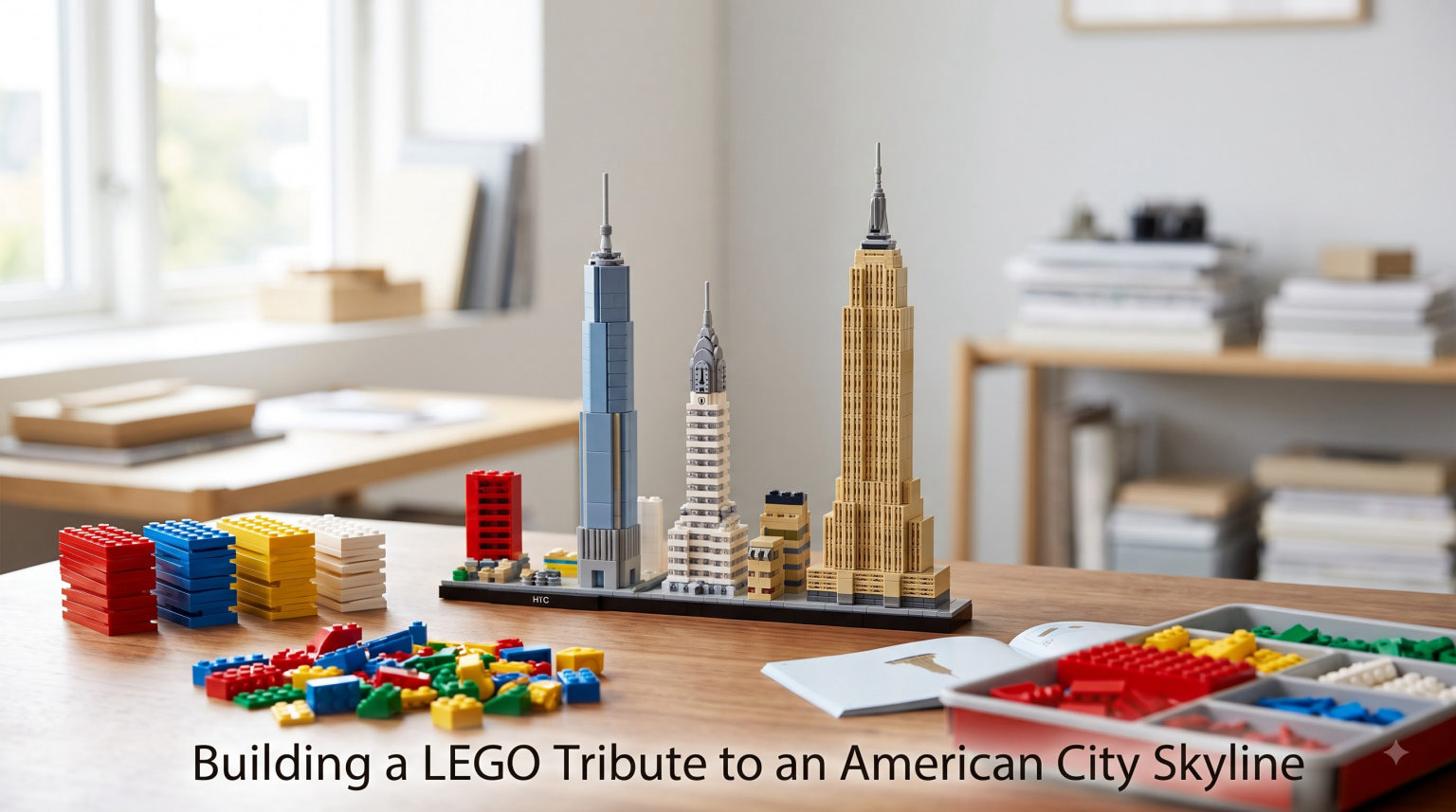
If you have ever stood on a rooftop at golden hour and watched a city wake up, you already know why a skyline is worth celebrating. A LEGO city skyline building guide is the playbook for capturing that moment in bricks, and an American city gives you the most iconic architecture on the planet to work with. In this guide, I will walk you through the exact process I use to plan, scale, build, and display a custom tribute that actually looks like the city on your wall.
By the end, you will know how to choose a city, calculate the right scale, lay out landmarks, build with confidence, and mount the finished piece so it stays safe for years. Whether you are honoring New York, Chicago, San Francisco, or your own hometown, the same framework applies.
Table of Contents
What Makes a Great American LEGO City Skyline Tribute
A LEGO skyline tribute is a custom display build that captures the most recognizable buildings of a single American city in miniature. It is more than a stack of skyscrapers. It is a curated portrait of a place, with the silhouette, the colors, and the landmarks that make the city feel like itself.
I built my first skyline in 2019 for Chicago, and I learned quickly that the difference between a pile of tall buildings and a real tribute is intentional selection. You are not trying to recreate every block. You are trying to recreate the feeling of looking at the city from a distance.
The best American LEGO skyline tributes share three traits. They pick a clear horizon line, usually a river or a waterfront. They choose five to eight landmarks that anyone from that city would recognize. And they use a consistent scale so the buildings feel like they belong together.
Think of it as portrait photography in brick. You are not capturing every detail. You are capturing the silhouette, the proportions, and the personality of the place.
How to Plan Your American City Skyline Project
Planning is where most LEGO skyline projects succeed or fail. I spend roughly 30 percent of my total build time on planning because it saves me from rebuilding the same wall three times.
Step 1: Choose Your City and Its Defining View
Pick a city, then pick a specific viewing angle. Every American city has a postcard view. New York has the Manhattan skyline from Brooklyn. Chicago has the lakefront from Alder Planetarium. San Francisco has the bay from Treasure Island. Seattle has the skyline from Kerry Park. Your viewing angle decides which buildings you need to include.
When I planned a Washington DC skyline last fall, I chose the view from the Arlington Memorial Bridge. That single decision told me I needed the Lincoln Memorial, the Washington Monument, the Capitol dome, and a hint of the Smithsonian. Anything else was optional.
Step 2: List Your Landmarks
Write down every building you want to include, then rank them. I aim for five to eight structures per skyline. Fewer than five feels empty. More than eight gets crowded and pushes the build length past a reasonable display size.
For each landmark, note its real-world height in feet, its width, and its most distinctive feature. That last column matters most. The Empire State Building is recognizable because of its spire. The Chrysler Building is recognizable because of its crown. The Flatiron is recognizable because of its triangular wedge.
Step 3: Decide on Build Size and Baseplate
Standard LEGO baseplates come in 32×32 stud and 48×48 stud sizes. A 48×48 baseplate gives you a 15 inch by 10 inch footprint, which is enough for a six-building skyline with breathing room. If your city has more landmarks, plan to extend the baseplate or connect two of them.
Sketch your layout on graph paper before you snap the first brick. One square per stud. This sketch becomes your blueprint and keeps you from improvising in the wrong direction halfway through.
Scale Calculation Guide for LEGO Skyline Builds
Scale is the math that makes your skyline believable. Get scale right and your buildings look like a city. Get it wrong and they look like toys stacked on a plate.
The official LEGO Architecture Skyline series uses a scale of roughly 1:650. That works because it lets the tallest real-world building (One World Trade at 1,776 feet) fit in about 36 bricks tall. For custom builds, you can pick any scale you want, but you must stay consistent across every building.
The Brick Height Formula
Here is the calculation I use on every build. A standard LEGO brick is 9.6 mm tall, and a plate is 3.2 mm tall. To find how many bricks tall a real building should be:
Bricks tall = (Real height in feet x 304.8) / 9.6
For One World Trade at 1,776 feet, that equals 56,400 mm divided by 9.6, or about 5,875 bricks tall. Obviously nobody is building that. Divide by your scale factor instead. At 1:650 scale, One World Trade becomes 2.7 feet tall in real measurements, which is about 34 bricks tall. That is the number you build to.
Choosing Your Scale Factor
Pick a scale based on your tallest building. If your skyline hero is the Willis Tower in Chicago at 1,451 feet, and you want it to be 40 bricks tall (about 38 cm), your scale factor is 1,451 divided by 40, which is roughly 1:36 in feet. That is a microscale.
If you want a more manageable build, scale your hero so it is 20 to 30 bricks tall. That gives you a scale factor between 1:50 and 1:80, which is what most custom MOC builders use for American skylines.
Width and Proportion Calculation
Width uses the same math but with the brick width of 8 mm. A 200-foot-wide building at 1:60 scale becomes 3.3 feet wide, or about 12 studs. Always build a fraction of a stud up to the nearest whole stud so your building sits cleanly on the baseplate.
Pro tip: hold a key landmark in proportion against a piece of paper with horizontal lines every 5 bricks. Mark the real height of every other building on the same sheet. That single page keeps your scale consistent as you build.
Step-by-Step Building Techniques for LEGO Skylines
Once you have your plan and your scale, the actual building follows a clear sequence. I have rebuilt six skylines, and every one of them followed these steps.
Step 1: Build the Baseplate Layout
Start with your baseplate or connected baseplates. Mark the footprint of each building with a light pencil line on the studs. This is where your graph paper sketch becomes real-world placement.
Step 2: Construct Each Building Bottom-Up
Build each building as a separate module before mounting it to the baseplate. This lets you work on details away from the crowded skyline and reduces the chance of bumping finished work. Use SNOT (Studs Not On Top) techniques for sideways-facing details like windows.
For American skyscrapers, I build the core first, then add the exterior cladding. The core is usually a 2×2 or 4×4 stack of bricks. The cladding uses 1×2 or 1×4 tiles and plates to create the facade pattern.
Step 3: Add the Silhouette Feature Last
The feature that makes a building recognizable goes on last. The Empire State Building spire. The Chrysler Building crown. The Capitol dome. The Transamerica Pyramid top. These details are fragile, so build them separately and attach them at the end with a single stud connection.
Step 4: Connect to the Baseplate
Once each building is complete, mount it to the baseplate in your planned position. Use a small amount of clear mounting putty on the bottom of each module for extra stability, especially if you plan to transport the build.
Step 5: Fill the Negative Space
Between your landmark buildings, add shorter structures to fill the cityscape. These can be 3 to 5 brick tall buildings made from simple stacked plates. They frame the landmarks and create the depth of a real city.
Step 6: Add Ground Details
Finish with streets, water, or green space. Dark gray plates for streets. Trans-blue tiles for water. Green plates for parks. These flat areas give the eye a place to rest and make the skyline pop.
Iconic American Landmarks to Include in Your Skyline
Here are the silhouettes that define the most built American skylines. Use these as a starting point for your own city selection.
New York City
The Manhattan skyline needs the Empire State Building, the Chrysler Building, One World Trade Center, and 432 Park Avenue if you want the modern look. From the Brooklyn viewing angle, the Brooklyn Bridge and a hint of Lower Manhattan complete the scene.
Chicago
Chicago is defined by the Willis Tower, the John Hancock Center (now 875 North Michigan Avenue), the Tribune Tower, and the Wrigley Building. From the lakefront, the radiating lines of the Chicago River add a unique geometric element.
San Francisco
San Francisco is a study in contrasts. The Transamerica Pyramid, the Salesforce Tower, the Golden Gate Bridge (from the right angle), and Coit Tower on Telegraph Hill are the must-haves. The bay water is what makes the skyline sing, so plan for a large blue area.
Washington DC
DC is not about height. It is about monuments. The Washington Monument, the Capitol dome, the Lincoln Memorial, the Jefferson Memorial, and the Smithsonian Castle make a tribute that is instantly recognizable. Plan for a horizontal layout rather than a vertical one.
Seattle
Seattle has the Space Needle as its hero, supported by the Smith Tower, the Columbia Center, and the Great Wheel. The Elliott Bay water in front and Mount Rainier in the background (if you are feeling ambitious) round out the Pacific Northwest feel.
Other Notable American Skylines
Los Angeles brings the US Bank Tower, the Wilshire Grand Center, and the Hollywood sign. Miami brings the skyline from South Beach with the pastel art deco district. Boston brings the Hancock Tower and the Custom House Tower. Each city has its own personality, and that is the point of a tribute.
Color Schemes and Brick Choices for Realistic Builds
Color is where most custom LEGO skylines go wrong. Too many colors and the city looks like a candy box. Too few colors and it looks like a Monopoly board. The trick is to use a tight palette of three to five colors per building.
For American skyscrapers, the classic palette is light gray, dark gray, sand blue, and black. Windows are usually achieved with dark gray or black tiles set flush into the wall. Doors and trim use a single accent color like dark red or brown.
For vintage buildings like the Flatiron or the Wrigley Building, add tan, cream, and reddish brown to the palette. These warmer tones suggest the older terra cotta and limestone facades that defined early 20th-century American architecture.
Use texture plates and grill tiles to add detail without adding colors. A 1×2 grille tile in dark gray makes a believable window. A modified brick with a clip lets you add signage without committing to printed pieces.
Display and Mounting Options for Your Completed Skyline
A skyline build deserves a display that protects it and shows it off. Here are the three approaches I have used with success.
Shelf Display
A floating shelf at eye level is the simplest option. Use a shelf that is at least 2 inches deeper than your baseplate so the build sits safely. Add small LED puck lights above for a gallery effect. The downside is dust, so a clear acrylic cover is a smart investment.
Wall Mount with Frame
Mount the build to a foam board backing, then frame it in a deep shadow box. This protects the build from dust and accidental bumps. You can hang the frame like a piece of art, which is fitting for a tribute. Use museum-grade glass or acrylic to prevent UV damage.
Built-In Lighting
For a showpiece, integrate LED strip lights into the baseplate before mounting the buildings. Hide the wiring along the back edge. A warm white strip behind the skyline creates a sunset glow that looks incredible. A cool white strip mimics a moonlit night. Avoid colored LEDs, which make the buildings look cartoonish.
Whatever you choose, keep the build out of direct sunlight. UV rays fade LEGO colors over time, and that is a tragedy for a tribute you spent weeks building.
Budget-Friendly Tips and Common Mistakes to Avoid
You can build a custom skyline for less than the cost of an official LEGO Architecture set. Buy gray, black, and tan bricks in bulk from Pick a Brick or trusted resellers. Reuse bricks from deconstructed sets you already own. Source unique pieces from BrickLink lots.
The community on Reddit r/legomoc regularly shares bulk-buying strategies and disassembly tips. Joining that community before your build saves you money and connects you with builders who have solved the same problems you will face.
Common mistakes to avoid. Do not mix scales between buildings. Do not skip the planning sketch. Do not glue bricks together (it kills resale value and repair options). Do not build directly on the baseplate without testing the layout first. And do not chase perfection on the first attempt. Your first skyline is a learning build. Your third one is the masterpiece.
Frequently Asked Questions About LEGO Skyline Tributes
How do I calculate scale for a LEGO skyline?
Multiply the real-world building height in feet by 304.8 to get millimeters, then divide by 9.6 (the height of a standard LEGO brick) to get the unscaled brick height. Divide that number by your scale factor (such as 1:60) to get the actual brick count you should build. Most American skyscrapers land between 20 and 40 bricks tall.
What scale should I use for a LEGO city skyline?
The most common scale for custom American LEGO skylines is between 1:50 and 1:80. The official LEGO Architecture Skyline series uses approximately 1:650. Pick a scale based on your tallest building: aim for 20 to 30 bricks tall for the hero structure so the build stays manageable.
Which American city landmarks work best in LEGO?
Landmarks with distinctive silhouettes work best. The Empire State Building spire, the Chrysler Building crown, the Transamerica Pyramid, the Capitol dome, and the Space Needle are all recognizable from a single shape. Avoid buildings that rely on signage or fine detail, since those elements are hard to read at small scale.
How long does it take to build a LEGO skyline tribute?
A six-building American skyline typically takes 20 to 40 hours spread over 2 to 4 weeks. Planning and brick sourcing take 30 percent of the time. Building takes 50 percent. Detailing and display setup take the remaining 20 percent. Larger skylines with 10 or more buildings can take 60+ hours.
Can I build a LEGO skyline without official sets?
Yes. You can source every brick you need from LEGO Pick a Brick, BrickLink, or bulk lots. Many custom builders never touch an official set. Buying bricks individually is more flexible and often cheaper than buying a set just for its pieces. The downside is that you need to plan your parts list carefully before ordering.
Start Your American City Skyline LEGO Tribute Today
Building a LEGO tribute to an American city skyline is one of the most rewarding projects in the hobby. You are not just stacking bricks. You are preserving a place that matters to you, in a form that lasts for decades. Pick your city, sketch your layout, calculate your scale, and start building. Months from now, you will be standing in front of a finished skyline that looks like the city you love, and that moment is worth every hour of planning.
For more LEGO building guides and MOC inspiration, bookmark The Brick Fantastic and check back often. If you have a city in mind that I did not cover, drop it in the comments. I am always looking for the next skyline to build.