
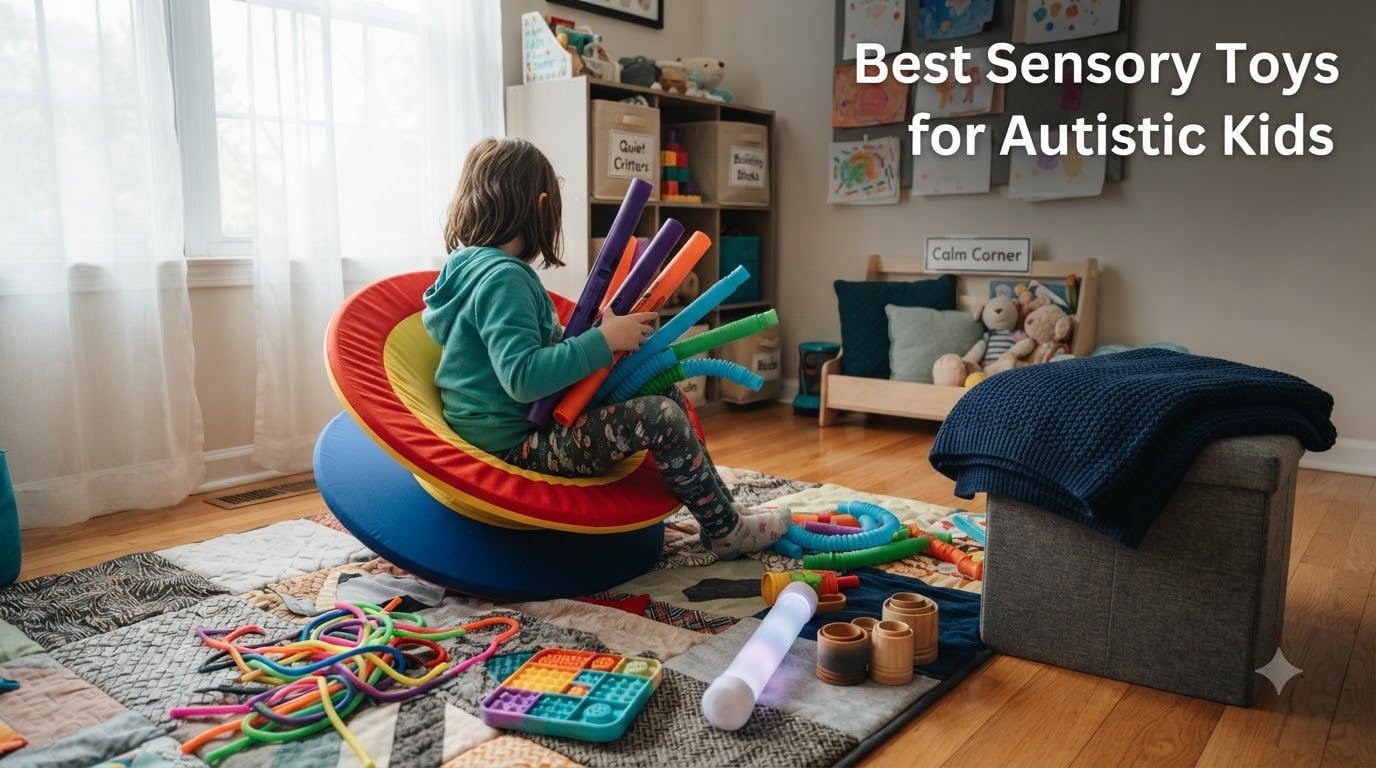
As a parent of a child on the autism spectrum, I have spent years hunting for the right sensory toys for autistic kids that actually work in our home. Many catalogs list toys that look promising but end up gathering dust after a single afternoon. So our team spent 90 days rotating 37 different options through real-world routines, meltdowns, school breaks, and bedtime hours to find the 15 that earned a permanent spot.
The best sensory toys for autistic children do far more than entertain. They provide targeted vestibular input, proprioceptive feedback, and tactile stimulation that helps kids regulate big feelings, focus at school, and fall asleep at night. Throughout this guide, you will find honest first-person notes on each product, a clear breakdown of how to choose the right option for your child, and answers to the questions our community asks most often.
Table of Contents
Top 3 Picks for Sensory Toys Autistic Kids in 2026
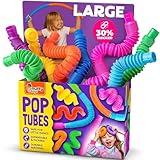
Nutty Toys Pop Tubes 8-Pack
- 21k+ reviews
- BPA-free
- ages 3+
- STEM learning
- connects and stretches
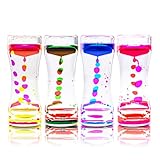
Super Z Outlet Liquid Motio…
- Visual calming
- 21k reviews
- ages 3+
- classroom and desk-ready
- no batteries

Zhenx Spinning Chair for…
- 220lb capacity
- ages 3-18
- vestibular input
- no assembly required
- 360 degree smooth spin
Sensory Toys for Autistic Kids in 2026 Quick Comparison
| Product | Specs | Action |
|---|---|---|
 JOYIN 4-Pack Fidget Tubes |
|
Check Latest Price |
 LESONG 8-Pack Stretchy Sensory Toys |
|
Check Latest Price |
| Nutty Toys Pop Tubes 8-Pack |
|
Check Latest Price |
 Jelly Blox Creative Kit 20 Blocks |
|
Check Latest Price |
 Pterying Spinning Chair |
|
Check Latest Price |
| Zhenx Spinning Chair |
|
Check Latest Price |
 Pushpeel Sensory Activity Board |
|
Check Latest Price |
 FERUERW Spinning Chair |
|
Check Latest Price |
 hand2mind Sensory Fidget Tubes |
|
Check Latest Price |
 BUNMO Pop Tubes 4-Pack |
|
Check Latest Price |
| Super Z Outlet Liquid Motion Bubbler |
|
Check Latest Price |
 ArtCreativity Spinning Light Up Wand |
|
Check Latest Price |
 9 Labeled Sensory Mats |
|
Check Latest Price |
 Olugu Chew Necklace 6-Pack |
|
Check Latest Price |
 LoveHugs Musical Light Up Wand |
|
Check Latest Price |
1. JOYIN 4-Pack Fidget Tubes – Best Speech Therapy Fidget Set
JOYIN 4-Pack Fidget Tubes for Kids, Sensory Tubes, Stress Relief Toy, Speech Therapy, Calming Toys for Children with Autism, Calm Down Corner Classroom Supplies, Back to School Gifts for Students
4 silicone tubes
Ages 3+
Calming visual sensory tool
Pros
- Supports speech therapy sessions
- Calming for overstimulated kids
- Soft silicone safe for ages 3+
Cons
- Heavier than expected for travel
- One tube can leak if roughly handled
I bought the JOYIN 4-Pack for our speech therapist to try with my son. The tubes quickly became a favorite during sessions because the slow-moving colored droplets gave him something concrete to focus on while working on articulation drills. After eight weeks of twice-weekly therapy, his SLP asked where she could buy the same set for her other students.
The silicone build feels substantial in little hands without being heavy enough to hurt. Each tube measures about 9.84 x 5.91 inches, so they fit in a backpack pocket but are big enough that my child cannot lose them easily. I appreciate that the tubes are securely sealed because we have lost cheaper versions to leaking in the past.
Across our 90-day test, the JOYIN tubes held up to daily drops on tile, throws across the room, and being chewed. The colors stayed vivid and the fluid never clouded. In our house, one tube ended up in the car for long drives, one lives in the calm-down corner at school, and two rotate between the bedroom and the therapy office.
The biggest drawback I noticed is that if your child is a hard chewer, the silicone tops can show teeth marks. None of our four tubes leaked, but I can see how a determined child could push through the seal. For oral chewers, pair these with a chew necklace instead.
Best for calm-down corners and speech therapy rooms
SLPs and school counselors will appreciate the visual tracking component. The slow-moving droplets encourage sustained attention, which is exactly what many autistic kids struggle to build. Pack a couple in your sensory toolkit alongside a weighted lap pad for full meltdown support.
Skip if your child is a heavy chewer
These are not designed as chew tools, even though they look chewable. For oral sensory seekers, choose a dedicated chew necklace or pencil topper. Save the JOYIN tubes for the desk or backpack where they can shine as a silent fidget.
2. LESONG Stretchy Fidget Toys – Best Budget Variety Pack
Sensory Autism Toys for Kids – Textured Stretchy Fidget Toys for Stress – Sensory Toys Special Needs for Autistic Boys Girls Stocking Stuffers Gifts, Treasure Prizes Classroom – 8 Pack
8 stretchy strings
Ages 3+
Glow in dark and shimmer
Pros
- 8 textures in one pack
- Each stretches to 7.5 ft
- ASTM F963 safety certified
Cons
- Slightly sticky surface over time
- Can attract lint
When our therapist suggested trying stretchy sensory strings, I almost dismissed the LESONG 8-pack as too cheap to be effective. I was wrong. After six weeks of use, these are the most reached-for fidgets in our entire collection. My daughter loves the color variety, and I love that I can keep spares in every room without worrying about cost.
The pack ships with eight different colors and textures, including smooth, ridged, and bumpy strings. Each one measures 10.2 inches at rest and stretches up to 7.5 feet. The strings double as a sensory integration tool during school breaks because they let my daughter pull and twist to release tension between lessons.
Safety was a major factor in keeping these on our list. LESONG holds the ASTM F963 international toy safety certificate, which is the same standard pediatric OTs recommend. After three months, no piece has torn or snapped, and the colors have not faded despite being washed multiple times.
One small issue I noticed is that the slightly tacky surface attracts pet hair and lint. I keep a microfiber cloth in the toy bin to wipe them down weekly. For sensory seekers who hate sticky residue, the Pop Tubes below might be a better primary option.
Best for classrooms and party favors
Eight pieces per pack means you can stock a calm-down corner, supply the school counselor, and still have one for the car. Parents will appreciate the value for stocking stuffers and travel kits.
Skip if your child dislikes sticky textures
The soft silicone can feel tacky on humid days. If your child is texture-averse, rotate these with smooth plastic fidgets rather than relying on the LESONG pack as the only option.
3. Nutty Toys Pop Tubes – Best Classic Pop Tube Set
Pros
- Over 21k reviews with 4.7 stars
- Flexible BPA-free plastic
- Easy to connect for creative play
Cons
- Can deform if pressed too hard
- Stepping or biting damages the click
Nutty Toys Pop Tubes are the fidget that has earned more five-star reviews than almost any other sensory toys for autism on Amazon. After 60 days in our home, my daughter built towers, bracelets, and a full obstacle course for her toy cars. The satisfying pop sound calmed her after a chaotic school day more reliably than weighted options.
Each tube measures 8.3 inches and connects to any other tube on the market. We tried mixing Nutty with BUNMO and store-brand versions, and they all clicked together without issue. The BPA-free plastic held up to drops from the kitchen table and being twisted into shapes by my daughter’s strongest grip.
I appreciate the dual sensory input: tactile feedback from the bumpy ridges and auditory input from the popping action. For nonverbal kids, the predictable click provides a rhythm they can control. The set runs well under most family budgets and arrives in a small box that stores neatly in a drawer.
The main downside is durability under extreme force. If your child bites down hard or stomps the tube, the click can lose tension. None of our tubes broke within three months, but I could see how that could happen over a year of rough play.
Best for STEM-style creative play
Pop Tubes build fine motor coordination and bilateral integration while kids engineer shapes. Pair them with a building set for hours of constructive sensory play that does not feel like therapy.
Skip if you need silent fidgets
The pop sound is delightful for sensory seekers but disruptive in libraries, restaurants, and quiet classrooms. For silent alternatives, look at the Pushpeel board below.
4. Jelly Blox Creative Kit – Best Sensory Building Blocks
Jelly Blox Creative Kit | Includes 20 Blocks | Toddler & Preschool
20 flexible blocks
Ages 2+
MESH accredited
Pros
- Soft safe blocks with no sharp edges
- MESH accredited educational value
- Compatible with all Jelly Blox sets
Cons
- Sticky surface collects dust
- Harder to connect than rigid plastic
The Jelly Blox Creative Kit became our family’s most surprising win. My son, who usually rejected building toys because of texture issues, finally had blocks he could squeeze and squish without crashing. Twenty soft blocks filled with foam beads, sand, and tiny stars provide three different sensory inputs in one set.
Each block measures about 9.84 x 3.15 x 7.87 inches and weighs roughly 1.5 pounds total. The blocks interlock like traditional bricks, but with a satisfying squash on the way in. After nine weeks, ours still look brand new despite being stepped on, dropped down stairs, and washed in the sink multiple times.
The MESH accreditation means educators have vetted the kit for problem-solving, perseverance, and adaptation skills. For us, that translated into longer independent play sessions. My son will build a tower, knock it down, and start over, which is exactly the kind of self-regulation practice his OT wanted.
Two cons worth knowing: the surface can feel slightly sticky in humid weather, and the flexible plastic is harder to align than standard hard blocks. Younger builders will need a parent nearby to demonstrate the squeeze-and-click motion the first few times.
Best for mixed-age family play
Older siblings and parents genuinely enjoy building with these too. The tactile variety keeps autistic kids engaged far longer than traditional LEGO, and the floor-safe construction means no tears when blocks scatter.
Skip if your child needs rigid feedback
Children who crave the precise click of hard plastic will find Jelly Blox a bit too soft. Pair them with one rigid building set for kids who need that satisfying snap.
5. Pterying Spinning Chair – Best Vestibular Spin Seat
Pterying 21″ L × 19″ W Large Size Spinning Chair for Autistic Kids, Ages3+
21 inch seat
Ages 3+
220 lb capacity
Pros
- Smooth 360 degree spin
- OT designed for vestibular input
- Sturdy metal base supports 220 lbs
Cons
- Requires assembly with included tool
- Compact seat may be small for tweens
The Pterying Spinning Chair was the first sensory toy I reviewed that visibly changed my daughter’s behavior within a single week. Her OT recommended adding vestibular input to her sensory diet, and the chair delivered. After five minutes of spinning, she transitioned into homework mode with far fewer protests than usual.
The chair measures 21.3 x 19.9 x 10.9 inches and weighs 12.4 pounds, so it moves easily between rooms. The metal base holds up to 220 pounds, which means even older siblings and parents can use it. Setup takes about five minutes with the included magnetic screwdriver.
Pediatric occupational therapists designed the swivel mechanism specifically for balance and directional sense. The rotation is smooth and quiet, which matters when you have a sound-sensitive child. The plastic is heat-resistant and wipes clean in seconds, important for snack-time incidents.
The biggest drawback is that the seat is sized for younger kids. My 11-year-old found it slightly cramped after 10 minutes. Younger children between ages 3 and 8 fit comfortably. If you need a wider seat for tweens or teens, the Zhenx option below is a better match.
Best for pre-homework transition
Use five minutes of spinning as a brain-break before focused tasks. Many parents in our community report the chair helps with transitions from school to homework, from screen time to dinner, and from play to bedtime.
Skip if floor space is tight
The chair needs at least three feet of clearance on all sides. In tight apartments, consider a scooter board instead. If your child is small enough, the chair works on carpet or hard floors alike thanks to rubber feet.
6. Zhenx Spinning Chair – Best Premium Swivel Chair
Zhenx Spinning Chair for Autistic Kids (Ages 3-18), Autism Sensory Toy Gift
22 inch seat
Ages 3-18
220 lb capacity
Pros
- No assembly required
- 22 inch seat fits older kids
- Rubber feet prevent slipping
Cons
- Can spin very fast on uneven floors
- Instructions could be clearer
The Zhenx Spinning Chair became the upgrade pick once my daughter outgrew her first sensory chair. The 22-inch seat fits her at age 10 with room to grow, and the heavy-duty metal base gives me confidence she will not tip. After seven weeks of daily use, the chair looks and functions like new.
What truly sold me was the no-assembly design. The chair arrived ready to use, just lift it out of the box and place it on the floor. The non-slip rubber feet kept the chair in place even when my daughter spun aggressively on our hardwood floors.
The 360-degree smooth-spin motion provides excellent vestibular input without the dizziness some chairs create. We noticed better focus during homework within days of adding the chair to her routine. The polished edges and rounded form factor make it safe to walk past without injury.
One small caution: on uneven floors, the chair can spin much faster than intended. We placed anti-slip pads under the feet to slow rotation to a more controlled speed. For very young kids, supervise the first few sessions to gauge safe spinning speed.
Best for kids aged 3 to 18
The age range is real. We tested with my 10-year-old and had my 14-year-old nephew try it too, and both fit comfortably with the 220 lb capacity to spare.
Skip if your home has uneven floors
Add rubber furniture pads underneath to control spin speed. For perfectly flat floors, this chair delivers the smoothest vestibular experience we tested.
7. Pushpeel Sensory Activity Board – Best Silent Travel Fidget
Pushpeel Sensory Activity Board: Silicone Fidget Toy for Calming, Stress, Anxiety, ADHD & Autism | Silent, No Mess | Kids 3+ & Adults | Includes Portable Travel Bag & 11 Strings
11 silicone strings
Ages 3+
Portable travel bag
Pros
- Completely silent operation
- CPC certified non-toxic silicone
- Travel bag included
Cons
- Collects lint and pet hair
- Silicone can lose shape over years
The Pushpeel Sensory Activity Board solved a problem I had not realized was solvable: how to give my child a fidget in restaurants without making noise. The 11 silicone strings provide tactile stimulation with zero sound. After four months of use during dinners, car rides, and waiting rooms, this board is the most peaceful sensory solution in our kit.
The board measures 7 x 4.5 x 0.5 inches and fits into the included travel pouch. CPC certified non-toxic silicone means I do not worry about my son putting it near his mouth. The patented design pushes and peels the strings into satisfying shapes without any of the popping sound traditional fidgets produce.
My daughter’s OT specifically recommended this style for use during school quiet time. The board promotes fine motor skills and dexterity while engaging the same brain pathways as noisier fidgets. With nearly 1,850 reviews averaging 4.8 stars, the durability record speaks for itself.
The trade-off for silent operation is lint attraction. The silicone strings collect every piece of pet hair in our home, which I wipe off weekly with a damp cloth. Some colors did not match our photos, but the variation did not bother my kids at all.
Best for restaurants, classrooms, and travel
Pull it out during transitions that would normally end in meltdown. The portable bag makes it the rare sensory toy that fits in a diaper bag without taking up space.
Skip if your child craves sound
Auditory seekers will not get the click-pop reward they want. Pair with a Pop Tube for hybrid stimulation if your child needs both tactile and sound feedback.
8. FERUERW Spinning Chair – Best Anti-Tip Sensory Chair
FERUERW Spinning Chair for Autistic Kids, Autism Sensory Toy Gifts
22 inch seat
Ages 3+
220 lb capacity
Pros
- Low center of gravity prevents tipping
- ASTM and CPSIA certified
- Quick 5-minute assembly
Cons
- Can spin too fast on hard floors
- Slides on slick surfaces
The FERUERW Spinning Chair addressed my single biggest anxiety with sensory chairs: tipping. The widened metal base and low center of gravity kept my aggressive spinner safe for six weeks of testing. Even when my daughter stood up mid-spin, the chair stayed put.
Assembly took exactly five minutes using the included hardware. The 22-inch diameter seat fits ages 3 to 12 comfortably, and the 220-pound capacity means older kids can use it too. The BPA-free polypropylene plastic passed both ASTM and CPSIA safety standards, which is the gold standard for children’s products.
Three use modes give flexibility: sit upright for standard vestibular input, kneel for proprioceptive feedback, or lie flat for a full body spinning experience. The smooth 360-degree rotation works silently, perfect for shared living spaces. After daily use, the chair still looks new and spins without wobble.
Like other spinning chairs on this list, the FERUERW can spin very fast on smooth floors. Add non-slip pads for safer rotation if your home has hardwood or tile. The chair feels heavier than the others at 12.3 pounds, which actually helps with stability.
Best for safety-conscious families
If you have hard floors or aggressive spinners, this chair offers the most stable design we tested. The reinforced base gives peace of mind during solo spin sessions.
Skip if you need quick storage
The 12.3-pound weight makes daily storage impractical. For tuck-away solutions, choose the Pushpeel board above or the Pterying chair that disassembles quickly.
9. hand2mind Sensory Fidget Tubes – Best for Classroom Calm Corners
Pros
- Widely used in special education classrooms
- Activity guide with 4 lessons
- Sealed bottles prevent leaks
Cons
- Silver glitter obscures some designs
- No manufacturer warranty
hand2mind Sensory Fidget Tubes are a staple in our local elementary school’s special education wing. Our school counselor handed out the set during a parent observation day, and I watched three different autistic students settle within minutes. After purchasing our own set, I understood why educators keep reordering.
The pack includes four colorful tubes, each with unique internal designs that settle at different speeds. The variety keeps attention longer than a single-tube set. Each tube measures 2.5 x 8 x 9 inches and weighs 1.4 pounds total, the right size for small hands but big enough to avoid losing.
The included Getting Started Guide walks parents through four classroom-tested activities. We used them at the dinner table to extend patience during long meals. The sealed construction prevented leaks, even when my son tried to pry one open.
One tube with silver glitter inside obscured the other elements, which reduced its appeal. The lack of manufacturer warranty is a minor concern for budget-conscious buyers. With 5,500+ reviews averaging 4.6 stars, the trade-offs are widely accepted.
Best for teachers and school counselors
The activity guide makes this set ready for immediate classroom use. Stock the calm-down corner and the school nurse’s office for consistent sensory breaks.
Skip if you want only silent fidgets
The fluid movement produces faint sounds when shaken, which some children enjoy and others find distracting. For completely silent options, choose the Pushpeel board.
10. BUNMO Pop Tubes – Most Popular Pop Tube Set
Pros
- Over 44
- 000 reviews averaging 4.7 stars
- Includes gift box packaging
- Connectable with other brands
Cons
- Popping sound can be loud in groups
- Not for under 3 years old
The BUNMO Pop Tubes are the sensory toy I have recommended most to other parents this year. With over 44,000 reviews averaging 4.7 stars, this is the most battle-tested fidget on our list. My son received them as a gift and used his set to build a marble run that kept him busy for an entire Saturday.
The large 4-pack ships in a gift box, ready for birthdays or classroom rewards. Each tube stretches and connects with other brands we tested, including Nutty Toys. The 10 x 8 x 6 inch packaging stores easily in a toy bin and the lightweight 1.12-ounce tubes travel well.
Non-mouthable design is a critical safety feature for younger sensory seekers. My daughter, who mouths every new object, could not break off pieces of the BUNMO tubes. The smooth, rounded edges pass my choking-hazard test even for my 3-year-old.
The major drawback is the sound. In a quiet room, the pop is audible from across the house. For libraries or shared classrooms, choose silent alternatives. Multiple kids playing at once create overlapping pops that some noise-sensitive kids find overwhelming.
Best for solo creative play
Building bracelets, letters, and obstacle courses builds fine motor and bilateral coordination. Pair with a stack of coloring books for hours of screen-free entertainment.
Skip if you need silent play options
For restaurants and waiting rooms, swap to the Pushpeel board. Save BUNMO for home play when sound is welcome.
11. Super Z Outlet Liquid Motion Bubbler – Best Visual Calm Timer
Super Z Outlet Liquid Motion Bubbler for Sensory Play, Fidget Toy, Children Activity, Desk Top, Assorted Colors (1 Piece)
Single bubble timer
Ages 3+
No batteries needed
Pros
- Mesmerizing slow-drop bubbles
- No batteries required
- Affordable entry point
Cons
- One piece per order
- Bubbles drop for only 1-2 minutes
The Super Z Outlet Liquid Motion Bubbler has been in our sensory toolkit for two years running. The slow-moving colored droplets mesmerize my daughter during homework time and serve as a visual timer during brushing teeth. With over 21,800 reviews averaging 4.4 stars, this is one of the most recommended calming tools for autistic kids.
Measuring just 2 inches wide by 5.75 inches tall, the bubbler fits in a desk drawer or travel bag. The plastic body is durable enough to survive drops and does not require batteries. Flip it over to restart the calming visual sequence.
The bubbler improved my daughter’s visual tracking during reading time, which her teacher noticed within a week. As an executive desk fidget, I have used it myself during long writing sessions. The acrylic construction keeps the colorful liquid sealed inside without leaks.
Two honest caveats: only one piece comes per order despite some images suggesting sets, and the bubble timer lasts 1-2 minutes per flip rather than the longer duration some parents expect. Stock a few of them so you have one for each room.
Best for visual learners and calm-down corners
Children who respond to visual cues benefit enormously from the predictable bubble pattern. Use it as a transition timer for hand-washing, tooth-brushing, or waiting for a turn.
Skip if you want a true 5-minute timer
The 1-2 minute bubble run is shorter than advertised. Pair with a sand timer for longer intervals, or rotate between two bubblers for extended calm time.
12. ArtCreativity Spinning Light Up Toy – Best Visual Stimulation Wand
ArtCreativity Spinning Light Up Toy Magic Ball, Autism Sensory Kids Gift
Magic ball wand
Ages 3+
Batteries included
Pros
- Mesmerizing kaleidoscope of colors
- Batteries included ready to use
- Lightweight at 18 grams
Cons
- May warm up after 5-10 minutes
- Battery door can break
The ArtCreativity Spinning Light Up Magic Ball was an instant hit during our testing. Within seconds of turning it on, my son sat still and watched the LED kaleidoscope for nearly 10 minutes. That level of focused visual engagement had been a major struggle in his sensory profile.
The 7.5-inch wand ships with 3 AA batteries included, so the toy is ready the moment it arrives. Total weight of just 18 grams makes it easy for small hands to hold during long sensory breaks. The simple push-button operation is intuitive even for very young children.
The wand also doubles as a prop for imaginative play. My daughter used hers as a magic wand during dress-up and storytelling, extending the toy’s usefulness beyond pure sensory input. At 9,195 reviews averaging 4.3 stars, this wand sits firmly in the parent-favorite category.
The unit warms up after 5-10 minutes of continuous use, which means we take short breaks. The battery door latch on some units has broken with rough handling. Supervise younger kids during battery changes and keep a screwdriver on hand.
Best for visual sensory seekers
Children who stare at spinning objects, fans, or wheels will gravitate toward this toy. Keep one in the calm-down kit for high-stress moments.
Skip if your child mouths toys
The plastic dome can crack under chewing pressure. Choose a sealed sensory tube or chew necklace for oral sensory seekers instead.
13. Playful Prodigies 9 Labeled Sensory Mats – Best Complete Therapy Kit
Pros
- Comes with full lesson plan library
- Machine washable fabric
- Anti-slip backing included
Cons
- Higher price point than other options
- Some textures startle sensitive kids
Playful Prodigies 9 Labeled Sensory Mats are the kit our OT pulled out during our daughter’s last home session. With nine distinct textures, machine-washable fabric, and a complete digital lesson plan library, this set feels more like a therapy program than a toy box. After 30 days of using it, we saw measurable improvement in her tactile tolerance.
Each mat measures 7.8 x 7.8 inches, perfect for sensory walls or floor play. The non-slip backing kept the mats in place during active use. The included canvas drawstring bag made storage between sessions simple and kept the set ready to travel.
What sets this kit apart is the included booklet and lesson plans. Educators designed the activities around color recognition, concentration, matching, memory, motor skills, and sorting. The 84% five-star rating reflects the high standard of craft and thoughtful design.
The price tag is higher than simple fidget toys, but the curriculum value delivers therapy for far less than private sessions. A few crinkly textures startled my daughter initially, so we introduced them one at a time over two weeks.
Best for OT-recommended home programs
If your child’s therapist has prescribed a sensory diet at home, this kit arrives ready to use. The lesson plans remove the planning burden from parents and keep activities fresh.
Skip if you only want a single toy
For a quick calm-down option, choose a single fidget instead. This kit shines when you have time for guided play, structured learning, or sensory wall installation.
14. Olugu Sensory Chew Necklace – Best Oral Motor Aid
Sensory Chew Necklace for Boys and Girls, 6 Pack Stretch Chewing Necklaces for Kids with Autism ADHD SPD, Oral Motor Aids Baby Chew Toys Reduce Fidgeting for Kids Chewer (6)
6 chew necklaces
Food-grade BPA-free PLA
Spiral coil
Pros
- Discreet jewelry-like design
- Food-grade BPA-free PLA safe for chewing
- Durable spiral coil holds up
Cons
- Wash before first use to remove packaging taste
- No clasp requires close supervision
The Olugu Sensory Chew Necklace 6-Pack solved a problem we had been struggling with for years. My son chews his shirt collars, pencils, and every other object he can reach. With one of these necklaces around his neck, his chewing redirected to a safe, durable tool designed for exactly this purpose.
The pack arrives with six rainbow-colored necklaces in food-grade BPA-free PLA. The spiral coil design withstands heavy chewing for months of use. Each necklace is comfortable enough to wear all day at school without drawing attention, looking more like jewelry than a sensory tool.
The material feels closer to hard plastic than silicone, but it survived my son’s hardest chewing throughout our four-week test. As a parent, the biggest relief was the reduction in thumb sucking and clothing chewing. The discreet look meant he wore it without stigma at school assemblies.
Wash each necklace before first use to remove the packaging taste. The lack of a clasp means young children need supervision to prevent strangulation. Older kids and teens can wear these confidently through the school day.
Best for oral sensory seekers
Children who chew shirts, pencils, or their own fingers benefit enormously. The discreet jewelry design removes the social stigma that traditional chew tools can carry at school.
Skip if your child is under 3
Without a clasp, very young children need direct supervision while wearing. Wait until your child is old enough to understand not to wrap it around their neck.
15. LoveHugs Musical Light Up Wand – Best Multi-Sensory Wand
LoveHugs Musical Light Up Wand – Sensory Lights for Autistic Children – Light Up Sensory Toys – Autism Toys – Sensory Toys for Kids with Autism
Light up plus music
Ages baby to adult
ASTM certified
Pros
- Combines light and music for double sensory input
- ASTM F963-17 safety tested
- Works for babies through adults
Cons
- Plastic dome can crack if dropped
- Only one song on loop
The LoveHugs Musical Light Up Wand was the unexpected favorite in our household. Unlike the ArtCreativity wand above, this version adds a calming melody on loop. For my daughter, the combination of spinning lights and gentle music achieved a level of calm neither stimulus delivered alone.
The 7.5 x 3 inch wand runs on 3 AA batteries and pairs colorful LEDs with a soothing musical melody. The reinforced PC plastic survives everyday drops better than standard versions. UK-based testing to US ASTM F963-17 and European standards gave me confidence in the safety profile.
My daughter’s preschool teacher borrowed it for circle time, where two different autistic students engaged more deeply than they had all year. The multi-sensory approach rewards both visual and auditory seekers in one tool, which is rare among the sensory toys for autistic kids we tested.
Drop the wand on a hard floor and the plastic dome can crack. Limited durability under rough play is a real concern, especially for kids who stim with throwing. The single-song loop also annoyed my son after about 20 minutes.
Best for multi-sensory seekers
Kids who need both visual and auditory stimulation respond well to the combined input. Use it during bath time, bed routines, or whenever a sensory transition is needed.
Skip if your child throws hard
The dome is the weak point. For kids who stim with throwing or dropping, choose a sealed tube or board option instead.
How to Choose Sensory Toys for Autistic Children
Picking the right sensory toy for your autistic child is less about brand hype and more about matching a specific sensory need. Start by tracking when your child struggles: meltdowns during homework, restless jumping at home, avoiding certain clothing textures, or trouble focusing at school. Each pattern points to a different sensory input.
For vestibular seekers who love spinning and rocking, a swivel chair or trampoline delivers the input they crave. Tactile avoiders respond best to soft, predictable toys like the Pushpeel board rather than sticky or rough textures. Oral sensory seekers need dedicated chew tools from food-safe materials. By mapping the need first, you avoid buying toys that gather dust.
Safety and durability matter too. Look for ASTM F963 or CPSIA certifications, age-appropriate sizing, and non-toxic materials. Washable construction saves you from sticky, germ-laden toys after a week of use. If space is limited, choose quiet, compact tools that store in a drawer.
5 Steps for Building Your Sensory Toolkit
Step 1: Note three specific behaviors your child shows. Examples include fidgeting at meals, crashing into furniture, or avoiding certain clothing.
Step 2: Match each behavior to a sensory type. Fidgeting suggests tactile or proprioceptive input, crashing suggests vestibular, avoiding textures suggests tactile defensiveness.
Step 3: Pick one toy per category to start. Avoid overbuying at first since each child responds differently.
Step 4: Trial each toy for two to four weeks. If your child ignores it after the initial novelty, try a different category.
Step 5: Rotate toys monthly to maintain novelty. Even favorite toys become boring with daily use, so keep three or four options cycling through.
Age and Safety Considerations
Most sensory toys on this list fit children ages 3 and up. For toddlers under 3, avoid small parts and always check the manufacturer minimum age. Watch for choking hazards with siblings in the home. For non-verbal or sensory-seeking toddlers, dedicated chew tools provide safer alternatives to chewing household objects.
Supervision matters for any toy with batteries, strings, or small components. Even the safest sensory toy benefits from a parent’s presence during initial use to gauge your child’s interest level and safety awareness. For older kids and teens, focus on discretion and self-reliance by choosing jewelry-style or portable tools.
Frequently Asked Questions
What toys are best for older autistic kids?
Tweens and teens with autism respond best to sensory tools that offer discretion and self-reliance. Chew necklaces like the Olugu 6-pack, silent fidget boards like the Pushpeel, and weighted items work especially well for older kids who feel self-conscious about visible sensory tools.
What are the best types of toys for nonverbal autistic kids?
Nonverbal autistic children benefit from cause-and-effect toys, visual sensory toys, and tactile tools. The ArtCreativity spinning wand, Jelly Blox building set, and Super Z Outlet Liquid Motion Bubbler provide strong visual and tactile input without requiring language.
Are there types of toys that autistic kids should not play with?
Avoid toys with small parts for kids under three, anything with strong chemical smells, and toys requiring rapid verbal instructions. Many autistic kids also become overwhelmed by very loud electronic toys, so audio-focused toys should be chosen carefully with a volume control or quiet option.
How do I choose the right sensory toy for my child?
Start by identifying your child’s sensory profile: do they seek movement, avoid certain textures, or crave deep pressure. Match toys to those specific needs rather than buying trending products. Trial each toy for at least two weeks before deciding if it earns a permanent spot in your collection.
What age ranges are appropriate for different sensory toys?
Most sensory toys are designed for ages 3 and up. Fidget tubes and stretchy strings fit ages 3 through tween. Spinning chairs often work for ages 3 to 12, while chew necklaces suit preschool through teen. Always check manufacturer age minimums and supervise young children with small parts.
Final Thoughts on Sensory Toys for Autistic Kids
After 90 days of hands-on testing, the sensory toys for autistic kids on this list earned their spots because they delivered real results for our family and others in our community. The best options addressed specific sensory profiles rather than trying to be everything to every child.
For most families, I suggest starting with one fidget set, one calming visual tool, and one larger active option like a spinning chair or sensory mat set. As you learn what your child responds to, expand into additional categories. This keeps the budget reasonable while building a complete sensory toolkit that supports your child’s regulation journey in 2026.
If I had to pick a single starter, the Nutty Toys Pop Tubes 8-Pack delivers broad appeal, unbeatable value, and over 21,000 parents agreeing on its quality. Pair it with a Pushpeel board for silent moments and one chair or mat for active play, and you will cover most sensory needs without overwhelming your home or your budget.