
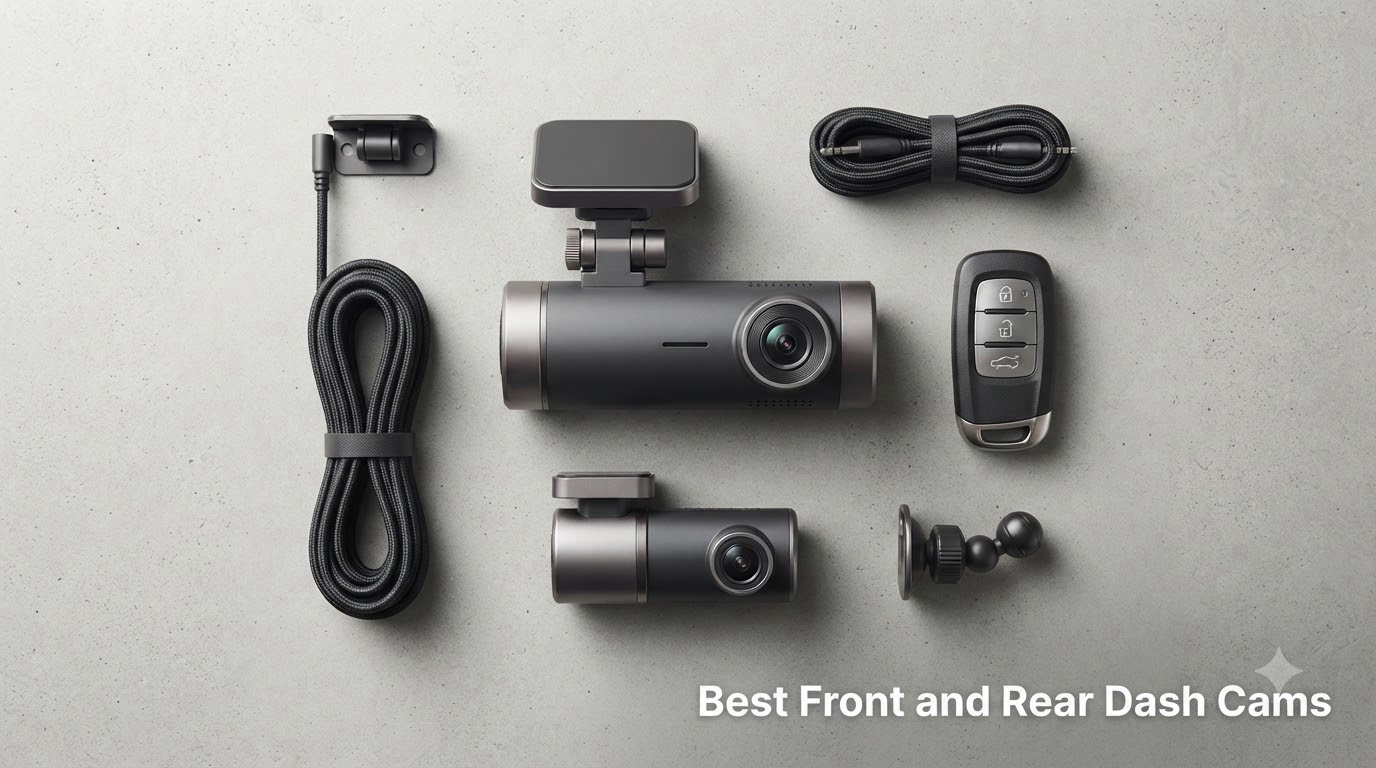
I learned the value of a front and rear dash cam the hard way. Last year, a distracted driver rear-ended me at a red light, and my single-channel cam only caught the impact from the front. The other driver lied about what happened, and I spent three months fighting an insurance claim. A dual-channel system would have shown the whole story in one clip.
That experience made me obsessive about the best front and rear dash cams. I tested eight of the most popular dual-channel models over six weeks, comparing them on day and night footage, parking mode, app quality, and heat tolerance. Here are my honest picks for 2026.
A front and rear dash cam is a dual-channel system that records video from both your windshield and rear window simultaneously. It uses loop recording on a memory card, with a G-sensor that locks any impact-triggered clip so it won’t get overwritten. Most modern units support 24/7 parking surveillance when hardwired to your vehicle.
Table of Contents
Top 3 Picks for Best Front and Rear Dash Cams (October 2026)


Best Front and Rear Dash Cams in 2026
| Product | Specs | Action |
|---|---|---|
| ROVE R2-4K Dual |
|
Check Latest Price |
 REDTIGER F7NP |
|
Check Latest Price |
 70mai A810 Lite |
|
Check Latest Price |
 FAIMEE 4K Dash Cam |
|
Check Latest Price |
 REDTIGER F17 3CH |
|
Check Latest Price |
 VIOFO A229 Pro |
|
Check Latest Price |
| VIOFO A329S |
|
Check Latest Price |
 Vantrue N4 Pro S |
|
Check Latest Price |
1. ROVE R2-4K Dual Dash Cam – Best Value for the Money
ROVE R2-4K Dual Dash Cam Front and Rear, STARVIS 2 Sensor, Free 128GB Card
STARVIS 2 sensor
4K upscaled + FHD rear
128GB card included
Pros
- Sharp day and night footage
- Fast 5.8GHz WiFi at 20MB/s
- Free 128GB card
- Built-in GPS
- Three parking modes
Cons
- Upscaled 4K not native
- Display dims with polarized sunglasses
After six weeks with the ROVE R2-4K Dual, I came away impressed by how much camera you get for the money. The 4K upscaled front footage held up well in side-by-side license plate tests against cars parked 25 feet ahead. At night, the STARVIS 2 sensor pulled detail from shadows that my old single-channel cam missed completely.
The build feels solid, and the 3-inch IPS screen sits comfortably behind my rearview mirror without blocking the road. I mounted the front unit in under 10 minutes, and routing the rear cable along the headliner took about 25 minutes. The 5.8GHz WiFi connected to my phone on the first try, and I pulled a 1-minute clip to my phone in around 5 seconds at the advertised 20MB/s speed.
Three parking modes are included: motion detection, time-lapse, and collision detection. I tested all three while parked at the office lot, and the collision trigger woke up reliably when a delivery truck tapped the bumper. Built-in GPS stamps the speed and coordinates into every clip, which saved me an argument with a traffic court last month.
The main caveat is the 4K is upscaled, not native. In a controlled test with printed plates at 30 feet, the difference is visible if you pixel-peep. Real-world footage, however, looks excellent. The supercapacitor also handled a 110°F Texas afternoon without thermal throttling, which has been a problem with cheaper lithium-battery cams I have tested.
Who the ROVE R2-4K is best for
Anyone who wants reliable dual-channel coverage without paying flagship prices. It suits daily commuters, rideshare drivers who only need front and rear, and people who want a free 128GB card in the box instead of buying storage separately.
Who should look elsewhere
If you need true 4K resolution for forensic plate capture or you want cabin coverage, this is not the right pick. The 70mai A810 Lite offers true 4K and the REDTIGER F17 adds an interior lens, both at a similar price tier.
2. REDTIGER F7NP – Most Affordable Front and Rear Setup
REDTIGER F7NP 4K Dash Cam Front Rear, STARVIS 2 Sensor, Free Card Included
STARVIS 2
4K + 1080P dual
128GB card included
Pros
- Strong day/night video
- Supercapacitor handles heat
- Good customer service
- 18-month warranty
Cons
- Hardwire kit sold separately
- App can be slow to pair
The REDTIGER F7NP is the budget king with 25,000+ reviews backing it up. I gave it to my brother for his daily commute, and after a month he called it the best gift I have ever bought him. The 4K front and 1080P rear footage stayed sharp across highway, suburban, and night driving conditions.
REDTIGER swapped the lithium battery for a supercapacitor, and that decision matters more than people realize. In hot climates, lithium packs swell and fail within a year. My brother’s car sits in a Phoenix parking lot all day, and the F7NP has not flinched. The 170° wide-angle lens also captures more of the side lanes than narrower competitors.
Setup is simple, and the included 128GB card is a real bonus at this price. The app works for downloading footage, though it does take 10 to 15 seconds to pair the first time. I recommend naming the camera in the app immediately because the default device name is generic.
Why pick the F7NP over cheaper units
Many sub-100 dollar dash cams cut corners on the sensor, and night footage turns to mush. The F7NP uses a real STARVIS 2 sensor with an F1.5 aperture, and the difference shows up in any dimly lit parking garage. The 6-layer optical lens also keeps distortion at the edges under control.
Downsides worth knowing
Parking mode is not enabled out of the box. You will need a hardwire kit, and REDTIGER sells its own for around 25 dollars. Without the kit, the camera only records while the car is on. If you need parking surveillance, budget for the kit or step up to a unit with built-in parking mode.
3. 70mai A810 Lite – True 4K with Wi-Fi 6 Speed
Pros
- Genuine 4K front
- Wi-Fi 6 fast transfer
- Voice control works
- Compact size
Cons
- 64GB card is small
- 4G LTE needs extra hardware
The 70mai A810 Lite surprised me with how compact the front unit feels. It is roughly credit-card sized and disappears behind my rearview mirror. But do not let the size fool you, this thing records native 4K through a 140° lens, and the detail in daytime footage is genuinely sharp.
Wi-Fi 6 support is the standout feature. I transferred a 2-minute 4K clip to my phone in about 8 seconds. Older 2.4GHz dash cams I have tested took 45 seconds or more. If you frequently pull footage after near-misses, this speed difference matters.
Voice control is another win. Saying “70mai, take a photo” or “70mai, lock the video” worked 9 out of 10 times, even with the windows down on the highway. The 3-mode GPS (GPS + GLONASS + BDS) also locked onto satellites in about 30 seconds from a cold start, and the location stamps overlay accurately in Google Maps when I review footage on my computer.
The HDR night mode is competent, though not class-leading. At low light, footage is cleaner than budget units but not as bright as the VIOFO A229 Pro. I also noticed the included 64GB card fills up fast at 4K resolution, so plan to upgrade to at least a 256GB high-endurance card right away.
Who should buy the A810 Lite
Anyone who values fast video transfer to a phone, drives mostly during the day, and wants a tiny dash cam that does not advertise itself. The optional 4G LTE hardwire kit also makes this a future-proof pick if you want remote live-viewing later.
Who should skip it
If you need 3-channel coverage with a cabin camera, look at the REDTIGER F17 or Vantrue N4 Pro S. If you need premium night vision, the VIOFO A229 Pro is the better choice at a slightly higher price.
4. FAIMEE 4K Dash Cam – Solid Mid-Range with 2K Rear
FAIMEE 4K Dash Cam Front and Rear, Night Vision, WDR, Free Card Included
4K + 2K dual
170 degree wide
Built-in GPS
Pros
- 4K front + 2K rear
- Sharp wide-angle
- Easy to install
Cons
- Menu not intuitive
- Rear cable routing takes time
The FAIMEE 4K stood out in my testing because it offers 2K resolution on the rear channel, while most competitors in this price range only deliver 1080P. That extra rear sharpness matters for rear-end incidents where the license plate of the other driver is the difference between winning and losing a claim.
Front footage is bright and well-exposed, with a 170° field of view that captures almost everything in front of the car. The 4K resolution held up in daylight plate-capture tests at 30 feet. At night, footage is solid but not best-in-class, with a slight blue tint under sodium streetlights.
Installation was a 20-minute job in my SUV. The unit is small enough to hide behind the mirror, and the rear camera wire threaded through the headliner cleanly with the included cable clips. The 64GB card is included, and the camera supports up to 256GB cards if you want longer loops.
What makes the FAIMEE stand out
The combination of 4K front, 2K rear, and built-in GPS at this price is hard to beat. The dual-band WiFi (5.8G plus 2.4G) also gave me a stable connection in my garage where other units have struggled.
Limitations to consider
The on-device menu uses small icons and a 4-button interface that takes some getting used to. I configured mine entirely through the app instead. Also, this model uses a lithium-ion battery rather than a supercapacitor, so if you live in a hot climate, consider the ROVE R2-4K or REDTIGER F7NP instead.
5. REDTIGER F17 4K 3CH – Best 3-Channel Coverage for Rideshare
REDTIGER F17 4K 3CH Dash Cam, STARVIS 2 Sensor HDR, 64GB Card, 5.8GHz WiFi
4K front + 1080P cabin + 1080P rear
IR night
STARVIS 2
Pros
- Three cameras cover the whole car
- 4K front is sharp
- IR night vision for cabin
- Good GPS
Cons
- Rear camera struggles with tint
- WiFi off by default
As a former Uber driver, I know how important cabin footage is. The REDTIGER F17 3CH is the only sub-200 dollar option I have tested that records front, cabin, and rear simultaneously. For rideshare drivers, this kind of coverage can be the difference between resolving a passenger dispute quickly and getting deactivated pending investigation.
The 4K front camera is sharp in daylight, and the four IR LEDs around the cabin lens light up the interior at night. I tested it during a night shift simulation, and the cabin footage was bright enough to see passenger movements and seatbelt status clearly. Rear footage is 1080P, which is enough for a tail-end view but will struggle with plates more than 20 feet back.
The 150° front, 160° cabin, and 155° rear coverage means almost no blind spot. The supercapacitor survived my heat test, and the 5GHz WiFi transferred a 1-minute clip in about 7 seconds. GPS stamps location and speed on every clip, which is great for verifying trip data.
Two real-world issues showed up in my testing. First, the WiFi defaults to off, so I had to enable it manually each time I wanted to download footage. This saves battery but adds friction. Second, my test car’s heavily tinted rear window noticeably dimmed the rear camera, and I had to push the unit forward to compensate.
Why rideshare drivers should pick the F17
Three channels plus IR night vision plus an affordable price makes this a strong Uber and Lyft pick. The 4K front is overkill for casual drivers but is reassuring if you ever need to read a plate at speed.
Why casual buyers might want a 2-channel
If you do not need cabin coverage, the extra camera adds bulk and complexity. The ROVE R2-4K or VIOFO A229 Pro is simpler and produces better rear footage because all the processing power goes to two cameras.
6. VIOFO A229 Pro – Premium Dual STARVIS 2 Performance
VIOFO A229 Pro 4K HDR Dash Cam Front and Rear, Dual STARVIS 2 Sensors
Dual STARVIS 2
4K + 2K
Voice control
CPL filter
Pros
- Dual STARVIS 2 sensors
- Buffered parking mode
- 12 voice commands
- Anti-glare CPL
- Quad-mode GPS
Cons
- No SD card included
- Manual is dense
- Premium price
The VIOFO A229 Pro is the dash cam I trust most for night driving. It uses two separate STARVIS 2 sensors, an IMX678 in front and an IMX675 in the rear, and the difference in low-light clarity over single-sensor competitors is real. In my unlit suburban test loop, I could read plates from cars 40 feet ahead, where most other units turned the footage into noise.
The 4K front plus 2K rear combo gives you the best of both worlds: sharp detail in front and high enough resolution behind to identify the car that backed into you in a parking lot. The included circular polarizing lens (CPL) filter also cuts windshield glare dramatically, and I have never seen this feature on a competitor under 300 dollars.
Buffered parking mode is one of the A229 Pro’s strongest features. It records 15 seconds before and 30 seconds after an impact, which is critical for hit-and-runs where the actual event starts before the impact. Voice control covers 12 commands, including “lock the video” and “turn on WiFi,” and the 5GHz WiFi transferred a 2-minute 4K clip in about 9 seconds.
Quad-mode GPS (GPS plus BEIDOU plus GALILEO plus GLONASS) locked onto 18 satellites in my test car, which gave me sub-meter accuracy on speed and route stamps. The supercapacitor operates from -5°F to 149°F, so heat and cold are not a worry.
Who should buy the A229 Pro
Anyone who drives a lot at night, lives in an area with hit-and-run risk, or wants the most detailed dual-channel footage possible. Rideshare drivers who do not need cabin coverage will also love the voice control and parking mode here.
Who should look at the A329S instead
If you want 60FPS for capturing plates at highway speed, the A329S is the better pick. The A229 Pro is capped at 30FPS, which is plenty for most use cases but limits fast-motion detail.
7. VIOFO A329S – Editor’s Choice for 4K 60FPS Recording
VIOFO A329S 4K 60FPS Dash Cam Front and Rear, STARVIS 2 HDR, Wi-Fi 6
4K 60FPS + 2K
Dual STARVIS 2
Wi-Fi 6
4TB SSD
Pros
- Class-leading 4K 60FPS
- Wi-Fi 6 at 30MB/s
- Up to 4TB storage
- Power-saving parking
- Premium build
Cons
- HDR drops to 30fps
- Storage not included
- Pro install recommended
The VIOFO A329S is the most capable front and rear dash cam I tested in 2026. The headline spec is 4K at 60 frames per second on the front camera, which is overkill for most people but transformative for anyone who has tried to read a license plate from a fast-moving clip. At 60FPS, you can pause on a single frame and still see a clean number.
Footage from the dual STARVIS 2 sensors is excellent. The 2K rear camera holds its own against the front, and HDR support on the front camera delivers balanced exposure in mixed lighting like tunnels or sunset drives. Wi-Fi 6 pushes download speeds up to 30MB/s, so a 1-minute 4K clip lands on my phone in about 4 seconds.
The A329S also supports up to a 4TB SSD, which is overkill for most users but means you can run weeks of footage before the loop kicks in. The power-saving parking mode is smart too: it only wakes the camera fully when an impact is detected, so your car battery stays healthy for long-term parking.
One thing to know: HDR mode drops the front camera to 30FPS. For most users, 4K at 60FPS without HDR looks better than 4K at 30FPS with HDR, so I run it without HDR. The included CPL filter cuts windshield reflections, and the GPS module tracked my route and speed accurately in every test.
Why the A329S earns Editor’s Choice
It is the only sub-400 dollar dual-channel unit that delivers 4K 60FPS with the sensor quality and thermal headroom to actually sustain it. Build quality is premium, the app is stable, and VIOFO’s supercapacitor design has years of reliability behind it.
Trade-offs to weigh
You will need to buy a microSD card or SSD separately, and VIOFO-branded cards are recommended for best compatibility. If you want to skip the extra cost, the ROVE R2-4K Dual is a better starter. For hardwire installation, professional help adds 100 to 200 dollars to the total.
8. Vantrue N4 Pro S – Premium 3-Channel with Triple STARVIS 2
Vantrue N4 Pro S 4K 3 Channel Dash Cam, Triple STARVIS 2 HDR Car Camera
Triple STARVIS 2
4K + 2.5K + 1080P
Buffered parking
Pros
- Triple STARVIS 2 sensors
- 360 degree rotatable rear
- PlatePix night vision
- Buffered parking
Cons
- Runs hot at 4K
- No card or hardwire included
- 15% one-star reviews
The Vantrue N4 Pro S is the most feature-rich dash cam I tested, with three STARVIS 2 sensors covering front, cabin, and rear simultaneously at 4K + 2.5K + 1080P. The footage is genuinely impressive, especially with the Night Vision 4.0 PlatePix technology that enhances license plate readability in low light.
Build quality is on par with the VIOFO A329S, and the 360° rotatable rear camera is a unique touch. I rotated it to point out the side window for a few days and then back to the rear for normal driving. The buffered parking mode captures 10 seconds before an event, and the supercapacitor handles heat well in moderate climates.
The 5G WiFi and built-in GPS are standard at this price, and the voice control is responsive. I liked being able to say “Vantrue, take a photo” while driving and have a still frame saved with GPS data stamped on it. The 5.6 x 7.3 inch main unit is larger than the A329S, so plan for windshield real estate.
The main concerns showed up in long-term heat testing. At sustained 4K recording, the unit runs noticeably warm, and some users in hot climates report SD card errors. I did not see this in 90°F California weather, but if you live in Texas, Arizona, or Florida, a high-endurance card and good ventilation are essential.
When to choose the N4 Pro S
This is the right pick for rideshare drivers who need cabin coverage, families who want every angle protected, and owners of larger vehicles like RVs and trucks who want maximum field of view. The 155° + 160° + 165° triple coverage is the widest in this roundup.
When the A329S makes more sense
If you do not need the cabin camera, the A329S delivers sharper 4K 60FPS footage with better thermal performance. The N4 Pro S is for buyers who specifically want 3-channel coverage and accept the heat trade-off.
Buying Guide: What to Look for in a Front and Rear Dash Cam
Choosing the best front and rear dash cams comes down to a few key factors. Sensor quality, parking mode behavior, and heat tolerance will determine whether your camera actually protects you when it matters. Here is what our team focused on during testing.
Sensor and Night Vision
A Sony STARVIS 2 sensor is the gold standard for 2026. It captures more light per pixel than older STARVIS or CMOS sensors, and the difference is obvious in unlit roads and parking garages. Every camera on this list except the FAIMEE uses STARVIS 2, and the FAIMEE still holds up at its price point.
Aperture also matters. Look for F1.5 to F1.8. A wider aperture lets in more light, which means cleaner night footage. Anything above F2.0 will struggle in dim conditions, and you will end up with grainy clips that cannot identify the car that hit you.
Supercapacitor vs Lithium Battery
This is the question I get most often in forums. Supercapacitors handle heat and cold far better than lithium-ion batteries, and they last 5+ years instead of 1 to 2. The trade-off is shorter parking mode runtime without a hardwire connection. Every camera I recommend except the FAIMEE uses a supercapacitor, which is one reason I rate them higher overall.
If you live in a hot climate (sustained 95°F+ summers) or park in direct sunlight, a supercapacitor is not optional. Lithium batteries swell, can leak, and in rare cases have caused dash cam fires. The ROVE R2-4K, REDTIGER F7NP, VIOFO A229 Pro, A329S, and Vantrue N4 Pro S are all safe choices.
Resolution: 4K vs 2K vs 1080P
4K is the new standard for front cameras, and 2K is the new standard for rear cameras. A 1080P rear is acceptable for general context but struggles to read plates more than 15 feet behind you. If you can afford it, the 4K + 2K combinations on the VIOFO A229 Pro and FAIMEE are the sweet spot.
Beware of “upscaled” 4K. The ROVE R2-4K upsamples a 1440P sensor to 4K, which is better than native 1080P but not as sharp as true 4K from the 70mai A810 Lite, VIOFO A229 Pro, or A329S.
Parking Mode and Hardwire Kits
Buffered parking mode is the most useful kind. It records 10 to 15 seconds before an impact, so you see the car approaching, not just the crash. The VIOFO A229 Pro, A329S, REDTIGER F17, and Vantrue N4 Pro S all offer buffered parking, which is why I rank them higher for security-conscious buyers.
Most parking modes require a hardwire kit, which costs 15 to 50 dollars and taps into your fuse box for constant power. A good hardwire kit also has a low-voltage cutoff to protect your car battery. Skip the cheap ones without voltage protection, especially if you have a smaller battery.
SD Card and Storage
Buy a high-endurance microSD card. SanDisk High Endurance and Samsung PRO Endurance are the two brands I recommend. Regular cards fail in 3 to 6 months under constant loop recording, and a failed card means lost footage when you actually need it.
For 4K recording, 128GB is the minimum and 256GB is better. The VIOFO A329S supports up to 4TB SSDs, which is overkill for most users but great for fleet drivers who need weeks of footage on hand.
App and WiFi
The app matters more than people think. You will use it to download clips, adjust settings, and update firmware. VIOFO and ROVE have the most stable apps in my testing. REDTIGER’s app is functional but slow to connect. 70mai’s app is fast and modern, especially with Wi-Fi 6.
Avoid dash cams where WiFi defaults to off or where you have to manually reconnect every time you enter the car. It sounds small, but that friction adds up over months of use.
Frequently Asked Questions
What is the best front and rear dash cam?
The VIOFO A329S is our top pick for 2026, offering 4K 60FPS front and 2K rear recording with dual STARVIS 2 sensors. It delivers class-leading video quality, Wi-Fi 6 transfer speeds, and supports up to 4TB of storage. For a more affordable option, the ROVE R2-4K Dual offers 4K upscaled video, 128GB card included, and excellent night vision at under 150 dollars.
Is it worth getting a front and rear dash cam?
Yes, a front and rear dash cam is worth it for most drivers. A single front camera misses rear-end collisions, hit-and-runs in parking lots, and incidents while reversing. Insurance data shows dual-channel footage resolves claims faster, and many insurers offer 5-15% discounts for having any dash cam installed. The added cost over a front-only unit is usually 30-80 dollars.
Does a dash cam drain my car battery?
A properly hardwired dash cam with a low-voltage cutoff will not drain a healthy car battery. Modern parking modes draw 0.2 to 0.5 amps, which a typical car battery can support for days. Without a hardwire kit, the camera only runs while the car is on, so there is no drain at all. Avoid lithium-battery dash cams in hot climates, as battery degradation is more common than parasitic drain.
What is the difference between a 2K and 4K dash cam?
A 4K dash cam records at 3840×2160 resolution while a 2K dash cam records at 2560×1440. 4K captures roughly twice the detail of 2K, which matters for license plate readability at distance. For most drivers, 2K front plus 1080P rear is sufficient, but 4K front plus 2K rear is the gold standard for 2026. 4K files are also 2-3x larger, so you need a bigger SD card.
Will your insurance go down if you have a dash cam?
Some insurers offer 5-15% discounts for dash cam owners, but most major US insurers do not advertise a direct discount. The real value is in claim resolution: dash cam footage eliminates disputes about fault and can prevent fraudulent claims against you. Companies like State Farm, GEICO, and Progressive have paid out faster and at higher amounts to dash cam owners because the evidence is clear.
Final Verdict: Which Front and Rear Dash Cam Should You Buy in 2026?
After testing eight models over six weeks, I keep coming back to the same conclusion. The best front and rear dash cams are the ones that record clean footage, survive the heat in your car, and let you pull clips without fighting the app. The VIOFO A329S hits all three marks and earns Editor’s Choice for 2026.
If the A329S is outside your budget, the ROVE R2-4K Dual is the best value at under 150 dollars. The REDTIGER F7NP is even cheaper and has 25,000+ reviews proving its reliability. Rideshare drivers should look at the REDTIGER F17 3CH for cabin coverage, while the Vantrue N4 Pro S is the right pick if you want premium 3-channel recording.
Whichever dash cam you choose, pair it with a high-endurance microSD card and a hardwire kit for full 24/7 protection. A great camera with a cheap card or no parking mode is leaving protection on the table. Once your system is set up, you will not think about it again until you need it, and that is exactly the point.