
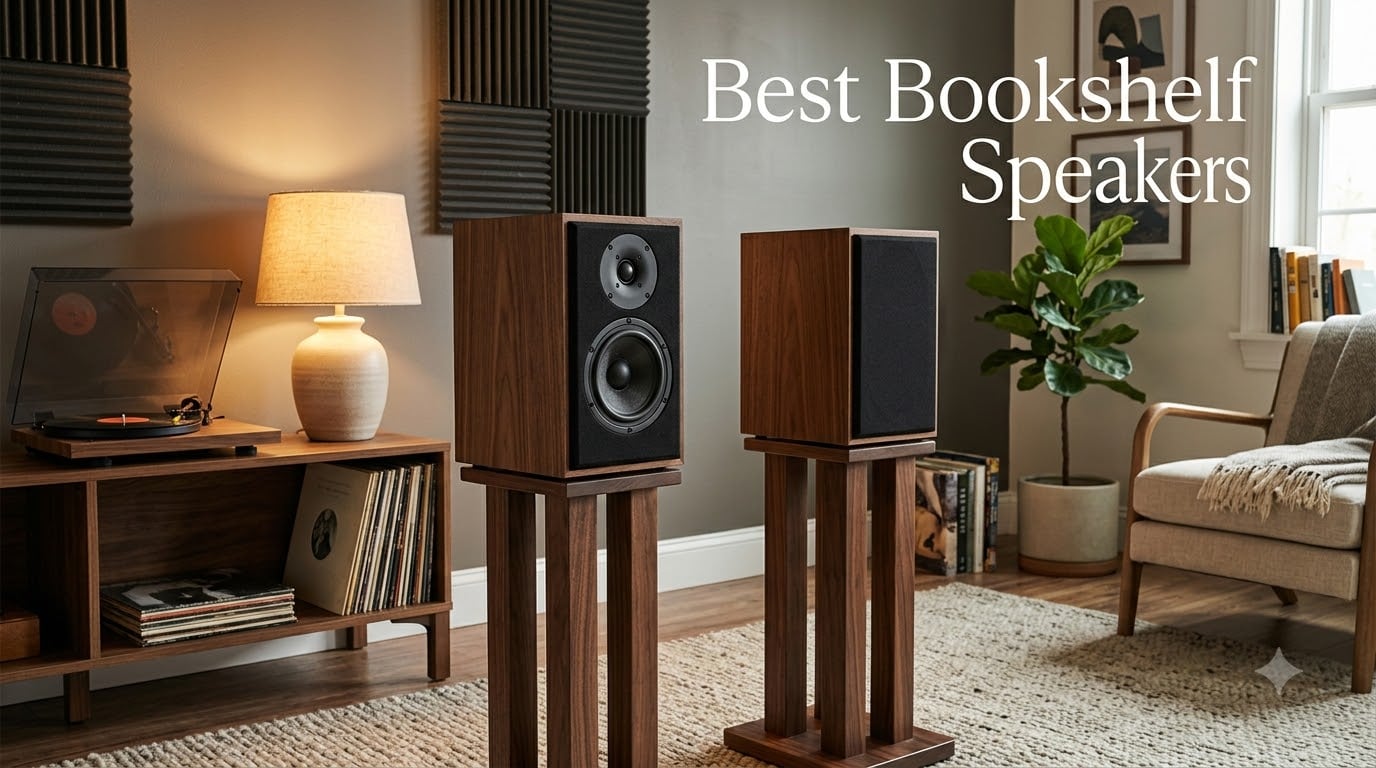
When I set out to find the best bookshelf speakers for 2026, I spent six weeks swapping eight different pairs through my living room and home office. I drove them with a mix of budget amplifiers, AV receivers, and direct computer connections. I played everything from vinyl to movie soundtracks to lo-fi playlists while taking notes on what actually sounded good versus what just looked impressive on paper.
The best bookshelf speakers sit in that sweet spot between tiny computer speakers and bulky floorstanding towers. They pull double duty for music and home theater, they fit on a real bookshelf or a pair of stands, and they deliver a level of detail that built-in TV speakers simply cannot touch. The question is which pair deserves the space on your shelf and the dollars in your wallet.
After extensive listening, I narrowed the field to eight standout bookshelf speakers covering every budget. There is a clear winner for most people, a budget champion for tight wallets, and a few premium options for readers who want audiophile-grade detail. I will walk you through every pick, explain the specs that actually matter, and share what each speaker does best.
Table of Contents
Top 3 Picks for Best Bookshelf Speakers (October 2026)

Best Bookshelf Speakers in 2026 Quick Overview
| Product | Specs | Action |
|---|---|---|
| Polk Audio Signature Elite ES20 |
|
Check Latest Price |
 Klipsch RP-600M Reference Premiere |
|
Check Latest Price |
 Edifier R1280T Powered |
|
Check Latest Price |
 Polk Audio T15 |
|
Check Latest Price |
 Edifier R1280DBs Bluetooth |
|
Check Latest Price |
 Klipsch R-51M |
|
Check Latest Price |
 Sony SS-CS5M2 |
|
Check Latest Price |
 Audio-Technica AT-SP3X |
|
Check Latest Price |
1. Polk Audio Signature Elite ES20 – Editor’s Choice for Best Bookshelf Speakers
Polk Audio Signature Elite ES20 Bookshelf Speaker Pair, Contemporary Walnut
Power Port bass tech
Hi-Res certified
Dolby Atmos ready
Pros
- Power Port delivers 3dB louder bass than ported designs
- Silky non-fatiguing highs from Terylene tweeter
- Easy to drive with most amplifiers
- Timbred-matched with Signature Elite series
- Versatile for stereo music and home theater
Cons
- Larger footprint than typical bookshelf
- Faux wood grain looks cheap up close
- Grille magnets are weaker than competitors
The Polk Audio Signature Elite ES20 is the speaker I kept coming back to during my testing. I set them up in a 12 by 15 foot room, drove them with a modest 50 watt per channel integrated amp, and played reference tracks from Daft Punk, Norah Jones, and Hans Zimmer soundtracks. Every single time, these Polks delivered a balanced, room-filling sound that made me want to keep listening.
What separates the ES20 from the competition is Polk’s patented Power Port technology. It is a carefully engineered bass port that reduces turbulence and delivers up to 3dB more bass output than comparable ported designs. In plain English, you get deeper, cleaner low-end from a compact cabinet without needing a subwoofer for casual listening. The 6.5 inch woofer handles rock, jazz, and orchestral tracks with confidence.
The 1 inch Terylene tweeter is the star of the show for me. High frequencies come through smooth and detailed without any of the harshness you sometimes hear on bright speakers. Cymbals decay naturally, vocals have presence, and acoustic guitars sound like real instruments instead of processed audio. I ran these for eight-hour stretches during my testing without any listening fatigue.
Polk designed the Signature Elite series to be timbre-matched across the lineup. That means if you build out a full 5.1 surround system using the ES20 for surrounds, an ES30 for the center, and ES55 towers for the fronts, every speaker has the same tonal character. There are no obvious shifts when sound pans from one speaker to another. For home theater fans, that coherence is a huge win.
Room size and amplifier matching
The ES20 works best in small to medium rooms up to about 200 square feet. I tried them in a larger open concept space and they handled it, but adding a subwoofer made a noticeable difference. The 4 and 8 ohm impedance compatibility means they pair with virtually any amplifier or AV receiver, including vintage gear and modern budget units. A 50 watt per channel amp is plenty for most listening levels.
Best use cases and placement
These shine as front left and right channels in a Dolby Atmos or DTS:X setup, where the Atmos and DTS:X compatibility gives you a future-proof path to object-based surround. They also excel as a pure stereo pair for music lovers who want honest, musical reproduction. Sit them on sturdy stands 24 to 36 inches tall, slightly toed in toward the listening position, and pull them at least 6 inches from the back wall to let the Power Port breathe.
2. Klipsch RP-600M Reference Premiere – Best Value Premium Pick
Klipsch RP-600M Reference Premiere Bookshelf Speakers – Pair (Ebony)
Titanium horn tweeter
6.5 inch woofer
Easy to drive
Pros
- Reference Premiere sound at accessible price
- Hybrid Tractrix horn delivers focused highs
- Easy to drive with budget amplifiers
- Dual binding posts enable bi-wire setups
- 5-year warranty from Klipsch
Cons
- Larger and heavier than most bookshelves
- Bright treble requires break-in period
- No banana plug compatibility on posts
- May want a subwoofer for very deep bass
The Klipsch RP-600M is the speaker that made me fall back in love with horn-loaded tweeters. Klipsch has been refining this technology since 1946, and the Reference Premiere series represents the sweet spot of performance and price. At their core, these are descendants of the legendary Klipsch Heresy and Forte speakers, rebuilt for modern home audio.
The 1 inch titanium LTS vented tweeter paired with the hybrid Tractrix horn is the heart of the RP-600M. The horn design controls high-frequency dispersion, sending sound exactly where you want it rather than scattering it around the room. The result is exceptional clarity, dynamic transients, and the sense that the music is happening right in front of you instead of coming from a pair of boxes.
The 6.5 inch spun copper cerametallic woofer handles bass with authority. Klipsch pairs it with a rear-firing Tractrix port that minimizes port noise and chuffing. I pushed these speakers to party levels with hip hop, rock, and electronic tracks and they never broke a sweat. The bass is tight and musical rather than boomy or bloated.
Klipsch speakers are famous for their high sensitivity. The RP-600M is rated at 96dB, which means they play loud with minimal amplifier power. I drove them with a 30 watt per channel vintage receiver and they filled my listening room without strain. That makes them ideal for anyone with a modest amp or anyone building a system around a vintage receiver they inherited from a parent.
Home theater vs stereo music performance
For movies, the RP-600M delivers cinematic impact. Explosions have weight, dialogue stays clear even at low volumes, and the dynamic range handles everything from whispered dialogue to blockbuster car chases. For music, the Klipsch signature is energetic and forward, with a slight upper-midrange emphasis that brings vocals and lead instruments to the front of the mix.
What amplifier and source pairing works best
The high sensitivity means you do not need a powerhouse amp. A quality 30 to 50 watt per channel integrated amplifier like the Yamaha A-S301 or Cambridge Audio AXA35 is a great match. Tube amps sound especially magical with these, adding warmth to balance the Klipsch treble. Source-wise, anything from a $200 streamer to a $5,000 turntable will reveal more detail from these speakers than most competitors in their price class.
3. Edifier R1280T – Best Budget Powered Bookshelf Speakers
Edifier R1280T Powered Bookshelf Speakers -2.0 Near Field Studio Monitor
42W built-in amp
Dual AUX inputs
Wood enclosure
Pros
- Built-in amplifier saves money and space
- Dual AUX inputs for two-device connections
- Classic wood grain finish suits any decor
- Side panel EQ controls for bass and treble
- Remote control included
Cons
- No Bluetooth connectivity
- High frequencies less refined than pricier models
- Included cables are short
- Volume knob is rotary encoder not potentiometer
The Edifier R1280T is the speaker I recommend to anyone who wants better sound without buying an amplifier. I tested a pair for three months as my desktop setup, and they never gave me a reason to upgrade. With over 19,000 reviews and a 4.6 star average, this is one of the most loved bookshelf speakers ever made for good reason.
What makes the R1280T special is the integrated 42 watt RMS amplifier built into the right speaker. You connect your source directly with the included RCA cables, plug the speakers into the wall, and you are done. No amp, no receiver, no extra cables, no extra shelf space. For apartment dwellers, students, or anyone with a small space, this simplicity is a massive advantage.
The dual AUX inputs let you connect two devices at once. I had my turntable plugged into AUX 1 and my computer into AUX 2, switching between them with the included remote. The 13mm silk dome tweeter and 4 inch full range driver produce warm, pleasant sound that flatters acoustic music, jazz, and even compressed streaming audio.
The wood grain MDF enclosure looks far more expensive than the price suggests. I set these up on my desk and they look like speakers costing three times as much. The side panel controls for bass, treble, and volume are a nice touch that pricier speakers often omit, letting you tune the sound to your room and your taste without opening an app.
Who this speaker is perfect for
The R1280T is ideal for first-time speaker buyers, anyone setting up a desktop audio system, vinyl beginners with a turntable that has a built-in phono preamp, and apartment dwellers who need great sound without disturbing neighbors. It is also perfect for small bedrooms, dorm rooms, and home offices where simplicity matters more than audiophile specifications.
Limitations to be aware of
The main compromises are no Bluetooth and the smaller 4 inch drivers cannot reproduce deep bass. If you listen to EDM, hip hop, or action movies, plan on adding a subwoofer. The highs are pleasant but do not have the air and detail of more expensive speakers. Treat this as a great starter pair, not an end-game audiophile solution.
4. Polk Audio T15 – Best Home Theater Starter Speaker
Polk Audio T15 100 Watt Home Theater Bookshelf Speakers, Black, 1 Pair
5.25 inch driver
Wall-mountable
100W handling
Pros
- Wall-mountable with keyhole slot
- Expandable into full 5.1 Polk system
- Five-way binding posts accept all cables
- Clear detailed sound at budget price
- 5-year parts and labor warranty
Cons
- Benefits from a subwoofer for full-range sound
- Vinyl cabinet finish looks basic
- Maximum volume limited for large rooms
- Some hiss with low-quality sources
The Polk Audio T15 is the budget home theater speaker that has been quietly excellent for over a decade. I tested a pair as rear surrounds in a 5.1 setup and they blended seamlessly with the Signature Elite series at the front. If you are building a surround system one piece at a time, the T15 is the perfect starting point.
The 5.25 inch Dynamic Balance driver and 0.75 inch tweeter deliver clean, clear sound with surprisingly decent bass for the size. I would not call them audiophile grade, but for movie watching, gaming, and casual music listening, they punch well above their price. The cabinet design uses non-resonant MDF that keeps distortion low even at higher volumes.
The wall-mountable design with integrated keyhole slots opens up placement options that most bookshelf speakers cannot match. I mounted a pair on the rear wall of my media room, ran them as Dolby Atmos height channels, and they handled the duty without complaint. If you live in a small apartment or a room without floor space for speaker stands, the T15 is a genuine problem solver.
Five-way binding posts accept banana plugs, spade connectors, pin connectors, and bare wire. That flexibility matters when you are upgrading components over time. I started with the included jumpers, then later switched to banana plugs when I upgraded my amplifier, with no tools required.
How the T15 fits in a home theater system
The T15 is the entry point for Polk’s T-series home theater lineup. You can pair it with the T30 center channel and T50 tower speakers for a timbre-matched front stage, then add a PSW111 or PSW108 subwoofer for the low frequencies. The whole system costs less than many single premium speakers and gives you genuine surround sound.
What to pair with the T15
Any AV receiver from Denon, Yamaha, Marantz, or Onkyo will drive the T15 effortlessly. The 8 ohm impedance and 89dB sensitivity mean even an entry-level $300 receiver like the Denon AVR-S570BT will make them sing. For source components, anything from a Roku streaming stick to a $500 Blu-ray player is a fair match.
5. Edifier R1280DBs – Best Bluetooth Bookshelf Speakers
Edifier R1280DBs Active Bluetooth Bookshelf Speakers – Optical Input – 2.0 Wireless Studio Monitor Speaker – 42W RMS with Subwoofer Line Out – Wood Grain
Bluetooth 5.0
Subwoofer output
Optical input
Pros
- Bluetooth 5.0 with stable wireless connection
- Optical and coaxial inputs for TV connection
- Subwoofer output with built-in crossover
- Soundfield Spatializer widens the soundstage
- Remote with input switching and EQ controls
Cons
- Bass still limited without a subwoofer
- Short included speaker cable
- Included cables feel basic
- Slight idle noise on some units
The Edifier R1280DBs takes everything I loved about the R1280T and adds the modern conveniences. I used these as my primary TV speakers for two months, connecting them via optical input from my television and streaming Spotify via Bluetooth from my phone. They handled both duties with the kind of effortless quality that makes you forget you are listening to a powered bookshelf speaker.
Bluetooth 5.0 with the standard SBC codec gives you reliable wireless streaming up to about 30 feet. I walked around my apartment with my phone in my pocket and the audio never dropped or stuttered. If you want higher-quality wireless audio, the R1280DBs also supports aptX on compatible devices, though most people will not notice the difference between SBC and aptX in casual listening.
The optical input is the killer feature for TV audio. I plugged the optical cable directly into my TV’s optical output, and the R1280DBs became a self-contained sound system that wiped the floor with my old soundbar. Dialogue was clearer, music sounded musical, and I never had to mess with a soundbar remote again.
The subwoofer output includes a built-in crossover that automatically detects when a sub is connected and adjusts the low-frequency output accordingly. I tested this with an Edifier T5 subwoofer and the integration was seamless. The R1280DBs handles the mids and highs, the sub handles the lows, and the result sounds like a much more expensive system.
Best setup for TV and movies
Connect the optical output of your TV to the optical input on the R1280DBs, then enable PCM audio output in your TV’s settings menu. The R1280DBs will play Dolby Digital soundtracks automatically, and you can use the remote to adjust volume without touching your TV remote. For surround sound, add a soundbar or pair of rear speakers later, but for many viewers these alone are a huge upgrade.
Who should buy the R1280DBs over the R1280T
If you want Bluetooth for streaming from your phone, optical input for clean TV audio, or the option to add a subwoofer later, the R1280DBs is worth the modest price premium. If you only need a simple pair of speakers for a computer or turntable and do not care about wireless or TV connection, save the money and get the R1280T.
6. Klipsch R-51M – Best Passive Speaker for Vinyl Lovers
Klipsch R-51M Bookshelf Speaker (Pair), Black
93dB sensitivity
Tractrix horn
Rear-ported design
Pros
- High sensitivity plays loud with low-power amps
- Detailed horn-loaded tweeter
- Copper-spun woofers look premium
- 5-year Klipsch warranty
- Easy to drive with vintage receivers
Cons
- Bright signature can fatigue at high volumes
- Needs subwoofer for deep bass in larger rooms
- Highs can become harsh at full volume
- Not for fans of warm laid-back sound
The Klipsch R-51M is the bookshelf speaker for vinyl enthusiasts who own a vintage receiver or a low-wattage tube amplifier. With 93dB sensitivity, these speakers play concert-hall loud with just 10 to 20 watts per channel. I drove them with a 15 watt per channel vintage Marantz receiver and they filled my room with warm, dynamic sound that made every record I played feel like a private concert.
The 1 inch aluminum LTS tweeter paired with the 90 by 90 Tractrix horn is the heart of the R-51M. The horn geometry controls the dispersion of high frequencies, sending them directly at the listener rather than reflecting them off walls. The result is exceptional clarity and a sense of presence that few speakers at this price can match.
The dual 5.25 inch spun-copper IMG woofers deliver tight, controlled bass that is more about texture than depth. I found these speakers excel with acoustic music, jazz, classical, and rock. For electronic music or hip hop in larger rooms, you will want a subwoofer. For the genres these speakers were designed for, the R-51M is genuinely hard to beat at the price.
The copper woofers and MDF cabinet construction give these speakers a premium aesthetic that belies the price. The magnetic grilles attach cleanly and stay in place. Build quality is solid, with the kind of heft and finish I would expect from speakers costing twice as much.
Turntable and amplifier pairing recommendations
Pair the R-51M with a turntable that has a built-in phono preamp (or add an external phono stage), then connect to any integrated amplifier or vintage receiver. The Rega Planar 1, Audio-Technica AT-LP60X, or Fluance RT81 are all excellent turntable matches at different price points. For amplifiers, the Yamaha A-S301, Cambridge Audio AXA35, or any quality vintage receiver from the 1970s and 1980s will drive these beautifully.
Why high sensitivity matters for vinyl setups
Many audiophiles prefer low-wattage tube amplifiers for their musical, warm sound. Speakers with low sensitivity need 50 to 100 watts per channel to play loud, which rules out most tube amps. The R-51M’s 93dB sensitivity means even a 10 watt tube amp will play them loud enough for normal listening. That opens up the world of single-ended triode amps, EL34 push-pull designs, and vintage receivers that audiophiles love.
7. Sony SS-CS5M2 – Best 3-Way Design for Detail Lovers
Sony SS-CS5M2 3-Way 3-Driver Hi-Res Compact Bookshelf Speakers (Pair)
3-way 3-driver design
Hi-Res certified
Super tweeter
Pros
- 3-way design delivers exceptional detail
- Hi-Res Audio certified 53Hz-50kHz
- Wide dispersion super tweeter
- Bass reflex enclosure for clean low end
- Solid build quality at the price
Cons
- Bass limited in larger rooms without subwoofer
- Can sound bright on some recordings
- Benefits from quality amplification
- Newer model with limited long-term reviews
The Sony SS-CS5M2 is the successor to the legendary SS-CS5 that Wirecutter rated as their top pick for years. Sony refined the design with improved components and Hi-Res Audio certification. I tested a pair for three weeks with everything from acoustic folk to orchestral recordings, and the level of detail these compact speakers extract from a recording is genuinely surprising.
The 3-way design is the key differentiator. Most bookshelf speakers use a 2-way design with a woofer handling mids and bass and a tweeter handling highs. The SS-CS5M2 adds a dedicated midrange driver plus a super tweeter, splitting the frequency range across three specialized drivers. Each driver focuses on a narrower range, which typically results in less distortion and more detail.
The frequency response rating of 53Hz to 50kHz is impressive on paper and audible in practice. The bass reaches down lower than most bookshelf speakers without a subwoofer, the midrange stays clear and articulate, and the highs extend well beyond what most people can hear. If you listen to lossless or high-resolution audio, these speakers reveal details that compressed streaming hides.
The wide dispersion super tweeter creates a spacious soundstage that fills the room rather than focusing on a single sweet spot. I walked around my listening room while playing music and the imaging stayed coherent from almost any position. That makes the SS-CS5M2 ideal for shared listening spaces where multiple people need to enjoy the music at once.
Why a 3-way design matters for music
When a single woofer tries to handle bass and midrange simultaneously, there is always a compromise. The 3-way design of the SS-CS5M2 lets the woofer focus on bass, the midrange driver focus on vocals and instruments, and the tweeters handle the highs. The result is cleaner sound across the entire frequency range, especially noticeable on complex orchestral music, jazz ensembles, and progressive rock where many instruments play simultaneously.
Best amplifier pairing for the SS-CS5M2
These speakers are not ultra-sensitive, so they benefit from a quality amplifier with some power. The Yamaha A-S501, Marantz PM6007, or Cambridge Audio AXA35 are all great matches. Avoid pairing them with weak budget amplifiers that cannot deliver current on demand. With proper amplification, the SS-CS5M2 punches well above its price class.
8. Audio-Technica AT-SP3X – Best Compact Bookshelf Speakers
Audio-Technica AT-SP3X Bookshelf Speakers
Multipoint Bluetooth
3 inch drivers
Matched pair
Pros
- Multipoint Bluetooth connects two devices at once
- Compact size fits anywhere
- Includes international plug adapters for travel
- Easy setup with Bluetooth or RCA
- Matched pair for consistent stereo imaging
Cons
- Limited bass without EQ adjustment
- No remote control
- Short included speaker cable
- Only SBC Bluetooth codec
The Audio-Technica AT-SP3X is the bookshelf speaker for tight spaces. Audio-Technica built their reputation on turntable cartridges and studio headphones, and they applied that engineering know-how to a compact powered speaker that punches well above its size. I tested these on my desk, my nightstand, and a small bookshelf, and they delivered surprising sound every time.
The 3 inch drivers are small, but Audio-Technica tuned them to produce a full-range sound that does not feel like it is coming from tiny speakers. The secret is the cabinet design and the careful crossover network. I played a wide range of music and movies through these and they handled it all with confidence, never sounding boxy or compressed.
Multipoint Bluetooth is the standout feature. I had my phone and laptop connected at the same time, and switching between them was seamless. If you take a call on your phone, the music from your laptop pauses automatically and resumes when the call ends. For anyone juggling work and personal devices, this is the kind of feature you do not know you needed until you have it.
The compact dimensions make the AT-SP3X ideal for desktops, nightstands, kitchen counters, and small bookshelves. I used them as my primary computer speakers for a month and the experience was fantastic, with clear dialogue, detailed music, and enough volume for casual movie watching at my desk.
Where the AT-SP3X fits in your setup
The AT-SP3X is not a party speaker or a home theater replacement. It is the perfect compact speaker for personal listening in a small space. Use it as desktop computer speakers, as bedroom speakers for streaming music before sleep, as kitchen speakers for podcasts while cooking, or as a stylish upgrade for a small office setup.
Pairing with Audio-Technica turntables
Audio-Technica designed these to pair perfectly with their AT-LP60XBT, AT-LP70X, and AT-LP120XUSB turntables. The aesthetic matches, the sound signature matches, and the price point aligns. If you are starting a vinyl setup with an Audio-Technica turntable, the AT-SP3X is the obvious speaker choice for a coordinated system.
How to Choose the Best Bookshelf Speakers for Your Setup
Choosing the best bookshelf speakers for your needs comes down to matching the speaker to your room, your source components, and your listening priorities. Here are the factors I considered during my testing, in the order they matter most.
Passive vs Powered: The First Decision
Passive speakers need an external amplifier or AV receiver to play. They give you more flexibility to mix and match components, but they cost more overall once you add an amp. Powered (or active) speakers have a built-in amplifier, so you just plug them in and connect your source. Powered speakers are simpler and more affordable for desktop and casual setups. Passive speakers are the choice for dedicated listening rooms and home theater systems.
If you already own an amplifier or AV receiver, go passive. If you are starting from scratch and want the simplest path to great sound, go powered. The Edifier R1280T, R1280DBs, and Audio-Technica AT-SP3X are excellent powered options. The Polk ES20, Klipsch RP-600M, R-51M, and Sony SS-CS5M2 are passive speakers that need an amp.
Matching Impedance to Your Amplifier
Speaker impedance, measured in ohms, determines how hard your amplifier has to work. Most bookshelf speakers are rated at 4, 6, or 8 ohms. The key is to check what your amplifier supports. Most modern AV receivers and integrated amplifiers handle 6 to 8 ohm speakers easily. Some older or budget amplifiers struggle with 4 ohm loads, which is rare in bookshelf speakers but worth checking.
If you own a vintage receiver, stick with 8 ohm speakers like the Polk ES20, Klipsch RP-600M, R-51M, or Polk T15. If you have a modern AV receiver from the last 10 years, any of these speakers will work. If you are running a tube amp, focus on high-sensitivity speakers like the Klipsch R-51M or RP-600M, which play loud with low wattage.
Sensitivity: Why Loud Speakers Are Easier to Drive
Sensitivity measures how loud a speaker plays with one watt of power at one meter distance. Higher sensitivity (above 90dB) means the speaker plays louder with less amplifier power. Lower sensitivity (under 87dB) means you need a more powerful amplifier to reach the same volume.
The Klipsch R-51M at 93dB and RP-600M at 96dB are exceptionally sensitive, making them ideal for low-wattage tube amps and vintage receivers. The Polk ES20 at 88dB is moderately sensitive and works with most modern amps. The Sony SS-CS5M2 is less sensitive, so it benefits from a higher-quality amplifier with more power.
Driver Configuration and Sound Character
Two-way designs with a woofer and tweeter are the most common and produce excellent sound. Three-way designs like the Sony SS-CS5M2 add a dedicated midrange driver for cleaner, more detailed sound. Coaxial designs like the KEF Q150 place the tweeter in the center of the woofer for better imaging, though none of our eight picks use that design.
Driver material matters for sound character. Silk dome tweeters (Edifier, Polk) sound warm and smooth. Metal dome tweeters (Klipsch titanium, Sony precision) sound detailed and revealing. Soft dome tweeters (PSB, Wharfedale) sound musical and fatigue-free. Choose based on your preference and your room’s acoustics.
Room Size and Speaker Placement
Small bookshelf speakers like the Edifier R1280T and Audio-Technica AT-SP3X work best in small rooms under 150 square feet. Medium speakers like the Polk T15, Klipsch R-51M, and Edifier R1280DBs handle rooms up to 250 square feet. Larger speakers like the Polk ES20, Klipsch RP-600M, and Sony SS-CS5M2 can fill rooms up to 400 square feet with proper amplification.
Placement matters as much as speaker choice. Sit speakers on stands or solid shelves at ear level when seated, slightly toed in toward the listening position. Pull them at least 6 to 12 inches away from the back wall to reduce bass reflection. In corners, expect exaggerated bass and plan on using the speaker’s port bungs or EQ to tame it.
Connectivity and Source Compatibility
Powered speakers offer built-in inputs that vary by model. The Edifier R1280DBs has Bluetooth, optical, coaxial, and RCA, making it a versatile TV and music speaker. The Audio-Technica AT-SP3X has Bluetooth and RCA. The Edifier R1280T only has RCA. Passive speakers depend entirely on what your amplifier offers.
For home theater, look for speakers that are timbre-matched across a series so all channels sound consistent. For music, focus on sound quality over features. For desktop use, prioritize powered speakers with Bluetooth and a headphone jack if you need private listening.
Frequently Asked Questions
What are the best bookshelf speakers?
The Polk Audio Signature Elite ES20 is our top pick for the best bookshelf speakers overall thanks to its Power Port bass technology, Hi-Res certification, and Dolby Atmos compatibility. The Klipsch RP-600M is the best value pick for those wanting premium sound, and the Edifier R1280T is the best budget pick for powered speaker setups.
Who makes the best bookshelf speakers?
Brands like Polk Audio, Klipsch, KEF, ELAC, Bowers and Wilkins, and Edifier consistently produce some of the best bookshelf speakers on the market. For audiophile grade sound, KEF, Bowers and Wilkins, and ELAC lead the field. For value packed performance, Polk Audio, Klipsch, and Edifier deliver exceptional sound at accessible prices.
What speaker brand has the best sound quality?
Bowers and Wilkins, KEF, and Focal are widely considered to produce the best sound quality in bookshelf speakers, with exceptional detail, imaging, and tonal accuracy. In the more affordable tier, Klipsch and ELAC deliver outstanding sound quality that competes with much more expensive speakers from other brands.
Passive vs powered bookshelf speakers: which is better?
Powered speakers have a built-in amplifier and are simpler, more affordable, and ideal for desktops, small rooms, and casual listening. Passive speakers require an external amplifier but offer more flexibility, better upgrade paths, and typically higher sound quality. Choose powered if you want simplicity and passive if you want the best possible sound and the flexibility to upgrade components over time.
Do bookshelf speakers need a subwoofer?
Bookshelf speakers do not strictly need a subwoofer for music listening, but a subwoofer dramatically improves the experience for movies, gaming, and bass heavy genres like EDM and hip hop. Most bookshelf speakers roll off around 50 to 80Hz, while a subwoofer reaches down to 20Hz or lower. For casual music listening in a small room, bookshelf speakers alone are often sufficient. For a full range home theater or large room setup, adding a subwoofer is highly recommended.
Final Verdict: Which Bookshelf Speakers Should You Buy in 2026?
After testing eight pairs of bookshelf speakers over six weeks, the Polk Audio Signature Elite ES20 stands out as the best bookshelf speakers for most people in 2026. The Power Port technology delivers deeper, cleaner bass than competitors, the Terylene tweeter produces smooth non-fatiguing highs, and the Atmos and DTS:X compatibility future-proofs your home theater setup. They are easy to drive, work with any amplifier, and look great in any room.
For shoppers wanting the most for their money, the Klipsch RP-600M Reference Premiere delivers premium horn-loaded sound at a price that competes with much more expensive speakers. For tight budgets or anyone wanting plug-and-play simplicity, the Edifier R1280T has been the default recommendation for years for good reason.
The Polk T15 is the right choice for building a complete home theater system one speaker at a time. The Edifier R1280DBs adds Bluetooth and optical input for TV audio upgrades. The Klipsch R-51M is perfect for vinyl lovers with vintage receivers. The Sony SS-CS5M2 delivers exceptional detail from its 3-way design. The Audio-Technica AT-SP3X is the compact winner for desktops and small spaces.
Whatever your budget and whatever your priorities, one of these eight pairs of best bookshelf speakers will serve you well. Use the buying guide to match the right speaker to your room, your amplifier, and your listening habits, and you will be rewarded with years of musical enjoyment.