
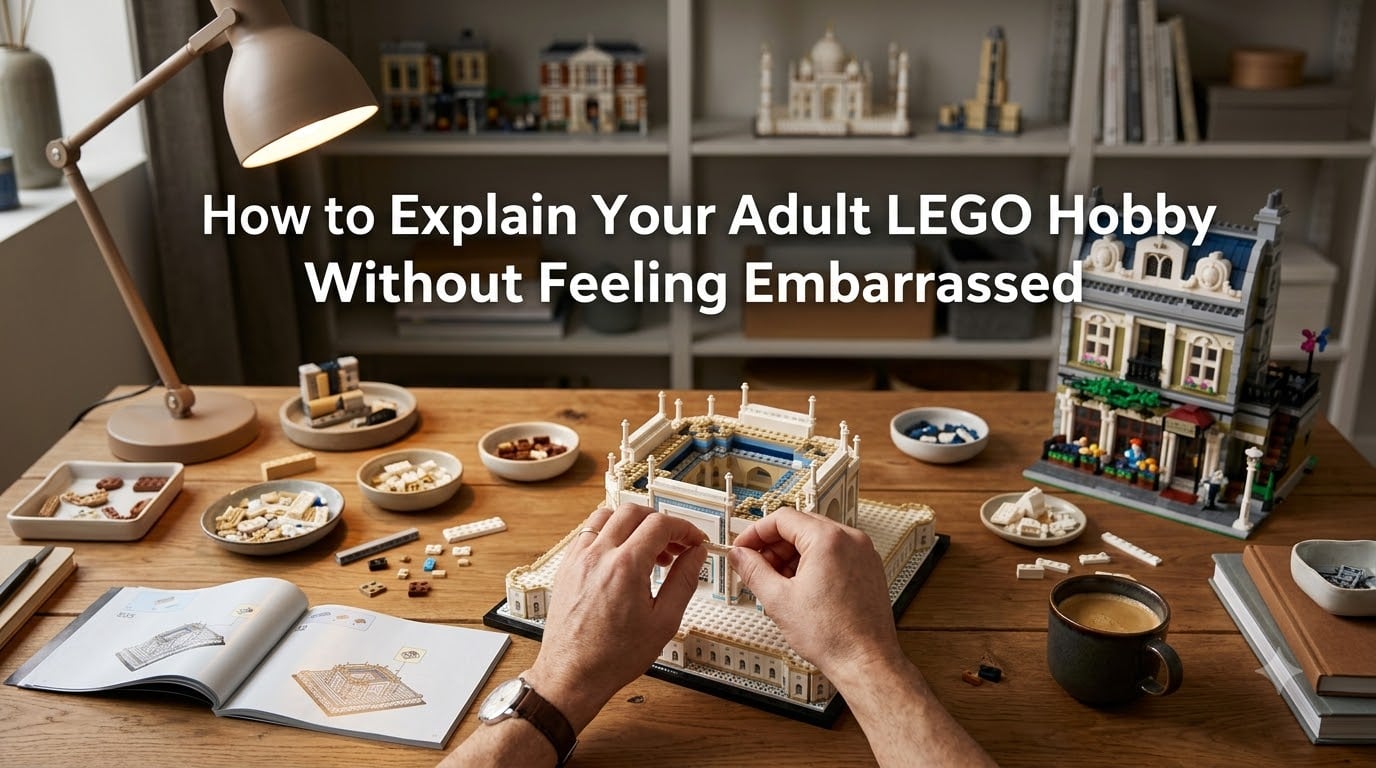
That awkward feeling when the cashier double-takes at your LEGO haul, the half-joke from a coworker about “kids’ toys,” the nervous laugh when a date asks what you do for fun — I have been there. If you love LEGO as a grown-up and find yourself hiding boxes in the back of the closet, this guide is for you. I am going to walk you through how to explain your adult LEGO hobby without feeling embarrassed, with real scripts, science, and a community that already has your back.
The short answer: adults who love LEGO are called AFOLs (Adult Fans of LEGO), the hobby is supported by psychology research, and there are concrete phrases you can use to shut down judgment without sounding defensive.
Table of Contents
What Is an AFOL?
An AFOL is an Adult Fan of LEGO, and the term has been used inside the LEGO community since the late 1990s. It describes any adult who builds, collects, displays, or creates with LEGO bricks beyond childhood. AFOLs range from casual builders who pick up one set a year to serious collectors with thousands of pieces and custom displays.
The acronym is recognized globally. LEGO itself uses it in official communications, and there are AFOL conventions, online forums, and even LEGO-recognized ambassador programs in dozens of countries. Knowing the term matters because it reframes your hobby from “a guy who plays with toys” to “an AFOL,” which sounds deliberate and identity-driven rather than childish.
Why Adults Feel Embarrassed About Their LEGO Hobby
The embarrassment is real, but it is learned, not natural. Cultural norms tell adults that “toys” belong to children, so anything resembling play triggers self-consciousness. One HuffPost writer confessed he once lied to a LEGO store employee about who a set was for, even though he had spent more than $45,000 on the hobby.
Several psychological factors drive the shame. First, there is the gendered toy stigma: research on toy marketing shows that building toys have historically been coded as masculine and childish, which makes adult men especially defensive. Second, there is the visibility problem: LEGO sets sit on shelves in public spaces, and a $200 Star Wars UCS set announces your hobby louder than a fishing rod ever could.
Third, there is the cost perception gap: people who don’t build don’t realize that a 3,000-piece set can take 12+ hours to assemble, so they assume you are paying toy-store prices for playtime. That gap is where most judgment enters.
You’re Not Alone: The Numbers Behind Adult LEGO
Adult LEGO building is no longer niche. LEGO’s own 2026 investor reports show that adult buyers now make up roughly 30% of the company’s annual sales, and the “18+” and “Icons” lines are among the fastest-growing product categories. Reddit’s r/lego subreddit has more than 1.6 million members, with daily threads from adults swapping build photos, set reviews, and yes, embarrassment stories.
If you feel alone, you are not seeing the full picture. In a viral Reddit thread titled “As an adult, is anyone else embarrassed buying LEGO?”, hundreds of users shared nearly identical experiences: hiding receipts, downplaying sets as “for my kid,” and skipping checkout lines when coworkers are nearby. That overlap itself is a signal — embarrassment is the rule, not the exception, and recognizing that should reduce the weight of it.
What Experts Say About LEGO and the Adult Brain
Psychologists have been paying attention to adult LEGO building for years. University of Arizona researchers who spoke with the university’s news service in 2026 noted that engaging in creative play like LEGO “encourages the brain to become more spontaneous, adopt a different perspective, and get out of a rut.” That is a clinical endorsement, not a marketing claim.
The mental health benefits fall into four buckets. First, stress reduction: focused building lowers cortisol levels and produces a flow state similar to meditation. Second, dopamine release: completing a section of a build triggers the same reward pathway associated with finishing a workout or solving a puzzle. Third, problem-solving practice: complex sets train spatial reasoning and patience. Fourth, community belonging: AFOL groups provide social connection that protects against isolation, especially for adults whose work is screen-bound.
LEGO Serious Play, an official methodology used by Fortune 500 companies for team building, uses the same bricks you have on your shelf. If LEGO is “just a toy,” it is one that corporate leadership trainers charge thousands per session to use.
The LEGO 5/2 Rule Explained
The LEGO 5/2 rule is an unofficial community guideline describing a healthy balance between the hobby and the rest of your life. The idea is simple: spend 5 units of time on LEGO for every 2 units of time you spend on related activities like researching sets, watching reviews, scrolling forums, or reorganizing your collection.
In practical terms, if you build for 5 hours a week, allow yourself 2 hours of “LEGO-adjacent” time — reading thebrickfantastic.com guides, browsing BrickLink, watching YouTube reviews. The rule exists to keep the hobby from tipping into compulsive spending or doomscrolling, which are real risks in any collector space. It also gives you a clean answer when someone asks how much time you spend on it: “I keep a 5/2 ratio, so the hobby stays in balance.” That answer is hard to argue with.
How to Explain Your LEGO Hobby: Scripts That Actually Work
Here is where most guides fail: they validate your feelings but never give you language. Below are five scripts I have used or seen other AFOLs use successfully. Adapt them to your own voice.
When a Coworker Says “Isn’t That for Kids?”
Try: “LEGO makes a full line of 18+ sets now designed for adults, including stress-relief and architectural builds. The building is more like woodworking than playing with toys — it is a creative, focused hobby.”
That works because it redirects the frame from “kids’ toy” to “adult creative hobby” using LEGO’s own marketing language.
When a Partner Asks “Why So Much Money?”
Try: “The sets cost more than video games or golf, but they last forever. A finished set holds value, doubles as home decor, and gives me hours of focused time off my phone. We can set a monthly budget that works for both of us.”
The budget line is key. It shows you respect shared finances without surrendering the hobby.
When a Parent Says “When Are You Going to Outgrow This?”
Try: “LEGO building keeps my hands busy and my mind off work stress. The psychologists I read about say it is one of the best creative outlets for adults. I am not growing out of it — I am taking better care of myself.”
When a Stranger at the Store Looks at You Funny
Try: “It is for me. The 18+ sets are some of the best engineering puzzles out there.”
Short, confident, and it signals you have done your homework. Most cashiers respond with their own LEGO stories.
When You Feel the Urge to Hide Your Hobby
Try telling yourself: “Hiding this costs me more than displaying it.” Shame thrives in secrecy. Even one friend who knows the real you is enough to start dismantling it.
Conversation Starters for New AFOLs
Sometimes you do not need a defense — you need an opening. Here are conversation starters that invite curiosity instead of judgment.
“I just finished a 2,000-piece set and my hands are still shaking — anyone else get that post-build high?”
“My desk has a Millennium Falcon on it. People either love it or ask about it, and both are fun.”
“I started building LEGO to unplug from work and accidentally became a collector. Have you ever fallen into a hobby sideways?”
“LEGO makes adult sets modeled after architecture, cars, and botanical gardens — it is not just Star Wars anymore.”
“Want to see what I built this weekend? I will show you the picture and skip the 4-hour build time.”
Each of these assumes the hobby is normal. That assumption is contagious — when you act like your LEGO hobby is unremarkable, other people tend to follow your lead.
Finding Your Tribe: The LEGO Community
The fastest way to stop feeling embarrassed is to spend time with people who already love what you love. AFOL communities exist at every level. Locally, most major cities have a LUG (LEGO User Group) that meets monthly to build, trade, and display. Nationally, conventions like BrickFair and Bricks Cascade draw thousands of adult builders. Online, Reddit’s r/lego, Eurobricks, and dozens of Discord servers are active around the clock.
Within these spaces, no one apologizes for owning 50 sets or spending weekends sorting bricks. That kind of unconditional acceptance rewires how you carry the hobby outside the group. Many AFOLs report that joining a community was the turning point from “secret hobby” to “public identity.”
FAQs
What are adults who love LEGO called?
Adults who love LEGO are called AFOLs, which stands for Adult Fans of LEGO. The term has been used since the late 1990s and is recognized by LEGO itself, with official ambassador programs in dozens of countries.
What is the 5/2 rule in LEGO?
The LEGO 5/2 rule is a community guideline suggesting you spend 5 units of time building for every 2 units spent on related activities like researching sets, watching reviews, or scrolling forums. It keeps the hobby balanced and prevents compulsive spending.
Is LEGO a good hobby for adults?
Yes. University of Arizona researchers note that creative play like LEGO reduces stress, encourages flexible thinking, and triggers dopamine release. LEGO Serious Play is even used by Fortune 500 companies for team building.
Is it normal for an adult to play with LEGO?
Completely normal. Adult buyers make up roughly 30% of LEGO’s annual sales, and the r/lego subreddit has more than 1.6 million members. LEGO now sells dedicated 18+ and Icons lines designed for grown-up builders.
Is it okay to like LEGO as an adult?
Yes. Psychology experts say LEGO building provides stress relief, problem-solving practice, and creative expression that adults often lack in their daily work. Liking LEGO as an adult is healthy, not childish.
Is LEGO good for the adult brain?
Research shows focused LEGO building produces a flow state similar to meditation, lowers cortisol, and trains spatial reasoning. It is one of the few hobbies that combines creative output with measurable cognitive benefits.
Should I feel shame for enjoying LEGO as an adult?
No. Shame around adult LEGO comes from cultural norms, not from the hobby itself. There is no clinical reason to feel ashamed, and joining the AFOL community usually eliminates the shame entirely.
Final Thoughts on Owning Your AFOL Identity
Your adult LEGO hobby is not something to apologize for. The embarrassment you feel is borrowed from other people’s expectations, not from anything wrong with what you do on a Saturday afternoon. You now have the language, the science, and the scripts to explain your LEGO hobby without flinching. Use them, share your builds, and welcome to the AFOL community.