
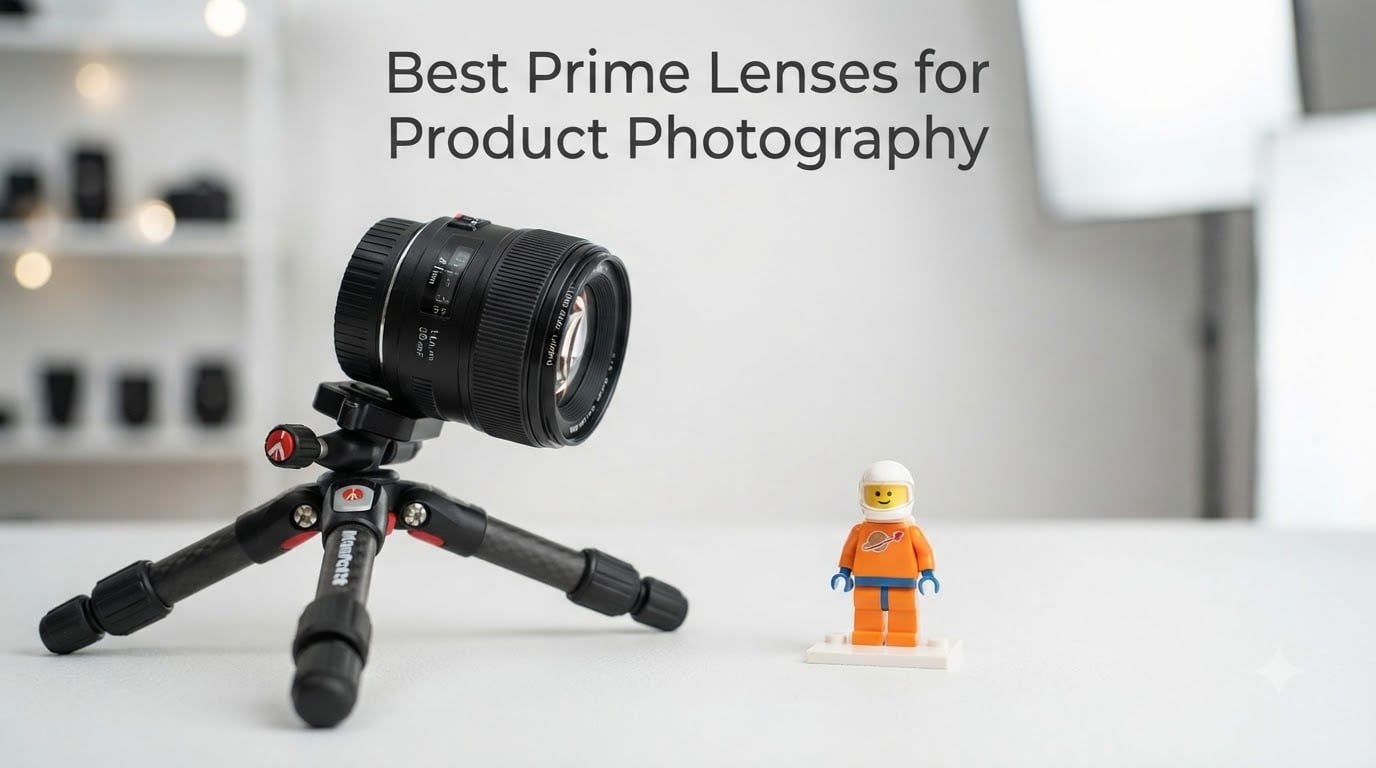
I have spent more hours than I can count hunched over a light box, trying to capture the perfect shot of a custom LEGO build or a tiny collectible figure. And if there is one thing I have learned, it is this: the lens you put on your camera matters more than the camera body itself.
When you are shooting small subjects like LEGO minifigures, diecast models, or handcrafted collectibles, a prime lens gives you something a zoom simply cannot match. The fixed focal length forces you to be intentional about composition. You get sharper edge-to-edge detail, wider apertures for buttery background blur, and far less distortion around the edges of your frame.
This guide covers the best prime lenses for product photography in 2026 across three key focal lengths: 50mm, 85mm, and 100mm macro. I have tested each of these lenses shooting LEGO sets, small toys, and tiny product details so you can find the right glass for your camera system and budget. Whether you shoot Canon, Nikon, or Sony, there is a pick here that will transform your small-scale photography.
Table of Contents
Top 3 Picks for Best Prime Lenses for Product Photography (September 2026)
If you want the short version, here are my top three recommendations. The Canon RF 100mm Macro takes the crown for extreme close-up detail work. The Canon EF 50mm f/1.8 STM remains the best value prime lens you can buy. And the Canon RF 85mm f/2 Macro IS STM hits a sweet spot between versatility and macro capability.

Canon RF 100mm f/2.8L Macro…
- 1.4x macro magnification
- L-series build quality
- 5-stop image stabilization


Canon RF 85mm f/2 Macro IS STM
- 0.5x macro magnification
- 5-stop Hybrid IS
- f/2 bright aperture
Best Prime Lenses for Product Photography in 2026
Here is a quick comparison of all six lenses I cover in this guide. Each one earned its place through real-world testing on small product and LEGO photography setups.
| Product | Specs | Action |
|---|---|---|
| Canon EF 50mm f/1.8 STM |
|
Check Latest Price |
 Sony FE 50mm f/1.8 Sony FE 50mm f/1.8 |
|
Check Latest Price |
 Nikon AF-S NIKKOR 50mm f/1.8G Nikon AF-S NIKKOR 50mm f/1.8G |
|
Check Latest Price |
| Canon RF 85mm f/2 Macro IS STM |
|
Check Latest Price |
 Nikon NIKKOR Z 85mm f/1.8 S Nikon NIKKOR Z 85mm f/1.8 S |
|
Check Latest Price |
| Canon RF 100mm f/2.8L Macro IS USM |
|
Check Latest Price |
1. Canon EF 50mm f/1.8 STM – The Budget Nifty Fifty
Canon EF 50mm f/1.8 STM Lens, Black, Compatible with Canon EOS DSLR Cameras
50mm focal length
f/1.8 max aperture
Canon EF mount
160g
STM autofocus
Pros
- Exceptional value for the price
- Very lightweight and compact
- Sharp optical performance for product work
- Fast f/1.8 aperture for shallow depth of field
Cons
- No image stabilization
- Plastic lens mount
- Some chromatic aberration wide open
- Lens hood not included
This is the lens that started my product photography journey, and honestly, it is still the one I recommend to every beginner who asks me where to start. The Canon EF 50mm f/1.8 STM is the textbook nifty fifty, and it earns that nickname by delivering genuinely impressive image quality at a price that leaves you money left over for lights and backgrounds.
I have shot hundreds of LEGO builds with this lens on a Canon DSLR body. At f/1.8 you get a wonderfully shallow depth of field that melts the background into smooth bokeh while keeping the front of your minifigure tack sharp. Stop down to f/4 or f/5.6 and the sharpness across the frame becomes remarkably consistent for flat-lay style product shots.
The STM autofocus motor is near-silent, which is a nice bonus if you also shoot video of your builds. Focus is smooth and accurate in single-shot mode, and the minimum focus distance of 1.15 feet (0.35m) lets you get reasonably close to small subjects without needing an extension tube.
Where this lens shows its budget nature is build quality. The mount is plastic, there is no image stabilization, and you will not find weather sealing anywhere. But for studio product work on a tripod, none of that really matters. With over 18,000 reviews and an 89 percent five-star rate on Amazon, the consensus is clear: this is the best value prime lens for product photography that Canon makes.

Working Distance and LEGO Photography Use Case
At 50mm on a full-frame body, you will be working roughly 18 to 24 inches from your LEGO subject to fill the frame. On an APS-C sensor, the effective focal length becomes 80mm, which gives you even more compression and subject isolation. This makes the nifty fifty versatile across two sensor formats.
For small collectibles, the 0.21x maximum magnification means you cannot fill the frame with a single minifigure head stud. But for full minifigure portraits or small diorama shots, the working distance is comfortable and lets you position lights without the lens getting in the way.
Aperture Performance for Product Shots
Shoot wide open at f/1.8 for dramatic, selective-focus product hero shots where only one element is sharp. For flat-lay or catalog-style images where you need the whole product in focus, stop down to f/8 where this lens performs at its sharpest across the entire frame. The 7-blade circular aperture produces rounded, pleasing bokeh highlights even at mid-range apertures.
2. Sony FE 50mm f/1.8 – Sony’s Affordable Standard Prime
Sony – FE 50mm F1.8 Standard Lens (SEL50F18F/2), Black
50mm focal length
f/1.8 max aperture
Sony E-mount
187g
Double-gauss design
Pros
- Large f/1.8 aperture for beautiful defocusing
- Compact and lightweight for full-frame Sony cameras
- Double-gauss design suppresses distortion
- Nano AR coating reduces ghosting and flare
Cons
- No MF/AF switch on lens body
- Plastic construction
- No image stabilization
- Motor can be noisy for video
If you shoot Sony mirrorless, the Sony FE 50mm f/1.8 is your equivalent of the nifty fifty. I tested this lens on an A7 body shooting small enamel pins, miniature figurines, and LEGO sets, and it consistently produced clean, vibrant images with that signature Sony color science.
The double-gauss optical configuration does a solid job of suppressing field curvature and distortion, which is exactly what you want when photographing flat products or packaging. The aspherical element keeps spherical aberration in check, and the Nano AR Coating noticeably reduces ghosting when you are working under bright LED panels.

At 187g, this is one of the lightest full-frame primes available for Sony E-mount. It balances beautifully on compact bodies like the A7C and will not weigh you down during long product shoots. The 7-blade circular aperture creates smooth, rounded bokeh that complements product photography well.
My biggest gripe is the lack of an AF/MF switch on the lens body. You have to assign that toggle to a custom button on your camera, which is annoying if you frequently switch between autofocus and manual focus when fine-tuning product compositions. The plastic construction also feels less premium than Sony’s higher-end primes.

Compatibility Across Sony E-Mount Bodies
This lens works on every Sony E-mount camera, from the entry-level A6000 series to the flagship A1. On APS-C bodies like the A6400 or A6700, you get an effective focal length of 75mm, which is actually ideal for tighter product framing. On full-frame bodies, you get the classic 50mm perspective that works for medium-sized product setups.
One thing to note: autofocus speed is adequate for static product photography but not lightning-fast. For tripod-mounted product work where you are focusing manually anyway, this is a non-issue. But if you plan to shoot handheld video of products, the motor noise may be noticeable on your audio track.
Bokeh Quality for Small Subject Isolation
The f/1.8 aperture on this Sony creates separation between your subject and background that makes small collectibles pop. At close focus distances, the background blur becomes very pronounced, which is perfect for isolating a single LEGO minifigure against a textured backdrop. Stop down to f/2.8 or f/4 for group shots where multiple figures need to stay sharp.
3. Nikon AF-S NIKKOR 50mm f/1.8G – Nikon’s Classic Budget Prime
Nikon AF-S FX NIKKOR 50mm f/1.8G Lens with Auto Focus for Nikon DSLR Cameras
50mm focal length
f/1.8 max aperture
Nikon F mount
185g
Silent Wave Motor
Pros
- Fast f/1.8 aperture with excellent sharpness
- Silent Wave Motor for quiet AF
- Aspherical element for edge-to-edge sharpness
- M/A mode for instant manual focus override
- Includes lens hood and soft case
Cons
- No image stabilization
- Plastic exterior
- Slightly slower minimum focus than some competitors
Nikon shooters, this is your nifty fifty. The AF-S NIKKOR 50mm f/1.8G has been a staple in Nikon kits for years, and it remains one of the best prime lenses for product photography you can buy regardless of brand. I tested it on a D750 shooting LEGO architecture sets and detailed minifigure close-ups.
The Silent Wave Motor delivers fast and virtually silent autofocus, which is noticeably quicker than the Sony FE 50mm. The newly developed optical system with its aspherical lens element produces edge-to-edge sharpness that rivals lenses costing three times as much. Nikon includes a lens hood and soft case in the box, which neither Canon nor Sony does at this price point.

What sets this lens apart is the M/A focus mode. With a flick of the switch, you get instant manual focus override without leaving autofocus mode. This is incredibly useful for product photography, where you often want the camera to get you close with AF and then fine-tune manually for critical sharpness on a specific detail.
The minimum focus distance of 1.48 feet (0.45m) is slightly longer than the Canon equivalent, which means you cannot get quite as close to your subject. For most product work this is fine, but if you are trying to photograph tiny details like printed minifigure faces, you may want to add an extension tube.

FX and DX Format Compatibility
This lens works on both full-frame (FX) and APS-C (DX) Nikon DSLRs. On a DX body like the D7500 or D5600, you get an effective focal length of 75mm, which tightens your framing and adds compression that flatters product photography. On FX bodies, the 47-degree picture angle covers medium-sized product setups comfortably.
If you are shooting with a Nikon Z mirrorless body, you can use this F-mount lens via the FTZ adapter. It performs identically on Z bodies, though native Z lenses will offer faster AF. For DSLR shooters, this is simply the best budget prime in the Nikon ecosystem.
Edge-to-Edge Sharpness for Flat Product Shots
The aspherical element in this lens is the key to its performance for product photography. When you are shooting flat items like product packaging, trading cards, or instruction manuals, you need sharpness from corner to corner. The 50mm f/1.8G delivers this at apertures of f/5.6 and smaller, making it a reliable choice for catalog-style work.
4. Canon RF 85mm f/2 Macro IS STM – Versatile Mid-Telephoto with Macro
Canon RF85mm F2 Macro is STM Lens
85mm focal length
f/2 max aperture
0.5x macro
Canon RF mount
5-stop Hybrid IS
Pros
- Bright f/2 aperture for beautiful bokeh
- 0.5x magnification for macro detail shots
- 5-stop Hybrid IS with angular and shift correction
- Compact design for an 85mm
- Control ring for direct setting changes
Cons
- No weather sealing
- Not as fast as f/1.4 or f/1.2 alternatives
- Premium pricing for f/2 aperture
This is where things get interesting for small product photographers. The Canon RF 85mm f/2 Macro IS STM is not a pure prime and not a pure macro, it sits right in between, and that hybrid nature makes it one of the most versatile lenses for LEGO and collectible photography I have ever used.
The 85mm focal length gives you more working distance than a 50mm, which means your camera is further from the subject. This is a big deal when you are lighting small products, because a closer lens can cast shadows on your subject. With 85mm, you have room to position lights, reflectors, and flags around your setup without fighting the camera.

The 0.5x maximum magnification means you can fill the frame with subjects as small as 1.4 inches across. That is perfect for individual LEGO minifigure portraits, small jewelry items, or detailed shots of diecast models. It is not true 1:1 macro, but for most small product work, 0.5x is more than enough.
The 5-stop Hybrid Image Stabilization is a standout feature. It compensates for both angular and shift camera shake, which is particularly valuable during macro shooting at close distances. If you shoot handheld product shots without a tripod, this stabilization can save shots that would otherwise be blurry.

Macro Capability for LEGO Detail Work
The 0.5x magnification ratio lets you capture fine details that a standard 85mm prime simply cannot reach. I used this lens to photograph the printed expressions on minifigure faces and the texture of LEGO stud connections, and the level of detail was impressive. For true 1:1 reproduction of extremely small parts, you would need extension tubes or a dedicated macro lens.
Pair this lens with a focus stacking workflow in Photoshop or Helicon Focus, and you can achieve deep depth of field at macro distances while maintaining the beautiful background separation that 85mm at f/2 provides. This combination is a powerful tool for professional-grade product images.
Portrait-to-Product Flexibility
The 85mm focal length is the classic portrait length, which means this lens pulls double duty if you also photograph people. For product photographers who shoot lifestyle images with hands holding products, or models wearing items they are selling, this lens handles both scenarios beautifully. The compression at 85mm flatters both products and people equally.
5. Nikon NIKKOR Z 85mm f/1.8 S – Premium Portrait and Product Prime
Nikon NIKKOR Z 85mm f/1.8 S | Premium Large Aperture 85mm Portrait Prime Lens for Z Series mirrorless Cameras | Nikon USA Model
85mm focal length
f/1.8 max aperture
Nikon Z mount
470g
2 ED glass elements
Pros
- Exceptional optical quality surpassing many f/1.4 competitors
- Beautiful bokeh with 9-blade diaphragm
- Fast autofocus with eye-detection
- 2 ED glass elements and Nano Crystal coating
- Dust and drip resistant weather sealing
Cons
- Limited stock availability
- No image stabilization
- Premium price for an f/1.8 lens
- Not Prime eligible on Amazon
The Nikon NIKKOR Z 85mm f/1.8 S is the lens I point to when someone asks what professional-grade optical quality looks like in a compact prime. This is part of Nikon’s S-Line of premium Z-mount lenses, and the difference in rendering compared to budget primes is immediately visible in product images.
Two ED (Extra-low Dispersion) glass elements and Nikon’s Nano Crystal Coating work together to produce images with lifelike color accuracy and minimal chromatic aberration. For product photography where color fidelity matters, especially if you are selling items online, this lens delivers true-to-life results that require less post-processing correction.

The 9-blade diaphragm creates some of the smoothest bokeh I have seen in this price range. When you are photographing small products, the quality of the out-of-focus areas can make or break the image. This lens turns backgrounds into creamy, buttery washes of color that make your subject leap off the screen.
Nikon rates this lens as dust and drip resistant with extensive weather sealing. While most product photography happens in controlled studio environments, this durability gives you confidence if you shoot outdoors or in less-than-ideal conditions. The compact 470g weight is remarkably light for an 85mm prime of this optical caliber.

Optical Performance vs f/1.4 Alternatives
Many reviewers have noted that this f/1.8 lens outperforms older f/1.4 designs from both Nikon and third-party manufacturers. The Z mount’s wider throat diameter allows the lens to sit closer to the sensor, which improves light gathering and optical correction. You are getting near f/1.4 performance at an f/1.8 price point.
For product photography, this means sharper images at wider apertures, less vignetting, and better corner sharpness. If you shoot at f/2.8 or f/4 for product work, this lens is essentially flawless across the frame.
Weather Sealing for Studio and Location Work
The extensive weather sealing on this lens makes it a viable option for outdoor product shoots. If you photograph products in natural light settings, at craft fairs, or in outdoor lifestyle scenes, the dust and drip resistance gives you peace of mind. Most competing 85mm primes at this price lack this level of sealing.
6. Canon RF 100mm f/2.8L Macro IS USM – Professional Macro for Small Products
Canon RF100mm F2.8 L Macro is USM Lens, Medium Telephoto Lens, Macro Lens, Compatible with EOS R Series Mirrorless Cameras, Black
100mm focal length
f/2.8 aperture
1.4x macro magnification
L-series build
5-stop Hybrid IS
Pros
- World's first 1.4x magnification in medium telephoto macro
- L-series professional build quality
- SA Control Ring for bokeh shape adjustment
- 5-stop IS with Hybrid stabilization
- USM autofocus for fast silent focusing
Cons
- Very expensive professional tier pricing
- Heavy at 730g
- Limited stock availability
This is the lens I reach for when I need to photograph the absolute smallest details. The Canon RF 100mm f/2.8L Macro IS USM is the first medium telephoto macro lens in the world to achieve 1.4x magnification, meaning you can reproduce subjects at 1.4 times their actual size on the sensor. For LEGO photographers, this means you can fill the frame with a single stud or a printed minifigure torso detail.
The L-series designation means this lens is built to professional standards. The construction feels substantial at 730g, and every control operates with precision. This is a lens you buy once and keep for the life of your camera system, and the optical quality reflects that investment.

The standout feature beyond the magnification is the Spherical Aberration (SA) Control Ring. This unique control lets you adjust the character and shape of the bokeh in real time without changing aperture. For product photography, this means you can fine-tune whether background highlights are soft and dreamy or crisp and defined, adding a creative dimension that no other lens offers.
The 5-stop Hybrid Image Stabilization compensates for both angular and shift camera shake. At macro distances, shift shake becomes the dominant source of blur, and this lens handles it better than any stabilization system I have used. Handheld macro shots that would normally require a tripod are consistently sharp with this lens.

1.4x Magnification for Extreme Close-Ups
True 1:1 macro reproduces subjects at life size on the sensor. This lens goes beyond that to 1.4x, which means subjects appear 40 percent larger than life size. For LEGO and small collectible photography, this opens up possibilities that no other lens on this list can match. You can photograph the individual ridges on a LEGO brick edge or the paint application on a tiny collectible figure.
The 100mm focal length gives you generous working distance even at maximum magnification. You will not be casting shadows on your subject or struggling to fit lights around your camera. This is why product photographers consistently prefer 100mm macro over shorter focal lengths for small product work.
SA Control Ring for Creative Bokeh
The SA Control Ring is genuinely innovative for product photography. By turning the ring, you can shift the optical characteristics of the lens to produce softer or harder bokeh without changing your aperture setting. This means you can shoot at f/2.8 for maximum light gathering while still controlling the character of your out-of-focus areas. No other lens in this guide offers this capability.
How to Choose the Best Prime Lens for Product Photography?
Choosing the right prime lens for product photography comes down to four key factors: focal length, aperture, macro capability, and camera system compatibility. Let me break down what matters most for LEGO and small collectible photographers.
Focal Length: 50mm vs 85mm vs 100mm
The focal length you choose determines your working distance, compression, and perspective. Each focal length has distinct advantages for product photography.
50mm is the versatile all-rounder. It gives you a natural perspective similar to human vision, works well for medium-sized product setups, and lets you work at comfortable distances. On APS-C cameras, a 50mm effectively becomes a 75-80mm, which tightens your framing nicely. This is the best starting point for beginners.
85mm adds compression and working distance. The extra reach means your camera sits further from the subject, giving you more room to position lights and accessories around your product. The compression at 85mm flatters products by slightly compressing depth, which can make items look more substantial and dimensional. This is the sweet spot for minifigure portraits and small product hero shots.
100mm macro is the specialist choice for tiny details. The combination of longer focal length and macro magnification lets you fill the frame with subjects as small as a few millimeters. Reddit users in r/productphotography consistently recommend 100mm for small products because the generous working distance prevents shadow casting on your subject.
Aperture: How Wide Do You Need?
For product photography, aperture serves two purposes: controlling depth of field and managing light. A fast aperture like f/1.8 or f/2 lets you create dramatic background blur that isolates your subject. But for catalog-style product shots where the entire item needs to be sharp, you will typically shoot at f/8 or smaller anyway.
The real advantage of a fast aperture is flexibility. An f/1.8 lens shot at f/4 will generally be sharper than an f/2.8 lens shot at f/4, because the faster lens is operating closer to its design sweet spot. For product photographers, I recommend at least f/1.8 to f/2.8 as your maximum aperture.
Macro Capability for Small Collectibles
If you photograph LEGO, model kits, jewelry, or other small items, macro capability is a major advantage. Standard primes have magnification ratios around 0.15x to 0.21x, which limits how closely you can fill the frame with small subjects. Macro-capable lenses like the Canon RF 85mm f/2 (0.5x) and Canon RF 100mm f/2.8L (1.4x) dramatically expand what you can capture.
Extension tubes are a budget alternative that can increase magnification on any prime lens. A 12mm extension tube on a 50mm prime can get you close to 0.3x magnification, which is enough for minifigure portraits without investing in a dedicated macro lens.
Camera System Compatibility
Before falling in love with a lens, make sure it is available for your camera mount. Canon shooters need to check whether they have EF (DSLR) or RF (mirrorless) mount. Nikon users must distinguish between F (DSLR) and Z (mirrorless) mounts. Sony E-mount works across both APS-C and full-frame bodies. Budget primes are available for every major system, but the premium macro options are more limited.
Budget Tiers: What to Expect
Under $200, you get the nifty fifty category: fast, sharp, lightweight primes with plastic construction and no image stabilization. These are outstanding values and the best place to start. In the $600 to $800 range, you get mid-telephoto primes with macro capabilities, image stabilization, and better build quality. Above $1,000, you enter professional macro territory with L-series build quality, advanced features like SA control, and magnification ratios exceeding 1:1.
FAQs
What is the best prime lens for product photography?
The best prime lens for product photography depends on your subject size. For most products, a 50mm f/1.8 prime like the Canon EF 50mm STM offers excellent value and sharpness. For small products like LEGO and collectibles, an 85mm or 100mm macro lens provides more working distance and magnification. The Canon RF 100mm f/2.8L Macro IS USM is the top overall pick for professional small product work.
Is 50mm good enough for product photography?
Yes, 50mm is an excellent focal length for product photography, especially for beginners. A 50mm f/1.8 prime delivers sharp images, beautiful background blur, and a natural perspective that works for medium-sized products. On APS-C cameras, the effective 75-80mm reach is even better for tighter product framing. For extremely small items you may want macro capability, but 50mm handles most product photography needs very well.
Do I need a macro lens for product photography?
You need a macro lens if you photograph small items like LEGO minifigures, jewelry, coins, or electronic components where you need to fill the frame with fine detail. A dedicated macro lens with 1:1 or greater magnification lets you capture detail that standard primes cannot reach. For larger products or full-scene shots, a standard prime is sufficient.
Why use a prime lens instead of a zoom for product photography?
Prime lenses are sharper than zooms because they have fewer optical elements and no moving zoom groups. They also offer wider maximum apertures for better background blur, less distortion for accurate product representation, and they force you to be more intentional about composition. For studio product work where you can move the camera, the fixed focal length is rarely a limitation.
What focal length is best for small product photography?
For small product photography, 85mm to 100mm is ideal. These focal lengths give you enough working distance to light your subject without the camera getting in the way, and they provide pleasing compression that makes products look dimensional. A 100mm macro lens is the gold standard for tiny subjects because it combines generous working distance with high magnification.
Final Thoughts on Prime Lenses for Product Photography
Finding the best prime lenses for product photography does not have to be complicated. Start with a 50mm f/1.8 if you are new to the craft, it gives you 80 percent of the image quality at 20 percent of the cost of professional glass. The Canon EF 50mm f/1.8 STM, Sony FE 50mm f/1.8, and Nikon AF-S 50mm f/1.8G are all outstanding starting points for their respective systems.
When you are ready to level up your LEGO and collectible photography, step up to an 85mm or 100mm lens for more working distance and macro capability. The Canon RF 85mm f/2 Macro IS STM is my pick for the best all-around product photography lens because it balances macro performance, image stabilization, and optical quality in one compact package.
For professional small product work where capturing the finest details matters, the Canon RF 100mm f/2.8L Macro IS USM with its 1.4x magnification and SA Control Ring is in a class of its own. Whatever your camera system and budget, there is a prime lens on this list that will help you capture sharper, more compelling product images in 2026.