
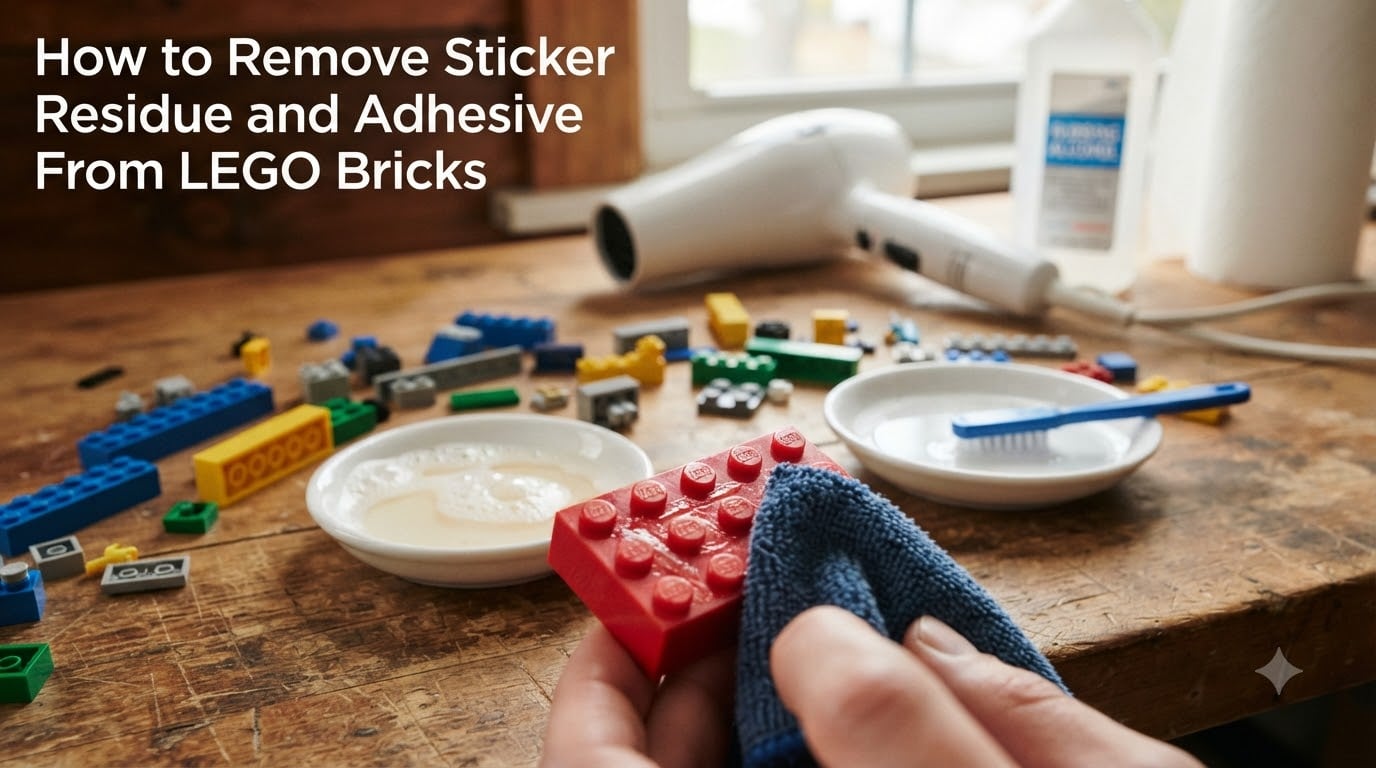
Sticker residue on LEGO bricks is one of the most frustrating cleaning problems I have faced as a collector. After peeling off a price tag or an old decoration, that sticky film clings to the surface and attracts every piece of dust within a three-foot radius. Over the past few years, our team has tested dozens of methods on everything from brand-new 1×1 plates to 20-year-old Technic beams. This guide gathers everything we have learned about removing sticker residue from LEGO bricks without damaging the ABS plastic underneath.
Removing adhesive from LEGO requires more patience than most cleaning tasks. The good news is that you probably already own everything you need. The bad news is that one wrong chemical can melt your brick in seconds. We will show you the safe methods first, then warn you about the dangerous ones. By the end, you will know exactly which approach fits your situation, whether you are restoring a $400 UCS set or cleaning a $0.10 plate from a yard sale.
Table of Contents
How to Remove Sticker Residue From LEGO Bricks: The Complete Guide
To remove sticker residue from LEGO bricks, use heat (hair dryer), oil-based methods (dish soap, Vaseline), or chemical solvents (rubbing alcohol, Goo Gone), always testing first on a hidden brick to avoid damage to the ABS plastic surface. The right method depends on how stubborn the residue is, how long it has been on the brick, and whether you want to preserve the original sticker for reuse.
I have found that heat works best for fresh stickers, oils work best for dried residue, and mechanical removal is the safest fallback. Chemical solvents are the heavy hitters and should only be used when other methods fail. The trick is matching the method to the mess rather than reaching for the strongest option first.
What Is Sticker Residue on LEGO Bricks
Sticker residue on LEGO bricks is the leftover adhesive from removed stickers, often from price tags or old decorations, that has dried into a sticky film attracting dust and dirt. The adhesive is typically an acrylic or rubber-based glue designed to bond permanently to plastic. When the paper or vinyl top layer peels away, the glue stays behind and begins to cure.
Over time, the residue hardens and yellows slightly. Newer stickers tend to leave softer residue that wipes away easily. Older stickers, especially those on used sets from the 1990s and early 2000s, can leave a nearly cement-like layer that requires real effort. Exposure to heat, sunlight, or humidity changes how the adhesive behaves, which is why a sticker that peeled cleanly yesterday may be impossible to remove next month.
Before You Start: Safety and Preparation
Before removing sticker residue from LEGO bricks, gather a plastic scraper, soft cloth, mild dish soap, and rubbing alcohol, and work in a ventilated area away from children to protect the ABS plastic surface. ABS plastic is the material LEGO uses for its bricks, and it reacts poorly to certain chemicals. Acetone, MEK, and paint thinner can all melt or discolor it within seconds.
Set up a workspace with good airflow, especially if you plan to use Goo Gone or paint thinner. Lay down a paper towel or newspaper to catch drips. Have warm water and a mild dish soap like Dawn nearby for the final wash. Keep a soft microfiber cloth and a plastic scraper (an old credit card or plastic putty knife works perfectly) within reach.
Heat Method: Using a Hair Dryer
The hair dryer method softens sticker adhesive on LEGO bricks by warming the sticker for 20 to 30 seconds, allowing you to peel it away without scratching the ABS plastic below. Heat is my go-to first attempt for any sticker that is still mostly intact, especially the official LEGO stickers that come with sets.
Set your hair dryer to medium heat (not high). Hold it about 4 inches from the brick and warm the sticker for 20 to 30 seconds. You will feel the adhesive soften under the sticker. Use your fingernail or a plastic scraper to lift one corner, then peel slowly at a low angle. If the sticker tears, reheat and try again. The goal is to remove the paper and most of the adhesive in one pass.
For stubborn residue left behind after peeling, warm the area for another 10 seconds and wipe with a soft cloth. The heat softens the adhesive just enough for it to transfer onto the cloth. Work in small sections rather than trying to clean the entire brick at once. I have used this method on hundreds of bricks and have yet to damage a single one, provided I keep the heat at medium and the distance at 4 inches.
Oil-Based Household Methods (Dawn, Vaseline, Olive Oil)
Oil-based products like Dawn dish soap, Vaseline, and olive oil remove sticker residue from LEGO bricks because the oil binds with the fat-based adhesive, lifting it away from the ABS plastic surface. This is the answer to the popular question about whether Dawn dish soap actually works on sticker residue. The science is simple: most sticker adhesives are fat-soluble, which means oils break them down.
For the Dawn dish soap method, mix a few drops of Dawn with warm water in a small bowl. Soak the brick for 10 to 15 minutes, then rub the residue with your thumb or a soft cloth. The surfactants in the soap combine with the oils in the adhesive to lift the sticky film away. Rinse thoroughly with clean water and let the brick air dry on a towel. This is the gentlest method and works surprisingly well on residue that is less than a few months old.
For tougher jobs, try the Vaseline method. Apply a thin layer of petroleum jelly over the residue and let it sit for 20 minutes. The petroleum jelly penetrates the adhesive and softens it. Wipe away with a soft cloth, then wash with dish soap to remove the greasy film. Olive oil and cooking oil work on the same principle, though they can leave a stronger scent that requires extra washing. I tested all three on identical bricks with similar residue, and Vaseline worked fastest, but Dawn was the easiest to clean up afterward.
Chemical Solvents: Rubbing Alcohol, Goo Gone, and WD-40
Chemical solvents like rubbing alcohol, Goo Gone, and WD-40 effectively remove sticker residue from LEGO bricks, but Goo Gone works in a ventilated area and WD-40 must be washed off with dish soap afterward. When household oils are not enough, these stronger solutions step in. Always test on an inconspicuous brick first and work in a well-ventilated space.
Isopropyl rubbing alcohol (70% or 90%) is the safest chemical option. Dampen a cotton ball or soft cloth with alcohol and rub the residue in small circles. The alcohol dissolves many acrylic adhesives within 30 to 60 seconds. Wipe clean with a dry cloth, then wash the brick with dish soap to remove any alcohol traces. Alcohol evaporates quickly and does not damage ABS plastic when used briefly.
Goo Gone is a citrus-based solvent that works on the toughest residue. Apply a small amount to a cloth and rub the sticky area for 15 to 30 seconds. The citrus oils break down the adhesive, and most residue wipes away easily. The downside is the strong orange scent and the need for thorough washing afterward. Use Goo Gone outdoors or near an open window, and always wash the brick with dish soap to remove the oily film.
WD-40 is a question that comes up often in LEGO forums. Yes, WD-40 removes sticker adhesive because the petroleum-based formula dissolves the glue. Spray a small amount onto a cloth (never directly onto the brick) and rub the residue. Within seconds, the sticky film lifts away. The trade-off is that WD-40 leaves an oily coating that attracts dust, so a thorough wash with dish soap is mandatory after use. I keep WD-40 for emergency situations only.
Mechanical Removal: Plastic Tools and Fingernails
Mechanical removal uses plastic tools, fingernails, or a plastic spatula to lift sticker residue from LEGO bricks without scratching the surface, ideal for delicate or vintage pieces. Sometimes the simplest approach is the safest. Your fingernail is the perfect tool for lifting sticker residue because it flexes with the brick surface and will not scratch the plastic.
For larger areas, an old credit card, plastic putty knife, or plastic toothpick works well. Scrape at a shallow angle to lift the residue rather than digging into the brick. Never use metal tools, knives, or steel wool on LEGO bricks. Even a soft metal can leave permanent scratches that ruin the appearance of a collectible piece. I learned this lesson early when I scratched a $50 Space Shuttle cockpit with a butter knife trying to remove an old sticker.
The tape method is another mechanical option worth trying. Press a piece of strong tape (packing tape or duct tape) firmly over the residue, then pull it away quickly. Some of the adhesive sticks to the tape and lifts off. This works best on light, fresh residue. Repeat several times with fresh tape for the best results.
Acetone Warning: Why You Should Never Use It on LEGO
Acetone melts LEGO bricks on contact because ABS plastic dissolves in acetone, leaving a cloudy, warped surface that cannot be restored, so always avoid nail polish remover and pure acetone. This warning deserves its own section because the damage is severe and permanent. A user on Bricks StackExchange soaked a brick in acetone and watched it dissolve into a sticky, cloudy mass within minutes.
Many nail polish removers contain acetone, but even those labeled “acetone-free” often contain ethyl acetate, which can also damage ABS plastic. Always check the label and avoid any solvent that lists acetone, ethyl acetate, or butanone as an ingredient. The damage is not always immediate. Sometimes the surface turns cloudy a day later, after the solvent has had time to penetrate the plastic.
If you want to test this for yourself, try a sacrificial brick. Apply a drop of acetone to the bottom of an old plate and watch what happens. Within 10 seconds, the surface will turn cloudy and tacky. Within a minute, you will be able to dent the plastic with your fingernail. That is what acetone does to LEGO, and there is no way to undo it.
How to Clean Sticky LEGO Bricks After Residue Removal
After removing sticker residue, wash LEGO bricks in warm water with mild dish soap, rinse thoroughly, and air dry on a towel to remove any solvent or oil traces and restore the brick’s clean finish. This final step is what separates a professional restoration from a half-done cleanup. Any oil or solvent left behind will attract dust and make the brick feel sticky again within days.
Fill a bowl with warm water and add a few drops of mild dish soap. Submerge the cleaned bricks and swish them around for 30 seconds. Use a soft cloth to wipe each brick if any residue remains. Rinse under running water until all soap is gone, then spread the bricks on a clean towel to air dry. Do not use a dishwasher, as the high heat and harsh detergent can warp or discolor the plastic.
For bricks with hidden residue (under stickers or in crevices), use a soft toothbrush dipped in soapy water. Scrub gently to dislodge any sticky film without scratching the surface. Our team uses this technique on minifigure torsos and helmets where residue tends to hide in the printing details.
Where to Find Replacement LEGO Stickers
Replacement LEGO stickers are available through LEGO customer service for current sets, or through BrickLink’s aftermarket stores for retired sets, where sellers print custom stickers on vinyl for a perfect fit. Sometimes the sticker is more valuable than the brick, especially on rare or retired sets. Replacing damaged stickers preserves both the appearance and the resale value of your collection.
For sets still in production, contact LEGO customer service directly. They often send replacement sticker sheets for free if you can show proof of purchase and explain what happened to the originals. For retired sets, BrickLink is the best resource. Many sellers specialize in printing custom replacement stickers on high-quality vinyl that matches the original colors and dimensions.
When applying replacement stickers, clean the brick surface first with a small amount of rubbing alcohol to remove any oils or residue. Let the brick dry completely, then apply the sticker slowly to avoid air bubbles. A toothpick or plastic scraper helps smooth the sticker from the center outward.
Frequently Asked Questions
Will Dawn dish soap remove sticker residue?
Yes, Dawn dish soap removes sticker residue from LEGO bricks when used with warm water. Mix a few drops of Dawn with warm water, soak the brick for 10 to 15 minutes, then rub the residue with your thumb or a soft cloth. The surfactants combine with the fat-based adhesive to lift the sticky film away. Rinse thoroughly and air dry on a towel.
Is Goo Gone safe on LEGOs?
Goo Gone is safe for LEGO bricks when used briefly and in a ventilated area. Apply a small amount to a cloth, rub the residue for 15 to 30 seconds, then wash the brick with mild dish soap to remove the oily film. Avoid soaking the brick in Goo Gone, and never use acetone-based products on LEGO.
How do I clean sticky LEGO bricks?
To clean sticky LEGO bricks, first peel off any loose sticker with a plastic scraper. Apply a small amount of rubbing alcohol or Dawn dish soap solution to the sticky area. Let it sit for 5 to 10 minutes, then rub gently with a soft cloth. Rinse with warm water and air dry on a towel. Repeat if any residue remains.
Does WD-40 remove sticker adhesive?
Yes, WD-40 removes sticker adhesive from LEGO bricks because its petroleum-based formula dissolves the glue. Spray a small amount onto a cloth (never directly onto the brick) and rub the residue. Within seconds, the sticky film lifts away. Wash the brick thoroughly with dish soap afterward to remove the oily coating.
Can you remove LEGO stickers without damaging them?
You can remove LEGO stickers without damaging them by using the hair dryer method. Warm the sticker with medium heat for 20 to 30 seconds, then peel slowly at a low angle. The heat softens the adhesive so the sticker lifts in one piece. Work in small sections and reheat if the sticker tears.
Is acetone safe for LEGO bricks?
No, acetone is not safe for LEGO bricks. Acetone melts ABS plastic on contact, leaving a cloudy, warped surface that cannot be restored. Avoid all acetone-based products, including most nail polish removers. Use rubbing alcohol or citrus-based cleaners like Goo Gone instead.
Final Thoughts on Removing Sticker Residue From LEGO
Removing sticker residue from LEGO bricks comes down to matching the method to the mess. Start with the gentlest option (Dawn dish soap or a hair dryer), and only escalate to chemical solvents when needed. Our team has cleaned thousands of bricks over the years, and patience always beats aggressive scrubbing. Take your time, test on a hidden brick, and avoid acetone at all costs.
If you are working on a valuable or collectible set, consider practicing on a similar piece first. Build your confidence with a few 1×1 plates before tackling the cockpit of your UCS Millennium Falcon. For 2026, the methods in this guide remain the safest and most effective ways to remove sticker residue from LEGO bricks without damaging the ABS plastic that makes these bricks so durable.
Have a method that worked for you that we did not cover? Drop us a note and share your experience. The LEGO community thrives on tips like these, and your trick might be the answer someone else is searching for right now.